Bitcoin is becoming a popular payment method in real estate, offering faster transactions, lower fees, and secure blockchain technology. By January 2025, over 659 million people were using cryptocurrency, with 15% of real estate firms already accepting it. Here's a quick guide to help you integrate Bitcoin into your real estate business:
- Payment Methods: Choose between direct wallet transfers or payment gateways that convert Bitcoin to USD instantly.
- Benefits: Faster payments, lower fees (1% vs. 2–5% for wire transfers), and reduced fraud risks.
- Challenges: Price volatility, regulatory compliance, and tax obligations.
- Preparation: Set up a Bitcoin wallet, decide on holding or converting Bitcoin, and consult legal and tax experts.
- Tools: Platforms like Flash simplify transactions with instant conversions and secure payment workflows.
Bitcoin payments can attract younger, tech-savvy buyers while streamlining international transactions. However, careful planning, compliance, and staff training are necessary to handle the complexities of cryptocurrency in real estate.
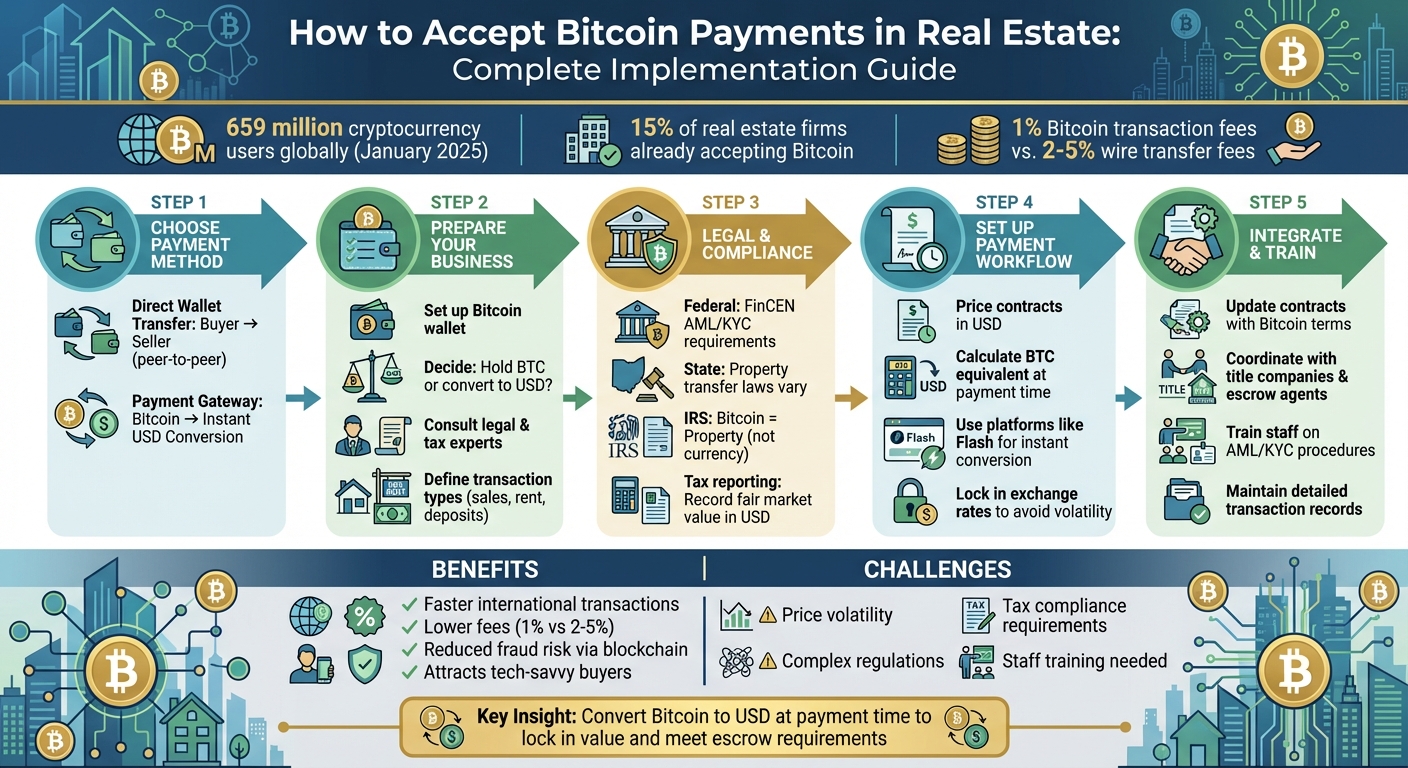
Step-by-Step Guide to Accepting Bitcoin Payments in Real Estate
Using Crypto to Buy/Sell U.S. Real Estate | Attorney's Compliance Guide
How Bitcoin Payments Work in Real Estate
Using Bitcoin in real estate transactions typically happens through two main methods: direct wallet transfers or payment gateways. In the first approach, the buyer sends Bitcoin directly from their digital wallet to the seller's wallet. This method works best when both parties are comfortable handling cryptocurrency. The second approach involves a payment gateway, which instantly converts Bitcoin into U.S. dollars. This option protects sellers from price swings and simplifies the process for those less experienced with digital currencies. These two methods highlight the flexibility of Bitcoin in real estate while also introducing unique challenges.
Payment Methods for Real Estate Bitcoin Transactions
Direct Wallet Transfers
In this method, buyers and sellers handle the entire transaction themselves. The blockchain records the transaction permanently, eliminating the need for intermediaries. While this gives both parties full control, it also means they must manage wallet security and understand how to handle cryptocurrency correctly. Any misstep, like sending funds to the wrong address, can result in irreversible losses.
Payment Gateways
Platforms like Flash make the process easier by converting Bitcoin into U.S. dollars immediately. These gateways manage the technical aspects, including compliance checks, and can send the converted funds to escrow accounts or traditional bank accounts. This allows sellers to avoid the complexities of managing digital assets and shields them from Bitcoin’s often unpredictable price fluctuations. While these tools simplify transactions, they also bring additional fees and require trust in the gateway provider.
Benefits of Accepting Bitcoin Payments
One of Bitcoin’s standout advantages is the speed of transactions. Unlike traditional banking systems, which can delay payments - especially in cross-border deals - Bitcoin transactions are processed quickly, making them ideal for international buyers and sellers.
Another key benefit is the lower transaction costs. Compared to international wire transfers, Bitcoin payments often come with reduced fees, which can save thousands of dollars in high-value deals. Additionally, the blockchain’s transparent and permanent ledger reduces risks like title fraud, mortgage fraud, or wire fraud, offering a layer of security not always present in traditional systems.
Challenges and Limitations of Bitcoin Payments
Despite its benefits, Bitcoin’s price volatility remains a significant hurdle. Its value can fluctuate dramatically, creating uncertainty between the time a contract is signed and the final payment is made. This makes it tricky to agree on a fixed cryptocurrency amount for a deal.
The regulatory environment in the U.S. adds another layer of complexity. Cryptocurrency regulations vary between federal and state governments, making compliance a challenge. Real estate professionals must navigate these rules carefully while adhering to strict Know Your Customer (KYC) and Anti-Money Laundering (AML) requirements.
Lastly, integrating Bitcoin into real estate transactions requires adjustments to traditional workflows. Contracts need updating, parties must be educated on the process, and settlement procedures must adapt to accommodate cryptocurrency - all of which demand time and expertise to implement effectively.
Getting Your Real Estate Business Ready for Bitcoin
Before diving into Bitcoin transactions, it's essential to plan how cryptocurrency will fit into your real estate operations. This preparation will help you avoid compliance headaches down the road.
Internal Steps Before Accepting Bitcoin
First, decide which types of transactions in your business will accept Bitcoin. Will it be limited to property sales, or will you also allow Bitcoin for rent payments or security deposits? Each type of transaction comes with its own set of requirements, so clarity here is key.
Next, determine whether your business will hold Bitcoin as an asset or convert it to U.S. dollars immediately upon receipt. Holding Bitcoin means you'll need to manage a digital wallet and track its fluctuating value, while immediate conversion can shield you from the volatility of cryptocurrency prices.
Once you’ve nailed down these internal processes, it’s time to address the legal framework to ensure everything complies with existing laws.
Legal and Regulatory Considerations
In the U.S., cryptocurrency regulation is far from unified, leaving businesses to navigate a patchwork of rules. To stay on the right side of the law, you’ll need legal counsel who understands both real estate and digital asset regulations. Your attorney will help ensure that Bitcoin transactions comply with state property transfer laws, escrow requirements, and recording statutes. Some states even have specific rules about documenting cryptocurrency in real estate contracts.
Additionally, compliance with federal regulations is critical. The Financial Crimes Enforcement Network (FinCEN) requires businesses handling digital assets to meet Anti-Money Laundering (AML) and Know Your Customer (KYC) standards, particularly for large transactions. This means setting up systems to verify buyers, conduct OFAC screenings, and document the source of funds to avoid legal risks.
Once the legal groundwork is in place, focus on setting up solid accounting practices.
Accounting and Tax Implications
The IRS treats Bitcoin as property, not currency, for federal tax purposes. This means you’ll need to recognize Bitcoin payments as income based on their fair market value in U.S. dollars at the time of receipt, regardless of whether you hold or convert the cryptocurrency. As XAIGATE explains:
"Every cryptocurrency transaction potentially creates a taxable event, whether it involves receiving payment, converting to fiat currency, or using cryptocurrency for business expenses".
To comply, record the transaction date, the amount of Bitcoin received, its fair market value in USD (using a reputable exchange), and any associated fees. Keep in mind that starting January 1, 2025, brokers will need to report gross proceeds from digital assets under IRC §6045. Basis reporting will phase in starting in 2026 through Form 1099-DA. While businesses are not yet required to report digital asset receipts as "cash" under IRC §6050I until specific regulations are issued, obligations under the Bank Secrecy Act still apply.
Work with tax professionals who specialize in digital assets to ensure your valuation methods align with IRS guidelines. They can also help you navigate federal and state tax regulations. Most states treat cryptocurrency payments like cash for sales tax purposes, basing the obligation on Bitcoin's fair market value at the time of the transaction.
Setting Up Bitcoin Payment Workflows with Flash

Planning Your Payment Process
First, figure out where Bitcoin fits into your transaction timeline. Bitcoin can be used in various ways, like for earnest money deposits, recurring rent payments, or even as part of closing funds. Each scenario requires a tailored approach: secure escrow for earnest deposits, automate rent payments for convenience, and carefully time the transfer of closing funds.
Contracts should still be structured in U.S. dollars, with Bitcoin offered as a payment option. This ensures the fiat value is locked in. For instance, if a property is listed at $500,000, the contract will specify that amount in USD. When Bitcoin is used for payment, the equivalent amount is calculated using the exchange rate at the time of the transaction. This way, the agreed-upon dollar amount is maintained, regardless of Bitcoin's price fluctuations. With this groundwork, you’ll be ready to utilize Flash’s tools effectively.
Setting Up Flash for Real Estate Transactions
Flash offers a variety of tools to handle different real estate payment needs. For one-time transactions, like security or earnest money deposits, you can generate a unique payment link, send it to the buyer, and allow them to pay directly from their Bitcoin wallet. For recurring payments, such as rent, Flash’s subscription feature simplifies the process by automating it. The platform also includes a mobile-optimized point-of-sale system for payments on the go.
Flash is built for speed, completing transactions in seconds - much faster than the standard Bitcoin confirmation process. Its non-custodial design ensures that funds go directly from the buyer’s wallet to yours, with no intermediaries holding the money. Once set up, Flash integrates seamlessly into your daily operations.
Technical Setup and Daily Operations
Start by setting up your Bitcoin wallet through Flash’s dashboard. You’ll need to decide whether to hold Bitcoin or convert it to USD immediately upon receipt. Flash provides real-time analytics, showing incoming payments, exchange rates, and conversion details for each transaction.
When you create a payment request, Flash calculates the Bitcoin amount based on the current exchange rate and locks it in, shielding you from volatility. The dashboard also logs essential details like timestamps, transaction IDs, and amounts in both Bitcoin and USD. These features make accounting and tax reconciliation straightforward, keeping everything organized and accessible.
sbb-itb-f81ab9b
Handling Price Volatility and Payment Risk
Managing Exchange Rate Fluctuations
Bitcoin's notorious price swings can create challenges between signing a contract and completing the transaction. One practical solution is to price transactions in U.S. dollars and convert Bitcoin at the moment of payment. Flash facilitates this by locking in the exchange rate as soon as a payment request is generated.
To avoid misunderstandings, make sure your purchase agreements clearly outline the conversion process. Specify the exchange rate benchmark, when the conversion will occur, and how significant rate changes will be handled. Some buyers choose to secure loans using cryptocurrency rather than selling their Bitcoin outright. This approach can help them sidestep capital gains taxes since the IRS treats Bitcoin as property, meaning selling or using it can trigger those taxes.
Settlement Options for U.S. Real Estate
Once exchange rate fluctuations are addressed, the next step is figuring out settlement methods. In most U.S. real estate transactions, Bitcoin is converted to U.S. dollars immediately before closing to meet escrow and regulatory requirements. Flash simplifies this process by instantly converting Bitcoin to USD.
If holding Bitcoin affects your cash flow reporting, you might explore requesting payment in USD-backed stablecoins. These digital assets offer a more predictable alternative compared to Bitcoin.
Risk Controls for High-Value Transactions
For high-value deals, managing risk becomes even more critical. Setting exposure limits that trigger automatic conversions can help mitigate risks. Flash’s dashboard not only locks in exchange rates but also provides tools to monitor these limits in real time across all transactions.
When handling international or large-scale transactions, enhanced due diligence is essential. Strengthen your compliance efforts by conducting thorough Anti-Money Laundering (AML) and Know Your Customer (KYC) checks to verify all parties involved. Flash’s transaction logs can assist with compliance by documenting key details like timestamps, wallet addresses, and conversion records, making regulatory reviews smoother and more efficient.
Adding Bitcoin Payments to Your Real Estate Operations
Including Bitcoin Terms in Contracts
When incorporating Bitcoin into real estate transactions, contracts need to spell out the payment terms clearly. Specify whether the deal will be conducted entirely in Bitcoin or follow a Bitcoin-USD hybrid structure. The latter is more common in U.S. real estate and tends to carry fewer risks.
The contract should detail the conversion process, the exchange rate benchmark, and the timing for these actions. It’s also crucial to define who assumes the risk if Bitcoin’s value fluctuates between signing the contract and the closing date. For all-Bitcoin transactions, where traditional banking systems aren’t involved, include Know Your Customer (KYC) and Anti-Money Laundering (AML) verification requirements.
To ensure compliance with federal and state laws, consult attorneys experienced in cryptocurrency and real estate.
Working with Title Companies, Escrow Agents, and Lenders
Once contract terms are in place, coordinate Bitcoin-related processes with third-party service providers. Many title and escrow companies require cryptocurrency to be converted into U.S. dollars before the transaction is finalized, primarily to meet lender and regulatory standards. Engage these providers early to understand their specific requirements. Tools like Flash can simplify this process by instantly converting Bitcoin to USD, ensuring the funds are delivered in the format your title company expects.
Keep in mind that title insurance policies may not cover issues unique to cryptocurrency, such as disputes over wallet ownership or errors in smart contract execution. Address these potential gaps in coverage with your title company and consider additional safeguards, especially for high-value transactions. If buyers plan to use crypto-collateralized loans, expect lenders to implement more stringent compliance measures, including enhanced identity checks and ongoing collateral monitoring.
Staff Training and Payment Management
With the payment infrastructure in place, it’s essential to train your staff on Bitcoin payment procedures. This includes understanding AML/KYC requirements and the tax implications tied to cryptocurrency. The IRS classifies cryptocurrency as property, which means every transaction could trigger capital gains taxes.
Ensure meticulous record-keeping for every transaction. Logs should include the transaction date and time, amounts in both Bitcoin and USD, applicable exchange rates, fees, and customer details. Your team should be ready to access and organize this information for audits and tax reporting purposes. Proper training and documentation will help ensure smooth compliance with regulatory standards.
Conclusion
Handling Bitcoin payments in real estate requires a strong focus on compliance, security, and operational preparedness. Adhering to AML, KYC, and state-specific regulations is a must, as these rules form the foundation for managing transactions effectively.
To meet tax and reporting obligations, every transaction should be recorded at its fair market value. With stricter documentation standards set to take effect in 2026, maintaining thorough records will become even more important for real estate businesses working with Bitcoin.
Using Flash for instant conversion can address Bitcoin’s price volatility in high-value transactions. This quick settlement process protects both buyers and sellers from sudden market changes that could otherwise complicate closings.
For added security, Flash’s non-custodial wallet solutions allow direct Bitcoin payments without relying on intermediaries. This reduces third-party risks and strengthens the overall safety of transactions.
FAQs
How can I manage Bitcoin's price fluctuations in real estate transactions?
Managing Bitcoin's price swings is a key consideration in real estate transactions to ensure the deal's value remains intact. One way to reduce this risk is by converting Bitcoin to USD right before closing, securing the transaction amount. Another approach involves using escrow services that provide hedging options to shield against price changes, offering more stability during the process. You could also explore accepting stablecoins, which are specifically created to hold a steady value, limiting exposure to market volatility.
What should I know about the legal and tax considerations when accepting Bitcoin for real estate transactions?
When using Bitcoin for real estate transactions in the U.S., it's crucial to grasp both the legal and tax considerations. From a tax perspective, the IRS classifies Bitcoin as property, which means that selling or exchanging it can trigger capital gains taxes. The amount you owe will be based on the difference between the Bitcoin's value when you acquired it and its value at the time of the transaction.
On the legal front, cryptocurrency regulations are constantly evolving. It's essential to comply with federal and state laws, including anti-money laundering (AML) and know-your-customer (KYC) requirements. Some states may have additional rules specific to cryptocurrency transactions. To navigate these complexities, working with a legal or tax professional is highly recommended to ensure you're meeting all necessary obligations.
How can I stay compliant with regulations when using Bitcoin for real estate transactions?
When using Bitcoin in real estate, staying compliant with tax regulations is crucial. The IRS provides clear guidelines on how to report transactions involving digital assets. This includes details on calculating the amount realized and determining the cost basis for these transactions.
Keep an eye on both federal and state regulations, as changes can directly affect how you manage Bitcoin transactions. To navigate these complexities, consider working with a tax professional or legal advisor who understands cryptocurrency laws. Their expertise can help ensure you're meeting all necessary compliance requirements.