Why Smart Merchants Are Making The Bitcoin Move
If you’re a business owner, the thought of adding Bitcoin to your checkout might feel like a huge step into the unknown. But for the growing number of merchants who have already done it, the story is surprisingly consistent: lower costs, fewer frustrations, and access to a brand-new wave of customers. This isn't about jumping on a trend; it's a strategic business move with very real benefits.
Say Goodbye to Profit-Eating Fees and Chargeback Nightmares
Let's talk about the most immediate win: your bottom line. Traditional credit card companies skim 2-3% off every single transaction. For a business doing $100,000 in annual sales, that’s up to $3,000 that disappears from your profits. With a service like Flash, Bitcoin transaction fees are just a fraction of that, which means more of your hard-earned money stays in your pocket.
Then there’s the constant headache of chargebacks. Any online merchant knows the pain of fraudulent chargebacks, which cost both money and countless hours of administrative work. Bitcoin transactions, however, work like digital cash—they are final and irreversible. Once a payment is confirmed, it's yours to keep. This one feature eliminates chargeback fraud entirely.
Unlock a Truly Global Marketplace
Have you ever wanted to expand your business internationally, only to be stopped by payment hurdles? Traditional systems are notorious for high cross-border fees, currency conversion chaos, and outright blocking customers from certain countries. Bitcoin, on the other hand, is a borderless, global currency. It lets you sell to anyone, anywhere in the world, just as easily as you sell to someone in your own city.
And this isn't some tiny, niche market. As of 2025, the global cryptocurrency market cap surged past $3.05 trillion, with projections showing adoption could exceed 11% of the world's population. This explosive growth is why major platforms have integrated Bitcoin, allowing over 2 million businesses to tap into this expanding customer base. You can see how crypto's market penetration is reaching a tipping point for yourself.
To make it crystal clear, let's look at how Bitcoin stacks up against the old guard. The table below compares the core differences in fees, speed, and risk.
Bitcoin vs Traditional Payment Methods Comparison A detailed comparison of transaction fees, processing times, and geographic reach between Bitcoin and traditional payment methods
| Payment Method | Transaction Fee | Processing Time | International Reach | Chargeback Risk |
|---|---|---|---|---|
| Bitcoin (with Flash) | Under 1% | Near-Instant | Global | None |
| Credit Cards | 2-3% + | 2-3 Days | Limited | High |
| Bank Transfers | Flat Fee ($15-$45) | 3-5 Days | Limited & Slow | Low |
| PayPal | 2.9% + Fixed Fee | Instant to Days | Global (Varies) | Medium |
As you can see, the numbers speak for themselves. Bitcoin with Flash offers a distinct advantage in nearly every category that matters to a modern business.
Gain a Competitive Edge by Being an Early Mover
Beyond the numbers, accepting Bitcoin sends a clear signal to your customers. It positions your brand as forward-thinking, innovative, and focused on providing options. In a crowded market, this can be a powerful way to stand out and capture the attention of customers who are specifically looking for merchants that accept bitcoin payments.
These customers are often tech-savvy early adopters. This demographic is known for being incredibly loyal, having more disposable income, and actively promoting businesses that share their values. By welcoming this community, you don't just get a sale—you gain a vocal advocate for your brand.
Finding Your Perfect Bitcoin Payment Processor
 Alright, you see the potential of accepting Bitcoin. Now for the crucial part: picking the right partner to make it happen. Choosing a Bitcoin payment processor isn't just a technical footnote; it’s a core business decision that affects your bottom line, your customer's experience, and frankly, your own stress levels. Let's cut through the marketing fluff and get to what really matters.
Key Factors to Scrutinize
When you decide to accept bitcoin payments, your processor is essentially a silent partner. The first thing you need to dig into is the complete fee structure. While many platforms advertise low transaction fees, the devil is in the details. Are there hidden setup costs, monthly minimums, or steep charges for converting your Bitcoin to cash? A 0.5% fee difference might not sound like much, but on $100,000 in sales, that's an extra $500 that belongs in your bank account, not theirs.
Next up is how easily the tool fits into your current setup. Are you a one-person shop running a site on Shopify, or do you have a dedicated dev team ready to tackle a custom API? Adding a payment button to a WordPress site should be a quick copy-and-paste job, not a week-long coding headache. A solution like Flash provides simple, low-code widgets that can get you up and running in minutes, no matter your technical skill level.
Finally, never underestimate the value of good customer support. Picture this: it’s your busiest sales day, a customer's payment is stuck in limbo, and they're getting anxious. That's when you need a real, knowledgeable person to help you, not a generic chatbot. Try reaching out to their support team before you sign up to see how responsive they are.
Comparing the Top Contenders
The market has a few big names you'll likely run into, such as BitPay and Coinbase Commerce, but their approaches are fundamentally different. Many operate as custodians, which means they hold your Bitcoin before sending it to you. This introduces another party into the transaction and often involves KYC (Know Your Customer) requirements for your shoppers, which can feel invasive and add friction to the checkout process.
This is where a non-custodial processor like Flash changes the game. It enables direct wallet-to-wallet transactions, meaning the payment goes straight from your customer's wallet to yours. You get full, immediate control of your funds with no intermediaries. Best of all, there are no KYC requirements, which protects the privacy of both you and your customers.
To help you see the differences clearly, here’s a look at how the top options stack up.
Top Bitcoin Payment Processor Feature Comparison
Side-by-side comparison of leading Bitcoin payment processors including fees, features, and integration requirements
| Processor | Setup Fee | Transaction Fee | Integration Complexity | Customer Support | Key Features |
|---|---|---|---|---|---|
| Flash | None | 1% | Low - Simple widgets & API | Email & Chat | Non-custodial, No KYC, Instant wallet-to-wallet settlement |
| BitPay | None | 1% - 2% | Moderate - Plugins & API | Tiered (Email, Phone) | Custodial, Automatic fiat conversion, Invoicing, KYC required |
| Coinbase Commerce | None | 1% | Moderate - Hosted checkout & API | Email only | Non-custodial, Integrates with Coinbase account, Multi-coin support |
As the table shows, your choice depends on what you prioritize. If you want a hands-off approach with automatic cash settlements and don't mind the third-party custody and KYC, a processor like BitPay might fit. But if you value financial self-sovereignty, privacy, and direct control over your money, a non-custodial solution like Flash is the clear winner.
Picking the right partner aligns your business with the future of commerce. This decision is more than just adding a new payment option; it connects to bigger ideas about how TLDs could change crypto and digital ownership. It’s about choosing a solution that not only works today but also grows with you tomorrow.
Getting Your Bitcoin Payments Live And Running
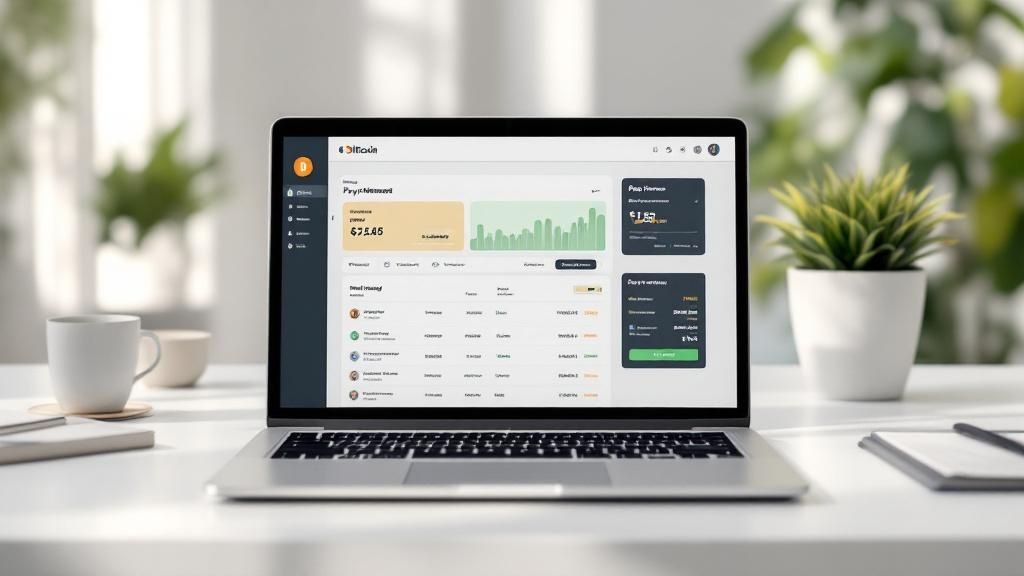 Okay, you've picked your processor. Now for the exciting part: making Bitcoin payments a reality on your platform. Forget any worries about a massive technical project. Modern tools like Flash are built to make this process incredibly simple, allowing you to accept bitcoin payments without disrupting your current checkout flow. Think of it as adding a new, efficient payment option, not rebuilding your store from the ground up.
Connecting Flash To Your Storefront
You might think this is the complicated part, but connecting a tool like Flash is surprisingly straightforward. For an e-commerce store on a platform like Shopify, it can be as simple as adding a custom HTML block to your checkout page. If you have a custom-built website, it typically involves pasting in a lightweight JavaScript widget. The end goal is to present a clean, clear “Pay with Bitcoin” button right alongside your card and PayPal options.
For those running a physical, brick-and-mortar business, the setup is even more direct. The Flash point-of-sale (POS) app can turn any smartphone or tablet into a dedicated Bitcoin terminal. You just type in the sale amount in your local currency, and the app generates a unique QR code for the customer to scan. It fits right into the physical checkout flow, much like the tap-to-pay systems customers are already used to.
Configuring Your Settlement Preferences
With the connection made, your next decision is about how to manage the Bitcoin you receive. A key feature of Flash is that it's non-custodial, meaning it sends payments directly to a Bitcoin wallet that you personally control. This gives you complete autonomy. Want to hold the Bitcoin as a business asset? Just connect a self-custody wallet like Muun or BlueWallet.
If you prefer the stability of your local currency, that’s just as easy. You can link Flash to a wallet or service that handles automatic conversion. When a customer pays you in Bitcoin, the funds are instantly converted to dollars, euros, or whatever your currency is, and then sent to your bank account. This way, you get all the perks of accepting Bitcoin—like low fees and zero chargebacks—without being exposed to price changes.
The All-Important Test Transaction
Before you tell your customers about your new payment option, you absolutely must run a test. This one action will save you from potential headaches on launch day. Go through the process of making a small, real purchase from your own store. This isn’t just to see if it “works,” but to feel the entire process from your customer's point of view.
During your test run, confirm these key details:
- Does the payment page show the correct Bitcoin QR code and amount?
- Is the payment confirmed on the Bitcoin network in a decent amount of time?
- Do the funds show up in the wallet you designated?
- Does your store’s backend system correctly update the order to "paid"?
- Did the customer (in this case, you) get a proper order confirmation email?
Getting this test right ensures that when you do go live, the experience for your real customers will be professional and smooth.
Bulletproofing Your Bitcoin Security Setup
 When you start accepting Bitcoin, you effectively become your own bank. This responsibility means that security isn't just a feature—it's the foundation of your entire operation. A single misstep can be incredibly costly, so building smart, robust security habits from day one is essential for protecting your funds and earning customer trust.
Hot Wallets vs. Cold Storage: Your Digital Vault
Think of a hot wallet—one that’s connected to the internet—as your storefront’s cash register. It’s perfect for handling the daily flow of customer payments, keeping transactions quick and convenient. However, you wouldn't leave a week's worth of earnings in the register overnight, and the same logic applies here.
For the bulk of your Bitcoin reserves, you need cold storage. This is typically a hardware wallet that stays completely offline, making it your business's digital bank vault. It's cut off from the internet and safe from online attacks. A sound practice is to keep only a small operational amount in your hot wallet and schedule regular "sweeps" to move larger balances into the safety of your cold storage.
Mastering Your Keys and Backups
In the world of Bitcoin, you’ll constantly hear the phrase, “not your keys, not your coins.” This is a fundamental truth for any merchant. Your private key grants complete control over your Bitcoin, and if someone else gets it, they have that control. That's why your seed phrase—the master password that can restore your entire wallet—is your most valuable secret.
Never store your seed phrase digitally. Don't email it to yourself, save it in a cloud drive, or keep it in a notes app on your phone. Instead, write it down on paper or, even better, etch it into a piece of metal. Create at least two copies and store them in different, highly secure physical locations, like a fireproof safe at home and a bank's safe deposit box. If you lose your keys and backups, those funds are gone for good.
For an even stronger defense, especially as your business grows, look into a multi-signature (multi-sig) wallet. This setup is like a bank vault that requires two different keys to open. It requires authorization from two or more private keys before any funds can be moved. For instance, you could configure it so that any large payment requires approval from both you and your business partner. This simple step drastically reduces the risk of both internal theft and external hacks.
Your Essential Security Checklist
Even the best technology can't protect against human error, which is why consistent, disciplined processes are your greatest defense. Security extends beyond just your wallet; the transaction's safety from start to finish is paramount. Securing Bitcoin payments properly begins with a secure checkout process, which is a vital part of protecting your customer's data.
Use this checklist to keep your operations secure:
- Make multi-factor authentication (MFA) non-negotiable on every account connected to your business, from your email to your exchange accounts.
- Create a routine for moving funds from your hot wallet to cold storage. Don't let large amounts build up in your "digital cash register."
- Periodically test your seed phrase backup. Don't wait for an emergency to find out your backup is unreadable or lost. Actually go through the process of restoring a small test wallet.
- Train your team to spot and avoid phishing scams. This is one of the most common ways funds are stolen, and education is the best prevention.
Understanding Your New Global Customer Base
 When you decide to accept bitcoin payments, you're doing more than adding a new button to your checkout page. You’re opening your doors to a global community with very specific reasons for using Bitcoin. These customers aren't your typical credit card users, and figuring out what drives them can completely reshape your marketing and support.
Who Are These Bitcoin Users?
It's easy to picture a single type of Bitcoin user, but the reality is much more diverse. In Western countries, you'll often find tech-savvy people who value financial independence and actively support businesses that are forward-thinking. These early adopters are a key part of the community, but they’re not the whole story.
The bigger picture is global. By 2025, over 560 million people worldwide were using cryptocurrencies, with more than half of them in Asia. In places like Latin America and Africa, people use Bitcoin for practical reasons—it's a shield against inflation and a cheaper, faster way to send money home than traditional banking. Explore the full cryptocurrency ownership data to see just how widespread it is. Your next loyal customer could just as easily be an entrepreneur in Buenos Aires as a software developer from Berlin.
What Bitcoin Customers Expect from You
This new group of customers has expectations rooted in the very principles of Bitcoin. They aren't looking for just another payment option; they want a better one. If you try to shoehorn this new technology into an old, clunky checkout process, you'll create frustration and lose sales.
Here's what they're looking for:
- Privacy and Control: Bitcoin users chose this path for a reason: to have direct control over their own money. They appreciate non-custodial payment solutions like Flash that don't rely on third parties or ask for invasive KYC (Know Your Customer) details just to make a simple purchase.
- Speed and Simplicity: A smooth, quick payment experience is non-negotiable. A confusing interface or a checkout flow with too many steps is a guaranteed way to lose a customer. The entire process should be as simple as scanning a QR code.
- Authenticity: This community can spot a business that's just hopping on a trend from a mile away. You'll build far more loyalty if you show that you genuinely understand and support the technology, rather than just treating it as another icon on your payment page.
Nailing these core values is your ticket to not only attracting this audience but also turning them into passionate advocates for your brand.
Capitalizing On Bitcoin's Explosive Growth Trajectory
Knowing who uses Bitcoin is just one piece of the puzzle. The real opportunity comes from understanding the incredible momentum behind the currency itself. Bitcoin's growth isn't just a temporary trend; it’s a major shift fueled from two different directions. You have big institutional money pouring in, which adds a lot of credibility. At the same time, you have everyday adoption in developing countries where Bitcoin helps people deal with real issues like inflation and sending money across borders.
This is far from a niche audience. The number of people using Bitcoin for payments has exploded since 2015. By early 2025, estimates showed that over 500 million people around the world held some cryptocurrency, with Bitcoin leading the pack as the most popular digital asset. That's a massive jump from just a few million users a decade ago. You can explore the full story of Bitcoin's global adoption to see the scale of this growth.
Crafting Your Announcement for Maximum Impact
How you share this news with your customers matters more than you might think. Simply adding a "We now accept Bitcoin" banner to your site isn't going to move the needle. You need a thoughtful plan that shows both new and existing customers the value in this, without making it seem like you're just hopping on a bandwagon. The idea is to present your business as modern and focused on what your customers want.
When you're ready to announce that you accept bitcoin payments, look beyond a single social media update. Think about timing it with a new product release or a holiday sale to get more eyes on it. More importantly, frame the news as something that gives your customers more freedom and control over how they pay.
Here are a few practical ways to get your message across:
- Talk about convenience, not just crypto. Your messaging should focus on adding another fast, secure, and private way to check out. It's a customer benefit, first and foremost.
- Create simple educational content. A short FAQ page on your website can make a huge difference. Answer the basic questions, like how someone can actually pay with Bitcoin at your store, and keep the language clear and direct.
- Show the benefits, don’t just list them. Point out what your customers gain. For instance, by using a non-custodial processor like Flash, you can tell them they get better privacy because payments go directly to you without a third party holding the funds.
- Be part of the community. Share your news in Bitcoin forums and social groups, but do it genuinely. Participate in conversations and answer questions instead of just dropping a link and leaving.
This kind of approach turns a simple payment update into a strong signal about your brand. It shows you're paying attention to your customers and building a business that's ready for the future.
Your Complete Bitcoin Payment Launch Strategy
You’ve laid the groundwork. You've chosen your processor, set up your wallets, and have a good handle on your new global customer base. Now for the exciting part: bringing it all together for a launch that runs like clockwork. This isn't just about flipping a switch; it's about a well-timed plan that gives your team and your customers confidence from day one.
Your Go-Live Readiness Checklist
Before you make the big announcement, it’s time for one final dress rehearsal. Running through this checklist ensures every part of the experience is ready for prime time.
- Final Technical Check: Process one last end-to-end test transaction. Seriously, do it. Make sure your order management system correctly flags the order as paid and that the funds actually appear in your designated wallet. This is your last chance to catch any small hitches.
- Team Briefing: Grab your staff for a quick huddle—even people not directly handling payments. Give them a simple rundown of how it works, what customers will see on their end, and, most importantly, who the point person is for any tricky questions.
- Prepare Your Announcement: Get your customer-facing email and social media posts drafted. Remember to frame the news around what’s in it for them: another secure payment option, more privacy, and a checkout experience that’s up to date.
Measuring Success and Sidestepping Pitfalls
Once you accept bitcoin payments, you need to know if it’s actually working for your bottom line. Don't get distracted by vanity metrics; focus on what really signals growth.
- Adoption Rate: What percentage of your customers are actually choosing Bitcoin at checkout?
- Transaction Volume: How much real revenue is coming through Bitcoin payments every month?
- Customer Feedback: Are customers finding the process intuitive? Are they sending support tickets or asking questions?
A common and costly mistake is poor communication that leads to a confusing checkout flow. If customers are confused, they won't contact support—they'll just abandon their carts. Make your instructions simple and visual. For example, instead of just saying "Pay with Bitcoin," use a simple graphic that shows a phone scanning a QR code.
Training and Educating for Long-Term Growth
Your team is your front line. When they’re equipped with the right knowledge, they can handle Bitcoin transactions with confidence. Create a simple one-page guide for them that covers how to generate a QR code for in-person sales and how to answer common questions like, “What’s a Bitcoin wallet?”
Customer education is just as critical. If you want to grow an ecommerce business with a solid strategy, preparing your customers is part of it. A simple FAQ page or a short blog post explaining why you've added this payment option and how easy it is to use can do wonders. This small effort reduces checkout friction and builds a ton of trust, turning a new payment method into a real asset for your business.
Ready to launch Bitcoin payments in under a minute and join the future of commerce? Get started with Flash today!