At its core, accepting crypto payments is simple: you're letting customers pay for your products or services with Bitcoin. For merchants, this isn't just a novelty; it's a strategic move that unlocks a new global customer base, slashes transaction fees, and completely wipes out chargeback fraud. It’s about modernizing how you get paid and making your business more efficient.
Why Your Business Should Accept Bitcoin Payments
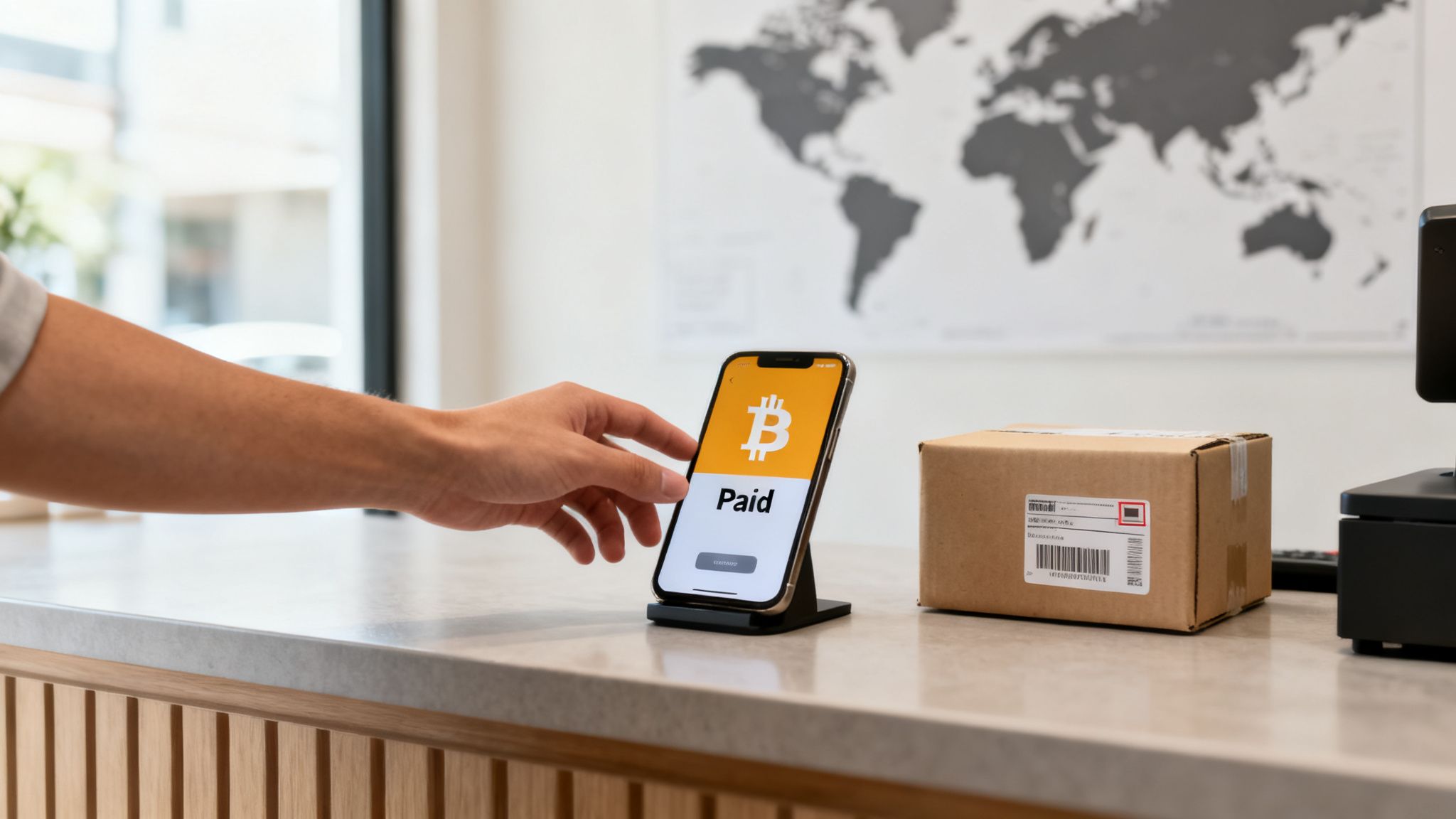
Moving beyond traditional payment rails isn’t just about adding another logo to your checkout page. It's a fundamental business decision with clear financial and operational upsides. When you start accepting Bitcoin, you gain a powerful set of tools to tackle the common headaches that come with credit cards and bank transfers.
The most immediate win is for your bottom line. Traditional payment processors skim 2-4% off every single transaction, which slowly bleeds your profit margins dry. Bitcoin transactions, especially with modern solutions, can crush those costs, letting you keep more of the revenue you worked hard to earn.
Bitcoin payments are final. Once a transaction is confirmed, it's irreversible. This one feature is a complete shield against chargeback fraud, a billion-dollar problem that plagues businesses relying on credit card payments.
Tap Into a Global Customer Base
The moment you accept Bitcoin, your business is global. Period. It erases the usual friction of cross-border payments, gets rid of currency conversion nightmares, and sidesteps the frustrating delays of international wire transfers. A customer in Japan can pay a merchant in Argentina as easily as if they were standing in the same room.
This gives you direct access to a growing, tech-savvy demographic of Bitcoin holders who are actively looking for businesses that speak their language. For many of these customers, paying with Bitcoin isn't just a preference; it's a necessity, especially if they live in countries with shaky local currencies or poor access to international banking.
Increase Financial Control and Security
When you accept Bitcoin directly into a wallet you control, you’re in the driver's seat. Unlike the traditional banking world, where your funds can be frozen or held hostage by a third party, a non-custodial Bitcoin payment goes straight from your customer to you. This peer-to-peer model delivers a level of financial sovereignty that old-school systems just can't offer.
The broader shift toward digital currencies is happening fast. In 2025 alone, some digital assets processed an incredible $46 trillion in transaction volume. That number dwarfed PayPal by more than 20 times and was nearly three times Visa's volume, signaling a massive change in global commerce. This explosion is exactly why businesses, from e-commerce brands to local retailers, are rushing to integrate tools like Flash's Bitcoin payment software. You can dive deeper into this financial trend over at a16zcrypto.com.
Choosing Your Bitcoin Integration Path
So, you've decided to start accepting Bitcoin. Great! The very next question you need to answer is how. This decision is a big one, as it dictates everything from your security and control to the fees you'll pay. It all comes down to a fundamental choice: are you going with a custodial or a non-custodial solution?
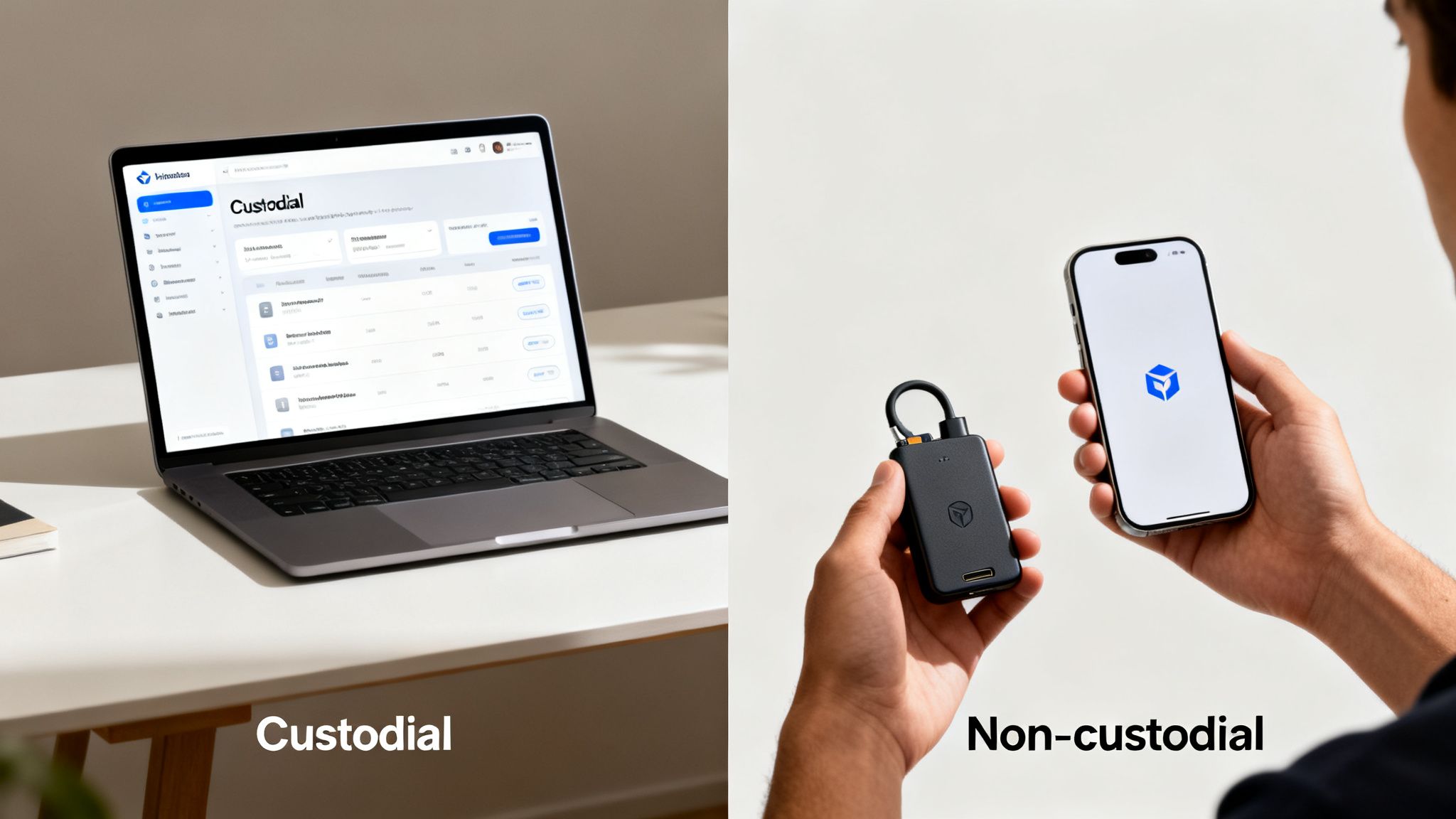
A non-custodial setup, which is what we built at Flash, means payments flow directly from your customer’s wallet straight into a wallet that only you control. It’s the purest form of a peer-to-peer transaction. You hold your own keys, giving you absolute ownership of your funds the second a payment is made.
Custodial solutions, on the other hand, work a lot like traditional payment processors. A third party gets the Bitcoin on your behalf, holds it in their own accounts, and then settles up with you later. While this might feel familiar, you're adding a middleman and trusting them with your money.
Custodial vs. Non-Custodial: What’s at Stake?
The difference here isn't just technical jargon—it’s about who is actually in charge of your revenue.
Think of it this way: a non-custodial payment is like a customer handing you cash that goes straight into your till. A custodial provider is like someone collecting that cash for you and promising to drop it off at your bank later. This choice has a direct impact on your operational security and financial freedom.
With a non-custodial system, you completely eliminate third-party risk. Your funds can't be frozen, seized, or lost if the provider gets hacked because they never actually touch your money. You are your own bank.
For any business that puts a premium on security and self-sovereignty, the non-custodial path is the only one that makes sense. It aligns perfectly with the core principles of Bitcoin itself: decentralization and direct control. When you're weighing your options, digging into comparisons of the best payment gateways for ecommerce can offer more clarity, but always keep this core distinction in mind.
To help you visualize the trade-offs, here's a direct comparison of the two models.
Custodial vs. Non-Custodial Bitcoin Payment Solutions
| Feature | Non-Custodial (e.g., Flash) | Custodial (Traditional Processors) |
|---|---|---|
| Fund Control | You have 100% control. Funds go directly to your wallet. | The provider holds your funds before settling with you. |
| Security Risk | You control your own keys; no third-party risk. | You trust the provider's security and solvency. |
| Settlement Time | Instant. Funds are available immediately. | Delayed. Settlements can take days. |
| Censorship | Your account cannot be frozen by the provider. | Provider can freeze or hold funds based on their policies. |
| Fees | Typically lower, often a flat processing fee. | Can include transaction fees, withdrawal fees, and monthly charges. |
| Setup Complexity | Simple setup of a personal wallet, but requires self-management. | Often feels more like a traditional bank account setup. |
Ultimately, the choice depends on your comfort level with managing your own funds versus relying on a third party.
On-Chain vs. Off-Chain: Speed and Fees
Another key decision is whether to use on-chain Bitcoin transactions or an off-chain solution like the Lightning Network.
- On-Chain Transactions: These are the standard Bitcoin transactions that get recorded directly on the main blockchain. They're incredibly secure and final, but they can be slower and more expensive when the network is busy.
- The Lightning Network: This is a "layer 2" solution built on top of Bitcoin. It’s designed for instant, nearly free payments, making it perfect for everyday commerce—think buying coffee or handling a high volume of small online sales.
Many modern payment solutions, including Flash, support both. This gives you the best of both worlds: you can use the Lightning Network for small, frequent purchases and rely on the main chain's unmatched security for larger, less urgent transactions. The right path for your business depends entirely on your needs, transaction volume, and how hands-on you want to be with your money.
Seamless Integration for Every Type of Business
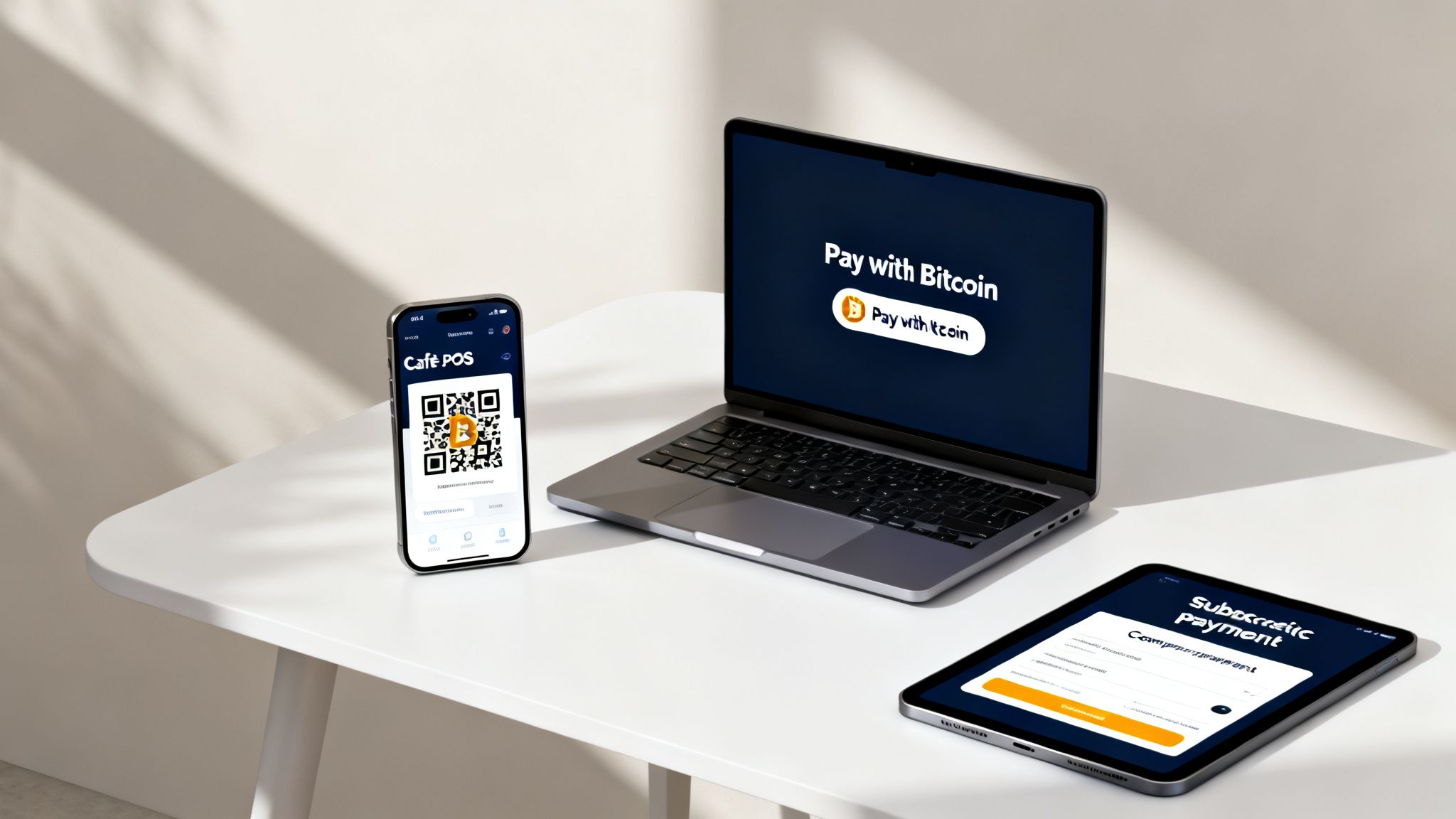
Once you've mapped out your strategy, it's time to get your hands dirty with the implementation. The great thing about modern Bitcoin payment tools is just how flexible they are. Whether you're running a busy coffee shop, a global e-commerce brand, or a digital subscription service, there's a straightforward path to accepting crypto without needing a team of developers.
The whole point is to meet your customers where they already are, making this new payment option feel like a natural part of their buying journey. Most of these methods are designed for simplicity and can be set up in minutes, completely changing how you handle payments.
For Physical Stores and In-Person Sales
If you have a brick-and-mortar business—anything from a local bakery to a pop-up market stall—a Point-of-Sale (POS) app is your quickest win. A tool like the Flash app can turn any smartphone or tablet you already own into a powerful Bitcoin terminal.
Here’s what that looks like in the real world:
- You punch in the sale amount in your local currency (say, $5.00 for a coffee).
- The app instantly generates a unique QR code with the equivalent Bitcoin amount.
- Your customer scans that code with their mobile Bitcoin wallet and hits 'confirm.'
- You get an immediate confirmation on your screen, and the funds land directly in your wallet.
The whole process is as quick as a credit card tap but comes with much lower fees. Best of all, it requires no extra hardware.
For E-commerce and Online Businesses
Online stores have a few different routes to take, from simple no-code solutions to full-blown API integrations. It really just depends on your technical comfort level and what your business needs.
Payment Buttons and Widgets are the easiest way to add a Bitcoin option to your site. These are pre-built, customizable snippets you can drop right onto product pages or your checkout flow. When a customer clicks the "Pay with Bitcoin" button, a payment interface pops up with the QR code and all the necessary details.
This approach is a lifesaver for businesses on platforms like Shopify, WooCommerce, or Squarespace. It requires almost zero coding, and you can be up and running in less than an hour, offering a smooth checkout experience.
Payment Links are incredibly versatile. You can generate a unique link for a specific amount and fire it off to customers via email, text, or even a social media DM. This is perfect for:
- Invoicing: Freelancers and B2B services can embed a payment link right into their invoices.
- Social Commerce: Selling on Instagram or X? Just send a payment link to close the deal.
- Donations: Non-profits can pop a permanent payment link in their social media bio or on their website for easy contributions.
For Advanced and Custom Solutions
For businesses that need a more custom-fit setup, an Application Programming Interface (API) gives you total control. An API lets you weave the Bitcoin payment flow directly into your existing software, mobile app, or bespoke e-commerce platform.
This is the path for maximum flexibility. You can design the user experience from scratch, sync payment data with your accounting software, and automate all sorts of complex workflows. It does require some development resources, but for businesses looking to make crypto a core piece of their infrastructure, an API is the ultimate tool for the job.
Designing a Flawless Bitcoin Checkout Experience
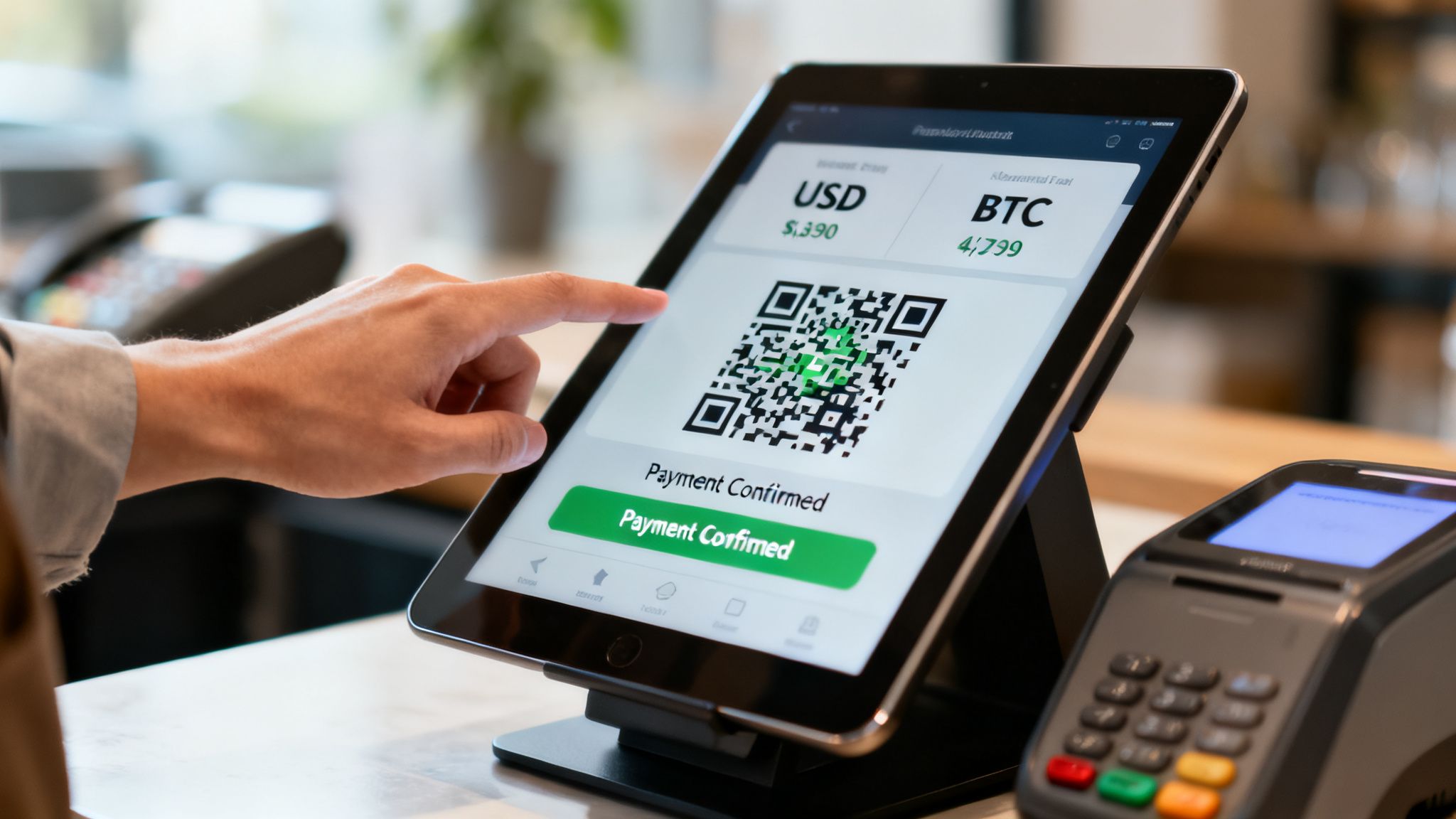
Getting the technical side of Bitcoin payments sorted is only half the battle. The real magic—and where sales are won or lost—happens at the checkout. A clunky, confusing payment process is a surefire way to kill a sale, no matter how keen a customer is to pay with Bitcoin.
Your goal is simple: make the experience feel as intuitive and trustworthy as swiping a credit card. Success all comes down to clarity. The second a customer decides to pay, they need to know exactly what to do next without any guesswork. This is especially true for the growing wave of users who are new to making Bitcoin payments.
Building an Intuitive Payment Flow
The best checkout experiences feel effortless. They guide the user from start to finish without any friction.
A great place to start is by displaying prices clearly in both your local fiat currency and BTC. This simple move eliminates the mental gymnastics of conversion rates and shows the customer the precise amount they need to send.
Next, a dynamic, single-use QR code is non-negotiable. Using a static wallet address for every transaction is just asking for accounting nightmares and payment errors. A fresh QR code for each order ensures the right amount goes to the right invoice, every single time.
You'll also want to include clear, concise instructions right next to the QR code. Something as simple as "Scan with your Bitcoin wallet to pay" can make all the difference.
Your checkout page should also feature:
- A countdown timer: Most payment gateways lock in the BTC exchange rate for a short window, usually around 15 minutes. A visible timer creates a sense of urgency and lets the customer know how long they have.
- The exact BTC amount: For users who prefer to copy and paste the address manually, displaying the full amount and wallet address is a crucial fallback.
- Real-time status updates: As soon as the payment is detected on the network, let the customer know. A simple "Processing..." message is all it takes to build confidence.
The core principle here is to eliminate ambiguity. A customer should never have to wonder if their payment went through or if they sent the correct amount. Instant feedback turns a one-time buyer into a loyal customer.
Handling Common Payment Issues Gracefully
Even with a perfect setup, things can go wrong. What happens if a customer sends the wrong amount? Or what if the network is congested and the payment takes longer than expected? Planning for these scenarios is what separates the pros from the amateurs.
If an underpayment happens, your system should automatically flag it and notify both you and the customer. Provide a simple way for them to pay the remaining balance, like a new invoice with a fresh QR code. In cases of network delays, a "Payment Pending" screen reassures the customer that their funds are on the way and haven't vanished into the ether.
This focus on the user experience is critical as adoption continues to climb. Projections show that the number of US cryptocurrency payment users will jump by 37.4% in 2026, a clear signal that Bitcoin is moving into everyday commerce. You can review the full analysis on emarketer.com to dig deeper into the trend.
By perfecting your checkout flow now, you’re setting your business up to capture this rapidly growing market.
Navigating Bitcoin Taxes and Compliance
While the upsides of accepting Bitcoin are huge, you absolutely can't ignore the accounting and tax side of things. I've seen many merchants get nervous about this, imagining a tangled mess of rules. But honestly, if you set things up correctly from day one, managing your Bitcoin transactions is surprisingly straightforward.
The whole game plan hinges on one critical distinction: in the eyes of the IRS and most tax agencies, Bitcoin is treated as property, not currency. That’s it. That one fact shapes your entire compliance strategy. It means every time you receive Bitcoin for a sale or swap it for fiat, you're triggering a taxable event.
Tracking and Reporting Best Practices
Your best defense against a massive tax season headache is meticulous record-keeping. Because Bitcoin’s price is always on the move, you have to lock in the fair market value the moment a customer pays you. That value, in your local currency, becomes the cost basis for that specific pile of sats.
For every single sale, you need to be tracking:
- The exact date and time of the transaction.
- The amount of Bitcoin you received.
- The fair market value of that Bitcoin in your local currency at that moment.
- The date and time you convert the Bitcoin to cash (if you do).
- The value of the Bitcoin in your local currency when you converted it.
When you finally sell that Bitcoin for dollars, you'll have either a capital gain or a capital loss. This is just the difference between its value when you got it and its value when you sold it. That's the number your accountant will need.
So many people think they only pay taxes on the profit from their product. With Bitcoin, you also have to account for any change in the coin's value between the time you received it and the time you cashed out.
Staying Compliant and Seeking Guidance
Look, this takes some diligence, but you don't have to do it all by hand. Most modern crypto payment processors have automated reporting tools built right in. They track all this data for you and spit out the summaries you need for tax time, which can save you a ton of administrative work.
While this guide gives you a solid starting point, tax laws are tricky and they change. I can't stress this enough: talk to a qualified tax professional who actually has experience with digital assets. As you dive deeper into crypto financial activities, having an expert in your corner is non-negotiable. They can give you advice that’s specific to your business and location, making sure you stay 100% compliant.
Your Top Questions About Accepting Crypto, Answered
Jumping into the world of crypto payments is exciting, but it's natural to have a few questions. I get it. Below, I’ve tackled the most common queries I hear from merchants, cutting through the noise to give you direct, practical answers focused on security, simplicity, and what this actually costs. My goal is to clear up the confusion and show you why a secure, non-custodial approach is the way to go.
Is Accepting Bitcoin Safe for My Business?
Yes, it's incredibly safe—especially when you use a non-custodial, wallet-to-wallet system. Think of it this way: the payment goes directly from your customer's wallet straight into yours. You hold your own keys, giving you complete and total control over your money at all times.
This setup sidesteps major risks you see with third-party custodial processors, like platform hacks or having your funds inexplicably frozen. On top of that, Bitcoin transactions are irreversible. This is a game-changer because it completely eliminates the expensive, time-sucking headache of chargeback fraud that plagues businesses relying on credit cards.
Do I Need to Be a Tech Wizard to Accept Bitcoin?
Not even close. Modern crypto payment tools are built for regular people, not developers. You can be up and running in just a few minutes with simple, no-code tools that require zero technical skills.
Some of the easiest ways to get started include:
- A point-of-sale app that runs on the phone or tablet you already own.
- Custom payment links you can drop into an invoice or share on social media.
- Pre-built website widgets that you can easily add to your online store.
Of course, for those who want a deeper, more custom setup, API options exist. But for most businesses, they are absolutely not necessary to start seeing the benefits.
How Do I Deal with Bitcoin's Price Volatility?
This is a big one, and merchants have a few great strategies to handle price swings. The flexibility here is a huge plus, letting you pick the path that aligns with your financial goals.
Some business owners I know choose to hold a portion of their earnings in Bitcoin, treating it as a long-term asset because they believe in its future growth. Others want zero exposure to volatility. For them, services that offer instant conversion to their local fiat currency are perfect. The moment a payment comes in, it's converted, locking in the exact sale price. The right move really just depends on your own business strategy and how comfortable you are with risk.
A landmark January 2026 survey found that a staggering 39% of US merchants now accept digital assets at their point-of-sale. And get this—an overwhelming 79% of them said it helps bring in new customers. This shows that accepting Bitcoin isn't some niche experiment anymore; it's a mainstream tool for growth. You can dive into the full report from the National Cryptocurrency Association and PayPal.
What Are the Real Costs Involved?
One of the most compelling reasons merchants make the switch is the cost. Accepting Bitcoin is almost always significantly cheaper than traditional payment methods.
With a non-custodial provider, you say goodbye to the hefty percentage-based fees that credit card companies charge, which are often in the 2-4% range for every single transaction. Your main cost becomes the Bitcoin network fee, which is typically a fraction of that. If you're using the Lightning Network for smaller, everyday purchases, the fees are even lower. This direct model puts substantial savings back into your pocket on every sale.
Ready to unlock a global customer base and finally put an end to chargebacks? Flash offers secure, non-custodial tools that get your business accepting crypto payments in minutes. Get started with Flash today.