If your business is growing, the question isn't if you should sell globally, but how. This guide is here to tackle that head-on. We'll cut through the confusion of slow settlements, surprise fees, and compliance headaches to show you a clearer path forward for accepting international payments.
We’ll explore the tried-and-true methods, but also dive into newer, borderless solutions like Bitcoin that can connect you directly with a global customer base.
Your Guide to Reaching Customers Anywhere

Pushing into new markets is one of the most powerful ways to grow. But it comes with a massive operational hurdle: how do you actually get paid by customers in different countries, without losing your shirt on fees or waiting forever for the money to land?
Let's be honest, the traditional systems for cross-border payments just weren't built for the speed and scale of modern e-commerce.
This creates some serious friction. You're left dealing with frustrating settlement delays that mess with your cash flow, hidden currency conversion fees that eat into your profits, and a tangled web of regional rules that are a nightmare to navigate. These roadblocks can make global expansion feel more like a liability than an opportunity.
The goal is simple: to transform international payments from a frustrating obstacle into your next big growth opportunity. This guide provides the knowledge you need to choose the right tools for your business.
The Soaring Demand for Global Commerce
The need for a better way to get paid is more urgent than ever. The global cross-border payments market has seen explosive growth, with some projections suggesting it could become a $250 trillion market by 2027.
This isn't just a blip; it's a clear signal that having the right payment infrastructure is no longer optional for anyone serious about global commerce.
Of course, a big part of reaching an international audience is simply presenting your prices in a way they understand. If you're new to this, it's worth brushing up on mastering currency formatting for global sales.
This guide will help you navigate this expanding landscape, comparing the old-school payment rails with modern alternatives like Bitcoin, which offers a direct, low-fee way to connect with customers anywhere in the world.
Decoding Your Global Payment Options
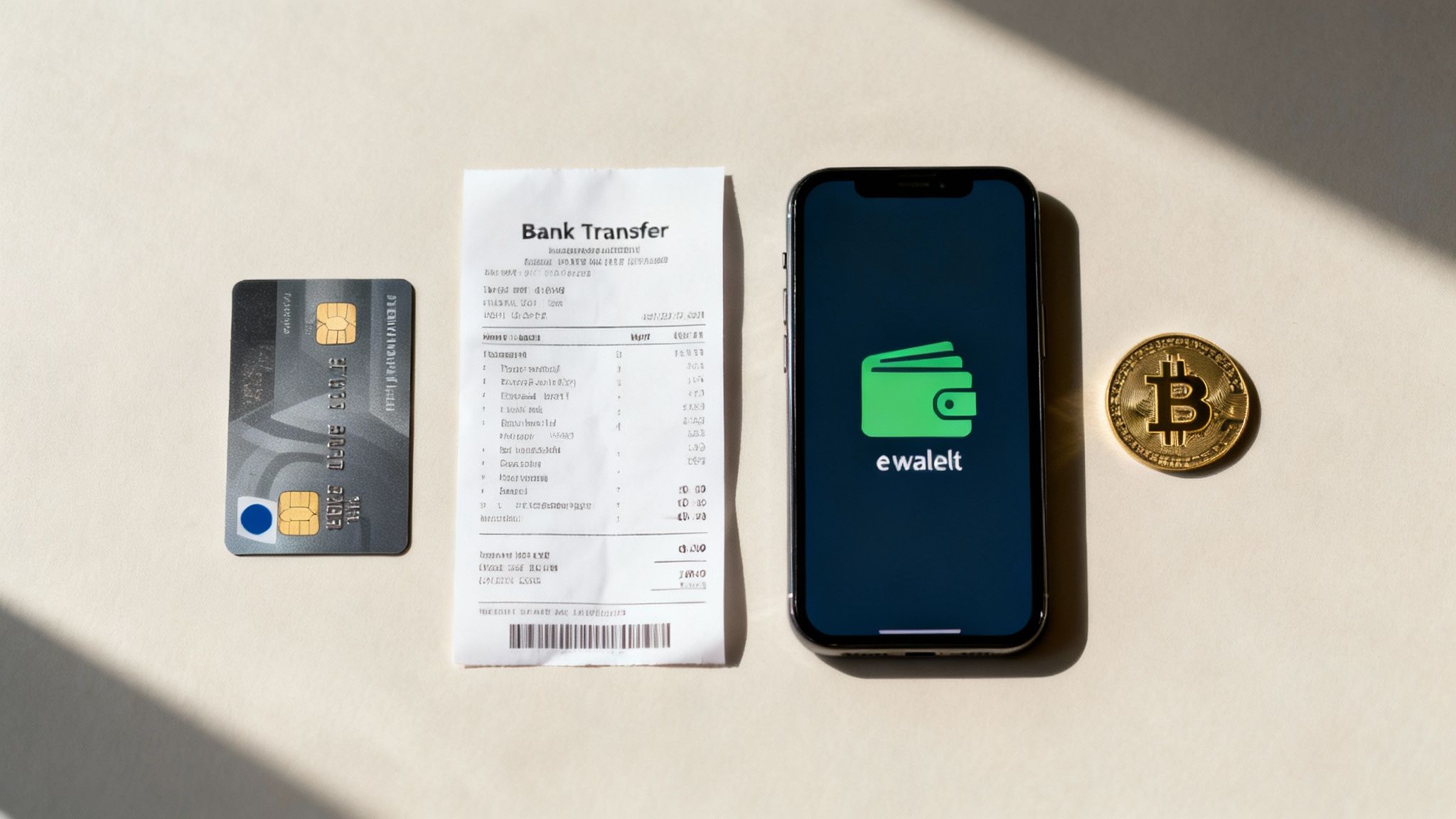
Before you can start accepting international payments, you have to understand the different "rails" money travels on. Think of them like different transportation systems—each has its own unique routes, speeds, and ticket prices. Picking the right one comes down to what your business needs, where your customers are, and how much you're willing to pay in tolls.
Let's break down the often-confusing world of global payments. Every option comes with a trade-off, and what's a perfect fit for one merchant could be a disaster for another.
The Superhighways: Credit and Debit Cards
Credit and debit cards are the superhighways of global commerce. Networks like Visa and Mastercard are recognized everywhere, giving your customers a checkout experience they already know and trust. That familiarity is their biggest advantage.
But just like a real highway, this route is packed with tolls. Card payments involve a whole chain of middlemen—issuing banks, acquiring banks, and payment processors—and every single one takes a cut. These interchange and processing fees can pile up fast, often landing somewhere between 2% and 4% of the total transaction.
For merchants, that means a big chunk of your international revenue vanishes before it ever hits your bank account. While cards offer convenience and reach, their high operating cost is a major hurdle for any business trying to maximize profit from global sales.
The Cargo Ships: SWIFT Bank Transfers
If cards are the highways, then traditional bank transfers on the SWIFT network are the world's reliable cargo ships. They're built to move huge sums of money securely between international banks, making them a trusted standard for B2B deals and high-value purchases.
The main catch? Speed. A SWIFT transfer isn't a direct flight. The payment message has to hop between several correspondent banks before it gets to where it's going. This journey can take 3 to 5 business days, and even longer if it hits a weekend or a holiday.
That glacial pace can create serious cash flow headaches, leaving your money stuck in transit for days. On top of that, each bank in the chain can skim its own fee off the top, making the final cost unpredictable and often surprisingly high.
The Local Couriers: E-Wallets
E-wallets like PayPal, Apple Pay, or WeChat Pay are like local courier services—they're incredibly quick and efficient within certain countries or ecosystems. Customers love them for the seamless, one-click experience.
Their weakness, however, is that they're fragmented. An e-wallet that's a household name in North America might be completely unheard of in Southeast Asia. To truly cater to a global audience, you’d need to integrate and juggle a dozen different e-wallet services, which just adds a ton of operational complexity.
They're great for optimizing payments in a specific region, but they aren't a single, unified solution for a truly global business. You’re left managing a fleet of different couriers instead of one global delivery system.
Each traditional payment rail forces a compromise. You can have speed, but it will cost you. You can have security for large values, but it will be slow. You can have regional convenience, but it won't be global.
The Direct Flight: Bitcoin
This brings us to a totally different kind of payment rail: Bitcoin. If the old options are highways and cargo ships, think of Bitcoin as the direct, non-stop flight for money. It’s a modern, borderless network that completely bypasses the tangled web of middlemen.
Because Bitcoin is a peer-to-peer network, a payment from a customer in Japan to a merchant in Brazil goes straight from one wallet to another. No correspondent banks, no regional processors, no separate currency conversion steps. This direct path slashes both the time and the cost of cross-border transactions.
Settlement happens in minutes, not days, and the fees are usually a tiny fraction of what card networks charge. It’s a single, unified system that works the exact same way anywhere in the world, giving merchants a truly global payment method with just one integration.
Comparing International Payment Rails
To make the right call, it helps to see the options laid out side-by-side. The best choice for your business really depends on what matters most—whether that’s speed, cost savings, or global reach.
| Payment Method | Typical Fees | Settlement Speed | Global Reach | Best For |
|---|---|---|---|---|
| Credit/Debit Cards | 2% - 4% + fixed fees | 1-3 business days | Very High | Businesses prioritizing customer convenience and broad acceptance over cost. |
| SWIFT Bank Transfers | $25 - $50 per transfer | 3-5 business days | Very High | High-value B2B transactions where security is paramount and speed is not critical. |
| E-Wallets | 2% - 5% | Near-Instant to 1 day | Regional | Merchants targeting specific regions where certain e-wallets are dominant. |
| Bitcoin | Typically under 1% | 10-60 minutes | Global | Merchants seeking low fees, instant settlement, and access to a global, tech-savvy market. |
As you can see, each payment system was designed for a different era of commerce. While the traditional rails still have their place, they just weren't built for the instant, borderless economy we operate in today. Bitcoin, on the other hand, was created from the ground up for this environment, offering a streamlined and cost-effective way of accepting international payments without all the legacy baggage.
The True Cost of Selling Across Borders
That price tag on an international sale? It’s rarely what it seems. While your payment processor might advertise a simple transaction fee, the real cost of accepting international payments is a different story—one told through a tangled web of hidden charges that quietly eat away at your profits.
When you sell something to a customer in another country, the money doesn’t just jump from their account to yours. It takes a winding journey through multiple hands, and every intermediary along the way takes their cut. This makes it frustratingly difficult to predict how much you'll actually keep from each sale.
Let's pull back the curtain and see why the final amount that lands in your bank account is often much smaller than you expected.
Unpacking the Hidden Fees of Global Sales
Imagine you sell a $100 product to a customer in Europe. That initial percentage-based fee you see is just the tip of the iceberg. Several other costs get layered on top, each one taking a little slice of your revenue.
This "death by a thousand cuts" model is standard practice in the traditional financial world. And to get the full picture, you also have to understand the tax implications of cross-border money transfers.
Here are the most common culprits you’ll run into:
- Currency Conversion Markups: When a customer pays in euros for your dollar-priced product, a bank or processor handles the conversion. They don't give you the real-time market rate, though. Instead, they add their own markup—a "spread"—which is pure profit for them and a direct hit to your bottom line.
- Interchange Fees: These are what your bank pays to the customer's card-issuing bank for the privilege of processing the transaction. The costs are all over the place, changing based on the card type, the country, and even the perceived risk level.
- Chargeback Penalties: If a customer disputes a charge, you don't just lose the sale. You also get slapped with a painful chargeback fee, which can be anywhere from $20 to $100 per incident, whether the dispute is legitimate or not.
The Problem with Too Many Middlemen
The real issue is the sheer number of players involved in a single cross-border card payment. You've got the customer's bank, the card network (like Visa or Mastercard), your payment processor, and your acquiring bank—and they all need to get paid.
Each one adds its own fee structure and its own delays. This convoluted process isn't just expensive; it's also completely opaque, making it nearly impossible for you to do a clear cost analysis. You're left trying to run a business within a system where your revenue shrinks at every step.
A $100 sale can easily lose 4% to 7% to this web of fees. That means up to $7 of your hard-earned revenue vanishes before it ever reaches you, simply because the payment had to cross a border.
Bitcoin Offers a More Transparent Path
This is where Bitcoin flips the script. Because it operates on a single, global network, it completely changes the cost structure of international payments.
When a customer pays you with Bitcoin, the transaction moves directly from their digital wallet to yours. No intermediary banks. No separate currency conversion steps with hidden markups. No confusing interchange fee schemes. The network is the settlement layer.
This direct, peer-to-peer model cuts out the entire chain of middlemen that inflates costs in the old system. The only mandatory cost is the Bitcoin network fee, which is paid to miners for processing the transaction and isn't based on the dollar value of your sale. This creates a transparent and predictable cost model for merchants.
For any business tired of surprise fees and watching their margins disappear, this simplicity is a game-changer when it comes to accepting international payments.
How to Integrate Global Payments Seamlessly
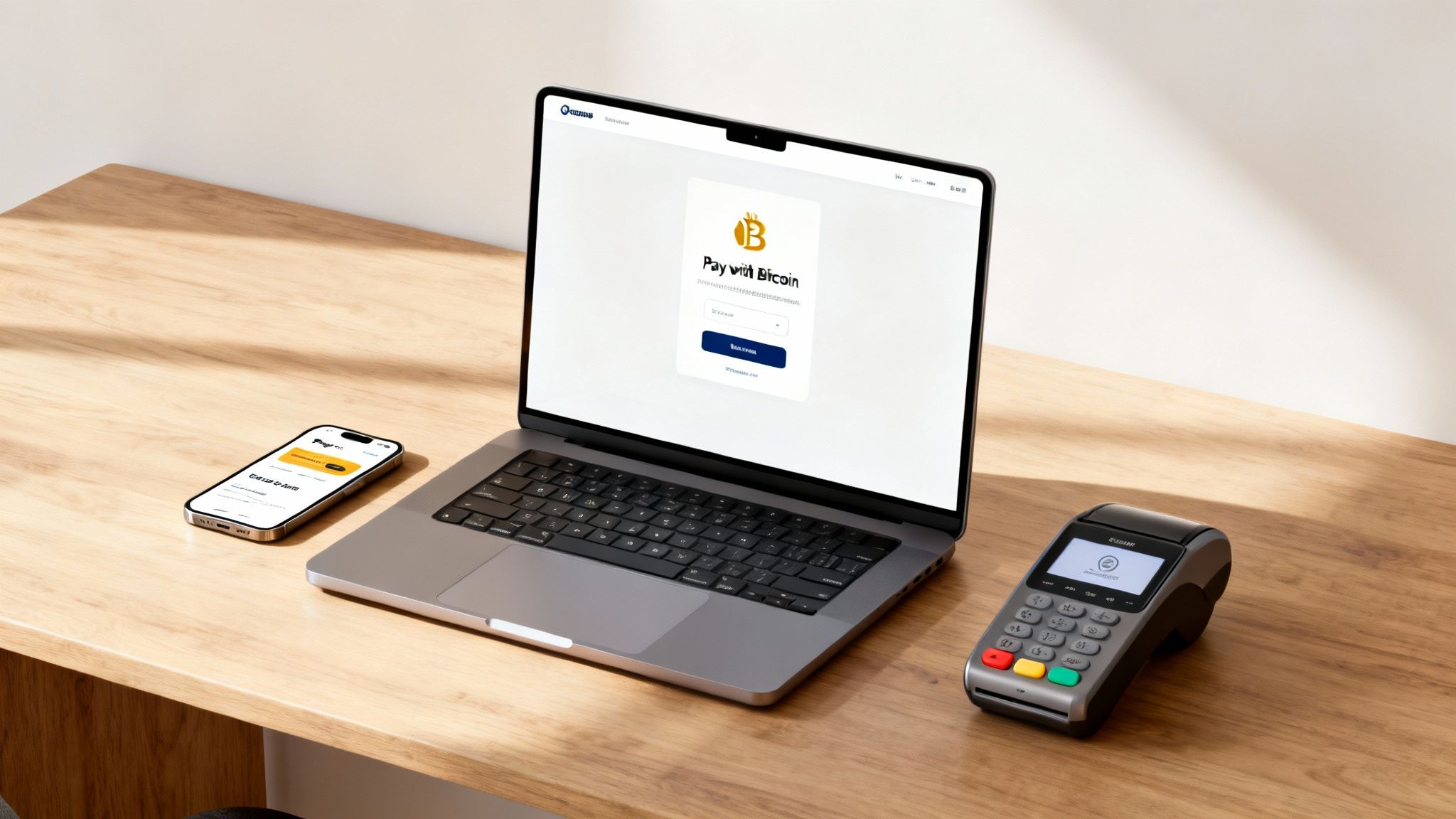
Getting set up for accepting international payments doesn't have to be a massive technical headache. Thanks to modern tools, connecting with a global customer base is easier than ever. The trick is simply to pick the path that fits your technical comfort zone and business goals.
You've really got two main routes for traditional payment systems: simple, hosted solutions that get you running fast, and more involved API-driven setups that give you total control. But there's a third way—integrating Bitcoin—which might just be the most accessible way to instantly unlock a worldwide audience.
The Plug-and-Play Approach with Hosted Pages
For businesses that want to go live with the least amount of fuss, hosted payment pages are a godsend. Think of it like renting a fully-equipped storefront instead of building one from the ground up. Your payment provider gives you a secure, pre-built checkout page you can just link to from your website.
When a customer is ready to buy, they're whisked away to this page to pop in their details. The provider handles all the nitty-gritty security, compliance, and processing behind the scenes. This method is fast, requires almost zero coding, and takes a huge weight off your shoulders, making it perfect for small businesses or anyone just dipping their toes into international markets.
Gaining Control with Custom API Integrations
If you're a larger business or just want a completely branded checkout experience, a direct API (Application Programming Interface) integration is the way to go. An API is basically a toolkit that lets your website talk directly to the payment processor’s systems, giving you full command over the look and feel of your checkout flow.
While this approach offers incredible customization, it's also a heavier lift. You'll need skilled developers to build, test, and maintain the integration. You're also on the hook for more of the security and compliance, but the payoff is a seamless customer experience that never sends shoppers away from your site.
The world of cross-border payments is in the middle of a huge technological shift. More than 70 countries are now rolling out real-time payment systems. This trend highlights the urgent need for modern infrastructure that can handle instant transactions, leaving the snail's pace of traditional banking in the dust. You can dig deeper into this global trend in recent findings from the Bank for International Settlements.
The Easiest Integration of All: Adding Bitcoin
While traditional payment setups can range from simple to complex, adding Bitcoin to your checkout is often the most straightforward way to start accepting international payments. Modern tools have completely torn down the old technical barriers, letting you get started in minutes with little to no coding.
This isn't some massive IT project; it's about adding a new, incredibly efficient payment rail with surprising ease. This simplicity makes Bitcoin a powerful tool for instantly reaching a global, tech-savvy customer base that traditional systems might otherwise miss.
Here’s just how simple it can be:
- Point-of-Sale (POS) Apps: For brick-and-mortar shops, an app like the Flash POS app can turn any smartphone or tablet into a Bitcoin-ready payment terminal. No expensive hardware needed—just download the app and you’re in business.
- Simple Payment Links: You can create a unique payment link for a product and share it anywhere—email, social media, you name it. The customer clicks, pays from their Bitcoin wallet, and the transaction is done.
- Checkout Widgets: For e-commerce sites, adding a "Pay with Bitcoin" button can be as simple as copying and pasting a small piece of code. These pre-built widgets handle the entire flow, from creating an invoice to confirming the payment on the blockchain.
By using these low-code and no-code solutions, any business can tap into the borderless Bitcoin network without needing a dedicated development team. It reframes global payments from a complex integration nightmare into a simple, powerful way to grow.
Why Bitcoin Is Built for Global Commerce
While the payment systems we use today were awkwardly adapted for the internet, Bitcoin was born from it. It was designed from the ground up as a native digital currency, completely free from the physical borders and institutional gatekeepers that define legacy finance. This isn't just a small detail; it’s a fundamental difference that makes Bitcoin uniquely suited for the real-world demands of global commerce.
Instead of wrestling with a tangled web of correspondent banks, processors, and card networks, Bitcoin runs on a single, unified global ledger. This peer-to-peer structure isn't just a technical quirk—it's a game-changing advantage for any business serious about accepting international payments. It turns a costly, slow, and opaque process into something direct, efficient, and transparent.
Dramatically Lowering Transaction Costs
Ever wondered why traditional international payments are so expensive? It's because of the sheer number of middlemen involved. From the issuing bank to the acquiring bank, every entity takes a slice of the pie, layering on fees that can easily eat up 3-7% of your revenue.
Bitcoin completely dismantles this chain. When a customer pays you, the transaction zips directly from their wallet to yours on the Bitcoin network. This peer-to-peer model cuts out the intermediaries, which in turn slashes the costs. The only fee is the small network fee paid to miners, which isn't tied to the payment amount.
That means a $10,000 international sale costs virtually the same to process as a $10 one—a world away from the percentage-based fees charged by card networks. This lets merchants keep more of their hard-earned money, especially on high-value or cross-border sales.
The broader payments industry is already shifting away from old habits. Recent analysis shows that account-to-account payments and digital wallets now make up about 30% of global point-of-sale volume as cash use dwindles. This points to a clear trend toward digital, decentralized transactions, and Bitcoin is leading the charge. You can dig into more global payment trends on McKinsey.com.
Achieving Near-Instant Settlement
Cash flow is the lifeblood of any business. Waiting days for international payments to clear can grind operations to a halt. Traditional systems like SWIFT or card networks can leave your funds in limbo for 3-5 business days, tying up capital you could be using for inventory, marketing, or growth.
Bitcoin transactions, on the other hand, settle almost instantly. A payment is typically confirmed on the blockchain and becomes final within minutes, not days. This completely changes the cash flow game for international merchants.
With Bitcoin, the moment a customer pays you is the moment you have the funds. Settlement is final, chargebacks are impossible, and you can track every transaction in real-time.
This speed delivers some major wins for your business:
- Improved Cash Flow: Get your hands on your revenue almost immediately, letting you reinvest in your business faster.
- Reduced Counterparty Risk: The funds are in your control quickly, minimizing the risk of payment reversals or processor holds.
- Operational Efficiency: Reconciliation becomes a breeze because payments settle quickly and transparently on a public ledger.
Gaining Unprecedented Financial Control
Perhaps the most powerful advantage of Bitcoin for merchants is self-custody. In the traditional financial system, a bank or payment processor always acts as a gatekeeper for your money. They hold your funds, and you’re just given permission to access them. This setup introduces a massive risk: your account can be frozen, funds can be held, and access can be denied at any time.
Bitcoin offers a radically different model. When you use a non-custodial solution like Flash, you are in complete control of your private keys and, therefore, your money. Funds from a sale are sent directly to a wallet that only you can access.
This wallet-to-wallet approach means:
- No Third-Party Risk: Flash, or any other service, never touches or holds your funds. The money is yours from the instant the transaction is confirmed.
- Censorship Resistance: No central authority can freeze your account or block your transactions. You have total financial autonomy.
- Greater Financial Freedom: You decide how and when to use your funds without asking for permission from a financial middleman.
This level of control is simply not possible with traditional payment rails. By embracing Bitcoin, businesses can move beyond being mere users of a financial system and become true owners of their capital—a profound shift when accepting international payments.
Navigating Cross-Border Compliance and Security
Selling to a global audience is a massive opportunity, but it also means you’re stepping into a new arena of rules and risks. Once you start accepting international payments, you're suddenly dealing with a whole host of different tax laws, data privacy standards, and fraud threats. It can feel like learning a new playbook for every country you sell to.
Getting a handle on this complex landscape is non-negotiable for protecting your business and your customers. The key is to understand your core responsibilities and find tools that simplify your compliance burden, not add to it.
Understanding Your Global Obligations
Expanding internationally isn't just about shipping products—it's about following local laws. Two big areas demand your attention right from the start. First, you have to get a grip on tax obligations like Value-Added Tax (VAT) or Goods and Services Tax (GST), which vary wildly from one country to the next.
Second, you absolutely have to respect data privacy regulations. Laws like Europe's GDPR (General Data Protection Regulation) have set very strict rules on how you collect, store, and process customer information. Getting this wrong can lead to heavy fines and seriously damage your brand's reputation. Trying to manage these different requirements for every market can quickly turn into an operational nightmare.
The real challenge of cross-border commerce is staying compliant without getting buried in administrative red tape. Your payment solution should ideally shrink your regulatory footprint, not expand it.
The Bitcoin Advantage for Simpler Compliance
This is where using a non-custodial Bitcoin solution completely changes the game. When you accept payments directly from a customer's wallet to yours, you sidestep many of the complex financial regulations that apply to traditional payment processors.
Think about a tool like Flash, which enables direct wallet-to-wallet transactions. Because Flash never holds or controls your funds, your business isn't operating as a money services business or a licensed financial intermediary. That distinction is crucial.
This model brings a few key benefits:
- Reduced Regulatory Scope: You aren't holding customer funds, which dramatically minimizes your exposure to the complex financial regulations that govern third-party payment handlers.
- Enhanced Privacy: Wallet-to-wallet Bitcoin payments can be done without collecting extensive personal data. This helps you align with privacy-first principles and reduces your data storage liabilities.
- Full Asset Control: You have complete control over your revenue from the moment a payment is confirmed. The funds are yours, in your wallet, with no risk of being frozen or held by a middleman.
Proactive Fraud Prevention
International transactions are often flagged as high-risk for fraud, especially with "card-not-present" sales online. The finality of Bitcoin transactions offers a powerful defense against one of the most common and costly problems out there: chargeback fraud.
Once a Bitcoin payment is confirmed on the blockchain, it’s irreversible. Period.
This simple fact eliminates the possibility of fraudulent chargebacks, where a customer disputes a legitimate transaction to get their money back while keeping the product. For merchants, this feature provides total payment certainty. It protects your revenue and gets rid of the administrative headaches and financial penalties that come with managing disputes.
By integrating a straightforward and secure rail for accepting international payments, you can finally focus more on growth and less on navigating global red tape.
A Few Common Questions About Global Payments
Jumping into the world of international payments can feel a bit daunting, especially when you start looking at newer options like Bitcoin. Let's clear up some of the most common questions merchants have when they decide to take their business global.
How Can I Start Accepting Bitcoin Payments?
Getting set up is a lot easier than you might think, and you probably won't need to write a single line of code.
You can download a point-of-sale (POS) app to a phone or tablet, create payment links you can share anywhere, or pop a pre-made widget onto your e-commerce site. These tools do the heavy lifting by creating a unique QR code for every sale, which your customers can scan to pay you directly from their Bitcoin wallet.
Are Bitcoin Payments Safe for Merchants?
Absolutely. In fact, they come with some security perks you just don't get with traditional payments.
Once a Bitcoin transaction is confirmed on the network, it’s set in stone—it's final and can't be reversed. This completely wipes out the risk of chargeback fraud, which is a huge (and expensive) headache for anyone accepting international credit cards.
The finality of Bitcoin gives you a kind of payment certainty that old-school systems can't offer. You're no longer in a position where revenue can be snatched back weeks or even months after you've made a sale.
How Does Bitcoin Get Around High International Fees?
It's all in the design. Bitcoin runs on one global, person-to-person network.
This setup cuts out the long chain of intermediary banks and payment processors that each take a slice of the pie in a typical cross-border payment. The only real cost is a small network fee to process the transaction, and it isn't based on how much money you're sending. That makes it incredibly efficient for international sales.
Ready to open your doors to a global customer base with fast, low-fee payments? Flash gives you the tools to start accepting Bitcoin in minutes. Explore our solutions at paywithflash.com.