So, what exactly is a Bitcoin payment processor? It’s a service that lets businesses accept the world's leading cryptocurrency. Think of it as a universal translator for digital money. It does all the complicated backend work, taking a customer's Bitcoin payment and turning it into something the merchant wants, like U.S. dollars. But this convenience brings up some big questions about security, who actually holds the money, and the whole point of decentralization.
Demystifying The Bitcoin Payment Processor
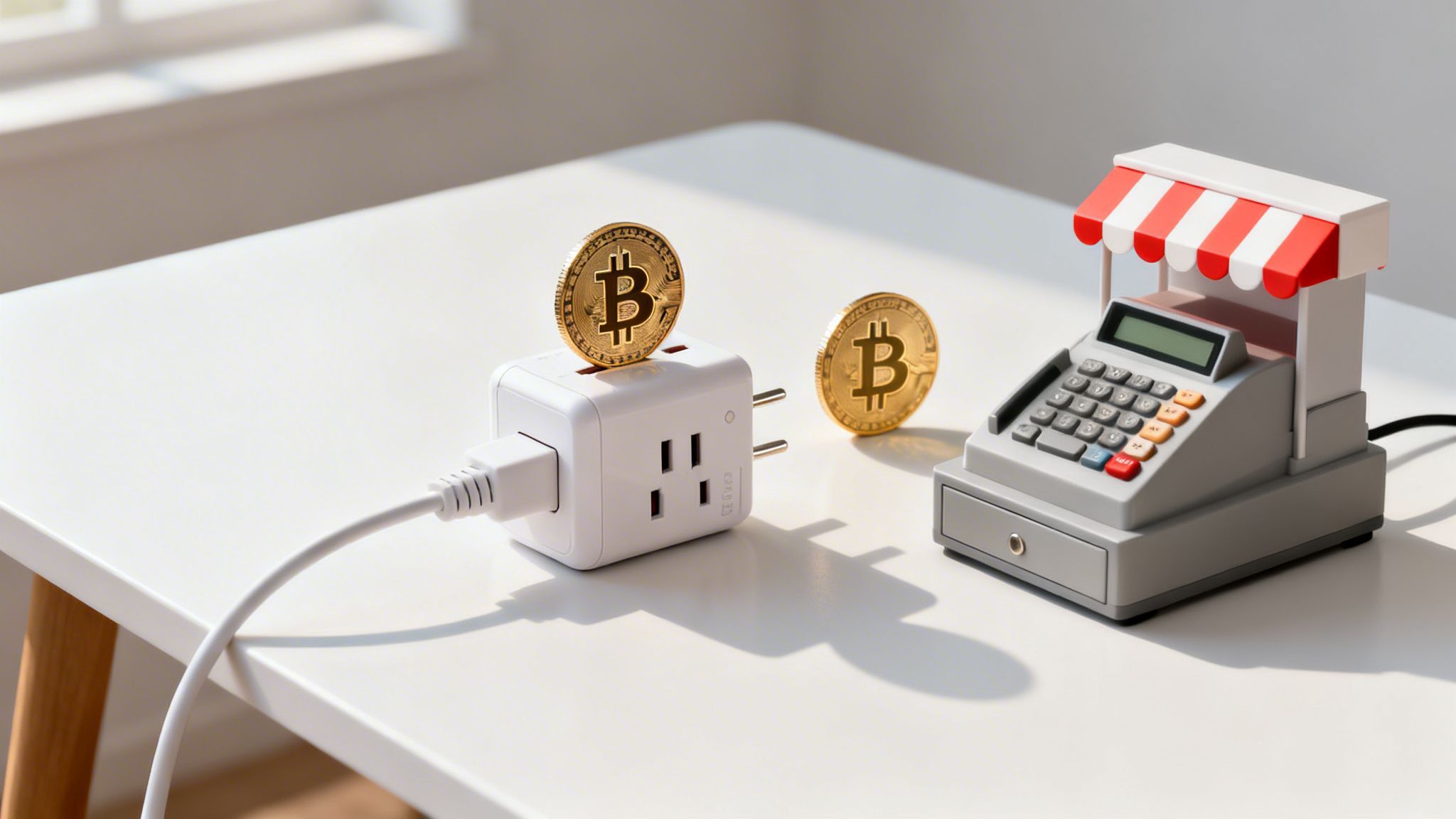
Imagine you have a universal travel adapter for money. When you go abroad, you need that little plastic gadget to plug your devices into foreign outlets. A Bitcoin payment processor is a lot like that—it's a financial adapter that connects a merchant's checkout system to the global Bitcoin network.
The whole point of these services is to make the payment process dead simple. A customer can pay with their Bitcoin, and the processor instantly confirms it. This shields the business from the messy technical details that can come with managing digital asset payments.
The Appeal and The Hidden Costs
For merchants, the main draw is pretty obvious: reach more customers. By accepting Bitcoin, a business can theoretically tap into a global audience of crypto holders. On the surface, it makes perfect sense. More payment options should mean more sales, right?
But this convenience usually comes with some serious trade-offs. Most payment processors are custodial, which means they take temporary ownership of your funds during the transaction. This puts a third party right back in the middle of your payments, which completely goes against the peer-to-peer spirit of Bitcoin.
By relying on a custodian, merchants are reintroducing the very intermediaries that Bitcoin was designed to eliminate. This creates a central point of failure and exposes businesses to counterparty risk.
This is a world away from non-custodial Bitcoin solutions, where money flows directly from the customer’s wallet to the merchant’s wallet. No middleman, no holding of keys.
Growth and Emerging Concerns
The market for these processors has exploded, largely thanks to the rise of digital assets. These have seen absolutely massive adoption for payments. To give you an idea, by mid-2025, stablecoins had already cleared over $8.9 trillion in transaction volume in the first half of the year alone, with total transfers hitting a staggering $18 trillion. You can find some great insights on this trend over at The Finanser.
Even with all this growth, relying on a third-party processor raises some tough questions for any business:
- Security: How secure are my funds when they are held by a third party?
- Decentralization: What’s the point of accepting decentralized money if you’re just going to use a centralized, custodial service to do it?
- Efficiency: Is the added risk of a custodial model worth it compared to a direct, peer-to-peer transaction on a secure and globally recognized network like Bitcoin’s?
At the end of the day, while a custodial processor offers convenience, it forces you to think hard about whether a focused, non-custodial approach offers better long-term value and security.
How These Payment Processors Actually Work
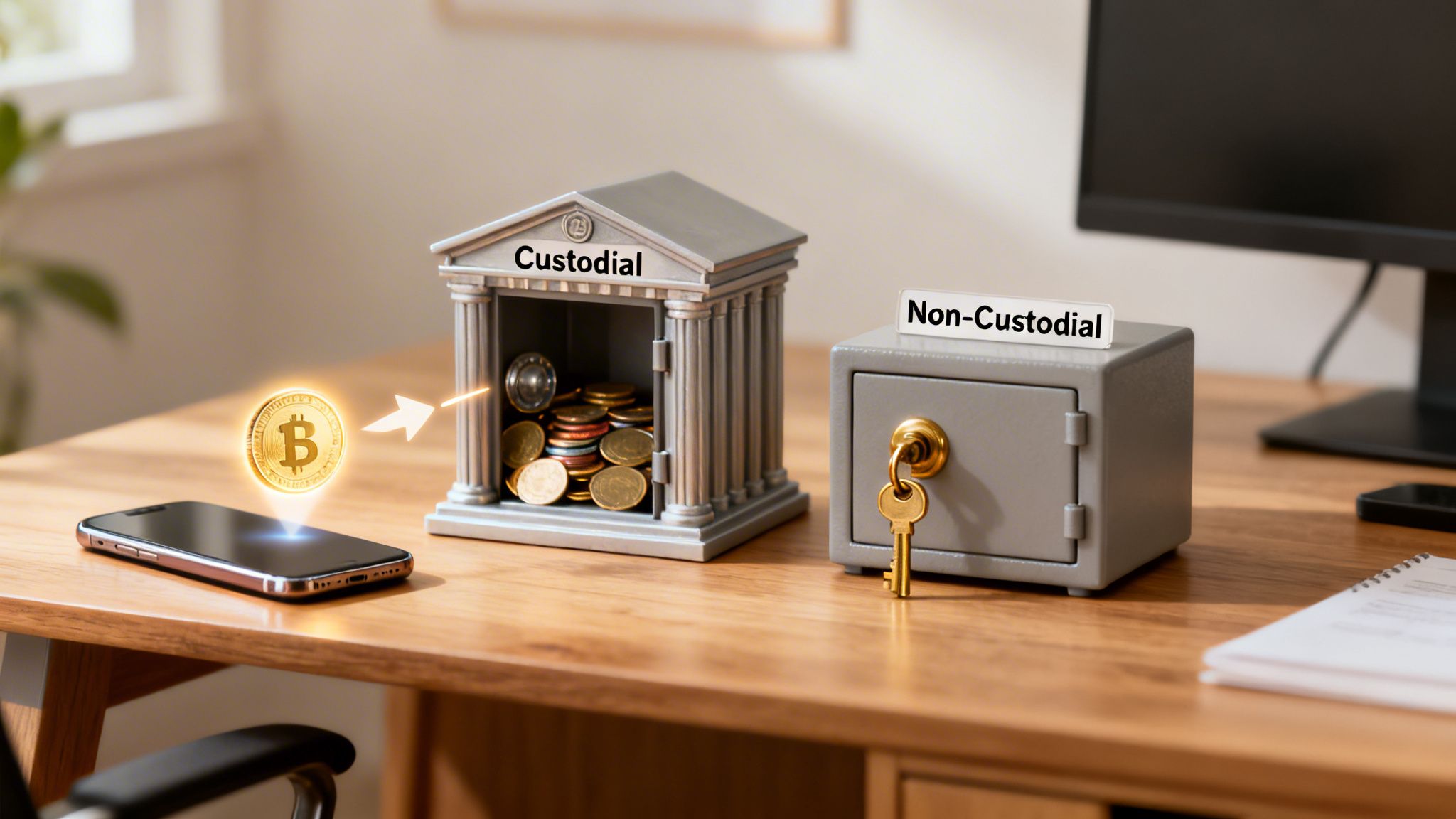
So, how does the magic actually happen? Let's trace the path of a payment from your customer's wallet all the way to your bank account. The most important question to ask is a simple one: who holds the crypto?
The answer splits processors into two very different camps, each with huge implications for your business, your risk, and your control over your own money.
The most common setup you'll find is the custodial model. Think of it like a bank. When a customer pays you, the processor takes custody of the Bitcoin, holds it for you, and handles the conversion into dollars or euros. It’s convenient, sure, but that convenience has a hidden price.
You’re trusting a third party with your revenue. This introduces counterparty risk—the very real danger that the processor could get hacked, go out of business, or simply freeze your funds. In essence, this model just rebuilds the old banking system on top of new technology, sticking an intermediary right between you and your money.
Custodial vs. Non-Custodial Models
The alternative is the non-custodial model, and it's a world apart. Imagine having a personal safe where only you have the key. In this setup, payments flow directly from your customer's wallet straight into a wallet that you control. The payment processor never actually touches your funds; it just acts as a facilitator, confirming the transaction on the blockchain.
This approach is the very heart and soul of what makes Bitcoin revolutionary. It gives you, the merchant, complete financial sovereignty. You eliminate the risks that come with handing your money over to someone else. You always have direct access to and control over your revenue, which is a powerful advantage for any business.
Non-custodial solutions restore the peer-to-peer nature of digital cash. By ensuring you are the sole custodian of your funds, they provide unparalleled security and censorship resistance, making them a strategic choice for businesses prioritizing control and autonomy.
The benefits are crystal clear. You sidestep any chance of a third party mismanaging your funds and gain total freedom to manage your assets exactly how you see fit.
The Fiat Settlement Process
Of course, most businesses still operate in traditional currencies. This is where fiat settlement comes in. Even non-custodial solutions need a way to bridge the gap between crypto and cash.
The process is pretty straightforward:
- Payment Initiation: The customer pays with Bitcoin at checkout.
- Conversion: The processor (or a connected service) instantly locks in the fiat value based on the current exchange rate.
- Transfer: The processor deposits the equivalent amount in USD, EUR, or another currency into your linked bank account.
While custodial services bake this into their all-in-one package, non-custodial Bitcoin solutions like Flash give you choices. You can hold the Bitcoin you receive, waiting for a better exchange rate, or use an independent exchange to convert it to fiat on your own schedule. You get full control over the timing and fees without ever giving up custody of your funds.
This flexibility also applies to how transactions get processed. Technologies built on top of Bitcoin, like the Lightning Network, offer a path for off-chain transactions. These are instant, near-free payments that settle on the main blockchain later, giving you the speed of modern payment systems with the security and self-sovereignty of Bitcoin.
Critical Factors for Choosing a Processor
Picking a payment processor isn’t just a technical task; it's a core business decision that shapes how you handle your money. Accepting Bitcoin can seem simple, but the processor you choose determines your risk and control. You need a solid framework to cut through the hype and choose a setup that actually prioritizes security and efficiency.
The most obvious factor is always cost. When you're looking at a Bitcoin payment processor, you absolutely have to look past the advertised transaction fee. It’s critical to dig deeper by understanding their pricing models, which almost always hide conversion costs, withdrawal fees, and other little charges. These "small" percentages can chew away at your profit margins, especially if you're running a high-volume or low-margin business.
But honestly, the direct fees are often the least of your worries. The real headaches come from the indirect costs tied to volatility and compliance, which can be far more draining.
The Hidden Burdens of Volatility and Compliance
Volatility is just part of the game with digital assets. Custodial processors try to shield you from this by instantly converting Bitcoin payments into fiat currency, but that "service" is never free. More importantly, to do this, they have to take control of your funds, which immediately exposes you to counterparty risk. You become completely dependent on a third party to protect your earnings from market swings.
The bigger migraine, though, is usually compliance. Most services that handle payments are regulated as money transmitters. This forces them to enforce strict Know Your Customer (KYC) and Anti-Money Laundering (AML) rules. For your customers, it creates friction—they have to upload personal ID just to pay you. For you, it's an administrative nightmare, making you responsible for navigating a maze of complex regulations.
In sharp contrast, a non-custodial Bitcoin processor works on a totally different principle. Since the funds move directly from your customer's wallet to yours, the processor never touches or holds them. This peer-to-peer model slashes the compliance burden and completely eliminates counterparty risk, giving you real autonomy and control.
This distinction is massive, especially as the payments industry keeps growing. Crypto payment processors are certainly making waves in e-commerce, but the entire processor market is projected to hit $122.08 billion by 2031. As this space gets bigger, the practical differences between custodial and non-custodial models will become even more stark.
Processor Model Comparison Custodial vs Non-Custodial (Flash)
To make sense of these trade-offs, it helps to see a direct comparison. The table below breaks down the key differences between a typical custodial processor and a non-custodial Bitcoin solution like Flash. This should give you a clearer picture of what you're giving up in exchange for convenience.
| Feature | Custodial Processor | Non-Custodial Bitcoin Processor (e.g., Flash) |
|---|---|---|
| Fund Control | Processor holds your funds | You have 100% self-custody |
| Counterparty Risk | High; you depend on the processor's solvency | None; funds are peer-to-peer |
| Fees | Transaction fees, conversion fees, withdrawal fees | Low, transparent transaction fee (e.g., 1%) |
| KYC/AML | Mandatory for merchant and often for customers | Not required; preserves privacy |
| Fiat Settlement | Automatic conversion to fiat | Direct Bitcoin settlement; you control conversion |
| Volatility | Managed by the processor (at a cost) | Managed by you, offering potential upside |
| Complexity | Simple for fiat settlement, complex compliance | Simple P2P payments, simple compliance |
| Ideal For | Merchants who prioritize fiat conversion above all else | Merchants who prioritize sovereignty, low fees, and control |
Ultimately, the choice comes down to what you value more: the hands-off convenience of a custodial service or the sovereignty and efficiency of a non-custodial one.
Simplicity as a Strategic Advantage
At the end of the day, the goal is simple: get paid efficiently and securely. The promise of accepting every digital asset might feel forward-thinking, but it often just leads to operational bloat and unnecessary risk. A streamlined, focused approach is a much more powerful strategic advantage.
By choosing a non-custodial Bitcoin solution, you're opting for a network that has been battle-tested for over a decade, with unmatched security and a dead-simple, direct payment flow. This approach lets you:
- Eliminate Middlemen: Transactions are truly peer-to-peer, cutting out the intermediaries who take a cut and add risk.
- Retain Full Control: You are the sole custodian of your funds. Always. No one can freeze or seize your money.
- Reduce Compliance Overhead: You can sidestep the intrusive KYC processes that are standard with custodial platforms.
This model empowers you to run your business with far greater efficiency and freedom. You can focus on what you do best instead of getting tangled in a web of volatile assets and regulatory red tape. It’s a clear choice for stability over novelty and sovereignty over outsourced convenience.
Integrating Crypto Payments Into Your Business
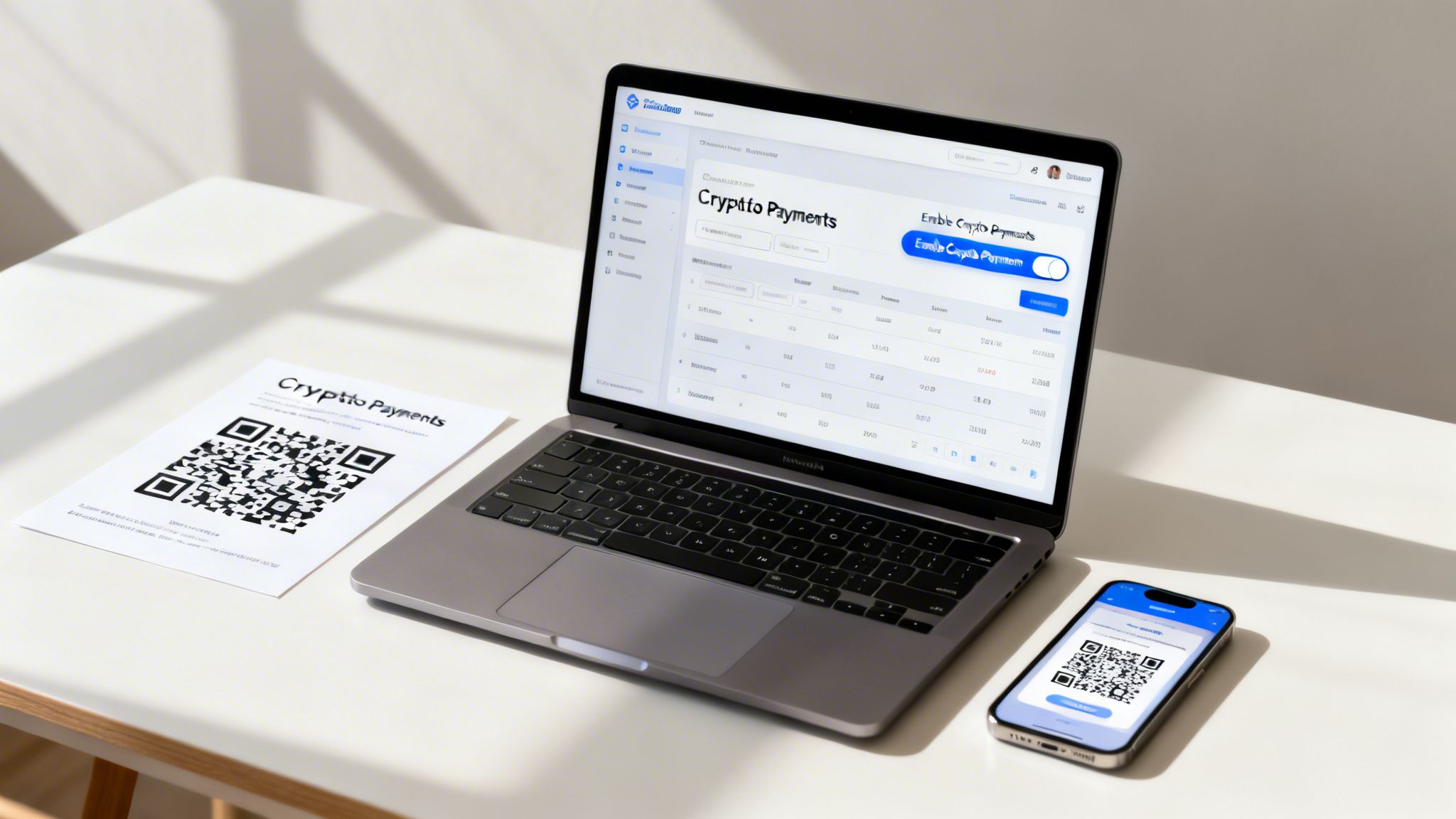
Jumping into crypto payments might sound like a huge technical headache, but it’s a lot simpler than you think. Modern tools are built to get you up and running fast, so you can start accepting Bitcoin without a long, drawn-out setup process. The real trick is picking the right method that fits your business and your team's comfort level with tech.
Whether you need a powerful API for a custom-built site or a simple plugin for an e-commerce platform, there’s an option for you. And if you’re looking for the absolute fastest way to start? No-code tools like payment links and embeddable buttons let you accept Bitcoin immediately, without touching a single line of code.
Choosing Your Integration Path
The "best" way to integrate is the one that makes sense for you. If you have a custom website, a flexible API gives you total control. On the other hand, if you're running on a platform like Shopify or WooCommerce, you can just install a dedicated plugin and be done in minutes.
Before you start, it’s worth understanding the nuts and bolts of integrating a payment gateway. Getting a handle on this helps you see exactly how a customer's payment makes its way from their checkout cart to your account.
This whole space is growing like crazy. The payment processor market is expected to jump from $71.15 billion in 2026 to a whopping $122.08 billion by 2031, with crypto gateways grabbing a bigger and bigger slice of that pie. You can dig into more market insights on Mordor Intelligence.
A Simple Setup Process
Getting started with a modern, non-custodial Bitcoin processor is surprisingly easy. These tools are designed to be as smooth as possible, cutting out the painful onboarding hoops you have to jump through with old-school financial services.
Here’s what a typical setup looks like:
- Create an Account: Just an email and password. No invasive KYC checks needed.
- Connect Your Wallet: Link the self-custody Bitcoin wallet where you want your funds to land directly.
- Deploy Your Tool: Pick your weapon of choice—a payment link, a website button, or a platform plugin.
- Run a Test Transaction: Send a small payment to yourself to make sure everything is working smoothly.
You can often get this entire process done in just a few minutes. The whole point is speed and simplicity, letting you get started without needing a developer on standby or getting bogged down in compliance paperwork.
This is a world away from custodial services that want your life story in documents before they’ll let you accept a single payment. A direct, peer-to-peer Bitcoin model like Flash puts you in the driver’s seat, letting you transact almost instantly.
Why Non-Custodial Bitcoin Is the Merchant's Gold Standard

While the crypto world throws endless options at you, the smartest move for a business is often the most focused one. For merchants, a non-custodial Bitcoin solution delivers on three pillars that are non-negotiable for long-term success: rock-solid security, real censorship resistance, and serious cost savings.
This isn't about picking a favorite digital asset; it's a strategic business decision. Choosing this path means you're building your payment infrastructure on the world's most proven and secure decentralized network, giving you direct control over every dollar you earn.
Ultimate Security Through Self-Custody
The single biggest point of failure in any financial setup is counterparty risk—the chance that a third party holding your money goes bust, gets hacked, or simply locks you out. Custodial services, including many a Bitcoin payment processor, bring this old-world risk right back into the picture. By holding your funds, they become a giant, glowing target for hackers and are subject to freezes, seizures, or insolvency.
A non-custodial Bitcoin processor wipes this threat off the map.
When you hold your own private keys, you cut out the middlemen. Your revenue flows directly from your customer's wallet to yours, secured by the most powerful computing network on the planet. This is what financial sovereignty actually looks like.
This direct, peer-to-peer model means your funds are as safe as you decide to make them. You’re not banking on a company's promises; you're relying on the mathematical certainty of the Bitcoin protocol. It’s a huge shift from outsourced trust to verifiable ownership.
True Censorship Resistance and Freedom
We live in an age where payment networks can de-platform businesses on a whim. In this environment, censorship resistance isn't a bonus feature—it's a core necessity. Bitcoin's decentralized design means no single company or government can block your transactions or freeze your account.
Your ability to do business is guaranteed by a global, leaderless network, not by a corporate policy that could change tomorrow. This gives you critical operational guarantees:
- Uninterrupted Revenue: Your payment channel can never be shut down by an angry intermediary.
- Global Access: You can accept payments from anyone, anywhere, without asking for permission.
- Privacy Preservation: You sidestep the invasive KYC/AML hoops required by custodial platforms, protecting both your business and your customers' data.
This freedom lets you operate with confidence, knowing your revenue stream is resilient and completely under your control.
Radical Cost-Efficiency and Simplicity
Complexity is a hidden tax. Supporting multiple digital assets requires constant security audits, tricky regulatory navigation, and massive technical overhead. Guess who pays for all that? You, the merchant.
A focused, non-custodial Bitcoin solution cuts through all that noise, resulting in a leaner, cheaper, and more efficient payment system.
By kicking out the layers of intermediaries, you slash your fees. There are no middlemen taking a slice for custody, conversion, or compliance checks. Instead, you pay a tiny, transparent fee for the direct facilitation of a peer-to-peer transaction. This isn't just about saving a few bucks; it's about simplifying your entire operation, reducing your risk, and taking back full control of your financial future.
Your Top Questions About Crypto Payments, Answered
Stepping into the world of crypto payments can feel like navigating a new frontier. It's natural to have questions. This final section tackles the most common ones we hear from merchants, cutting through the noise to give you clear, straight answers. The goal is to reinforce the core ideas of security, control, and simplicity we've covered and leave you ready to make the best choice for your business.
What's the Real Difference Between Processor Types?
At its core, the difference between a custodial and non-custodial processor boils down to control versus complexity.
Most payment processors are custodial. This means they hold your funds on your behalf, introducing a third party right back into the middle of your transactions. This model brings back the very things Bitcoin was designed to eliminate: third-party risk and hefty compliance burdens like KYC checks.
A non-custodial Bitcoin processor, on the other hand, is just a facilitator for direct, peer-to-peer payments. You always have full, sovereign control over your money. Settlement is final, and no intermediary can freeze your account or meddle with your funds. It's a fundamentally more secure, private, and liberating way to do business.
How Do I Protect My Business from Price Swings?
Volatility is a real and valid concern for any business owner. Custodial services often pitch an "easy" solution by automatically converting your crypto into fiat currency. But this convenience comes at a price: they charge you for the service and, more importantly, you have to surrender custody of your funds to make it happen. You're trading control for a perceived convenience.
With a non-custodial Bitcoin solution like Flash, you're the one in the driver's seat. You get to decide. You can hold the Bitcoin as a long-term asset on your balance sheet, or you can use an independent service to convert it to fiat on your own terms and timeline. This puts you in charge of managing risk, without ever giving up your financial sovereignty.
Is Adding a Bitcoin Payment Option Difficult?
Not anymore. The days of needing to be a Bitcoin wizard to accept payments are long gone. Modern non-custodial Bitcoin solutions are built from the ground up for simplicity and ease of use.
Many businesses can get up and running in just a few minutes using simple, no-code tools. Think about it:
- Payment Buttons: Drop a "Pay with Bitcoin" button onto any page on your site.
- Embeddable Widgets: Integrate a clean, seamless checkout experience right where you need it.
- E-commerce Plugins: Connect to giants like Shopify or WooCommerce with just a few clicks.
This kind of rapid, straightforward deployment is a world away from the complicated integrations and lengthy compliance ordeals that often come with traditional payment processors.
Why Choose Bitcoin Exclusively?
The idea of accepting hundreds of different cryptocurrencies sounds appealing on the surface, but dig a little deeper and you'll find it introduces a ton of risk, operational headaches, and regulatory uncertainty. More options don't automatically mean more value for your business.
Bitcoin’s network is the largest, most secure, and most battle-tested decentralized network in the world. By choosing a non-custodial Bitcoin solution, you're making a strategic decision to prioritize the security of your revenue and completely eliminate counterparty risk. It’s a choice for reliability and long-term stability over a dizzying, and often fleeting, variety of unproven digital assets.
Ready to take back control of your payments with a secure, non-custodial solution? Get started with Flash and begin accepting Bitcoin in under a minute. Visit to learn more.