In a competitive digital marketplace, relying solely on traditional credit and debit cards is a surefire way to limit your business's potential. Today's customers demand flexibility, security, and convenience at checkout. Failing to provide these options means risking higher cart abandonment and missing out on entire customer segments who prefer modern payment solutions.
Alternative payment methods, which encompass everything from digital wallets and Buy Now, Pay Later (BNPL) to direct bank transfers and cryptocurrency, are essential for growth. Integrating these solutions is a strategic move to lower transaction fees, tap into new global markets, and cater to the preferences of a diverse, tech-literate customer base. Adding new payment buttons isn't enough; they must be part of a seamless customer journey. For a holistic approach, consider these proven strategies for optimizing your website's checkout process to ensure your new payment options truly enhance the user experience.
This comprehensive guide breaks down the top alternative payment method providers, including Flash, Stripe, and Klarna. We'll dive deep into each platform's features, benefits, fee structures, and ideal use cases. Complete with screenshots and direct links, this roundup provides the actionable insights you need to choose the right solutions to future-proof your payment infrastructure.
1. Flash: The Future of Decentralized Bitcoin Payments
As businesses increasingly seek to diversify their payment ecosystems, Flash emerges as a premier choice for integrating one of the most significant alternative payment methods: Bitcoin. This platform is meticulously engineered for merchants who prioritize security, decentralization, and direct control over their finances. Flash distinguishes itself by facilitating truly peer-to-peer transactions, connecting a customer's Bitcoin wallet directly to the merchant's without any intermediary holding funds. This non-custodial approach is a cornerstone of its design, dramatically reducing counterparty risk and eliminating the need for cumbersome KYC (Know Your Customer) procedures.
For businesses aiming to future-proof their operations, Flash provides a direct gateway to the expansive global cryptocurrency economy, which includes over 400 million users. It empowers merchants to accept payments from anyone, anywhere, fostering a borderless commercial environment.
Key Features and Strategic Advantages
Flash’s toolkit is both powerful and remarkably accessible, designed to get businesses up and running with Bitcoin payments in minutes. Its strength lies in a combination of speed, low costs, and versatile implementation options.
- Instant, Low-Cost Transactions: Leveraging the Bitcoin Lightning Network, Flash processes payments instantaneously with negligible fees. This is a significant advantage over traditional card networks that often involve delays and high percentage-based costs.
- Comprehensive No-Code/Low-Code Solutions: Flash removes technical barriers with a suite of ready-to-use tools. These include a point-of-sale (POS) app that turns any mobile device into a Bitcoin terminal, a recurring billing module for subscriptions, content paywalls, and customizable payment widgets and links.
- Complete Decentralization and Security: The platform's wallet-to-wallet architecture means merchants retain full custody of their funds at all times. This enhances security and aligns with the core principles of cryptocurrency, offering unparalleled financial sovereignty.
- Global Reach and Scalability: Built on a robust and scalable infrastructure, Flash is equipped to handle high transaction volumes, making it a reliable partner for both startups and established enterprises looking to tap into a worldwide market.
Practical Implementation and Use Cases
The versatility of Flash makes it a compelling solution across various business models. An eCommerce store can integrate a payment widget into its checkout page, while a brick-and-mortar cafe can use the POS app for seamless in-person transactions. SaaS companies benefit from the subscription management tools to offer recurring plans paid in Bitcoin.
Expert Insight: The true value of Flash lies in its ability to blend the revolutionary potential of Bitcoin with the practical needs of modern commerce. By abstracting the complexity, it makes decentralized finance a tangible and profitable reality for everyday businesses.
While Flash specializes in Bitcoin, its adoption opens the door for businesses to understand the broader landscape of decentralized currencies. Beyond Bitcoin, other networks also offer distinct advantages for transactions; interested merchants can explore Stellar Lumens (XLM) to see how different technologies address specific use cases like cross-border remittances and asset tokenization.
Regarding accessibility, Flash's pricing details require a direct inquiry or account creation, which allows them to tailor solutions. Although its no-code tools are exceptionally user-friendly, businesses seeking highly customized integrations may require some technical familiarity with APIs, for which Flash provides detailed developer documentation.
2. Square
Square stands out as a powerful and highly accessible ecosystem for businesses that operate both online and in person. While often associated with its iconic white card readers for brick-and-mortar stores, its true strength lies in its unified platform that seamlessly integrates a wide range of alternative payment methods across all sales channels. This makes it an ideal choice for businesses seeking a single, cohesive solution rather than piecing together different services for e-commerce, invoicing, and physical sales.
Unlike many payment processors that focus exclusively on online transactions, Square's omnichannel approach empowers merchants to accept payments wherever their customers are. Whether it's through an e-commerce store built on Shopify or WooCommerce, a direct invoice, or a contactless tap at a farmers' market, the transaction data flows into one centralized dashboard. This integration provides real-time analytics and inventory management, offering a holistic view of business performance.
Key Features and Pricing
Square's platform is designed for ease of use and transparency, particularly for small to medium-sized businesses.
- Payment Versatility: Accepts all major credit and debit cards, digital wallets like Apple Pay and Google Pay, and even ACH bank transfers for lower-fee invoicing.
- Integrated Hardware: Offers a range of point-of-sale (POS) systems, from simple tap-to-pay on a phone to full-fledged registers and terminals.
- Transparent Pricing: For online transactions, the standard fee is 2.9% + 30¢. In-person payments are typically 2.6% + 10¢. There are no monthly fees or PCI compliance fees for a standard account, which is a significant advantage for new businesses.
- E-commerce Integration: Provides robust APIs and pre-built integrations for major platforms, including its own free Square Online store builder.
Getting the Most Out of Square
To effectively leverage Square, focus on its ecosystem. Use the invoicing feature for service-based transactions to take advantage of lower-cost ACH payment options. If you run a physical location, ensure your POS setup is configured to accept contactless and digital wallet payments, as this speeds up checkout and caters to modern consumer preferences.
Pro Tip: Explore the Square App Marketplace. You can find integrations for accounting software like QuickBooks, marketing tools, and industry-specific apps that extend the platform's core functionality, automating your workflows and saving valuable time.
While its transaction fees can be slightly higher for very small in-person purchases, the lack of monthly fees and the comprehensive suite of free business management tools offer immense value. It's a top-tier choice for businesses looking for a scalable, all-in-one payment solution.
Website: https://squareup.com/
3. Stripe
Stripe has established itself as the gold standard for online payment processing, particularly for internet-native businesses that require a flexible and developer-centric solution. While it excels at standard card transactions, its true power for modern commerce lies in its vast support for a global array of alternative payment methods. Stripe is designed from the ground up to be a programmable infrastructure for money, making it the top choice for companies needing to build custom payment flows, integrate with complex systems, or scale internationally.
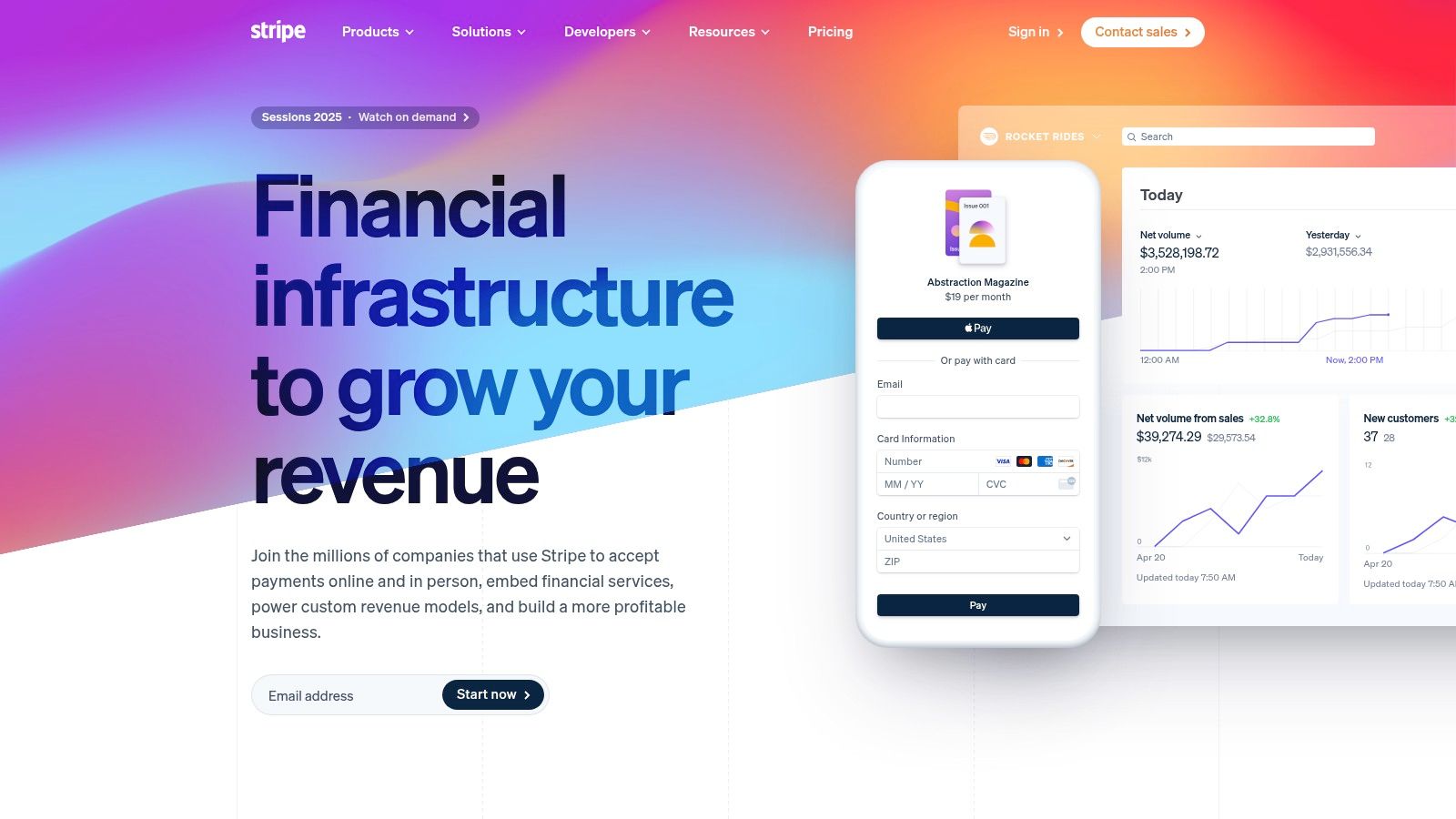
Unlike many platforms that simply bundle common payment options, Stripe provides a unified API to access everything from digital wallets like Apple Pay and Google Pay to local European methods like iDEAL and Giropay, plus direct debit systems like ACH. This developer-first approach allows businesses to activate new payment methods with just a few lines of code, adapting quickly to customer preferences in different markets without needing to integrate entirely new gateways. It’s an incredibly powerful and scalable system for SaaS, e-commerce, and platform businesses.
Key Features and Pricing
Stripe’s platform is known for its robust features and transparent, pay-as-you-go pricing model.
- Global Payment Methods: Natively supports over 135 currencies and dozens of payment methods, including digital wallets, bank debits, bank redirects, and "Buy Now, Pay Later" services like Klarna and Afterpay.
- Developer-Friendly API: Features world-class documentation, client libraries in multiple programming languages, and a comprehensive API that allows for deep customization of the checkout experience.
- Transparent Pricing: The standard fee for online card transactions is 2.9% + 30¢. ACH Direct Debit is priced at 0.8% with a $5.00 cap. There are no setup fees, monthly fees, or hidden costs for a standard account.
- Advanced Tools: Offers sophisticated products like Stripe Billing for recurring revenue, Radar for AI-powered fraud detection, and Connect for building multi-sided marketplaces.
Getting the Most Out of Stripe
To fully leverage Stripe, go beyond its basic payment processing. Use the Stripe Payment Element, a prebuilt UI component that dynamically displays the most relevant payment methods to each customer based on their location and device. This single integration can significantly boost conversion rates, especially in international markets.
Pro Tip: Dive into Stripe's extensive documentation to explore low-cost options like ACH Direct Debit for B2B transactions or recurring subscription payments. The lower percentage-based fee can lead to substantial savings on large-ticket invoices compared to standard card processing.
While implementing its more advanced features can require technical know-how, the platform's scalability and extensive support for alternative payment methods make it an unparalleled choice for ambitious businesses aiming for growth.
Website: https://stripe.com/
4. Klarna
Klarna has become a dominant force in the e-commerce landscape by popularizing the "Buy Now, Pay Later" (BNPL) model. It operates as one of the most effective alternative payment methods for merchants aiming to reduce friction at checkout and appeal to a generation of shoppers who prefer flexible financing over traditional credit. By allowing customers to split purchases into manageable, interest-free installments, Klarna directly addresses purchase hesitation tied to upfront costs, which can significantly increase conversion rates and average order value.
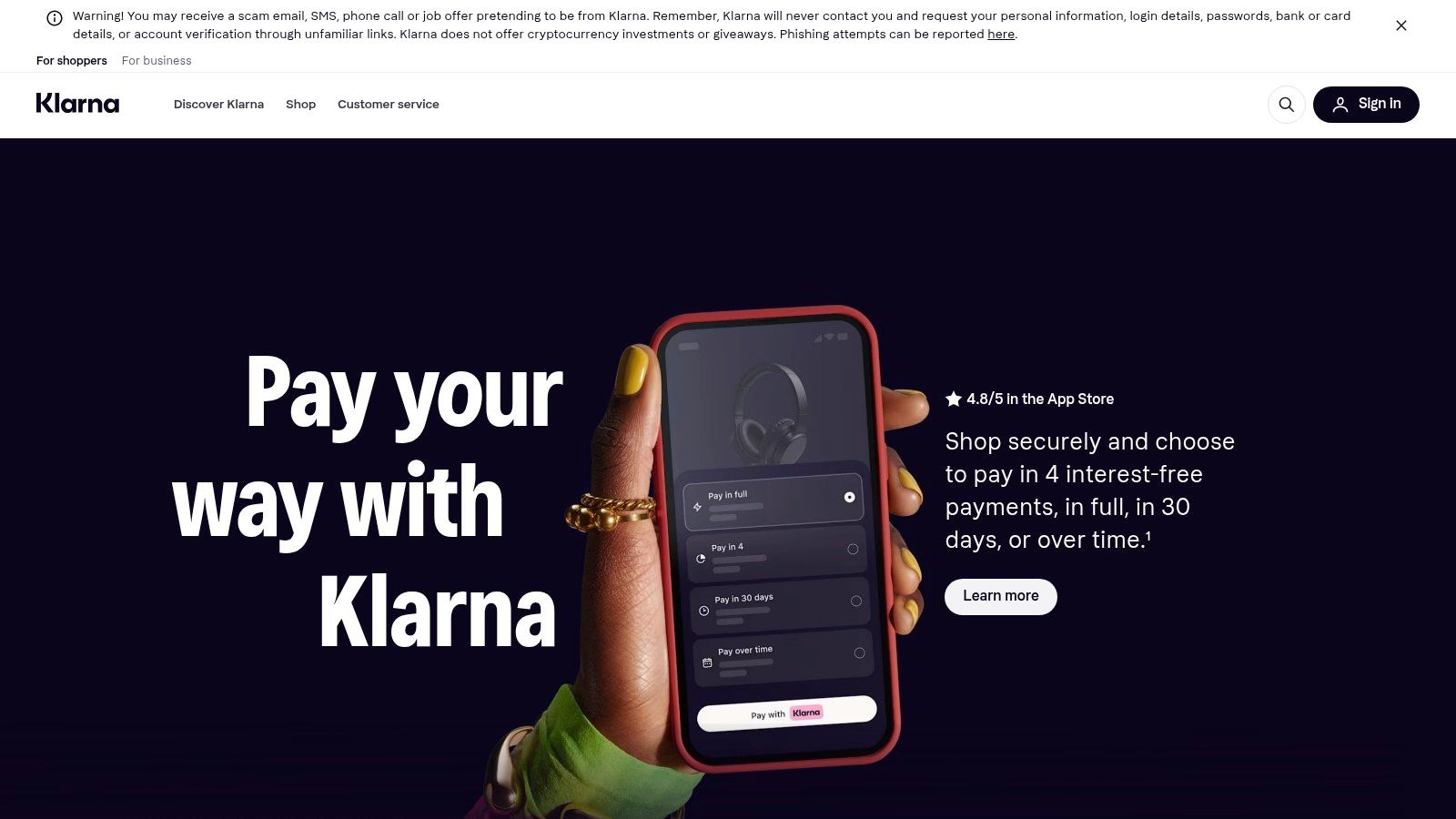
Unlike simple payment gateways, Klarna assumes the full credit and fraud risk, paying the merchant upfront and in full while handling the customer's payment schedule. This model provides immediate cash flow for the business and a seamless, modern financing experience for the consumer. Its smooth integration into major e-commerce platforms like Shopify, Magento, and BigCommerce makes it a powerful and accessible tool for online retailers of all sizes.
Key Features and Pricing
Klarna’s offerings are centered on providing customers with choice and flexibility, which in turn benefits the merchant.
- Flexible Payment Options: Offers several plans, including "Pay in 4" (four interest-free installments), "Pay in 30 days," and longer-term financing for larger purchases.
- Seamless Integration: Provides well-documented APIs and pre-built plugins for all major e-commerce platforms, ensuring a quick and easy setup.
- Merchant Protection: Merchants receive the full payment immediately, eliminating the risk of customer non-payment or fraud.
- Merchant Fees: Pricing is quote-based and varies by country, business volume, and the specific Klarna products used. Fees typically consist of a fixed transaction fee plus a variable percentage, generally ranging from 3.29% to 5.99% + 30¢ per transaction.
Getting the Most Out of Klarna
To maximize Klarna’s impact, promote it clearly on your product and checkout pages. Use the marketing assets Klarna provides to show customers that flexible payment options are available before they even add items to their cart. This can influence purchasing decisions early in the customer journey. Also, analyze which payment option ("Pay in 4" vs. "Pay in 30 days") is most popular with your audience and tailor your marketing messages accordingly.
Pro Tip: Leverage Klarna's global presence if you sell internationally. Its brand recognition and localized payment offerings can build trust and boost conversions in new markets where traditional credit card usage might be lower.
While transaction fees are higher than standard card payments, the proven lift in sales and average order value often provides a strong return on investment. Klarna is an essential option for consumer-focused brands looking to remove price as a barrier to purchase.
Website: https://www.klarna.com/
5. Adyen
Adyen operates as a sophisticated, global payment powerhouse built for large-scale and international businesses. Its core strength is its unified commerce platform, which consolidates online, mobile, and in-store payment processing into a single, cohesive system. This approach is particularly valuable for enterprise-level merchants that require a robust infrastructure to manage a high volume of transactions across multiple countries and currencies, offering a wide array of alternative payment methods from a single integration.
Unlike platforms geared toward small businesses, Adyen is engineered for complexity and scale. It supports over 250 local payment methods and 150 currencies, allowing businesses to offer familiar and trusted payment options to customers worldwide. This global reach, combined with advanced data analytics and fraud prevention tools, empowers companies to optimize payment authorization rates and create seamless customer experiences on a global scale.
Key Features and Pricing
Adyen's platform is designed for customization and performance, making it a preferred choice for large, multinational corporations.
- Unified Commerce: A single platform connects e-commerce, mobile, and physical point-of-sale transactions, providing a single source of customer and payment data.
- Global Payment Methods: Extensive support for international credit cards (Visa, Mastercard, Amex) and local options like iDEAL in the Netherlands, Boleto in Brazil, and Alipay in China.
- Interchange++ Pricing: Adyen uses a transparent Interchange++ model. This consists of the interchange fee, the card scheme fee, and Adyen’s processing fee, which varies by payment method (e.g., 0.60% for most credit cards). It has a minimum monthly invoice of €100 / $120.
- Advanced Fraud Protection: Leverages a data-driven risk management system called RevenueProtect to identify and block fraudulent transactions without impacting legitimate sales.
Getting the Most Out of Adyen
To fully leverage Adyen, businesses should focus on its international capabilities and data tools. Use the platform’s extensive reporting to analyze payment data by region, identifying which payment methods are most popular in specific markets. This insight allows you to tailor your checkout experience to local preferences, which can significantly boost conversion rates.
Pro Tip: Dive into Adyen’s "RevenueAccelerate" suite of tools. This feature uses data-driven logic to dynamically route transactions to the best-performing acquiring banks, automatically retry failed payments, and manage network tokenization to increase authorization rates and reduce processing costs.
While its complex setup and minimum invoice requirements make it unsuitable for small businesses, Adyen is an unparalleled solution for enterprises seeking a scalable, all-in-one partner for global payments.
Website: https://www.adyen.com/
6. Braintree
Braintree, a PayPal service, positions itself as a powerful, developer-centric payment gateway designed for businesses that demand flexibility and scalability. It excels at unifying a diverse array of alternative payment methods under a single integration, including exclusive access to PayPal and Venmo, alongside traditional cards and digital wallets. This makes it an exceptional choice for tech-savvy businesses and growing companies that need a customizable checkout experience without the complexity of managing multiple payment providers.
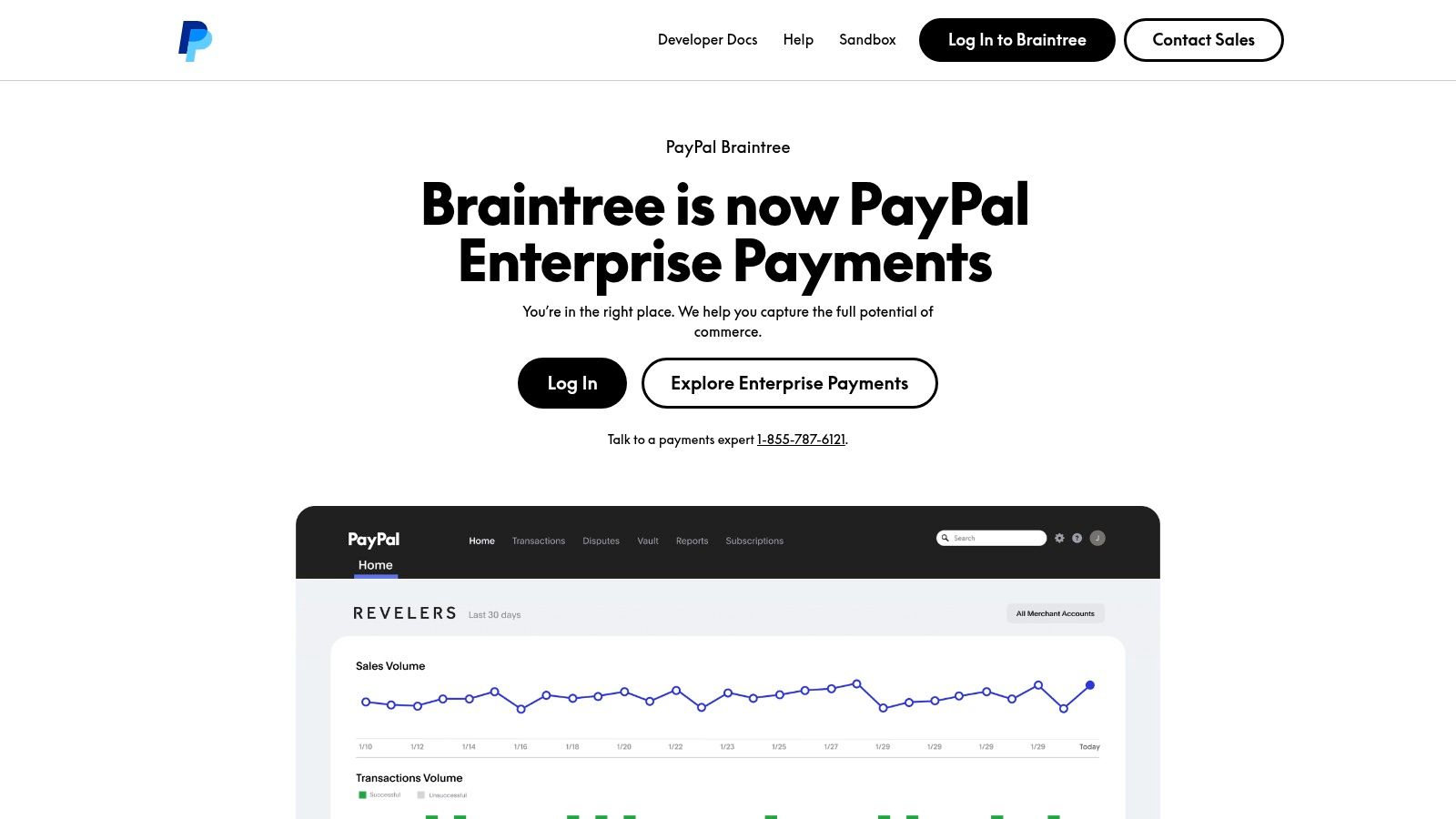
Unlike many all-in-one platforms, Braintree's strength is its unbundled, API-first approach. It provides merchants with the tools to build a completely bespoke payment flow tailored to their specific business model, from e-commerce to subscription services. This focus on customization, backed by PayPal's robust infrastructure, gives businesses the ability to offer a seamless user experience while leveraging advanced features like fraud protection and detailed analytics.
Key Features and Pricing
Braintree is built to support businesses as they scale, offering sophisticated tools with a straightforward pricing model.
- Diverse Payment Options: Accepts all major credit/debit cards, PayPal, Venmo, Apple Pay, and Google Pay, all through one integration.
- Developer-Friendly API: Features comprehensive APIs and extensive documentation (Braintree Direct, Braintree Extend, Braintree Marketplace) that allow for deep customization.
- Transparent Pricing: Standard pricing is a flat-rate 2.59% + 49¢ per transaction for cards and digital wallets. There are no monthly or setup fees for a standard account.
- Advanced Functionality: Includes built-in support for recurring billing, subscription management, advanced fraud protection tools, and detailed reporting capabilities.
Getting the Most Out of Braintree
To truly harness Braintree's power, lean into its customization capabilities. Use the API to create a frictionless, on-site checkout experience so customers never have to leave your website to complete a purchase. This reduces cart abandonment and builds trust. The integration with Venmo is a significant advantage, especially for businesses targeting younger demographics, so be sure to enable it and promote it as a payment option.
Pro Tip: Use Braintree's "3D Secure 2" feature. This adds an extra layer of authentication for card payments, which not only significantly reduces the risk of fraudulent chargebacks but may also help shift liability for certain fraudulent transactions from you to the card issuer.
While Braintree's developer-focused nature means it may require technical resources to implement fully, its scalability and comprehensive feature set are invaluable. It’s an ideal solution for businesses that have outgrown simpler platforms and need a robust, adaptable engine to power their global payment processing.
Website: https://www.braintreepayments.com/
7. Helcim
Helcim distinguishes itself in the crowded payment processing market with a commitment to transparency and affordability, specifically designed for small to medium-sized businesses. Its core philosophy revolves around an interchange-plus pricing model, which automatically provides volume-based discounts as a business grows. This approach ensures merchants get the fairest rates possible, making it a compelling choice for businesses wary of complex fee structures and hidden charges.
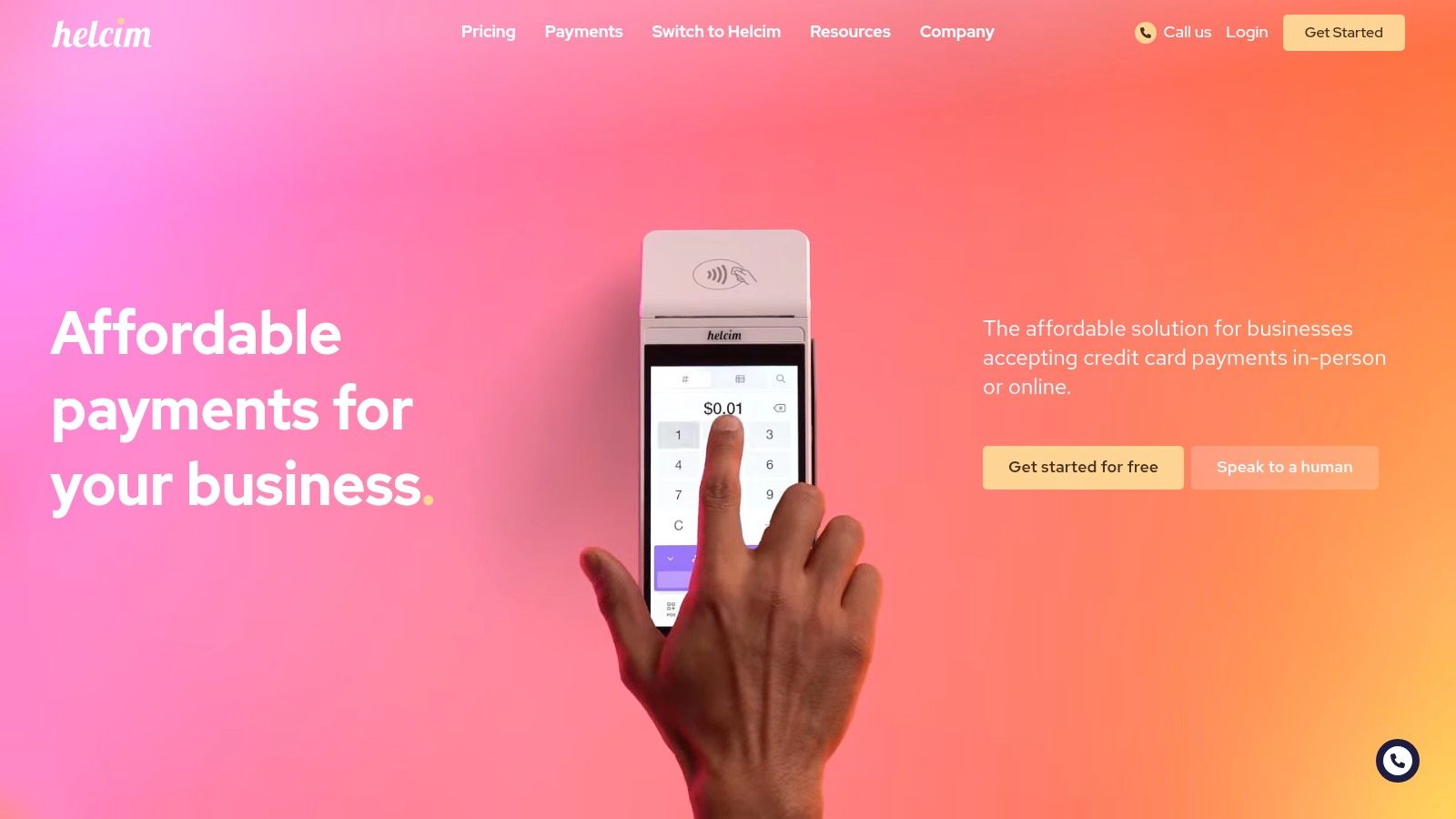
Unlike flat-rate processors, Helcim’s model can result in significant savings for businesses with higher transaction volumes. The platform supports a comprehensive range of alternative payment methods, including ACH bank transfers, alongside standard credit/debit cards and digital wallets. It offers an all-in-one ecosystem that includes point-of-sale systems, invoicing, recurring billing, and a user-friendly interface with detailed reporting, all without charging a monthly fee.
Key Features and Pricing
Helcim's platform is built to scale with your business, offering powerful features without the hefty price tag.
- Interchange-Plus Pricing: Helcim's transparent model passes the wholesale interchange cost directly to the merchant, plus a small, clearly stated margin. Rates automatically decrease as your processing volume increases. There are no monthly fees, setup fees, or cancellation penalties.
- Payment Versatility: Supports all major credit and debit cards, Google Pay, Apple Pay, and ACH direct debit for lower-cost transactions, ideal for B2B invoices or recurring subscriptions.
- Integrated Business Tools: Includes a free online store, invoicing, subscription management, customer relationship management (CRM) tools, and a virtual terminal at no extra cost.
- POS System: Offers proprietary hardware for in-person payments, including a smart terminal that syncs inventory and sales data across all channels.
Getting the Most Out of Helcim
Leverage Helcim’s built-in features to minimize costs and streamline operations. For recurring revenue streams, use the subscription management tool with the ACH payment option to drastically reduce transaction fees compared to credit cards. Regularly check your dashboard to monitor your processing volume, as you will automatically qualify for lower rates as your business scales.
Pro Tip: Take advantage of the "Helcim Fee Saver." This feature allows you to legally and automatically apply a surcharge to credit card transactions (where permitted) to cover your processing costs, effectively making card acceptance nearly free while still offering customers a no-fee debit option.
While Helcim requires using its proprietary hardware for in-person sales, its transparent, volume-based pricing and robust suite of free business management tools offer exceptional value. It's a top-tier solution for merchants seeking predictable costs and a scalable payment partner.
Website: https://www.helcim.com/
Alternative Payment Methods Comparison
| Solution | Implementation Complexity 🔄 | Resource Requirements ⚡ | Expected Outcomes 📊 | Ideal Use Cases 💡 | Key Advantages ⭐ |
|---|---|---|---|---|---|
| Flash | Low to moderate; no/low-code tools but some technical familiarity for advanced use | Moderate; requires Lightning Network setup and wallet integration | Instant, low-fee Bitcoin payments; enhanced privacy and security | Merchants wanting decentralized Bitcoin payments, startups & enterprises diversifying payment options | Non-custodial payments, instant Lightning Network transfers, no KYC, scalable infrastructure |
| Square | Low; user-friendly interface and quick setup | Low; basic accounts have no monthly fees and standard hardware | Reliable multi-method payments with good business management tools | Small to medium businesses needing easy online & in-person payments | Easy setup, integrated POS and e-commerce, transparent pricing |
| Stripe | High; developer-friendly with comprehensive API, requires technical expertise | Moderate to high; API integration and developer resources needed | Customizable, scalable payments with advanced fraud detection and analytics | Businesses requiring flexible custom payment solutions and global payment options | Highly customizable, extensive payment methods, subscription support |
| Klarna | Low to moderate; seamless e-commerce integration | Low to moderate; mostly software integration | Increased conversions via flexible financing; upfront merchant payment | E-commerce businesses focused on consumer financing and installment plans | Buy Now Pay Later options, increased sales, immediate merchant payment |
| Adyen | High; complex setup with technical expertise required | High; scalable infrastructure for large volumes | Global payments with fraud protection and detailed analytics | Enterprises with international transactions and high volume sales | Extensive payment methods, advanced security, global reach |
| Braintree | High; requires developer knowledge for custom APIs | Moderate to high; integration with PayPal, Venmo, and wallets | Flexible, scalable payments with security and subscription features | Businesses needing multi-channel payments with developer customization | Support for PayPal/Venmo, robust fraud tools, extensive APIs |
| Helcim | Low; straightforward for small/medium businesses but hardware purchase needed for in-person | Low to moderate; no monthly fees but some proprietary hardware | Cost-effective payment processing with transparent pricing and volume discounts | Small to medium businesses focusing on affordability and simplicity | Transparent interchange-plus pricing, no monthly fees, strong customer support |
Choosing the Right Payment Mix for Your Business Growth
Navigating the landscape of alternative payment methods can feel complex, but making the right choices is a powerful lever for business growth. Throughout this guide, we've dissected a range of powerful tools, from comprehensive platforms like Stripe and Adyen to specialized solutions like Klarna and the decentralized, innovative Flash. The central theme is clear: the monolithic, one-size-fits-all payment gateway is a relic of the past. Today’s most successful businesses curate a flexible, strategic payment stack tailored to their unique audience and operational needs.
Your journey doesn't end with simply picking a provider. It begins with a deep understanding of your customer. Are they young, mobile-first shoppers drawn to the flexibility of Buy Now, Pay Later? Are they international clients who prefer local bank transfers? Or are they part of a growing, tech-savvy demographic that values the privacy, speed, and low costs of decentralized options like Bitcoin payments facilitated by Flash? Answering these questions is the first step toward building a frictionless checkout experience that boosts conversions.
Key Factors for Your Final Decision
As you move from evaluation to implementation, keep these critical factors at the forefront of your strategy. This isn't just about accepting payments; it's about optimizing your entire commercial operation.
- Customer Experience: Prioritize methods that your target demographic already knows and trusts. A familiar payment option can be the deciding factor between a completed sale and an abandoned cart.
- Transaction Costs: Look beyond the surface-level percentage fee. Consider all associated costs, including monthly fees, chargeback penalties, and cross-border transaction surcharges. This is an area where alternative payment methods like crypto can offer significant savings.
- Scalability and Integration: Choose solutions that can grow with you. A platform like Adyen or a versatile API from Braintree might be perfect for global expansion, while a simple, lightweight integration like Flash is ideal for merchants wanting to add a new-age payment rail without overhauling their existing system.
- Security and Compliance: Ensure any provider you select adheres to the highest security standards, like PCI DSS compliance. For those venturing into crypto, solutions that offer robust security without holding your private keys are paramount.
Ultimately, the goal is to create a seamless, secure, and inclusive payment ecosystem. By strategically combining traditional card processors with a thoughtful selection of alternative payment methods, you empower your customers with choice. This not-only enhances their experience but also positions your business as a forward-thinking, adaptable, and customer-centric brand ready for the future of commerce.
Ready to step into the future of payments with a solution built for speed, security, and global reach? Explore how Flash can help you accept Bitcoin and other digital currencies seamlessly, reducing your transaction fees and delighting a new generation of customers. Visit Flash to see how easy it is to add this powerful alternative payment method to your checkout.