Bitcoin payment APIs, powered by the Lightning Network, are transforming how businesses handle transactions. Here's what makes them stand out:
- Fast Transactions: Payments settle in under a second, unlike Bitcoin's usual 10-minute confirmation time.
- Low Fees: Transaction costs are fractions of a cent, ideal for high volumes or micropayments.
- Global Reach: Access over 400 million Bitcoin users without currency conversion or banking restrictions.
- Non-Custodial Security: Funds move directly between wallets, reducing risks and eliminating intermediaries.
- Easy Integration: No-code/low-code APIs make adding Bitcoin payments simple, even for non-technical teams.
The Lightning Network enhances scalability, enabling millions of transactions per second with minimal fees. Businesses can use APIs for features like payment links, subscriptions, and point-of-sale systems. While regulatory compliance and Bitcoin's price volatility pose challenges, solutions like Flash offer tools to simplify adoption, improve cash flow, and expand global sales.
Quick Overview:
| Feature | Bitcoin Payment APIs (Lightning Network) | Credit Cards/ACH |
|---|---|---|
| Speed | <1 second | Hours to days |
| Fees | Fractions of a cent | 1–3% |
| Global Access | Borderless | Limited |
| Chargebacks | None | Possible |
Bitcoin APIs are reshaping digital payments by offering speed, cost efficiency, and direct wallet-to-wallet transfers. Businesses ready to embrace these solutions can gain a competitive edge in the evolving payment landscape.
Lightning Network and API Technology
How the Lightning Network Works
The Lightning Network enables fast, private transactions using bidirectional channels between two parties. Here's how it works: both parties deposit funds into a shared multi-signature wallet, which acts as a joint account. Transactions happen off-chain, with each one updating the balance in the wallet. These updates are validated using smart contracts, ensuring security and accuracy.
This setup offers impressive speed and cost advantages. The Lightning Network can handle millions of transactions per second, far surpassing Bitcoin's base layer. Fees are reduced to fractions of a cent, and payments settle almost instantly - no more waiting 10 minutes for confirmation.
When users decide to close a channel, the final balance is settled on the blockchain. Payments can also flow through interconnected channels, making the system highly efficient. This structure creates an ideal environment for APIs to connect businesses to these rapid payment pathways.
APIs Connect Businesses to the Lightning Network
APIs help simplify the complex operations of the Lightning Network, giving businesses easy-to-use tools to manage channels, process payments, and handle transactions. With these interfaces, companies can integrate Lightning payments into e-commerce platforms, mobile apps, and even point-of-sale systems - no deep blockchain expertise required.
Take Flash, for example. They provide no-code solutions and custom integrations, complete with detailed documentation. Their tools include payment links, paywalls, subscription models, widgets, and point-of-sale systems. By leveraging the Lightning Network’s speed and low fees, Flash enables businesses to process instant Bitcoin payments directly between wallets. Along with seamless integration, security remains a top priority.
Security and Compliance Requirements
Ensuring secure transactions is crucial for businesses using API-driven Lightning solutions. A key focus is the use of non-custodial wallet architectures, where users retain full control of their private keys. This approach reduces counterparty risks since payment providers don’t hold customer funds. Transactions are further safeguarded by encryption protocols, requiring authorization from both parties for any transfer of funds.
Flash emphasizes this non-custodial model, ensuring they never hold customer funds and even bypassing KYC requirements for merchants.
API providers must also implement strong authentication and encryption measures to secure access. Smart contracts play a vital role in protecting transaction data and preventing issues like fraud or double-spending. Regular security audits help identify and fix vulnerabilities, ensuring the system remains reliable.
For U.S.-based businesses, compliance with regulations like Know Your Customer (KYC) and Anti-Money Laundering (AML) laws is essential. While non-custodial solutions reduce some regulatory burdens by avoiding fund custody, companies still need to meet federal and state legal requirements.
Bitcoin Payment API Features for Businesses
Instant Settlement and Low Fees
Bitcoin payment APIs powered by the Lightning Network offer lightning-fast transaction speeds - literally under a second - and fees so low they’re almost negligible. This is a game-changer compared to Bitcoin's usual 10-minute settlement time. Businesses dealing with high transaction volumes or handling micropayments stand to benefit the most. For instance, Lightning payments with just one hop boast a success rate of over 99%. However, each additional hop can lower that rate by 4–8%. For companies processing thousands of transactions daily, these features mean smoother cash flow and significantly reduced operational costs. Unlike traditional payment processors, which often charge hefty fees, Lightning's tiny transaction costs make even micropayments practical - opening up new revenue streams and expanding payment possibilities.
Multiple Payment Solution Types
Top-tier Bitcoin payment APIs are designed to support a variety of business models with flexible solutions. These include tools like payment links for invoicing, paywalls for monetizing digital content, subscription management for recurring payments, point-of-sale systems for brick-and-mortar retail, and widgets for seamless website integration.
For example, point-of-sale systems enable in-person Bitcoin payments using mobile devices or tablets. They come equipped with features like QR code generation and real-time exchange rate updates, making them perfect for physical retail settings. On the other hand, widgets provide businesses with an easy way to integrate Bitcoin payments into websites or mobile apps, requiring little to no coding expertise.
Flash simplifies this process by offering all these options through a single API platform. Whether you’re a small retailer or a large enterprise, Flash’s solutions can be set up in as little as one minute, making Bitcoin payments accessible and efficient.
Custom Integrations and Analytics
Beyond basic payment solutions, advanced Bitcoin payment APIs empower businesses with customization and insightful analytics. These APIs allow for tailored checkout experiences, enabling companies to embed Bitcoin payments directly into their e-commerce platforms, mobile apps, or internal systems.
For businesses without technical expertise, no-code and low-code tools make integration straightforward. Pre-built templates and drag-and-drop interfaces ensure that even non-technical teams can get Bitcoin payments up and running quickly.
What sets enterprise-grade APIs apart is their advanced analytics. Real-time dashboards provide a wealth of data, including transaction volumes, settlement times, fee breakdowns, and user behavior trends. These insights help businesses fine-tune their payment processes, spot trends, and make informed decisions about their Bitcoin payment strategies. Features like geographic transaction mapping, user payment preferences, and conversion rate tracking are especially valuable for companies looking to expand internationally. Plus, the ability to integrate Bitcoin payment data with broader business intelligence systems ensures a seamless flow of information across the organization.
Business Benefits and Challenges
Benefits for Enterprises
API-driven Bitcoin payments offer U.S. businesses a major advantage: speed. Transactions settle in milliseconds to seconds, compared to the typical 1–3 business days required for traditional methods. This rapid settlement improves cash flow, making it easier for businesses to cover critical expenses like inventory or payroll. Plus, faster access to funds opens up opportunities for reinvestment almost immediately.
Another game-changer is the global reach. U.S. enterprises can tap into a worldwide network of over 400 million Bitcoin users without worrying about currency conversions or dealing with international banking restrictions. With the Lightning Network, transactions typically finalize in under a second, and operational costs are slashed - especially compared to the 1–3% fees associated with credit card payments.
Operationally, things become simpler too. Non-custodial wallet-to-wallet payments cut out intermediaries, reducing potential points of failure. On top of that, quick API integrations lower the technical hurdles that might otherwise slow down adoption.
Still, while the benefits are clear, U.S. businesses must also address the challenges that come with implementing API-driven Bitcoin payments.
Implementation Challenges
One of the biggest hurdles is regulatory compliance. U.S. companies must navigate complex rules around anti-money laundering (AML), know-your-customer (KYC) protocols, and cryptocurrency tax reporting. Staying up to date with guidance from authorities like FinCEN and the SEC is essential but can be daunting.
Managing liquidity and payment channels on the Lightning Network presents another challenge. Each additional "hop" in a transaction can reduce success rates by 4–8%. Balancing user privacy with robust security measures is also critical. While off-chain processing on the Lightning Network offers enhanced privacy, businesses need strong safeguards to prevent hacks and protect customer data. And since Bitcoin transactions are irreversible, errors can be costly - there's no chargeback safety net.
Price volatility is another concern. Bitcoin's fluctuating value can complicate business planning and accounting. To mitigate this, companies may need strategies like immediate conversion to stable currencies or hedging against currency risk.
Bitcoin APIs vs Traditional Payment Methods
The pros and cons of API-driven Bitcoin payments become even clearer when compared to traditional payment systems.
| Feature | API-Driven Bitcoin Payments (Lightning Network) | Traditional Payment Methods (Credit Card, ACH, Wire) |
|---|---|---|
| Transaction Speed | Milliseconds to seconds | Hours to days |
| Settlement | Instant | 1–3 business days |
| Transaction Fees | Fractions of a cent | 1–3% for cards; flat fees for wires |
| Global Reach | Borderless, 24/7 availability | Limited by banking networks; currency conversion required |
| Privacy | Enhanced (off-chain transactions) | Limited (extensive bank/card records) |
| Chargebacks | Not possible (irreversible) | Possible, creating fraud risk |
| Scalability | Millions of transactions per second (theoretical) | Limited by network capacity |
| Regulatory Compliance | Evolving; requires specialized knowledge | Well-established; standardized processes |
| Integration Complexity | Moderate (API setup and wallet management) | Low to moderate (leveraging existing infrastructure) |
| Volatility Risk | Yes (Bitcoin price fluctuations) | No currency risk for domestic transactions |
The Lightning Network stands out with its ability to handle millions of transactions per second and boasts a success rate of over 99% for single-hop payments. However, these benefits come with added complexity. Businesses need specialized expertise to manage the technical demands and navigate the ever-changing cryptocurrency landscape effectively.
sbb-itb-f81ab9b
Flash API Solutions for Bitcoin Payments
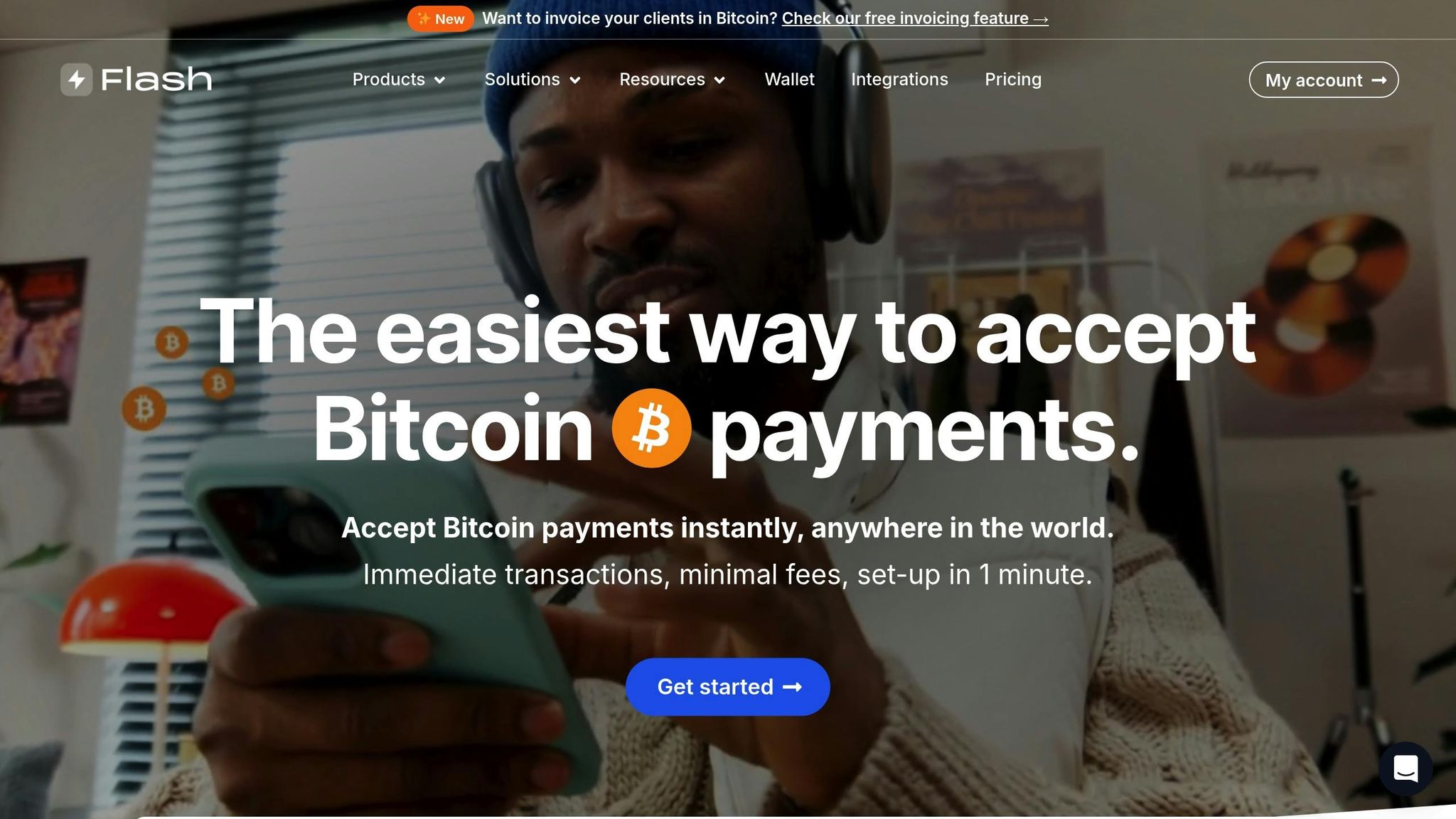
Flash Platform Features
Flash simplifies Bitcoin payments for U.S. businesses by leveraging Lightning API integrations. Using the Lightning Network, the platform enables instant, low-cost Bitcoin transactions while maintaining a non-custodial design. This approach allows businesses to connect wallets directly and retain full control over their funds.
The platform offers a variety of payment solutions tailored to different needs, including:
- Payment links for generating instant Bitcoin invoices
- Paywalls to monetize digital content
- Subscription systems for recurring billing
- Widgets for seamless integration into websites and e-commerce platforms
- Point-of-sale systems for accepting Bitcoin payments in physical stores
For businesses seeking customized solutions, Flash provides API integrations with features like RESTful calls, webhook notifications, and sandbox testing. The setup process is designed to be quick and user-friendly, with no-code and low-code options enabling merchants to get started in under a minute. This ease of implementation lowers the technical hurdles that often discourage cryptocurrency adoption.
Benefits for U.S. Businesses
Flash opens the door for U.S. businesses to tap into a global network of over 400 million Bitcoin users. Transactions settle in less than a second, with fees costing just a fraction of a cent - dramatically cutting both processing times and costs.
The wallet-to-wallet payment model eliminates the need for intermediaries, reducing counterparty risks and potential system failures. Flash also simplifies onboarding by removing KYC requirements for merchants, which minimizes compliance burdens. With a 99% success rate for single-hop payments, the platform delivers a highly reliable solution.
Security is a top priority for Flash. Its non-custodial wallet setup ensures businesses maintain control over their funds, while encrypted API communications provide an extra layer of protection. Additionally, the irreversible nature of Bitcoin transactions helps businesses avoid chargeback fraud, a persistent issue with traditional payment methods.
Flash Implementation Results
Merchants in the U.S. have seen impressive outcomes after implementing Flash. Many report a 30% increase in international sales and up to a 90% reduction in transaction fees. Immediate settlements also improve cash flow, offering a financial advantage over conventional payment systems.
Flash provides businesses with analytics dashboards and API endpoints to monitor transaction metrics such as volumes, settlement times, customer behavior, and fee structures. These tools allow companies to refine their payment strategies based on real-time data.
The platform’s modular design supports gradual adoption. Businesses can start small with payment links, then expand to full API integrations as transaction volumes grow and confidence in the system builds. To ensure a smooth implementation, Flash offers onboarding assistance, intuitive interfaces, and compliance tools tailored to U.S. regulations.
Looking ahead, Flash plans to expand its cryptocurrency offerings, enhance analytics with AI-driven insights, and introduce advanced fraud detection tools. These ongoing developments highlight its commitment to evolving alongside the needs of businesses, further cementing its role in advancing Bitcoin payment solutions.
The Future of Bitcoin Payment APIs
Main Points Summary
Bitcoin payment APIs, powered by the Lightning Network, have drastically improved transaction speeds - payments now settle in under one second, compared to the traditional 10-minute wait for on-chain transactions.
These APIs have also simplified Bitcoin adoption by removing technical barriers. Today, no-code and low-code platforms allow businesses to integrate Bitcoin payments in just minutes, giving them access to a global audience of over 400 million Bitcoin users. Non-custodial transactions ensure businesses retain full control of their funds through direct wallet-to-wallet payments, reducing both counterparty risks and potential points of failure.
Another major benefit is cost savings. While traditional payment methods often charge fees of several percentage points, Lightning-powered APIs enable transactions for mere fractions of a cent. Instant settlements further enhance cash flow, making Bitcoin payments an attractive option for businesses.
Looking ahead, the next generation of Bitcoin payment APIs is set to build on these advancements, refining and expanding their capabilities.
What's Next for Bitcoin Payment APIs
As businesses take advantage of the efficiencies offered by current APIs, ongoing advancements promise to deliver even more. The Lightning Network itself is evolving, with updates like enhanced privacy features and improved routing algorithms making payment channels even more efficient. Developers are also introducing payment retries and optimized channel strategies to improve success rates for multi-hop payments.
New innovations, such as cross-chain atomic swaps and greater interoperability with other blockchain networks, are set to expand payment possibilities. These advancements will create seamless connections between different digital asset ecosystems, paving the way for broader adoption.
Institutional interest is growing rapidly. Financial institutions and payment processors are exploring Bitcoin APIs to gain a competitive edge in global remittance and transaction processing. The Lightning Network’s reliance on native Bitcoin tokens is particularly appealing to enterprises that wish to avoid the complexities of tokenomics associated with other cryptocurrencies.
The negligible transaction fees enabled by the Lightning Network are also unlocking exciting possibilities for streaming payments and micropayments. This opens up new opportunities for creators, developers, and businesses looking to innovate in these areas.
On the regulatory front, the emergence of clearer standards and better compliance tools is encouraging more traditional businesses to adopt Bitcoin payment solutions. As the regulatory environment matures, it is expected to fuel further innovation and investment in Bitcoin APIs.
Platforms like Flash are already leveraging these advancements to deliver practical, enterprise-ready solutions. With the continued evolution of API technology and the efficiency of the Lightning Network, Bitcoin payments are poised to become a standard feature in global commerce. What was once experimental technology is now a practical tool delivering tangible benefits for businesses ready to embrace the future of digital payments.
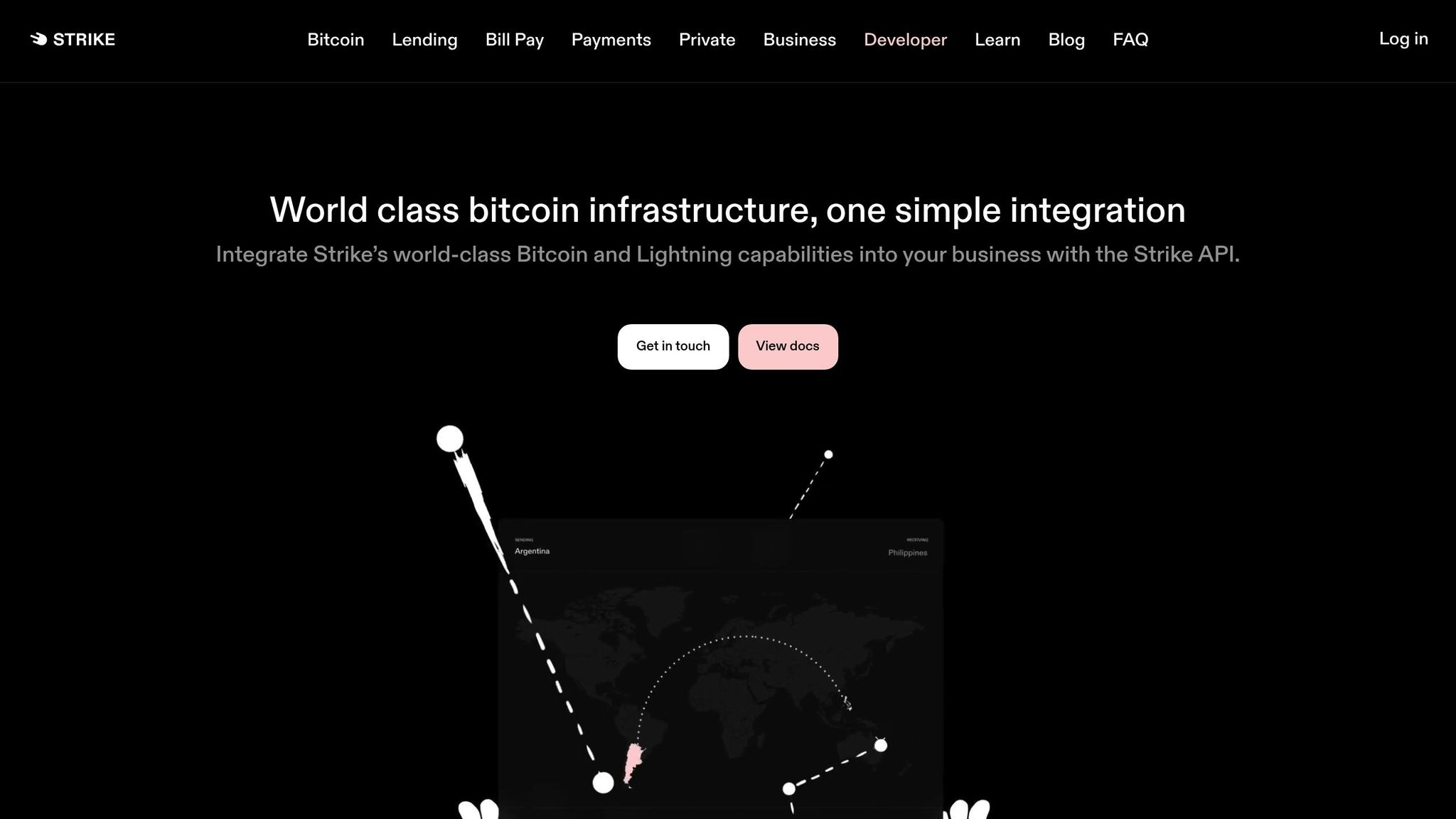
Jack Mallers' Strike API: Integrate Lightning payments into your React App.
FAQs
How does the Lightning Network keep Bitcoin payments secure and private?
The Lightning Network leverages cutting-edge cryptographic methods and secure payment channels to safeguard Bitcoin transactions. By processing transactions off-chain, it enables payments to be completed quickly and privately, while still being finalized on the main blockchain without revealing sensitive information.
Thanks to its decentralized structure, it minimizes the risk of fraud and unauthorized access, offering a trustworthy way to handle instant and secure Bitcoin payments.
What advantages do Bitcoin payment APIs offer businesses compared to traditional payment methods?
Bitcoin payment APIs come with several standout benefits that set them apart from traditional payment methods. For starters, transactions are processed instantly, with immediate settlement - no waiting around for bank processing delays. This means businesses can enjoy quicker cash flow and smoother operations.
Another big plus? Lower transaction fees. By cutting out intermediaries, these APIs keep costs minimal. They also make global transactions a breeze, eliminating the hassle of currency conversion and opening the door to customers from all over the world.
Incorporating Bitcoin payment APIs into your business not only simplifies payment handling but also makes it easier to thrive in an international marketplace.
What steps can businesses take to navigate regulatory challenges when using Bitcoin payment APIs?
To tackle regulatory challenges effectively, businesses should establish robust KYC (Know Your Customer) and AML (Anti-Money Laundering) processes to stay compliant. Keeping up with changing regulations and seeking advice from legal experts can further reduce potential risks. Moreover, leveraging platforms built with security and compliance as priorities can streamline operations while fostering trust and clarity in Bitcoin transactions.