Non-custodial payment systems give you full control over your funds by eliminating middlemen. They allow wallet-to-wallet transactions, ensuring your payments go directly to your digital wallet. This approach is growing in popularity, especially as businesses seek secure, cost-effective, and flexible payment solutions. Here's what you need to know:
- Direct control over funds: You hold your private keys, reducing risks like account freezes or third-party breaches.
- Lower costs: Skip traditional payment processor fees (1.5%–3.5%) with near-zero transaction costs.
- Enhanced security: No centralized points of failure; private keys ensure only you control your funds.
- Global reach: Accept payments worldwide without restrictions or high fees.
- Simple integration: Use APIs, plugins, and tools to customize payment processes for your business.
Non-custodial systems are redefining payment processing by offering better security, reduced costs, and global accessibility - all while putting businesses in charge of their financial operations.
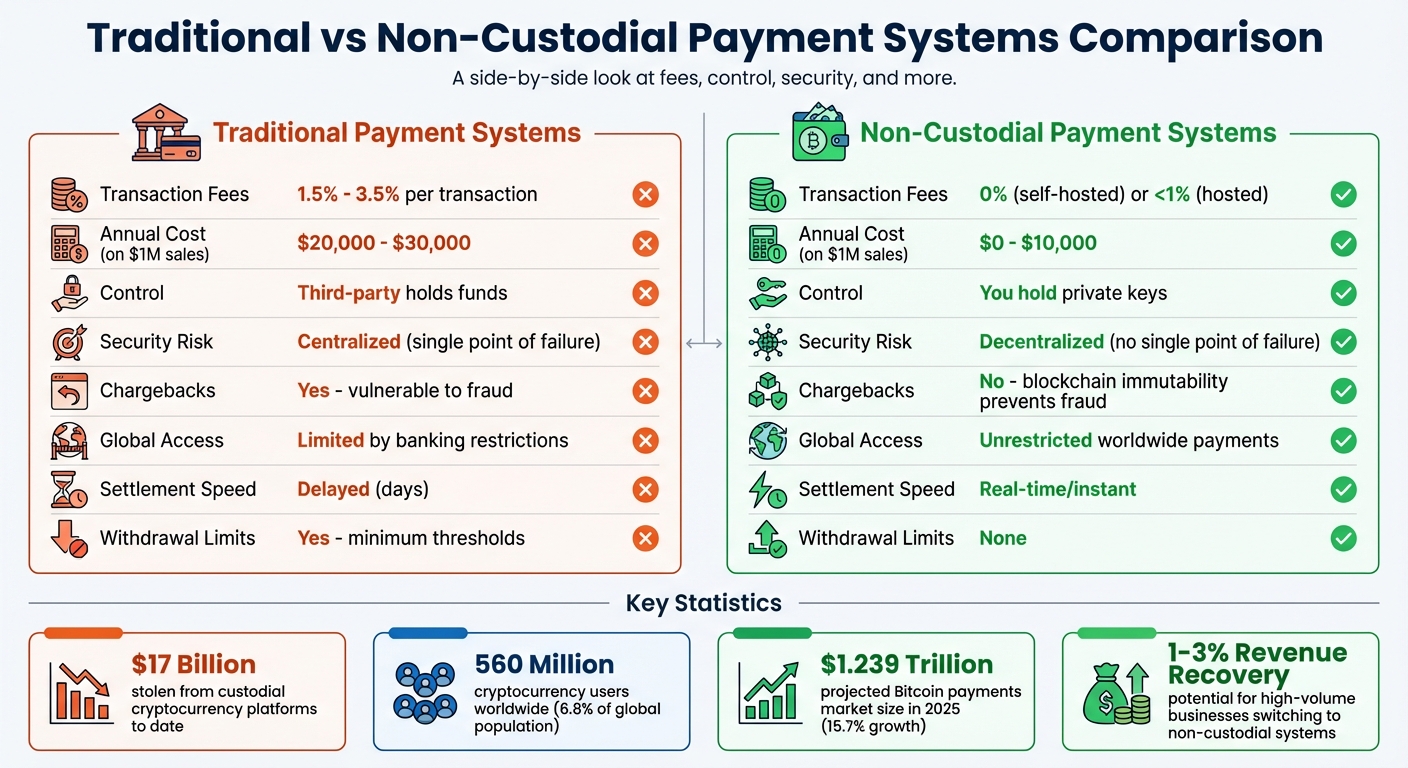
Traditional vs Non-Custodial Payment Systems: Cost and Feature Comparison
1. Direct Control Over Your Funds
Using a non-custodial system means you hold the private keys that secure and give access to your funds. In simpler terms, your business becomes the sole owner of its assets, with no bank or payment processor acting as a middleman. Without those private keys, you're essentially left with just a promise of access - not the assets themselves.
This direct ownership offers more than just peace of mind. It eliminates the risk of a third party freezing, seizing, or restricting access to your capital. Since you interact directly with the blockchain network, you bypass intermediaries, reducing both costs and potential vulnerabilities.
The growing popularity of self-custody is partly driven by high-profile security breaches in custodial systems, highlighting the importance of keeping control in your hands. However, this approach does come with a responsibility: it demands strong security measures to safeguard your digital assets.
Operationally, the benefits are hard to ignore. Transactions settle in real time, meaning funds are transferred directly to your wallet without delay. This immediate access to capital showcases the practical strength of self-custody. As Pierre Corbin, CEO of Flash, explains:
"Flash 2.0 is not just about making Bitcoin payments easier - it's about building the infrastructure for a decentralized financial future. Businesses that embrace this shift today will be the pioneers of tomorrow."
2. Lower Costs and Minimal Transaction Fees
Traditional payment processors often charge between 1.5% and 3.5% per transaction, with even higher costs for international transfers. For businesses generating $1 million in sales, these fees can add up to a hefty $20,000–$30,000 in expenses. Non-custodial systems, however, cut out intermediaries entirely by enabling direct wallet-to-wallet payments, resulting in much leaner transaction costs.
With self-hosted solutions, businesses can operate at 0% transaction fees, while hosted gateways typically charge less than 1%. For instance, Flash provides a non-custodial Bitcoin payment gateway with minimal fees, allowing businesses to accept global payments without the added costs associated with custodial platforms. This streamlined approach not only reduces overhead but also ensures businesses maintain full control over their funds - a key benefit of self-custody.
Beyond just saving on fees, non-custodial systems bring additional advantages. They eliminate chargeback fraud thanks to the irreversible nature of blockchain transactions and avoid issues like withdrawal delays or minimum payout thresholds.
For high-volume businesses, these savings can be game-changing, potentially recovering 1–3% of revenue that would otherwise be lost to processing fees. This shift transforms payment processing from a costly necessity into an operational advantage. Industries with tight margins, such as e-commerce and iGaming, stand to gain the most, as every percentage saved directly boosts profitability.
3. Better Security Through Private Key Management
Managing your private keys eliminates the risk of a centralized single point of failure. To date, over $17 billion has been stolen from cryptocurrency platforms, with most breaches targeting custodial entities. A single breach in these systems can compromise a massive number of users' funds. By contrast, when a service doesn’t store your private keys, your assets remain secure - even if the platform itself is breached.
Private keys, which are alphanumeric sequences ranging from 25 to 36 characters, serve as proof of ownership. With end-to-end encryption, only you have access to your keys. As Andreas Antonopoulos aptly put it: "Not your keys, not your coins". Non-custodial platforms build on this secure foundation by integrating advanced protocols to further safeguard your assets.
Take Flash’s non-custodial Bitcoin payment gateway, for example. It uses the Extended Public Key (xPub) protocol. This protocol allows the system to create new deposit addresses and monitor blockchain transactions without ever being able to access or spend your funds. This setup enables businesses to accept Bitcoin payments worldwide while maintaining full control over their assets.
To bolster security even more, consider these measures:
- Use multi-signature (multisig) setups: Transactions require approvals from multiple private keys, adding an extra layer of protection.
- Avoid hardcoding API keys: Instead, rely on environment variables to secure your credentials.
- Store recovery seed phrases safely: Write your 12- to 24-word recovery phrase on paper and keep it in a fireproof, waterproof safe. Never store it digitally.
These practices ensure that your private keys - and, by extension, your funds - remain secure under all circumstances.
sbb-itb-f81ab9b
4. Accept Payments From Anywhere in the World
Non-custodial Bitcoin payment systems break down the barriers traditional banking often puts in place. With Bitcoin, there’s no need to deal with slow international wire transfers or banks rejecting transactions from certain countries. Payments move directly from your customer’s wallet to yours, whether they’re in Tokyo, Toronto, or Timbuktu. This approach not only speeds up transactions but also simplifies global business operations.
As of 2024, there are over 560 million cryptocurrency users worldwide, accounting for about 6.8% of the global population. The Bitcoin payments market is expected to grow from $1.071 trillion in 2024 to $1.239 trillion in 2025, reflecting a 15.7% annual growth rate. This is no longer a niche - it’s a massive, international customer base ready to transact.
Beyond opening up new markets, Bitcoin payments can help businesses recover revenue lost to traditional fees. Payment processors typically charge 1.5% to 3.5% per transaction and often limit which countries you can serve. In contrast, non-custodial gateways like Flash charge 0% in core processing fees. For large enterprises, this can mean reclaiming 1% to 3% of gross revenue that would otherwise go to processing fees. The Lightning Network takes it a step further, enabling near-instant settlements with very low fees.
Here’s how this creates even more opportunities:
"Bitcoin is a global currency, and with Flash, you can accept payments from anywhere in the world. There are no restrictions or complications with currency conversions, giving your business access to a truly international market." - Olivia Carter, Marketing and Bitcoin Expert, Flash
Flash’s non-custodial Bitcoin gateway expands global access through tools like payment links, subscriptions, widgets, point-of-sale systems, and custom integrations. With instant transactions that bypass intermediaries and regulatory delays, businesses can tap into markets with high crypto adoption but limited access to credit cards. It’s a gateway to new customers and untapped revenue streams.
5. Easy Integration and Custom Configuration
Setting up a non-custodial payment system doesn’t mean overhauling your existing infrastructure. Many platforms come with pre-built plugins for popular e-commerce platforms, making it possible to start accepting Bitcoin payments in just a few minutes. If your setup is custom-built, REST APIs offer the flexibility to integrate features like payment requests, subscriptions, and paywalls directly into your backend. This straightforward approach makes it easy to create payment configurations that fit your business needs.
Customization options make managing payments even smoother. For instance, you can automate invoice callbacks to confirm payments, design custom billing flows for subscription services, or even split incoming payments automatically. Imagine routing 30% of a payment to suppliers, 20% to yield-bearing DeFi protocols, and 50% to cold storage - all without manual intervention.
For businesses that want complete control, self-hosting is a game-changer. Platforms like SHKeeper allow you to run payment software on your own servers. This gives you full control over everything - payment logic, interface, and integrations. Even if your gateway provider shuts down, your payment system stays operational because you’re in charge.
Handling high transaction volumes? Scalable APIs make mass payouts and multi-chain compatibility a breeze, supporting assets like BTC, ETH, and USDT. From installation to deployment, the process is seamless: set up your platform, configure wallet API keys, integrate plugins into your CMS, and test everything in a sandbox environment before going live.
"Test API keys allow safe experimentation before live deployment."
– Olivia Carter, Marketing and Bitcoin Expert
Conclusion
Customizable non-custodial payment systems bring a powerful mix of control, cost savings, security, and global accessibility to the table.
With these systems, users gain direct control over their funds by holding their own private keys, eliminating the risks tied to centralized custodians. This independence means no reliance on banks or intermediaries for approvals. For businesses, skipping traditional payment processors translates to lower fees and faster transaction settlements.
The security advantages are just as compelling. Blockchain's immutable nature prevents chargeback fraud, sparing merchants from the headaches and financial losses of disputed payments. Additionally, features like end-to-end encryption and recovery seed phrases ensure funds remain secure and accessible, even if a service provider shuts down.
On the global stage, wallet-to-wallet transactions allow businesses to scale effortlessly. They bypass currency conversion fees and banking restrictions, making cross-border payments smoother than ever. Whether handling micropayments via the Lightning Network or managing large-scale payouts across multiple blockchains, modern APIs simplify integration.
As Pierre Corbin, CEO of Flash, puts it:
"Flash 2.0 is not just about making Bitcoin payments easier - it's about building the infrastructure for a decentralized financial future. Businesses that embrace this shift today will be the pioneers of tomorrow".
FAQs
How do non-custodial payment systems improve security over traditional payment methods?
Non-custodial payment systems put security in the hands of the users by allowing them to maintain full control over their funds. Instead of depending on third parties, users handle their private keys themselves, ensuring that access to their wallets remains exclusively theirs.
This approach removes risks like account freezing or improper handling of funds that can arise with intermediaries. Transactions are conducted directly between wallets, which helps minimize exposure to potential vulnerabilities and offers better privacy.
What are the cost benefits of using non-custodial payment systems for businesses?
Non-custodial payment systems help businesses cut costs by offering transaction fees that are usually under 1%. That’s a big difference compared to the 3–5% fees charged by traditional payment processors. These systems also skip the need for intermediaries, enabling direct wallet-to-wallet payments.
With lower fees and no third-party involvement, businesses can boost their profit margins while ensuring transactions remain secure and efficient.
How can businesses easily integrate non-custodial payment systems into their current setup?
Businesses can easily incorporate non-custodial payment systems like Flash into their operations using the platform's user-friendly tools. Flash provides plugins for popular e-commerce platforms such as WooCommerce, Shopify, and Wix, allowing for quick integration without requiring advanced coding skills.
For those with more complex needs, Flash supports webhooks, enabling automated payment confirmations and tailored payment experiences. Additionally, the platform offers no-code and low-code solutions, such as payment links and widgets, so businesses can start accepting Bitcoin payments almost immediately.
With direct wallet-to-wallet transactions, Flash eliminates intermediaries, giving businesses complete control over their funds. This approach ensures not only security and efficiency but also the ability to scale transactions across the globe.