When you're hunting for the best donation platform, you're looking for that sweet spot: low processing fees, powerful donor management, and flexible payment options—including Bitcoin. The top contenders are usually the all-in-one solutions that make running a campaign easier while giving your supporters a smooth, secure way to contribute.
Why Your Choice of Donation Platform Matters
Picking the right online donation tool isn't just a tech decision. It's a strategic move that directly affects how much you can raise and how much time your team spends managing it all. A good platform is like a digital partner, helping you connect with more people, build real relationships with donors, and secure the funding you need to push your mission forward. Digital giving has exploded, and nonprofits have to keep up with what modern donors expect.
This isn't a small shift; it's a massive market expansion. The charity fundraising platform market hit around $12.8 billion in 2023 and is on track to reach an incredible $44.6 billion by 2033. This boom is all about the move to cloud-based tools and the big push into digital-first fundraising. You can dig deeper into the evolving fundraising market to see what's driving this growth.
Core Functions of a Modern Donation Platform
A great platform does way more than just take payments. It should make your entire fundraising process simpler. Here's what to look for:
- Customizable Donation Forms: You need forms that look and feel like your organization. A professional, branded form builds trust right at the point of donation.
- Recurring Giving Programs: These are the lifeblood of sustainable funding. The platform should make it dead simple for supporters to sign up for monthly or annual gifts.
- Donor Management Tools: This is your command center for tracking interactions, segmenting your audience, and personalizing how you talk to people.
- Multiple Payment Options: Donors want to give in the way that's easiest for them, whether that’s a credit card or a digital asset like Bitcoin.
Choosing a platform is about future-proofing your fundraising. A tool that accommodates emerging payment methods, such as Bitcoin, positions your nonprofit to connect with a new generation of tech-savvy philanthropists and can lead to larger average donation sizes.
We'll be comparing the best donation platforms based on these critical features. This side-by-side look will show you how different tools are built for different needs, from small grassroots groups to large, established charities.
High-Level Platform Feature Comparison
This table gives you a quick snapshot of what to expect from different kinds of platforms. Think of it as the starting point for our deep dive.
| Feature Type | Basic Platforms | Advanced Platforms |
|---|---|---|
| Primary Use Case | Simple donation buttons, basic campaigns | Comprehensive fundraising and donor management |
| Bitcoin Support | Often unavailable or requires third-party tools | Increasingly offered as a native, integrated option |
| Recurring Donations | Basic monthly options | Flexible intervals and donor self-service portals |
| Customization | Limited branding and layout control | Full control over design, branding, and user flow |
| Ideal For | Small nonprofits with limited technical resources | Organizations focused on scaling their operations |
Core Criteria for Evaluating Donation Platforms
Picking the right donation platform for your nonprofit isn't a quick decision—it requires a solid framework. Before you start comparing features side-by-side, it's crucial to understand what really matters. A methodical approach ensures you're choosing a tool that not only takes payments but actually fuels your long-term fundraising strategy and helps your mission grow.
This evaluation goes deeper than just surface-level features. We're going to break down what to look for in pricing, payment flexibility, the donor experience, and security. Armed with this knowledge, you can make a practical, informed decision that fits your organization's unique needs like a glove.
Before diving into individual platforms, it helps to have a clear checklist of what you're looking for. This ensures you're comparing apples to apples and not getting distracted by flashy features that don't serve your core mission.
Donation Platform Evaluation Checklist
| Evaluation Criterion | What to Look For | Why It Matters for Your Mission |
|---|---|---|
| Pricing & Fees | Platform fees, payment processing fees, hidden costs, and total cost of ownership. | Transparent pricing ensures more of each donation goes directly to your cause, not to overhead. |
| Payment Methods | Credit/debit cards, ACH, digital wallets (Apple/Google Pay), and Bitcoin. | More ways to give means fewer abandoned donations and access to a wider, more diverse donor base. |
| Ease of Use | An intuitive backend for your team and a simple, fast checkout process for donors. | A complicated system frustrates your staff and turns away potential supporters at the final step. |
| Brand Customization | Ability to use your own logo, colors, fonts, and messaging on donation forms. | A consistent brand experience builds trust and reassures donors they're in the right place. |
| Recurring Donations | Simple options for donors to set up monthly or other recurring gift schedules. | Predictable, recurring revenue provides stability and allows for better long-term financial planning. |
| Security & Compliance | PCI compliance, SSL encryption, and robust data protection measures. | Protecting donor data is non-negotiable for maintaining trust and avoiding costly breaches. |
This checklist serves as our guide. By focusing on these core areas, you can cut through the marketing noise and find a platform that truly aligns with your operational needs and fundraising goals.
Unpacking the True Cost of a Platform
The first hurdle is figuring out what you'll actually pay. A platform's pricing is rarely just one number; it’s a mix of different fees that can eat into your net revenue. You have to look past the advertised monthly subscription cost to get the real picture.
You'll almost always encounter two main types of fees:
- Platform Fees: This is what the software provider charges for using their service. It could be a flat monthly rate, a percentage of donations, or some combination of the two.
- Payment Processing Fees: These are separate charges from payment gateways like Stripe or PayPal for actually moving the money. These are pretty much unavoidable and are usually a percentage plus a small fixed fee for each transaction.
Calculating the total cost of ownership is the only way to compare platforms accurately. A platform with zero monthly fees might look tempting, but if its percentage-based platform fee is high, it could end up costing you far more than a subscription model as your donation volume increases.
Essential Payment Methods Including Bitcoin
The easier you make it for people to give, the more likely they are to follow through. Offering a range of payment options isn't a luxury anymore—it's a must-have for maximizing contributions. Your platform needs to handle the traditional methods flawlessly while also keeping an eye on the future.
Modern donors expect convenience. At a minimum, your platform should support:
- Credit and debit cards
- ACH bank transfers
- Digital wallets like Apple Pay and Google Pay
A key differentiator among the best donation platforms for nonprofits is native Bitcoin support. Accepting Bitcoin opens your organization to a global, tech-forward demographic of philanthropists who value privacy and efficiency, often resulting in larger average donation sizes.
Choosing a platform that integrates Bitcoin directly makes the whole process simpler. It means you don't have to mess with complicated third-party tools, ensuring every transaction is secure and straightforward for both your team and your donors. This single feature can genuinely expand your potential donor base.
Ease of Use and Brand Customization
A platform's technical power is completely wasted if your team struggles to use it or if it creates a clunky experience for donors. The best solution should feel intuitive for non-technical staff, letting them spin up campaigns, pull reports, and manage donor data without needing a week of training.
At the same time, the donor-facing side must be fully customizable. A generic, third-party donation form can feel sketchy and lead to people abandoning their donation midway through. Your platform absolutely must let you build donation pages that match your nonprofit’s branding—your logo, your colors, your messaging—to create a seamless and trustworthy giving experience. That brand consistency is vital for building and keeping donor confidence.
Alright, let's get these platforms under the microscope. Now that we have a solid framework for what to look for, we can dig into a real-world comparison of the top donation platforms out there. This isn't just about ticking off feature boxes; it's about seeing how they actually perform when the rubber meets the road. We'll be looking hard at their pricing models, how they handle donor management, and—critically for any forward-thinking nonprofit—their native support for Bitcoin donations.
The goal here is a straight-up, balanced view. I want to show you the real advantages and the potential trade-offs you'll face with each one. Whether you're a small, volunteer-led group or a massive international charity, this comparison will help you find the platform that truly fits your fundraising strategy and your team's capacity. Choosing a donation platform has a lot in common with selecting an online store builder; you can see how similar criteria apply in that space by checking out a good ecommerce platform comparison for some extra perspective.
Donorbox: An All-in-One Solution for Growth
Donorbox has carved out a serious reputation as a powerful, do-it-all option, and for good reason—it’s trusted by over 100,000 organizations. It’s built from the ground up to be a complete fundraising suite, handling everything from a simple "donate now" button to complex, multi-layered campaigns.
One of its biggest wins is the user-friendly interface. You don't need to be a developer to get a customized, on-brand donation form up and running in minutes. That focus on simplicity carries over to the donor side, too, making for a smooth, secure checkout process that helps keep those donation conversion rates high.
Pricing and Fee Structure
Donorbox runs on a flexible pricing model that scales as you grow. The Standard plan has no monthly fee, which is a huge deal for smaller nonprofits just getting their online fundraising off the ground. Instead, they take a platform fee of 2.95% on most donations, with the usual payment processing fees (like from Stripe) added on top.
For bigger organizations that need more muscle and want lower fees, Donorbox offers Pro and Premium plans. These monthly subscriptions drop the platform fee to as low as 1.75%. A standout feature is the option for donors to cover the fees themselves, which can make a massive difference in how much of each donation actually lands in your account.
Bitcoin and Payment Flexibility
When it comes to getting paid, Donorbox gives donors plenty of choices. It handles all the standards you'd expect—credit cards, ACH transfers, and popular digital wallets.
But here's the kicker: Donorbox supports Bitcoin donations through a direct, native integration. This is a game-changer. It means you can accept Bitcoin without messing around with clunky third-party tools or complicated workarounds. The platform handles the entire transaction process securely, making it dead simple to tap into a growing pool of tech-savvy donors.
By offering a native and streamlined process for Bitcoin donations, Donorbox removes the technical barriers that often prevent nonprofits from accepting digital assets. This positions organizations to attract a new class of donors who prefer the efficiency and privacy of Bitcoin.
GoFundMe: A Focus on Crowdfunding and Social Reach
GoFundMe is a household name in crowdfunding. While it's famous for personal causes, it also has a solid setup for registered charities. Its real power comes from its enormous user base and built-in social sharing tools, making it a beast for campaigns designed to go viral and leverage peer-to-peer fundraising.
Once your nonprofit is registered, supporters can launch fundraisers on your behalf. This model is brilliant because it turns your most passionate advocates into active fundraisers, blasting your message far beyond your own email list and social media followers.
Pricing and Fee Structure
For registered charities, GoFundMe keeps the pricing simple. There are no platform fees to start a fundraiser. The only cost is the standard transaction fee of 2.9% + $0.30 per donation, which covers payment processing. It's a transparent, easy-to-understand model with no monthly subscriptions or surprise charges.
Bitcoin and Payment Flexibility
GoFundMe's payment system is built for the masses, focusing on traditional methods like credit cards and digital wallets. It’s a familiar and seamless experience for most donors.
However, this is where its big limitation shows up for modern nonprofits: it has no native Bitcoin support. If you want to accept Bitcoin, you'd have to send donors to a completely different platform or wallet. That creates friction and is a surefire way to lose potential donations. This makes GoFundMe a poor fit for any organization serious about building a fundraising strategy that includes digital assets.
A Comparative Look at Key Features
To see how these two platforms really stack up, let's put them side-by-side based on the core features that matter most. This table gives you a quick, at-a-glance summary to help guide your decision.
| Feature | Donorbox | GoFundMe |
|---|---|---|
| Ideal Use Case | All-in-one fundraising for ongoing and campaign-based needs | Peer-to-peer and crowdfunding campaigns leveraging social networks |
| Platform Fee | Starts at 2.95% (can be donor-covered); subscription plans available | 0% for registered charities |
| Payment Processing | Standard fees (e.g., 2.2% + $0.30 for Stripe) | Standard fees (2.9% + $0.30) |
| Bitcoin Support | Yes, native integration for seamless Bitcoin donations | No, does not support Bitcoin transactions |
| Recurring Donations | Advanced options with flexible intervals and donor portal | Not available on the standard charity platform |
| Brand Customization | High degree of control over forms, colors, and branding | Limited to campaign page template |
| Donor Management | Built-in CRM for tracking donors and communication | Basic reporting and data export |
Situational Recommendations: Making the Right Choice
There’s no single "best" platform. The right answer depends entirely on your organization’s specific needs, goals, and resources.
Choose Donorbox if:
- You need a comprehensive platform to manage all your fundraising, not just one-off campaigns.
- Accepting Bitcoin donations is a strategic priority to connect with modern philanthropists.
- Building a sustainable recurring donation program is a core part of your financial strategy.
- Maintaining consistent branding across your donation forms is crucial for building trust.
Choose GoFundMe if:
- Your fundraising is built around time-sensitive crowdfunding or supporter-led peer-to-peer campaigns.
- Your main goal is to leverage social proof and viral sharing to reach the largest possible audience.
- You prioritize a 0% platform fee and your donors stick to traditional payment methods.
- You don't need advanced donor management tools or deep brand customization.
Ultimately, let your fundraising objectives guide you. For nonprofits that need a robust, future-ready solution to handle a full spectrum of fundraising activities and payment types—including Bitcoin—Donorbox is the more complete and scalable choice. But for organizations focused squarely on the raw power of social crowdfunding, GoFundMe's massive reach and simplicity are hard to beat.
Why Accepting Bitcoin Donations is a Smart Move

Opening your doors to Bitcoin donations isn't just about adding another payment button; it's a strategic decision that can give your nonprofit a real edge. This move immediately connects you with a global network of over 300 million Bitcoin users, many of whom value privacy and the ability to give without borders.
By simply expanding your payment options, you differentiate your organization and show you're ahead of the curve. The benefits are pretty clear-cut:
- Speed: Forget waiting days for funds to clear. Bitcoin transactions typically settle in about 10 minutes.
- Lower Fees: Transaction fees are often below 1%, a huge improvement over the standard 2–3% skimmed off by credit card processors.
- Global Reach: Donations can come from anywhere in the world, with no currency conversion headaches or international transfer fees to worry about.
For many smaller nonprofits, the impact is immediate. We've seen average Bitcoin gifts come in 20% larger than typical credit card donations.
Making Bitcoin Integration Simple
Getting started with Bitcoin might sound complicated, but it usually boils down to two straightforward paths. You can either use wallet-to-wallet links or work with an API-driven processor that handles all the technical heavy lifting.
The best part? These services manage the security for you, so your nonprofit never has to hold or protect private keys. This frees up your team to focus on your mission, not on cryptography. The process is simpler than you'd think:
- Pick a platform that has native Bitcoin tools built in (like Flash or another specialized payment gateway).
- Generate a unique wallet link or embed a donation widget on your site.
- Run a few small test transactions on the testnet before you go live.
Platforms like Flash are built for this, offering instant confirmations and cutting down on any potential delays. They also come with security audits and multi-signature support, ensuring funds are safe from being mishandled—a level of risk management you just don't get with standard payment processors.
“Accepting Bitcoin can boost average gift size by over 20%, thanks to higher average ticket sizes and donor enthusiasm.”
Of course, the price of Bitcoin can be volatile. The key is to have a process in place for prompt conversion to your local currency to keep your budget stable.
And while you're exploring new donation methods, it's worth looking at all kinds of alternative giving. For example, some nonprofits have found success by learning how to donate coins to charity and accepting physical currency collections.
Boosting Donor Engagement
Once you're set up, you need to let people know. Targeted messaging about your new Bitcoin option will resonate strongly with your tech-savvy supporters. Make it obvious by adding clear call-to-action buttons like "Donate Bitcoin" right next to your traditional payment options.
When donors see a clear, easy path to contribute, their confidence goes up, and so do your donations. The data speaks for itself:
| Metric | Credit Cards | Bitcoin Gifts |
|---|---|---|
| Average Gift | $50 | $60 |
| Processing Time | 1–3 days | 10 minutes |
| Fees | 2.9% + $0.30 | <1% |
We've seen nonprofits that actively highlight their Bitcoin option increase their overall conversion rates by as much as 15%. It's a clear signal that the best donation platforms are the ones that give donors more choice.
A great way to start is by running a small pilot campaign to measure the impact for yourself. Keep an eye on metrics like gift size, frequency, and donor demographics to get a clear picture.
“A pilot test with Bitcoin resulted in 30% higher retention among younger donors.”
Platforms like Flash make this easy with built-in analytics dashboards. You can integrate this data with your existing CRM or use their tools to keep everything in one place, which cuts down on administrative work.
Embracing Bitcoin positions your nonprofit as an innovator in the fundraising space. It's a strategic move that sets you apart and can drive real growth.
Start by running a small pilot and watch how your fundraising performance improves. Here are a few ideas to get the word out:
- Promote your new Bitcoin option on social media with some clean, clear visuals.
- Offer small incentives, like a special thank you or shout-out for the first few Bitcoin donors.
- Host a quick webinar or create a short video explaining how and why you're accepting Bitcoin.
With the right tools and a clear message, your nonprofit can confidently step into the world of digital currency donations and connect with a whole new community of supporters.
How to Maximize Your Recurring Donation Program
For any nonprofit, sustainable revenue is the dream. A solid recurring donation program is how you get there. It’s what turns one-time supporters into genuine, long-term partners in your mission.
Think about it: a predictable income stream allows for real strategic planning and gives your team the confidence to execute big ideas. The best donation platforms are built specifically to help you nurture this kind of loyalty.
This isn’t just a fleeting trend. We're seeing a fundamental shift in how people give. In the United States and Canada, monthly donations have jumped by 11%, now making up 28% of all online giving. Even more telling, 94% of these donors actually prefer this subscription-style model. You can dig into more fundraising statistics to see just how deep this preference runs.
To ride this wave, you need the right tools. Simply slapping a "make this monthly" checkbox on your form won't cut it. You need a system designed from the ground up to encourage and simplify recurring support at every opportunity.
Essential Platform Features for Recurring Giving
The whole game is about making recurring giving frictionless for donors and a breeze for your team to manage. That means looking for a platform with features built specifically to grow your monthly giving program.
Here’s what to look for:
- Automated Payment Processing: The system should handle everything automatically, charging donors at their chosen interval without anyone on your team lifting a finger. This keeps the cash flow consistent and slashes administrative busywork.
- Flexible Donation Intervals: Monthly is the go-to, but offering quarterly or annual options can capture donors with different financial habits. More choice means more supporters.
- Donor Self-Service Portals: This is huge. Giving donors a place to manage their own recurring plans is a must. When they can easily update their payment info, tweak donation amounts, or even pause their gifts, you reduce churn and free up your staff’s time.
A self-service portal isn't just a nice-to-have; it's a powerful retention tool. When a donor can update an expired credit card on their own, they're far more likely to stick around. It prevents the kind of involuntary drop-off that quietly kills so many giving programs.
Proven Strategies to Grow Your Program
Once your tech is sorted, it’s time to focus on promotion. You have to actively guide supporters toward becoming recurring givers.
One of the most effective tactics is the post-donation upsell. Right after someone makes a one-time gift, a simple pop-up can ask them to convert that single donation into a smaller, recurring monthly gift. It's an incredibly effective moment to make the ask.
Another powerful strategy is to connect recurring donations to tangible outcomes. Don't just ask for "$20 a month." Frame it as "$20 a month provides school supplies for one child." When you contextualize the impact, the commitment feels more meaningful and concrete.
Finally, use your platform's analytics. Keep a close eye on key metrics like your donor retention rate and lifetime value (LTV). This data is gold—it helps you pinpoint your most loyal supporters, understand what keeps them engaged, and fine-tune your messaging to keep churn low. The goal isn't just to attract new recurring donors, but to build a program that keeps them for the long haul.
Optimizing the Donor Journey Across Devices
A clunky giving experience is the fastest way to lose a donation. Today, your supporters are coming from everywhere—laptops, tablets, phones—and how they behave on each device is wildly different. If you don't nail the experience on both big and small screens, you're leaving money on the table.
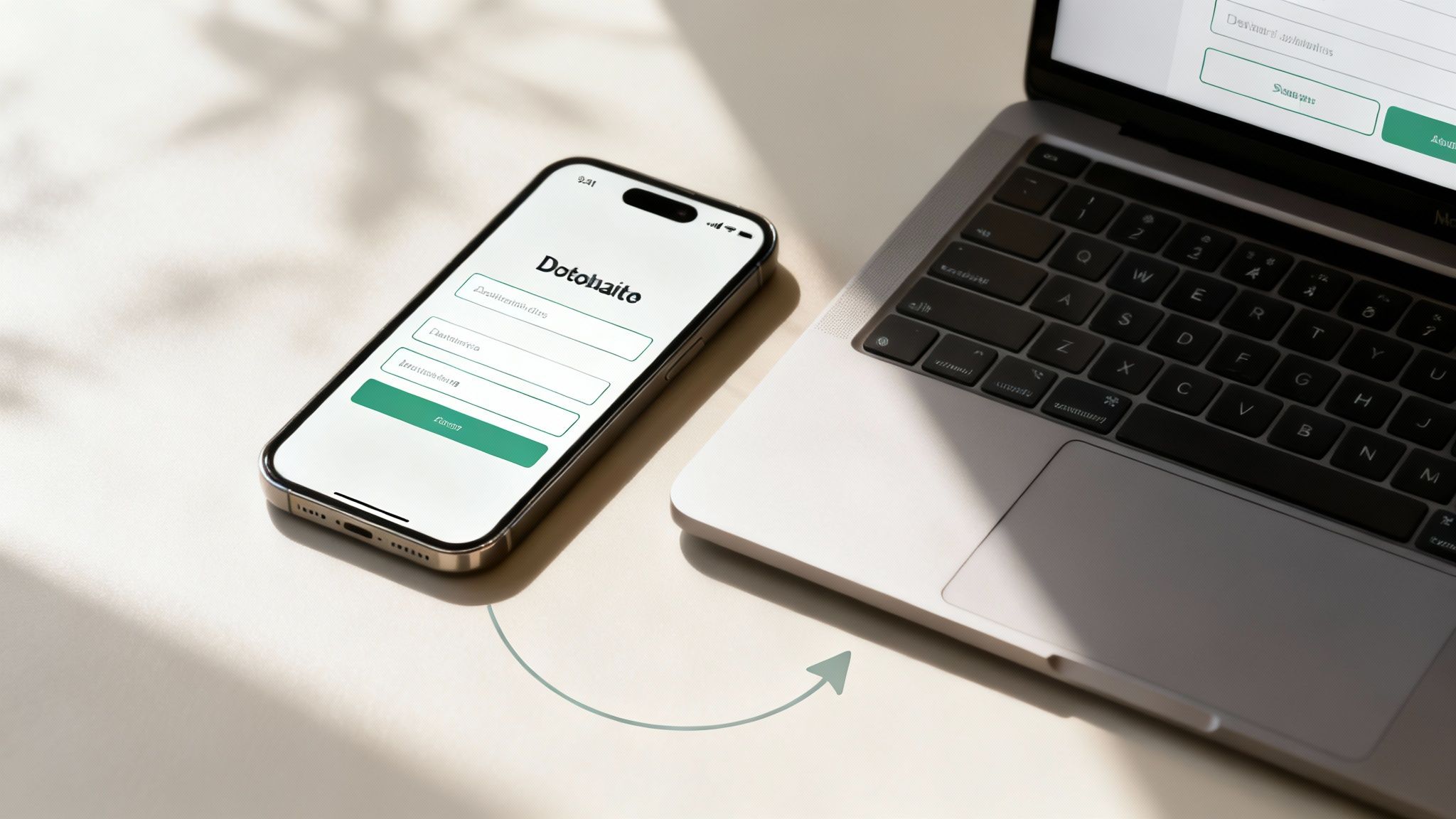
Here's a fascinating look into donor habits: while mobile traffic might dominate your website visits, the big money still comes from the desktop. The average desktop donation is $145, which is nearly double the $76 average from a mobile device.
This doesn't mean mobile is less important. It just tells a different story. People browse and discover on their phones but often switch to a desktop for the final act of giving, especially for larger amounts. It feels more secure, more official. You can discover more donation platform marketing statistics that back up these behavioral splits.
Your platform needs to be brilliant in both arenas. It's not about choosing one over the other; it's about creating a tailored journey that meets donors where they are.
Tailoring the Experience for Mobile Donors
On mobile, it's all about speed. Your donor is likely on the move, multitasking, and has zero patience for a complicated form. The goal is to make giving feel completely effortless.
A winning mobile experience boils down to a few key things:
- Minimal Form Fields: Only ask for what is absolutely necessary. Every extra field you ask them to fill out on a tiny screen increases the odds they'll just give up.
- Big, Tappable Buttons: Make sure donation amounts and the final "Donate" button are easy to hit with a thumb. No one wants to pinch-and-zoom just to give you money.
- Digital Wallet Integration: This is a game-changer. Adding Apple Pay or Google Pay can turn a multi-step process into a single tap, and conversion rates soar.
- Vertical Layout: The form should flow naturally down the screen. If a donor has to scroll sideways, you've already lost.
When you’re vetting donation platforms, test their mobile checkout yourself. Don’t just take their word for it. If all it does is shrink the desktop form down to fit a phone screen, it’s not truly mobile-friendly—and it will absolutely cost you donations.
Creating an Engaging Desktop Journey
With the luxury of a larger screen, you have more room to tell your story and guide the donor. While you still want to keep things simple, the desktop is where you can build a deeper connection right at the point of transaction.
This is the perfect environment to:
- Showcase Impact: Place compelling images or a short video right next to the donation form. Remind them exactly what their gift will accomplish.
- Promote Recurring Giving: You have the space to properly explain the benefits of becoming a monthly donor, making the ask much more effective.
- Offer Bitcoin Donations: Desktop is where more considered, often larger, gifts happen. Donors in this mindset may be more open to using alternative methods like Bitcoin. A clean, easy-to-use Bitcoin option can capture a valuable segment of supporters.
Ultimately, the best platforms don't just have a "mobile version"—they intelligently adapt the entire journey to the device. By creating a fast, frictionless path on mobile and a rich, engaging experience on desktop, you ensure that every potential donor has a perfect path to support your cause.
Common Questions Answered
Diving into the world of online fundraising tools can feel overwhelming. Let's clear up a few of the most common questions nonprofits ask when they're trying to pick the right donation platform.
What’s the Single Most Important Factor to Consider?
When you cut through all the noise, the total cost of ownership is almost always the deciding factor. This isn't just about the monthly subscription fee; it's the combination of that fee plus the third-party payment processing fees that really matters.
A platform might look cheap with a low monthly cost, but if it hits you with high processing fees on every single donation, it can quickly become a drain on your resources. Always do the math based on what you expect to raise to see the true cost to your mission.
How Can We Actually Start Taking Bitcoin Donations?
The easiest way to get started is by picking a donation platform that either has Bitcoin support baked right in or integrates smoothly with a trusted Bitcoin payment processor. These systems are designed to handle all the technical heavy lifting for you.
You'll need to set up a digital wallet to receive the funds, but any good platform will walk you through it. This keeps the whole process secure and simple for both your team and your donors, taking the technical headache out of the process.
Most modern platforms make enabling Bitcoin as easy as flipping a switch in your settings, often just a few clicks to add it to your donation forms.
Do Small and Large Nonprofits Really Need Different Platforms?
Absolutely. An organization's size and resources play a huge role in what it needs from a donation platform. A one-size-fits-all approach just doesn't work here.
- For small nonprofits: The best bet is usually a platform with low (or zero) monthly fees. Simple setup, clean and customizable forms, and basic donor tracking are the essentials that provide the most value without breaking the bank.
- For large nonprofits: Bigger organizations are often looking for a powerhouse. They'll prioritize advanced features like deep CRM integration, powerful analytics, and API access to build custom solutions, and they're usually willing to pay a premium for that kind of capability.
Ready to unlock a new stream of global, tech-savvy donors? With Flash, you can accept Bitcoin donations instantly and securely, with minimal fees. Our wallet-to-wallet technology ensures you are always in control of your funds. Get started in minutes at .