The best mobile POS systems are so much more than just a way to take payments on the go. They're a complete command center for your business, letting you manage sales, track inventory, and handle customer relationships right from a smartphone or tablet. For any merchant who needs flexibility and modern payment options, these systems are indispensable—especially when they open the door to new financial networks like Bitcoin for faster, global transactions.
The Shift to Mobile POS and What It Means for Merchants
Let's face it, the days of the bulky, stationary cash register are numbered. Business today moves fast, and merchants need the speed and flexibility to meet customers wherever they are. This reality has kicked off a massive shift toward mobile point-of-sale (mPOS) systems, effectively turning the devices we use every day into powerful sales hubs.
This isn't just a trend; it's a fundamental change in how commerce works.
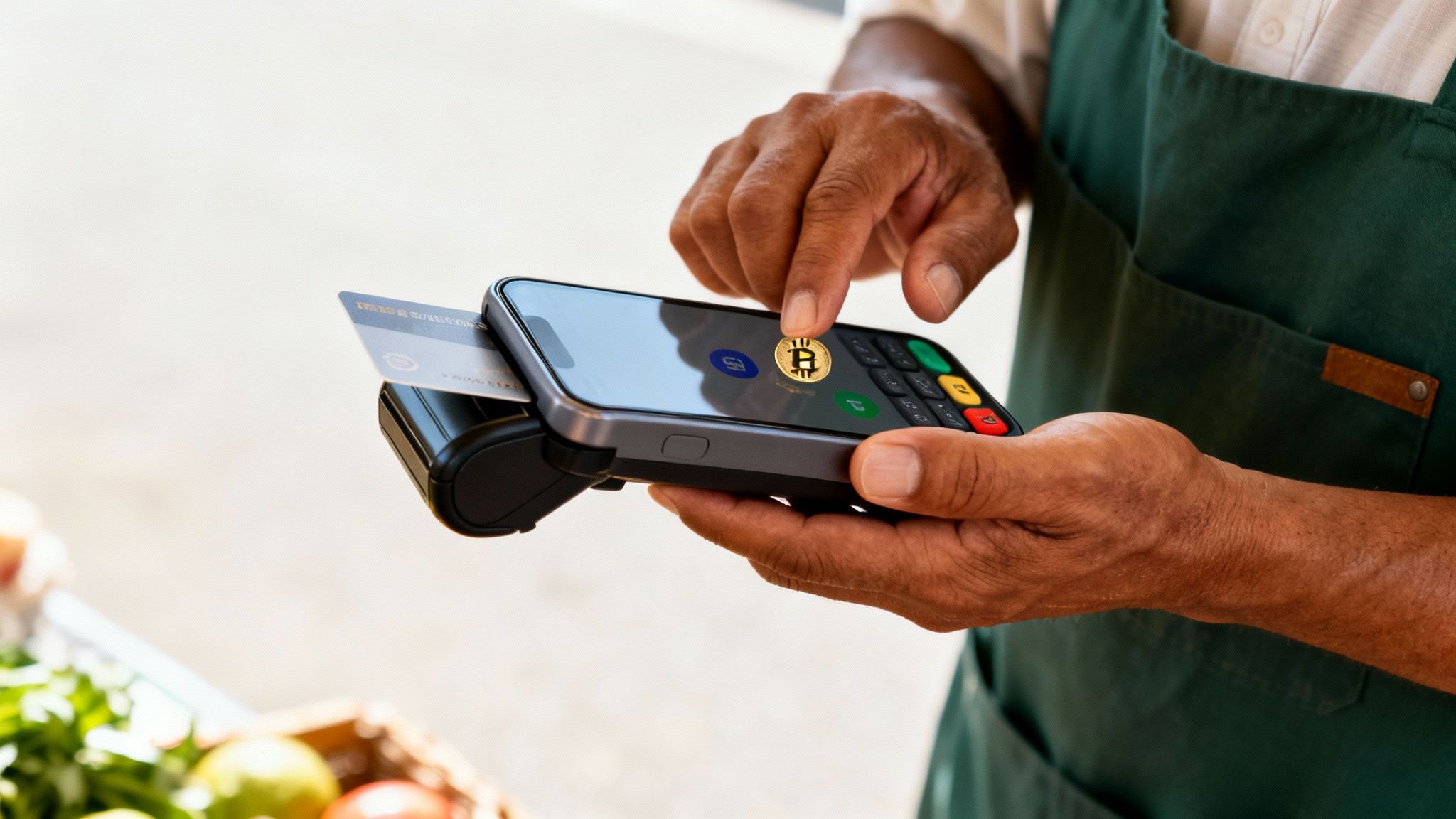
The numbers back this up loud and clear. In 2025, the global Mobile POS market was already valued at USD 27.51 billion, and it's on track to hit an incredible USD 57.13 billion by 2033. That’s a compound annual growth rate of 12.15%, which leaves traditional systems—still holding a 58.40% market share in 2025—in the dust. You can dig deeper into these market trends in the full report.
The Driving Forces Behind mPOS Adoption
So, what's fueling this rapid move to mobile? A few key factors are completely reshaping how merchants run their businesses and connect with customers.
- The Need for Flexibility: Merchants are no longer chained to a checkout counter. A vendor at a farmer's market, a pop-up shop owner, or a consultant visiting a client can all process payments instantly, right on the spot. This dramatically improves cash flow and makes buying easier for the customer.
- The Rise of Omnichannel Retail: Customers now expect a smooth experience whether they're shopping on your website, in your store, or through a social media post. The best mobile POS systems tie all these channels together, keeping your inventory and sales data perfectly synced in real-time.
- The Demand for Contactless Payments: After the last few years, tap-to-pay and QR code payments aren't just a convenience; they're an expectation. Mobile devices are built for these kinds of touch-free transactions.
The Next Frontier: Bitcoin Integration
As commerce goes increasingly digital and global, the payment systems that power it have to keep up. That’s why integrating modern, decentralized networks like Bitcoin is the next logical step in the evolution of mobile POS.
Bitcoin’s wallet-to-wallet architecture is a perfect match for the core ideas of mobile commerce: efficiency, security, and direct interaction. It cuts out the middlemen, slashes fees, and erases cross-border headaches, letting merchants operate on a truly global playing field.
This direct-payment model is a powerful alternative to the old way of doing things. Think about a digital artist selling to fans worldwide or a non-profit taking donations from anywhere on the planet. Bitcoin delivers near-instant settlement without the frustrating delays and high fees of the legacy banking system.
It's the ultimate expression of the freedom and control that mobile POS systems first promised, making it a critical feature for any forward-thinking merchant.
How to Evaluate and Choose a Mobile POS System
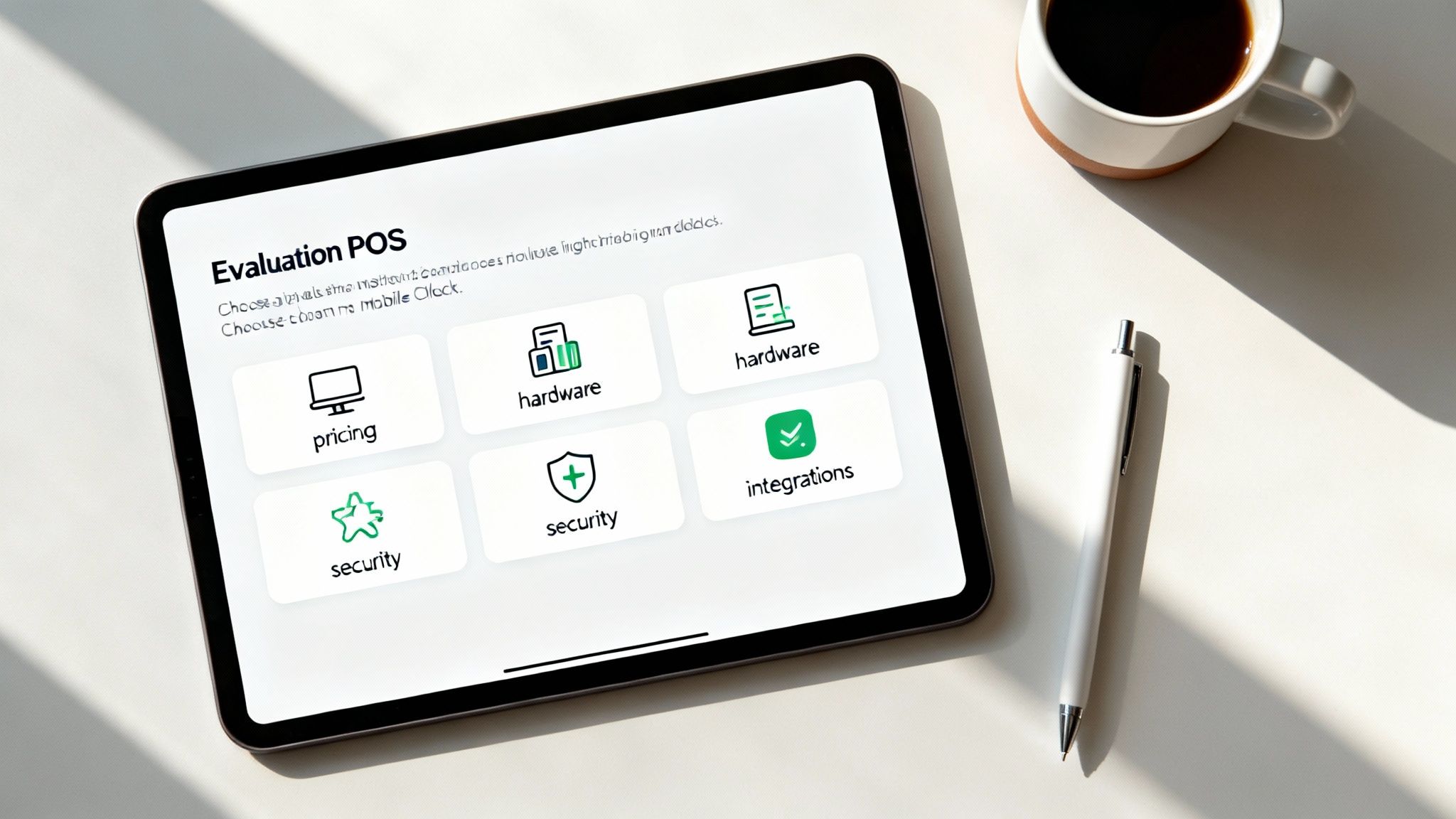
Picking the right mobile POS system is about way more than just taking payments. It's a core decision that touches everything from how smoothly your day runs to your actual bottom line. Before you can even start comparing the best mobile pos systems, you need a clear game plan for how you're going to judge them.
This guide will help you build that checklist, making sure whatever you choose actually fits what your business needs.
Unpacking Pricing and Fee Structures
The first thing every merchant runs into is the true cost of a mobile POS. Fee structures can get complicated, and it's easy to get blindsided by hidden costs that pile up over time. You have to look past the shiny monthly fee and get into the weeds of the transaction charges.
Most traditional systems will hit you with a percentage plus a fixed fee for every single sale (think 2.9% + $0.30). A Bitcoin POS system, on the other hand, plays by a completely different set of rules. It often involves tiny network fees that don't care how big the transaction is. That difference is huge for businesses doing high volume or selling big-ticket items, where those percentage fees can really start to sting.
A classic mistake is grabbing a POS with a low monthly subscription only to get hammered by high per-transaction fees. Always run the numbers based on your average monthly sales to see what you'll really be paying.
Hardware and Software Compatibility
Your mobile POS needs to play nice with the gear you already own. A lot of modern solutions are just software, turning any regular smartphone or tablet into a full-blown point-of-sale terminal. That flexibility is a massive plus because it cuts your upfront hardware costs down to almost nothing.
When you are looking at hardware, consider durable and wallet-friendly options like refurbished phones for work. This approach lets you set up multiple payment points without breaking the bank. Also, double-check that the software works on both iOS and Android so you're not stuck in one ecosystem.
Evaluating Payment Versatility
Today's customers expect to pay how they want. Your mobile POS absolutely must handle the basics, from credit and debit cards to digital wallets. But if you're thinking about the future, you should be looking at systems that can handle global, decentralized payments, too.
Adding a Bitcoin-native POS opens you up to a growing worldwide market. Here’s a quick breakdown of how payment methods stack up:
- Credit/Debit Cards: The old standby. Most customers use them, but they come with processing fees and the constant headache of chargebacks.
- Mobile Wallets (NFC): Super convenient for customers, but they're just a slick front-end for the same old card payment systems.
- Bitcoin Payments: These offer nearly instant settlement, completely wipe out chargeback fraud, and have drastically lower transaction fees. It's a direct wallet-to-wallet connection with your customer—no middlemen.
Security and Compliance Models
Security is a deal-breaker, but how you achieve it can vary a lot. Traditional mobile POS companies take custody of your money during settlement and centralize all your customer data. This forces you into strict PCI compliance to protect that sensitive info, putting a massive responsibility on your shoulders.
A non-custodial Bitcoin POS offers a fundamentally different security model. Since the money goes directly from your customer's wallet to yours, the POS provider never touches your funds or your customer's payment details. This decentralized setup gets rid of the central point of failure, seriously reducing your compliance burden and killing the risk of a data breach on the provider's end.
Integration Capabilities
Finally, your POS can't be an island. The best mobile pos systems connect seamlessly with the other tools you rely on, like your accounting software, inventory platform, or CRM. Look for systems with an open API; that's a huge bonus that lets you build custom solutions as your business evolves. This kind of connectivity makes sure your sales data flows where it needs to go automatically, saving you from hours of mind-numbing manual entry and cutting down on errors.
Comparing Traditional Mobile POS With Bitcoin POS Solutions
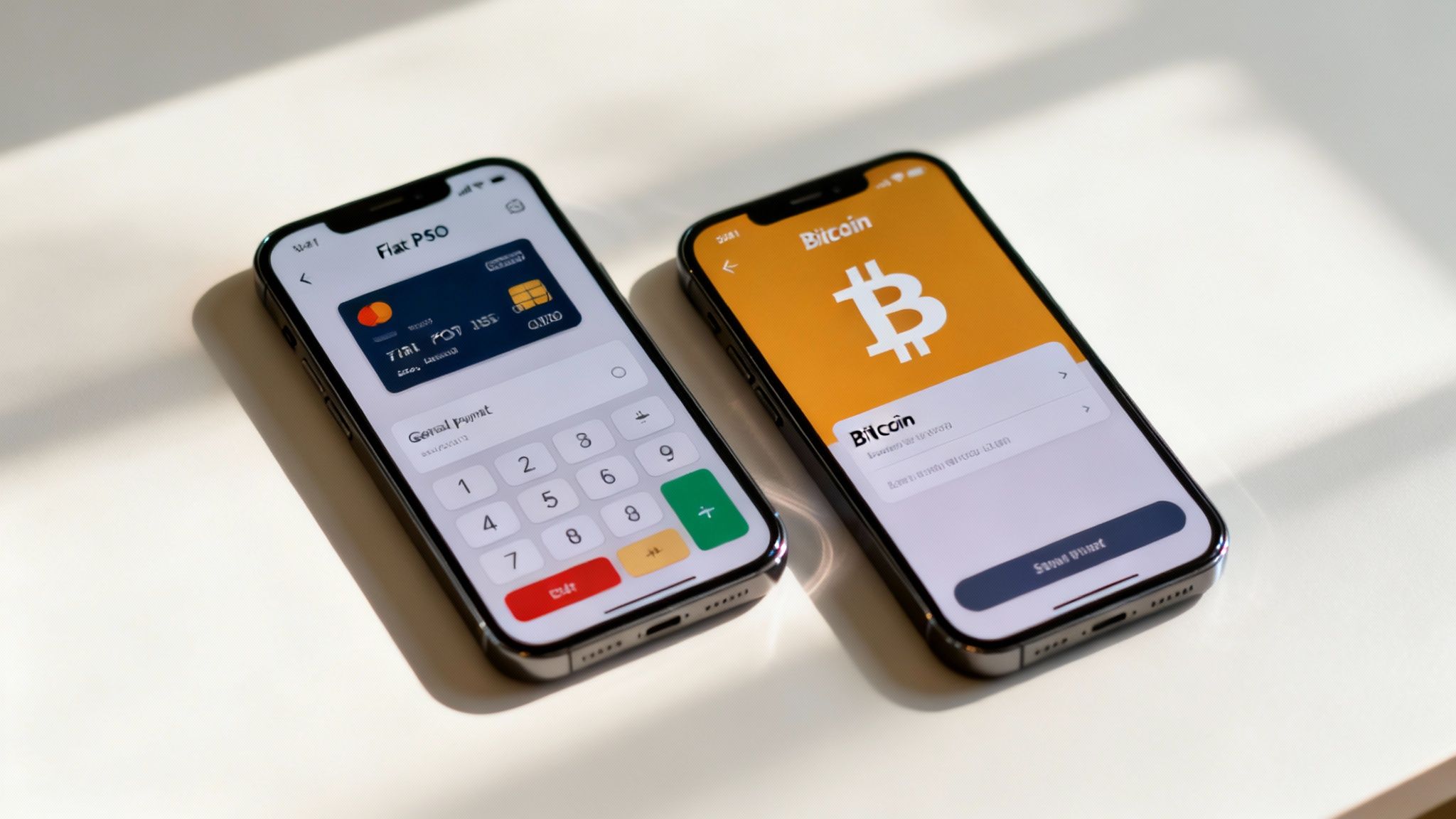
Picking the right mobile POS system really boils down to one thing: understanding the massive difference between old-school financial rails and modern, decentralized networks. You've got the familiar players like Square and PayPal Zettle on one side. On the other, you have specialized Bitcoin POS solutions like Flash, which represent a totally different way to think about commerce.
Let's break down how these two approaches really stack up on the things that matter to your business every single day.
Pricing and Fee Structures
The first thing you’ll notice—and feel in your bank account—is how you get charged for taking a payment. Traditional mobile POS systems are built on a percentage-based fee model, and those little percentages can take a huge bite out of your margins, especially on bigger sales.
Traditional mPOS (e.g., Square): You’re looking at a percentage of the sale plus a fixed fee. The standard is something like 2.6% + $0.10 for in-person payments. On a $1,000 sale, that’s $26.10 straight to the processor. Your costs scale directly with your revenue, which means you get penalized for your own success.
Bitcoin mPOS (e.g., Flash): This works on the Bitcoin network, where transaction fees are tiny and have nothing to do with how much money is being sent. Whether the sale is for $10 or $10,000, the network fee is based on data, not value, and often costs just a few cents. This flat-cost model gives you predictable, low fees that don’t punish you for making a big sale.
For businesses with tight margins or those selling high-ticket items, this isn't a small detail. The savings from a Bitcoin-based system can become seriously substantial over time, money that goes directly back into your business.
Security and Fund Control
Everyone talks about security, but the how is what matters. The difference between custodial and non-custodial systems is probably the biggest factor when deciding on the best mobile pos systems for your financial freedom.
Traditional platforms are custodial. This means they literally take ownership of your money for a while during the settlement process. They also centralize all your customer data, creating a juicy target for hackers and forcing you to deal with strict PCI compliance rules.
In a centralized, custodial model, a third party holds your funds. Your access can be frozen or delayed whenever they see fit. You're not just trusting them with your money—you're trusting them with your customers' sensitive information.
On the flip side, a non-custodial Bitcoin POS like Flash is just a tool for direct, wallet-to-wallet transactions. The software is just a conduit; it never touches your money or stores any customer payment data.
This non-custodial approach comes with some huge security wins:
- No Intermediary Risk: Money moves from the customer's wallet straight to yours. There's no middleman who can freeze your account or hold up your settlements.
- Enhanced Data Privacy: Since the POS provider never processes or stores payment details, the risk of a massive, centralized data breach is gone.
- Reduced Compliance Burden: Without a central vault of sensitive card data, the headaches and costs of PCI compliance are massively reduced.
Settlement Speed and Cash Flow
How fast you get your money directly impacts your cash flow. It’s that simple. Traditional systems are tied to banking hours and schedules, which often means you’re waiting days for your own money to clear.
With a provider like Square or PayPal, a typical settlement takes 1-2 business days. Sure, they might offer "instant" deposits, but that almost always comes with an extra fee, cutting into your profits even more.
Bitcoin transactions, however, settle on the network in minutes. Once a transaction gets a few confirmations on the blockchain—usually within 10-30 minutes—the funds are yours. They are final and irreversible. This gives you immediate access to your capital, letting you manage your finances with more agility. You can reinvest, pay suppliers, or take your profits without any artificial delays.
A Comparative Look at Key Features
To really hammer these points home, let's put the core features side-by-side. This table gets right to the practical reality of choosing between a traditional, fiat-based mPOS and a specialized Bitcoin POS.
Mobile POS System Feature Comparison
| Feature | Traditional mPOS (e.g., Square) | Bitcoin mPOS (e.g., Flash) |
|---|---|---|
| Transaction Fees | Percentage-based (2.6% + 10¢), scales with sale amount. | Minimal, flat network fee; independent of sale amount. |
| Settlement Speed | 1-2 business days (or pay extra for instant). | Near-instant (minutes), final settlement. |
| Fund Control | Custodial; provider holds funds during settlement. | Non-custodial; funds go directly to your wallet. |
| Global Reach | Limited by country and currency; cross-border fees apply. | Global by default; borderless with no extra fees. |
| Chargeback Risk | High; merchants are liable for fraudulent chargebacks. | Zero; Bitcoin transactions are irreversible. |
| Privacy | Centralized data collection; requires customer PII. | No KYC; direct wallet-to-wallet, no personal data stored. |
| Hardware | Often requires proprietary card readers. | Software-only; runs on any standard smartphone or tablet. |
At the end of the day, it all comes down to what you prioritize. If your business values financial control, rock-bottom fees, and instant access to a global customer base, a Bitcoin POS solution offers a powerful alternative to the old, intermediary-clogged model of traditional mobile payments.
The Strategic Advantage of Accepting Bitcoin Payments
Let’s move past a simple feature list. It's time to talk about why accepting Bitcoin on your mobile POS is a genuine game-changer. This isn't just about tacking on another payment button; it's a strategic pivot that solves some of the most persistent headaches in modern business. Your smartphone stops being just a payment terminal and becomes a gateway to global commerce.
Eliminate Chargeback Fraud Entirely
If you've ever dealt with a chargeback, you know the frustration. Traditional card networks give customers a long window to dispute a charge, often leaving you, the merchant, to eat the cost—even when you did everything right. It’s an unpredictable drain on your revenue and a massive administrative time-sink.
Bitcoin payments are, by their very design, final. Once a transaction is locked into the network, it’s irreversible. This completely removes the risk of someone clawing back their money through a fraudulent chargeback. You can finally have certainty that the money you earn is yours.
With a Bitcoin POS, the entire concept of chargeback fraud becomes obsolete. This one feature can save businesses thousands of dollars a year, offering a level of financial security that traditional payment rails simply can't match.
This finality isn't a policy; it's a core function of the Bitcoin network. You no longer have to budget for potential losses or waste hours fighting baseless disputes. Every sale is truly a final sale—a critical advantage for anyone selling high-value items or digital goods.
Unlock a Truly Global Customer Base
Think about how geographically limited most mobile POS systems are. Taking payments from international customers means wrestling with currency conversions, exorbitant cross-border fees, and a patchwork of regulations. These hurdles effectively wall you off from a massive global market.
Bitcoin, on the other hand, is a borderless network. It doesn't know or care about country codes and exchange rates.
This means you can take a payment from anyone, anywhere on the planet, as easily as you would from a customer standing right in front of you. For eCommerce stores, content creators, and non-profits, this unlocks a previously unreachable global audience. A customer in Tokyo can pay a merchant in Toronto with zero friction or extra fees, as if they were in the same room.
Achieve Near-Instant Settlement and Superior Cash Flow
One of the oldest gripes with legacy payment systems is the waiting game. Merchants routinely wait 1-3 business days for their money to actually hit their bank account. That delay ties up your working capital, makes managing cash flow a nightmare, and creates a lag between earning revenue and being able to use it.
Bitcoin transactions offer near-instant settlement. Once the payment is broadcast and confirmed on the network—which usually takes just a few minutes—the funds are in your wallet, ready to go. No more arbitrary holding periods or batch processing schedules tied to banking hours.
This immediate access to capital gives your business incredible agility. You can pay suppliers, reinvest in inventory, or cover expenses without waiting. For any business, but especially for small and medium-sized ones, this accelerated cash flow is a massive operational advantage and a key factor when evaluating the best mobile pos systems.
Finding the Right Mobile POS for Your Business Model
The theory behind any payment system is just that—theory. It doesn't mean much until you see how it actually works for a real business. There’s no single "best" mobile point-of-sale setup; the right choice is always the one that fits your specific operations, your customers, and where you plan to take your business.
This decision is more crucial than ever, especially as customer habits are changing fast. Contactless and mobile payments have absolutely exploded, making mobile POS systems a must-have. The global mobile POS market jumped from USD 482 million in 2024 to USD 595 million in 2025, and it's expected to hit USD 2,032 million by 2032—that's a massive 23.4% CAGR. You can dig deeper into this trend with market research on mobile POS systems. This boom is driven by small and medium-sized businesses needing affordable, flexible solutions that can keep up.
Brick-and-Mortar Retailers
If you run a physical shop, a cafe, or even a pop-up, you live and die by flexibility. You need a system that just works—at the counter, on the floor, and when you’re out at an event. A hybrid approach usually gives you the best of both worlds.
A familiar mPOS like Square is a solid choice for handling the daily rush of credit and debit cards. The hardware is recognizable, customers trust it, and it fits neatly into standard retail workflows.
But here’s a pro move: add a Bitcoin POS like Flash onto the same device. This gives you a powerful second payment rail. It's perfect for accepting larger payments without getting hammered by high percentage fees, and you can cater to a growing crowd of Bitcoin users. Plus, you get instant settlement and zero chargeback risk.
Digital Content Creators
Creators, educators, and online personalities have a global audience. The problem is, traditional payment gateways weren't built for a borderless world. They create friction with high cross-border fees, currency conversion headaches, and weird regional blocks.
For this business model, a Bitcoin-native POS just makes more sense.
- Payment Links: Quickly create a simple link to accept tips or payments for your digital downloads, courses, or exclusive content.
- Global Access: Get paid by anyone, anywhere. You don't have to worry about the complexities of international banking.
- No KYC: Your audience can pay you directly from their wallet without signing up for yet another third-party service, which is a huge win for their privacy.
Using a solution like Flash, you can easily put up a paywall or embed a payment button right on your site. You get paid instantly and directly for your work.
For creators, the goal is to remove every possible barrier between your content and your audience's support. A direct, wallet-to-wallet Bitcoin payment does exactly that—it's fast, private, and works everywhere.
Service-Based Businesses and Freelancers
If you’re a consultant, designer, or freelancer, invoicing is your lifeblood. Your two biggest headaches are usually high processing fees carving up your profits and settlement delays messing with your cash flow.
While traditional systems can send invoices, they’ll typically skim around 3% off the top to process the payment. A Bitcoin POS is a far more efficient route. You can generate a QR code or a payment link, pop it on your invoice, and let clients pay with almost no fees.
The instant settlement is a game-changer, too. Instead of waiting days for the money to clear, the payment hits your wallet in minutes. That means you get access to the revenue you've earned, right away.
Non-Profits and Charities
For non-profits, every single dollar counts. Unfortunately, traditional payment processors can take a noticeable slice of donations through fees, which means less money for your actual mission. Donors are also increasingly concerned about transparency.
Accepting Bitcoin gives you two massive advantages:
- Minimal Fees: With drastically lower transaction costs, a much larger portion of every donation goes directly to your cause.
- Global Reach: Supporters from anywhere on the planet can donate instantly, without the usual friction of international bank transfers.
With a simple Bitcoin POS app, a non-profit can set up a donation terminal at an event or put a permanent QR code on its website. It's a transparent, low-cost, and globally accessible tool for fundraising.
Questions Merchants Are Asking About Mobile POS
When you're looking at mobile POS systems, especially with new payment options like Bitcoin in the mix, a lot of questions come up. Let's tackle the most common ones I hear from merchants.
Can I Use One Mobile POS for Both Fiat and Bitcoin Payments?
Yes, and this is exactly how most businesses do it. You don't need to find one single app that handles both card payments and Bitcoin. The most practical approach is running two specialized apps on the same device—your smartphone or tablet.
Think of it this way: you can keep using a trusted system like Square for all your standard credit and debit card sales. Right alongside it, you can have a dedicated Bitcoin POS app like Flash ready for customers who want to pay with Bitcoin. This setup gives you the best of both worlds, ensuring you’re equipped for any customer preference. Your card payments settle in a few days, while your Bitcoin payments hit your wallet instantly.
What Are the Security Differences Between Traditional and Bitcoin POS Systems?
The security models are worlds apart, and this is a critical distinction for any business owner. Traditional mobile POS systems are centralized and custodial. This means the company you're using (like Square or Stripe) processes, holds, and temporarily takes custody of your money and customer data during that settlement window. This structure makes them a prime target for data breaches, which is why merchants have to deal with rigid PCI compliance rules.
A non-custodial Bitcoin POS operates on a completely different principle. It never holds your money or your customer's data. Security is rooted in the decentralized nature of the Bitcoin network itself, not in the security practices of a single company.
A Bitcoin POS like Flash, on the other hand, is decentralized and non-custodial. Transactions flow directly from your customer's wallet to your own. The app is just a facilitator—it never touches the funds or stores sensitive payment details. This design eliminates the middleman risk and gets rid of that "honeypot" of centralized data that attackers love to target.
How Difficult Is Setting Up a Bitcoin Mobile POS?
It's shockingly simple. You can be up and running in less than a minute. The whole process is designed to be frictionless, cutting out the red tape that comes with traditional payment systems.
For an app like Flash, it really is just two steps:
- Download the app from the App Store or Google Play.
- Connect your existing Bitcoin wallet.
And that's it. No long application forms, no waiting for hardware to arrive, and no mandatory KYC (Know Your Customer) checks. This means anyone from a food truck owner to a freelance designer can start accepting global Bitcoin payments almost instantly, using nothing more than the phone already in their pocket.
Do I Need Special Hardware to Accept Bitcoin Payments?
Nope, not at all. This is one of the biggest perks of a modern Bitcoin mobile POS. You don't need to buy any special card readers, terminals, or proprietary gadgets.
The entire system is software-based and works on the devices you already have, like an iPhone, Android phone, or tablet. The POS app generates a unique QR code on your screen for each sale. Your customer just scans that code with their Bitcoin wallet app to pay. This software-only approach completely removes the cost and hassle of buying and managing extra hardware, making it an incredibly lean and cost-effective way to accept payments.
Ready to unlock global payments with zero chargebacks and near-instant settlements? Flash turns your smartphone into a powerful Bitcoin POS in under a minute. Start accepting borderless payments today at .