Picking the best payment gateway for ecommerce usually comes down to a choice: stick with the familiar names like Stripe, or explore modern Bitcoin-native options that promise lower fees and zero chargeback headaches. The right answer really depends on your business, your customers, and what you prioritize—widespread adoption or next-gen efficiency.
Choosing Your Ecommerce Payment Gateway

Deciding on a payment gateway is one of the heaviest decisions you'll make for your online store. It's so much more than a bit of code on your site; it directly hits your profit margins, your day-to-day operations, and even your ability to sell to a global audience. This choice defines how you get paid, how much you give away in fees, and how long you have to wait for your money.
The market is split into two completely different camps. On one side, you have the established, traditional fiat gateways we've used for years. On the other, you have modern gateways built on the Bitcoin network, designed from the ground up to fix the problems baked into the old financial system.
Comparing Core Payment Philosophies
Traditional processors are the middlemen connecting your store to the big credit card networks and banks. They handle the authorization, capture, and settlement, but that convenience comes with some serious costs and strings attached. While everyone knows how to use them, they leave merchants exposed to things like chargeback fraud and frustrating delays in getting paid.
Bitcoin gateways work differently. They're all about direct, peer-to-peer transactions. By cutting out the costly intermediaries, they can offer much lower fees. More importantly, they create a system of final, irreversible payments. This completely gets rid of the threat of chargebacks, a constant pain point for so many online businesses.
The real difference is about control. Traditional gateways work inside a system of permissions and middlemen. Bitcoin hands control back to the merchant with direct, final settlement—you effectively become your own bank.
Getting your head around this fundamental split is the first step. To make it clearer, here’s a quick rundown of how they stack up.
| Feature | Traditional Gateways (e.g., Stripe, PayPal) | Bitcoin Gateways |
|---|---|---|
| Transaction Fees | Typically 2.9% + $0.30 per transaction | Often 1% or less, with no fixed fee |
| Chargeback Risk | High; merchants are on the hook for disputes | Eliminated; all payments are final |
| Settlement Speed | 2-7 business days to get your funds | Near-instant; funds available in minutes |
| Global Reach | Restricted by country, currency, and local banks | Truly global and borderless out of the box |
| Intermediaries | Multiple (acquiring bank, issuing bank, card network) | None; direct wallet-to-wallet transfer |
Getting to Grips with the Payment Gateway Scene
The explosion of e-commerce has turned the payment processing world into a battlefield. Competition is fierce, which has been great for pushing providers to get faster, more secure, and cheaper. At the heart of every online sale is a payment gateway—it's the technology that securely connects your customer's card details, your storefront, and all the financial plumbing needed to get you paid. Think of it as your digital cash register.
But let's be honest, this traditional setup is starting to creak under the strain. Merchants are getting louder about their frustrations. Sky-high transaction fees are nibbling away at profits, it can take days for money to actually hit your account, and the ever-present risk of fraud is a constant headache. These aren't minor gripes; they're major problems sparking a real demand for something better.
The Push for Merchant Control
Businesses are tired of the old way and are now actively hunting for payment solutions that put them back in the driver's seat, with way less overhead. The legacy system is a tangled mess of middlemen—issuing banks, acquiring banks, card networks—and each one introduces a potential point of failure and, you guessed it, a fee.
Every layer takes its slice, which is how we end up with those infamous 2-3% processing fees that come straight off your bottom line.
This is exactly why a growing wave of businesses are taking a hard look at decentralized options. They're looking for a smarter, safer, and cheaper way to do business on a global scale.
The real problem isn't just about the cost; it's the entire architecture of trust. Old-school gateways depend on a complex and expensive web of third parties to vouch for transactions. Decentralized networks like Bitcoin bake trust directly into the system, cutting out the need for those costly go-betweens.
This single difference is what’s setting the stage for a completely new era in how we handle payments online. The global payment gateway market is already huge and growing at a blistering pace, fueled by our collective shift to online shopping. Valued at around USD 42.68 billion in 2024, it's expected to hit USD 146.28 billion by 2030. You can dig into more of these market growth insights on nextmsc.com.
Setting the Stage for a New Comparison
This rapid growth just throws a brighter spotlight on the need for better solutions. As more and more money flows online, the clunky, inefficient nature of the old guard becomes impossible to ignore. This is the perfect environment to pit the established systems against a new model built on the Bitcoin network.
In the next sections, we'll dive headfirst into that comparison. We’re going to dissect what each system really means for your business—from fees and settlement times to security and global reach—to figure out what truly is the best payment gateway for ecommerce right now.
Analyzing Traditional Fiat Gateways

You can't talk about the best payment gateway for ecommerce without tipping your hat to the giants in the room. Names like Stripe and PayPal are practically synonymous with online checkout, offering a familiar process that customers instinctively trust. Their real power comes from this massive adoption and the incredible ecosystems they’ve built.
These traditional fiat gateways are the essential middlemen. They connect your online store to the sprawling, complicated web of credit card networks and banks. They manage payment authorizations, encrypt data, and move funds around, all to make it seem simple for you to accept credit and debit cards globally. For anyone just starting out, that convenience is a huge draw.
But once you look under the hood, you start to see the cracks. While they nail the front-end experience for shoppers, the back-end reality for merchants is often expensive, slow, and full of risk.
Dissecting the Fee Structures
The first and most obvious hit to your bottom line is the fee structure. Traditional gateways usually take a percentage plus a fixed fee from every single sale. A typical rate like 2.9% + $0.30 doesn't sound like much, but it brutally punishes businesses with low average order values or tight margins. That fixed fee can devour a significant chunk of a small sale.
And that advertised rate? It’s just the beginning. Merchants quickly discover a maze of extra costs that weren't on the brochure.
- International Transaction Fees: Selling across borders? Expect to pay an extra 1-2%.
- Currency Conversion Fees: If a customer pays in another currency, the gateway takes another slice to convert it back to yours.
- Chargeback Fees: When a customer disputes a charge, you get hit with a non-refundable fee, usually $15-$25, even if you prove the charge was legitimate.
- Monthly or Incidental Fees: Some providers tack on monthly account fees, PCI compliance costs, or charges for decent customer support.
This tangled and often murky pricing makes it a nightmare to forecast your actual costs. The total amount you pay for payment processing almost always ends up being way higher than you first thought.
Integration and Security Realities
To be fair, the market leaders have poured resources into creating excellent developer tools and extensive plugin libraries. Getting Stripe or PayPal running on platforms like Shopify or WooCommerce is usually a straightforward, "plug-and-play" affair. To really understand how they work, you can look into resources detailing Stripe's payment platform, which show just how deep their integration capabilities go.
Security is another area where they spend big. They are required to maintain Payment Card Industry Data Security Standard (PCI DSS) compliance, which means they take on the massive burden of securely handling and storing sensitive credit card information for you.
But this entire security model is fundamentally reactive. It’s designed to protect stored data inside a system that accepts fraud as a given. The whole chargeback system exists because the network is inherently vulnerable to fraudulent claims and disputes.
This leaves merchants in a tough spot. You have to rely on the gateway for security, but you're still on the hook for the financial and administrative headache of chargebacks—which can come from actual fraud or just simple buyer's remorse.
A quick side-by-side look at the big players shows how they stack up on the core features that matter most to a merchant.
Traditional Payment Gateway Feature Comparison
| Feature | Stripe | PayPal | Key Merchant Consideration |
|---|---|---|---|
| Transaction Fees | Typically 2.9% + $0.30 for online transactions | 2.99% + fixed fee (varies by currency) | PayPal's fees can be slightly higher and more complex for international sales. |
| Integration | Developer-first approach with robust APIs and extensive documentation | Strong presence with simple buttons and pre-built checkouts | Stripe offers more customization for developers; PayPal is often faster for basic setups. |
| Fund Settlement | 2-3 business days standard payout schedule in most regions | Instant transfer to PayPal balance; 1-3 days to transfer to a bank account | PayPal offers faster access to funds in-platform, but bank transfers add time. |
| Global Reach | Available in 47+ countries with support for 135+ currencies | Available in over 200 countries and supports 25 currencies | PayPal has broader country availability, but Stripe supports more currencies for pricing. |
While both offer comprehensive solutions, the subtle differences in fees, settlement times, and global reach can have a big impact depending on your business model.
Settlement Delays and Cash Flow Impact
Maybe the biggest operational headache with traditional gateways is the wait time to get your money. When a customer clicks "buy," that cash doesn't land in your bank account right away. The settlement process winds its way through multiple intermediaries and usually takes anywhere from 2 to 7 business days.
This delay puts a direct strain on your cash flow. It makes it harder to manage inventory, pay your suppliers, or reinvest in growing the business. For a small business or startup running lean, waiting a week to get paid for a sale can cause serious financial stress.
Stripe has undeniably become a powerhouse by simplifying this complex world for developers. Its market share is a testament to its success. By 2025, Stripe is estimated to control between 20.8% and 29% of the global online payment processing market. In the U.S., its grip is even tighter, holding around a 45% share. Even with its clean APIs, however, it still operates within this old-school framework of delays and vulnerabilities, which is exactly what new payment models are trying to fix.
Exploring Bitcoin Payment Gateways

While traditional payment systems get by on a tangled web of banks and third-party processors, Bitcoin payment gateways offer a completely different model. They represent a fundamental shift in how e-commerce transactions are handled, built on the decentralized, peer-to-peer principles of the digital currency. This structure directly tackles some of the most frustrating and costly problems merchants have been forced to accept from the legacy financial system.
For any business on the hunt for the best payment gateway for ecommerce, getting to know this alternative is a must. Bitcoin gateways simply cut out the middlemen, paving the way for direct wallet-to-wallet transfers between your customer and your business. It's this streamlined design that unlocks massive benefits like dramatically lower fees, instant settlement, and the total elimination of chargeback fraud.
Eliminating Chargeback Fraud Entirely
One of the most powerful features of accepting Bitcoin is the finality of its transactions. Unlike a credit card payment that can be clawed back weeks or even months after a sale, a Bitcoin payment is irreversible once it's confirmed on the network.
This simple reality means chargeback fraud becomes impossible. It’s a complete game-changer for merchants, especially those selling high-value goods or digital products where fraudulent disputes are a constant threat. You no longer have to budget for fraud losses or waste precious time fighting bogus claims.
The core value of a Bitcoin payment gateway is a return to payment certainty. Every sale is final, secure, and settled, stripping away the financial risk and administrative headaches that merchants have been forced to treat as a cost of doing business online.
With a Bitcoin gateway, the second that payment is confirmed, the money is yours. No take-backs, no dispute fees, and absolutely no risk of losing both your product and your revenue to a scammer.
Drastically Lowering Transaction Fees
Traditional payment processors bake all their overhead into their fees—covering the costs of multiple intermediaries and managing the fraud risk baked into the credit card system. Bitcoin's decentralized nature sidesteps this entire expensive mess.
The result? Bitcoin payment gateways can offer significantly lower transaction fees, often charging 1% or less. This is a world away from the standard 2.9% + $0.30 you'll see from most fiat gateways. The difference is huge for businesses running on thin margins or those with high sales volume, as the savings drop directly to your bottom line.
This cost advantage becomes even more obvious with international sales. With Bitcoin, you can forget about extra cross-border fees or currency conversion charges. It's a truly global and borderless payment rail.
Gaining Control with Instant Settlement
Another major headache with traditional systems is the waiting game. It can take anywhere from two to seven business days for the money from a credit card sale to actually land in your bank account. That lag can put a serious strain on cash flow, making it tough to manage inventory, pay suppliers, and reinvest in your business.
Bitcoin payment gateways solve this with near-instant settlement. As soon as a transaction is confirmed on the network—a process that usually takes just a few minutes—the funds are available to you. This immediate access to your capital gives you far more control over your finances.
How Gateways Remove Volatility Risk
A common worry for merchants thinking about Bitcoin is price volatility. But modern Bitcoin payment gateways are designed to completely shield you from this risk. They offer instant, automatic conversion from Bitcoin into your local currency, whether that's USD, EUR, or GBP.
Here’s how that plays out:
- A customer pays for a $100 product using Bitcoin.
- The gateway instantly processes the transaction, locking in the $100 value.
- The full $100 is settled directly to your bank account in your local currency.
This setup gives you all the core benefits of accepting Bitcoin—no chargebacks, low fees, and instant cash—without you ever needing to hold or manage the cryptocurrency yourself. You simply get paid the exact purchase price, just faster and cheaper.
Bitcoin Versus Traditional Gateways: A Head-To-Head Analysis
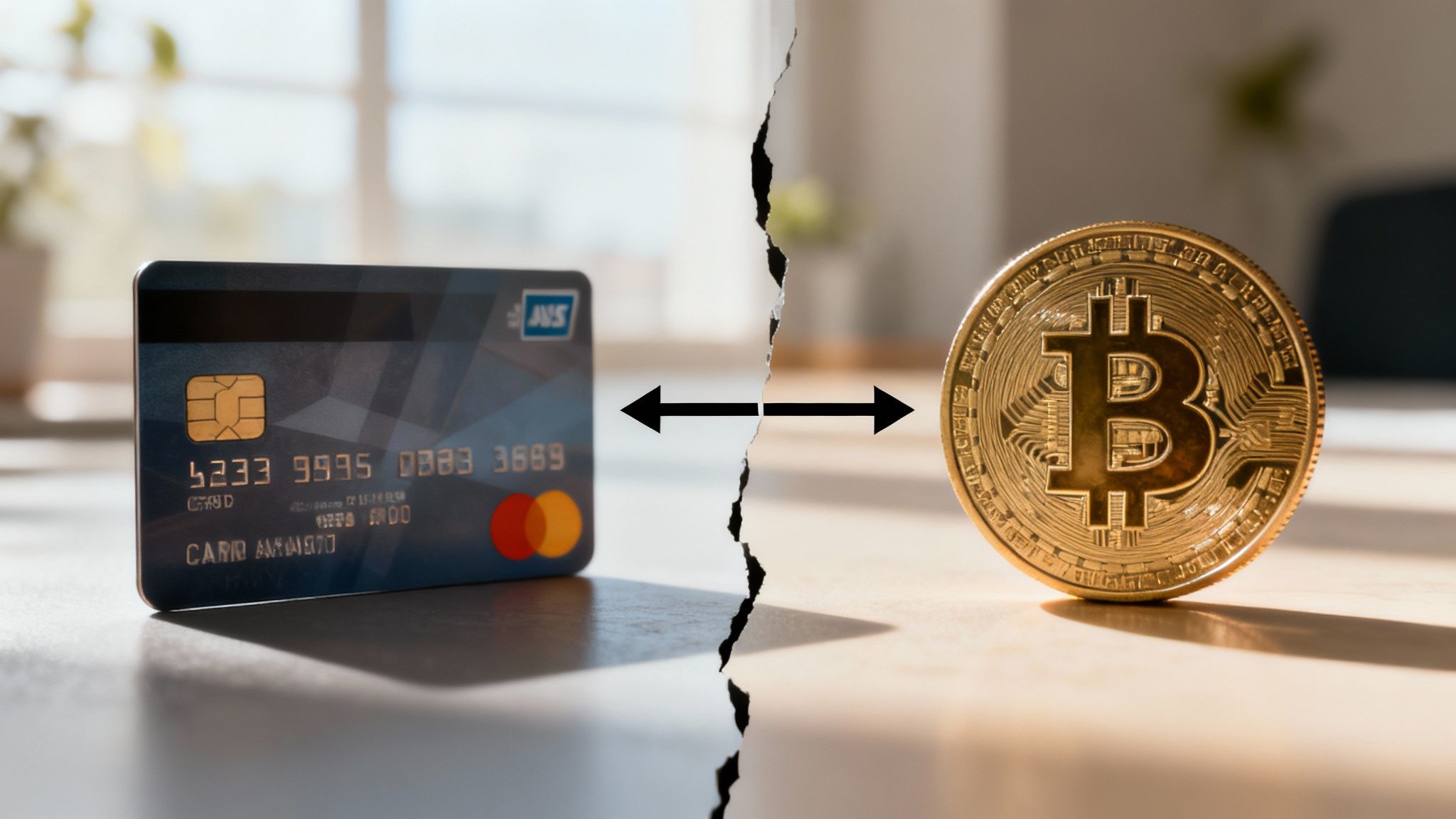
Choosing the best payment gateway for ecommerce means looking under the hood, far beyond the checkout button, to understand the raw mechanics of how you get paid. A direct comparison between Bitcoin and traditional gateways isn't just about features; it's about fundamental differences in cost, speed, security, and global access.
When you put these systems side-by-side, the trade-offs become crystal clear. Traditional gateways bring a sense of familiarity, but Bitcoin gateways offer a robust framework built for protecting your revenue and enabling truly borderless commerce.
The Great Divide On Fees
The first and most painful difference merchants feel is in the fee structure. Traditional gateways run on a percentage-plus-fixed-fee model, typically taking 2.9% + $0.30 from every single transaction. This model is especially punishing for businesses with high sales volume or those with a low average order value.
Bitcoin payment gateways, on the other hand, usually stick to a simple, flat processing fee, often just 1% or less. Why the massive difference? They don't have to prop up a complex web of intermediary banks and card networks. Their overhead is dramatically lower, and you get to keep the savings. For any business pushing thousands of transactions a month, this adds up to significant capital recovered.
The core differentiator in cost comes down to complexity. Traditional fees are high because they fund a bloated, multi-layered system. Bitcoin's simple, direct network allows for a pricing model that is lean, transparent, and predictable.
Settlement Speed: Days Versus Minutes
Cash flow is the lifeblood of any e-commerce business, and this is where the two systems couldn't be more different. With a traditional gateway like Stripe or PayPal, you're looking at an average of 2-7 business days for the money from a sale to actually land in your bank account. This delay creates a serious drag on operations, making it harder to manage inventory and pay your own suppliers on time.
Bitcoin transactions are settled on a global, decentralized ledger in a matter of minutes. Once a payment gets a few confirmations on the network—which happens fast—the funds are irrevocably yours. Modern Bitcoin gateways then handle the conversion to your local currency and the transfer to your bank, a process that is miles ahead of the legacy system. You get near-instant access to your working capital.
The Chargeback Dilemma
For merchants, chargebacks are a constant, costly headache. The entire traditional payment system is built to favor the consumer in disputes, leaving businesses exposed to both legitimate issues and outright fraud. A single chargeback doesn't just cost you the sale and the product; it also hits you with a non-refundable dispute fee of $15-$25.
This is arguably the single most compelling reason for an online business to consider a Bitcoin gateway. Bitcoin transactions are final and irreversible, just like a cash payment. This design completely eliminates the possibility of chargeback fraud. If you're selling digital goods or high-value items—sectors that are prime targets for scammers—this feature alone can save you thousands of dollars and countless hours of administrative pain.
Here’s a practical look at how these operational differences stack up:
| Decision Criterion | Traditional Gateways (e.g., Stripe, PayPal) | Bitcoin Gateways (e.g., Flash) |
|---|---|---|
| Transaction Fees | Complex percentage + fixed fee (avg. 2.9% + $0.30) | Simple flat fee (often 1% or less) |
| Settlement Speed | 2-7 business days | Minutes to confirm, fast bank settlement |
| Chargeback Risk | High; merchant is liable for fraud and disputes | Zero; all payments are final and irreversible |
| Global Reach | Region-locked; requires different integrations for new markets | Natively global and borderless from day one |
Truly Borderless Global Reach
Trying to expand internationally with a traditional gateway is a logistical nightmare. You have to navigate different banking regulations, currency conversion fees, and cross-border transaction costs for every new market you want to enter. Your ability to sell is often handcuffed by where your payment processor has established banking relationships.
Bitcoin, by its very nature, is a global and permissionless network. It works the exact same way everywhere in the world, without caring about borders or local currencies. This makes Bitcoin an incredibly powerful tool for international e-commerce. You can accept a payment from a customer anywhere on the planet just as easily as from someone next door, with no extra fees or regulatory hoops to jump through.
While North America's payment gateway market is massive, valued at around USD 38.63 billion, the real growth is happening in places like Asia-Pacific, fueled by an explosion in digital transactions. You can dig into more data on these global payment trends from Coinlaw.io. Bitcoin gateways give you a direct, frictionless path to tap into these expanding markets.
How To Choose The Right Payment Gateway For Your Business
Picking the right payment gateway isn't about finding the one "best" option. It’s about finding the right fit for your specific business. As we've seen, there's a clear line in the sand: on one side, you have the familiar but clunky traditional systems, and on the other, the lean, secure model offered by Bitcoin.
To make the right call, you have to go beyond a simple feature list. This is a strategic decision that starts with a hard look at your operations, your customers, and your biggest financial headaches. A one-size-fits-all recommendation is useless; your choice needs to support where your business is headed long-term.
When A Bitcoin Gateway Makes The Most Sense
For some businesses, a Bitcoin payment gateway isn't just an alternative—it's a clear-cut upgrade. If your business fits one or more of these profiles, the benefits can be immediate and massive.
Consider going with Bitcoin if you are:
- Selling Internationally: Have customers all over the globe? Bitcoin cuts through the mess of cross-border fees, currency conversion, and the nightmare of managing payments from different regions. It’s a single, smooth rail for global commerce.
- Selling Digital Products: If you're selling software, e-books, courses, or anything that isn't physical, you're a prime target for chargeback fraud. Bitcoin payments are final. This means the threat is completely off the table, protecting your revenue and freeing you from administrative battles.
- Drowning in Chargebacks: Any business getting hit with a high rate of payment disputes can find instant relief. The finality of Bitcoin means every sale is secure and irreversible. You get to end the costly cycle of fighting fraudulent claims for good.
Choosing a gateway is a strategic business decision, not just a technical one. It’s about identifying your greatest financial risks and operational hurdles—like fraud or slow cash flow—and selecting the tool designed to solve them. Bitcoin gateways directly address the core weaknesses of the traditional payment system.
Why A Hybrid Strategy Often Wins
But this doesn't mean you have to burn the boats and abandon traditional gateways entirely. For many businesses, the most practical approach is a hybrid model.
By offering both a familiar credit card option and a modern Bitcoin payment method at checkout, you meet every customer where they are. This strategy lets you capture sales from traditional shoppers while tapping into the low-fee, fraud-proof benefits of Bitcoin for a growing part of your audience. The goal is to make a choice that empowers your business, protects your profits, and sets you up for what's next.
Common Questions Answered
Choosing the right payment gateway always stirs up a few questions. Let's tackle the most common ones merchants ask when weighing traditional options against modern Bitcoin solutions like Flash.
Can I Offer Both Traditional and Bitcoin Payment Options?
Absolutely. In fact, running a hybrid model is one of the smartest strategies for an online business today. You get to keep your credit card die-hards happy while opening the door to the low-cost, secure world of Bitcoin payments.
Most e-commerce platforms are built for this. Adding multiple payment processors at checkout is usually straightforward, giving your customers the freedom to choose without creating a backend nightmare for you.
Is Integrating a Bitcoin Payment Gateway Difficult?
Not anymore. Modern Bitcoin gateways are designed to plug right into the tools you’re already using. You'll find dedicated plugins and apps for all the big names like Shopify, WooCommerce, and Magento.
This means you can be up and running in minutes, no advanced coding skills required. The process is pretty much identical to adding any other payment provider, making it accessible for any merchant, big or small.
The idea that Bitcoin integration is hard is a hangover from the early days. Today’s solutions are built for merchants, not developers. The focus is on a quick, "plug-and-play" setup so you can start accepting payments almost instantly.
Do I Have to Manage Bitcoin Myself to Accept It?
Nope. You don't have to touch, hold, or manage a single satoshi if you don't want to. The best Bitcoin payment gateways offer automatic settlement directly into your local currency, whether that's USD, EUR, or something else.
The gateway handles the Bitcoin-to-fiat conversion instantly and quietly in the background. You get the full purchase amount in your bank account, completely protected from price swings, while still reaping all the benefits of the Bitcoin network's efficiency.
Ready to kill chargebacks and slash your transaction fees? With Flash, you can start accepting Bitcoin payments in just a few minutes. Our platform offers direct wallet-to-wallet transactions with no KYC, so you always have full control of your money. Check out our tools and see how easy it is to get started with Flash.