Picking the right payment gateway for your small business is a huge decision, but there's no single "best" answer. It all comes down to your specific business model and who your customers are. The ideal choice is always a careful balance between low fees, solid security, and getting your money fast.
For a growing number of businesses, modern Bitcoin gateways are proving to have a serious competitive edge over traditional players like Stripe or PayPal.
Finding Your First Payment Gateway
Choosing your first payment gateway is one of the most foundational steps you'll take when building your online presence. It directly impacts your profit margins, customer experience, and how smoothly your day-to-day operations run. This is why having a solid digital platform is so critical; you can learn more about essential web development for small businesses to make sure your checkout process has a sturdy home.
The global rush toward digital payments makes this decision even more pressing. The payment gateway market was valued at USD 35.17 billion in 2024 and is expected to explode to USD 152.26 billion by 2032—that's a massive growth rate of 20.1% every year. This isn't just a trend; it's a fundamental shift in how business gets done.
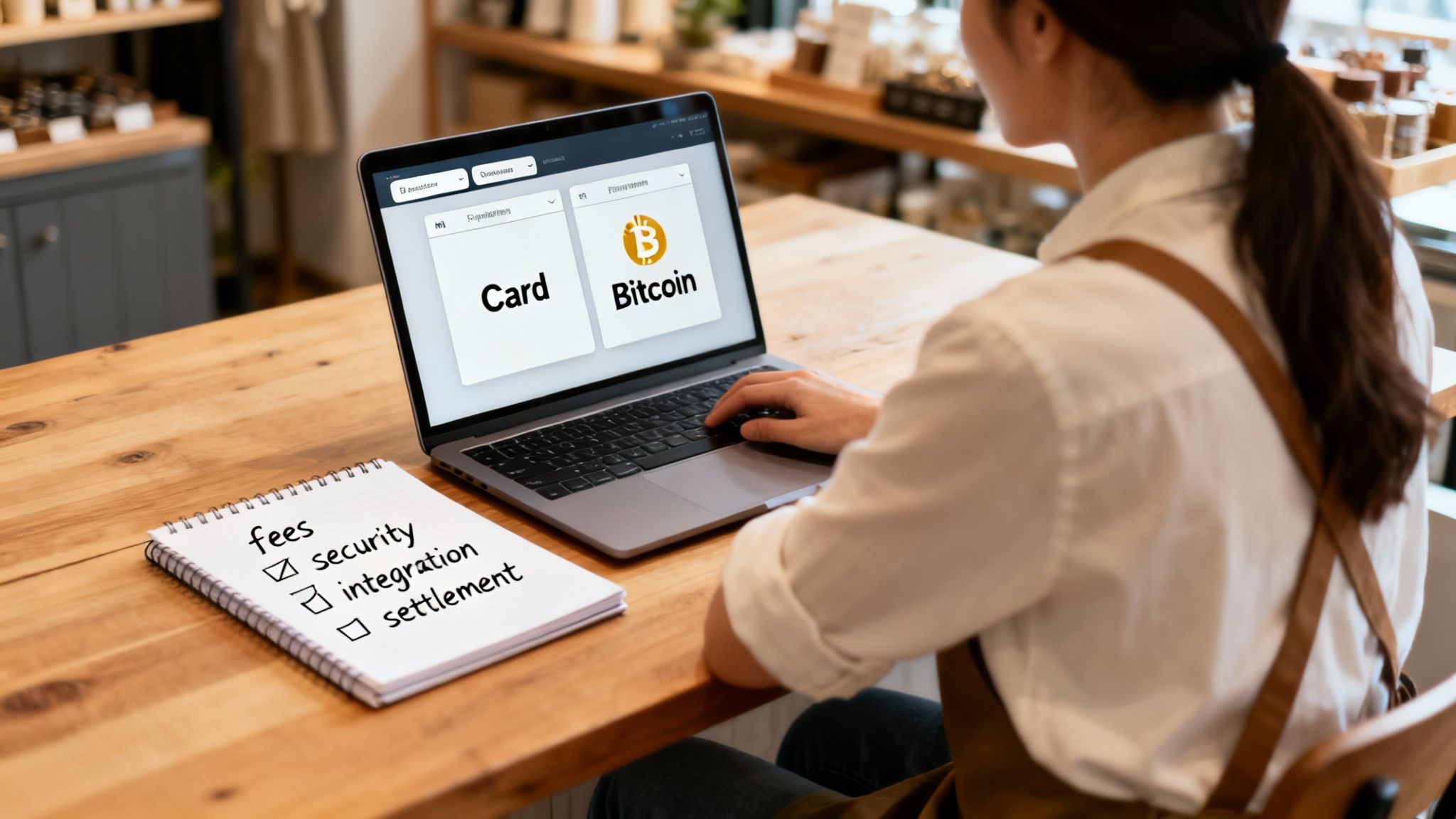
Comparing Traditional and Modern Options
For small businesses, the choice usually boils down to two camps: old-school card processors and modern Bitcoin payment gateways. They each serve different needs and offer very different advantages. Getting a handle on their core differences is the first step to figuring out what works for you.
| Feature | Traditional Gateways (e.g., Stripe) | Bitcoin Gateways (e.g., Flash) |
|---|---|---|
| Transaction Fees | Typically 2.9% + $0.30 per transaction | Often 1% or less, sometimes free |
| Chargeback Risk | High; subject to customer disputes | Eliminated; transactions are final |
| Settlement Speed | 2-7 business days to receive funds | Near-instant, funds arrive in minutes |
| Global Reach | Complex; involves currency conversion fees | Seamless; borderless payments without FX fees |
While traditional gateways are what most customers are used to, they come with high costs and the ever-present threat of chargebacks. These disputes can lock up your funds and wreck your cash flow—a serious risk for any small business trying to stay lean.
The Bitcoin Advantage for Small Businesses
This is where Bitcoin gateways present a compelling alternative, tackling the biggest headaches of traditional systems head-on. By accepting Bitcoin, you can slash your transaction costs. But more importantly, Bitcoin transactions are irreversible, making you completely immune to chargeback fraud. That one feature alone can save a small business thousands of dollars every year in lost revenue and administrative pain.
For small businesses operating on thin margins or selling internationally, eliminating chargebacks and high processing fees isn't just a minor improvement—it's a fundamental change that can directly boost profitability and simplify operations.
On top of that, Bitcoin enables faster, truly borderless payments. You can get paid from anywhere in the world in a matter of minutes, without ever having to think about currency conversion rates or cross-border fees. This makes Bitcoin an incredible tool for businesses with customers all over the globe. We'll dive deeper into all these factors throughout this guide to help you make the call.
The Core Criteria for Evaluating Payment Gateways
When you're picking a payment gateway for your small business, you have to cut through the marketing noise and look at what actually hits your bottom line and keeps things running smoothly. Digging into the details of fees, security, settlement speed, and integrations will show you which solution really fits your business—and which one will just create headaches. These aren't just boxes to check; they're the critical points that will either fuel your growth or become expensive bottlenecks.
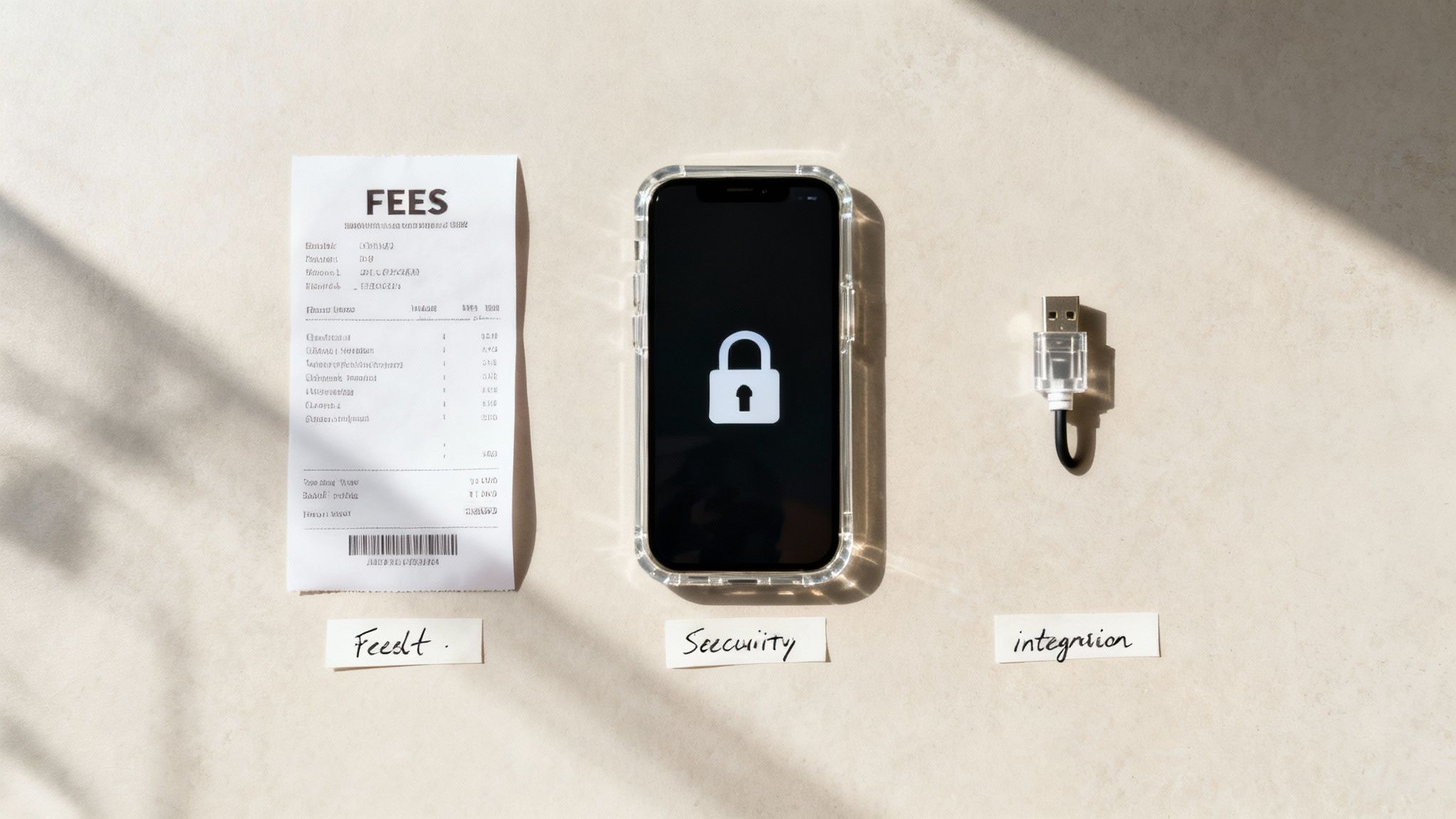
This is especially true when you put old-school systems up against modern options like Bitcoin gateways. One feels familiar, sure, but the other brings massive efficiencies in cost and security that are just too big to ignore.
Deconstructing Complex Fee Structures
Fees are the first thing we all look at, but that headline rate? It almost never tells the whole story. A seemingly low percentage can quickly get bloated by a bunch of hidden costs that quietly siphon off your profits.
Most traditional processors run on a percentage-plus-fixed-fee model, something like 2.9% + $0.30. If you sell low-cost items, that fixed fee is a killer. But the pain doesn't stop there. You've also got to watch out for:
- Monthly Fees: A regular charge just for the privilege of having an account.
- Setup Fees: An upfront cost to get your account activated.
- Chargeback Fees: A nasty penalty, often $15-$25 a pop, that hits you anytime a customer disputes a charge—even if you win.
- Currency Conversion Fees: Extra charges tacked on for processing international payments.
Bitcoin payment gateways, on the other hand, usually have a much simpler, more honest pricing model. Many operate on a low flat-rate percentage—often 1% or less—and that’s it. No setup fees, no monthly costs. This simple structure makes it a breeze to forecast your expenses and actually keep the money you earn.
Security and the Reality of Chargeback Fraud
For any small business, security is everything. With credit cards, the big buzzword is PCI DSS (Payment Card Industry Data Security Standard) compliance. It's a complicated maze of security rules meant to protect customer card data. While necessary, it's a huge burden and, critically, it does absolutely nothing to protect you from the single biggest threat to online merchants: chargeback fraud.
A chargeback is what happens when a customer complains to their bank, which then just yanks the money right out of your account. The system is ridiculously skewed in the customer's favor, and for every dollar of fraud, merchants lose another $0.65 just in operational costs trying to fight it.
This is where Bitcoin’s design gives you a massive, built-in advantage.
Because Bitcoin transactions are cryptographically secured and irreversible, the concept of a chargeback simply does not exist. Once a payment is confirmed on the blockchain, it is final. This single feature permanently eliminates the risk of chargeback fraud for merchants.
This fundamentally shifts power back to you, the business owner. It protects your revenue from fraudulent claims and gets rid of the administrative nightmare of fighting them.
Settlement Speed and Your Cash Flow
How fast you get your money after a sale is a huge deal for cash flow. As a small business, you can't afford to have your revenue locked up for days or even weeks.
The traditional banking system is built on delays. When a customer pays with a card, the money has to bounce between multiple middlemen, which is why settlement takes anywhere from 2 to 7 business days. If the sale is international, you can expect it to take even longer.
Bitcoin operates on a completely different clock. Payments are sent directly from the customer's wallet to yours on a peer-to-peer network.
- Transaction Confirmation: Payments are usually confirmed on the Bitcoin network in minutes.
- Final Settlement: Once confirmed, the money is yours. There's no intermediary holding it hostage.
This near-instant settlement gives you immediate access to your capital. You can reinvest it, pay suppliers, and manage your finances with a level of agility that's impossible with the old system.
Integrations and Compliance Considerations
Lastly, a payment gateway has to play nice with the tools you already use. Most gateways offer plugins for popular e-commerce platforms like Shopify, WooCommerce, and Magento. How easy it is to integrate is key—you want something you can set up in minutes, not days.
Compliance is another big piece of the puzzle. Traditional processors bury you in KYC (Know Your Customer) paperwork, demanding detailed personal and business information. Because Bitcoin gateways facilitate direct wallet-to-wallet transactions, they often have minimal or zero KYC requirements. This doesn't just get you onboarded faster; it adds a layer of privacy for both you and your customers.
Traditional Processors vs Bitcoin Gateways
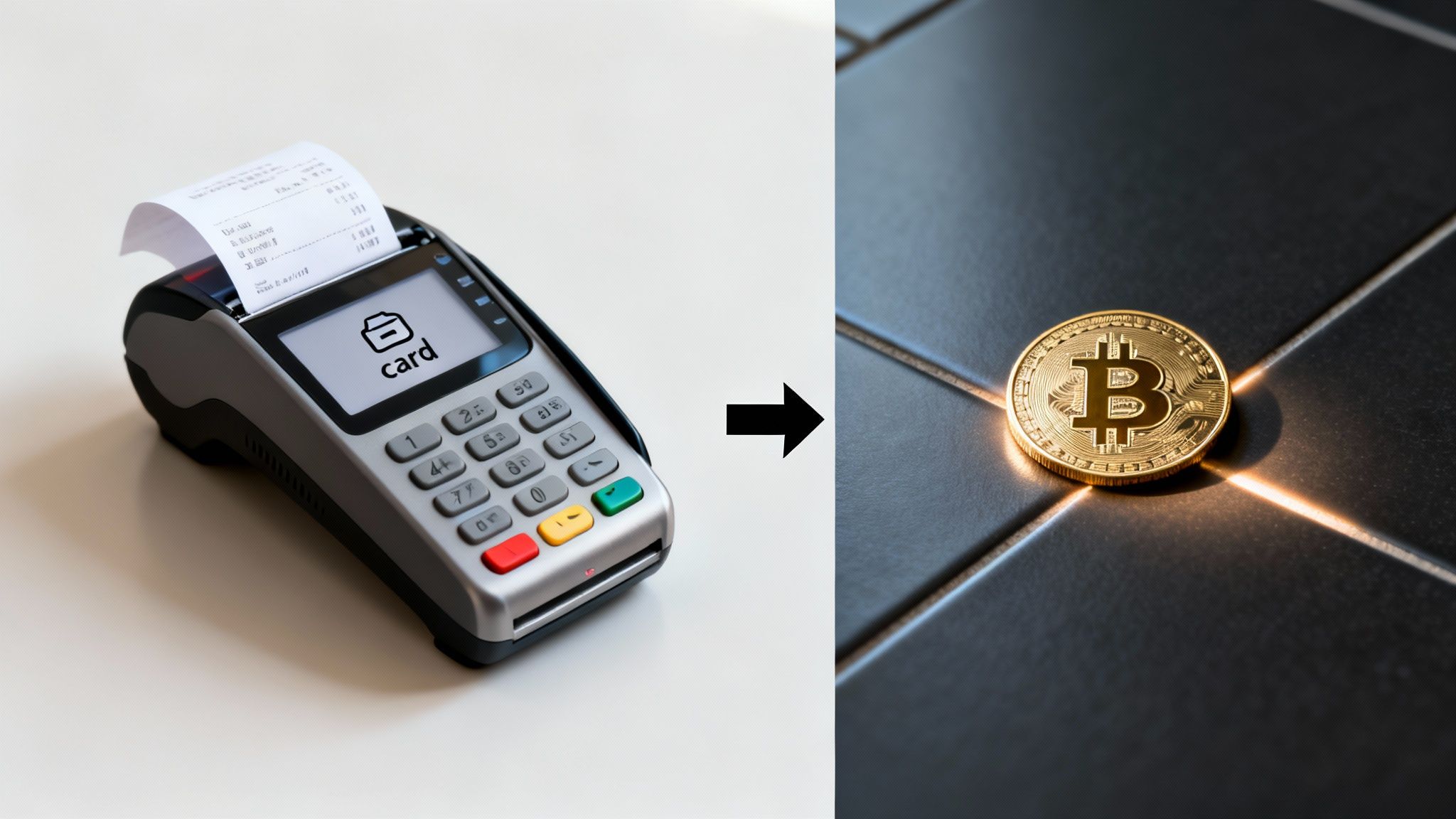
When picking the best payment gateway for your small business, you’re basically standing at a crossroads between two completely different worlds. In one direction, you have the giants you already know—PayPal and Stripe. In the other, you have the lean, efficient model of Bitcoin payment gateways.
Each path comes with its own financial and operational realities. Getting a handle on these differences is key to choosing a system that doesn't just take payments, but actually helps your business grow and stay profitable.
The Familiarity of Traditional Gateways
Traditional payment processors are the incumbents for a reason. They're woven into the fabric of global commerce and are what most customers expect at checkout. Their real strength is their massive adoption and the comfort that comes with a familiar process.
These platforms have built out huge ecosystems with tons of developer tools, ready-made integrations for almost any e-commerce platform you can think of, and brand names everyone recognizes. For a lot of new businesses, this plug-and-play setup is a massive win, letting them accept credit and debit cards right out of the gate.
But this convenience has a real cost, and it hits a small business’s bottom line hard. The fee structures can be a maze of percentage cuts, fixed per-transaction charges, monthly fees, and painful penalties for things like chargebacks.
The Problem of High Fees and Delays
The typical fee for a processor like Stripe or PayPal hovers around 2.9% + $0.30 for every transaction. That might not sound like much, but it adds up fast, especially if you're a high-volume business or sell low-margin items. Selling internationally? Tack on currency conversion fees that eat even more of your profit.
Settlement times are another big headache. Because these systems are built on the old-school banking network, it can take anywhere from two to seven business days for your money to actually show up in your bank account. That kind of delay can create serious cash flow problems for small businesses that need their capital now.
The core issue with traditional payment systems is their reliance on intermediaries. Every transaction must pass through multiple banks and networks, each taking a cut and adding delays, creating a system that is inherently slow and expensive for the merchant.
The Bitcoin Gateway Advantage
Bitcoin payment gateways were built to fix these very problems. By running on a decentralized, peer-to-peer network, they cut out the middlemen that make traditional finance so expensive and clunky. For any small business trying to operate more efficiently, this offers a powerful set of perks.
The most obvious win is the massive cut in transaction fees. Bitcoin gateways often charge a simple, flat fee of 1% or less, with no surprise costs. This straightforward pricing means you keep more of the money you earn from every single sale.
Let's break it down: on a $100 sale, a traditional processor could take $3.20. A Bitcoin gateway charging 1% would take just $1.00. That's an extra $2.20 going directly back into your business. Over hundreds or thousands of transactions, those savings become huge.
Eliminating Chargebacks and Global Friction
Beyond the cost savings, Bitcoin gateways offer something truly game-changing: complete immunity to chargeback fraud. Because Bitcoin transactions are final and irreversible, the whole concept of a customer disputing a charge and having the funds yanked from your account is gone. This one feature protects your revenue and frees you from the nightmare of fighting fraudulent claims.
On top of that, Bitcoin is a global currency by nature. It lets you take payments from anyone, anywhere in the world, without stressing about cross-border fees or currency conversion rates. The payment settles in minutes, not days, giving you almost instant access to your funds, no matter where your customer is.
A Head-to-Head Comparison
To make the choice crystal clear, let's put these two options side-by-side and look at the key operational features that really matter.
Feature Comparison: Traditional Gateways vs Bitcoin Gateways
The table below breaks down the fundamental differences in how these two types of gateways operate, from the fees you pay to the risks you face.
| Feature | Traditional Gateways (e.g., Stripe, PayPal) | Bitcoin Gateways |
|---|---|---|
| Average Fee | 2.9% + $0.30 | ~1% or less |
| Settlement Time | 2-7 business days | Minutes |
| Chargeback Risk | High; merchant is liable | Zero; transactions are final |
| Global Payments | Incurs currency conversion fees | Frictionless and borderless |
| Account Setup | Requires extensive KYC/documentation | Often requires no KYC |
While traditional processors still dominate the market, their model creates obvious hurdles for small businesses. PayPal, for example, controls about 45% of the online payment processing market. But its market share doesn't change the fundamental problems of high fees and chargeback risks that directly impact small business owners. To get a better sense of the market, you can read more about the global share of payment platforms.
Ultimately, your choice comes down to your priorities. If familiarity is what you value most, a traditional processor will get the job done. But for a small business focused on maximizing profit, protecting revenue, and reaching a global audience, a Bitcoin payment gateway offers a clear and compelling path forward.
Choosing Between Hosted and Integrated Gateways
After you've weighed traditional vs. Bitcoin gateways, your next big technical decision is how it will plug into your business. You're looking at two main paths here: hosted (off-site) or integrated (API-driven) gateways. This isn't just a tech choice; it fundamentally shapes your customer's checkout experience and how much work lands on your plate.
A hosted gateway is the simplest way to get started and is the go-to for most small businesses. Think of it as a secure, pre-built checkout page that your payment provider runs for you. When a customer hits "pay," they're sent from your site to this trusted, third-party page to handle their payment details.
The biggest win with this model is its sheer simplicity. Since the gateway provider manages the entire payment environment, they're the ones responsible for the heavy lifting of security and PCI DSS compliance. For a small business without a dedicated developer, this is a huge relief. You can get up and running quickly and sleep better at night.

Understanding Hosted Gateways
It's no surprise hosted gateways are so popular—they minimize risk and technical headaches. In fact, hosted solutions are projected to account for about 62% of revenue in 2024 because they streamline compliance and make onboarding a breeze. This is especially true for small and medium-sized businesses that need rock-solid payment processing without the cost of a big IT team. You can dive deeper into why this model leads the pack in the full payment gateway market report.
The trade-off? A slightly disjointed customer journey. Sending shoppers to another website can feel a bit clunky and might ding your conversion rates if the handoff isn't smooth. But for many merchants, offloading the security burden is well worth it.
Exploring Integrated (API) Gateways
An integrated gateway—often called an API-driven gateway—is the polar opposite. It uses an Application Programming Interface (API) to build the entire payment process directly into your own website. From the customer’s point of view, they never leave your domain.
This approach creates a seamless, fully branded checkout that feels slick and builds trust. You get total control over the design and flow of the entire payment experience, right down to the confirmation page. It's the perfect setup for businesses that want to deliver a premium, uninterrupted user experience.
Of course, with great power comes great responsibility.
With an integrated gateway, your own servers handle sensitive payment data. This means you are on the hook for implementing tough security measures and ensuring your systems are fully PCI compliant—a process that can be both technically demanding and expensive.
Making the Right Decision for Your Business
So, which is the best payment gateway for your small business? It really comes down to a clear-eyed look at your resources and priorities. There’s no one-size-fits-all answer; the right choice is the one that fits your technical skills, budget, and the kind of experience you want for your customers.
Here are the key things to consider:
- Technical Expertise: Do you have a developer who can securely implement an API and manage ongoing compliance? If the answer is no, a hosted gateway is the smarter, safer bet.
- Customer Experience: How critical is a perfectly branded, seamless checkout for your business? If you're selling a high-end product, the polished feel of an integrated gateway might justify the investment.
- Budget and Timeline: Integrated gateways demand a serious upfront investment of development time and money. Hosted solutions are pretty much plug-and-play; you can often get one running in hours, not weeks.
- Bitcoin Gateway Specifics: Many Bitcoin gateways, like Flash, offer hosted payment pages that are incredibly simple to set up. This gives you the security benefits of a hosted model combined with the low fees and finality of Bitcoin—a really powerful combination.
At the end of the day, start with what you can manage securely and effectively right now. You can always switch from a hosted to an integrated solution down the road as your business grows and you have more technical firepower.
Which Payment Gateway Fits Your Business Model?
Choosing the right payment gateway isn't some abstract exercise—it's about matching the tech to how your business actually works on the ground. The best choice depends entirely on how you sell, who you sell to, and where you're trying to go. Let's ditch the feature lists and dive into real-world business models to find the smartest payment strategy for each.
By looking at your specific situation, you can build a payment system that doesn't just take money but actively helps you grow by cutting costs and getting cash in your hands faster.
For E-commerce and Online Retailers
If you're running an e-commerce store, your game is all about two things: maximizing conversions and slashing costs. For online shops, especially those shipping both locally and internationally, a hybrid payment strategy is usually the smartest play.
You can keep a traditional gateway to handle domestic credit card payments, giving local shoppers the checkout they know and expect. At the same time, adding a Bitcoin payment option opens a massive door for international sales. This dual setup lets you completely sidestep cross-border fees and currency conversion losses on global orders, which means more profit from every single sale. If you're using a platform like Shopify, understanding the ins and outs of building a Shopify store effectively can sharpen your choice of gateway.
Think about it: for an e-commerce store selling a $150 product to a customer in Europe, a traditional processor might skim over $7 in processing and currency fees. With a Bitcoin gateway, that same transaction could cost as little as $1.50, and the money would be yours in minutes, not days.
This approach gives your customers options while making your backend more profitable and efficient—a critical edge in the cutthroat world of online retail.
For Digital Service Providers and Freelancers
Freelancers, consultants, and agencies have their own set of payment headaches, especially when clients are scattered across the globe. Traditional bank transfers and payment platforms are notoriously slow and gouge you on fees for cross-border deals.
This is where a Bitcoin payment gateway isn't just nice to have; it's a game-changer. It directly solves the biggest pains for service businesses by offering a cheap, direct, and nearly instant way to get paid from anywhere on the planet.
- No More Bank Delays: Forget waiting 5-7 business days for an international wire to clear. A Bitcoin payment lands in your wallet and is confirmed in minutes.
- Dodge the High Fees: You completely bypass the correspondent bank fees and awful currency conversion rates that can easily eat up 3-5% of your total invoice.
- Ironclad Proof of Payment: The Bitcoin ledger is public and can't be changed, giving you undeniable proof of payment. No more "the check is in the mail" excuses.
For a web developer in the US billing a client in Japan, accepting Bitcoin means they get the full amount they invoiced, fast. That's a massive improvement to cash flow.
For Subscription and Membership Businesses
If your business runs on recurring revenue—like a SaaS platform, membership site, or subscription box—you live and die by smooth, automated billing. While plenty of traditional gateways offer recurring payments, they're built on a shaky foundation.
Credit card details expire. Cards get lost or canceled. Every time that happens, a payment fails, leading to involuntary customer churn. Each failure kicks off a dunning process to chase down new info, wasting time and risking the loss of a good customer.
Using a Bitcoin payment gateway like Flash for subscriptions provides a far more durable solution. When you set up recurring payments directly from a customer's Bitcoin wallet, you create a payment channel that isn't tied to the fragile credit card system. This direct wallet-to-wallet link dramatically cuts the risk of payments failing because of outdated card info.
This modern approach leads to more predictable revenue, slashes the admin work of chasing failed payments, and offers a secure, forward-thinking option for a growing global audience that prefers direct digital transactions.
Got Questions About Payment Gateways? We've Got Answers.
Jumping into the world of payment gateways can feel like learning a new language. To wrap things up, here are some straight-talking answers to the questions we hear most often from small business owners. This should clear up any lingering doubts and help you lock in your choice with confidence.
Do I Need a Merchant Account to Use a Payment Gateway?
Not always, and this is where things get interesting. Traditional players like Stripe or PayPal bundle the merchant account and the gateway together. It’s certainly easier than the old days of juggling separate agreements, but you're still playing squarely within the traditional banking system.
Bitcoin gateways, on the other hand, operate completely outside of that system. They facilitate direct, peer-to-peer payments from your customer's Bitcoin wallet straight to yours. Since there are no bank intermediaries, no merchant account is required. This massively simplifies your setup and cuts down on the compliance headaches.
How Much of a Headache Is It to Switch Gateways Later On?
That really depends on what you're switching from and to. Moving between traditional card processors can be a real pain. The biggest snag is often that your customer's stored payment info can't be moved over, forcing your regulars to re-enter all their details. That’s a surefire way to kill a sale.
Adding or switching to a Bitcoin payment gateway is a totally different story. You can plug it in right alongside your existing credit card processor without disrupting anything. This lets you offer Bitcoin as a new payment option and test the waters—enjoying benefits like lower fees and zero chargebacks—completely risk-free.
This parallel approach gives you the best of both worlds. You can introduce customers to a new way to pay without forcing a sudden, jarring change on anyone.
Are Bitcoin Payment Gateways Actually Secure for My Customers?
Yes, and they offer a different, arguably stronger, type of security for both you and your customers. As a merchant, the killer feature is the cryptographic security of the Bitcoin network itself. Once a transaction is confirmed on the blockchain, it's irreversible. This completely eliminates the risk of chargeback fraud.
For your customers, paying with Bitcoin is a huge boost for their privacy and security. They never have to transmit sensitive credit card numbers or personal info across the internet. Instead, they just authorize the payment directly from their own secure Bitcoin wallet, drastically reducing their exposure to data breaches and identity theft. Just remember, the security of your funds depends on your own wallet practices, so picking a reputable, non-custodial wallet is a must.
Can I Take Both Credit Cards and Bitcoin?
Absolutely. In fact, for most small businesses, this hybrid strategy is the smartest way to go. You can keep your traditional gateway for customers who want to use their credit cards while offering a Bitcoin option through a separate gateway. You cater to everyone and never miss a sale.
Running a dual-gateway setup gives you maximum flexibility. It lets your business tap into the unique advantages of Bitcoin—like its tiny transaction fees, instant global settlement, and immunity to fraud—without leaving behind customers who are more comfortable with the old ways. More ways to pay means a better checkout experience, which leads directly to a healthier bottom line.
Ready to unlock the power of instant, low-fee, and fraud-proof payments? Flash provides the tools you need to accept Bitcoin in under a minute, with no KYC and wallet-to-wallet transactions that put you in full control. Join the growing economy of over 500 million Bitcoin users and see the difference for your small business. Start accepting Bitcoin today.