Picking the right payment processing software is one of those foundational decisions that can make or break a small business. It's not just about getting paid; it’s about cash flow, customer experience, and the security of every single dollar that comes through your door (or website). For most businesses, the big names like Stripe, PayPal, and Square are the go-to choices for handling credit cards. But for those looking to dive into the world of Bitcoin, BTCPay Server is a standout option for accepting it directly, completely cutting out the middleman.
The best fit for you really boils down to your business model. Are you running an online shop that needs a developer-friendly gateway? Or a retail store needing an all-in-one system? Maybe you're a freelancer who wants direct control over Bitcoin payments. Each scenario points to a different solution.
Choosing Your Small Business Payment Software
This choice directly impacts your bottom line and how smoothly your business operates. With the global payment processor market hitting around $54.32 billion in 2024—a number expected to nearly double by 2032—it's clear that digital payments are no longer optional. The pressure is on to pick a partner that won’t just take a cut, but will actually help you grow. You can learn more about these market shifts in this detailed report.
Comparing Top Payment Processors
Before we get into the weeds of feature lists, let's look at the big picture. Some processors are built for the hustle and bustle of in-person sales, while others live and breathe e-commerce. Then you have specialists, like those focused on Bitcoin. And remember, processing payments is just one piece of the puzzle. Managing your accounts receivable and keeping cash flow healthy is just as important, which is where tools like the top invoice factoring software solutions come into play.
The key is to match the processor's core function to your business model. An e-commerce store has vastly different needs than a local cafe, and a service provider accepting international payments faces unique challenges that a self-hosted Bitcoin processor can solve.
To make things a bit clearer, here’s a quick rundown of how the leading options stack up against each other for different business needs.
Top Payment Processors For Small Business At a Glance
This table gives you a high-level look at our top picks, helping you see at a glance which processor might align with your business goals, fee structure, and interest in Bitcoin.
| Processor | Best For | Standard Online Fee | Bitcoin Support |
|---|---|---|---|
| Stripe | Online businesses & API integrations | 2.9% + 30¢ | Via third-party integrations |
| PayPal | E-commerce & brand recognition | 2.99% + 49¢ | Limited, custodial options |
| Square | Brick-and-mortar & retail POS | 2.9% + 30¢ | Limited, custodial options |
| BTCPay Server | Direct Bitcoin acceptance & no fees | 0% (self-hosted) | Native, non-custodial support |
As you can see, the "best" option is entirely situational. An online-first business will likely gravitate towards Stripe's powerful tools, while a physical shop will find an all-in-one ally in Square. Meanwhile, BTCPay Server offers a compelling, fee-free alternative for those ready to embrace Bitcoin directly.
What Really Makes Payment Software Great?
Before we jump into a side-by-side comparison, let's get on the same page about what separates a great payment processor from one that just gets the job done. The best software isn't just about taking money; it's a core part of your business operations, security, and bottom line. Think of it as the central nervous system for your revenue.

This isn't a small decision. The global payment processing market ballooned to $61.1 billion in 2023, and it's not slowing down. There's a reason 72% of small businesses now see their payment processor as their primary partner for managing financial services—from spotting fraud to staying compliant.
Breaking Down Transaction Fees
Fees are the first thing everyone looks at, but the pricing structures can feel intentionally confusing. Getting this right is crucial for managing your costs.
- Flat-Rate Pricing: This is the no-fuss model. You pay a simple, fixed percentage plus a small fee for every transaction (think 2.9% + 30¢). It's predictable, which is perfect for new businesses or those with lots of small-ticket sales.
- Interchange-Plus Pricing: This one is more transparent. You pay the direct interchange fee from the card network (like Visa or Mastercard) and the processor adds their fixed markup on top. For businesses pushing higher sales volumes, this almost always works out cheaper.
A new small business often benefits from the pure simplicity of a flat rate. You can forecast your expenses without getting lost in the weeds of interchange tables. But as you grow, the savings from an interchange-plus model can become too significant to ignore.
Security and PCI Compliance are Non-Negotiable
Let's be clear: security isn't just a feature, it's the foundation. Your payment processor absolutely must adhere to the Payment Card Industry Data Security Standard (PCI DSS). This is the rulebook that ensures customer card data is locked down, protecting both you and your customers from the nightmare of a data breach.
When a processor handles PCI compliance for you, it takes a massive weight off your shoulders. You can get back to running your business, knowing that all that sensitive data is being protected by things like encryption and tokenization.
Seamless Integrations and Welcoming All Payments
The best software doesn't live on an island. It needs to play nicely with the tools you already rely on—your accounting software, e-commerce platform, or inventory system. A key piece of this puzzle is the payment gateway, which is the bridge that enables different transaction types to work. If you want to dig into the technical side, check out this excellent a guide to payment gateway integration.
Beyond that, the more ways you can let customers pay, the better. This goes beyond just credit and debit cards. Embracing Bitcoin, for example, does more than just look modern. It opens your doors to a global, tech-savvy audience and comes with perks like lower fees and zero chargebacks. A processor that supports both old-school and new-school money gives you the ultimate flexibility.
A Practical Comparison Of Leading Payment Processors
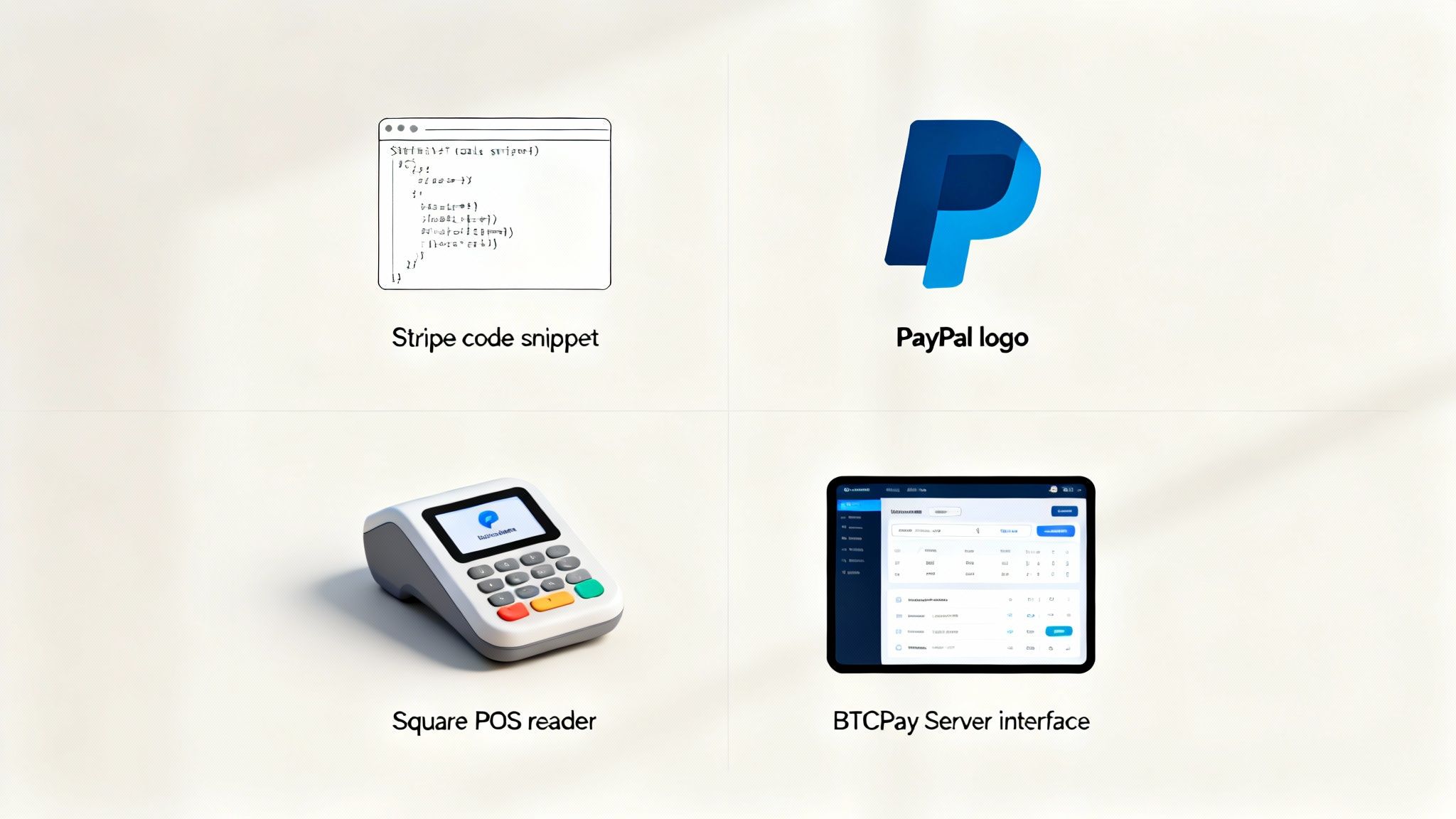
Choosing the right payment processor for your business means looking past the slick marketing and getting into the nitty-gritty of how they actually work. We're talking about the developer-first power of Stripe, the familiar comfort of PayPal, the retail muscle of Square, and the pure financial sovereignty of a Bitcoin-native solution like BTCPay Server.
Each of these platforms was built to solve a different problem, and the "best" one is entirely dependent on what you sell, how you sell it, and who you sell it to.
The market for this tech is exploding—it's on track to hit a staggering $94.72 billion by 2025 and will keep climbing. This massive growth is driven by small businesses demanding reliable, secure, and flexible ways to get paid. You can dig into more of the data and trends on datainsightsmarket.com.
Stripe For Online Customization
Stripe has cemented its place as the top choice for online-first businesses that crave control and flexibility. Its real magic lies in its powerful API, which lets you build a completely custom checkout experience from the ground up. If you’re running a SaaS platform, a unique e-commerce store, or any online model that needs a specific payment flow, Stripe gives you the developer tools to do it right.
But that power comes with a learning curve. While Stripe has user-friendly options like Payment Links, tapping into its full potential usually requires some coding know-how or a developer on hand. It's the perfect fit when your top priority is a slick, branded online payment experience, not an all-in-one system for a physical store.
PayPal For Brand Recognition And Trust
PayPal’s superpower is its brand. With a massive global user base, that familiar blue button is an instant signal of trust for customers, and that trust can make a real difference in cutting down on abandoned carts. It’s also incredibly easy to get started with, making it a go-to for new businesses that just need to start accepting payments now.
The trade-off? PayPal's checkout process often pulls customers away from your website to its own, which can break the flow of the shopping experience. Its fees can also be a bit higher than the competition, and it's known for having pretty strict policies on holding funds. It's best for businesses that want a simple, trusted, plug-and-play solution for online payments without needing deep technical customization.
Square For Integrated In-Person Sales
For any business with a physical footprint, Square is the king. It has built an entire ecosystem around brick-and-mortar sales, from simple card readers to sophisticated POS registers that all work seamlessly with its software for inventory, appointments, and even payroll. This all-in-one approach is a lifesaver for cafes, boutiques, and service-based businesses.
The real value of Square is its unified ecosystem. A customer can book an appointment online, pay in-person with a card, and get a digital receipt, all while the transaction and inventory data sync automatically. This level of integration is difficult to replicate with other processors.
While Square does have online payment tools, they aren't nearly as customizable as Stripe's. The company's DNA is firmly rooted in creating a powerful, streamlined experience for businesses that interact with customers face-to-face.
BTCPay Server For Financial Sovereignty
BTCPay Server is playing a completely different game. As a self-hosted, open-source platform, it lets you become your own payment processor for Bitcoin. That means zero transaction fees from the platform, no third-party holding your money, and no risk of your account being frozen. Payments go straight from your customer's wallet to yours.
This gives you an incredible amount of control and can save you a ton of money, especially if you deal with international customers or want to eliminate chargebacks. The big consideration here is the technical side—you're responsible for setting up and maintaining the server yourself. It’s the ultimate choice for merchants who want to cut out the middlemen and take full custody of their revenue.
Detailed Feature And Fee Comparison
To make sense of the key differences, it helps to see everything laid out side-by-side. This table breaks down the core features and costs you'll encounter with each platform.
| Feature | Stripe | PayPal | Square | BTCPay Server |
|---|---|---|---|---|
| Transaction Fees | 2.9% + $0.30 for online cards | 2.99% + $0.49 for online cards | 2.6% + $0.10 for in-person; 2.9% + $0.30 online | 0% (only Bitcoin network fees apply) |
| Best For | E-commerce, SaaS, Platforms | Quick online setup, high-trust checkout | Retail, Restaurants, In-person services | Bitcoin-only merchants, Financial sovereignty |
| Payout Schedule | 2 business days (customizable) | Instant to PayPal balance, 1-3 days to bank | 1-2 business days (instant for a fee) | Instant (direct to your Bitcoin wallet) |
| Integration | Extensive API, developer-focused | Simple buttons & hosted checkout | POS hardware, Online Store builder | Open-source, self-hosted integration |
| Chargeback Fees | $15 per dispute (often waived if you win) | $20 per dispute | $0 (Square covers up to $250/month) | $0 (Bitcoin transactions are final) |
| Bitcoin Support | No (Discontinued) | Yes, but custodial (buy/sell/hold) | Yes, via Cash App integration | Native, non-custodial and direct |
This comparison highlights the fundamental trade-offs. While Stripe, PayPal, and Square compete on fees and features within the traditional finance world, BTCPay Server offers a completely different path for those ready to embrace a decentralized payment model. Your choice depends entirely on your business's priorities—be it customization, trust, physical integration, or true financial independence.
Integrating Bitcoin Payments Into Your Business
Deciding to accept Bitcoin isn't just about adding another payment button at checkout. It's about tapping into a global, tech-savvy customer base and unlocking some pretty significant financial advantages for your small business.
Unlike credit card payments, Bitcoin transactions are final. This completely wipes out the risk of expensive, time-sucking chargebacks. For anyone selling digital goods or high-value items, that level of payment certainty is a game-changer.
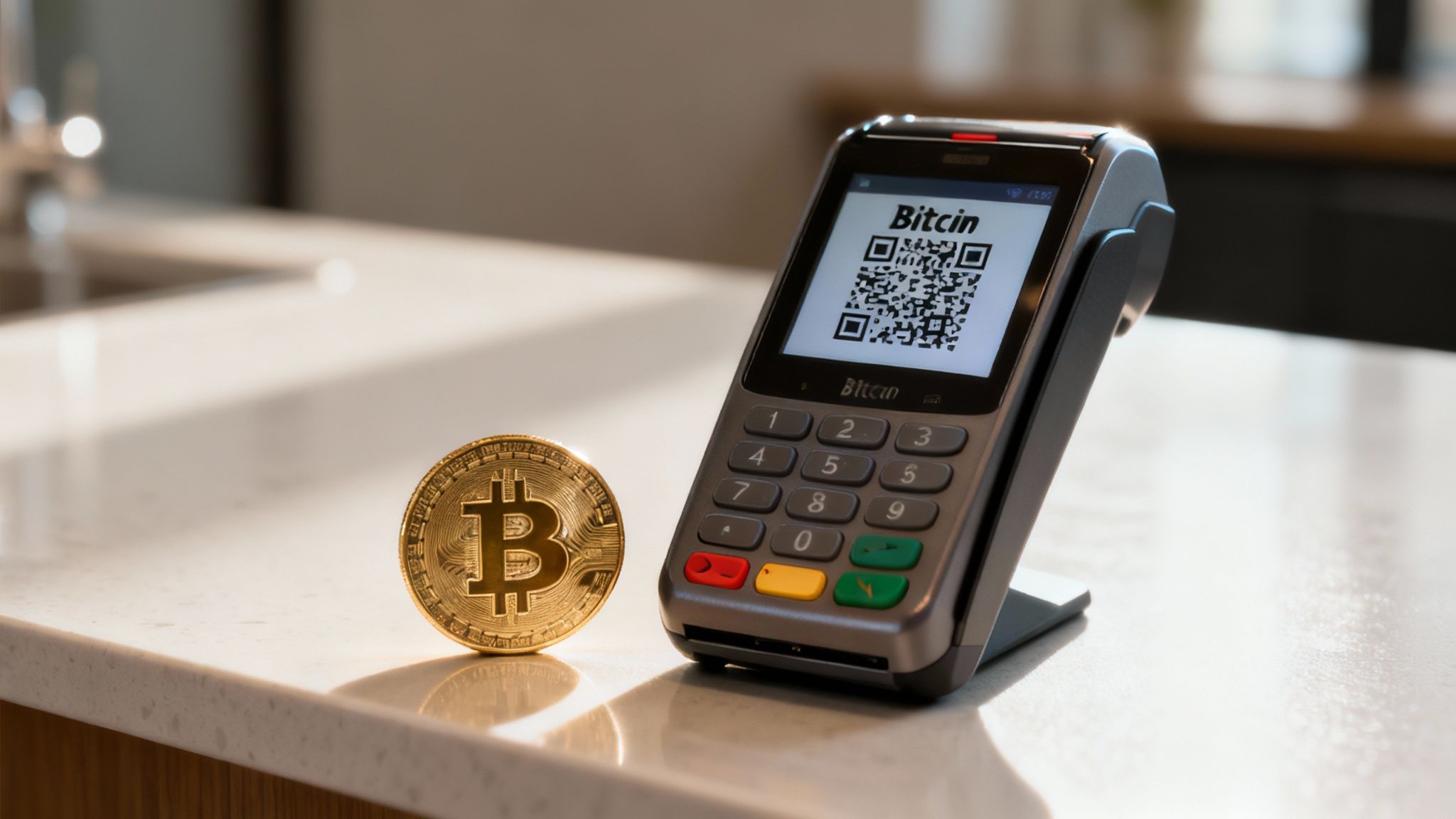
On top of that, Bitcoin is a peer-to-peer network. Payments go straight from your customer's wallet to yours, cutting out the middlemen who skim fees off the top. This direct line not only slashes transaction costs but also shrinks settlement times from days down to minutes. It's a powerful way to hang on to more of your revenue and seriously improve your cash flow.
Choosing Your Integration Method
So, how do you actually start accepting Bitcoin? You've got two main routes: using a third-party processor that handles the heavy lifting, or going with a self-hosted solution for total control. The right choice really boils down to your technical comfort level and what you want to achieve.
- Third-Party Processors: These services make it incredibly easy to accept Bitcoin and have it instantly converted into your local currency. This approach is great because it shields you from Bitcoin's price swings—you get the exact dollar amount you charged. The downside? They charge processing fees, and you're trusting someone else with your money.
- Self-Hosted Solutions: For businesses that want to be their own bank, a self-hosted platform like BTCPay Server is the gold standard. It's open-source software that lets you process payments with zero processing fees. The Bitcoin goes directly into a wallet you control, giving you full custody and financial sovereignty.
For a small business, the decision hinges on a simple trade-off: convenience versus control. A third-party processor offers simplicity and shields you from volatility, while a self-hosted solution like BTCPay Server delivers financial sovereignty and eliminates processing costs.
Setting Up Your Bitcoin Payment Option
Getting started is a lot more straightforward than most people think. A non-custodial approach, where you control your own funds, gives you the most security and freedom.
Here’s the basic game plan:
- Select a Secure Bitcoin Wallet: First things first, you need a safe place to receive and store your Bitcoin. It's absolutely crucial to pick a non-custodial wallet where you—and only you—control the private keys.
- Choose Your Processing Software: Next, install and set up a self-hosted solution like BTCPay Server. Think of it as your own personal payment gateway that generates unique addresses for every single transaction.
- Integrate With Your Store: Finally, connect your new Bitcoin processor to your e-commerce platform or point-of-sale system. Most of these solutions have simple plugins for popular platforms, which makes the integration process surprisingly smooth.
By following these steps, you can offer a modern, low-cost payment method that opens your doors to a growing global market. Adding Bitcoin is a strategic move that not only improves your bottom line but also positions your small business at the forefront of financial technology.
Figuring out the features and fees is one thing, but how do these payment processors actually perform in the real world? That’s what really matters. The right choice for your small business comes down to what you sell, who you sell to, and how you operate.
Let’s break down a few common business scenarios to see which platform makes the most sense. Seeing how each one solves a specific problem will help you feel much more confident in your own decision.
For The Online Shopify Store
Let's say you're running an e-commerce store on Shopify, selling handmade goods to customers all over the country. Your main goals are a dead-simple checkout that doesn't scare customers away and fees you can actually predict.
In this situation, Stripe is almost always the path of least resistance.
Its integration with Shopify is so deep that setup is a breeze. The checkout process feels like it’s part of your store, not some clunky third-party handoff, which is huge for cutting down on abandoned carts. Plus, as your store grows, Stripe’s developer tools give you the flexibility to customize the experience—a major leg up over more rigid systems.
For The Local Coffee Shop
Now, think about a busy neighborhood coffee shop. You need to handle a line of customers quickly for in-person sales but also want to let people order ahead online for pickup. This kind of hybrid business needs a single system to manage both sides without turning into an operational nightmare.
This is where Square absolutely crushes it.
Their point-of-sale (POS) hardware is built for the chaos of a retail environment—it’s fast and reliable. Because it's an all-in-one ecosystem, an online order syncs instantly with your in-store system. That means your inventory and sales data are always aligned, with no manual tracking needed.
For any business with both a physical and digital footprint, a unified ecosystem is a lifesaver. Square gets rid of the headache of trying to manage separate systems for your in-person and online sales, creating one central hub for all your revenue.
For The Digital Services Agency
Finally, what about a digital marketing agency with clients scattered across the globe? This business has two big payment headaches: insane cross-border transaction fees and painfully long settlement times from traditional banks. Accepting international payments can quickly chew through your profits and mess with your cash flow.
This is a perfect use case for bringing in Bitcoin payments with a self-hosted platform like BTCPay Server.
By accepting Bitcoin directly, the agency sidesteps the entire traditional banking system. This isn't just a small change; it completely slashes transaction fees, gets rid of currency conversion costs, and delivers near-instant settlement. Payments move directly from the client’s wallet to the agency's, with no middleman holding onto the funds. For any business operating on a global scale, this approach offers control, speed, and savings that old-school payment rails just can't match.
Trying to make sense of payment processing can feel like wading through alphabet soup. As a business owner, you just want to know what works, what's safe, and what won't eat into your profits. Let's clear up some of the most common questions.
My goal here is to give you the straightforward answers you need to pick the right payment tools for your small business with confidence.
What Is The Cheapest Way To Process Payments?
This really boils down to how much you sell and what your average sale looks like. If your sales are on the lower side or fluctuate month to month, a flat-rate processor like Square or Stripe is usually your best bet. Their simple model (around 2.9% + $0.30 for online sales) means no surprise monthly fees, so you always know what you're paying.
Once your business is doing consistent, high-volume sales, it's worth looking into a traditional merchant account with interchange-plus pricing. It can be cheaper in the long run, but be prepared for more complex monthly statements and a few extra fees.
The absolute cheapest way? Go direct with a self-hosted Bitcoin solution like BTCPay Server. You cut out the middleman entirely, so all you pay is a tiny network fee. This means you keep virtually 100% of your revenue from every single sale.
Do I Need A Merchant Account For Stripe Or PayPal?
Nope. You can skip the traditional merchant account entirely with services like Stripe, PayPal, or Square. These platforms are what we call payment service providers (PSPs). They essentially bundle a bunch of small businesses like yours under their own massive merchant account.
This is a huge time-saver. It lets you sidestep the painfully slow application and underwriting process that comes with getting a dedicated merchant account, meaning you can get up and running and start taking payments way faster.
How Can I Start Accepting Bitcoin Payments Safely?
When it comes to accepting Bitcoin, one rule trumps all others: control your own private keys. The only truly safe and sovereign way to do this is with a non-custodial, self-hosted setup. This guarantees that customer payments go straight into a Bitcoin wallet that only you can access.
The gold standard for this is using open-source software like BTCPay Server. It lets you become your own payment processor, completely removing any third-party that could freeze your funds or block a transaction.
Here’s the basic game plan:
- Step 1: Get your self-hosted payment server up and running.
- Step 2: Link it to a secure, non-custodial Bitcoin wallet that you control.
- Step 3: Integrate the payment gateway into your online store or point-of-sale system.
- Step 4: This one is non-negotiable: create a secure, offline backup of your wallet's seed phrase and store it somewhere safe.
Taking this direct, peer-to-peer route gives you total security and financial freedom.
What Is PCI Compliance And Why Is It Important?
PCI compliance is short for the Payment Card Industry Data Security Standard (PCI DSS). Think of it as the mandatory rulebook for any business that touches credit card information—whether you accept, process, store, or transmit it. The whole point is to create a secure environment that protects customer data from getting into the wrong hands.
For a small business, this is a very big deal. A data breach can not only cost you a fortune but can also destroy the trust you've built with your customers. Using a trusted processor like Stripe or Square is a massive help here. They handle the heaviest, most sensitive security requirements on their own certified servers, which drastically reduces your risk and liability.
Ready to offer your customers a modern, secure, and low-cost payment option? With Flash, you can start accepting Bitcoin payments in under a minute. Our non-custodial software ensures that funds go directly to your wallet, giving you complete control with no middlemen and no KYC.
Get started with Flash today and join the future of commerce.