Picking the right Point of Sale (POS) system is one of the most important decisions you'll make as a restaurant owner. Today, the names that keep coming up for a reason are Toast, Square, and Lightspeed. These guys have nailed the formula, blending powerful order management, hardware that can take a beating, and flexible payment processing into one clean package.
How to Choose Your Restaurant POS System
A modern restaurant POS isn't just a glorified cash register. Think of it as the central nervous system for your entire business. It has to manage everything from the moment a customer walks in to the second their payment hits your account. The right system connects your front-of-house team with the kitchen, creating a smooth workflow that keeps everyone sane.
This guide will break down the leading platforms side-by-side, giving you a clear path to making a smart decision. We'll dig into the criteria that actually matter when the dinner rush hits.
Core Evaluation Criteria
When you're comparing the best POS systems for restaurants, you need to look past the shiny features on the homepage. The real test is how it performs in the chaos of a real-world restaurant.
Here’s what you should be focusing on:
- Ease of Use: A POS with a straightforward interface means less time training new staff and fewer mistakes during peak hours. If your team can't figure it out in minutes, it's the wrong system.
- Hardware Reliability: Restaurant-grade hardware is non-negotiable. Spills, drops, and constant tapping mean you need equipment built for a warzone, not an office.
- Integration Capabilities: Your POS has to play nice with the other tools you rely on, whether it's your online ordering platform, delivery apps, or accounting software.
- Transparent Pricing: Getting a clear picture of the total cost—software fees, hardware, and payment processing rates—is essential. No one likes surprise charges on their monthly statement.
A great POS system isn't just for taking orders; it's a strategic asset that hands you the data and efficiency you need to grow your business and keep up with what customers want.
The Rise of Modern Payment Solutions
On top of the usual credit cards and cash, smart restaurant owners are now looking at systems that can handle modern digital payments. The ability to accept Bitcoin is becoming a real differentiator, attracting a growing crowd of tech-savvy customers who prefer it.
This kind of flexibility doesn't just improve the guest experience; it can also offer some serious advantages in transaction fees and how quickly you get your money.
Here’s a quick rundown of what to look for when you’re sizing up the payment side of things.
| Feature Area | Key Considerations for Evaluation |
|---|---|
| Card Processing | Look for competitive and clear pricing, whether it's interchange-plus or a simple flat rate. |
| Bitcoin Support | Does the system offer a direct, seamless integration with Bitcoin payment gateways? |
| Contactless Payments | Native support for NFC payments like Apple Pay and Google Pay is a must-have. |
| Hardware | Are the terminals fast, reliable, and easy for both your staff and your customers to use? |
The Shift to Cloud-Based Restaurant POS

Before we jump into a side-by-side comparison of the best restaurant POS systems, it’s worth taking a moment to understand the tech that’s running the show. The industry has made a decisive break from the past—those clunky, server-based terminals that kept all your data locked away in the back office. Today, the clear winner is the cloud.
This isn't just some passing trend; it's a fundamental change in how restaurants are run. Cloud-based POS systems store your data on remote servers, which means you can get to it from anywhere with an internet connection. This simple but powerful shift unlocks a whole new level of agility for restaurant owners.
Why Cloud Technology Dominates
The magic of a cloud-based POS really comes down to one word: flexibility. With an old-school on-premise system, you were physically tethered to the restaurant. If you needed to check daily sales, tweak a menu item, or pull a report, you had to be standing right there.
Cloud technology shatters those chains. You can log into your POS dashboard from a laptop at home or even a smartphone while on vacation and see exactly what's happening in real-time. For anyone trying to manage operations, especially across multiple locations, this is an absolute game-changer.
On top of that, software updates just happen. No more scheduling a technician to come in and install new features or security patches—a process that was always costly and disruptive. Cloud systems update seamlessly in the background, so you always have the latest tools without any downtime.
The Power of Real-Time Data and Scalability
One of the biggest wins of moving to the cloud is having instant access to business intelligence. Legacy systems often made you manually export data to run reports, which was a time-consuming chore. A modern cloud POS gives you a live dashboard with all your key metrics right at your fingertips.
This data-driven approach means you can make smarter decisions, faster. You can instantly see which dishes are flying out of the kitchen, pinpoint your busiest hours, and track staff performance without having to wait for end-of-day summaries.
The real value of a cloud-based POS is its ability to grow with you. Adding a new terminal, launching a food truck, or opening a second location is as simple as activating new devices—not overhauling your entire IT infrastructure.
This kind of scalability is driving massive adoption across the industry. The global restaurant POS terminals market is valued at around $26.04 billion in 2025, with an estimated 83% of US restaurants now using cloud-based solutions. It’s a clear signal that the industry prefers systems that can adapt. You can dive deeper into the data on POS system adoption trends to see where the market is headed.
The Rise of Mobile POS for Better Service
The move to the cloud also paved the way for mobile POS (mPOS) technology. Servers can now take orders and process payments right at the table using tablets or handheld devices. It seems like a small change, but it has a huge impact on the guest experience.
- Increased Speed and Efficiency: Orders fire directly to the kitchen from the tableside. That means less time for servers walking back and forth to a stationary terminal and faster service for your guests.
- Improved Order Accuracy: When servers input orders directly, the chance for human error drops dramatically. No more trying to decipher messy handwriting from a notepad.
- Enhanced Customer Interaction: With the transactional part of the job streamlined, servers can spend more quality time with guests, answering menu questions and providing a more personal touch.
This tableside tech doesn't just make your operation run smoother; it modernizes the entire payment process, leading to faster checkouts and happier customers.
Comparing the Top Restaurant POS Systems
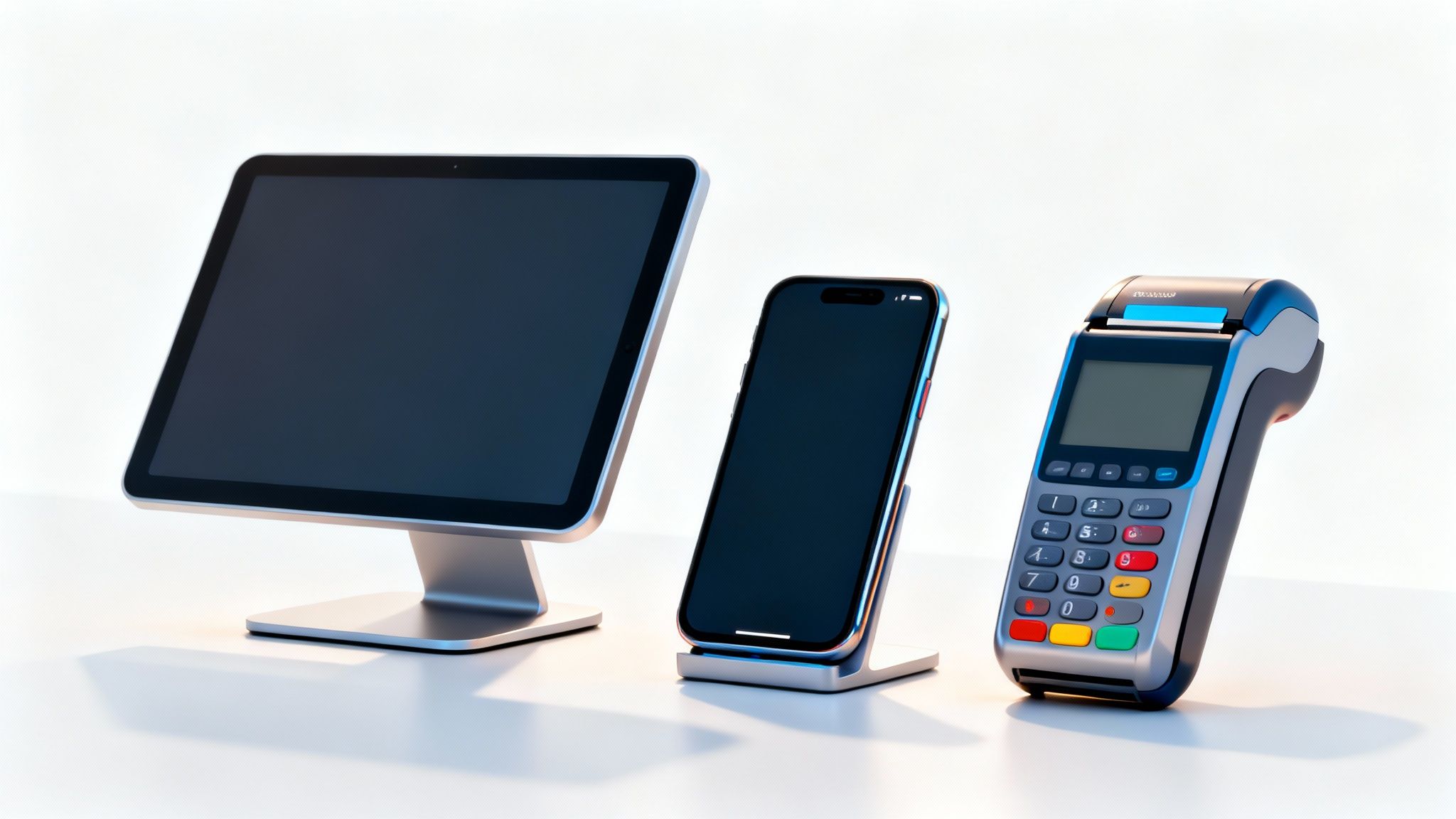
Choosing from the best POS systems for restaurants isn't about picking the one with the longest feature list. It's about understanding how a platform actually performs in the controlled chaos of a real restaurant. Top names like Toast, Square for Restaurants, and Lightspeed have all earned their stripes, but they are absolutely not one-size-fits-all. Each was built with a different kind of restaurant in mind, and they shine in very different ways.
This guide will put these systems under a microscope. We're going beyond the marketing fluff to analyze their core strengths and weaknesses, from the durability of their hardware to the intelligence of their management tools. A big piece of this puzzle is payment flexibility—especially the ability to accept modern payments like Bitcoin, which is quickly becoming a serious differentiator.
Toast Restaurant POS: A Deep Dive
Toast is what many consider the industry benchmark, a system built from the ground up just for restaurants. You can feel that singular focus in everything from its rugged, kitchen-proof hardware to a software suite that touches every part of the operation, front to back.
The hardware is genuinely built to survive. We're talking spill-proof terminals and durable handhelds that can take a beating on a busy service floor. Software-wise, Toast's command of complex order management is its superpower, with the kind of detailed modifiers and coursing options that a full-service dining room can't live without.
Its all-in-one model bundles hardware, software, and payment processing. This makes for a beautifully seamless experience, but it also locks you into their ecosystem and their processing rates. For operators who want a powerful, turnkey solution without juggling vendors, Toast is a beast.
Key Takeaway: Toast is the go-to for established, high-volume restaurants that need an all-in-one powerhouse. Its true value lies in deep operational control, from intricate menus to granular back-end reporting.
But that comprehensive power comes at a price. While Toast has a starter plan, its real potential is unlocked through add-on modules for things like online ordering, loyalty, and serious inventory management. Those extras can add up, increasing the monthly bill significantly.
Square for Restaurants: The Accessibility Champion
Square for Restaurants offers a much friendlier on-ramp to the world of modern POS systems. Known for its dead-simple interface and transparent, flat-rate pricing, Square is a magnet for smaller spots like cafes, food trucks, and quick-service joints.
The software is incredibly intuitive. You can get new staff trained and taking orders in minutes. A huge draw is the free starter plan, which delivers core POS functions without a monthly subscription, making it one of the best POS systems for restaurants on a tight budget.
Where Square really nails it is flexibility and setup. You can run the whole system on iPads, keeping those initial hardware costs way down. Plus, it plugs right into the wider Square ecosystem—payroll, marketing, online stores—giving you a clear path to scale as your business grows.
For a complex, full-service restaurant, however, Square's feature set might feel a bit light compared to Toast. The reporting is solid for day-to-day use but can lack the deep, granular detail a multi-location operator needs. And while that flat-rate processing is simple, it isn't always the cheapest for high-volume businesses.
Lightspeed Restaurant: The Data-Driven Powerhouse
Lightspeed Restaurant carves out its niche with best-in-class inventory management and advanced analytics. This is the system for restaurants where tight stock control is everything—think places with huge bar programs or multiple locations needing centralized purchasing.
The platform gets down to ingredient-level inventory tracking, letting you monitor food costs with incredible precision. You can manage purchase orders, get low-stock alerts, and track waste right in the POS. For an operator focused on shaving points off their cost of goods, this level of detail is a game-changer.
Lightspeed also delivers some seriously powerful reporting, giving you deep insights into sales trends, staff performance, and customer habits. It's a data-driven approach designed to help you make smarter decisions about your menu, staffing, and marketing.
Like Square, the system runs on iPads, giving you hardware flexibility. But its pricing is more in line with Toast, using tiered monthly subscriptions. You're paying for its robust capabilities, which puts it at a higher price point than Square's entry-level plans.
Head-to-Head Feature Comparison of Leading POS Systems
To see exactly how these platforms stack up in the real world, let's break down their performance across the areas that matter most. This comparison shines a light on where each system truly excels.
| Feature | Toast | Square for Restaurants | Lightspeed Restaurant |
|---|---|---|---|
| Ideal Restaurant Type | Full-service, multi-location, high-volume venues requiring an all-in-one solution. | Cafes, food trucks, quick-service, and new restaurants seeking ease of use and low startup costs. | Restaurants with complex inventories, bars, and those needing deep analytics for optimization. |
| Hardware | Proprietary, durable, restaurant-grade terminals and handhelds. Locked into their ecosystem. | Flexible; runs on iPads and Square's proprietary hardware. Lower upfront hardware investment. | Flexible; primarily runs on iPads, offering choice in hardware setup. |
| Software Intuition | Comprehensive but can have a steeper learning curve due to the depth of features. | Extremely user-friendly and intuitive. Minimal staff training required. | Feature-rich with a modern interface, balancing power with ease of use. |
| Inventory Management | Strong, with add-on modules for advanced, recipe-level tracking. | Basic inventory tracking included; suitable for simpler menus. | Best-in-class, with granular ingredient-level tracking and purchase order management. |
| Payment Processing | In-house processing required. Competitive rates but no flexibility to choose another provider. | In-house flat-rate processing. Simple and predictable, but potentially costly for high volume. | Offers a choice of integrated payment processors, providing more flexibility. |
| Bitcoin Integration | Varies; requires integration with third-party payment gateways that support Bitcoin transactions. | Can integrate with Bitcoin payment processors through its extensive app marketplace. | Open architecture allows for integration with various payment gateways, including those for Bitcoin. |
This table makes one thing clear: the "best" POS is entirely situational. What's perfect for a high-end steakhouse would be overkill for a neighborhood coffee shop, and vice-versa.
Payment Processing Flexibility and Bitcoin Support
A critical, often overlooked, piece of the POS puzzle is how it handles payments. The game is changing fast. Customers expect modern, secure checkout experiences. In fact, 32% of restaurant owners are prioritizing POS upgrades as a key investment. Why? Because 74% of customers now prefer contactless payments over cash. You can dig into more of this data in these restaurant POS trends.
This is where accepting something like Bitcoin comes into play. For a forward-thinking restaurant, it's not just about a niche customer base; it’s a signal that you're an innovator who gives customers options.
- Toast's Approach: Being a closed ecosystem, Toast requires you to use their built-in payment processing. To accept Bitcoin, you'd have to find a third-party gateway that integrates with their system to handle the conversion.
- Square's Advantage: Square has always been friendly toward Bitcoin. Its open app marketplace makes it much simpler to plug in services that facilitate direct Bitcoin payments, making it a more natural fit for restaurants eager to adopt it.
- Lightspeed's Flexibility: By letting you choose from multiple payment processors, Lightspeed offers the most freedom. This makes it easier to find and partner with a processor specializing in Bitcoin transactions, giving you more control over the entire process and any associated fees.
Ultimately, the right system comes down to your restaurant's specific DNA—your service style, your budget, and your five-year plan. A small cafe has wildly different needs than a multi-state franchise. The best POS system for your restaurant is the one that feels like it was built just for you.
Breaking Down POS Pricing and the True Cost of Ownership
Figuring out the real cost of a POS system goes way beyond the advertised monthly fee. That initial number you see is just the starting point; the genuine financial hit, what we call the Total Cost of Ownership (TCO), piles on costs for hardware, software, payment processing, and a whole menu of potential add-ons. To make a smart investment, you have to dissect each of these parts to avoid nasty surprises down the road.
First up is your hardware outlay. Some POS providers, like Toast, insist you buy their proprietary, restaurant-grade terminals. It’s a hefty upfront cost, but that gear is built to survive the chaos of a busy kitchen. On the other hand, systems like Square and Lightspeed give you the flexibility to run their software on iPads, which can seriously slash your initial spending if you already have the devices.
Software and Subscription Models
After hardware, your recurring software subscription is the next big line item. Most of the best POS systems for restaurants run on a Software-as-a-Service (SaaS) model, meaning you’re paying a monthly fee based on a tiered plan.
- Starter Plans: These usually cover the bare essentials like taking orders and payments, making them a good fit for small coffee shops. Square for Restaurants is famous for its free baseline plan, which makes it a very tempting entry point for new businesses.
- Mid-Tier Plans: Step up a level and you’ll typically get features like better reporting, basic inventory management, and tools for managing your staff.
- Premium Plans: These are built for the big players—multi-location chains or high-volume spots that need deep analytics, full-blown inventory control, and integrated loyalty programs.
The trick is to think about what you'll need as your business grows. That cheap starter plan can get expensive fast once you start tacking on modules for online ordering, gift cards, or marketing tools. Those almost always come with their own monthly price tags.
You absolutely have to map out your needs for today and for the future. It’s often cheaper in the long run to pay for a higher-tier plan that bundles everything you need, rather than getting nickel-and-dimed on individual add-ons later.
Getting a Handle on Payment Processing Fees
Payment processing is easily the most complicated—and most impactful—part of your POS costs. These fees are skimmed off every single non-cash transaction and can take a real bite out of your profit margins.
Traditional credit card fees are a mix of a percentage and a small fixed amount (think 2.9% + $0.30). But here's where things get interesting. Processing Bitcoin payments often comes with much, much lower fees. Because it runs on a decentralized network without all the middleman banks, the costs are tiny, which can mean huge savings, especially for restaurants with a high average check.
Here’s a quick look at how they stack up:
| Payment Type | Typical Fee Structure | What It Means for Your Restaurant |
|---|---|---|
| Credit Cards | Percentage + fixed fee per transaction. | These fees are a necessary evil for card payments and can differ a lot between POS providers. |
| Bitcoin | A tiny network fee, often just a fraction of a percent. | This is a major opportunity to slash transaction costs and attract a more tech-forward crowd. |
When you're comparing the best POS systems for restaurants, demand a crystal-clear breakdown of their processing rates. A system that offers flexible payment options can empower you to adopt cost-saving methods like Bitcoin, putting money directly back into your business. The total cost is never just that monthly fee—it’s the sum of every single piece working together.
What to Look For in POS Integration Capabilities
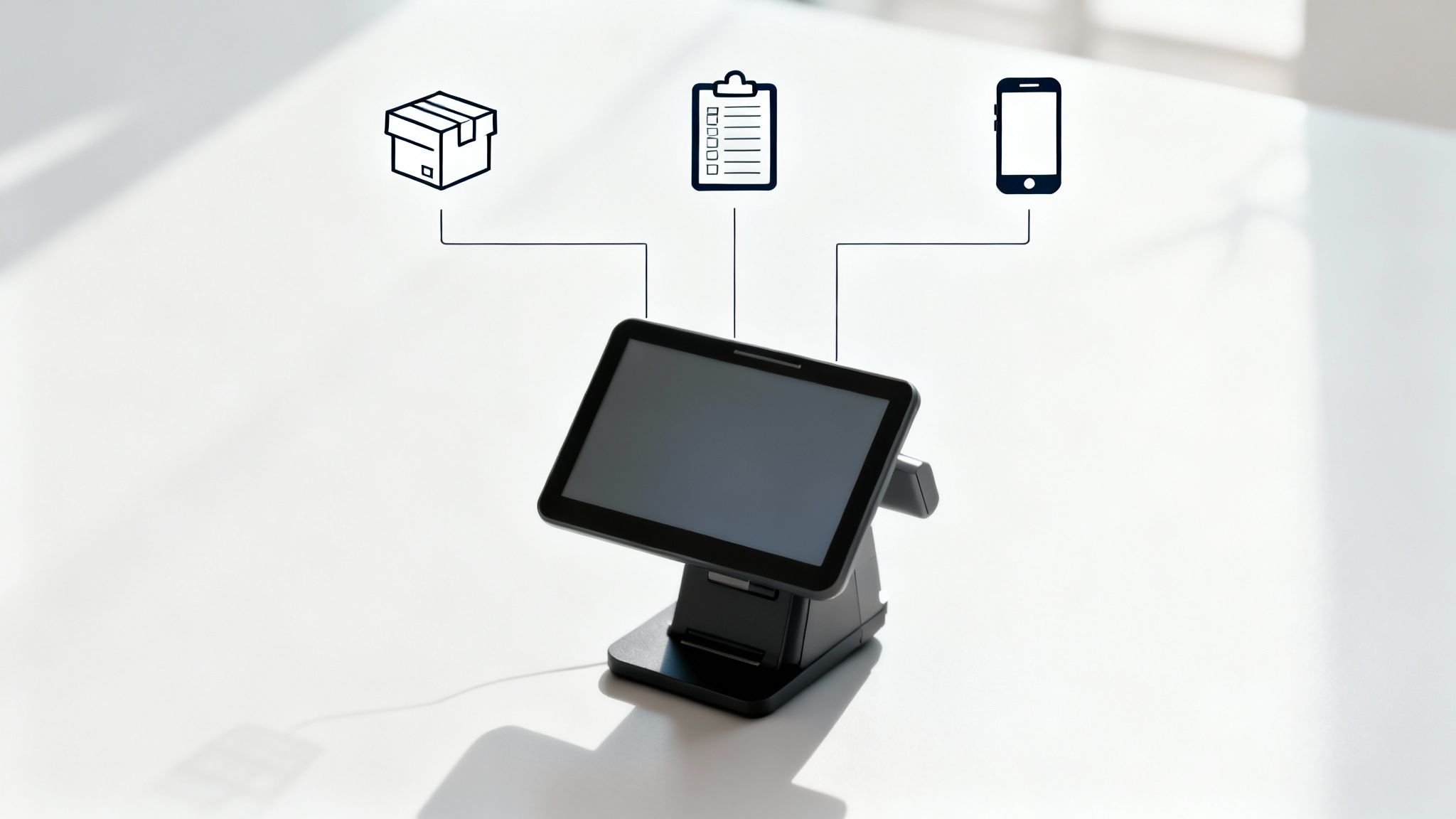
These days, a POS system can't just be an island. It needs to be the central nervous system for your entire restaurant's tech stack. The best POS systems for restaurants don't just process payments; they seamlessly connect with all the other tools you use to run your business, turning a simple terminal into your operational command center.
Think about the chaos of a busy night. Orders are flooding in from your website, third-party apps like DoorDash and Uber Eats, and your dining room. Without solid integrations, your staff is stuck juggling multiple tablets, manually punching online orders into the POS. It’s a recipe for slow service, frustrated staff, and costly mistakes.
A properly integrated POS changes the game entirely. When your delivery apps talk directly to your system, every order fires straight to the kitchen printer. No manual entry, no delays. This simple connection means faster ticket times, better accuracy, and a much smoother experience for both your team and your customers.
Tying the Back Office Together
This connectivity is just as critical for your back-of-house operations. A POS that links directly with accounting software like QuickBooks automates the soul-crushing task of daily sales reconciliation. Instead of your manager spending hours exporting reports and punching numbers into a spreadsheet, the data syncs automatically. It saves a massive amount of time and cuts down on human error.
The right integrations can also sharpen specific parts of your business. For instance, connecting your POS with specialized tools for mastering bar inventory management systems can tighten up your pour costs and boost profit margins. This kind of deep connection gives you a complete, real-time picture of your restaurant's financial health.
A truly integrated POS acts as a force multiplier. It makes every piece of your tech stack more valuable by letting them share data and work in unison, creating a single source of truth for sales, inventory, and customer info.
Don't Forget Modern Payment Options
One of the most important integrations to watch for is with modern payment gateways, especially those that support Bitcoin. Offering Bitcoin as a payment option isn't just a novelty; it's a smart way to attract a tech-savvy crowd and can seriously slash your transaction fees compared to traditional credit cards.
The trick is finding a POS that connects easily with a Bitcoin payment processor. This enables secure, wallet-to-wallet transactions that settle almost instantly.
- For your customers: It's a fast, private, and slick way to pay.
- For your business: It means lower fees, zero chargebacks, and faster access to your money.
This push towards more advanced payment solutions is a big reason the restaurant POS market, valued at around $18.5 billion in 2025, is expected to explode to nearly $56.9 billion by 2035—a CAGR of 11.9%. Choosing a system with forward-thinking integrations, especially for emerging payment types, is how you set your restaurant up for the future.
A Framework for Making Your Final Decision
So, you've seen what the top platforms can do. How do you actually make the final call without second-guessing yourself? This isn't about generic advice; it's a practical framework to help you pick the right POS system whether you're launching a food truck or running a high-end dining room. The goal is simple: align your choice with how you operate, what you can afford, and where you plan to be in a few years.
Choosing a POS is a huge piece of the puzzle, but it's still just one piece. For a bird's-eye view of everything involved in getting a new restaurant off the ground, check out this ultimate checklist for opening a restaurant from PrepTables.com. It's a great resource for seeing how this critical tech investment fits into your broader launch strategy.
Tailoring Your Choice to Your Restaurant Type
The best POS systems for restaurants are never one-size-fits-all. Your service style is the single most important factor, so start there. Looking at the options through this lens is the quickest way to cut through the noise and focus on what your team actually needs day-to-day.
- Quick-Service & Cafes: Speed is everything. You need a dead-simple interface and minimal upfront cost. Systems like Square for Restaurants are built for this world, with intuitive software that a new hire can pick up in minutes.
- Full-Service Dining: Here, you're juggling table management, complex order modifications, and deep-dive reporting. A powerhouse like Toast usually wins out, offering granular control over intricate menus and service flows.
- Bars & Nightclubs: Your inventory is your lifeblood. For this, Lightspeed's incredibly detailed, ingredient-level tracking for liquor and stock makes it a serious contender for any bar-centric operation.
The most expensive POS with the longest feature list is worthless if it overcomplicates your workflow. Your final choice should feel like a natural extension of your service style, making life easier for your staff, not harder.
Critical Questions for Your Sales Demo
Once you have a shortlist, the sales demo is where the rubber meets the road. This is your chance to get past the slick presentation and see how the system holds up under pressure. Go in armed with pointed questions to get the real answers you need.
- Can you show me, step-by-step, the exact process of integrating a Bitcoin payment gateway?
- What is the total, all-in cost—hardware, software, and payment processing fees—for a business with my sales volume?
- What does customer support actually look like when the system goes down on a chaotic Saturday night?
Got Questions About Restaurant POS Systems? We Have Answers.
Picking the right POS system for your restaurant inevitably brings up a ton of questions. You’re juggling hardware costs, software features, and all the new ways customers want to pay. It can feel like a lot, but a few key details can clear things right up. Let's break down the most common things restaurant owners ask.
One of the first hurdles is figuring out the whole cloud-based versus legacy system debate. A legacy system keeps all your data on a local server right there in your restaurant—meaning you have to be on-site to pull reports. In contrast, a cloud-based system stores everything online, giving you the freedom to check your sales and manage operations from anywhere you've got an internet connection.
How Long Are POS System Contracts?
Contract lengths are all over the map. Some POS providers will try to lock you into a multi-year deal, often for two to three years, especially if they're giving you a break on the upfront hardware costs. Always, always read the fine print before you sign anything.
On the flip side, you’ll find more flexible companies offering month-to-month plans. This is a great, low-risk option if you're just starting out or simply don't want to be tied down. It gives you the agility to switch things up if your business needs change down the road.
Can I Accept Bitcoin with My POS System?
Absolutely. Many modern POS systems are ready to handle Bitcoin payments, though how they do it can vary. Some platforms have direct integrations with Bitcoin payment gateways, which makes for a really smooth checkout experience with direct wallet-to-wallet transactions.
For systems that don't have a direct hookup, you can usually find a third-party Bitcoin payment processor in their app marketplace. This is a game-changer for any restaurant wanting to slash transaction fees and attract a more tech-savvy crowd.
What Should I Expect During Installation?
The setup process really depends on how complex your system is. If you're going with a simple iPad-based setup, you could probably handle it yourself in a few hours. Just download the app and start plugging in your menu.
For the bigger, hardwired systems, the provider will usually send a technician to your restaurant. They’ll get the terminals, printers, and network all connected and should stick around to train your staff. Make sure you ask exactly what level of setup and training support is included in your plan before you commit.
Ready to give your customers the speed and security of Bitcoin payments? Flash makes it happen. Our software enables direct, wallet-to-wallet transactions with tiny fees and integrates right into your business. You can launch Bitcoin payments in under a minute at .