The absolute best way to store a seed phrase is on a durable, offline, physical backup. We’re talking about metal plates, locked away in a secure location. This strategy is your best defense against both digital threats like hackers and physical disasters like a fire or flood, making sure only you can ever access your Bitcoin.
For most people, this hits the sweet spot between paranoid-level security and practical, real-world use.
Your Keys, Your Bitcoin: An Introduction to Self-Custody
If you’re new to this, welcome. You’re taking the first step into the world of Bitcoin self-custody, a journey that starts with understanding one thing: the seed phrase.
Don't think of it as just another password. Your seed phrase is the master key to your personal financial vault. It’s the one and only thing that can unlock your funds.
This simple string of 12 or 24 words is the blueprint to every single satoshi you own. If your hardware wallet gets stolen or your computer gives up the ghost, this phrase is your only way back in. Lose the phrase, and that vault is sealed forever. No one can help you recover it.
This brings us to the most important mantra in Bitcoin: "Not your keys, not your coins." True ownership means you—and only you—are in control of this master key.
This idea of absolute control is what makes Bitcoin so different from the traditional financial world. There are no middlemen, no "forgot password" links, and certainly no customer service agents to call. You are the bank.
Choosing Your Storage Method
Securing this master key is the single most critical job for any Bitcoin holder. The storage method you choose directly impacts the long-term safety of your assets, and different methods protect you from different kinds of risks.
To help you get a lay of the land, let’s take a quick look at the most common approaches.
Seed Phrase Storage Methods At a Glance
Here’s a quick comparison to see how the main options stack up against each other. We’ll dive deeper into each of these throughout the guide.
| Method | Security Level | Durability | Best For |
|---|---|---|---|
| Paper Backup | Low-Medium | Low | Beginners with small amounts, for initial setup only. |
| Metal Storage | High | High | Long-term holders, merchants, and anyone serious about security. |
| Multisignature | Very High | Varies | Businesses, families, or individuals protecting significant wealth. |
Each of these solutions comes with its own trade-offs in cost, complexity, and the specific threats they guard against.
As you focus on securing your digital assets, remember that responsible ownership extends to physical hardware, too. When equipment becomes outdated, for example, services for Bitcoin mining hardware disposal can help you manage it securely.
What Are You Protecting Your Bitcoin From?
Before you can pick the right way to store your seed phrase, you first need to figure out what you’re actually protecting it from. Choosing a storage method is a bit like designing a vault. You wouldn't build it without knowing who might try to break in or if it needs to withstand a fire. This process is called threat modeling.
It sounds more complicated than it is. Really, it’s just about asking a few practical questions. Are you protecting a small amount of bitcoin you're experimenting with? Or are you safeguarding your entire life savings? The answer completely changes how you should approach security.
A good threat model helps you find that sweet spot between paranoia and carelessness. You need enough security to sleep well at night, but not so much that it becomes a tangled mess you can't even use. For most of us, the dangers fall into two main camps: physical and digital.
Physical Threats to Your Seed Phrase
Physical threats are the real-world dangers that can get to your backup. People tend to fixate on sophisticated hackers, but honestly, a simple household accident can be just as final as a cyberattack. These are the risks you can literally touch.
Here's what you're up against:
- Accidental Loss: This is a big one. It's surprisingly easy to just misplace your backup. It could get tossed out during a spring cleaning spree or vanish during a chaotic move.
- Theft or Coercion: A burglar rummaging through your home might stumble upon your seed phrase. Or worse, someone could pressure you into giving it up. This is often called the "$5 wrench attack" for a grimly practical reason.
- Natural Disasters: Think fires, floods, or earthquakes. These events can obliterate common backup materials like paper in an instant. A typical house fire can hit temperatures over 1,100°F (600°C), which will turn a paper backup to ash in seconds.
- Environmental Decay: Time is the silent enemy. Ink fades, and paper breaks down, especially when it gets damp or sits in the sun. What’s perfectly clear today could be an unreadable smudge a decade from now.
These risks are exactly why the material you use for your backup is so important. A simple piece of paper is vulnerable to pretty much every single one of these threats, making it a terrible choice for anything other than short-term, low-value storage.
Digital Threats and Human Error
Even though your seed phrase should never touch the internet, digital threats are designed to strike at the moment you create or use it. Attackers are clever; they use sophisticated tricks to get you to expose your master key, essentially turning your own actions against you.
The weakest link in any security setup is almost always the person using it. Modern scams are built to exploit our trust and create a false sense of urgency, bypassing all the fancy tech by tricking you, the user.
Here are the most common digital traps:
- Phishing Scams: These are fake emails, texts, or websites that look incredibly real. An attacker might pretend to be a popular wallet provider and ask you to enter your seed phrase to "sync your account," giving them the keys to your entire stash.
- Malware and Spyware: Sneaky software on your computer or phone can be watching everything you do. It can log your keystrokes, take screenshots, or copy anything on your clipboard. If you ever type or paste your seed phrase on a compromised device, it’s gone.
- Unsecured Devices: Using a public computer or hopping on an unsecured public Wi-Fi network to manage your bitcoin is asking for trouble. Any device connected to the internet is a potential doorway for an attacker.
Getting a handle on these specific threats—both in the real world and online—is the crucial first step. Once you know what you’re up against, you can start making smart choices about a storage solution that actually protects you from them.
Comparing Durable Physical Storage Solutions
When it comes to safeguarding the master key to your Bitcoin, the physical material you choose is just as important as the secrecy you keep. Once you've figured out what threats you're up against, the next logical step is to pick a storage solution that can actually withstand them. This is where durable physical backups go from being a good idea to an absolute must for long-term security.
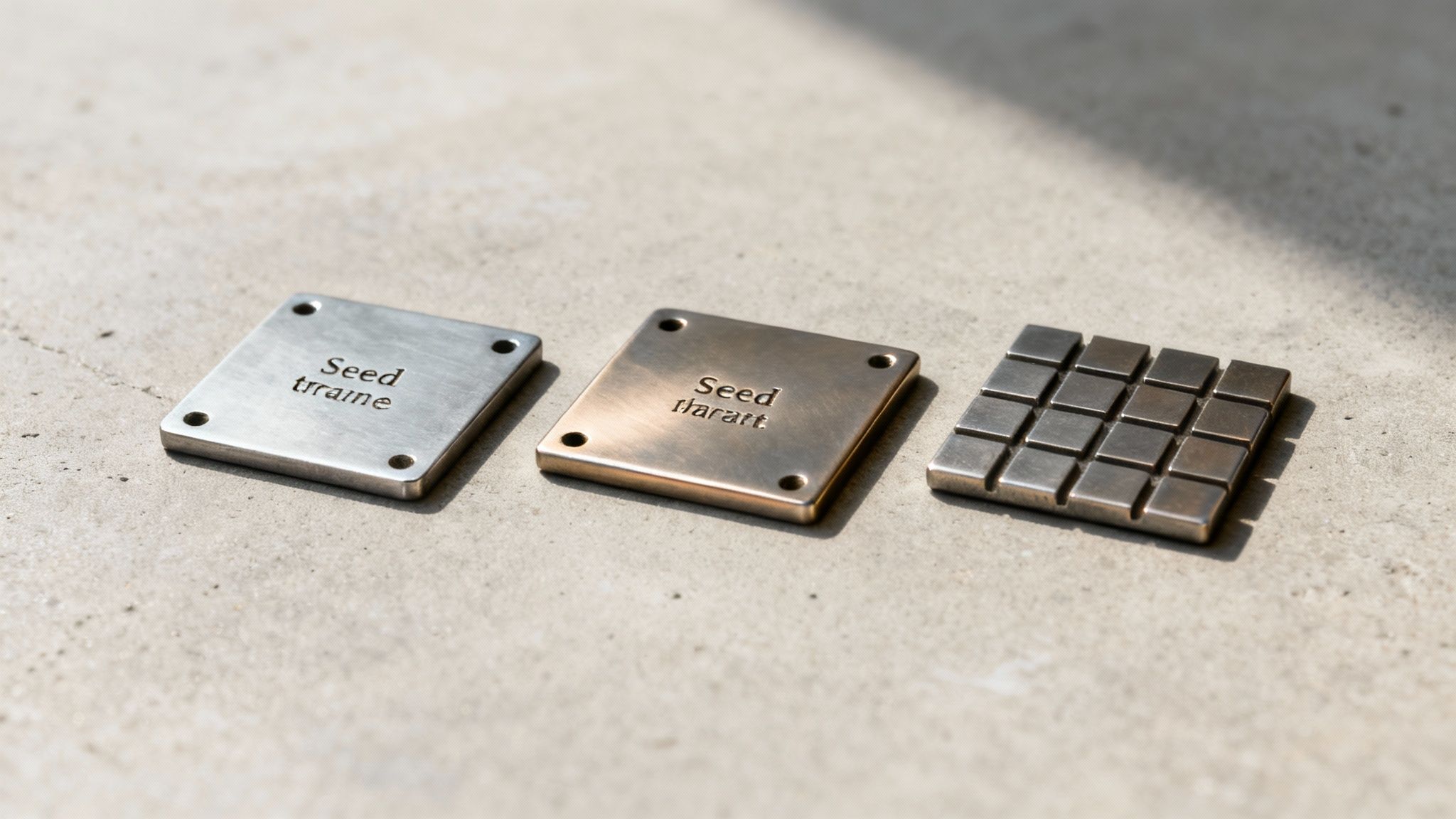
We'll kick things off with the most basic method—good old paper—and explore why its convenience masks some serious risks. From there, we’ll dive into the far superior world of metal storage, which has quickly become the gold standard for anyone serious about protecting their assets.
The Paper Backup: A Fragile Starting Point
Writing your seed phrase on a piece of paper is often the first step suggested by wallet software, and for good reason. It’s simple, anyone can do it, and it gets your key offline immediately. But that simplicity is also its biggest weakness.
Think of a paper backup as a temporary placeholder, not a permanent fortress. While it’s great for protecting you from digital threats like malware, it’s completely helpless against the physical world.
- Environmental Damage: Paper has zero defense against fire or water. A small kitchen fire or a minor plumbing leak could completely destroy your only way back into your Bitcoin.
- Physical Decay: Over time, ink fades and paper degrades, especially with a bit of sunlight or moisture. What was once a clear backup can easily become an unreadable smudge.
- Accidental Disposal: Let’s be honest—a piece of paper can look a lot like trash. It can be tossed out during a spring clean or lost in a move, leading to a catastrophic loss.
Because of these vulnerabilities, a paper backup should only ever be a short-term fix while you get a more permanent and durable storage method sorted.
The Rise of Metal: The Gold Standard for Seed Phrase Storage
To truly secure your seed phrase for the long haul, you need a material that can survive a worst-case scenario. This is exactly why metal has become the go-to choice for the best seed phrase storage. Metal backups are engineered to survive everything paper can't: fire, floods, corrosion, and the simple passage of time.
These devices aren't just hunks of metal; they are specialized tools built to protect those 12 or 24 words that represent your financial sovereignty. The data backs this up, too. Users who store their seed phrases on metal plates report a much higher recovery success rate—often by a margin of 2:1 or more—compared to those who stick with paper. You can dig into more of these long-term storage trends to see how the landscape is shifting.
That massive difference drives home a critical point: your backup is only as good as its ability to survive a real-world disaster.
Types of Metal Storage Solutions
The market for metal seed phrase storage has a few different designs, each with its own way of recording your words. The main players are stamping, engraving, and tile-based systems. All offer fantastic protection, but they come with different trade-offs in cost and ease of use.
Stamped Steel Plates
This is one of the most popular and budget-friendly methods out there. A typical kit gives you a thick stainless steel plate and a set of letter and number punches. You simply use a hammer to permanently stamp each word of your seed phrase right into the metal.
- Pros: Extremely durable, fire-resistant (stainless steel's melting point is around 2,500°F / 1,370°C), and relatively cheap. The impression is deep, clear, and permanent.
- Cons: The stamping process can be loud and takes a bit of elbow grease. You’ll need a solid, sturdy surface to work on.
Engraved Titanium Plates
For an even higher level of durability, there's titanium. These kits often come with a small, specialized engraving pen to etch your seed phrase onto the plate. Titanium is famous for its incredible corrosion resistance and a melting point of over 3,000°F / 1,650°C.
- Pros: Superior resistance to extreme heat and chemical corrosion. The final result often looks cleaner and more discreet than stamped plates.
- Cons: Usually more expensive than steel options. Engraving can also be more time-consuming than hammering away with a stamp.
Your choice between steel and titanium often comes down to balancing your budget against the level of paranoia—ahem, protection—you desire. For most people, high-grade stainless steel offers more than enough protection against common household disasters.
Tile-Based Systems
These clever systems use individual letter tiles that you arrange to spell out the words of your seed phrase. Once arranged, the tiles are locked into a compact, fire-resistant case. The big advantage here is that you don't need any hammers or engravers.
- Pros: Easy and quiet to assemble. The process is clean, simple, and doesn't require any special tools or physical effort.
- Cons: Can be a bit bulkier than a single plate. The initial cost might also be higher due to the more complex design.
Ultimately, choosing a durable solution like metal storage transforms your backup from a fragile piece of paper into a resilient asset. By investing in a material that can stand up to fire, water, and time, you're building a true foundation for long-term Bitcoin self-custody.
Exploring Advanced Security Strategies
When you're safeguarding a serious amount of Bitcoin, relying on a single backup in one location is a recipe for disaster. It creates a dangerous single point of failure. If that one backup gets lost, stolen, or destroyed, everything is gone in an instant. This is where you need to level up your security game, moving beyond a simple backup to distribute risk and make a catastrophic loss almost impossible.
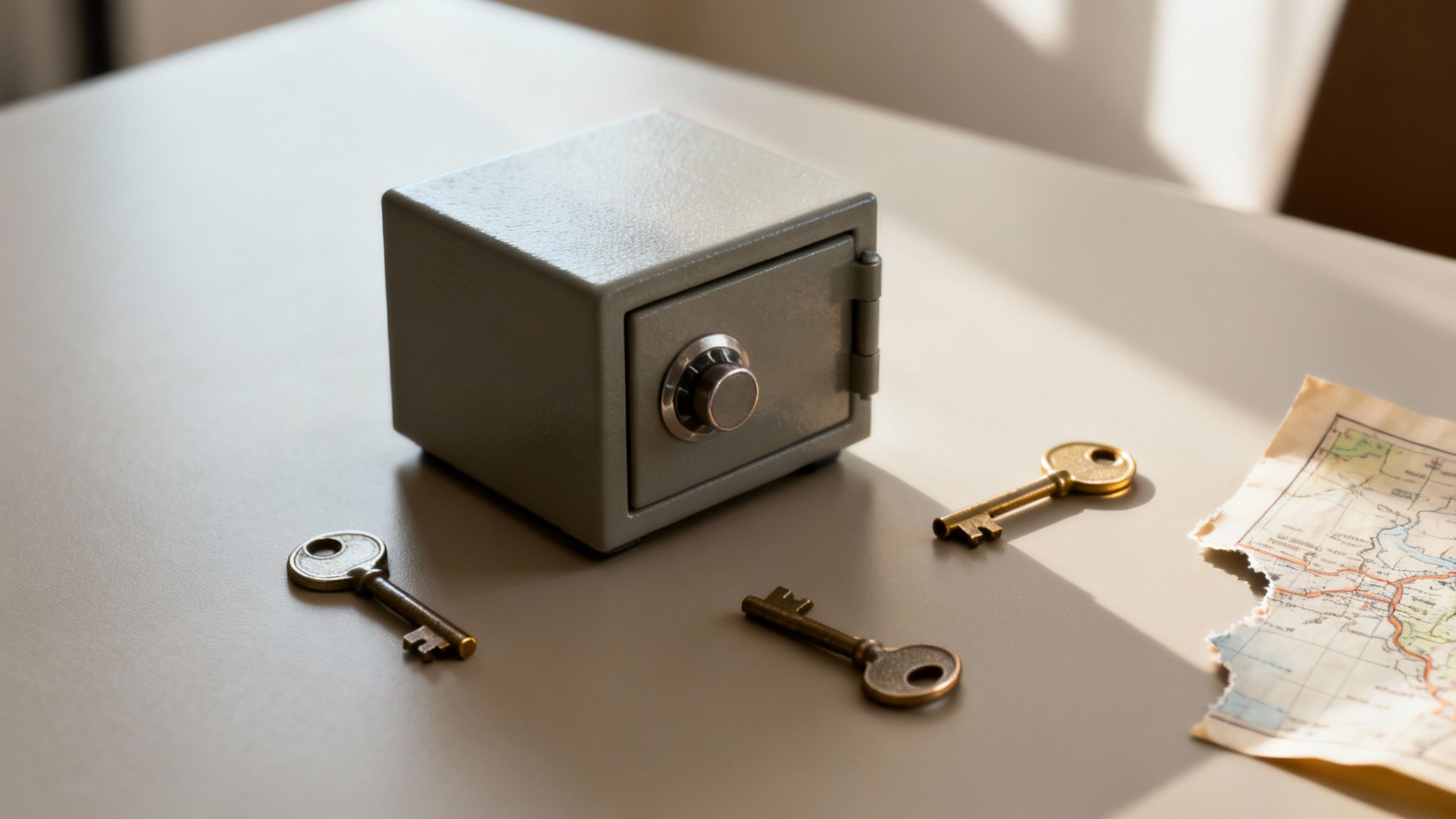
These advanced methods introduce redundancy and shared control, which completely changes your security model. Instead of "hide one treasure chest," you're "scattering the treasure map." Let's walk through two of the most powerful, Bitcoin-native approaches: multisignature (multisig) and Shamir's Secret Sharing (SSS).
Understanding Multisignature Wallets
A standard Bitcoin wallet is pretty simple: one key (derived from your seed phrase) is all it takes to sign off on a transaction. A multisignature wallet, or multisig, changes the rules by requiring two or more signatures from totally independent keys to send any funds. This massively boosts your security by getting rid of that single point of failure.
Think of it like a bank vault in a heist movie. It needs multiple keyholders to show up and turn their keys at the exact same time. One person, even with their own key, can't get inside alone.
A multisig setup ensures that even if one of your seed phrases is compromised, your funds are still safe. An attacker would have to steal multiple keys—which you've cleverly stored in different locations—to have any chance.
This kind of setup is perfect for businesses, families, or anyone who wants to distribute control and protect their stack from both theft and simple accidents. One of the most common and bulletproof arrangements is a 2-of-3 multisig.
- How it Works: You create three separate seed phrases, which means you have three independent private keys.
- Transaction Rule: To spend any Bitcoin, you need to sign with any two of those three keys.
- Security Benefit: If one key gets lost, stolen, or incinerated in a house fire, no big deal. The funds are still safe and completely accessible with the other two keys.
This makes multisig an incredibly robust choice for long-term storage and day-to-day operational security, as it builds in fault tolerance right from the start.
Distributing Risk with Shamir's Secret Sharing
While multisig is all about requiring multiple authorizations, Shamir's Secret Sharing (SSS) is about splitting a single secret—your seed phrase—into multiple pieces, called "shares." The magic of SSS is that you can reconstruct the original seed phrase by bringing a certain number of these shares back together.
The best way to think about SSS is splitting up a treasure map. Imagine tearing a map into five pieces and handing one piece to five different trusted friends. You can set it up so that any three of those five pieces are enough to perfectly reassemble the map and find the treasure.
This means that even if a couple of pieces get lost or end up in the wrong hands, your secret is still totally safe.
A popular SSS setup is a 3-of-5 scheme:
- Your single seed phrase gets split into five unique shares.
- You store these shares in geographically separate, secure spots (think trusted family members, different safe deposit boxes, or even buried in the backyard).
- Any three of the five shares can be brought together to perfectly reconstruct your original seed phrase.
This approach is one of the absolute best for things like inheritance planning or ensuring a business can recover its funds no matter what. It completely obliterates the single point of failure tied to having one master backup.
Choosing Between Multisig and SSS
Both multisig and SSS offer top-tier security by removing single points of failure, but they solve slightly different problems.
| Feature | Multisignature (Multisig) | Shamir's Secret Sharing (SSS) |
|---|---|---|
| Core Concept | Requires multiple independent keys to authorize transactions. | Splits one key (seed phrase) into multiple recoverable shares. |
| Primary Use | Shared control over funds, operational security for businesses. | Disaster recovery, inheritance planning, deep cold storage. |
| Complexity | More complex to set up and manage transactions on-chain. | Simpler concept but requires careful handling during recovery. |
| When to Use | When you need multiple parties to approve payments. | When you want to protect a single backup from loss or theft. |
For a business that needs multiple partners to sign off on payroll, multisig is the obvious winner. For an individual laser-focused on creating the most resilient backup possible for long-term cold storage, SSS is an elegant and incredibly powerful solution. By picking one of these advanced strategies, you can build a security system that protects your Bitcoin against a much wider range of real-world threats.
Critical Storage Mistakes That Can Cost You Everything
Even the most advanced security tools are useless if you handle them the wrong way. Owning the best steel plate for your seed phrase means nothing if you make a fundamental mistake during setup or backup. This is where we’ll break down the most common—and devastating—errors people make, turning their financial fortress into a house of cards.
Understanding what not to do is just as important as knowing the right steps. A single misstep can expose your master key to the entire world, leading to a complete and irreversible loss of your Bitcoin. It's a bit like learning from the common mistakes in disposing of sensitive data on old computers—the principles of protecting crucial information are universal.
The Fatal Error of Digital Convenience
The golden rule of seed phrase security is dead simple: keep it completely offline, always. The second your seed phrase touches a device connected to the internet, you’ve destroyed its security. The temptation for a quick, convenient digital backup is strong, but the risks are catastrophic.
Here are the digital mistakes that can wipe you out:
- Taking a Photo or Screenshot: This is by far the most common and dangerous blunder. Snapping a picture saves your seed phrase to your phone’s gallery, which is almost always automatically synced to cloud services like iCloud or Google Photos. Think of it as leaving a copy of your house key on a public park bench—it’s only a matter of time before someone finds it.
- Saving it in a Text File: Typing your seed phrase into a notes app, a Word document, or any text file on your computer is just asking for trouble. Malware and spyware are specifically built to sniff out files on your hard drive for anything that looks like a 12 or 24-word phrase.
- Emailing it to Yourself: Firing off an email to yourself with your seed phrase is a nightmare scenario. It creates multiple copies on various servers all over the world. Your email account is a prime target for hackers, and a single breach gives them direct access to your master key.
Once you’ve made one of these mistakes, your seed phrase is compromised forever. Even if you delete the file or photo, digital forensic tools can often recover the data, leaving you permanently vulnerable.
Misusing Cloud and Password Managers
Cloud storage and password managers are fantastic tools for your everyday digital life, but they are fundamentally unsafe for your Bitcoin seed phrase. Their entire purpose is to be accessible online, which is the exact opposite of what you need for your master key.
Despite the loud warnings about the immense risks, the allure of digital storage persists. A 2025 survey revealed that 31% of users still use cloud services for their seed phrase backups.
A password manager is designed to protect passwords—low-stakes secrets that can be reset if compromised. A seed phrase is an unchangeable master key to your wealth. Storing it in a password manager is like putting your life's biggest secret in a place that is, by its very nature, a massive, high-value target for attackers.
Here’s exactly why these tools are the wrong choice for the job:
- They are online: Both cloud services and most password managers sync across the internet, creating a constant attack surface.
- They are centralized targets: Services like Dropbox, Google Drive, and major password managers are under constant assault from hackers looking for a big payday.
- They create a single point of failure: If your cloud account or password manager is breached, the attacker gets everything—including the keys to your Bitcoin.
At the end of the day, the only truly safe storage solution is one that never, ever touches a device with an internet connection. Resisting the siren song of digital shortcuts is the most important discipline you can practice to secure your financial future.
How to Create and Secure Your Bitcoin Backup
It's one thing to understand the theory behind storing your seed phrase, but putting it into practice flawlessly is where your security is actually forged. This part of the guide is all about rolling up your sleeves and doing the work. We'll walk through the exact steps for generating and locking down your Bitcoin seed phrase using a trusted hardware wallet.
Follow these steps with care. They are the bedrock of your self-custody.
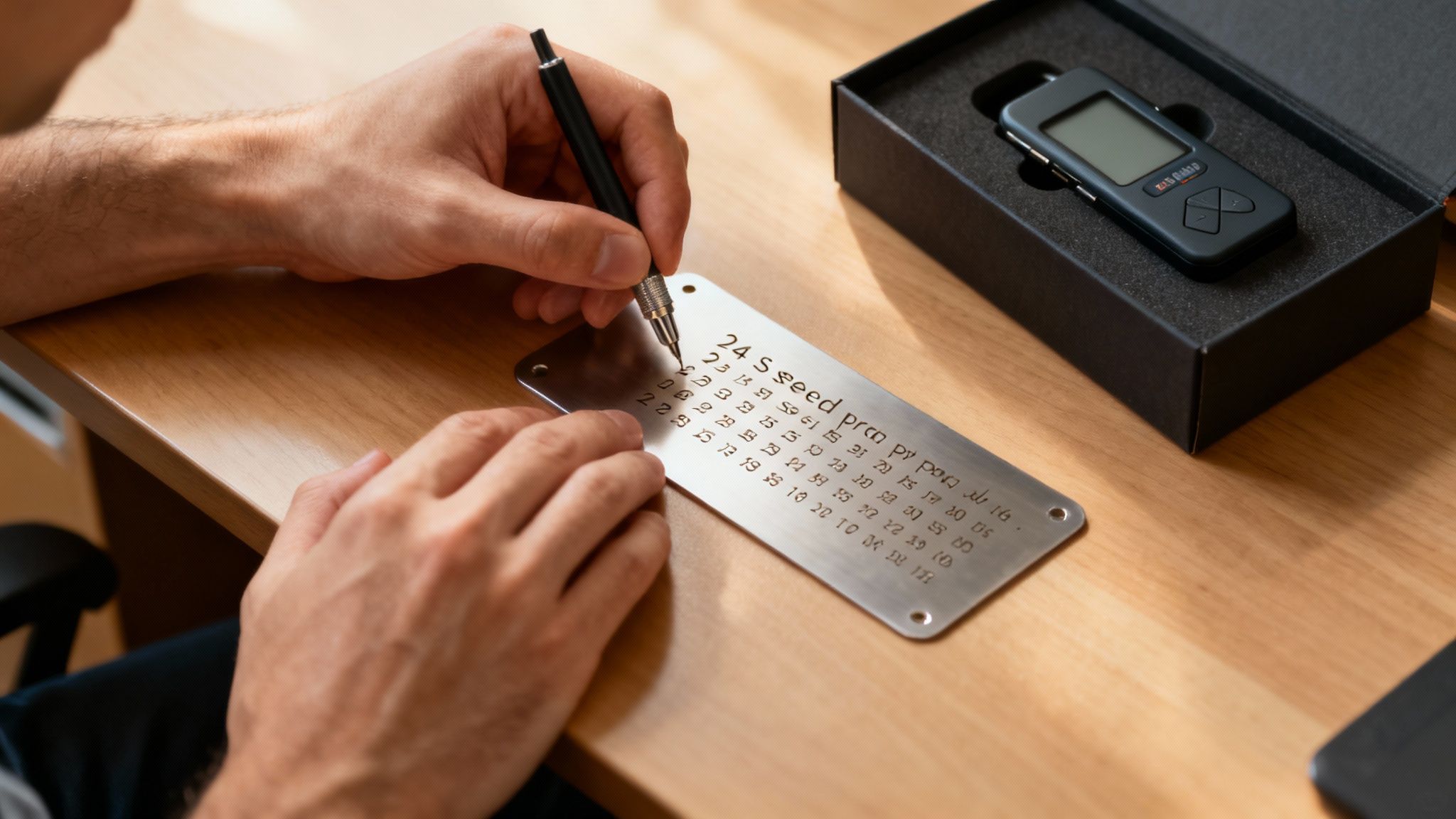
Treat this entire process with the seriousness it deserves. Your seed phrase is a bearer asset, like a stack of cash or a gold bar. It demands your full, undivided attention to sidestep simple mistakes that could cost you everything.
Step 1: Prepare Your Environment
Before you even crack open the box of your new hardware wallet, your number one job is to create a secure, private space. This step is all about killing any chance of digital or physical snooping. Think of it as setting up a sterile "cleanroom" before a critical operation.
Here's a quick operational security checklist to run through:
- Go Private: Find a room where you can be totally alone, without any interruptions. Lock the door.
- No Eyes or Ears: Make sure there are no active cameras or microphones anywhere near you. Slap a piece of tape over your laptop's webcam. Unplug or remove any smart speakers like Alexa or Google Home.
- Offline First: If you can, disconnect the computer you're using from the internet, especially while the phrase is being generated.
This prep work drastically cuts the risk of your seed phrase getting snatched by malware or a listening device at the exact moment of its birth.
Step 2: Generate and Transcribe Your Seed Phrase
With your secure space ready, it's time to bring your master key into existence. Power on your hardware wallet and follow the device's instructions to create a new wallet. It will generate a fresh, random 24-word seed phrase and show it to you, one word at a time.
This is the moment of truth.
Painstakingly write down each word, in the correct order, onto your chosen medium. Whether that's paper for temporary holding or straight onto your metal plate, be meticulous.
Double-check every single word. Check the spelling. Check the order. A single wrong letter or two swapped words will render your backup completely useless. It will lock you out of your funds, permanently.
Step 3: Verify Your Backup and Secure It
Once you’ve written everything down, the most crucial final step is to verify it. Do not skip this. Most hardware wallets will walk you through a "dry run" recovery test right after setup. They'll ask you to re-enter the words to confirm your backup is 100% correct.
After you've successfully verified your backup, it's time to secure the physical copy. If you used paper, transfer the words to your permanent metal storage as soon as you can.
Then, stash your durable metal backup in the secure, discreet location you planned out based on your personal threat model. Only after your backup is verified and safely stored away should you even think about sending any Bitcoin to your new wallet.
Your Top Seed Phrase Security Questions, Answered
Jumping into Bitcoin self-custody can feel like learning a new language, and it's natural to have questions. Let's tackle some of the most common concerns people have when figuring out the best way to store their seed phrase and protect their bitcoin for the long haul.
Is a Bank Safe Deposit Box a Good Idea?
Using a bank's safe deposit box can seem like an obvious choice to protect a backup from theft or disaster at home, but it's not a silver bullet. You're introducing a third party into your security, and with that comes potential headaches like bank holidays, limited hours, or even legal freezes on your assets.
Instead of just shifting your single point of failure from your house to the bank, think about using that box as just one piece of a bigger puzzle. It's a great location for one part of a multisig or Shamir’s Secret Sharing setup. That way, you eliminate single points of failure altogether.
Should I Just Memorize My Seed Phrase?
Memorizing your seed phrase is incredibly risky and should never be your only backup plan. Our memories are surprisingly fragile, especially over many years or in a high-stress situation. A serious accident could also mean the phrase is lost forever.
Always, always create durable physical backups first. Think of memorization as an extra, redundant layer on top—a nice bonus, but never the foundation of your entire security strategy.
Relying on memory alone is like building a vault with no door, hoping you'll always remember where the hidden entrance is. A physical backup is the door, and you hold the only key.
How Many Backup Copies Should I Have?
For most people holding Bitcoin, creating two or three durable backups is a solid, highly effective strategy. The key is to store these copies in geographically separate, secure locations. This protects you from a single disaster, like a fire or flood, wiping out your only way to recover your funds.
A simple setup could be keeping one metal plate in a fireproof safe at home and another at a trusted family member's house or in another secure, private spot.
What's the Big Deal Between a 12 and 24-Word Seed Phrase?
A 24-word seed phrase is exponentially more secure than a 12-word one. The level of randomness, what we call entropy, in a 24-word seed is so massive that it's completely impossible for any computer, now or in the foreseeable future, to guess or brute-force it.
While some might say a 12-word phrase is okay for tiny amounts, the industry standard for truly securing your bitcoin has firmly landed on 24 words. If your wallet gives you a choice, always pick the 24-word option for maximum peace of mind.
Ready to accept Bitcoin payments directly and securely? Flash provides merchants with powerful, easy-to-use tools for instant, wallet-to-wallet transactions. Get started in under a minute and connect with a global network of Bitcoin users.