For merchants, figuring out how to store Bitcoin isn't just a technical task—it's a core business decision. The best approach is rarely a single solution. It's usually a hybrid model that combines secure, offline "cold" storage for the bulk of your funds with a smaller, online "hot" wallet for handling daily transactions. This gives you the best of both worlds: serious security and operational flexibility.
Choosing the Right Bitcoin Storage for Your Business
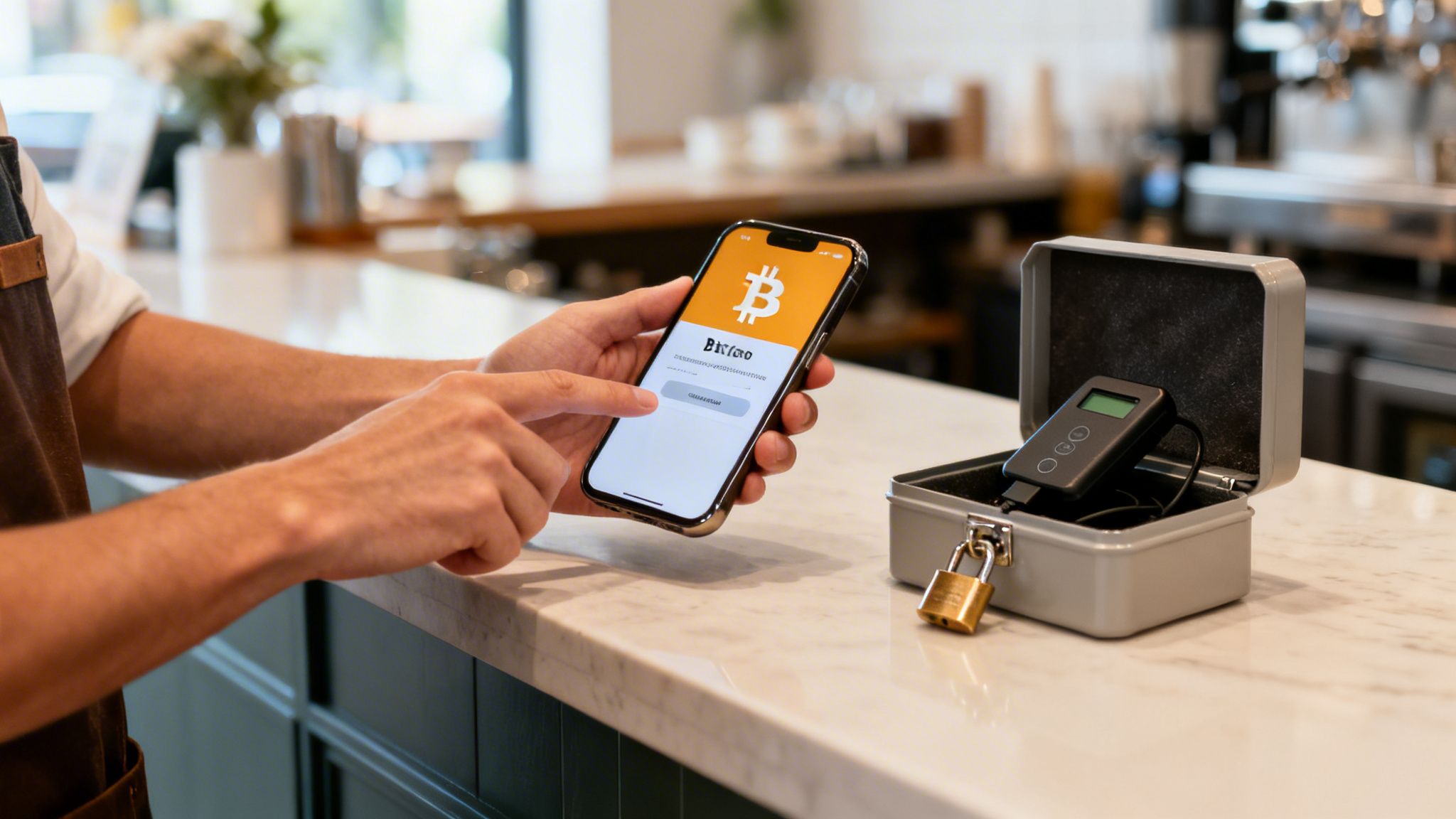
This guide cuts through the jargon to give you a straight-up comparison of storage options, all framed for business needs. The first and most critical choice you'll make is between custodial and non-custodial storage. Getting this right from the start is the most important step in protecting your revenue.
We'll break down this fundamental concept before diving into the most common types of Bitcoin wallets that fit into each category. This will arm you with the knowledge to protect your company’s assets while confidently accepting Bitcoin payments.
Custodial Versus Non-Custodial Storage
The real difference between storage options comes down to one thing: who holds the private keys. These keys are the secret password that proves ownership and lets you spend your Bitcoin. Your choice here dictates your control, your security, and your level of responsibility.
| Feature | Custodial Storage | Non-Custodial Storage (Self-Custody) |
|---|---|---|
| Control of Funds | A third party (like an exchange) holds your private keys. | You hold your private keys. You have absolute and final control. |
| Security Risk | You're trusting the third party's security. This exposes you to their hacks, account freezes, or them going out of business. | Your security is 100% your responsibility. This completely removes third-party risk. |
| Best Use Case | Good for buying your first Bitcoin or holding it for a very short time. Not for business treasuries. | Securing business revenue and managing long-term capital holdings. |
| Analogy | It’s like a traditional bank account. The bank ultimately controls your access. | It’s like a personal safe. Only you have the key or combination. |
For any serious merchant, non-custodial self-storage is the only way to go. It’s the entire point of Bitcoin—"not your keys, not your coins." This ensures you have complete, censorship-proof sovereignty over your company's money, without having to ask anyone for permission.
Because self-custody is so vital for businesses, this guide will focus entirely on non-custodial solutions. We’ll analyze the top options—hardware, software, and multisig wallets—to help you build a secure and practical treasury management system from the ground up.
Custodial vs Non-Custodial Wallets
Getting this one right is the most important decision you'll make for your business's Bitcoin strategy. The choice between a custodial and a non-custodial wallet determines who actually controls your money and sets the entire foundation for your company's security. It's a simple distinction with massive consequences.
A custodial wallet, which you typically find on a big exchange, acts a lot like a traditional bank. A third-party company holds your private keys for you. While that might feel convenient and familiar, especially when it comes to account recovery, it introduces a huge business risk: counterparty risk.
For a merchant, this isn't just a technical detail—it's a serious liability. It means your company’s funds could be frozen, seized, or just plain lost if the service you're using gets hacked, goes broke, or is targeted by regulators. You're putting your trust entirely in their security, their business practices, and their willingness to comply with government orders.
The Power of Self-Sovereignty
A non-custodial wallet, on the other hand, puts you—and only you—in complete control. This is the whole point of Bitcoin, captured in the simple phrase: "not your keys, not your coins." By holding the private keys yourself, you cut out the middleman entirely.
This level of direct control is a game-changer for merchants. It guarantees your revenue is censorship-resistant and always accessible, 24/7, without asking anyone for permission. Think of it as the difference between keeping your cash in a bank vault versus your own personal safe. With your own safe, you’re responsible for securing it, but nobody can stop you from opening it.
A non-custodial wallet transforms your Bitcoin from a liability held by someone else into a true asset under your direct command. This is the foundation of a secure and resilient business treasury.
This difference is becoming more critical as more people get into Bitcoin. By 2026, 61% of current owners plan to hold more, yet simple storage mistakes remain a huge problem. Hot wallets, while great for the instant payments you need with Flash, have a 200% higher attack surface from online threats than offline cold storage. People are catching on, though. Self-custody saw a 25% jump after some recent big exchange failures, showing a clear trend toward taking back control. You can get more details on the evolving wallet landscape from Codewave.
Custodial vs Non-Custodial Wallets: A Merchant's View
Choosing the right wallet model isn't just about technology; it's about aligning your storage strategy with your business goals. For merchants, the key differences come down to control, risk, and operational freedom. Let's break it down from a business perspective.
| Feature | Custodial Wallets (Exchanges) | Non-Custodial Wallets (Self-Custody) |
|---|---|---|
| Private Key Control | A third party holds and controls your keys. | You hold and control your own keys. |
| Asset Sovereignty | Your funds are an IOU from the custodian. | Your funds are a direct bearer asset you own. |
| Transaction Freedom | Transactions can be delayed, blocked, or censored. | You can send transactions to anyone, anytime, 24/7. |
| Security Responsibility | You rely on the custodian's security measures. | You are 100% responsible for securing your keys. |
| Business Implication | Exposes your business to third-party failure, hacks, and account freezes. | Empowers your business with full, censorship-resistant control over its assets. |
For any serious merchant looking to accept and hold Bitcoin, the verdict is in. Non-custodial wallets are the only way to guarantee your business assets truly belong to you, safe from external risks you can't control.
Because of this, the rest of this guide will focus exclusively on the best non-custodial methods for businesses.
Comparing the Top Bitcoin Storage Methods
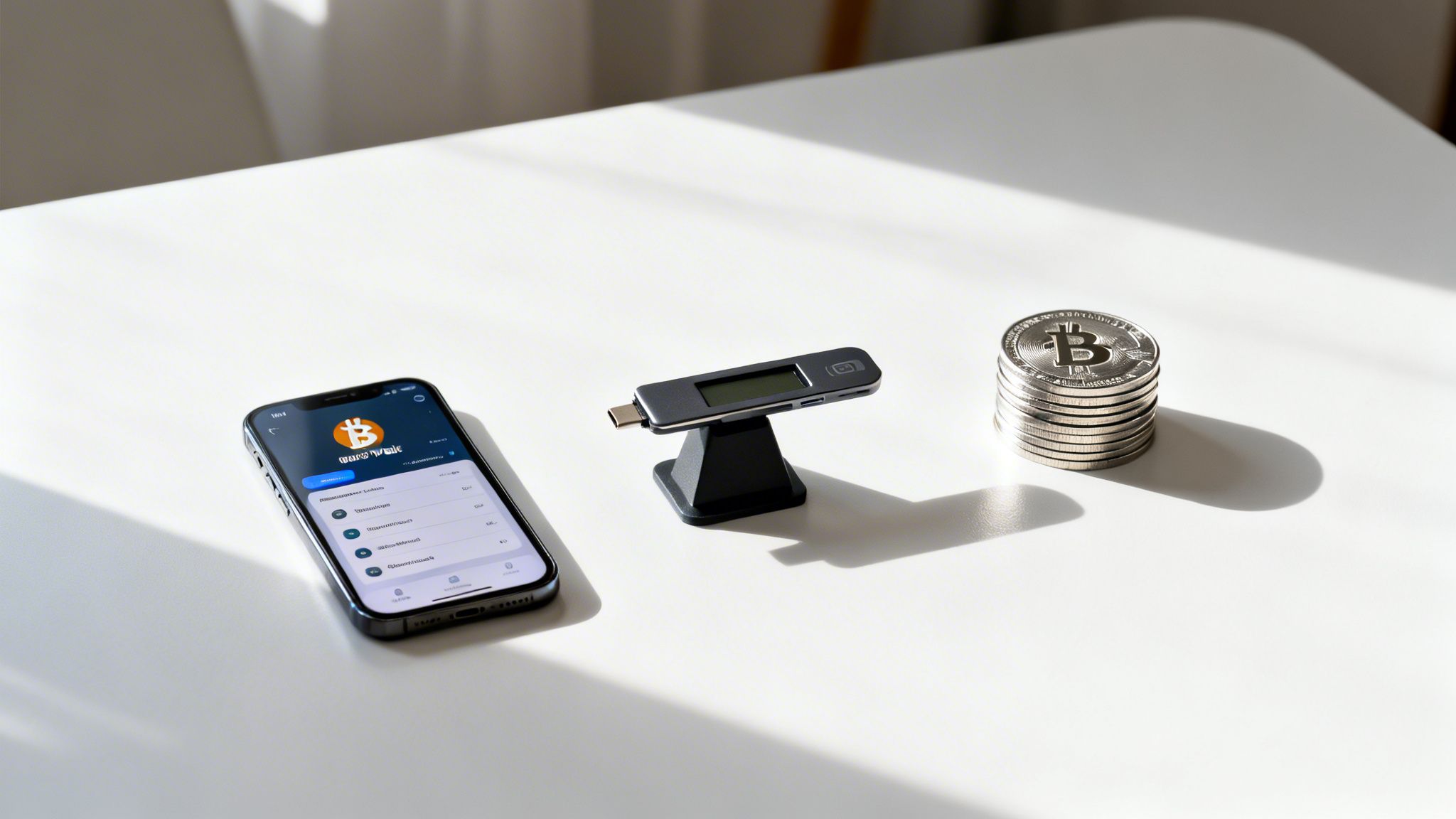
Once you’ve committed to self-custody, the real work begins: picking the right tools for the job. There’s no single "best" way to store Bitcoin. The right choice is all about matching the tool to your business's specific needs. For merchants, this is a balancing act between having liquid funds for daily transactions and locking down your long-term treasury with maximum security.
Let's break down the three pillars of non-custodial Bitcoin storage: software wallets (hot wallets), hardware wallets (cold storage), and multisig setups. Each one plays a unique and critical role in a resilient business operation.
Software Wallets for Daily Operations
Software wallets, or "hot wallets," are just apps that run on your phone or computer. Their defining trait is their constant connection to the internet, which makes sending and receiving Bitcoin incredibly fast and convenient. But this connectivity is both their greatest advantage and their biggest vulnerability.
Think of a software wallet as your digital cash register. It’s the perfect tool for a coffee shop that handles dozens of small payments a day or an online store managing a steady stream of customer orders. Point-of-sale apps like Flash instantly turn any smartphone into a Bitcoin terminal, making these wallets essential for your day-to-day business.
Because they’re always online, however, they are more exposed to remote attacks like malware and phishing scams. That's why you should only keep a small, operational amount of your company's Bitcoin in one—just enough to handle a typical day's sales. The rest of your funds need to live somewhere much safer.
Hardware Wallets The Vault for Your Treasury
Hardware wallets are the undisputed gold standard for securing the bulk of your company's Bitcoin. These are small, physical devices, kind of like a specialized USB drive, built for one purpose: to keep your private keys completely offline. This "cold storage" method creates a physical firewall between your money and online threats.
Even when you plug a hardware wallet into an internet-connected computer to make a payment, the private key never leaves the secure chip inside the device. The transaction is signed on the device itself, and you have to physically press a button to confirm it.
The real magic of a hardware wallet is its air-gapped security. By keeping your private keys isolated from any online environment, it becomes immune to the kind of malware, spyware, and phishing attacks that can drain a software wallet. It's the non-negotiable choice for securing your main company treasury.
For any business, this is your long-term savings vault. It's where you put the Bitcoin you don't need for immediate daily operations. Any merchant holding a significant amount of Bitcoin without a hardware wallet is simply taking an unnecessary and unprofessional risk with their capital.
Multisig Wallets Corporate Control and Shared Custody
Multisignature, or "multisig," wallets add a powerful layer of security that’s perfect for corporate governance. Instead of a single private key controlling the funds, a multisig setup requires multiple keys to sign off on a transaction. A common setup is "2-of-3," where three keys exist, but any two of them are needed to send a payment.
This approach is the ultimate defense against single points of failure. If one key is lost, stolen, or compromised, the funds are still safe. For a business with multiple partners or a leadership team, multisig is a total game-changer. It lets you distribute control, so no one person can move company funds on their own.
Imagine a company where the CEO, CFO, and COO each hold one key in a 2-of-3 wallet. A transaction would need approval from at least two of them, building a system of checks and balances that protects against both internal fraud and external threats. It elevates Bitcoin storage from a personal responsibility to a structured corporate procedure.
A Practical Comparison for Business Scenarios
Choosing the right tool is all about context. Let's look at how these methods stack up in real-world scenarios that every merchant faces.
| Scenario | Software Wallet (Hot) | Hardware Wallet (Cold) | Multisig Wallet |
|---|---|---|---|
| Point-of-Sale Transactions | Excellent. Fast, convenient, and ideal for daily customer payments. | Impractical. Too slow and cumbersome for frequent, small transactions. | Overkill. Unnecessary complexity for front-line operational needs. |
| Securing Main Treasury | Extremely Risky. Never use for storing the bulk of your business capital. | Excellent. The industry standard for securing large sums of Bitcoin offline. | Superior. The highest level of security, especially for shared ownership. |
| Partner/Team Fund Access | Poor. Relies on a single point of failure and trust. | Good, but limited. Still relies on a single device and seed phrase. | Excellent. Distributes control and removes single points of failure. |
| Disaster Recovery | Vulnerable. Dependent on a single device and its backup. | Strong. A single seed phrase backup can restore funds. | Most Resilient. Multiple key backups provide redundant recovery paths. |
At the end of the day, a smart business strategy doesn't pick just one method; it combines them. A professional setup might use a mobile software wallet for daily sales, sweep that revenue to a hardware wallet each week, and keep the main corporate treasury locked down in a multisig wallet controlled by the executive team. This hybrid approach gives you both operational speed and Fort Knox-level security.
Hardware Wallets: The Gold Standard for Asset Security
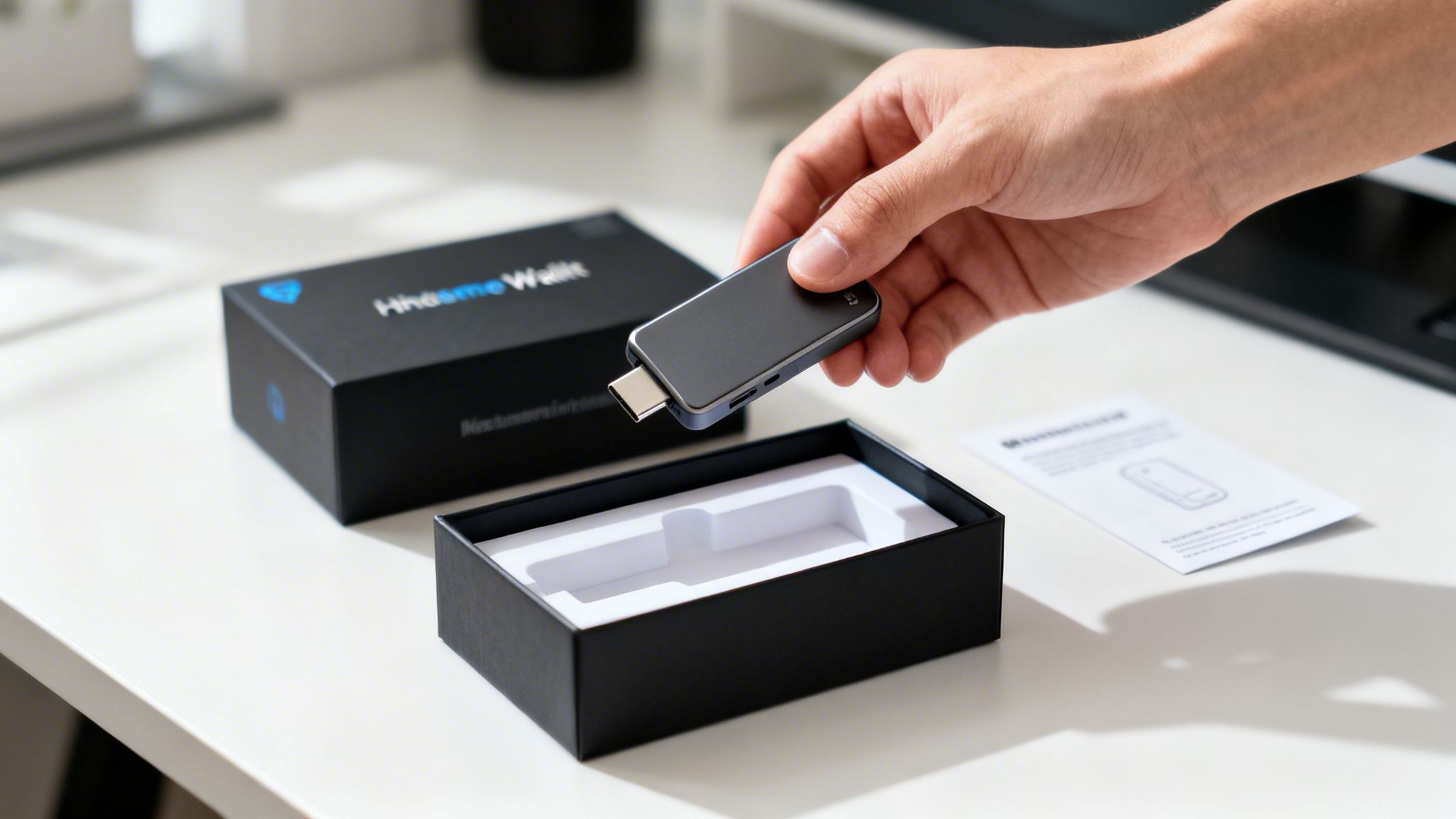
For any merchant serious about securing their Bitcoin revenue, a hardware wallet isn't just a nice-to-have—it's the very foundation of a professional security plan. Think of these small, physical devices as an impenetrable vault built specifically for your private keys, making them the best way to store your Bitcoin for the long haul.
Their entire purpose is to keep your private keys completely offline at all times. This approach, known as cold storage, creates a physical air gap between your company's capital and the internet. In practice, this makes your funds immune to the kind of online threats that plague software wallets, like malware, spyware, and sophisticated phishing schemes.
How Hardware Wallets Create a Digital Fortress
The real genius of a hardware wallet is its "air-gapped" design. Even when you plug the device into an internet-connected computer to authorize a payment, the private key never leaves the wallet's secure, isolated environment.
The transaction signing process happens entirely on the device itself. To send funds, you have to physically press a button on the hardware wallet to give your final confirmation. This physical interaction is a critical security feature, making it impossible for a remote hacker to drain your funds, even if they've completely compromised your computer.
By isolating your private keys from any online connection, a hardware wallet effectively builds a digital fortress around your Bitcoin. It's the most reliable and accessible tool for safeguarding your business's main treasury against remote theft.
This is exactly why cold wallets are hailed as the gold standard. In fact, industry data shows that using a cold wallet can slash your odds of theft by 99% compared to a hot wallet. It's an essential tool for eCommerce merchants looking to tap into the massive market of Bitcoin users that platforms like Flash unlock. Yet, despite their power, many users still make critical setup mistakes that leave their funds vulnerable. You can explore key cold wallet statistics to see how secure storage practices are evolving.
Selecting the Right Device for Your Business
Not all hardware wallets are created equal, and your choice is a crucial business decision. The market is flooded with options, but for securing Bitcoin, the best practice is to choose a Bitcoin-only device. These wallets have a much smaller attack surface because their firmware is simpler and laser-focused, leaving less room for potential bugs or vulnerabilities.
When you're comparing your options, keep an eye out for these non-negotiable features:
- Secure Element Chip: This is a specialized, tamper-resistant microprocessor designed to securely house applications and your private keys. It offers a powerful defense against physical tampering and sophisticated extraction attacks.
- Physical Confirmation Buttons: As mentioned, the need to physically press buttons to approve transactions is a must-have. It’s the final, manual checkpoint that protects you from remote hacks.
- Reputable Manufacturer: Stick with well-known brands that have a long, proven track record of security and transparency. A solid history is your best indicator of a reliable product.
The Most Important Step: Sourcing Your Device
Finally, one of the most critical—and often overlooked—aspects of using a hardware wallet is how you get it. You must always purchase your device directly from the manufacturer. Never, ever buy a hardware wallet from a third-party marketplace, a reseller, or a second-hand seller.
Buying from anywhere else introduces the risk of a supply chain attack, where a malicious actor could have tampered with the device before it ever reaches you. By ordering directly from the official source, you ensure the device arrives in its original, factory-sealed packaging, giving you peace of mind that your digital vault is secure from day one. This simple step is fundamental to establishing the best way to store your Bitcoin.
Implementing Secure Operational Practices
Getting a secure hardware wallet is a great start, but it's only half the battle. The best security technology is only as strong as the human processes built around it. To truly secure your company's Bitcoin, you need to move beyond just buying a device and start thinking about building a set of robust, repeatable operational practices.
This isn't just about storing your Bitcoin; it's about integrating secure treasury management into your daily workflow. For a solid framework, it's worth understanding what comprehensive Information Security Management Systems look like, as they provide a valuable structure for protecting all your digital assets, including Bitcoin.
The absolute cornerstone of this framework is your backup and recovery plan. And that plan revolves around one single, critical element: your seed phrase. Those 12 or 24 words you get when setting up a wallet are the master key to everything. With them, anyone can restore your wallet and access your Bitcoin.
Building a Resilient Recovery Plan
Think of your seed phrase as the ultimate failsafe. If your hardware wallet is lost, stolen, or smashed to bits, that phrase is the only thing that can bring your company's capital back.
This is why just writing it down on a piece of paper is a dangerously amateur move. Paper is fragile. It burns, it gets waterlogged, and it decays. It’s simply not a professional solution for a business treasury.
For any serious business, upgrading to a metal seed storage solution is non-negotiable. These are devices made from materials like stainless steel or titanium where you physically stamp or etch your seed phrase. They're built to withstand just about anything.
Metal backups are the unsung heroes of cold storage, offering serious protection against disasters. An estimated 15–20% of all BTC is considered lost forever, a figure that represents over $1 billion in irrecoverable funds each year. A simple metal plate can survive house fires exceeding 1,400°C and complete submersion, offering a 99.9% theft prevention rate for offline seeds.
A metal seed backup isn't an expense; it's a one-time insurance policy on your entire treasury. It ensures the master key to your company's funds can survive virtually any physical catastrophe, protecting your capital indefinitely.
The 80/20 Treasury Management Rule
With a rock-solid backup in place, the next step is to define how you'll manage your funds day-to-day. A practical and highly effective strategy for merchants is the 80/20 treasury management rule. It strikes the perfect balance between maximum security for your core capital and the liquidity you need to run your business.
The rule is simple:
- 80% in Cold Storage: The vast majority of your Bitcoin—your main treasury—sits in a hardware wallet, offline, in a secure location. This isn't your daily spending money; it's your business's long-term savings.
- 20% in a Hot Wallet: The remaining, smaller portion stays in a software or mobile wallet, like the one used for the Flash point-of-sale system. This gives you the liquidity to handle daily sales and operational expenses without putting your main treasury at risk.
This hybrid approach lets your business stay nimble while keeping its core capital locked down. You might, for example, set a weekly policy to sweep funds from your hot wallet into your cold storage. This kind of disciplined process transforms your Bitcoin storage from a static holding pattern into a dynamic and secure treasury management system.
Adding Corporate Controls with Multisig Wallets

For any business that's serious about security and internal controls, multisignature wallets are a game-changer. You'll often hear them called multisig, and the technology moves past the vulnerability of single-key security. Instead, it demands approval from multiple private keys before any transaction can go through, effectively wiping out any single point of failure.
This setup fundamentally changes how a company can approach corporate governance in the Bitcoin space. Instead of one person holding the "keys to the kingdom," you distribute control across several trusted individuals. This makes it an essential tool for partnerships, corporations, or any organization where shared financial control isn't just a preference—it's a requirement.
Think of multisig less as a technical upgrade and more as a foundational shift in asset management. It turns Bitcoin storage from an individual's burden into a structured, auditable corporate procedure.
How Multisig Builds a Human Firewall
The classic multisig setup is "2-of-3." What that means is you create three unique private keys, but you only need two of them to sign off on a transaction. From a business standpoint, this cracks open a world of possibilities for creating bulletproof internal controls.
Imagine a company where the CEO, CFO, and a board member each hold one of the three keys. To move funds out of the company treasury, at least two of these executives have to give their approval.
Right away, this creates a human firewall that guards against several all-too-common threats:
- Internal Fraud: No single employee, no matter how senior, can walk away with company funds. They simply don't have enough keys to authorize a payment on their own.
- External Coercion: A bad actor can't force one executive to drain the treasury. A single key is useless without a co-signer.
- Accidental Loss: If one person misplaces their key or its backup, the funds aren't gone forever. The other two keyholders can still access the treasury and move the money to a new, secure wallet.
Multisig provides a powerful system of checks and balances that mirrors traditional corporate finance controls. It ensures that no single point of failure—whether malicious, accidental, or coerced—can compromise the company's capital.
Practical Applications for Merchants
Beyond just locking down your main treasury, multisig offers elegant solutions for day-to-day business operations. For example, a 2-of-3 wallet is perfect for managing an escrow service. You'd need signatures from the buyer, the seller, and a neutral third-party arbitrator to release the funds.
Another powerful use case is building a tiered spending system. A company could use a robust 2-of-3 wallet for its main treasury while setting up a separate 1-of-2 wallet for a specific department's budget. This would only require the department head's approval for smaller, routine expenses.
By distributing trust and authority, multisig wallets are easily the best way to store Bitcoin for any organization that needs a higher standard of security and operational integrity. They provide a flexible framework for you to design custom security policies that fit your business’s unique governance needs like a glove.
Frequently Asked Questions
When you start handling Bitcoin for your business, a few practical questions always pop up. It's one thing to understand the theory, but another to put it into practice. Here are some straight answers to the most common queries we hear from merchants.
Think of this as the practical side of your security strategy—the little details that make a big difference.
What Is the Safest Way to Store a Large Amount of Bitcoin?
When your business treasury starts to grow, a single hardware wallet isn't enough. The gold standard for securing significant funds is a multisig wallet.
Imagine a bank vault that needs multiple keys to open. That's multisig. You distribute the keys across separate hardware wallets, give them to different executives, and store them in geographically separate, secure locations. This setup removes any single point of failure. No one person can move the funds, protecting you from internal theft, a lost device, or even coercion.
How Often Should I Move Bitcoin to Cold Storage?
This really comes down to your daily sales volume. There’s no one-size-fits-all answer, but a great rule of thumb is to set a threshold for your hot wallet.
For example, decide that you'll sweep funds once your hot wallet balance exceeds one day's average revenue. If you're a high-volume business, this might be a daily task. If your transaction flow is slower, a weekly sweep might be perfect. This routine keeps your online exposure minimal while ensuring you have enough liquidity for day-to-day operations.
This disciplined approach is the heart of professional treasury management. It’s a simple system that ensures the vast majority of your capital stays protected in deep cold storage, where it belongs.
Can I Use One Hardware Wallet for Business and Personal Funds?
Technically, you can. But you absolutely shouldn't. We strongly discourage it.
Mixing business and personal funds is a recipe for disaster. It creates a nightmare for accounting, makes tax season incredibly complicated, and can even expose you to legal liabilities. Do yourself a favor and keep things clean from day one.
Use a dedicated hardware wallet exclusively for your business assets. This simple step is fundamental for clean financial records, easy audits, and securing both your personal and company funds properly.
Are Metal Seed Phrase Backups Really Necessary?
For any serious business, yes. A metal backup is non-negotiable. Your paper backup is fragile—it can be destroyed by a simple fire or water leak, and it will degrade over time.
Etching your seed phrase into steel or titanium is a small, one-time investment that acts as your ultimate failsafe. It’s built to survive a catastrophe, ensuring you can always recover your company’s capital. This isn't just a best practice; it's the mark of responsible, long-term asset management.
Ready to bring secure, direct Bitcoin payments to your business? Flash gives you the tools to accept wallet-to-wallet Bitcoin in under a minute. No KYC, no middlemen, just a direct connection to your customers. Learn more and get set up at .