Bitcoin APIs are transforming corporate treasury management by enabling faster transactions, lower fees, and 24/7 operations. Traditional banking systems often fall short with slow settlements and limited hours. In contrast, Bitcoin APIs directly connect treasury systems to the blockchain, offering real-time updates, automated workflows, and global liquidity. Key benefits include:
- Cost Savings: Companies like Hunt reduced transaction fees from $6.00 to under $1.00 per wire transfer in 2025.
- Efficiency: Automates payment processing, reconciliation, and cash forecasting.
- Security: Features like multi-signature controls and Multi-Party Computation (MPC) ensure secure transactions.
- Flexibility: Supports real-time price tracking and integration with treasury and accounting systems.
By 2025, the cryptocurrency payment app market grew to $1.26 billion, reflecting the increasing adoption of Bitcoin APIs. Companies like MicroStrategy have successfully used these tools to manage large Bitcoin reserves, demonstrating their practicality for modern treasury operations.
Bitcoin APIs streamline tasks like payment processing, transaction verification, and portfolio tracking. They also address Bitcoin's price volatility with features like exchange rate locking and automated rebalancing. With proper integration and security measures, Bitcoin APIs are reshaping how businesses manage assets and payments.
Bitcoin APIs in Treasury Management
What Bitcoin APIs Do
Bitcoin APIs act as a bridge between treasury systems (like TMS or ERP platforms) and the Bitcoin blockchain, enabling businesses to integrate digital currency capabilities without building new infrastructure from scratch.
These APIs handle four primary tasks:
- Payment Processing: They generate wallet addresses, process payments, and can even convert Bitcoin into fiat currency when needed.
- Transaction Verification: They confirm blockchain transactions to ensure accuracy and security.
- Portfolio Tracking: APIs provide real-time updates on Bitcoin holdings and market values.
- Accounting Support: They integrate with accounting systems, offering features like sub-ledgering and enhanced security through multi-signature or MPC (multi-party computation) controls.
The cryptocurrency payment app market reflects the growing adoption of such tools. By 2025, this market is projected to hit $1.26 billion, up from $1.04 billion in 2024, growing at an annual rate of 20.9%. Additionally, the number of merchants accepting cryptocurrency nearly doubled to 15,000 by early 2025. These trends highlight how APIs simplify Bitcoin integration, even for companies without blockchain expertise.
Benefits of Bitcoin APIs for Treasury
By performing these tasks, Bitcoin APIs bring tangible improvements to corporate treasury operations.
One key advantage is cost reduction. Bitcoin APIs offer transparent fee structures and faster settlements. For instance, Flash charges a 1.5% transaction fee with instant settlement, eliminating the delays often seen in traditional banking systems.
Another major benefit is round-the-clock global liquidity. Unlike banks that operate only during business hours, the Bitcoin network is always active. This allows treasury teams to initiate payments, monitor confirmations, and settle transactions at any time, no matter the time zone.
Additionally, Bitcoin APIs streamline accounting processes by syncing blockchain data with internal systems. This automation generates audit-ready reports, reducing administrative work and lowering the risk of errors in financial records.
"BitGo has invested the time and energy to bring the best financial tools from mainstream treasury management to digital currency." - Nejc Kodrič, Co-Founder, Bitstamp
The Building of Bitcoin Treasury Companies
How to Integrate Bitcoin APIs into Treasury Systems
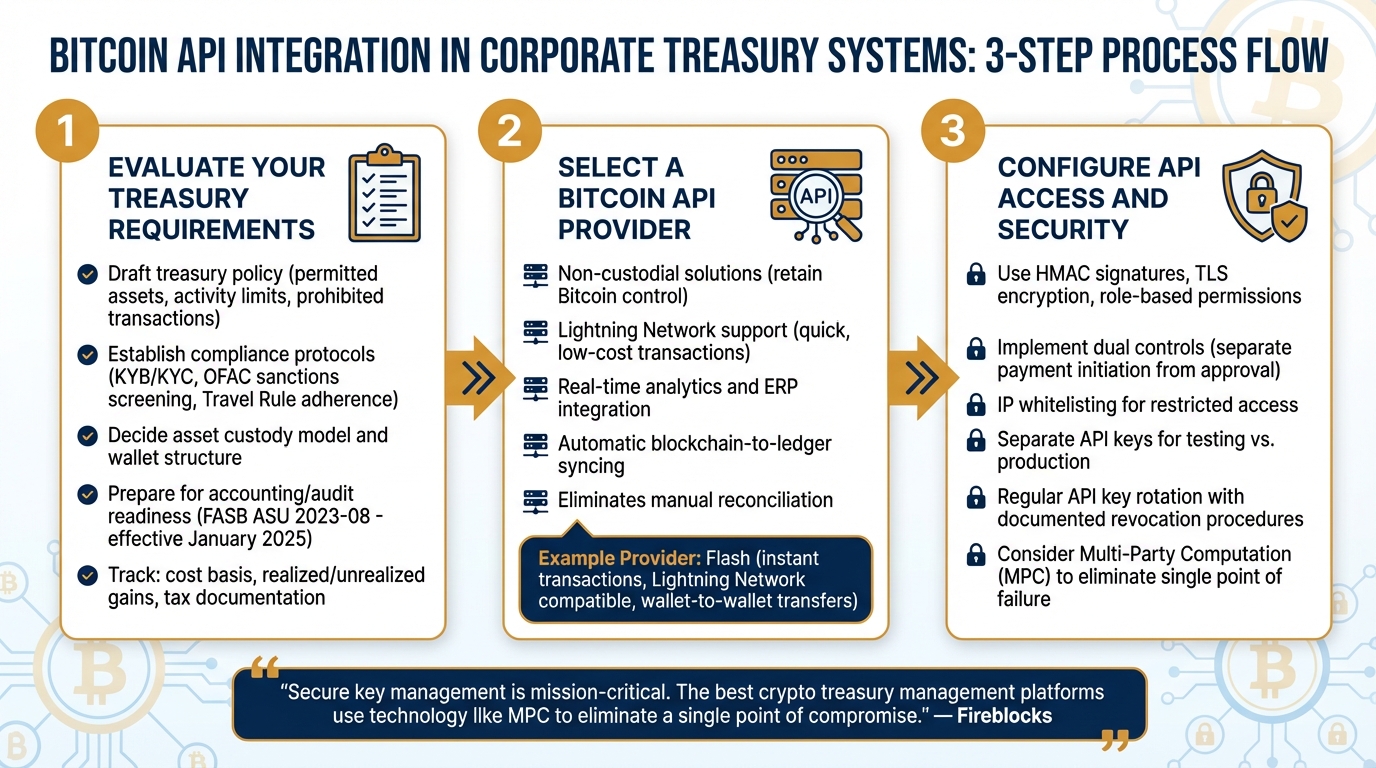
3-Step Process for Integrating Bitcoin APIs into Corporate Treasury Systems
Step 1: Evaluate Your Treasury Requirements
Start by identifying your treasury objectives - whether it’s hedging, facilitating cross-border payments, or diversifying reserves. These goals will directly influence the technical and compliance needs of your system.
Begin with governance and policy design. Draft a treasury policy that clearly outlines permitted assets, activity limits, and prohibited transactions. This policy becomes the backbone of all subsequent technical and operational decisions.
Next, establish compliance protocols. These should include Know Your Business (KYB) and Know Your Customer (KYC) processes, sanctions screenings in line with OFAC lists, and adherence to the Travel Rule for virtual asset transfers. These steps are essential for any regulated entity working with Bitcoin.
Decide on your asset custody model and how wallets will be structured to meet both operational and reserve requirements.
Lastly, prepare for accounting and audit readiness. With FASB ASU 2023-08 coming into effect in January 2025, U.S. companies can measure Bitcoin at fair value, with changes reflected in net income. Your system should handle sub-ledger tracking for cost basis, realized and unrealized gains or losses, and tax documentation.
Once your goals and compliance measures are set, you’re ready to select an API provider that aligns with these criteria.
Step 2: Select a Bitcoin API Provider
With your requirements in hand, evaluate API providers based on how well their features align with your treasury workflows. Look for non-custodial solutions that allow you to retain control over your Bitcoin while automating key processes like payments and reporting.
Ensure the API supports the Lightning Network for quick, low-cost transactions, especially if your treasury handles frequent or micro-payments.
Another critical feature is real-time analytics and ERP integration. The API should seamlessly connect to your existing treasury management or accounting systems, automatically syncing blockchain data with internal ledgers. This eliminates manual reconciliation and minimizes errors in financial records.
For example, Flash offers instant transactions, Lightning Network compatibility, and wallet-to-wallet transfers, making it a strong option for these needs.
Step 3: Configure API Access and Security
Once you’ve chosen a provider, focus on secure integration.
Protect API access using HMAC signatures, TLS encryption, and strict role-based permissions for API keys. Implement dual controls by separating payment initiation from approval, restrict access through IP whitelisting, and use separate keys for testing and production environments. Regularly rotate API keys and document revocation procedures. Segregating duties is a key step in reducing risks.
For enhanced security, consider Multi-Party Computation (MPC). This technology splits key material among multiple participants, removing any single point of failure for private keys. As Fireblocks highlights:
"Secure key management is mission-critical. The best crypto treasury management platforms use technology like MPC to eliminate a single point of compromise." - Fireblocks
sbb-itb-f81ab9b
Common Uses for Bitcoin APIs in Treasury
Processing Bitcoin Payments and Invoices
APIs simplify payment operations by automating the generation of unique Bitcoin addresses for every transaction. This ensures easier reconciliation and enhances privacy. Using real-time exchange rates, these systems can convert fiat-based invoices into satoshis, with expiration windows of 10–20 minutes to prevent customers from taking advantage of price fluctuations.
Once a payment is initiated, the API tracks blockchain confirmations. While a single confirmation significantly reduces the risk of double spending, six confirmations (approximately one hour) are the standard for high-value transactions.
Additionally, modern APIs support the Lightning Network, which enables instant settlements without waiting for block confirmations. For instance, Flash processes Lightning payments almost instantly, charging a 1.5% fee. This makes it a practical option for both large-scale treasury transactions and frequent smaller payments. APIs also handle protocols like BIP21 URIs to ensure wallet compatibility and generate QR codes for point-of-sale or digital invoicing. This streamlined payment process is essential for maintaining efficient treasury operations.
Tracking Bitcoin Holdings in Real Time
With APIs, finance teams can access a centralized dashboard that displays balances across all wallets and accounts, offering real-time visibility into treasury assets. These tools also provide live BTC-to-USD conversion rates, which is especially relevant as fair-value accounting for Bitcoin under FASB ASU 2023-08 begins in January 2025.
Advanced APIs go further by integrating with crypto sub-ledgers to track detailed information such as lot-level cost basis, acquisition dates, and realized or unrealized gains and losses. This level of detail not only simplifies compliance reporting but also eases audit preparation. By syncing blockchain data directly with ERP or treasury management systems, APIs eliminate manual reconciliation efforts, reducing errors and saving time. Beyond tracking, these tools help manage market fluctuations and liquidity concerns effectively.
Managing Price Volatility and Cash Flow
APIs play a key role in addressing Bitcoin's price volatility. They use exchange rate locking to freeze conversion rates at the time of a transaction, shielding treasury teams from potential price swings during settlement. For ongoing holdings, APIs enable automated rebalancing, allowing teams to buy, sell, or adjust positions based on preset risk parameters.
Treasury departments often use APIs to implement dollar-cost averaging (DCA) strategies, making regular Bitcoin purchases to smooth out entry prices and minimize exposure to short-term market fluctuations.
"After studying various alternatives, we decided that holding Bitcoin would be the best use of our excess cash."
Automated on/off-ramps further enhance cash flow management by seamlessly moving funds between local fiat currencies, Bitcoin, or stablecoins whenever needed.
Best Practices for Bitcoin API Treasury Management
Building on the earlier discussion of integration and operational benefits, these practices aim to help treasury teams enhance efficiency, strengthen security, and prepare for growth. By following these steps, Bitcoin API integration can streamline operations while ensuring long-term success in treasury management.
Reducing Transaction Costs and Processing Time
Using the Lightning Network can dramatically cut settlement times and fees. For example, Flash processes payments at just 1.5%, eliminating delays and avoiding the added costs of intermediaries. Direct wallet-to-wallet transactions also bypass third-party processors, reducing fees and enhancing security.
To manage exchange rate volatility, lock rates at the start of transactions and apply double-spend risk analysis to speed up lower-value payments. Adding invoice expiration policies can further limit exposure to fluctuating rates.
Maintaining Security and Regulatory Compliance
A three-tier wallet architecture is key to safeguarding Bitcoin assets. Use cold wallets for long-term reserves, keeping them offline with multi-person approval processes and FIPS 140-3 compliant hardware. Warm wallets should handle settlements with controlled access and quorum approvals, while hot wallets are reserved for automated flows, protected by strict velocity limits and continuous monitoring.
Enhance security by implementing dual control systems and using multi-signature or Multi-Party Computation (MPC) techniques to distribute key material, reducing single points of failure. Avoid storing private keys on internet-facing servers, and ensure all API requests are encrypted with HTTPS to prevent attacks like man-in-the-middle breaches.
For compliance, integrate KYB/KYC screening and apply geofencing to block prohibited jurisdictions. Adhere to the Travel Rule by transmitting required originator and beneficiary details. Use crypto sub-ledgers to monitor addresses, transaction IDs, and lot-level costs, which simplifies reconciliation with on-chain data, custodian reports, and internal records.
With these security measures, organizations can scale their Bitcoin operations securely and efficiently.
Scaling Bitcoin Operations for Large Organizations
Start with a phased rollout, introducing Bitcoin API integration to a pilot group or a specific product line. This allows teams to fine-tune processes and train staff before expanding across the entire organization. Companies like MicroStrategy have successfully validated workflows using this approach before full-scale implementation.
For enterprise-level operations, ensure cross-functional alignment between treasury and IT teams from the beginning. This collaboration addresses technical customizations and avoids potential bottlenecks. APIs can enable high-volume automation - for instance, some organizations poll account data every second to update real-time dashboards.
Implement a board-approved treasury policy to manage operational risks as Bitcoin holdings grow. This policy should outline approved assets, wallet structures, spending limits, authorized personnel, and rebalancing strategies. Choose institutional-grade trading platforms and custody providers that offer compliance certifications and advanced security features, such as cold storage with multi-signature protections.
Conclusion
Bitcoin APIs bring practical advantages to treasury operations by automating blockchain tasks, cutting costs, and facilitating global payments without the delays tied to traditional banking systems. The growing adoption of cryptocurrency in corporate finance highlights its increasing relevance in modern financial strategies.
For corporate treasurers, these APIs offer around-the-clock liquidity and enable direct wallet-to-wallet transactions, bypassing intermediary fees. On top of operational savings, Bitcoin’s fixed supply of 21 million units positions it as a limited digital asset, providing a hedge against the approximately 7% annual expansion of the U.S. money supply.
Platforms like Flash further enhance efficiency by simplifying wallet management. With features like wallet address generation, transaction verification, and real-time settlement, it removes the need for in-house blockchain expertise. These streamlined processes make Bitcoin APIs an essential tool for modern treasury operations.
Chris Pavlovski, Chairman and CEO of Rumble, captures this sentiment perfectly:
"Unlike any government-issued currency, Bitcoin is not subject to dilution through endless money-printing, enabling it to be a valuable inflation hedge and an excellent addition to our treasury".
FAQs
How do Bitcoin APIs improve security for corporate treasury management?
Bitcoin APIs play a key role in enhancing security for corporate treasury management by offering tools and processes designed to protect digital assets. For example, they enable the use of multi-signature wallets, which require multiple approvals for transactions, and tiered storage solutions - like hot, warm, and cold wallets - to minimize the risk of theft or unauthorized access.
These APIs also facilitate formal transaction approval workflows, ensuring that transfers need consent from multiple parties, which reduces the chances of fraud or accidental errors. On top of that, real-time monitoring and reconciliation features add an extra layer of transparency and auditability, helping businesses stay compliant with regulations and maintain strong internal controls. By integrating advanced technology with solid procedures, Bitcoin APIs allow companies to manage their treasury operations securely and efficiently.
How can businesses integrate Bitcoin APIs into their treasury systems?
To bring Bitcoin APIs into your treasury system, start by picking a solution that fits your business goals. Look for features like support for global Bitcoin payments, low fees, and instant transactions. Dive into the API documentation to get a clear understanding of the technical setup and integration process.
Once you've chosen the API, set up authentication by acquiring API credentials such as keys or tokens. These will allow you to securely handle tasks like creating wallets, processing transactions, and managing payments. Make sure to establish internal controls - like approval workflows and transaction limits - to stay compliant and reduce risks.
Before launching, test the integration in a secure testing environment to ensure everything works as expected. After going live, keep an eye on the system to maintain security and fine-tune operations. By following these steps, you can manage Bitcoin transactions efficiently and securely within your treasury system.
How can Bitcoin APIs help businesses manage price volatility effectively?
Bitcoin APIs help businesses navigate the challenges of price volatility by offering real-time market data and tools to track Bitcoin's value relative to the US dollar. With this information, companies can keep an eye on price fluctuations and decide when to convert Bitcoin into fiat currency, reducing the risk of unexpected financial losses.
These APIs also support automated risk management, such as setting up automatic conversions during volatile market periods. By incorporating these tools into their treasury systems, businesses can better manage financial risks and maintain steady operations, even when the market is unpredictable. In short, Bitcoin APIs play a key role in promoting stability and efficiency in managing corporate finances.