Picture this: you walk into a coffee shop to buy a $3 coffee, but all you have is a $20 bill. You hand over the twenty, and the barista gives you your coffee along with $17 in change. You don't get your original $20 back with a $3 hole cut out of it; you get entirely new bills and coins.
A Bitcoin change address works on a very similar principle. It's a brand-new address, generated automatically by your wallet, where the "change" from a Bitcoin transaction is sent. This isn't just a neat feature; it's a fundamental part of how Bitcoin protects your financial privacy on a public ledger.
What Is a Bitcoin Change Address and Why Does It Matter?
When you send Bitcoin, you aren't just deducting a number from a bank account. Instead, you're spending whole "chunks" of digital cash you've previously received. These chunks are called Unspent Transaction Outputs (UTXOs).
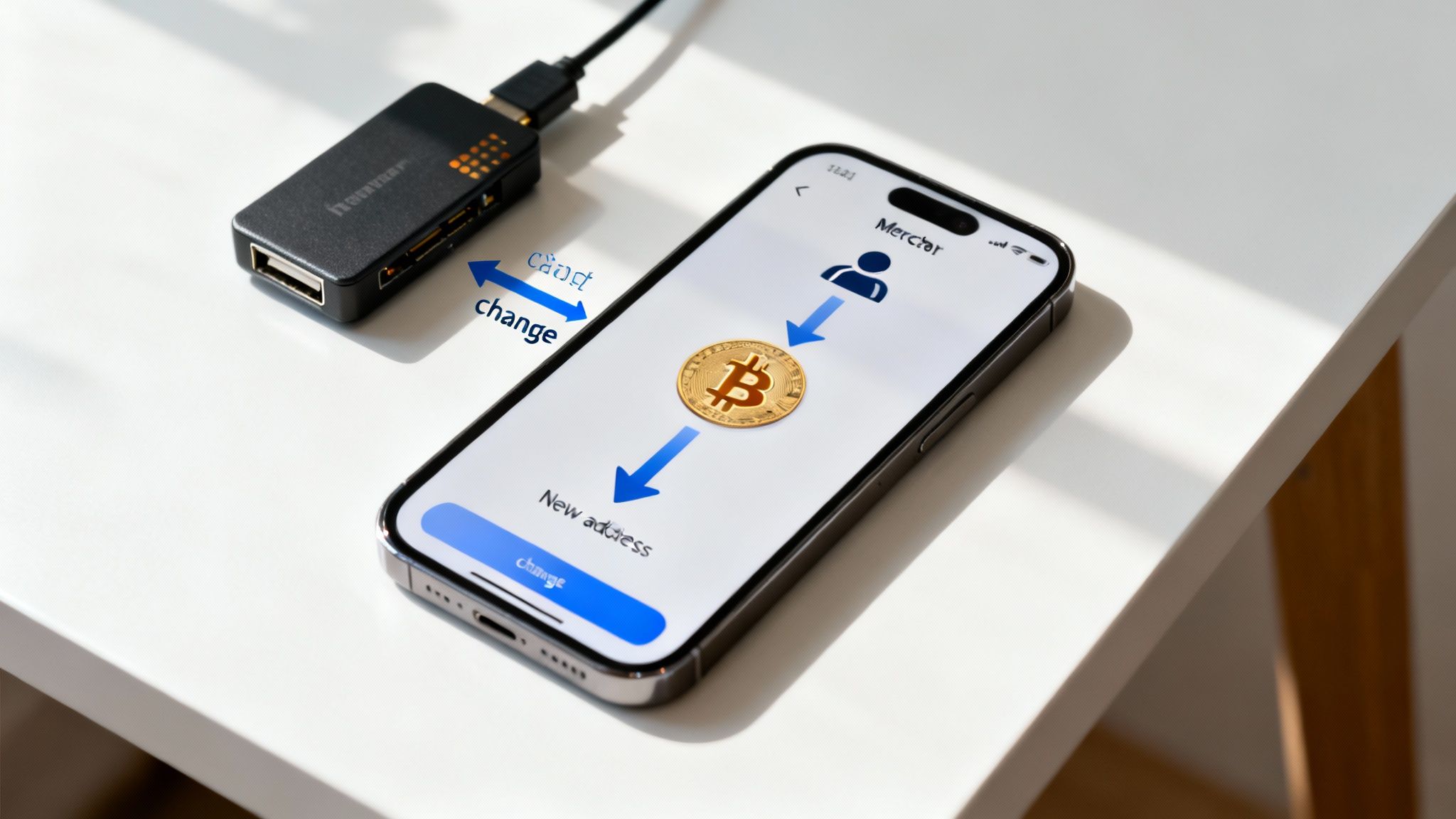
Let's say you have a single UTXO worth 1 BTC in your wallet and you need to pay someone 0.2 BTC. Your wallet has no choice but to spend the entire 1 BTC chunk. It can't just break off a piece.
To make this happen, your wallet creates a transaction with two destinations (outputs): one sends the 0.2 BTC to the person you're paying, and the other sends the remaining 0.8 BTC back to you. But here’s the crucial part: for privacy, that 0.8 BTC isn't sent back to the address it came from. Instead, your wallet generates a fresh, unused Bitcoin change address that you control to catch this leftover amount.
The Core Purpose of a Change Address
So, why go through all this trouble? It all comes down to privacy.
If your change was always sent back to the same address you spent from, it would paint a crystal-clear picture of your financial life for anyone watching the blockchain. This bad habit, called address reuse, makes it dangerously easy for observers to:
- Track your spending habits: They could easily link all your purchases together and build a detailed profile of your financial activity.
- Estimate your total holdings: By connecting the dots between your addresses, they could get a good idea of how much Bitcoin you actually own.
- Target you for attacks: A big, visible balance makes you a much more attractive target for hackers, scammers, and thieves.
By automatically using a new address for the change every single time, modern wallets shatter these links. Your transaction history becomes a tangled web that's much, much harder for an outsider to follow. It’s one of the simplest and most effective privacy tools built right into Bitcoin.
To help simplify these concepts, here’s a quick breakdown of the key terms.
Bitcoin Change Address Core Concepts
| Concept | Simple Analogy | Main Purpose |
|---|---|---|
| UTXO | A digital bill or coin in your wallet (e.g., a $20 bill). | Represents a specific amount of Bitcoin you can spend. |
| Transaction Input | The UTXO(s) you are spending (the $20 bill you hand over). | To provide the funds needed for the payment. |
| Transaction Output | The destinations for the funds (the coffee shop and your change). | To direct Bitcoin to the recipient and return the leftover amount. |
| Change Address | A brand-new pocket to put your change in. | To receive leftover BTC while breaking the link to your past transactions, boosting privacy. |
This table shows how each piece fits together to enable a private and secure transaction model.
A common misconception is that a "change address" is some special kind of address. It's not. It’s just a standard Bitcoin address that your wallet designates to receive the change. It works exactly like any other address you’d use to receive funds.
Ultimately, your wallet handles all of this automatically in the background. You don't have to manually create or manage these change addresses. But understanding why they exist is the first step to truly grasping how Bitcoin is designed to protect its users.
Now, let's dive deeper into the concept of UTXOs to see exactly why this "change" is necessary in the first place.
Understanding UTXOs: The Building Blocks of Bitcoin
To really get why a Bitcoin change address is so important, you first need to rewire how you think about your Bitcoin balance. It's nothing like a traditional bank account with a single, running total. A Bitcoin wallet's balance is actually just the sum of many different pieces of digital money held together.
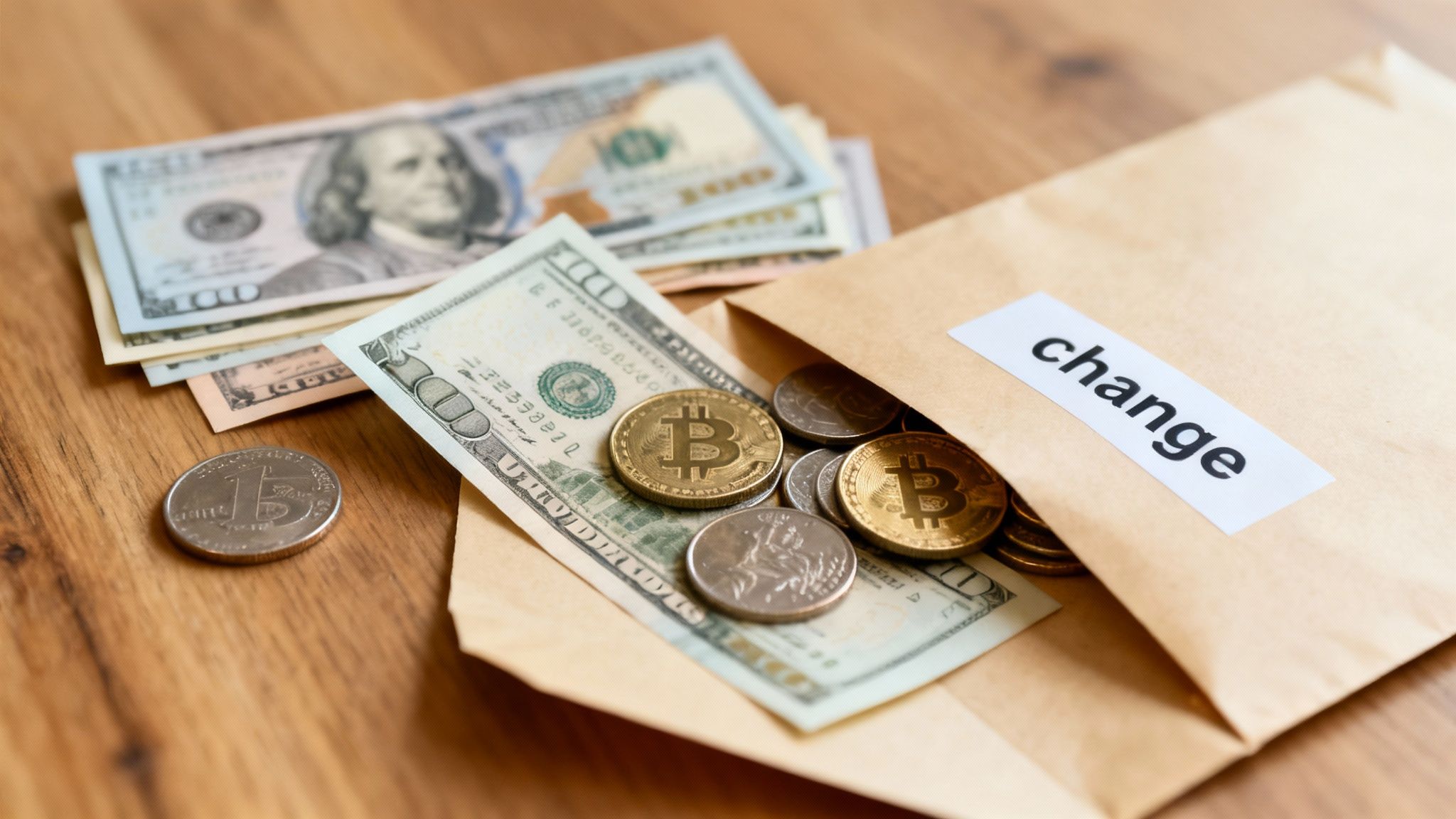
These individual pieces are called Unspent Transaction Outputs, or UTXOs. The easiest way to picture them is as digital cash—think of a wallet full of different bills and coins. Your total balance is simply what you get when you add up all those UTXOs.
Let's say your wallet holds:
- One UTXO worth 0.5 BTC
- Another UTXO worth 0.25 BTC
- And a third UTXO worth 0.1 BTC
Your total balance is 0.85 BTC, but it isn't stored as one lump sum. It's held as three separate digital "bills." This structure is the absolute foundation of how every single Bitcoin transaction is built.
The Cash Analogy Explained
Imagine you want to buy something that costs 0.3 BTC. Looking at your wallet, you don't have a single UTXO that matches that amount perfectly. And just like you can't tear a $20 bill in half, you can't just slice off a piece of your 0.5 BTC UTXO and spend it.
Bitcoin works a lot like physical cash here. You have to spend the entire UTXO. Your wallet has to pick one or more of your digital "bills" that add up to at least the payment amount. In this case, it would grab the 0.5 BTC UTXO to cover the purchase.
Think of a UTXO as an indivisible piece of Bitcoin. Once it's created, it must be spent in its entirety in a new transaction. This is the core mechanic that makes "change" a necessity.
This is exactly where the concept of "change" comes from. You only needed to pay 0.3 BTC, but you had to use a 0.5 BTC bill. The leftover 0.2 BTC has to come back to you.
How UTXOs Create Change
Behind the scenes, your wallet constructs a transaction that takes your 0.5 BTC UTXO as its input and creates two brand-new outputs:
- Payment Output: 0.3 BTC goes to the person you're paying.
- Change Output: The remaining 0.2 BTC is sent back to you.
And here's the critical part: that 0.2 BTC in change is sent to a completely new Bitcoin change address that your wallet generates on the fly, just for this single transaction. This 0.2 BTC now becomes a fresh UTXO in your wallet, ready to be used in the future.
This whole process keeps the Bitcoin ledger perfectly balanced. The entire input UTXO is consumed, and new output UTXOs are created to replace it—one for the payment, one for the change. This model is why understanding UTXOs is the key to seeing why your wallet constantly creates new addresses. Without it, Bitcoin's privacy would fall apart.
One of the slickest, most underrated features of any modern Bitcoin wallet is how it handles your change. You never have to manually create a bitcoin change address or even think about where your leftover sats are going. It all just works, humming along in the background to protect your privacy without you lifting a finger.
So, how does your wallet pull this off?
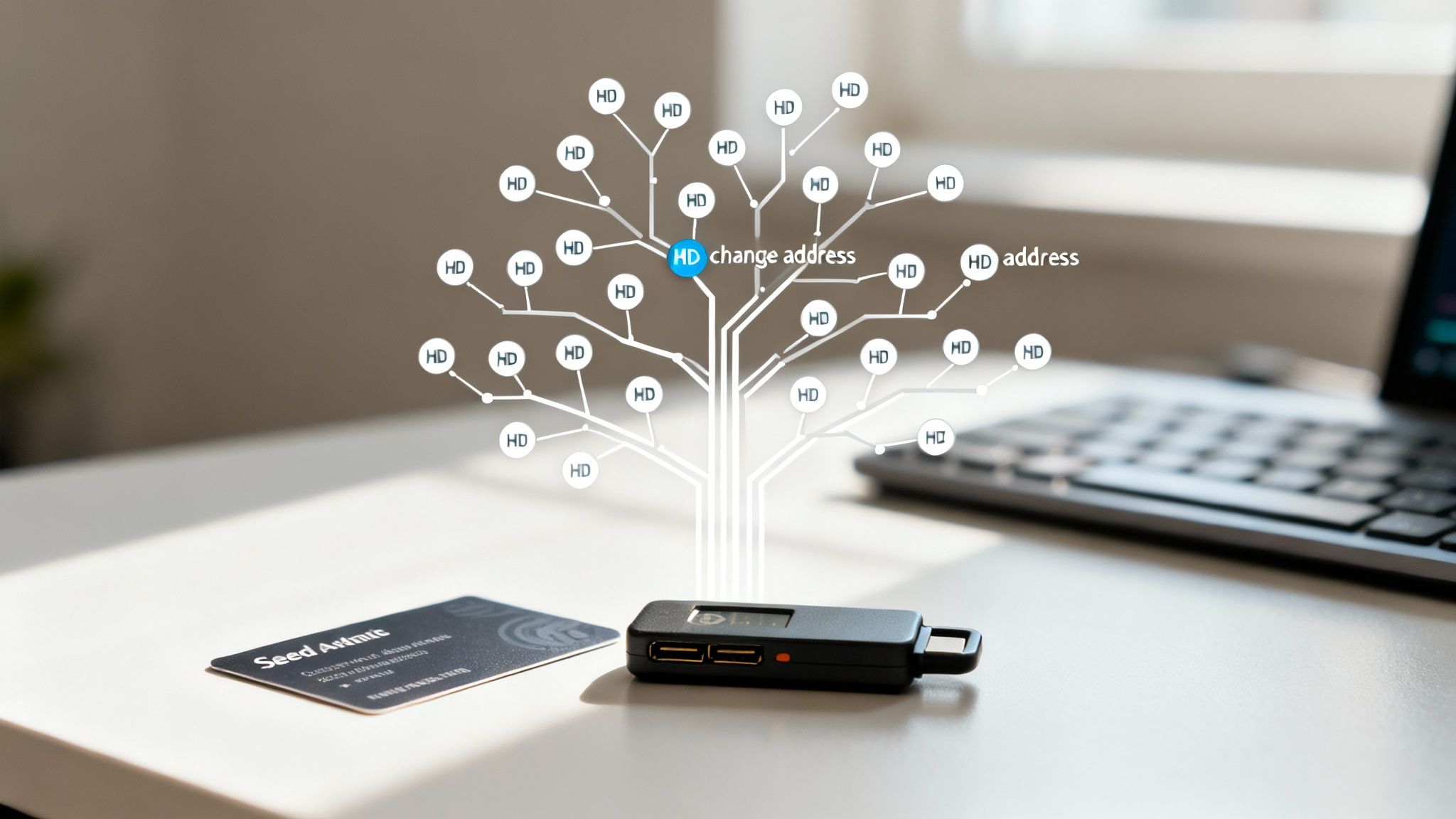
The secret sauce is a technology standard called Hierarchical Deterministic (HD) wallets. Your wallet’s secret recovery phrase—that list of 12 or 24 words—acts like a master key. From that single phrase, your wallet can mathematically generate a nearly infinite tree of addresses and their private keys, all in a predictable and organized fashion.
This structure is what lets your wallet generate a brand-new, never-before-used address for every single transaction, whether it's for receiving a payment or getting your change. It doesn't need to store millions of individual keys or ask for your permission every time. It's all automated, secure, and built right into the wallet's DNA.
The Power of BIP 32 and BIP 44
This whole process isn't just random magic; it follows a strict set of rules laid out in Bitcoin Improvement Proposals (BIPs). Two of the most important ones here are:
- BIP 32: This is the OG proposal that introduced the idea of HD wallets. It defined the "tree" structure, which allows a parent key to derive a whole sequence of child keys and their corresponding addresses.
- BIP 44: This standard builds on BIP 32 by giving the address tree a filing system. It specifies different "derivation paths" for different jobs, including a dedicated path just for generating change addresses.
This means your wallet keeps two separate, organized ledgers: one for your public receiving addresses (the ones you give out) and another for its internal change addresses (the ones you never see). This simple separation keeps your transaction history clean, protects your privacy, and all springs from that one seed phrase you wrote down.
By following this blueprint, your wallet can generate a fresh bitcoin change address every single time you spend. This is a non-negotiable privacy feature. It makes it exponentially harder for blockchain spies to connect the dots and trace your financial activity.
You can see the real-world impact of this automation right on the blockchain. According to analysis from the BitMEX Blog, address reuse has plummeted. In 2023, around 50% of transaction outputs were sent to previously used addresses—a huge improvement from rates that were over 70% back in 2013. This massive shift is almost entirely thanks to HD wallets making good privacy automatic.
Ultimately, this behind-the-scenes system makes strong privacy practices completely effortless for the average person, which is a massive win for Bitcoin's usability and security.
How Change Addresses Protect Your Privacy
Using a new bitcoin change address for every transaction isn't just some technical detail—it's one of the most powerful, built-in privacy tools you have. This automated wallet feature is your first line of defense against a common tactic used by blockchain analysis firms: the common-ownership heuristic.
This heuristic works on a simple, yet effective, assumption: if multiple chunks of bitcoin (UTXOs) are spent together in one transaction, they probably belong to the same person. When a wallet sends your change back to an old, used address, it basically confirms this assumption for anyone watching. It creates a concrete link, allowing observers to say, "Aha! These addresses are all controlled by the same entity."
Breaking the Chain of Analysis
By generating a completely fresh change address every single time, your wallet cleverly breaks this heuristic. An outside observer looking at the transaction can no longer be sure which output is the actual payment and which is the change coming back to you.
This simple act of never reusing addresses throws a wrench into the works, introducing ambiguity and plausible deniability. It makes it significantly harder for an analyst to:
- Map out your entire wallet: They'll struggle to connect all your UTXOs, making it nearly impossible to get a clear picture of your on-chain financial footprint.
- Guess your total holdings: Without a clear map of all your addresses, calculating your total balance becomes a much more difficult, if not futile, exercise.
- Follow your spending habits: The links between your past and future transactions are effectively severed, preventing them from building a detailed profile of your financial activity.
Every time your wallet uses a new change address, it weaves another layer of complexity into the public ledger. Instead of leaving a neat trail of breadcrumbs for anyone to follow, you're creating a tangled web that's far more difficult and expensive to unravel.
The Danger of Reusing Addresses
Now, let's contrast that with the privacy disaster that is address reuse. Imagine you have a 0.5 BTC UTXO and you want to pay someone 0.2 BTC. If your wallet sent the 0.3 BTC in change back to the very same address it came from, the transaction graph would be painfully obvious to anyone with a block explorer.
They'd see one address sending funds to two different outputs. But since one of those destination addresses is the exact same as the input address, it immediately screams, "This one is the change!" This one bad habit single-handedly torpedoes the privacy benefits of the entire UTXO model.
Thankfully, any modern wallet worth its salt is designed to prevent this mistake automatically. This proactive approach means that even if you're not a privacy expert, your wallet is already following best practices to protect your financial sovereignty. By simply letting your wallet do its job, you’re actively making the Bitcoin network a more private place for everyone.
How to Spot a Change Address on a Block Explorer
Your wallet takes care of creating and managing change addresses automatically, but it’s a fascinating exercise to see if you can spot the change yourself. When you look up a transaction on a public block explorer, you can often make a strong, educated guess about which output is the payment and which is the leftover change coming back to the sender.
You can never be 100% certain, but learning to identify the clues gives you a real window into how blockchain analysis firms operate. It also drives home just how important this privacy feature is.
Common Clues to Look For
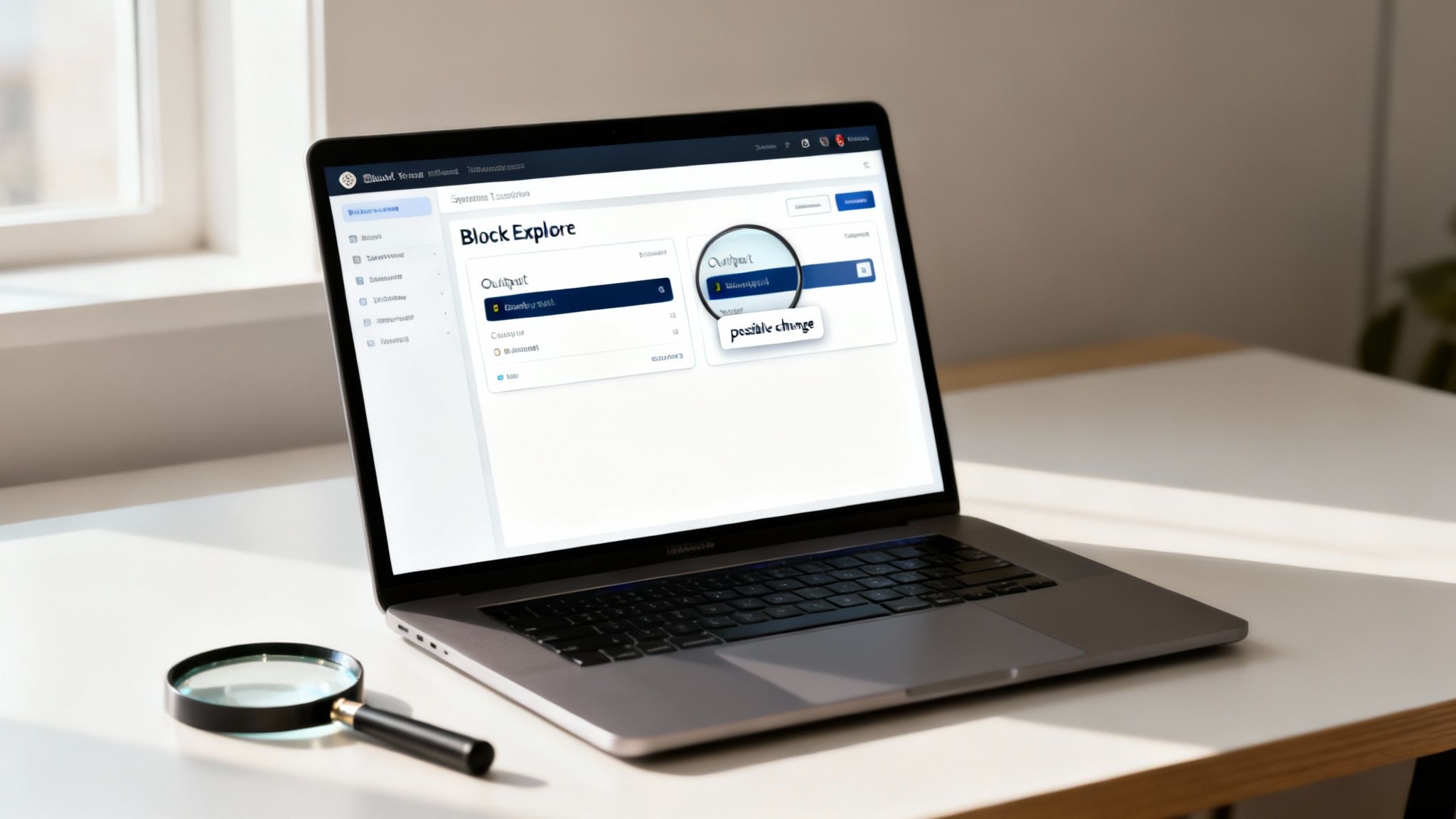
Go ahead and pull up a transaction on any block explorer. Now, focus on the "output" side—this is the list of addresses receiving Bitcoin. Here are the most common signs that one of them is actually the change:
- Non-Round, "Ugly" Numbers: Think about it: payments are usually for a specific, often rounded price, like 0.005 BTC for a coffee. The change, however, is just the leftover scrap. It almost always looks like a random, highly specific number (e.g., 0.01847261 BTC). This is your single most reliable indicator.
- Newer Address Formats: Modern wallets love generating change addresses using the latest formats, like Bech32 (those addresses starting with "bc1q"). If you see a transaction where one output goes to an old-school legacy address (starting with "1") and the other goes to a shiny new Bech32 address, the modern one is very likely the change.
- Brand-New, Unused Addresses: By design, a bitcoin change address is a one-time-use address. It should have absolutely no previous transaction history. If you check the output addresses and one has a long history of use while the other is completely fresh, the new one is the prime suspect for being the change.
This simple practice of sending change to a fresh address is a cornerstone of Bitcoin's pseudonymity. During the peak of the 2021 bull market, when daily active addresses were hitting nearly 1.4 million, countless billions in value were quietly circulating as change outputs. This just highlights the massive scale of this built-in privacy feature. You can explore more data about Bitcoin's active addresses to see these trends for yourself.
Identifying a change address is a game of probability. While these heuristics are powerful, sophisticated wallets can sometimes create transactions that intentionally obscure these patterns to further enhance user privacy.
Let's look at a real example where you can see these clues in action.
In this screenshot, notice the second output. The value is a highly specific, non-round number. That makes it the most probable change output heading right back to the sender's wallet.
Best Practices for Managing Bitcoin Change
When it comes to handling your bitcoin change address, the best advice is often the simplest: don't. For the average person, the easiest way to protect your privacy and security is to just let your wallet do its thing.
Modern Hierarchical Deterministic (HD) wallets are built for this exact purpose. They automatically generate a brand new, never-before-seen change address for every single transaction you make. Trying to step in and manage this yourself is not only pointless but also risky—it’s an easy way to make a mistake and accidentally link your transaction history together. Trust the software; it knows what it's doing.
Advice for Merchants and Payment Processors
Things get a bit more involved if you're a business or a payment processor. When a customer sends you a payment, their transaction will almost always have at least two outputs: one that pays you, and another that sends the leftover change back to them. Your system absolutely must know how to tell these two apart, or you're heading for a bookkeeping nightmare.
If your system mistakenly identifies the customer's change as part of their payment, you could end up marking an invoice as overpaid or, even worse, shipping products for an order that was never fully paid. It's critical to only watch the specific payment address you gave the customer and ignore all other outputs in that transaction.
A robust payment system never assumes the entire value of an incoming transaction is the payment. It must validate the specific output sent to the designated merchant address to ensure accurate reconciliation and prevent errors.
This practice of always creating new change addresses is a huge win for everyone's privacy. We can even see its impact on the network. Bitcoin address data shows 'shrimp' addresses (those holding less than 1 BTC) made up over 80% of all addresses by 2025. Their accumulation patterns often come from making purchases and receiving change back to fresh addresses, a habit that boosts privacy for the largest group of Bitcoin users. You can learn more about these Bitcoin distribution trends.
Finally, getting change management right is crucial for accurate financial reporting. To keep your books clean and figure out your tax obligations correctly, it's worth looking into specialized tools like guides on using a crypto tax calculator.
A Few Lingering Questions About Change Addresses
We've walked through the mechanics and privacy perks of using a bitcoin change address, but a few common questions always seem to pop up. Let's tackle them head-on to clear up any final confusion.
Do I Pay an Extra Fee for the Change Address?
Nope. You don't pay a separate or extra fee for the change output. The Bitcoin transaction fee you pay is based on the total data size of your entire transaction, not how many outputs it has.
Think of it this way: the change output is just one part of the single transaction you're already building. Its cost is bundled into the total network fee you pay to the miners. The fee covers the whole package—the inputs, the payment, and the change you get back.
What Happens if Change Goes Back to My Sending Address?
This is called address reuse, and it's a huge privacy no-go. When you send change back to the same address you spent from, you're creating a permanent, public link on the blockchain.
That link screams that a single person or entity controls both addresses. This makes it incredibly easy for blockchain analysis firms to connect the dots, trace your entire transaction history, and get a very good estimate of your total Bitcoin holdings. Modern HD wallets are built specifically to avoid this trap by always generating a fresh address for your change.
Sending change back to a used address is a major privacy mistake. It’s like paying for everything from the same physical wallet day after day and putting the change right back in, letting any observer easily track your balance and spending habits.
Can I See My Change Addresses in My Wallet?
Usually, no. You won't see your change addresses in your wallet's main screen. Most modern Bitcoin wallets are designed to hide them on purpose to keep the user experience clean and simple.
Your total wallet balance is the sum of all the unspent coins (UTXOs) you control, including the ones sitting in these hidden change addresses. While some advanced or command-line wallets might let you dig in and view them, it's not a standard feature because you don't need to see them to use Bitcoin safely. Your wallet handles all of that for you in the background.
Ready to accept Bitcoin payments with a system that respects privacy and security? Flash offers wallet-to-wallet transactions that are fast, decentralized, and seamless. Get started in under a minute.