Managing Bitcoin compliance is now a top priority for CFOs. With the rise of cryptocurrency adoption and increasing regulatory scrutiny, manual processes can no longer keep up. Compliance automation offers CFOs a way to streamline operations, reduce risks, and meet evolving legal requirements.
Key Takeaways:
- Why It Matters: Bitcoin compliance automation helps monitor transactions, flag risks, and meet global Anti-Money Laundering (AML) standards.
- Regulatory Landscape: IRS reporting, the Bank Secrecy Act, and international rules like the EU's Travel Rule demand precise tracking of digital assets.
- Automation Benefits:
- Real-time monitoring reduces regulatory risks.
- Automated risk scoring focuses on real threats, minimizing manual reviews.
- Seamless integration with financial systems simplifies compliance efforts.
- Tools to Consider: Platforms like Flash enable wallet-to-wallet transactions while ensuring compliance with blockchain transparency.
CFOs must adopt these tools to handle growing cryptocurrency exposure, avoid penalties, and maintain financial integrity in a complex digital economy.
Regulatory Requirements for Bitcoin Transactions
Bitcoin Regulations You Need to Know
For CFOs aiming to stay on top of compliance, understanding Bitcoin's regulatory environment is non-negotiable. The IRS classifies Bitcoin as property, which means tax reporting rules apply. On forms like 1120, 1120-S, and 1065, businesses must declare their digital asset holdings - even for internal transfers. However, if no taxable activity occurred, they can select "No." As the IRS explains:
Digital assets are treated as property for tax purposes, and general property tax principles apply to any of these transactions.
The Bank Secrecy Act (BSA) imposes additional obligations on businesses handling convertible virtual currencies. These include maintaining Anti-Money Laundering (AML) programs, conducting Customer Due Diligence (CDD), and filing Suspicious Activity Reports (SARs) for any transaction that raises red flags about illegal activity. Financial institutions must also report cash transactions exceeding $10,000 in a single day. Automated tools can simplify tracking and meeting these compliance benchmarks.
The regulatory framework around Bitcoin is evolving quickly. For instance, on January 29, 2026, the Senate Agriculture Committee narrowly advanced the Digital Commodity Intermediaries Act, giving the Commodity Futures Trading Commission (CFTC) authority over digital commodity spot markets, including Bitcoin. Senator John Boozman highlighted the act’s significance:
The measure would establish a clear legal definition of digital commodities and would create a spot market digital commodity intermediary regulatory regime with the CFTC.
Accurate tracking of Bitcoin's fair market value at receipt and disposal is crucial for calculating capital gains or losses, which are reported on Form 8949. Misreporting income can lead to penalties and interest.
While these domestic guidelines are essential, CFOs managing international operations face even more complex compliance challenges.
Meeting Compliance Standards Across Countries
Global operations bring additional layers of compliance for CFOs, particularly under the Financial Action Task Force (FATF) standards for AML and counter-terrorism financing (CFT). CFOs must also engage in international information sharing through the Egmont Group of Financial Intelligence Units (FIUs).
One key regulation is the "Travel Rule" under EU Regulation 2023/1113. This rule requires crypto-asset service providers to include identifying information with every crypto-asset transfer. Fully enforced as of December 30, 2024, this rule mandates systems that flag transfers missing originator or beneficiary details.
The Financial Crimes Enforcement Network (FinCEN) works closely with international governments to implement AML/CFT frameworks. According to FinCEN:
FinCEN works with foreign governments to provide policy recommendations and guidance... in order to foster the implementation of anti-money laundering and counter-terrorism financing (AML/CFT) regimes worldwide.
Additionally, CFOs must align their companies with the Corporate Transparency Act (CTA), which requires reporting beneficial ownership details - identifying the individuals who ultimately control the business. This measure has become a cornerstone of modern AML efforts across jurisdictions.
Navigating these domestic and international requirements demands a proactive approach, especially for companies operating across borders. Advanced compliance systems and a clear understanding of these regulations are key to avoiding pitfalls.
What to Look for in Bitcoin Compliance Automation Systems
Real-Time Monitoring and Reporting
An effective compliance system starts with real-time transaction screening. This capability flags high-risk transactions before they’re finalized, giving CFOs the chance to address potential issues proactively. It’s a critical tool for preventing the "information asymmetry" that can conceal vulnerabilities, helping finance teams act before small problems escalate into major failures.
The best systems also produce audit-ready reports that comply with US GAAP and IFRS standards, eliminating the need for manual adjustments. They perform three-way reconciliations between on-chain data, custodian or exchange statements, and internal records to ensure accuracy. A standout example is the Cardano Foundation’s initiative in January 2026. Using the Reeve platform, CFO Stephen Wood published the foundation’s financial data directly onto the blockchain. This created a real-time, verifiable record of assets and allocations while enabling the team to monitor treasury positions and liquidity directly on the ledger. As Wood explained:
By moving financial data onto a transparent ledger, we eliminate the "information asymmetry" that typically hides systemic vulnerabilities.
Real-time systems also help detect "stress signals" early. They can identify red flags like "layering" (structuring transactions to obscure fund origins) or "splintering" (spreading funds across multiple exchanges), allowing teams to address these risks at scale.
Automated Risk Assessment
Once real-time monitoring is in place, the next step is automating risk assessment to focus on genuine threats. Automated risk scoring is a game-changer for managing Bitcoin transaction risks. These tools assign risk scores to wallet addresses and transactions in real time, helping teams reduce false positives and concentrate on actual risks. Customizable rule engines are particularly valuable, allowing businesses to tailor rules to their specific needs and regulatory environments.
Advanced platforms go further with visual fund tracing tools, which map the flow of funds across tokens and connect blockchain activity to real-world entities. This is essential for meeting anti-money laundering (AML) requirements. For example, Sardine, a fraud and compliance platform led by CEO Soups Ranjan, uses Coinbase Tracer to enhance their Transaction Monitoring solution. As Ranjan noted:
Coinbase Tracer powers critical signals and insights in Sardine's Transaction Monitoring solution. We power crypto businesses around the world by monitoring for illicit activity in real time.
Look for systems offering approved and blocked entity lists with detailed controls. This feature allows you to quickly manage risks by authorizing or blocking specific entities at the database level. As your Bitcoin operations expand, the ability to scale monitoring across millions of transactions without increasing operational complexity becomes increasingly important.
Integrating these tools with your existing infrastructure ensures compliance efforts remain efficient and effective.
Connecting with Your Existing Financial Systems
Finally, integration with your current financial systems is key to making compliance automation a seamless part of your workflow. API-driven integration allows compliance tools to plug directly into existing processes. Modern systems provide APIs - like Know Your Transaction (KYT) APIs - that connect with financial systems and third-party case management tools. This unified approach simplifies wallet management, transaction evaluation, and reporting, reducing the need for multiple vendors and minimizing training requirements.
Bitwise Asset Management, led by President Teddy Fusaro, uses institutional-grade compliance tools to maintain high standards of data security and usability. Fusaro highlighted:
Coinbase Tracer provides the comfort of using the same crypto data tools as one of the most trusted brands in crypto.
When assessing integration capabilities, check whether the system allows for easy export of detailed transaction logs for internal reviews and regulatory audits. For businesses with cross-border operations, ensure the tool supports the Travel Rule for identifying counterparties and securely transmitting data. Additionally, CFOs should evaluate the security measures of potential providers, as regulators increasingly scrutinize the cyber risks associated with third-party technology services.
FIN Podcast: "Crypto Compliance in 2025: From the Wild West to Guardrails" (Episode 11)
sbb-itb-f81ab9b
Using Flash for Bitcoin Compliance Automation

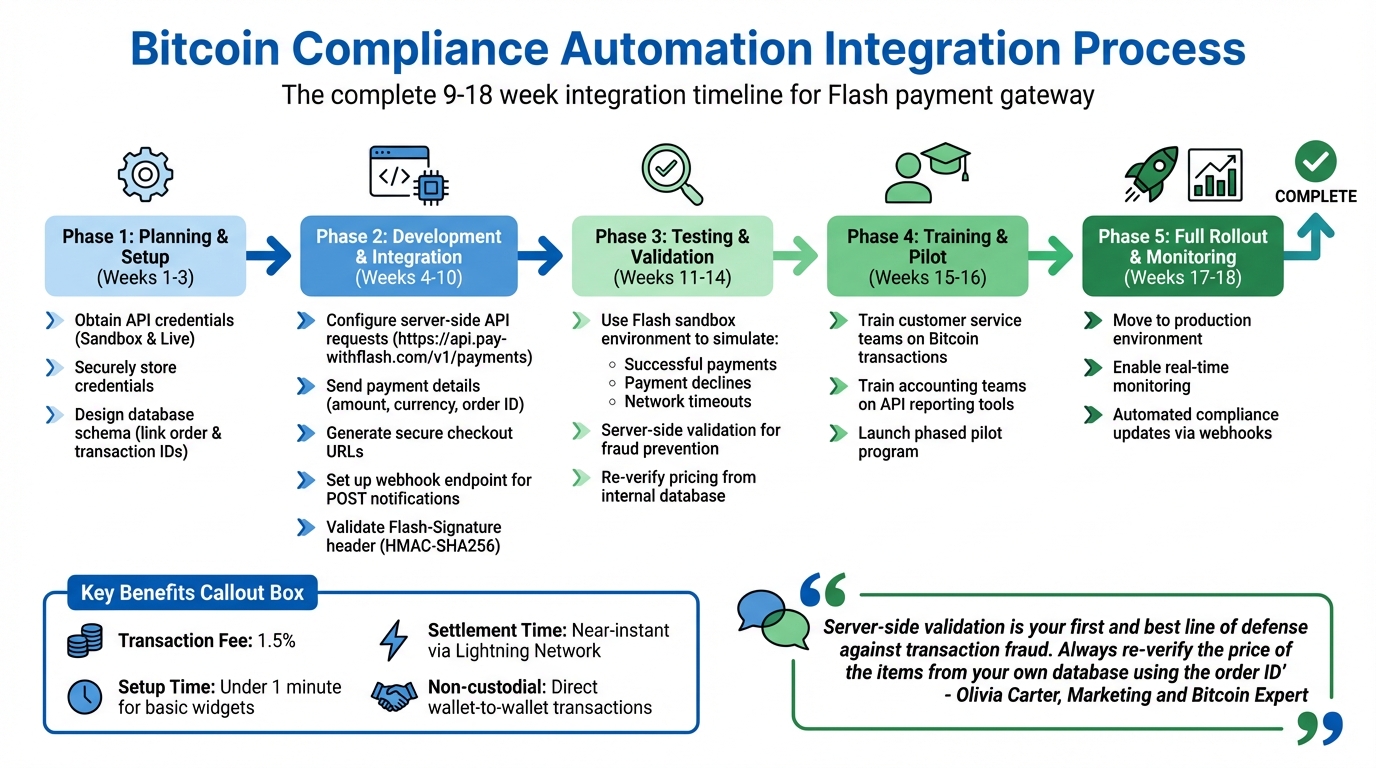
Bitcoin Compliance Automation Integration Process for CFOs
Flash addresses the growing demand for real-time monitoring and seamless system integration, offering tailored solutions for Bitcoin compliance.
Flash Features and Capabilities
Flash functions as a non-custodial Bitcoin payment gateway, allowing direct wallet-to-wallet transactions without relying on traditional intermediaries. It supports a variety of payment solutions, including payment links, paywalls, subscriptions, widgets, point-of-sale systems, and custom API integrations. Leveraging the Lightning Network, Flash enables transactions to settle almost instantly, a significant improvement over the typical 1–3 business-day processing times.
The platform generates unique invoices and QR codes for each transaction, ensuring that payments are easily identifiable for accounting and regulatory purposes. With a simple 1.5% transaction fee, Flash provides a predictable pricing model, making cost planning easier for financial teams.
The rise in cryptocurrency payments highlights the need for dependable infrastructure. By early 2025, global cryptocurrency users exceeded 659 million, reflecting a 30% growth from 2024, while approximately 15,000 merchants accepted cryptocurrency payments. The market for cryptocurrency payment apps also expanded, growing from $1.04 billion in 2024 to an estimated $1.26 billion in 2025, with an annual growth rate of 20.9%. Flash not only simplifies transactions but also sets the stage for automated compliance, as described below.
How Flash Makes Compliance Easier
Flash's non-custodial design reduces the regulatory complexities often associated with custodial financial services. Since Flash facilitates direct transactions without holding user funds, it eliminates third-party custody risks and the compliance challenges that come with them.
The platform automatically verifies transactions on the blockchain and provides immediate notifications to financial systems, enabling real-time audit trails. This blockchain transparency ensures a verifiable, up-to-date record of assets. The Lightning Network's speed requires real-time monitoring systems capable of identifying fraud patterns as they emerge.
Flash also delivers real-time analytics and webhooks that send transaction updates - whether completed, failed, or pending - straight to financial systems. This automation removes the need for manual record-keeping, keeping compliance documentation accurate and up to date. As Olivia Carter, a Marketing and Bitcoin expert, explains:
A flawless payment process builds brand credibility. When a transaction is effortless, it reinforces the customer's perception that your entire business is professional, reliable, and trustworthy.
Steps to Integrate Flash into Your Financial Systems
Integrating Flash into your financial systems typically takes 9–18 weeks, covering everything from planning to post-launch monitoring. Start by obtaining API credentials (Sandbox for development, Live for production) from the Flash dashboard and securely storing them in environment variables.
Design a database schema that links your internal order IDs to Flash's transaction IDs and statuses. Use server-side requests to send payment details - amount, currency, and order ID - to https://api.paywithflash.com/v1/payments, and redirect users to the secure checkout URL generated by the API.
Set up webhooks to automate compliance updates. Create a dedicated endpoint to receive real-time POST notifications, which eliminates the need for manual status checks and allows for immediate actions like updating ledgers or sending receipts. Always validate the Flash-Signature header using HMAC-SHA256 and your webhook secret to ensure the data is authentic. Olivia Carter emphasizes:
Server-side validation is your first and best line of defense against transaction fraud. Always re-verify the price of the items from your own database using the order ID.
Begin with a phased pilot to fine-tune compliance processes before rolling out the system fully. Use Flash's sandbox environment to simulate various scenarios, such as successful payments, declines, and network timeouts, before moving to production. Provide brief training for customer service and accounting teams on Bitcoin transactions and the API's reporting tools to complete the integration process.
This structured approach ensures automated compliance, real-time monitoring, and secure financial operations.
How to Measure Compliance Automation Performance
Key Metrics to Track
To gauge the effectiveness of compliance automation, start by tracking the cost basis for every Bitcoin transaction - both acquisitions and dispositions. This ensures accurate calculation of capital gains or losses, a critical component for reliable financial reporting. Additionally, measure reconciliation efficiency, which involves monitoring the process from USD invoicing to crypto receipt and eventual fiat conversion.
Another vital metric is settlement latency. Faster settlement times, such as near-instant transactions, can provide significant operational benefits. Pay close attention to the alert-to-report ratio - the percentage of automated alerts that lead to a filed Suspicious Activity Report (SAR). This metric highlights how effectively your risk assessment system identifies genuine threats while minimizing false positives. A high false positive rate wastes valuable resources, while too few alerts could indicate blind spots in your coverage.
Also, track the detection rates of unknown exposure. This measures how many crypto-linked entities your system identifies within traditional payment systems that manual processes might overlook. These metrics collectively help determine cost savings and overall return on investment (ROI).
Calculating Cost Savings and ROI
Once you’ve established the key metrics, use them to evaluate ROI by quantifying both transactional and operational efficiencies. For instance, transaction fee optimization can significantly reduce costs. By leveraging the Lightning Network, which charges as little as $0.001–$0.005 per transaction, you can avoid the 1%–3% fees typically associated with traditional wire transfers - especially valuable in high-cost cross-border transactions.
Operational efficiency gains are another area to measure. Automation can drastically reduce manual labor hours by integrating Virtual Asset Service Provider (VASP) lists, eliminating the need for time-consuming manual searches. Compare the time spent on due diligence tasks before and after automation to assess these gains.
Automation also enables revenue growth by streamlining more complex processes like on-chain tracing and Source of Wealth analysis. This efficiency makes it easier to onboard high-net-worth and institutional clients, unlocking new revenue streams.
The most impactful ROI often comes from avoiding regulatory fines. As TRM Labs explains:
The biggest risk isn't exposure to crypto - it's not knowing you're exposed at all.
Automation can uncover hidden crypto exposures in traditional wire transfers, such as those involving shell companies or unregistered money services businesses. This transparency reduces the likelihood of regulatory penalties. Additionally, by identifying and approving legitimate transactions that were previously blocked due to insufficient transparency, automation can reclaim lost revenue. In the end, effective automation not only cuts costs but also mitigates risks, providing a comprehensive boost to compliance performance.
Conclusion
For CFOs juggling the complexities of traditional finance and digital assets, Bitcoin compliance automation is no longer optional - it's a necessity. With a growing number of U.S. adults involved in cryptocurrency, hidden risks are emerging across sectors like retail banking, wealth management, and capital markets.
Automation offers real, measurable benefits. It can reduce false positives by up to 30% and cut manual reconciliation efforts by 70%, freeing CFOs to focus on strategic initiatives. Additionally, it speeds up cash flow with near-instant settlements and lower transaction costs - some automated crypto gateways report fees as low as 0.23%.
Flash simplifies this process with its non-custodial, wallet-to-wallet gateway that eliminates intermediaries and streamlines KYC requirements. Its low-code widgets, POS systems, and custom APIs allow for setup in under a minute while giving companies full control over their funds.
However, automation alone isn’t enough. A risk-based approach is critical. By combining real-time on-chain tracing with existing transaction monitoring systems, CFOs can turn compliance into a competitive advantage. Automating tasks like VASP due diligence, source of wealth verification, and cross-border compliance checks ensures regulatory risks are minimized.
To stay ahead, map your company’s crypto exposure and invest in tools that integrate seamlessly with your ERP systems. Pairing strong compliance frameworks with solutions like Flash equips your organization to tackle regulatory challenges while boosting treasury efficiency.
FAQs
How can Bitcoin compliance automation help CFOs manage regulatory risks?
Bitcoin compliance automation helps CFOs navigate the maze of regulatory requirements by breaking down complex legal standards and ensuring alignment with key U.S. regulations, such as those from FinCEN, the IRS, and OFAC. These automated tools take care of critical tasks like anti-money laundering (AML) and know-your-customer (KYC) protocols, transaction verification, and record-keeping. This reduces the chances of mistakes or violations that could result in hefty fines or penalties.
Additionally, these systems offer real-time transaction monitoring, conduct risk assessments, and maintain detailed audit trails. This makes it easier to identify suspicious activities and comply with sanctions regulations. By automating these processes, businesses not only lower the likelihood of human error but also build stronger trust with regulators and stakeholders. For CFOs, this means managing Bitcoin payments with greater confidence and efficiency.
What features should CFOs prioritize in a Bitcoin compliance automation system?
When it comes to selecting a Bitcoin compliance automation system, CFOs should focus on features that not only ensure adherence to regulations but also make day-to-day operations smoother. One key aspect to look for is strong AML (Anti-Money Laundering) and KYC (Know Your Customer) protocols. These are essential for meeting legal standards and keeping an eye on transactions for any suspicious behavior in real-time.
Another must-have is detailed record-keeping and automated reporting. This helps ensure compliance with IRS tax regulations and other governing bodies. Tools that include sanctions screening and risk assessment are particularly important for following OFAC guidelines, especially given Bitcoin's pseudonymous nature.
Finally, the system should offer seamless integration with analytics platforms and automated workflows. By reducing manual tasks, these features can simplify compliance processes, save time, and cut down on resource use.
How can CFOs seamlessly integrate Bitcoin compliance tools like Flash into their financial systems?
CFOs looking to streamline Bitcoin compliance can turn to tools like Flash, which offers non-custodial wallet-to-wallet transaction capabilities and robust automation features. Flash helps simplify compliance by automating critical tasks like transaction tracking, reporting, and adhering to regulations such as AML (Anti-Money Laundering) and KYC (Know Your Customer). This not only reduces manual work but also ensures compliance accuracy in challenging regulatory landscapes.
To integrate Flash into financial systems, CFOs should first confirm that their existing platforms - such as accounting or CRM systems - support API integrations or plugins compatible with Flash. Once compatibility is confirmed, they can set up API credentials and connect Flash to these platforms. This integration allows for real-time transaction monitoring, automated compliance checks, and secure data sharing, making Bitcoin payment management and compliance much smoother and more efficient.