Accepting bitcoin is no longer just an experiment for the tech-curious—it’s a powerful strategic move for any business looking to cut costs, kill fraud, and tap into a rapidly growing global market. By integrating bitcoin payments, you can immediately ditch high transaction fees and offer a secure, modern payment option that a new wave of customers is actively looking for.
Why Accepting Bitcoin Is a Smart Move
Thinking about adding a Bitcoin payment option today is a lot like how businesses viewed e-commerce back in the late 1990s. The ones who got in early didn't just add a new sales channel; they gained a massive competitive advantage by meeting customers where they were headed.
Today, accepting bitcoin does the same thing. It positions your business as an innovator, ready for the next evolution of money. This isn't just about adding another payment button to your checkout page; it's about future-proofing your operations and connecting with a new generation of buyers.
And that customer base is already huge and growing fast. Recent data shows that by 2025, around 28% of American adults—that's roughly 65 million people—will own some form of cryptocurrency. That figure has nearly doubled since late 2021. For merchants ready to serve them, this is a massive, untapped market. You can find more insights on this growing user base from Security.org.
The Core Advantages for Your Business
Jumping into Bitcoin payments unlocks immediate, real-world benefits that go straight to your bottom line. Forget the idea that it's some complex technical nightmare. Modern tools have made the process incredibly simple, secure, and completely risk-free for merchants.
Here are the key advantages you can expect right out of the gate:
- Dramatically Lower Fees: Say goodbye to the standard 2-3% credit card processing fees that chip away at every sale. Bitcoin payment solutions often charge less than 1%, which means you keep more of your hard-earned revenue.
- Zero Chargeback Fraud: Bitcoin transactions are final. They're irreversible. This completely wipes out the risk of costly and frustrating chargeback disputes, protecting your business from a major source of financial loss and headaches.
- Instant Global Reach: You can now sell to anyone, anywhere in the world. There are no currency conversion hassles, no ridiculous international banking fees, and no cross-border payment friction. Just a direct, clean transaction.
To put these differences into perspective, let's take a quick look at how Bitcoin stacks up against the credit card system most merchants are stuck with.
Traditional Payments vs. Bitcoin At a Glance
This table breaks down the key distinctions from a merchant's point of view.
| Feature | Traditional Payments (Credit Cards) | Bitcoin Payments |
|---|---|---|
| Transaction Fees | Typically 2-3% + fixed fees per transaction. | Usually under 1%, often much lower. |
| Chargeback Risk | High. Customers can dispute charges, leading to lost revenue and fees. | Zero. Transactions are final and cannot be reversed by the customer. |
| Settlement Time | 2-3 business days, sometimes longer. | Near-instant. Funds are available in minutes. |
| Global Access | Limited. Subject to currency conversion fees, regional blocks, and banking hurdles. | Borderless. Accept payments from anyone, anywhere, 24/7. |
| Required Information | Customer must provide sensitive personal and financial data. | No sensitive user data is required to make a payment. |
It's pretty clear that the old way of doing things comes with a lot of baggage—costs, risks, and delays that simply don't exist with Bitcoin.
By embracing Bitcoin, merchants are not just updating their payment systems; they are tapping into a global economy that operates 24/7 without intermediaries, creating a more efficient and direct relationship with their customers.
How Bitcoin Payments Actually Work
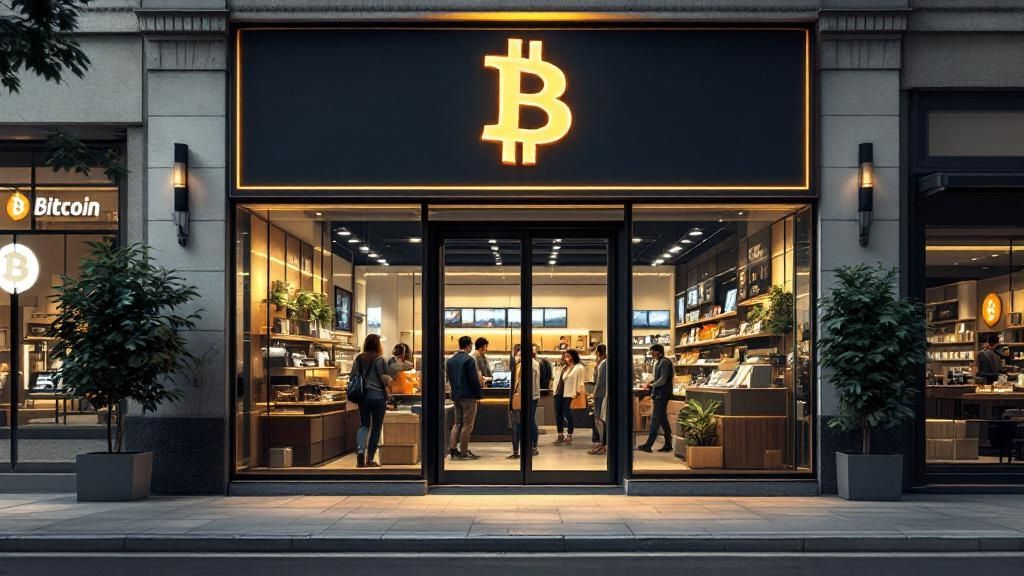
To get a handle on how a bitcoin payment works, it helps to think of the network as a global, transparent digital ledger. Picture a notebook that’s been copied thousands of times and distributed across computers all over the world. Every single time a transaction happens, it gets recorded on every copy of that notebook.
This unique setup means no single company or bank is in charge. Instead, the network itself verifies that each payment is legitimate. Once a transaction is locked into this global ledger, it's permanent and can't be undone—which is the secret sauce behind Bitcoin’s fraud-proof design.
It’s this decentralized system that lets a business in one country seamlessly take a payment from a customer on the complete other side of the planet. There are no currency conversion delays or hefty international wire transfer fees because the network simply doesn’t see borders.
The Customer and Merchant Experience
For both you and your customer, the process is surprisingly straightforward and direct. In fact, it’s often much quicker than swiping a credit card and waiting for the terminal to think about it.
The entire exchange feels as easy as sending a photo. Here’s what that looks like in the real world, from both sides of the counter.
For the Customer: Your customer just opens their Bitcoin wallet app on their phone. They scan a QR code you show them—either on a screen or a printed receipt—and confirm the payment amount. With a single tap, the funds are sent.
For the Merchant: Your point-of-sale system or payment app gives you an instant notification that the payment has arrived. This confirmation happens in seconds, and you know the funds are secure. The transaction is final, which means no nasty surprise chargebacks weeks down the line.
At its heart, a Bitcoin transaction is a direct transfer of value from one person to another, with no middleman needed to approve it. This peer-to-peer nature is what makes the whole system so efficient, secure, and cheap for merchants.
How Payments Settle
As soon as the customer hits "send," the Bitcoin network gets to work. Computers on the network, called miners, bundle transactions together into "blocks" and add them to the public ledger, known as the blockchain.
This process permanently cements the payment into the record. While the tech behind it is pretty complex, the outcome for you as a merchant is simple: fast, final settlement. You get confirmation almost immediately and can rest assured the funds are yours, without the typical two-to-three-day limbo common with credit card payments. This speed and finality are huge advantages of using bitcoin for merchants who want better cash flow and security.
The Real-World Benefits for Your Business
Bringing Bitcoin into your payment options is about more than just looking tech-savvy. It's about making smart financial moves that directly strengthen your bottom line. These aren't abstract concepts—they are practical upgrades to your cash flow, security, and ability to reach customers anywhere.
The real value shines through in three key areas where Bitcoin simply outperforms the old way of doing things. When you see how accepting bitcoin for merchants is less of a tech project and more of a strategic financial decision, it all clicks. It's a clear path to keeping more of your revenue, shutting down common sources of loss, and opening up new markets.
And this isn't a niche trend anymore. In 2023, the use of digital currency as a payment method shot up by a remarkable 55%. That's a huge leap, showing just how many businesses are getting on board. In fact, by that year, roughly 40% of small-to-medium enterprises around the globe had started accepting digital payments. You can dig into more of this data over at CoinLaw.io.
Slash Your Transaction Fees
One of the first things you'll notice is the dramatic drop in processing fees. With credit cards, you're used to giving away 2% to 3% of every sale, not to mention other fixed fees. Those costs nibble away at your profit margins, sale after sale.
Bitcoin flips the script. Payment processors that handle Bitcoin transactions usually charge fees under 1%, often much less. That difference means more of your hard-earned revenue stays right where it belongs: in your business.
For a business pulling in $100,000 in monthly sales, switching from a 2.9% credit card fee to a 0.9% Bitcoin processing fee puts an extra $2,000 in your pocket every single month. That’s a powerful incentive.
Eliminate Chargeback Fraud for Good
Chargeback fraud is a constant headache and a major drain on revenue for any merchant. A customer buys something, gets the product, and then disputes the charge with their credit card company. Too often, you're left losing both the product and the payment.
Bitcoin transactions are irreversible. Once a payment is confirmed on the network, it’s final. The customer can't undo it. This simple but powerful feature completely wipes out the risk of fraudulent chargebacks. It gives you a level of payment security that traditional systems just can't offer, so you can be confident that a sale is actually a sale.
Reach a Global Customer Base Instantly
Finally, Bitcoin tears down the walls of international commerce. Selling to customers in other countries is often a mess of currency conversion fees, expensive wire transfers, and frustrating delays while banks sort things out. It's so much friction that it can make selling globally impractical.
Because Bitcoin runs on a single, borderless network, all that complexity disappears. A customer in Japan can pay you just as easily as a customer down the street.
- No Currency Conversion: The payment is sent and received as Bitcoin, so you skip the currency exchange headache entirely.
- No International Bank Fees: Transactions are settled on the Bitcoin network, not through a chain of correspondent banks that each take a hefty cut.
- Instant Access: You can market your products to anyone with an internet connection, opening up a massive new pool of potential customers.
How to Start Accepting Bitcoin Payments

Alright, now that you see the upside of accepting Bitcoin, let's get into the practical side of things. How do you actually start?
The good news is you don’t need to be a coding wizard or a financial guru to make this happen. There are really two main roads you can go down, and the right one for you just depends on your business and how hands-on you want to be.
The first route, and the one I recommend for most businesses, is using a specialized service that handles all the heavy lifting. The second is a more direct, DIY approach for those who want total control from start to finish. Let's break down both.
Using a Bitcoin Payment Processor
Think of a Bitcoin payment processor as the perfect on-ramp. These services act as a bridge, letting your customers pay you in Bitcoin while you receive good old-fashioned dollars (or your local currency) in your bank account.
They’re designed from the ground up to be simple, secure, and to solve the biggest headache for merchants: price volatility.
The whole process is incredibly smooth. The processor generates the invoices and QR codes, watches the Bitcoin network to confirm the payment, and—this is the key part—instantly converts the Bitcoin into your currency. This means you are guaranteed to receive the exact sale price every single time, completely shielding you from Bitcoin's price swings.
Getting set up is usually just a few simple steps:
- Pick a Provider: Find a reputable Bitcoin payment processor that clicks with your business model.
- Create an Account: Sign up and fill in your business and bank details for settlement.
- Integrate: Add their payment button to your website with a simple plugin, or use their point-of-sale app on a tablet for in-person transactions.
This method is really the gold standard for most merchants. You get all the perks—low fees, no chargebacks, global reach—without ever having to touch or manage Bitcoin yourself. It’s a true set-it-and-forget-it solution.
Direct Wallet-to-Wallet Payments
For the more tech-savvy business owner who loves having complete control, going direct is a solid option. This method cuts out the middleman entirely. A customer’s payment zips directly from their Bitcoin wallet straight into a dedicated business wallet that you control.
This is the purest form of a peer-to-peer transaction.
While this path gives you maximum sovereignty and potentially even lower fees, it also comes with more responsibility. You're in charge of everything: securing the wallet, safeguarding your private keys (the master password to your funds), and manually converting the Bitcoin to cash if and when you decide to.
Crucially, this approach means you are directly exposed to Bitcoin's price volatility until you sell. A payment you receive could be worth more—or less—by the time you get around to converting it.
This path requires a bit more vigilance and a solid handle on how Bitcoin wallets work. It's an excellent choice for businesses that are already comfortable in the Bitcoin world and don't mind the operational tasks of managing their own funds.
Choosing the Right Bitcoin Payment Processor

Alright, you’re sold on the idea of accepting Bitcoin. The next step is arguably the most critical: picking the right partner to process those payments. Think of a payment processor as the bridge between your business and the Bitcoin network. A great one makes the crossing seamless, handling all the technical heavy lifting so you can stay focused on what you do best—running your business.
The goal isn't just to accept Bitcoin; it's to do it effortlessly. You want a service that slots right into your existing workflow, whether you're running a bustling e-commerce store or a brick-and-mortar shop. The right choice just works.
This is especially true for businesses that have run into issues with traditional payment processors. Because Bitcoin is decentralized, it offers a payment rail that can't be shut down by a single company, providing a much-needed lifeline for many merchants.
Key Factors For Your Decision
Not all payment processors are built the same. To find the best fit, you'll need to look past the flashy marketing and dig into the features that actually impact your operations and, more importantly, your bottom line.
Here are the non-negotiables to investigate for any provider you're considering:
- Transaction Fees: Pricing should be crystal clear. Most processors charge a fee under 1%, which is a massive discount compared to credit cards. But always check for hidden setup fees or monthly charges that can sneak up on you.
- Settlement Options: This is a big one. Can the processor instantly and automatically convert your Bitcoin payments into your local currency, like USD or EUR? This feature is your shield against Bitcoin's price volatility, letting you lock in your revenue without any guesswork.
- Integration Ease: A top-tier processor should offer dead-simple plugins for major e-commerce platforms like Shopify or WooCommerce. You want to be up and running in minutes, not days. The less technical hassle, the better.
- Point-of-Sale (POS) Support: If you have a physical storefront, make sure the provider offers a clean, user-friendly POS app. It should run smoothly on a tablet or smartphone, making in-person payments just as easy as tapping a credit card.
- Security and Reputation: Do your homework. Look into the provider’s history and security measures. A reputable company will have iron-clad protocols to protect your account and ensure your funds are always secure.
Feature Checklist for a Bitcoin Payment Processor
To make this even easier, use this checklist to compare your options side-by-side. It will help you methodically evaluate what each service brings to the table and identify the one that truly aligns with your business needs.
| Feature | Importance for Your Business | Notes |
|---|---|---|
| Low Transaction Fees (<1%) | High / Medium / Low | Are there any hidden setup or monthly costs? |
| Automatic Fiat Conversion | Critical / Nice to Have / Not Needed | Does this feature protect me from BTC price swings? |
| E-commerce Platform Plugins | Shopify / WooCommerce / Other / N/A | How quickly can I integrate this into my online store? |
| Physical POS App/Terminal | Essential for my store / N/A | Is the app intuitive for my staff and customers? |
| Security Track Record | Non-negotiable | What do reviews and industry experts say about their security? |
| Customer Support Quality | High / Medium / Low | Can I get help quickly if something goes wrong? |
| Settlement Speed | Daily / Weekly / Instant | How long will I have to wait for funds to hit my bank account? |
| Settlement Currency Support | Essential / Not Needed | Do they support the currencies I operate with (USD, EUR, etc.)? |
By taking a structured approach, you'll be able to confidently select a processor that doesn't just add a new payment option but actually enhances your business operations.
Your ideal payment processor should make accepting Bitcoin feel as easy as any other payment method you currently offer. The technology should be invisible, the process smooth, and the benefits to your business clear.
Managing Volatility and Security Concerns

If you're a merchant looking into Bitcoin, two big questions probably jump out right away: "What about the price swings?" and "How secure is it, really?"
These are completely fair questions. The good news is that the tools available today were built specifically to solve these problems, making the whole process surprisingly safe and predictable for your business. The perceived risk is often what holds businesses back, but the solutions are much simpler than you might think.
Solving Price Volatility Instantly
One of the biggest myths about accepting bitcoin for merchants is that you’re forced to ride the rollercoaster of its price changes. That couldn't be further from the truth.
Modern payment processors have an elegant fix called instant fiat conversion. Here’s how it works in the real world: a customer pays you $100 worth of Bitcoin. Your processor immediately converts it, and $100 lands in your bank account. Simple as that.
You receive the exact amount of the sale, every single time. This feature completely shields your business from any price volatility, guaranteeing your revenue is locked in and predictable. You get all the upsides of Bitcoin without touching the risk.
Best Practices for Security
When it comes to security, using a trusted payment processor means they do the heavy lifting. They handle all the complex technical stuff, so you don't have to worry about managing private keys or running your own Bitcoin node.
Your main job is to secure your merchant account—the same way you would with your online banking or any other financial service.
Here are the absolute must-dos to protect your account:
- Use a Strong, Unique Password: Don't recycle passwords. A solid mix of letters, numbers, and symbols is your first line of defense.
- Enable Two-Factor Authentication (2FA): This is non-negotiable. 2FA adds a powerful layer of security by asking for a second code, usually from your phone, before anyone can log in.
As global adoption keeps climbing, these security habits become more crucial than ever. As of 2025, nearly 24% of people in major economies reported owning digital assets, up from 21% in 2024. For a deeper dive into risk management, it's also smart to understand how to manage crypto payment disputes and chargebacks.
Answering Your Top Questions
Even with all the upside, it's totally normal to have a few practical questions before jumping in. Let's tackle the most common concerns we hear from business owners who are new to Bitcoin.
Do I Have to Hold Bitcoin Myself to Accept It?
Absolutely not. In fact, the easiest way for any business to get started is by using a Bitcoin payment processor. These services act as the bridge.
Your customers pay you in Bitcoin, and the processor instantly settles the funds in your local currency, like USD or EUR, right into your bank account. You get all the benefits of accepting a global currency without ever having to touch Bitcoin or worry about its price swings.
How Do I Handle Taxes on Bitcoin Sales?
Tax rules can get tricky and vary a lot from place to place. The good news is, if your payment processor converts Bitcoin to your local currency right away, your bookkeeping usually stays simple. You just treat it like any other sale.
That said, it's always smart to talk to a qualified tax professional in your area. They'll give you the specific advice you need to make sure you're buttoned up and fully compliant with local rules for digital payments.
Is Adding Bitcoin Payments to My Store Complicated?
Not at all. The process is surprisingly simple these days. Top Bitcoin payment processors have built easy-to-install plugins for all the major e-commerce platforms like Shopify, WooCommerce, and Magento. Getting set up is often just a matter of a few clicks.
If you run a brick-and-mortar store, they offer simple point-of-sale (POS) apps that work on any tablet or smartphone. The whole goal is to get you up and running with minimal technical headaches.
Ready to unlock lower fees and a global customer base? With Flash, you can start accepting Bitcoin payments in under a minute. Our platform connects directly to your wallet, ensuring you always remain in control of your funds. See how easy it is to get started with Flash.