Diving into Bitcoin can feel like learning a new language, but it really just boils down to a few key things: picking a wallet, getting some bitcoin, and learning how to keep it safe. It’s a lot more approachable than you might think, and it opens the door to a global financial network that doesn't rely on traditional banks.
Your Practical First Steps Into Bitcoin
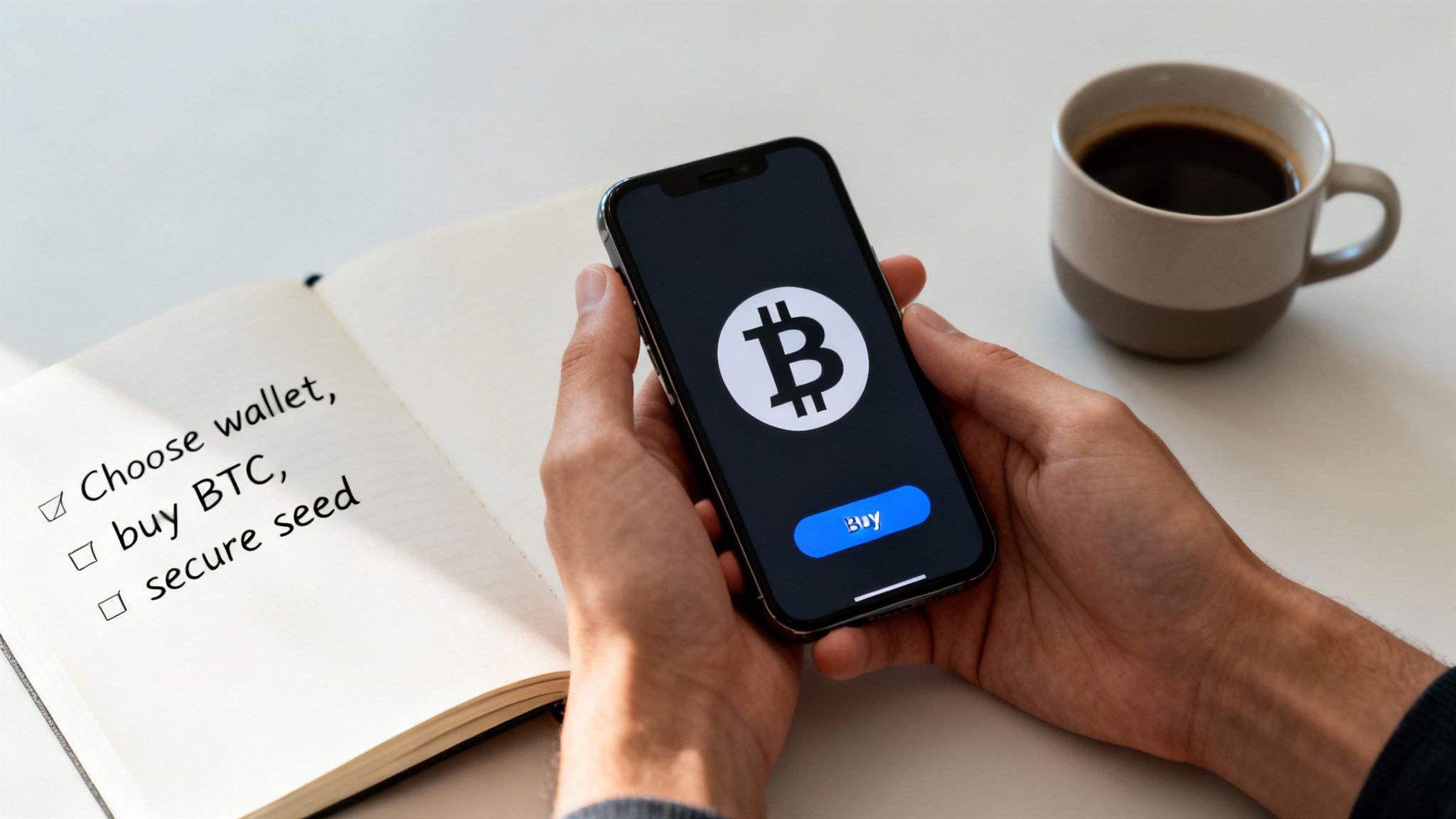
At its heart, Bitcoin is a peer-to-peer digital currency. What makes it special is that it operates on a network no single bank, government, or company can control. This decentralization is its killer feature.
Unlike the financial system you're used to, where every transaction needs a bank's approval, Bitcoin transactions are verified by a worldwide network of computers. This creates a transparent and censorship-resistant system where you are in complete control of your money. This principle of self-sovereignty is the core reason why Bitcoin is so important.
Why Bitcoin Matters for Individuals and Merchants
For individuals, Bitcoin is a powerful tool. It can be a way to protect your savings from inflation or a lifeline for sending money across borders without the crazy fees and slow wait times of the old system.
For merchants, accepting Bitcoin is more than just adding another payment button. It’s a signal that your business is forward-thinking and ready to serve a global, tech-savvy audience. The practical benefits kick in immediately:
- Lower Transaction Fees than what credit card companies charge.
- No Chargebacks. Bitcoin transactions are final, which means no more surprise reversals.
- Faster Settlement Times. Funds are typically available in minutes, not days.
- Global Reach. You can accept payments from anyone, anywhere in the world, instantly.
The big idea is simple: Bitcoin gives you direct ownership of your money. When you hold your own Bitcoin, nobody can freeze your account or block you from sending funds. This is the financial freedom that draws millions of people to the network.
From Genesis to Global Adoption
Think back to 2009, when Satoshi Nakamoto mined the very first Bitcoin block. Tucked inside that block was a newspaper headline about bank bailouts—a clear nod to Bitcoin's purpose as an alternative to a shaky financial system.
Fast forward to today, and that vision has exploded into a massive global movement. Recent data for 2025 shows there are now over 560–650 million Bitcoin users worldwide. In the United States alone, activity jumped by about 50% in the first half of 2025, showing just how fast this is growing. You can dig into more of these insights in the TRM Labs' 2025 report.
To help you navigate this new world, we've put together a clear, actionable roadmap.
Here’s a quick look at the journey ahead. This checklist breaks down the essential phases of getting started, from your first wallet to integrating Bitcoin into your business.
Quick Start Checklist: Your Path to Using Bitcoin
| Phase | Action Required | Key Consideration |
|---|---|---|
| 1. Foundation | Choose and set up a Bitcoin wallet. | Decide between a custodial (easy but less control) or non-custodial (full control, more responsibility) wallet. |
| 2. Acquisition | Buy or receive your first Bitcoin (BTC). | Use a reputable exchange or receive a payment directly. Start small to get comfortable with the process. |
| 3. Security | Secure your wallet and learn best practices. | Back up your seed phrase and store it offline. Never share it with anyone. |
| 4. Integration | (For Merchants) Set up to accept Bitcoin payments. | Choose a method: a simple wallet-to-wallet transfer, a payment processor, or a dedicated solution like Flash. |
This guide is designed to walk you through each of these steps. We'll cover everything from picking the right wallet to making your first purchase and, for business owners, seamlessly accepting Bitcoin payments. By the time you’re done, you'll have the confidence and knowledge to dive in.
Choosing Your First Bitcoin Wallet
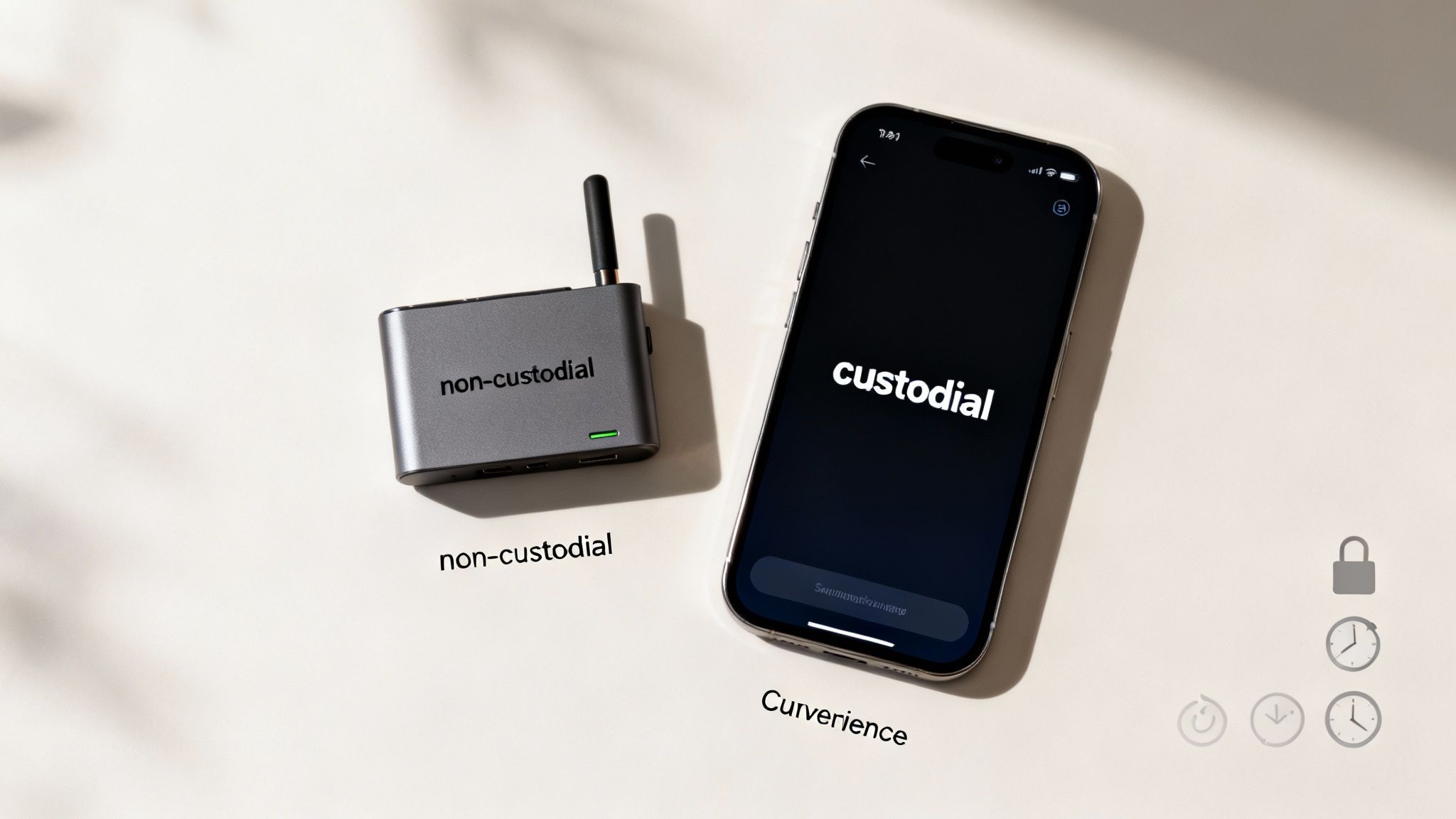
Alright, let's talk about the most important tool you'll use on your Bitcoin journey: your wallet. It’s a common misconception to think of it like the leather wallet in your pocket. A Bitcoin wallet doesn't actually hold your coins.
Instead, it securely stores the private keys—the secret codes you need to access and spend your bitcoin on the network. Think of it more like a specialized password manager just for your money. Getting this choice right from the start is critical.
The first big decision you'll face is whether to use a custodial or a non-custodial wallet. This single choice determines who is ultimately in control of your funds.
Custodial Wallets: Convenience at a Cost
A custodial wallet is one where a third party, usually an exchange, holds your private keys for you. When you buy bitcoin on many popular platforms, this is the default option. It feels simple and familiar, a lot like using your online banking app.
The main draw here is convenience. You don't have to stress about losing your keys because the company manages all the security and recovery protocols. But this ease of use comes with a massive trade-off, one that cuts against the very reason Bitcoin exists.
The core idea behind Bitcoin is self-sovereignty—the principle that you, and only you, should have final say over your money. When you use a custodial service, you're trusting them not to freeze, block, or lose your funds. This is where the famous mantra comes from: "Not your keys, not your coins."
For anyone serious about Bitcoin, understanding this distinction is the first major hurdle. While custodial services are a decent on-ramp for your first purchase, they are not where you want to store your bitcoin long-term.
Non-Custodial Wallets: Taking True Ownership
This is where you take the reins. A non-custodial wallet puts you in complete control. You are the sole keeper of your private keys, meaning nobody can touch your bitcoin without your explicit permission. This is the financial freedom Bitcoin was built to deliver.
This approach aligns perfectly with the goal of decentralization. You become your own bank. You can send and receive value anywhere in the world, anytime, without asking for permission. For merchants, this is a game-changer, allowing payments to flow directly from customer to business without a middleman taking a cut or imposing arbitrary rules.
When you create a non-custodial wallet, you’ll be given a unique seed phrase (sometimes called a recovery phrase). This is a list of 12 or 24 random words that acts as the master key to your entire wallet.
Securing Your Seed Phrase Is Everything
I can't overstate this: your seed phrase is the single most critical piece of information you will manage. Guard it with your life.
- Write It Down: Use a pen and paper. Seriously. Do not store it digitally—no screenshots, no text files, and definitely no cloud backups. Digital copies are a hacker's dream.
- Store It Securely: Keep the physical copy somewhere safe, private, and protected from accidents like fire or water. Many people make multiple copies and store them in different secure locations.
- Never Share It: No legitimate company, developer, or support agent will ever ask for your seed phrase. Anyone who does is trying to steal your funds, full stop.
Taking on this responsibility is a small price for true financial sovereignty. Once your non-custodial wallet is set up and your seed phrase is safely stored, you're ready to really get started. The next step is picking the right wallet for your needs; our guide to the Best Bitcoin Wallet in 2025 breaks down some of the most trusted options available.
How to Get Your Hands on Bitcoin and Keep It Safe
Alright, your non-custodial wallet is set up and your seed phrase is tucked away safely offline. Now for the main event: getting your first bitcoin. This is where the rubber meets the road and you move from theory into practice.
There are a few well-worn paths to acquiring bitcoin. The most common on-ramp, especially for beginners, is a centralized bitcoin exchange. Think of these platforms as a marketplace where you can easily swap your local currency for BTC. They're built to be user-friendly, but they do require you to complete an identity verification process, commonly known as KYC (Know Your Customer).
This means you'll need to provide some personal info and a government-issued ID to satisfy regulations. It's a trade-off: you give up a bit of privacy for the sake of convenience. Just remember, the goal is to use these exchanges as a bridge, not a bank.
Common Ways to Buy Bitcoin
Knowing your options lets you pick the method that feels right for you. Each one strikes a different balance between ease of use, fees, and privacy.
- Centralized Exchanges: These are the big, popular platforms. You connect a bank account, verify your identity, and can be buying bitcoin in minutes. Their fees are usually a small slice of your purchase.
- Peer-to-Peer (P2P) Markets: P2P platforms are like a Craigslist for bitcoin, connecting buyers and sellers directly. You'll find more payment options here and can often maintain more privacy. The catch? You need to do your homework to make sure you're dealing with someone trustworthy.
- Bitcoin ATMs: These machines work just like a regular ATM, but you feed them cash and they send bitcoin to your wallet. They're handy for small, quick buys, but that convenience comes at a price—fees can be steep, sometimes topping 10% of your transaction.
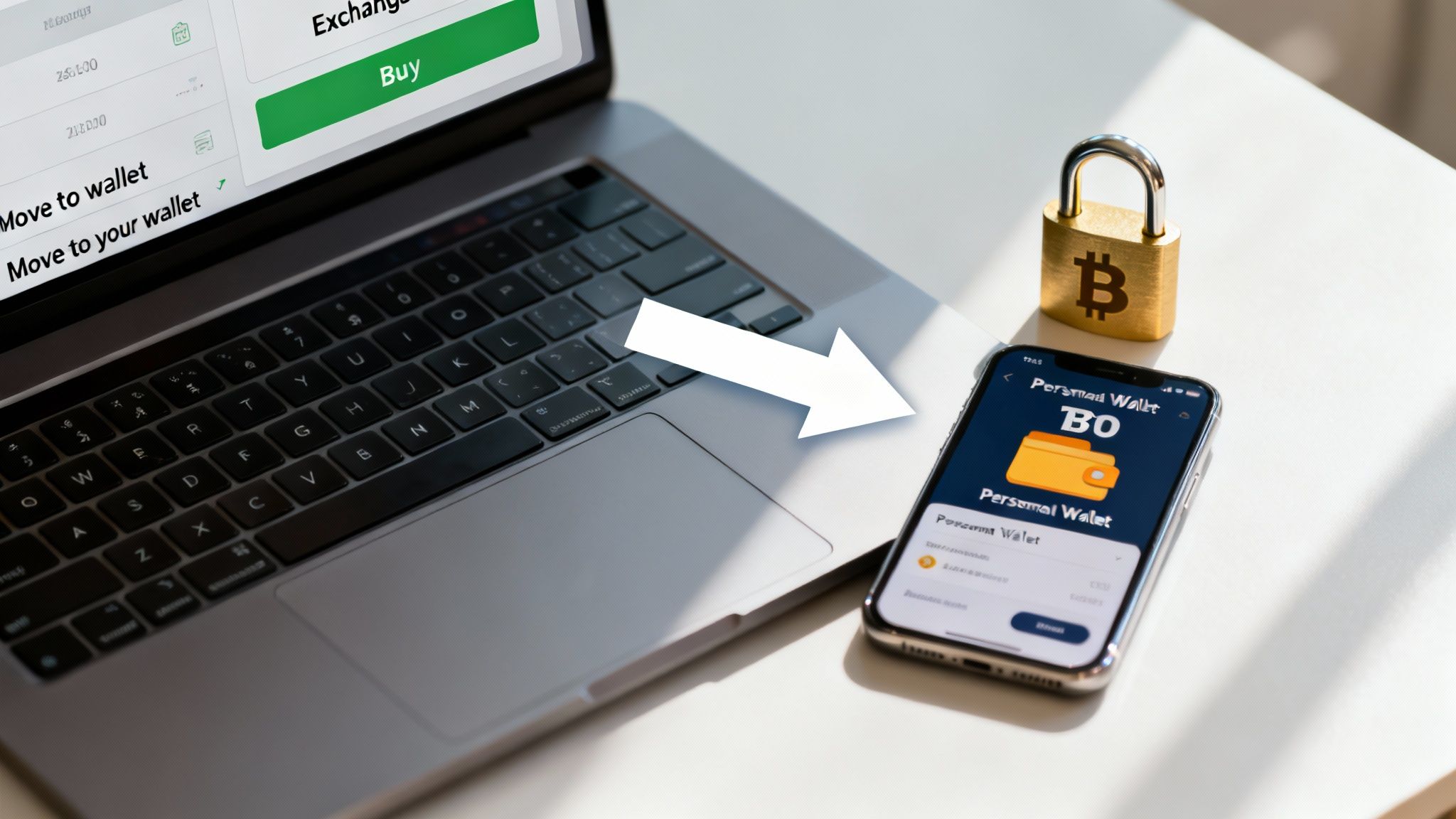
No matter which path you take, the mission is always the same: buy your bitcoin, then immediately move it to the non-custodial wallet you control. This isn't just a suggestion; it's the core principle of self-sovereignty.
Your security mindset has to kick in the second you decide to buy. The only workflow that matters is this: buy on an exchange, then immediately transfer it to your personal wallet. Leaving coins on an exchange is like leaving your cash on a coffee shop counter—you're just hoping nobody takes it.
Your Security Is 100% Your Responsibility
Buying bitcoin is just the first step. Securing it is what truly matters for the long haul. The digital world has plenty of scammers looking for an easy score, and your best defense is being proactive.
This starts with locking down the accounts you use to buy bitcoin in the first place.
Using two-factor authentication (2FA) isn't optional; it's essential. It adds a critical layer of defense beyond a simple password. Ditch the less-secure SMS codes and use an authenticator app like Google Authenticator or Authy. This makes it exponentially harder for an attacker to get into your exchange account.
Phishing scams are another constant threat. These are clever tricks to get you to reveal sensitive info, like your exchange password or—worst of all—your wallet's seed phrase. Be extremely skeptical of any unsolicited emails, texts, or DMs.
Watch out for these classic red flags:
- Urgent warnings claiming your account is compromised.
- Offers that are too good to be true, like "free bitcoin" giveaways.
- Slight misspellings in URLs or email addresses that look almost right.
Always, always double-check the website address before typing in your login details. A smart habit is to bookmark your trusted exchanges and only access them through your bookmarks.
Burn this mantra into your brain: "not your keys, not your coins." Let it guide every action you take. It's the simple truth that you only truly own your bitcoin when it's in a wallet where you, and only you, hold the keys.
How Merchants Can Start Accepting Bitcoin Payments
For business owners, accepting Bitcoin isn't just about adding another payment option. It's about opening your doors to a global, tech-forward customer base that values privacy and efficiency. Bringing Bitcoin into your business is surprisingly straightforward and can be adapted to fit any model, from a local coffee shop to a global SaaS company.
The most direct way to get started is by using the non-custodial wallet you already have. This wallet-to-wallet method is the purest form of a Bitcoin transaction—direct, peer-to-peer, and with zero intermediaries.
The Simple Wallet and QR Code Method
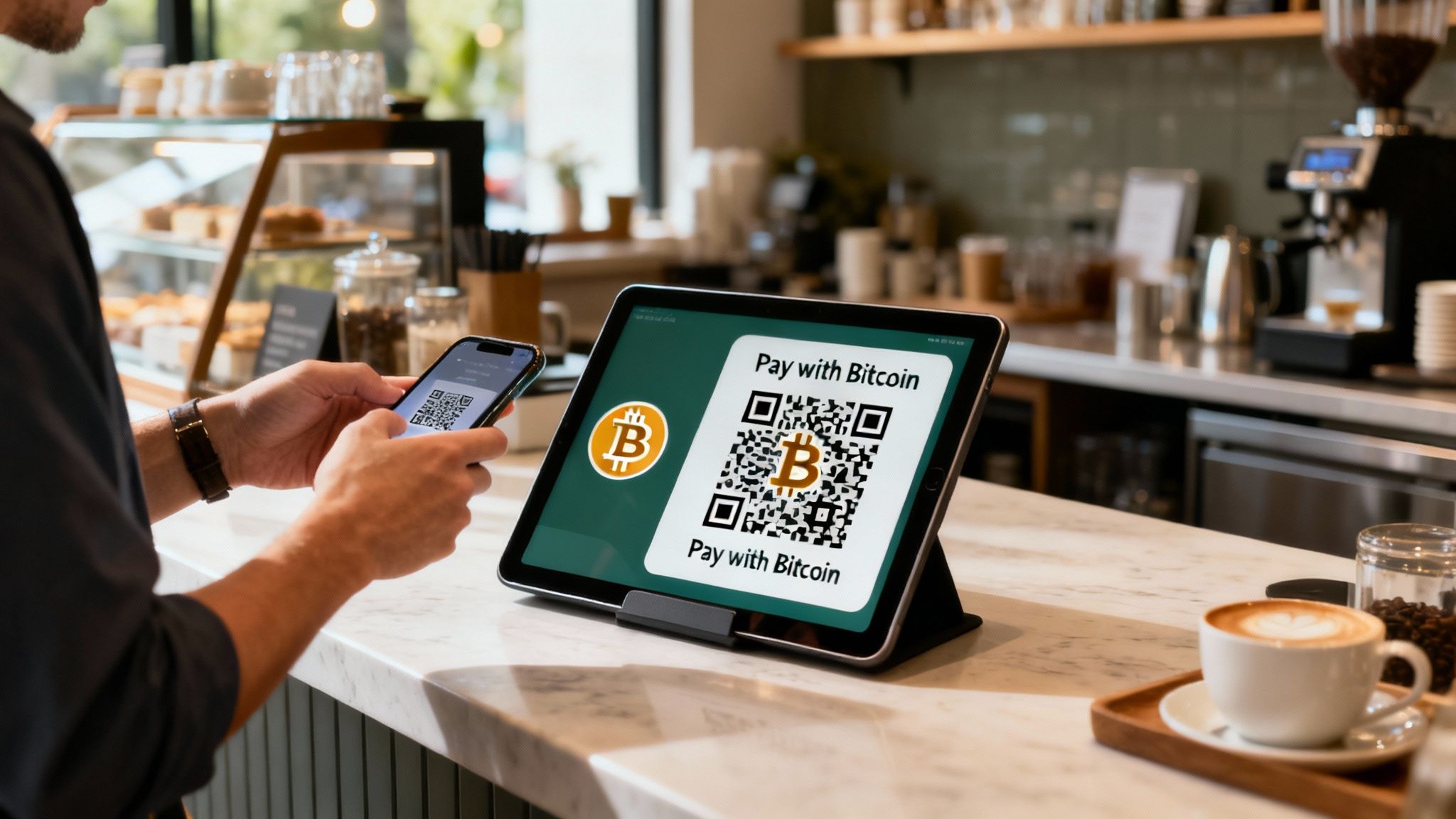
This approach is perfect for freelancers, artists, or small retailers. You just generate a receiving address in your wallet app, which instantly creates a QR code. Your customer scans it with their wallet, types in the amount, and hits send.
That’s it. The funds arrive directly in your wallet within minutes. You’ve just completed a global transaction without a bank or payment processor taking a cut. The power is in its simplicity.
Think about the practical benefits here. Bitcoin transactions are final, which completely eliminates the risk of costly chargebacks that plague credit card merchants. On top of that, settlement is nearly instant, freeing up cash flow that would otherwise be stuck for days in the traditional banking system.
But as your business grows, manually creating a QR code for every single sale can become a bottleneck. This is where dedicated payment solutions come in, giving you the automation you need for a professional checkout experience without sacrificing the core principles of Bitcoin.
Streamlining Payments With Dedicated Solutions
While the manual QR code method is a great starting point, dedicated software brings a level of professionalism and efficiency that customers have come to expect. Solutions like Flash are built for exactly this. They generate unique invoices and payment requests on the fly, making the entire checkout process seamless for everyone involved.
The key thing about a decentralized solution like Flash is that it never takes custody of your funds. It simply facilitates the transaction directly between your customer's wallet and your own. This non-custodial approach means you keep full control of your money, reduce compliance headaches, and benefit from much lower fees.
For businesses looking to build out more custom integrations, understanding the broader landscape of Fintech Software Development can offer valuable insights into building unique solutions or choosing the right platform for your specific needs.
To help you decide what's right for you, here’s a quick comparison of the different ways you can start accepting Bitcoin.
Bitcoin Payment Solutions for Your Business
| Method | Best For | Setup Time | Key Feature |
|---|---|---|---|
| Wallet-to-Wallet QR Code | Freelancers, small shops, in-person sales | 5 minutes | Simple, direct, no extra software needed |
| E-commerce Plugin | Online stores on platforms like Shopify | 30 minutes | Integrates directly into your existing checkout flow |
| Dedicated POS App | Cafes, retail, brick-and-mortar stores | 15 minutes | Turns any tablet or phone into a Bitcoin terminal |
| Merchant Solution (Flash) | Any business needing automation & scale | 1 hour | Non-custodial, generates invoices, recurring billing |
As you can see, a dedicated tool like Flash bridges the gap between the simplicity of a direct wallet payment and the professional features a growing business needs.
Real-World Scenarios for Bitcoin Payments
Seeing how other businesses are using Bitcoin can spark some great ideas. The flexibility of Bitcoin payments opens up a ton of possibilities across different industries.
Retail Point-of-Sale (POS): A local cafe or boutique can use a tablet or smartphone as a dedicated Bitcoin POS. A solution like the Flash POS app turns any mobile device into a Bitcoin terminal, letting you generate payment requests instantly. The customer scans, pays, and the transaction settles directly to your wallet.
Online Creator Paywalls: A writer or video producer can sell access to premium content with a Bitcoin paywall. Instead of giving up a huge cut to traditional platforms, they can receive payments directly from their global audience and keep more of their revenue.
SaaS and Subscriptions: A software company can set up recurring billing cycles in Bitcoin. This lets them serve an international customer base without the usual cross-border payment friction, offering subscriptions priced in BTC that are collected automatically.
This isn't some far-off future; it's happening right now. The global adoption of Bitcoin for real-world use is accelerating, especially in emerging markets. By 2025, Bitcoin ownership in places like Nigeria was nearing 33%, far outpacing rates in many Western countries. Data from Chainalysis puts countries like Pakistan, Vietnam, and Brazil in the top 10 for adoption, with South Asia's transaction volume growing to $300 billion.
These aren't just abstract numbers; they represent millions of potential customers ready to pay with Bitcoin. Tapping into this market today gives your business a serious advantage.
Navigating Bitcoin Privacy and Compliance
When you start using Bitcoin, two words you'll hear a lot are privacy and compliance. People often mix them up, but understanding the difference is key to using Bitcoin responsibly, whether you're a casual user or a business owner.
The biggest myth out there? That Bitcoin is anonymous. It's not. The right word is pseudonymous. Think of it this way: your real-world identity isn't stamped on your Bitcoin address, but every single transaction you make is permanently etched onto a public ledger. Anyone with an internet connection can look up an address and see its entire history.
Privacy Practices for Individuals
For everyday users, privacy is all about breaking the chain of evidence that connects your real name to your on-chain activity. The most common weak link is the point of purchase—when you buy Bitcoin from an exchange that requires KYC (Know Your Customer) documents, that exchange now knows which addresses belong to you.
Here are a few simple habits that make a world of difference:
- Always Use New Addresses. This is the golden rule of Bitcoin privacy. Most modern wallets handle this for you, but it’s crucial. Reusing the same address for every transaction is like using the same bank account for everything—it makes it incredibly easy for others to connect the dots and profile your spending habits.
- Don't Dox Yourself. Never post a Bitcoin address on social media or a public website. Once it's out there, it’s linked to you forever.
- Know That People Are Watching. Be aware of blockchain analysis. Sophisticated firms are paid to trace the flow of funds across the network. Basic privacy hygiene isn't paranoia; it's just common sense.
The goal isn’t to become a ghost. It’s about being deliberate. Think of it like using a pen name online—it creates a layer of separation, but you still have to be mindful of your actions to avoid linking it back to your real identity.
Compliance for Merchants
If you're a business, accepting Bitcoin opens up new considerations, but they're often much simpler than you'd expect, especially with the right setup. The main objective is to operate within your local legal framework.
Here's where a non-custodial payment solution like Flash becomes a game-changer. Since tools like Flash facilitate direct wallet-to-wallet payments, they never hold your funds. This simple fact removes a massive compliance headache because you aren't acting as a custodian of customer money.
This streamlined approach lets you tap into a massive and growing global market. By 2025, the number of Bitcoin users worldwide is projected to hit somewhere between 560-650 million. Bitcoin is the undisputed king, making up 41% of all fiat inflows in the US and 34% in the UK. For a business, a solution that enables instant, decentralized payments is a direct bridge to this huge user base, without drowning you in KYC paperwork for every customer. You can dig into more stats on global cryptocurrency ownership on Statista.
Even with simplified tools, you can't ignore the basics. Good record-keeping is a must. You'll need to track your Bitcoin transactions for tax season, just like any other payment method. The rules vary wildly from place to place, so staying on top of your local regulations is smart. This isn't legal or financial advice, of course—when in doubt, always chat with a professional.
Got Questions? Let's Talk Bitcoin Basics
Even after you've wrapped your head around the big ideas, a few practical questions always pop up when you're about to make your first move. This part of the guide is all about tackling those lingering "what ifs" and "how do I" moments.
We'll cover the real-world concerns we hear most often from both new users and merchants dipping their toes into Bitcoin for the first time. Getting started is a learning process, and asking the right questions is half the battle.
How Much Bitcoin Should I Buy to Get Started?
This is, without a doubt, the number one question. The answer? Refreshingly simple: start with an amount you'd be totally fine with losing.
You absolutely do not need to buy a whole Bitcoin. In fact, one Bitcoin is divisible into 100 million smaller units called satoshis (or "sats" for short).
This incredible divisibility means you can get your hands dirty with just $20 or $50. The goal of your first purchase isn't to get rich; it's purely educational. Think of it as a small tuition fee to learn the real-world mechanics of buying, sending, and securing Bitcoin in your own non-custodial wallet. That hands-on experience is priceless.
Is It Too Late to Get Into Bitcoin?
It’s easy to look at old price charts and feel like you’ve missed the boat. That’s a common feeling, but it’s a narrow way of looking at things. Bitcoin's story is far from over.
The real thing to watch is the network's growing utility and global adoption—both of which are still in their very early days.
For an individual, getting started today is about joining a fundamentally new kind of financial network. For a merchant, it's about future-proofing your business and connecting with a growing, tech-savvy market that actively seeks out businesses that get it. From that perspective, you’re still very, very early.
Thinking you're "too late" is like thinking it was too late to get on the internet in 1998. The most exciting developments and widespread uses are still ahead. Getting involved now puts you well ahead of the curve.
What Are the Most Common Beginner Mistakes?
The most painful—and totally avoidable—mistakes almost always boil down to security. Newcomers tend to trip over the same few hurdles, so just knowing what they are is your best defense.
Here are the top three errors to sidestep:
- Mishandling Your Seed Phrase. This is the big one. People screenshot their 12 or 24 words, save them in a cloud doc, or email them to themselves. Any digital copy is a neon sign for hackers. Write it down on paper. Store it somewhere safe and offline. Period.
- Leaving Bitcoin on an Exchange. It’s tempting to treat an exchange like a bank account, but it's not. Leaving your funds there means you're trusting a third party with your money. The old saying "not your keys, not your coins" exists for a damn good reason. Always move your bitcoin to a non-custodial wallet that you control.
- Falling for Scams. Promises of "free Bitcoin" or urgent security alerts designed to make you panic are classic tricks. Never click on suspicious links, and remember: no legitimate service will ever ask for your seed phrase.
Burn those three points into your brain. They'll protect you from the vast majority of threats you're ever likely to face.
As a Merchant, How Do I Handle Price Volatility?
A critical and very valid question for any business owner. The price of Bitcoin moves, and managing that is key to making it work for your business. The good news is, you have complete flexibility.
One option is to simply hold the Bitcoin you receive. If you believe in its long-term potential, you can treat it as an asset on your balance sheet.
But what if you need stable cash flow to pay suppliers and employees? No problem. You can instantly convert your Bitcoin payments into your local currency. Since non-custodial payment tools like Flash send BTC directly to your wallet, you have full control. From there, you can immediately send the funds to an exchange and sell for fiat, locking in the value at the time of the sale and eliminating your exposure to price swings.
Many businesses find a hybrid approach works best—converting what they need for operations while holding a small portion for the long haul.
Ready to unlock a global market and offer your customers a secure, modern payment option? With Flash, you can start accepting Bitcoin in under a minute. Our non-custodial tools ensure payments go directly to your wallet, giving you full control without the complexity. Learn more and get started with Flash today.