Bitcoin loyalty programs are reshaping how businesses reward customers while addressing key financial challenges for CFOs. By replacing traditional points with Bitcoin, these programs cut costs, simplify global operations, and provide real-time financial transparency.
Here’s why CFOs should care:
- Lower Costs: Bitcoin transactions cost less than 1.5%, compared to 3%+ for credit cards.
- Global Reach: Instant, borderless payments eliminate currency conversion fees and settlement delays.
- Fraud Reduction: Blockchain technology ensures secure, irreversible transactions.
- Real-Time Tracking: Automated systems provide immediate financial visibility and simplify compliance.
With nearly 40% of large enterprises planning to adopt digital currencies by 2027, Bitcoin loyalty programs offer a modern solution to outdated systems. Businesses can save money, expand globally, and attract tech-savvy consumers - all while streamlining operations. Platforms like Flash make implementation quick and easy, enabling CFOs to focus on growth and efficiency.
Problems CFOs Face with Traditional Loyalty Programs
Traditional loyalty programs come with three major challenges for CFOs: escalating costs, difficulties with global expansion, and limited financial transparency. These issues not only strain budgets but also hinder strategic growth.
High Operating Costs
Running traditional loyalty programs isn’t cheap. Beyond the rewards themselves, credit card payment channels - the backbone of most programs - charge steep fees, often 3% or more per transaction. For a business handling $10 million annually in loyalty transactions, that’s a $300,000 hit just in fees.
But the costs don’t stop there. As John McCabe, a former Mastercard executive, explains, managing fiat-based merchant offers requires "a complex tech stack and dedicated staff to credentialize participating merchants, confirm merchant contracts, and reconcile billing". This process eats up resources, delaying month-end financial closes and pulling skilled employees away from higher-value tasks like strategic financial analysis.
Fraud and chargebacks add even more to the bill. For example, resolving a single loyalty point error - factoring in customer support and investigation - costs about $5 per incident. In mid-sized programs, even a small error rate of 0.1% can result in hundreds of mistakes every month, creating a significant financial and operational burden.
When companies expand these programs internationally, the costs only grow.
Difficulty Scaling Across Borders
Taking a loyalty program global is no small feat. Currency conversion fees quickly erode margins, and navigating diverse AML (anti-money laundering) and KYC (know-your-customer) regulations adds layers of complexity. Settlement delays are another hurdle, as international wire transfers often take 3 to 5 business days, disrupting cash flow and preventing real-time budget adjustments.
These delays force CFOs to pre-fund budgets weeks in advance, making it nearly impossible to respond quickly to emerging market opportunities or phase out underperforming campaigns. This lack of flexibility limits a company’s ability to scale efficiently and stay competitive in new markets.
Poor Tracking and Auditing Capabilities
On top of cost and scalability issues, traditional loyalty programs often lack transparency, creating significant challenges for CFOs. Most systems rely on batch processing that updates daily or weekly, leaving rewards in a "pending" state and invisible to real-time tracking. Unlike blockchain-based systems, traditional methods fall short in offering immediate financial clarity.
This lack of real-time oversight poses serious risks. Globally, unredeemed loyalty points are estimated to total $360 billion. Yet, accurately tracking breakage - points that go unused - remains a challenge. Even a 5% miscalculation in breakage can lead to major year-end profit and loss adjustments and inaccurate revenue reporting. Finance teams often spend hours manually reconciling data between partner platforms and internal ledgers, a process prone to human error and inefficiency.
As Bitwave highlights:
"When skilled professionals spend hours on manual matching and data entry, higher-value analysis and strategic work gets pushed aside".
Without reliable tracking and auditing tools, CFOs struggle to make informed decisions, leaving them with limited control over financial performance and strategic planning.
How Bitcoin Loyalty Programs Solve CFO Challenges
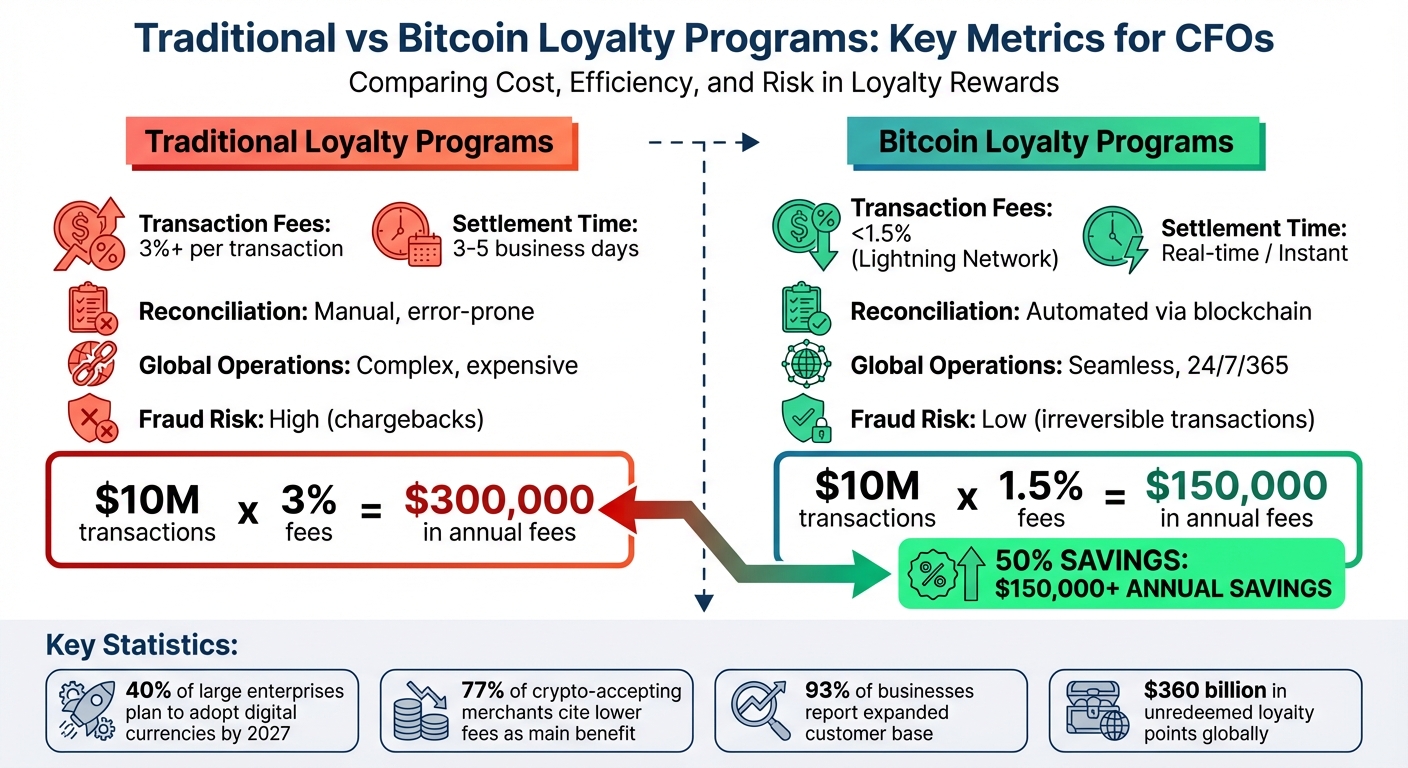
Traditional vs Bitcoin Loyalty Programs: Cost and Performance Comparison for CFOs
Bitcoin loyalty programs tackle common financial challenges by reducing costs, enabling instant global transactions, and offering real-time financial visibility. By replacing traditional systems with blockchain technology, these programs operate 24/7 without the need for intermediaries.
Lower Costs Through Blockchain Technology
One of the biggest advantages is cost savings. Bitcoin loyalty programs, especially those using the Lightning Network, can significantly reduce the standard 3% or higher credit card processing fees. Cryptocurrency payment processors typically charge less than 1.5%, which is less than half the cost of traditional credit card fees. For a business handling $10 million in loyalty transactions annually, this means saving at least $150,000 in direct fees alone.
John McCabe, a former Mastercard executive, highlights the impact:
"The redeeming-transactions are all now driven on low cost Lightning Network rails, stripping out not just the direct credit card fee costs (typically 3% or higher) but also the indirect costs of chargebacks and fraud".
Blockchain technology also eliminates chargeback costs, while smart contracts automate processes like reconciliation and billing. Deloitte notes that this automation reduces errors and fraud while freeing up finance teams from manual data entry. Unlike traditional 30-day billing cycles, Bitcoin loyalty programs allow split payments at the point of sale, streamlining operations. With lower fees and automated systems ensuring liquidity, businesses can scale globally with ease.
Global Reach with Bitcoin
Bitcoin's decentralized nature makes it ideal for seamless global operations. It functions 24/7/365, independent of banking hours or geographic limitations. This eliminates the typical 3- to 5-business-day delays associated with international wire transfers, giving CFOs the ability to adjust budgets in real time and manage scalability challenges more effectively.
By early 2024, over 6,000 businesses were accepting Bitcoin, with 77% of surveyed merchants citing lower transaction fees as their main reason. For CFOs overseeing cross-border operations, Bitcoin simplifies currency conversion, reduces compliance complexities related to AML and KYC regulations, and supports global scalability. Its round-the-clock availability also provides real-time financial oversight, which is critical for quick decision-making.
Real-Time Tracking and Auditing
Blockchain's distributed ledger ensures every transaction is permanently recorded, time-stamped, and easily traceable. Unlike traditional systems that update only periodically, blockchain offers instant visibility into loyalty program activity. CFOs can monitor budgets, track redemptions, and adjust campaigns on the fly, eliminating the need to wait for month-end reconciliations.
This transparency helps finance teams improve financial reporting accuracy and monitor breakage rates more effectively. Deloitte explains:
"Programmable money can enable real-time and accurate revenue-sharing while enhancing transparency to facilitate back-office reconciliation".
The transition to fair value accounting under FASB ASU 2023-08 - set to take effect for fiscal years starting after December 15, 2024 - further highlights the importance of real-time tracking for compliance and accuracy . With nearly 40% of large enterprises expecting their finance teams to adopt digital currency by 2027, the benefits of real-time auditing and transparency are becoming increasingly clear. This capability empowers CFOs to make timely, informed decisions and address audit-related concerns with confidence.
| Feature | Traditional Loyalty Programs | Bitcoin Loyalty Programs |
|---|---|---|
| Transaction Fees | 3%+ | <1.5% |
| Settlement Time | 3-5 business days | Real-time / Instant |
| Reconciliation | Manual, error-prone | Automated via blockchain |
| Global Operations | Complex, expensive | Seamless, 24/7 |
| Fraud Risk | High (chargebacks) | Low (irreversible) |
Flash: Bitcoin Payment Gateway for Loyalty Programs
Flash offers a non-custodial Bitcoin payment gateway designed to help businesses create and manage loyalty programs without relying on intermediaries. By connecting customer and business wallets directly, CFOs retain full control over transactions while avoiding the delays and costs associated with third parties. Using the Lightning Network, Flash ensures instant payments with minimal fees, forming the foundation for a range of powerful features.
Flash Features for Loyalty Programs
Flash simplifies Bitcoin integration with tools that even non-technical businesses can use effortlessly:
- Payment links for distributing rewards instantly
- Automated subscription rewards for recurring incentives
- Widgets for seamless integration into websites and apps
- Flash PoS for in-store Bitcoin transactions
The setup process takes just 1–3 minutes, thanks to no-code or low-code solutions. Additionally, native integrations with platforms like Shopify and WooCommerce make it easy for businesses to introduce Bitcoin-based loyalty programs quickly.
Pierre Corbin, CEO of Flash, highlights the platform's broader mission:
"Flash 2.0 is not just about making Bitcoin payments easier - it's about building the infrastructure for a decentralized financial future. Businesses that embrace this shift today will be the pioneers of tomorrow."
Cost Savings and Instant Payments for CFOs
Flash’s wallet-to-wallet payment model and use of the Lightning Network significantly reduce transaction costs. With fees that are up to 80% lower than traditional payment processors, which typically charge over 3%, businesses can save a substantial amount. For instance, a company handling $10 million annually in loyalty transactions could save hundreds of thousands of dollars.
The platform also eliminates chargeback fraud by ensuring all transactions are final on the blockchain. Refunds are managed directly by merchants, giving CFOs greater control over cash flow and enabling quick adjustments to marketing budgets. With the number of cryptocurrency users projected to exceed 659 million globally by early 2025 - a 30% increase from the previous year - the potential customer base for Bitcoin loyalty programs is growing rapidly.
Custom Solutions for Large Businesses
For enterprises with unique needs, Flash provides custom integrations supported by detailed developer documentation. This allows large businesses to build loyalty programs tailored to their branding and workflows. Real-time analytics and tracking tools help CFOs monitor transaction volumes, average spend, and customer engagement, making it easier to calculate ROI and make informed decisions.
Flash’s non-custodial design ensures that businesses retain full control of their funds, reducing regulatory risks. The platform also supports multi-signature and hardware wallet integrations for added security. Companies that implement organized crypto payment systems and train their staff effectively have reported 73% fewer customer service issues and a 45% faster adoption rate.
sbb-itb-f81ab9b
Calculating the ROI of Bitcoin Loyalty Programs
For CFOs, the decision to transition loyalty program infrastructure requires clear, measurable benefits. Bitcoin-based systems offer a compelling case by lowering costs, reducing fraud, and enabling global scalability compared to traditional models. Understanding these metrics allows finance teams to plan adoption timelines and allocate budgets effectively.
Cost Comparison: Traditional vs. Bitcoin Loyalty Programs
| Metric | Traditional Programs | Bitcoin Programs |
|---|---|---|
| Transaction Fees | 2–3% per transaction | $0.01–$0.10 (Lightning Network) |
| Fraud & Chargebacks | Substantial indirect costs | Minimal; irreversible blockchain transactions |
| Settlement Time | Multiple days | Near real-time |
| Global Reach | Limited by borders and exchange rates | 190+ countries, borderless |
| Breakage Rate | 10–20% unredeemed points | Lower due to liquid, tradable rewards |
John McCabe, a former Mastercard executive, highlights the cost-saving potential of Bitcoin loyalty systems, noting that the Lightning Network significantly reduces both transaction fees and fraud-related expenses.
Additionally, smart contracts streamline operations by automating secure transactions. This reduces costs associated with manual errors and reconciliation, further improving efficiency. Together, these cost advantages not only enhance profit margins but also open doors to new revenue opportunities.
New Revenue Opportunities
Beyond cost savings, Bitcoin loyalty programs unlock revenue streams that traditional systems simply cannot match. The customer demographic for cryptocurrency is a prime example - crypto users tend to have annual incomes exceeding $100,000 and demonstrate higher engagement with loyalty programs. Moreover, 93% of businesses accepting cryptocurrency report an expanded customer base and improved brand perception.
Bitcoin’s global reach eliminates the need to manage local currencies or exchange rates, enabling businesses to scale loyalty programs instantly. In fact, 85% of merchants in a survey identified crypto payments as a key method for attracting new customers.
Take Eight Sleep, for instance. In April 2023, the company introduced a cryptocurrency rebate program using BitPay Send. Alexandra Zatarain, Co-founder and VP of Brand and Marketing, shared the results:
"Very high engagement, great adoption. It was beyond what we were expecting - and we're definitely going to bring back offers such as the crypto rebates."
This initiative resulted in one of the company’s highest-performing sales periods, rivaling Black Friday and Cyber Monday.
Another advantage of blockchain-based programs is their ability to reduce deferred revenue liabilities. Traditional systems often see 10–20% of loyalty points go unredeemed, creating financial obligations. Bitcoin loyalty programs, with their liquid and tradable rewards, encourage higher redemption rates. Some even generate additional income through "open loyalty" models, where brands earn royalties when customers trade tokenized rewards on marketplaces.
Conclusion: Bitcoin Loyalty Programs for CFO Goals
Bitcoin loyalty programs align perfectly with CFO priorities. Traditional credit card fees - often exceeding 3% - can drop to just pennies by leveraging the Lightning Network. Additionally, blockchain's immutable ledger provides real-time auditing capabilities, reducing errors and fraud significantly .
The numbers back this up: nearly 40% of CFOs at large enterprises anticipate incorporating digital currency into their finance functions by 2027. Among merchants already accepting crypto, 77% highlight lower transaction fees as the key motivator. Plus, the global loyalty management software market is expected to grow to $17–$18 billion by 2026, showing the potential for scalable and cost-efficient loyalty programs.
For CFOs ready to embrace this shift, Flash offers a seamless solution. The platform supports instant wallet-to-wallet transactions with minimal fees, eliminating the delays of multi-day settlements. It’s versatile too - handling everything from point-of-sale transactions to recurring billing, all without requiring businesses to hold digital assets on their balance sheets.
The strategic advantages are clear: Bitcoin loyalty programs cut costs, broaden global customer access, and provide the level of transparency today’s CFOs expect. Flash makes this transition simple, delivering immediate and measurable results. By adopting Bitcoin loyalty programs with Flash, finance leaders can achieve their goals while paving the way for scalable and efficient global financial operations.
FAQs
How can Bitcoin loyalty programs help businesses save on transaction costs?
Bitcoin loyalty programs offer businesses a way to reduce transaction costs through blockchain technology, enabling direct wallet-to-wallet transfers. Unlike traditional payment systems that depend on intermediaries and often involve steep processing fees, Bitcoin transactions are quick, secure, and economical, with minimal fees and no need for middlemen.
Blockchain's transparency and automation also help cut administrative expenses, streamline reconciliation processes, and minimize the chances of errors or fraud. By integrating Bitcoin loyalty programs, businesses can distribute rewards more effectively, lower operational costs, and expand their reach on a global scale.
Why are Bitcoin loyalty programs a better fit for global business growth than traditional methods?
Bitcoin loyalty programs offer a compelling way for businesses to expand globally by leveraging Bitcoin's universal and borderless appeal. Unlike traditional loyalty points that are often tied to specific brands or regions, Bitcoin rewards have the advantage of being usable and redeemable anywhere. This makes them particularly attractive to a worldwide audience, helping businesses connect with and retain customers across different markets.
What’s more, Bitcoin rewards have the potential to increase in value over time, giving customers an added reason to engage with these programs. They also resonate with the growing cryptocurrency community, positioning businesses as forward-thinking and in tune with modern trends. Thanks to Bitcoin's seamless cross-border functionality and its rising acceptance, these loyalty programs present an efficient and scalable option for companies aiming to broaden their international reach.
How does blockchain improve transparency and prevent fraud in loyalty programs?
Blockchain technology enhances loyalty programs by introducing a decentralized, tamper-resistant ledger that records every transaction. This means every loyalty point issued, redeemed, or exchanged is securely tracked, ensuring authenticity and eliminating fraud. Both businesses and customers benefit from this transparency, as they can monitor loyalty transactions in real-time, cutting down risks like double-spending or system manipulation.
Another key feature is smart contracts, which automate program rules and enforce them without needing intermediaries. This reduces human error, ensures consistent execution, and limits opportunities for fraudulent activities. Because blockchain operates on a distributed network, it adds an extra layer of security, making it nearly impossible for any single party to alter the system. These combined benefits help build trust, simplify processes, and make loyalty programs safer and more efficient for everyone involved.