Bitcoin is increasingly being used by companies as a treasury asset. Here's why:
- Inflation Hedge: Bitcoin's capped supply of 21 million coins makes it resistant to inflation, unlike fiat currencies that lose value over time due to monetary expansion.
- Diversification: It has a low correlation with traditional assets like bonds and cash, offering a way to improve risk-adjusted returns.
- Liquidity & Speed: Bitcoin enables 24/7 global transactions, with settlement times in minutes and lower fees compared to traditional banking systems.
- Reduced Risk: Decentralization minimizes counterparty risks, especially after events like the 2023 Silicon Valley Bank collapse.
- Accounting Updates: New FASB rules (effective 2025) allow Bitcoin to be valued at fair market prices, simplifying financial reporting for companies.
Companies like MicroStrategy, Block Inc., and Tesla have integrated Bitcoin into their balance sheets to address inefficiencies in traditional treasury strategies, such as inflation, counterparty risk, and slow cross-border payments. Even small and medium-sized businesses are adopting Bitcoin for payments and as a reserve asset, signaling a shift in corporate finance.
While its volatility remains a concern, Bitcoin's maturing market, improved accounting standards, and growing adoption make it increasingly appealing for corporate treasuries.
Bitcoin as a Treasury Diversification Asset
Benefits of Diversifying with Bitcoin
For decades, treasury portfolios have leaned heavily on cash, Treasury bills, and bonds - assets that often move in sync. Bitcoin, however, offers something different. Its low short-term correlation with traditional assets like T-bills and long-term Treasury bonds makes it a compelling diversification option, potentially improving risk-adjusted returns.
What sets Bitcoin apart is its fixed supply of 21 million tokens. Compare this to the U.S. money supply (M2), which grows at about 7% annually, or even gold, which experiences a 1.7% annual supply increase. Bitcoin's scarcity gives it a structural edge against currency devaluation.
Bitcoin also provides continuous liquidity and enables global transactions without reliance on banks, reducing counterparty risk. This became a significant consideration after the collapse of Silicon Valley Bank, which led 73% of Fortune 500 treasury executives to reevaluate their bank-counterparty risk metrics.
The potential for outsized returns is another factor to consider. For instance, a 1% allocation ($100 million) in Bitcoin in June 2019 could have grown to nearly $700 million by June 2024. Even a small Bitcoin allocation can outperform traditional cash reserves, which often lose value over time. These benefits have already inspired several companies to rethink their treasury strategies.
"Bitcoin offers corporate treasurers a compelling option for allocating their excess cash. It is a scarce digital commodity that can serve as an inflation hedge, mitigate counterparty and liquidity risks, and add diversification benefits."
– BitGo
Companies Holding Bitcoin on Their Balance Sheets
These diversification benefits have encouraged some leading companies to include Bitcoin in their treasuries.
MicroStrategy Incorporated was one of the first to embrace Bitcoin as a reserve asset. In August 2020, CEO Michael Saylor spearheaded the company’s initial $250 million Bitcoin purchase. By the first quarter of 2024, MicroStrategy had amassed 214,400 BTC, valued at approximately $15.2 billion. By late 2024, its holdings had exceeded 226,000 BTC, showcasing the company’s long-term commitment to Bitcoin.
Block Inc. (formerly Square) adopted a different strategy. In October 2020, the company invested $50 million in Bitcoin, representing 1% of its total assets at the time. CEO Jack Dorsey doubled down in February 2021 with an additional $170 million purchase. By April 2024, Block held around 8,027 BTC, valued at roughly $572 million. The company also announced plans to reinvest 10% of its Bitcoin-related profits into buying more BTC on a monthly basis.
Semler Scientific entered the Bitcoin space in May 2024. The healthcare technology company purchased 581 BTC for $40 million, making Bitcoin its primary treasury reserve. Chairman Eric Semler explained the rationale:
"We believe it has unique characteristics as a scarce and finite asset that can serve as a reasonable inflation hedge and safe haven amid global instability."
Tesla, Inc. made waves in February 2021 with a $1.5 billion Bitcoin investment. The electric vehicle giant aimed to diversify and maximize returns on cash that wasn’t immediately needed for operations. Tesla’s move demonstrated that even capital-intensive industries could incorporate Bitcoin into their treasury strategies.
sbb-itb-f81ab9b
Using Bitcoin as a Hedge Against Inflation
Bitcoin's Fixed Supply and Anti-Inflation Properties
One of the biggest challenges for cash reserves in corporate treasuries is the gradual erosion of purchasing power. Historically, the U.S. money supply (M2) has grown at an average rate of 7% per year, leading to a steady decline in the dollar's value as more currency enters circulation.
Bitcoin, on the other hand, operates on a completely different principle. Its supply is permanently capped at 21 million tokens, controlled by a decentralized protocol that ensures no additional Bitcoin can ever be created. This built-in scarcity sets it apart from fiat currencies, which are often subject to ongoing monetary expansion.
"Unlike any government-issued currency, Bitcoin is not subject to dilution through endless money-printing, enabling it to be a valuable inflation hedge and an excellent addition to our treasury."
– Chris Pavlovski, Chairman and CEO, Rumble
Bitcoin's Historical Performance During Inflation
Over the five years ending in June 2024, Bitcoin's value surged by 414%, significantly outperforming corporate bonds, which lagged behind with a mere 3% return over the same period. Meanwhile, U.S. consumer price inflation (CPI) hit a peak of 9.1% in June 2022, underscoring the pressure on fiat currencies during inflationary periods.
Looking at more extreme cases, the Argentine peso lost 99% of its value against the dollar over a decade, while Bitcoin's value skyrocketed by nearly 17,000%. These numbers highlight Bitcoin's potential as a store of value, especially in economies grappling with severe inflation.
Bitcoin's volatility - a common concern - has been steadily decreasing as the market matures. By February 25, 2025, the 60-day volatility index had dropped to 1.58%, a significant improvement from 7.05% in April 2020. This growing stability, combined with milestones like the approval of spot Bitcoin ETFs in January 2024 and the adoption of new FASB fair value accounting rules in January 2025, has made Bitcoin a more practical and appealing option for corporate treasuries looking to shield themselves from inflation. These developments reflect Bitcoin's increasing role as a tool for mitigating the negative effects of inflation on corporate cash reserves.
Bitcoin for Cross-Border Transactions and Liquidity
Instant Cross-Border Payments with Bitcoin
Sending money internationally through banks is often a slow and expensive process. According to the World Bank, these transfers can take up to five days and cost an average of 6.3% of the transaction's value. Bitcoin offers a much faster and cheaper alternative. Transactions are completed in minutes, and the average fee for an international Bitcoin transaction is around $1.
What makes Bitcoin different? It operates on a decentralized network, allowing for direct transactions without the need for banks or other intermediaries. This means there’s no waiting for banking hours, no dealing with geographic restrictions, and no unnecessary delays. Whether it’s sending funds to international vendors or subsidiaries, Bitcoin enables businesses to operate on their own schedule - 24/7, every day of the year.
"Bitcoin provides a unique solution because it is a global asset that can be transacted anytime, regardless of banking hours or geographic constraints." – BitGo
This speed and flexibility not only save money but also improve how businesses manage their liquidity.
Improving Liquidity Management with Bitcoin
Bitcoin’s always-on nature is a game-changer for liquidity management. Treasurers can move funds instantly, which is especially useful during volatile markets or when quick decisions are needed across different time zones.
Modern treasury systems now integrate directly with Bitcoin, providing real-time insights into liquidity across wallets and exchanges. Tools like Flash make managing Bitcoin liquidity easier by offering features such as Bitcoin invoicing, real-time analytics, and customizable payment solutions. These tools also support non-custodial, wallet-to-wallet transactions, which help reduce counterparty risk.
For businesses handling large volumes of international transactions, the efficiency gains can be substantial. In fact, over 20% of small to medium-sized enterprises in the U.S. are already purchasing Bitcoin for their own use, and more than one-third now accept it as payment. To handle the complexities of taxes and accounting, companies should consider separating wallets - using one for daily operations and another for long-term investments. Additionally, implementing standing tax instructions for frequent transactions can make documentation much smoother.
Bitcoin on the Balance Sheet: Why Companies Are Turning to Crypto as a Treasury Strategy
Market Positioning with Bitcoin
Beyond the operational perks, Bitcoin can redefine how a company positions itself in the market by reshaping its financial identity.
Positioning as a Digital Asset Treasury Company (DATCO)
Adopting Bitcoin as a core treasury asset transforms a company's balance sheet into a digital-first model. Businesses that embrace this strategy can evolve into Digital Asset Treasury Companies (DATCOs), focusing on accumulating digital assets as a central part of their strategy. As of July 2025, DATCOs collectively hold over $100 billion in digital assets, with treasury companies controlling approximately 791,662 BTC - about 3.98% of Bitcoin's total circulating supply. This demonstrates a shift toward readiness for the digital economy.
The DATCO model also provides a competitive edge in raising capital. Companies trading at a premium to their net asset value (NAV) can leverage ATM equity programs to raise funds, enabling them to acquire more Bitcoin per share than they dilute. For instance, in July 2025, Metaplanet - dubbed "Japan's MicroStrategy" - achieved an equity premium to NAV as high as 179%, driven by its aggressive Bitcoin accumulation strategy. This premium exists because many institutional investors, managing trillions of dollars globally, are restricted from directly owning cryptocurrency but can invest in public equities like DATCOs. This approach not only strengthens financial positioning but also sends a strong market signal, as outlined below.
Market Signaling Through Bitcoin Holdings
Publicly revealing Bitcoin holdings sends a bold message to stakeholders, positioning the company as a leader in financial innovation. It signals a forward-thinking approach to combating fiat currency debasement and inflation, which appeals to a broader and more diversified investor base. This is particularly attractive to institutional investors seeking crypto exposure through regulated equities.
For example, in June 2025, Nakamoto Holdings announced a $51.5 million PIPE financing to bolster its Bitcoin treasury strategy. The entire funding round was completed in under 72 hours at $5.00 per share. CEO David Bailey emphasized the company's goal: to acquire as much Bitcoin as possible.
"For these investors (pensions, sovereign wealth funds, endowments), DATCOs offer compliant access to crypto exposure, and their share prices often reflect this scarcity." – Will Owens, Research Analyst, Galaxy
As of July 4, 2025, the number of companies holding Bitcoin on their balance sheets reached 250, signaling that this approach is becoming more mainstream. By incorporating Bitcoin, companies set themselves apart from competitors who rely on traditional treasury strategies, which are more vulnerable to fiat currency risks. This distinction creates a clear competitive advantage in a rapidly evolving financial landscape.
Implementing Bitcoin Into Corporate Treasury Strategies
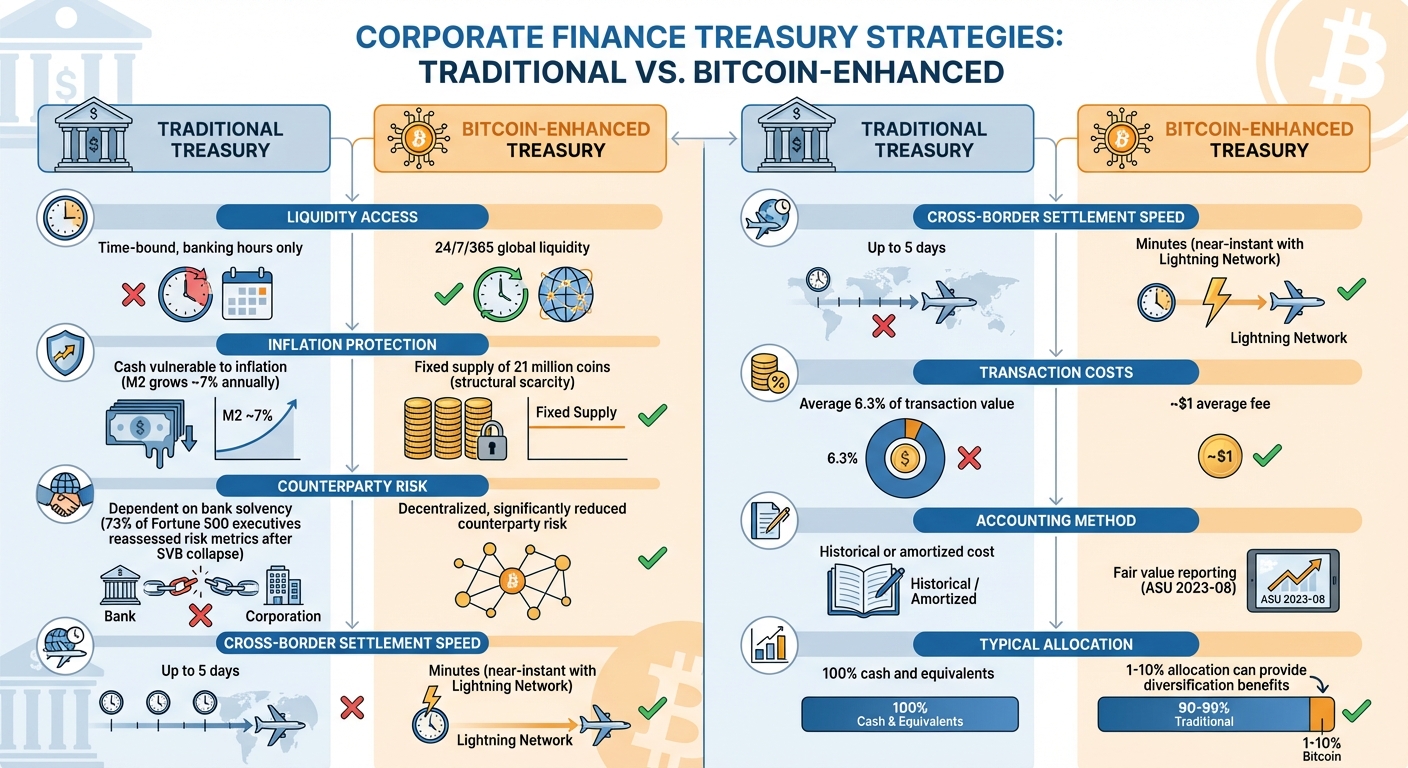
Traditional vs Bitcoin-Enhanced Corporate Treasury: Key Differences
Key Considerations for Bitcoin Adoption
Bringing Bitcoin into a corporate treasury strategy goes beyond operational tweaks - it's about aligning with broader financial goals. Start by defining your objectives for Bitcoin. Are you viewing it as a hedge against inflation, a diversification tool, or a way to showcase technological leadership? Once your goals are clear, assess your risk tolerance. How much of your excess cash can you comfortably allocate, knowing Bitcoin's volatility?
Strong governance is essential. This means involving key stakeholders like the board, CEO, CFO, legal, compliance, and investor relations teams. Together, they can craft a formal Bitcoin trading policy, setting clear allocation limits and rebalancing rules to avoid unauthorized trades and ensure oversight.
Accounting and tax implications also deserve attention. Under the updated FASB ASU 2023-08 standard, effective January 2025, Bitcoin will be measured at fair value each reporting period, with gains or losses reflected in net income. This replaces the previous impairment-only model, which many found limiting. Additionally, new U.S. Treasury guidance from June 2024 requires companies to use specific identification for digital asset units by purchase date and time, moving away from the default FIFO method for tax purposes.
Choosing the right infrastructure and custody solution is another critical step. Conduct thorough due diligence on third-party custodians, prioritizing those with SOC-1/SOC-2 certifications, multi-signature security, and comprehensive insurance. For instance, MicroStrategy negotiates contracts with its custodians to ensure its Bitcoin holdings are protected from creditor claims in case of custodial insolvency. Decide whether Bitcoin will be part of your daily operations - like cross-border payments or vendor invoicing - or if it will strictly serve as a treasury asset.
Once governance and strategy are in place, the focus shifts to operational tools for executing your Bitcoin treasury plans effectively.
Evaluating Bitcoin Payment Tools and Infrastructure
For secure and efficient Bitcoin management, institutional-grade custody solutions are a must. These typically combine cold storage (offline) for long-term holdings with hot wallets (online) for immediate liquidity. To reduce risks like internal fraud, multi-signature wallets require multiple authorizations for transactions, adding an extra layer of security.
For companies seeking seamless Bitcoin transaction management, platforms like Flash offer a practical solution. Flash enables businesses to accept Bitcoin globally through payment links, invoicing, subscriptions, and point-of-sale systems. It also supports Lightning Network transactions, allowing for near-instant settlements with minimal fees. Since all payments occur as wallet-to-wallet transfers, businesses retain full control over their funds.
When making large Bitcoin purchases for treasury purposes, using OTC liquidity providers and institutional trading platforms is advisable. For example, Semler Scientific employs Time-Weighted Average Price (TWAP) strategies, which help spread out purchases over time to minimize market impact and reduce the risks associated with lump-sum buys.
With the right tools and infrastructure in place, companies can effectively integrate Bitcoin into their treasury operations and compare its benefits to traditional approaches.
Comparison: Traditional vs. Bitcoin-Enhanced Treasuries
Traditional treasury strategies often rely on holding cash and equivalents, which are subject to time-bound liquidity constraints. Bitcoin, on the other hand, offers global liquidity around the clock - 24/7/365. While cash is vulnerable to inflation, Bitcoin's fixed supply introduces structural scarcity, making it an attractive alternative.
Counterparty risk also sets these strategies apart. Traditional treasuries depend on the solvency of banks, a concern that gained prominence after the Silicon Valley Bank collapse in March 2023. In fact, 73% of Fortune 500 treasury executives introduced new bank-counterparty risk metrics following the incident. Bitcoin, being decentralized, significantly reduces counterparty risk.
Transaction speed is another major advantage. Cross-border settlements through traditional banking systems can take days, whereas Bitcoin transactions - especially those using the Lightning Network - are nearly instantaneous. Additionally, while traditional assets are often recorded at historical or amortized cost, Bitcoin can now be reported at fair value under ASU 2023-08, offering greater transparency in financial reporting.
Research from the National Center for Public Policy Research suggests that even a modest allocation to Bitcoin - sometimes as little as 1% of total assets - can provide benefits like inflation protection, despite its higher volatility compared to traditional corporate bonds.
Conclusion
Key Takeaways for Financial Leaders
Bitcoin is addressing some of the most pressing challenges in corporate finance. With its capped supply of 21 million coins, it offers a hedge against inflation, provides uninterrupted global liquidity, and facilitates fast cross-border transactions at a fraction of the cost associated with traditional methods. These features are reshaping how companies approach treasury management and align with the growing shift toward digital assets.
However, the success of adopting Bitcoin hinges on more than just the asset itself - it requires a strong governance framework. Companies that thrive in this space typically establish well-defined policies approved by their boards, set clear allocation limits, and implement multi-signature security measures. To maintain operational stability, they also keep 6–12 months of expenses in fiat currency and use dollar-cost averaging to manage entry points and mitigate short-term market fluctuations. Additionally, fair value accounting under FASB ASU 2023-08 has introduced greater transparency in valuing Bitcoin holdings.
These practices are paving the way for a sustainable and forward-thinking approach to Bitcoin adoption in corporate finance.
Future Outlook on Bitcoin in Corporate Finance
The adoption of Bitcoin in corporate finance continues to gain momentum. By August 2025, businesses held 6.2% of the total Bitcoin supply - a staggering 21× increase compared to January 2020. In just the first eight months of 2025, Bitcoin inflows reached $12.5 billion, surpassing the total for all of 2024. The creation of the U.S. Strategic Bitcoin Reserve in March 2025 has further cemented Bitcoin's legitimacy among institutions, while advancements in accounting standards have eased concerns for CFOs.
Interestingly, small and medium-sized enterprises (SMEs) are leading this wave of adoption. Seventy-five percent of businesses embracing Bitcoin have fewer than 50 employees, with a median allocation of 10% of their net income. As the infrastructure supporting Bitcoin matures and regulatory frameworks become clearer, the primary hurdle remains education. Nearly half (46%) of businesses identify a lack of understanding as their main challenge. Financial leaders who dedicate time to grasp Bitcoin's mechanics, risks, and strategic applications will be better equipped to incorporate it into a modern, diversified treasury approach.
"The infrastructure, regulation, and accounting standards are in place. The primary barrier remaining is education and awareness." – River Financial
FAQs
What are the benefits of Bitcoin’s fixed supply for corporate treasuries?
Bitcoin’s capped supply of 21 million coins positions it as a non-inflationary asset, providing corporate treasuries with a dependable option for preserving capital over time. Unlike fiat currencies that can erode in value due to inflation or shifts in monetary policy, Bitcoin’s limited availability helps guard against devaluation.
For companies, holding Bitcoin can serve multiple purposes: it diversifies treasury reserves, acts as a hedge against the unpredictability of fiat currency movements, and offers a way to strengthen long-term financial stability. In today’s volatile economic climate, it’s a compelling consideration for CFOs aiming to protect their balance sheets.
What are the risks of adding Bitcoin to a company’s balance sheet?
Adding Bitcoin to a company’s balance sheet isn’t without its challenges, and financial leaders need to tread carefully. The biggest concern? Price volatility. Bitcoin’s value can swing wildly in short timeframes, potentially causing large, non-cash impairments. These fluctuations can impact the company’s net asset value (NAV), shake investor confidence, and even affect stock performance.
Then there’s the issue of accounting and regulatory uncertainty. Bitcoin is often classified as an intangible asset, which can lead to unpredictable earnings and tricky compliance hurdles - especially for public companies. On top of that, custody and security risks loom large. Digital assets are prone to hacking, loss of private keys, or operational mishaps, any of which could mean losing the funds entirely. And let’s not forget liquidity risks. If a company needs to offload a substantial Bitcoin position quickly, the market might not have enough depth, forcing sales at less-than-ideal prices.
To navigate these risks, companies must have robust risk management strategies in place. This includes secure custody solutions and well-defined accounting practices before making Bitcoin a part of their financial strategy.
How do new accounting rules affect how companies value Bitcoin?
Under the current accounting rules, Bitcoin falls under the category of an intangible asset. This classification requires companies to list Bitcoin on their balance sheets at its original purchase price, without allowing for upward adjustments if its market value increases. On the flip side, if Bitcoin’s value drops below the purchase price, the company must report an impairment loss. Once impaired, the asset remains recorded at the lower value until it’s sold, at which point any gains or losses are accounted for.
This method creates challenges for companies trying to value Bitcoin accurately, as it doesn’t align with real-time market fluctuations. It’s crucial for financial decision-makers to take these rules into account when planning to include Bitcoin in their business strategies.