Think of a bitcoin wallet address as your personal mailbox on the Bitcoin network. It's a unique string of characters you can share with anyone, anywhere in the world, so they can send you bitcoin. Just like you'd give someone your mailing address to receive a package, you share your bitcoin address to receive a payment.
What Is a Bitcoin Wallet Address
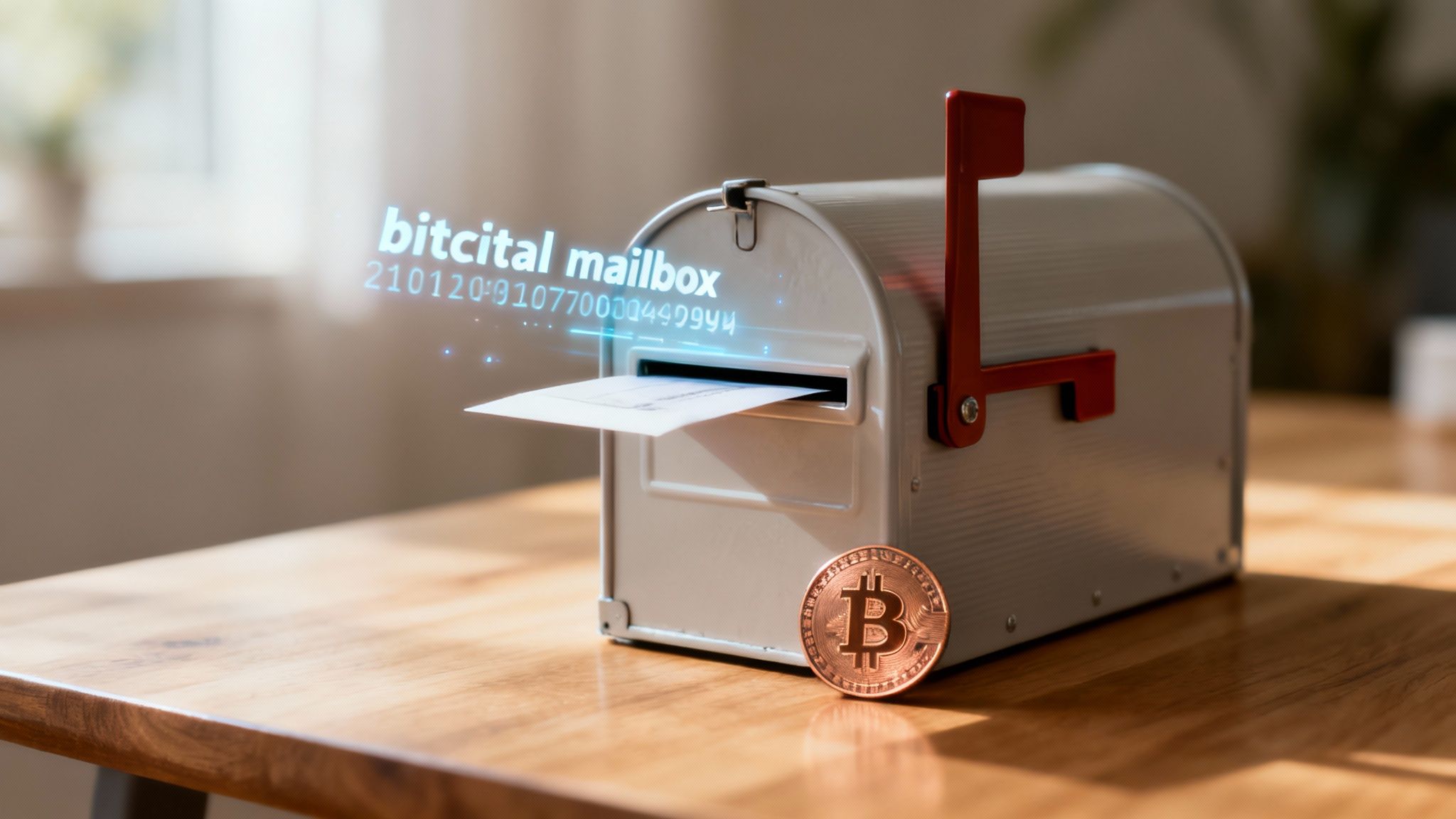
It’s the public-facing side of your wallet, and giving it out is perfectly safe. Nobody can access your funds just by knowing your address.
But here’s a crucial distinction: your address doesn't actually "hold" your bitcoin. Instead, it’s more like a public record on the Bitcoin blockchain that points to the funds controlled by your wallet.
The real security isn't the address itself, but the private key that corresponds to it. This secret key is the only thing that can "unlock" the mailbox, giving you the authority to access and spend the bitcoin sent to that address.
Different Types of Addresses
Over the years, the format for a bitcoin wallet address has evolved to become more efficient and secure. You don’t need to be a technical expert, but learning to spot the different types can be pretty handy.
Each address format starts with a unique character, making them easy to identify at a glance. Knowing the difference gives you a solid foundation for navigating the Bitcoin network.
Common Bitcoin Address Formats at a Glance
Here's a quick rundown of the most common formats you'll run into.
| Format Type | Starts With | Key Benefit |
|---|---|---|
| P2PKH (Legacy) | 1 |
The original Bitcoin address format, widely compatible with all wallets. |
| P2SH (Script) | 3 |
Supports more complex features like multi-signature transactions. |
| Bech32 (SegWit) | bc1 |
Offers lower transaction fees and better error detection. |
As you can imagine, the growth of Bitcoin has led to a massive number of addresses being created.
As of early 2024, there are over 460 million unique Bitcoin addresses that have held a balance at some point. However, only around 25 million are considered economically active wallets, highlighting the difference between simply generating an address and using it consistently. You can dive deeper into Bitcoin user metrics on bitbo.io. This growth underscores why understanding how these addresses work is so important as the network continues to expand.
How Your Bitcoin Address Is Created
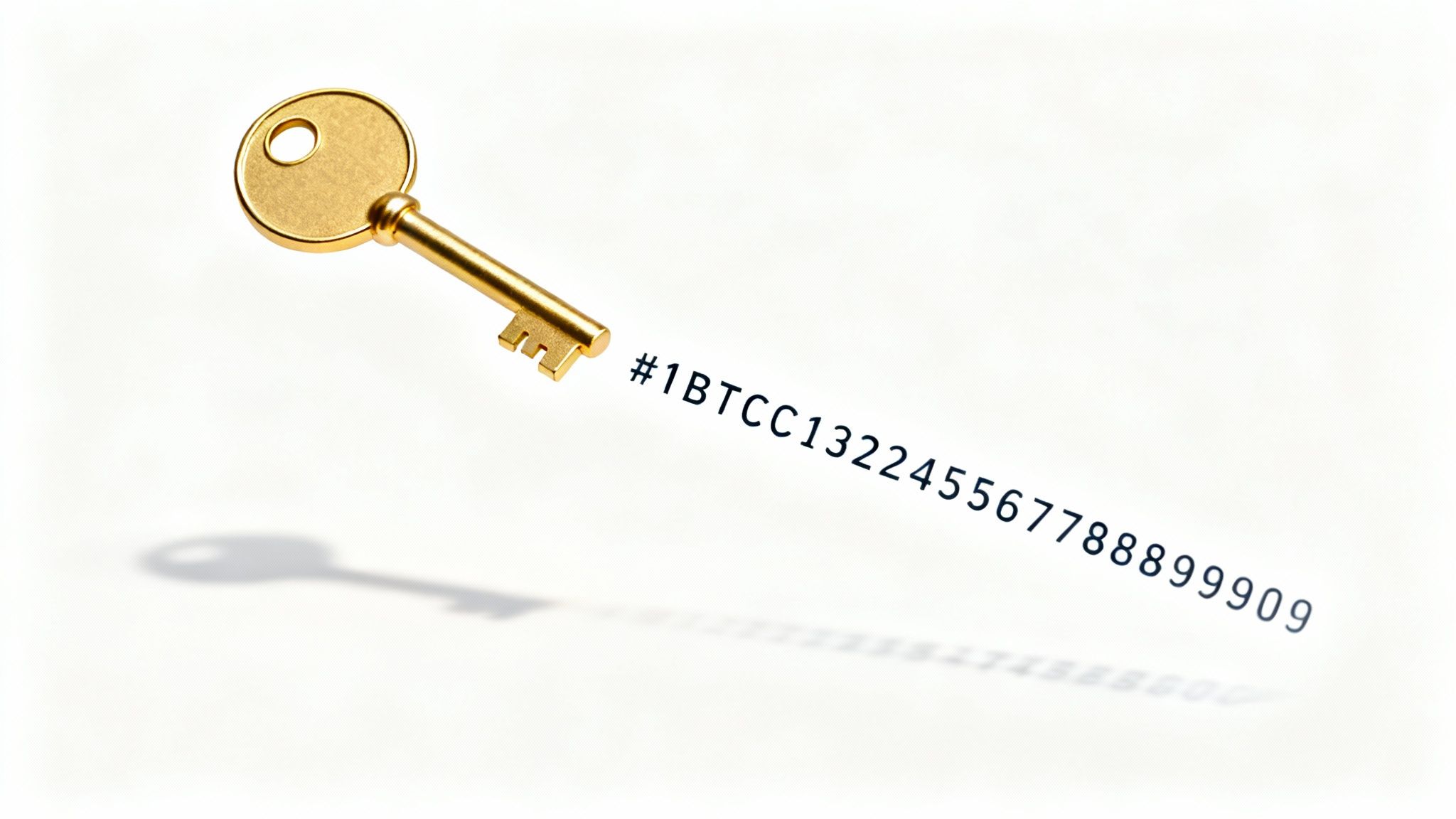
Every single bitcoin wallet address starts its life as a secret—a private key.
Think of this private key as the master key to your digital vault. It's a massive, randomly generated number that's mathematically unique, known only to you and your wallet software. This isn't just a password; it's the one thing that grants absolute control over your bitcoin.
Because of this power, your private key must be guarded like your most valuable possession. It should never, ever be shared. Its security is the bedrock of your wallet's safety.
From this secret key, your wallet uses a one-way mathematical function to forge a public key. This process, called elliptic curve cryptography, is a bit like mixing paint. It's easy to mix blue and yellow to get green, but it's practically impossible to separate the green back into its original colors.
You can effortlessly create a public key from your private one, but no one can reverse the process to find your secret. This cryptographic magic is a core security feature of Bitcoin, ensuring your public-facing information can't compromise your funds.
From Public Key to Public Address
But the journey doesn't end there. To create the final, shareable address, the public key goes through another transformation. It gets put through cryptographic "hashing" functions, which further disguise the public key and shrink it down into that familiar string of letters and numbers you see in your wallet.
This multi-step creation process intentionally builds layers of security, creating a clear and safe separation between your secret key and the public address you share.
- Private Key: Your secret master key. It signs transactions to prove you own the funds. Keep it secret, keep it safe.
- Public Key: Derived from the private key. It's used to verify your signatures without ever revealing the secret key itself.
- Bitcoin Address: A hashed, shorter version of the public key. This is the one you share to receive funds.
To put it simply, your private key is like the master key to a vault. You can use that key to create a blueprint for a public-facing deposit slot (your address). It's easy to build the deposit slot from the blueprint, but it's impossible to re-create the master key just by looking at the slot.
This is exactly why sharing your address is completely safe, while guarding your private key is mission-critical. Anyone can slide funds into your deposit slot, but only you, the holder of that master key, can ever open the vault. It’s this elegant design that makes the Bitcoin network both open for business and incredibly secure for its users.
How to Find and Share Your Address
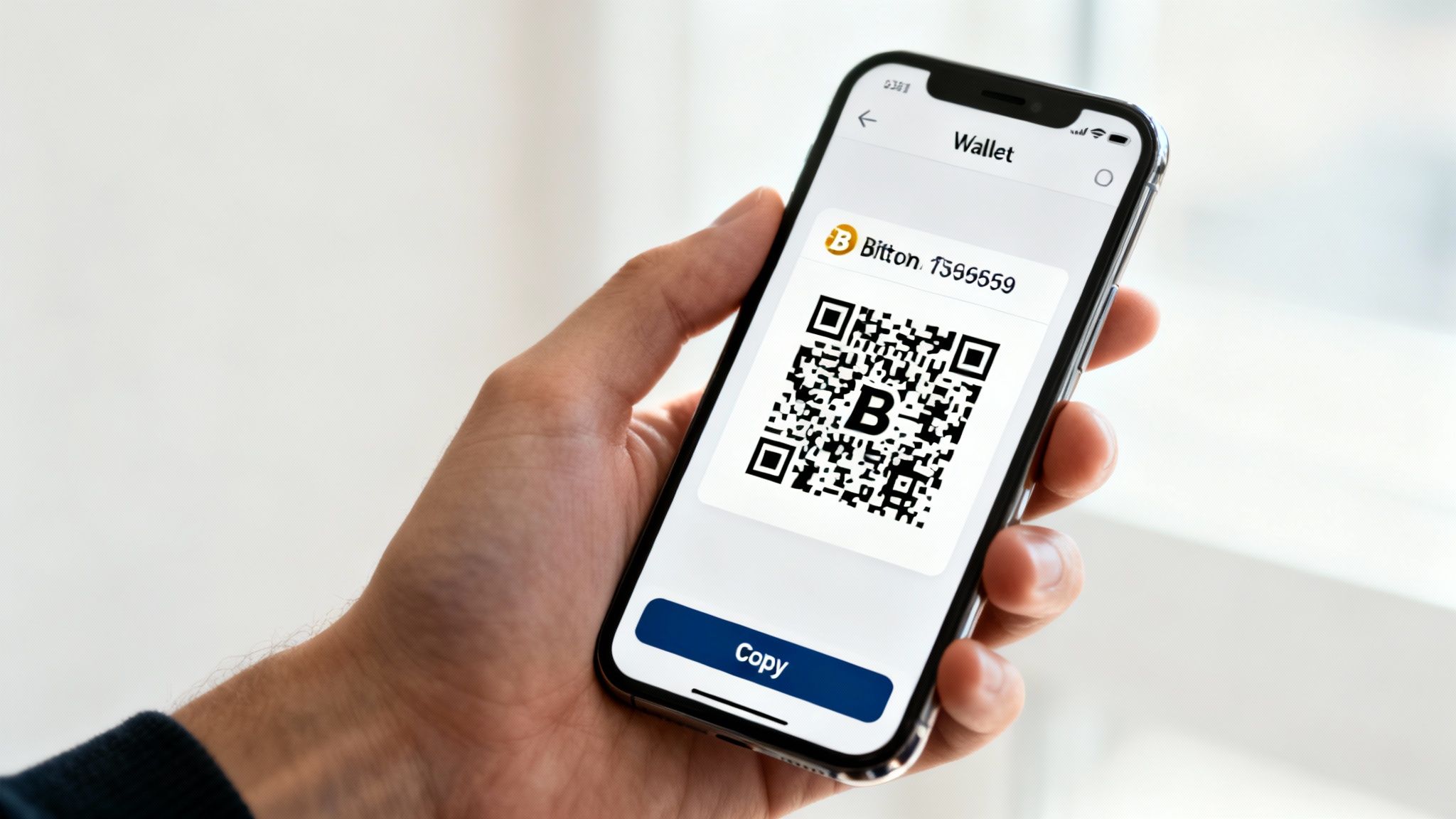
Alright, you know what a bitcoin wallet address is and how it’s generated. Now for the practical part: how do you actually find it and give it to someone?
The good news is that wallet developers have made this incredibly easy, whether you're on a mobile app, desktop software, or a hardware device.
While every wallet has its own look and feel, the basic steps are the same. Just open your wallet and look for a button that says “Receive” or sometimes “Deposit.” Tapping that will bring up your current address, ready to be shared.
Sharing Your Address Safely
Sharing your address is simple, but doing it right is crucial. One tiny mistake can send your funds into a digital black hole, never to be seen again.
Here's the golden rule: never, ever type a bitcoin wallet address by hand. These long strings of random letters and numbers are completely unforgiving.
Instead, always use your wallet’s built-in copy function. This puts the entire address on your device's clipboard, letting you paste it directly into a message or email. No chance of a typo.
Even with copy-paste, take one final second to be sure.
Before you send or confirm anything, always double-check the first few and last few characters of the address you pasted. This simple habit is a powerful security step that protects you from malware or a simple copy-paste glitch.
The QR Code: A Faster, Safer Method
For paying in person or sharing quickly online, the QR code is the undisputed king. It’s the industry standard for a reason.
When you hit "Receive" in your wallet, you'll see both the long alphanumeric address and a square, scannable QR code. Think of the QR code as a picture of your address.
This method completely removes the chance of human error. The person sending you bitcoin just scans your QR code with their own wallet app, and the correct address is instantly and perfectly filled in on their end. It’s the fastest, most foolproof way to get paid.
Here’s why QR codes are the go-to choice:
- Accuracy: They eliminate the risk of typos that can happen with manual entry or even copy-pasting. What they scan is exactly what their wallet gets.
- Speed: Scanning a code is instant. It’s way faster than sending a text string back and forth and verifying it.
- Convenience: It’s perfect for face-to-face payments at a shop, showing your address to a friend, or putting it on a website invoice for customers to scan and pay.
By using your wallet's copy function and verifying the characters—or even better, just using QR codes—you can share your address with confidence, knowing your funds are heading to the right place.
Best Practices for Address Management
Managing your bitcoin wallet address is about more than just knowing how to find it. It's about building smart habits that protect both your privacy and your money. The most critical rule? Avoid reusing the same address for every payment you receive.
Think of the Bitcoin blockchain as a public book that anyone can read. When you keep using the same address, it's like using the same page for every entry. Anyone can flip to that page and see every single payment you’ve ever received, creating a detailed financial history that reveals your transaction habits and total balance. It's a huge privacy leak.
The Power of New Addresses
To fix this, modern Bitcoin wallets are designed to be "Hierarchical Deterministic," or HD wallets. That might sound technical, but the idea is actually pretty simple: your wallet automatically creates a fresh, unique address for every single transaction you receive.
This simple step makes it incredibly difficult for snoops to connect the dots between your payments. It’s like having a new, secret mailbox for every letter you get, even though they all end up safely in your hands. You get a massive privacy boost without lifting a finger—the wallet does all the work for you.
The core principle is simple but powerful: one transaction, one new address. This is the gold standard for maintaining financial privacy on the Bitcoin network and is a key feature built into nearly all modern wallets.
Focus on Your Master Key
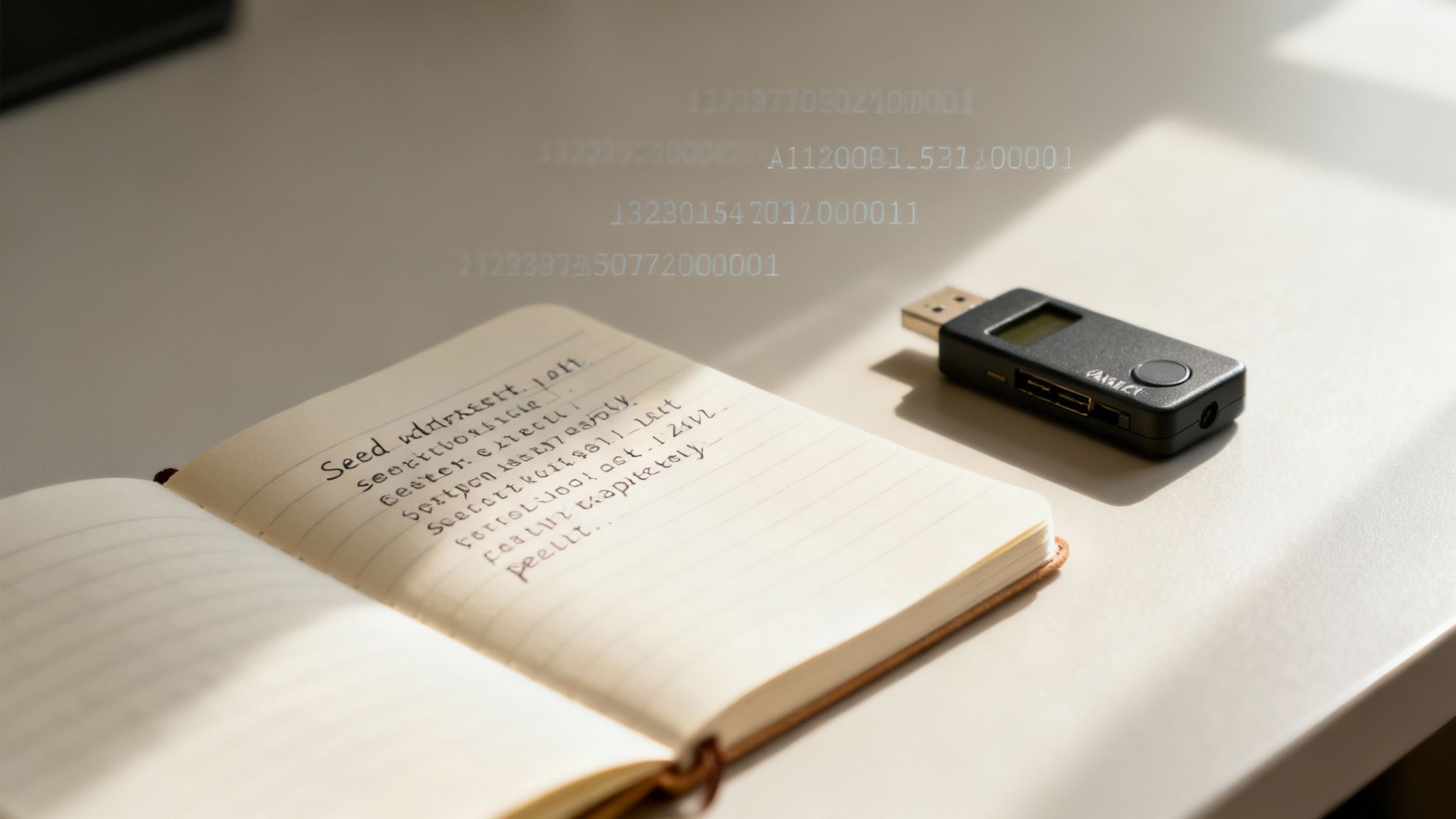
While generating new addresses is a crucial privacy habit, your ultimate security lies with your wallet’s seed phrase (also known as a recovery phrase). This is a list of 12 to 24 words that acts as the master key to your entire wallet.
A common rookie mistake is trying to save individual bitcoin address strings. Don't bother. Your seed phrase is infinitely more important because it can restore every single address your wallet has ever created—past, present, and future—along with all the funds tied to them.
- Backup Your Seed Phrase: Write it down on paper. Store it somewhere safe and offline where it won't get lost or damaged. Never, ever store it digitally on a device connected to the internet.
- Don't Save Addresses: Forget about saving long strings of characters. Your seed phrase is the only backup you'll ever need. It's your single source of truth.
- Guard It Fiercely: Anyone who gets their hands on your seed phrase gets full control of your bitcoin. Treat it like the keys to your financial kingdom.
How Businesses Use Bitcoin Addresses
For any business, a bitcoin wallet address is far more than just a string of characters for getting paid. It's a gateway to direct, sovereign commerce.
By accepting Bitcoin, you can sidestep the traditional financial middlemen who demand a cut of every single transaction. This means you can finally say goodbye to expensive card processing fees, the constant threat of chargebacks, and waiting days for your own money to settle.
When a customer pays a Bitcoin invoice, the funds travel directly from their wallet to yours. The settlement is final and etched onto the blockchain, often within minutes. This gives you immediate, full control over your revenue without asking anyone for permission. It's a monumental shift from depending on payment processors to truly owning your earnings.
Streamlining Payments with Unique Addresses
One of the most important practices for any business accepting Bitcoin is to generate a unique bitcoin wallet address for every single invoice. Think of it like giving each customer a dedicated, one-time-use payment instruction. This simple habit brings massive benefits for accounting and tracking payments.
When an invoice gets paid, you know precisely which customer and order it belongs to because the money arrives at an address tied only to them. This simple step cuts out all the guesswork of multiple payments piling into one generic account, making your bookkeeping a walk in the park. Modern Bitcoin payment software, like Flash, handles this entire process for you, creating and watching a new address for each transaction.
Adopting a one-address-per-invoice policy is a game-changer for business operations. It provides perfect payment clarity, strengthens financial privacy, and simplifies your bookkeeping, allowing you to focus on your business instead of untangling transactions.
Taking Control with Self-Custody
Maybe the biggest win here is the raw control that comes with self-custody. When you accept Bitcoin directly into a wallet you control, you are the one holding the private keys. That means you have absolute ownership and authority over your funds the second they arrive.
This direct model is a world away from using custodial payment services where a third party is essentially holding your money for you. With true wallet-to-wallet payments, you can:
- Eliminate Counterparty Risk: You're no longer at the mercy of a processor's financial health or their terms of service, which can change on a whim.
- Reduce Compliance Burden: Since you aren't acting as a financial intermediary, you can often sidestep complex know-your-customer (KYC) hurdles, protecting both your privacy and your customers'.
- Gain Financial Sovereignty: You decide when and how to move, spend, or hold your revenue. No one can freeze, hold, or put external controls on your hard-earned money.
This approach gives businesses the power to truly own their financial destiny, turning the simple bitcoin wallet address into a key to a more efficient and independent payment system.
Let's Clear Up Some Common Misconceptions
Getting into Bitcoin is exciting, but it also means unlearning a few things we take for granted from traditional banking. A lot of newcomers trip over the same myths about how a bitcoin wallet address works, leading to confusion or—worse—costly mistakes.
Let’s tackle these misunderstandings head-on, so you can manage your Bitcoin with confidence.
The first big hurdle is shaking the idea that a Bitcoin address is like your bank account. It’s really not. A bank account ties your name, balance, and transaction history together in one neat package. A Bitcoin address, on the other hand, is more like a single-use invoice number. It's designed for privacy and has no personal identity attached to it.
Myth Versus Fact: What You Really Need to Know
To get this right, let's bust the most common myths one by one.
Myth 1: A Bitcoin Address Is an Account
It's easy to assume a bitcoin address acts like a bank or email account—a permanent place that holds your balance and shows all your activity.
Fact: An address is just a destination for a specific payment. Think of it as a single receiving point on the public blockchain. While it can receive multiple payments, modern wallets are smart enough to generate a brand-new address for every single transaction. This is a huge win for your privacy. Your wallet, which is secured by your private key, is what actually "holds" and manages your total balance across all of the addresses it generates for you.
The Bitcoin network was built for privacy through pseudonymity. If you kept reusing the same address, you'd be creating a public record of your entire financial life for anyone to see. It would be like publishing your bank statement online.
Myth 2: You Can Just Reverse a Mistake
We're all used to the safety nets of traditional finance. Sent money to the wrong person? Just call the bank or click a "cancel" button. It's natural to think Bitcoin works the same way.
Fact: Bitcoin transactions are final and irreversible. Once a transaction is confirmed on the blockchain, it's set in stone. There's no central authority like a bank to call for a do-over. This is precisely why it's absolutely critical to double-check every address before you hit "send." Even better, just use QR codes to scan the address. It completely removes the risk of a typo.
Myth 3: It’s Fine to Reuse the Same Address
For convenience, some people find one address and just stick with it for every payment they receive. It seems harmless enough, right?
Fact: Reusing a bitcoin wallet address is a massive privacy and security risk. It creates a public trail that allows anyone to easily connect the dots between all your transactions, revealing your balance and spending habits. There's a simple rule of thumb here: always let your wallet generate a fresh, clean address for every single payment you receive. It's the easiest way to protect your financial privacy.
Frequently Asked Questions
Now that we’ve walked through the fundamentals of what a bitcoin wallet address is and how to use one, you probably have a few practical questions. Let's tackle some of the most common ones that come up.
Can I Have Multiple Bitcoin Wallet Addresses?
Yes, you can—and you absolutely should. In fact, it’s not just a good idea; it’s a core feature of modern Bitcoin wallets.
Your wallet is designed to generate a completely new, unique address for every single payment you receive. This is a huge deal for your privacy. By using a fresh address for each transaction, you make it incredibly difficult for anyone to link all your payments together on the public blockchain. Think of it like using a different, private P.O. box for every letter you receive—they all come to you, but no one can connect them from the outside.
What Happens If I Send Bitcoin to the Wrong Address?
This is the one you really need to pay attention to: Bitcoin transactions are final. If you accidentally send funds to a valid but incorrect address, those funds are almost certainly gone for good. There's no central bank to call and no "undo" button.
That’s why you have to be so careful. The golden rule is to never type an address by hand. Always, always use your wallet’s copy-paste function or, even better, scan a QR code. It takes just a second and ensures 100% accuracy, saving you from a potentially costly and irreversible mistake.
Once a transaction is confirmed on the blockchain, it cannot be reversed. This finality is a fundamental feature of the Bitcoin network, which is why double-checking an address before sending is a non-negotiable habit for every user.
Is My Bitcoin Wallet Address Case-Sensitive?
Good question! The answer depends entirely on the address format you're dealing with.
- Legacy (P2PKH) addresses, the ones that start with a
1, are case-sensitive. For these,Ais a completely different character froma. - SegWit (Bech32) addresses, which start with
bc1, are not case-sensitive. They cleverly use only lowercase letters and numbers, which helps cut down on human error.
But no matter the format, the best practice doesn't change: let your software handle it. Copy and paste or scan a QR code every time.
Ready to accept Bitcoin payments directly and securely? With Flash, merchants can launch wallet-to-wallet transactions in under a minute, eliminating intermediaries and high fees. Start today at .