Think of securing your Bitcoin like protecting a priceless treasure. It’s not about finding a single, magical lockbox; it’s about creating layers of defense, a fortress built on good habits and the right tools. At the heart of it all are your private keys—the one and only key to your digital vault. If someone else gets that key, your Bitcoin is gone.
Your Guide to Keeping Your Bitcoin Safe
This guide is your roadmap to building that fortress. We’ll cut through the noise and show you what actually matters, from spotting real-world threats like phishing scams and malware to choosing the right kind of wallet for your needs. The only way to protect your digital wealth is to be proactive. Whether you're just starting out or have been holding Bitcoin for years, these principles are the bedrock of keeping your assets safe.
The central truth of Bitcoin security is simple: you are your own bank. This gives you incredible freedom, but it also comes with serious responsibility. There’s no 1-800 number to call if your funds get stolen. Once your Bitcoin leaves your wallet, it’s gone for good.
The Human Element in Security Breaches
Most people think Bitcoin gets stolen by super-hackers cracking complex code. That’s rarely the case. Today’s threats are far more likely to target the person holding the keys—you. Attackers have realized it’s much easier to trick someone into handing over access than it is to break the underlying technology. Understanding this is the first major step toward real security.
The statistics are sobering. In 2025 alone, over $2.1 billion in crypto was stolen, with a huge portion of that coming from compromised wallets and clever phishing schemes. This shows a clear shift: hackers are moving away from attacking complex code and are now laser-focused on social engineering. They’re exploiting human psychology, not software bugs. You can dig deeper into these evolving tactics in this report on Cointelegraph.
Your biggest security risk isn't a flaw in Bitcoin's code; it's a lapse in your own personal security practices. Mastering the fundamentals is your strongest defense.
This guide is designed to arm you with the knowledge to make those fundamentals second nature. We’ll start with the absolute essentials—the pillars of protection that every single user needs to live by.
The Pillars of Bitcoin Wallet Security
Before we dive into specific tools and techniques, let's establish the ground rules. These are the fundamental principles that form the foundation of strong Bitcoin security. Internalizing them is non-negotiable.
| Security Pillar | Core Principle | Why It Matters |
|---|---|---|
| Private Key Control | Never share your private keys or recovery phrase with anyone, for any reason. | This is the master key to your funds. Anyone who has it has complete control over your Bitcoin. |
| Offline Storage | Keep your primary store of value in a hardware wallet, disconnected from the internet. | This prevents online threats like malware and hackers from ever accessing your keys. |
| Verification | Always double-check wallet addresses before sending funds. | A single typo or a clipboard-hijacking attack can send your Bitcoin to an attacker irreversibly. |
| Vigilance | Be skeptical of unsolicited offers, links, and messages asking for information. | Social engineering and phishing are the most common ways users lose their crypto. |
By building your security strategy around these pillars, you shift from being a potential victim to a well-defended participant in the Bitcoin economy. Now, let’s build on this foundation and give you the practical tools to put these principles into action.
Understanding How Crypto Is Stolen
To really get a handle on bitcoin wallet security, you have to think like a thief. Forget the dramatic Hollywood scenes of hackers furiously typing to crack impossible encryption. The truth is usually much simpler and hits closer to home. Most crypto isn't stolen by breaking Bitcoin's complex code; it's stolen by tricking the person holding it—you.
Attackers know the easiest vulnerability to exploit isn't technological, it's human. They use a crafty mix of technical tricks and psychological manipulation to get their hands on your funds. Once you understand their playbook, that vague sense of fear turns into practical, actionable awareness. You start seeing the traps before you can fall into one.
These aren't just hypothetical risks; they're happening constantly. Just in the first half of 2025, there were 344 reported crypto security incidents, with each one averaging a staggering $7.18 million in losses. That's more than double the average from 2024, showing just how fast this threat is growing. A huge slice of these thefts came from direct wallet compromises where attackers simply got ahold of a user's private keys.
Social Engineering and Phishing Attacks
The most common weapon in a crypto thief's arsenal is social engineering. It’s the age-old art of the con, just updated for the digital world. At its heart, it’s about manipulating people into giving up information they shouldn't. And their favorite tool for this is phishing.
A phishing attack is when a scammer pretends to be someone you trust—like your wallet provider or a crypto exchange—to trick you into sharing sensitive info. You might get a panicked email about a "security breach," urging you to "verify your wallet" immediately by clicking a link. That link takes you to a pixel-perfect fake website. The moment you type in your recovery phrase or password, it’s game over. The attackers have it.
Crucial Tip: No legitimate company will ever ask for your private key or recovery phrase. Not your wallet provider, not an exchange, nobody. If you see that request, it’s a scam. 100% of the time.
Learning to spot the red flags of these schemes is one of the most important skills a Bitcoin user can have. For a deeper dive, there are some great resources for protecting against phishing email scams.
Malware and Device Compromise
While phishing plays on your mind, malware goes straight for your hardware. This malicious software can infect your computer or phone, often without you even noticing. Once it's in, it can compromise your bitcoin wallet security in a few nasty ways.
- Keyloggers: This type of malware is a digital spy, recording everything you type. The second you enter your wallet password or recovery phrase, the keylogger sends a perfect copy straight to the attacker.
- Clipboard Hijackers: This one is especially devious. You copy a long Bitcoin address to make a payment. In the background, the malware instantly swaps that address with the attacker's address in your clipboard. You paste what you think is the right address, hit send, and your funds are gone for good.
- Remote Access Trojans (RATs): Think of a RAT as giving an attacker a ghost-like presence on your device. They can see your screen, rifle through your files, and even control your wallet as if they were sitting right there with you.
Some malware, like the StilachiRAT, is specifically built to hunt for crypto. It can scan a Google Chrome browser for over 20 different crypto wallet extensions, sniffing for any scrap of data that could lead to a compromise. This is exactly why you must double-check every single character of a recipient's address before you send a payment.
Physical Threats
Finally, we have the most direct threat of all. While it's less common, physical danger is a real risk, especially for people who are known to hold a lot of Bitcoin. This can be as simple as someone stealing a laptop or phone that has a software wallet on it.
On the more extreme end is the dreaded "wrench attack," where a thief uses physical violence or threats to force you to hand over your crypto. It’s a brutal reminder of why it’s a bad idea to broadcast your holdings and why serious holders often rely on advanced setups like multisig wallets to protect themselves.
Choosing the Right Wallet for Your Needs
Alright, you understand the threats. Now, let’s talk about your first line of defense. Picking the right Bitcoin wallet is probably the single most important decision you'll make in protecting your crypto. There’s no single “best” wallet—the right choice is all about what’s best for you. It comes down to your personal habits, how much Bitcoin you're holding, and how often you plan to use it.
Think about it like storing cash. You wouldn't keep your life savings in your pocket, but you also wouldn't lock up your lunch money in a high-security bank vault. It's the same with Bitcoin. Each type of wallet strikes a different balance between security and convenience, and the key to solid bitcoin wallet security is picking the right tool for the job.
Let's walk through the main options.
Hardware Wallets: The Personal Bank Vault
A hardware wallet is a small physical device built for one purpose: keeping your private keys completely offline. For serious bitcoin wallet security, this is the undisputed champion.
Picture it as your own personal, impenetrable bank vault. To send any Bitcoin, you have to physically approve the transaction on the device itself. This creates an "air gap"—a physical barrier between your keys and the internet. So even if your computer is completely compromised with malware, the keys never leave the safety of the hardware wallet. They simply can't be stolen by an online attacker.
- Best For: Long-term storage of significant amounts of Bitcoin. This is your HODL stash, your savings.
- Security: The highest you can get.
- Convenience: Lower. You need the device with you to access your funds, making it a bit slow for everyday spending.
Software Wallets: The High-End Home Safe
A software wallet (often called a "hot wallet") is an app you install on your computer or phone. These wallets offer a fantastic blend of security and everyday usability.
Think of this as a top-of-the-line safe in your house. It’s connected to the internet, making it far more accessible than your bank vault, but it's still locked down with passwords and encryption. It’s perfect for the funds you need to access regularly.
- Best For: Managing smaller, active amounts for spending, trading, or other frequent transactions. This is your digital checking account.
- Security: Medium. Because it's on a device connected to the internet, it's vulnerable if that device gets a virus.
- Convenience: High. Sending and receiving Bitcoin is as easy as using any other app on your phone.
A critical security practice is to never store your life savings on a software wallet. Use it for convenience with smaller balances, but always move large holdings to a hardware wallet for long-term safety.
Web Wallets: The Pocket Wallet
A web wallet is one you access through your browser, usually run by a crypto exchange or other online service. This is the easiest to use, but it's also the riskiest because you're trusting a third party to hold your private keys for you.
This is the digital equivalent of the cash in your back pocket. It's super convenient for a quick purchase, but it's also the most vulnerable. If the exchange gets hacked or you fall for a phishing email, your funds can be gone in an instant. You're not really in control—they are.
- Best For: Holding very small amounts of Bitcoin for immediate trading or transfers. Think of it as pocket change.
- Security: The lowest. You're completely dependent on the service's security measures and your own password strength.
- Convenience: The highest. Access it from anywhere with an internet connection.
Comparing Bitcoin Wallet Security and Convenience
Choosing the right wallet means being honest about your needs. The table below breaks down the trade-offs at a glance, helping you match the wallet type to your specific use case.
| Wallet Type | Security Level | Convenience | Best For |
|---|---|---|---|
| Hardware Wallet | Highest | Low | Long-term holding, large amounts ("cold storage") |
| Software Wallet | Medium | High | Daily spending, active trading of smaller amounts |
| Web Wallet | Lowest | Highest | Storing "pocket change" on exchanges for quick trades |
Ultimately, most experienced users don't just pick one. A smart approach is to use a combination: a hardware wallet for your savings, a software wallet on your phone for spending, and maybe a tiny amount on an exchange for trading. This layered strategy gives you the best of both worlds—maximum security for your core holdings and practical convenience for everything else.
Essential Security Practices You Must Follow
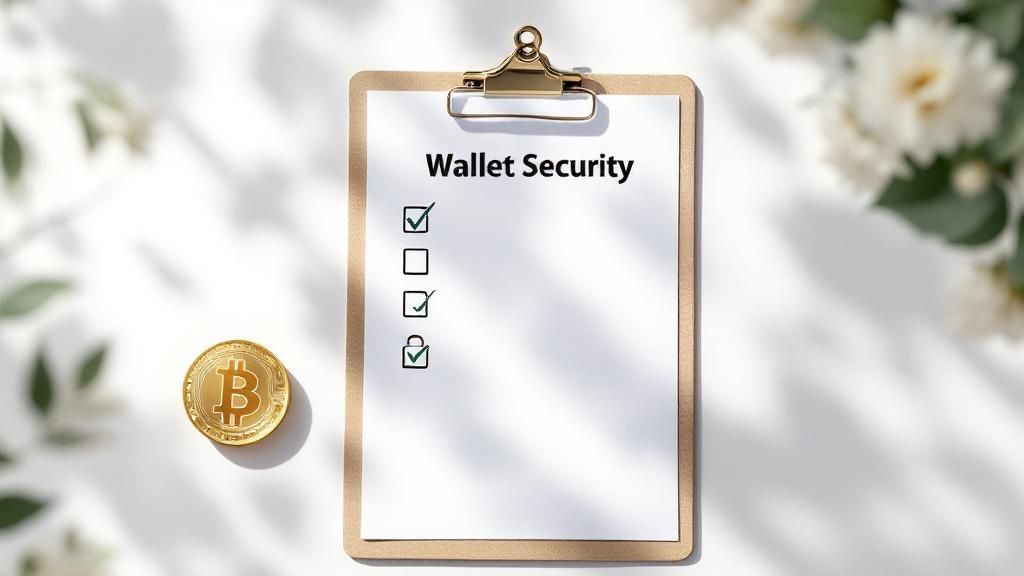
Alright, you understand the threats out there and you’ve picked a wallet. That’s a great start. But now comes the part that really matters: the day-to-day discipline that keeps your Bitcoin safe. Think of bitcoin wallet security less as a one-time setup and more as a constant practice, a set of non-negotiable rules you live by.
The absolute most important thing you need to protect is your recovery seed phrase. You know, that list of 12 or 24 words you were given when you first set up your wallet. This isn't just a backup—it's the master key to your entire crypto balance. If your hardware wallet gets run over by a bus, this phrase is the only thing that lets you get your funds back.
Your seed phrase is more valuable than the hardware device itself. Treat it like the ultimate secret. Anyone who finds it gains complete and irreversible control over your funds.
So, how do you store it? Never, ever digitally. No photos, no text files, no password managers, no cloud storage. A digital copy is just a target waiting for a hacker. Instead, write it down on paper—or better yet, stamp it onto a metal plate to make it fireproof and waterproof. Keep at least two copies in different, secure physical locations.
Creating a Secure Environment
Your security mindset has to extend beyond just the seed phrase. Every device and network you use to manage your crypto is a potential backdoor for an attacker. Keeping your digital environment clean is just as crucial as hiding your keys.
A little bit of caution goes a long, long way. For instance, never use public Wi-Fi for crypto transactions. It's just not worth the risk. Those free networks are a playground for anyone looking to snoop on your activity. Stick to a trusted, private network like your home Wi-Fi, and for an extra layer of security, use a reputable VPN.
Keeping your software updated isn’t just about new features, either. It’s a core security task.
- Wallet Software: Developers are constantly patching security holes. Running an outdated wallet app is like leaving your front door unlocked.
- Operating System: Your phone and computer (iOS, Android, Windows, macOS) get regular security patches for a reason. Turn on automatic updates so you're always protected from the latest known threats.
This isn't theoretical. Attackers love to exploit old software. A breach in early 2025 involved malware slipped into a popular browser plugin, which then stole seed phrases from five different types of wallets. It’s a stark reminder that even trusted tools can be compromised. If you want to see just how common this is, you can find a long list of crypto hacks and exploits over at CCN.
Transaction Diligence
Finally, let's talk about the moment you actually send Bitcoin. Because Bitcoin transactions are irreversible, there's no "undo" button. A single slip-up can mean your funds are gone for good.
Before you ever hit that "send" button, run through this mental checklist:
- Verify the Address: Double-check it. Then check it again.
- Confirm on a Second Channel: Sending a large sum? Call or text the person to confirm the address is correct. Don't rely on just one channel of communication.
- Be Wary of Clipboard Hijackers: This is a nasty one. Malware can secretly swap the address you copied with one belonging to a thief. After you paste, always visually inspect the address to make sure it matches.
- Send a Test Transaction: For a new address, especially for a big payment, send a tiny amount first. Wait for it to confirm before you send the rest.
These steps might feel a bit tedious, but they are your last line of defense against both clever scams and simple mistakes. Making these habits second nature is how you build a real wall of security around your Bitcoin.
Advanced Security for Serious Investors
When your Bitcoin holdings start to grow, your security strategy has to grow up with them. The basic precautions that work just fine for a small amount of crypto simply won't cut it when you have significant value on the line. For serious investors, it's time to graduate from standard protection to advanced measures that create multiple, independent layers of defense. The goal is to make a successful attack nearly impossible.
This is the point where you move from thinking about personal security to practicing operational security, or "OpSec." It's a fundamental mindset shift. You start hunting down and eliminating every single point of failure you can find, looking critically at not just digital threats, but physical and social ones, too.
Deploying Multi-Signature Wallets
The single most powerful upgrade for your bitcoin wallet security is a multi-signature (multisig) wallet. Imagine a bank's safe deposit box that needs two different keys, held by two different people, to be opened. That's the core idea here. A multisig wallet requires multiple private keys to sign off on a single transaction.
A very common setup is a "2-of-3" wallet. This means you have three total private keys, but you only need two of them to send your bitcoin. You might keep one key on your hardware wallet, a second on a separate device stashed in a different location, and hand the third to a trusted family member or a security firm.
This structure gives you enormous advantages:
- Theft Protection: A hacker would have to compromise two of your keys, which are stored in completely separate environments. A remote hack becomes practically impossible.
- Redundancy: If you lose one key—say, in a fire or a move—you aren't locked out of your funds. You can still access everything with the other two. You're protected against a single point of loss.
- Geographic Security: You can spread your keys across different cities or even countries. This protects you from localized disasters or even physical threats.
A multisig setup is the gold standard for protecting significant wealth. It fundamentally changes the security game from protecting a single secret (one seed phrase) to defending a distributed system where no single component can fail.
For anyone managing substantial assets, performing regular security audits is also a non-negotiable practice. Using an IT security audit checklist provides a structured way to evaluate your entire setup, from network security to device hardening, ensuring no weak spots get overlooked.
The Ultimate Defense: An Air-Gapped Setup
For the truly paranoid, or for those protecting generational wealth, the air-gapped computer represents the final frontier of security. An air-gapped machine is a computer that has never been connected to the internet and never will be. Its only job is to sign Bitcoin transactions in complete isolation.
Here’s how it works in practice:
- First, you create an unsigned transaction on your normal, everyday online computer.
- Next, you transfer this unsigned transaction file over to the air-gapped computer using a physical medium, like a USB drive or QR code.
- You then sign the transaction on the offline machine, using a private key that has never been exposed to the internet.
- Finally, you move the now-signed transaction back to your online computer and broadcast it to the Bitcoin network.
This entire process ensures your private keys remain in a pristine, isolated environment. They are completely immune to any online malware, spyware, or remote attacks that could compromise them.
Plausible Deniability with Passphrases
One last advanced feature to consider is the passphrase, which is supported by most modern hardware wallets. It's often called the "13th word" or "25th word." This is an extra word or phrase you create that, when used with your 24-word recovery seed, generates a totally new and separate wallet.
This is how you create a "decoy" wallet. You can keep a small, believable amount of Bitcoin in your primary wallet (the one protected just by your PIN). The vast majority of your funds, however, would be stored in the hidden wallet protected by the passphrase.
If you ever find yourself in a duress situation—like a physical "wrench attack"—you can give up your PIN. The attacker gets access to the decoy wallet, sees a reasonable balance, and hopefully leaves satisfied, while your main stash remains completely hidden and secure.
Answering Your Top Security Questions
It's one thing to understand the theory behind bitcoin security, but it's another thing entirely when you're faced with a real-world "what-if" scenario. When you're your own bank, a little bit of doubt is perfectly normal. Let's walk through some of the most common questions we hear, so you can feel confident and prepared.
Think of this as your quick-reference guide. Knowing these answers turns a moment of potential panic into a calm, measured response.
https://www.youtube.com/embed/GPpZxOjvU10
What Should I Do If I Lose My Hardware Wallet?
First and foremost: don't panic. The physical device is just a piece of plastic and metal, and it should be protected by a PIN that prevents anyone from immediately using it. Your real treasure is the recovery seed phrase—those 12 or 24 words you wrote down and stored safely offline during setup.
Your Bitcoin was never on the device itself; it lives on the blockchain. The hardware wallet simply holds the private keys that prove you own the funds. To get your access back, all you have to do is:
- Get your hands on a new hardware wallet. It can be from the same brand or another compatible one.
- During its initial setup, look for the "restore" or "recover" option.
- Carefully input your recovery seed phrase.
That’s it. The new device will regenerate your private keys and give you full access to your Bitcoin, just as it was before. This is exactly why safeguarding that seed phrase is the absolute cornerstone of your entire security strategy.
Is It Safe to Use a Mobile Bitcoin Wallet?
Absolutely, as long as you use it for its intended purpose. Think of a mobile wallet like the physical wallet you carry in your pocket. It’s perfect for holding a small amount of cash for daily spending, but you’d never walk around town with your life savings tucked inside.
Because our phones are always online, they're naturally more exposed to things like malware or clever phishing attacks. For that reason, you should never store large amounts of Bitcoin on a mobile wallet. Use it for convenience with smaller, spendable balances, and keep the majority of your funds tucked away in a cold-storage hardware wallet. And of course, always lock your phone with a strong passcode and biometrics like a fingerprint or face ID.
How Can I Spot a Phishing Scam?
Phishing scams are all about psychological manipulation. They create a false sense of urgency, fear, or greed to rush you into making a critical mistake. The best defense is a healthy dose of skepticism and a sharp eye for the typical red flags.
Be instantly suspicious of any unsolicited email, text, or social media message that demands immediate action, promises unbelievable returns, or claims your wallet has been compromised.
Always double-check the sender's email address for tiny misspellings designed to look legitimate (like [email protected] instead of [email protected]). Before you click any link, hover your mouse over it to preview the actual destination URL. If it doesn't look right, it's a scam.
Most importantly, remember this golden rule: no legitimate crypto company, wallet provider, or exchange will ever ask for your private keys or recovery seed phrase. A request for that information isn't just a red flag; it's a giant, blaring siren telling you it's a scam.
Ready to accept Bitcoin securely and efficiently? With Flash, you can integrate wallet-to-wallet payments directly into your business, eliminating intermediaries and reducing fees. Start accepting decentralized payments in under a minute.