So, you're thinking about building your own Bitcoin payment gateway. This means piecing together secure wallet management, a direct line to the Bitcoin network, and a custom API. You'll be creating a system from the ground up that spits out unique addresses for each payment, keeps an eye on the blockchain for incoming funds, and tells your merchants' systems when the money has arrived.
Going this route gives you maximum control over fees and cuts out the middleman completely. It's a big project, no doubt, but the payoff can be huge.
Why Build a Custom Bitcoin Payment Gateway
Let's be clear: building your own payment gateway is a serious undertaking. But the strategic wins can be massive, especially when you’re all-in on Bitcoin. Sure, off-the-shelf solutions are convenient, but they always come with strings attached—transaction fees that eat into your margins, limited ways to customize the experience, and being at the mercy of a third party's development schedule.
When you own the infrastructure, you call the shots.
The biggest reason people take the plunge is cost. Third-party gateways take a slice of every single transaction. For a business doing any real volume, those fees pile up fast, turning into a major operating expense. A custom gateway swaps that endless bleed for a predictable, fixed cost to keep your servers running.
But it’s not just about the money. A custom build gives you a level of control and flexibility you just can't buy. You're no longer stuck with someone else's feature set. This is your chance to build exactly what you need and innovate on your own timeline.
Gaining a Competitive Edge
A proprietary gateway lets you design the payment experience around your business model and your customers, not the other way around. Think about implementing unique features without having to beg a third-party provider to add them to their roadmap.
What could this look like in the real world?
- Instant Settlement Flows: You could design a system where merchants get their funds the second a transaction gets its first confirmation on the blockchain. No more waiting days for payouts.
- Custom Invoicing: Imagine building specialized invoicing that talks directly to your accounting software, making reconciliation practically automatic.
- Tailored Security Protocols: Instead of a one-size-fits-all security plan, you can implement measures that perfectly match your company's risk profile.
This level of customization isn't just a nice-to-have; it's a powerful competitive advantage. You can react to market shifts faster, deliver a better user experience, and build a payment system that's far more resilient.
By taking ownership of your payment infrastructure, you’re turning a standard business function into a strategic asset. You can innovate on your own terms, slash long-term costs, and offer a payment experience your competitors simply can't replicate.
Understanding the Market Opportunity
This move also puts your business right in the middle of a booming sector. The global payment gateway market was valued at $12.81 billion in 2025 and is on a steep upward curve. This growth is being driven by the relentless rise of e-commerce and digital payments, opening up a huge window for specialized solutions—exactly like a Bitcoin-focused gateway.
You can dig deeper into the expanding payment gateway market and its trends yourself. Making this move isn't just about fixing today's problems; it's about setting yourself up for where digital commerce is headed next.
Designing Your Gateway Architecture
Before you write a single line of code, you have to get the architecture right. This is the blueprint for your entire payment gateway, and a shaky foundation here will cause major headaches down the road. You’re aiming for a system that’s secure, scalable, and doesn’t become a tangled mess when you need to update it. This means carefully mapping out your core components, picking the right tech, and defining how everything talks to each other.
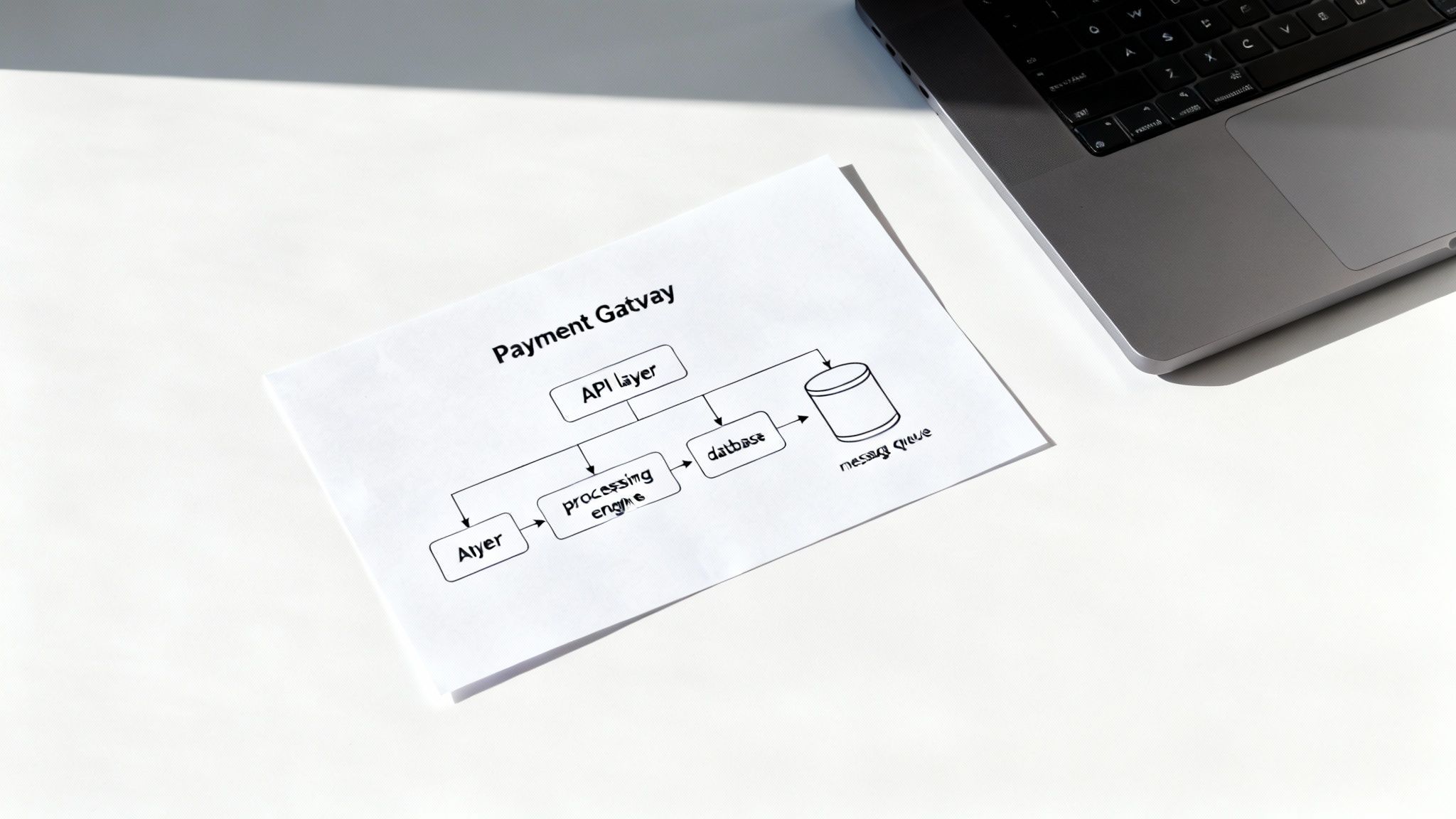
Think of your gateway as having three main layers. First, there's the API Layer—this is the front door your merchants will use to create invoices and check on payments. Behind that sits the Core Processing Engine, the real brains of the operation. It’s what handles all the business logic, talks to the Bitcoin network, and confirms transactions. Finally, you have the Database Layer, which securely stores everything from transaction data and merchant info to API keys.
Each layer has a distinct job. If you cut corners on one, you'll create bottlenecks that drag the whole system down.
Monolithic vs. Microservices Architecture
One of the first big decisions you'll make is whether to build a single, monolithic system or break it up into microservices. When you build your own payment gateway for Bitcoin, this choice has massive implications.
A monolithic architecture lumps everything into one big codebase. It’s often faster to get started with, which makes it tempting if you're trying to get a minimum viable product (MVP) out the door. The problem is that as it grows, it can become a nightmare to manage and update. A single bug can bring the whole system crashing down.
A microservices architecture, on the other hand, splits your gateway into smaller, independent services that do one thing well. For a Bitcoin gateway, that might look something like this:
- An Invoice Service that only generates payment requests.
- A Notification Service that fires off webhooks to merchants when a payment is confirmed.
- A Wallet Service that’s responsible for generating addresses and watching the blockchain.
This approach gives you way more flexibility. If your notification service is getting hammered with traffic, you can scale it up independently without touching the rest of the gateway. The trade-off is more complexity in deployment and monitoring—you have to make sure all these little services can talk to each other reliably.
If you're planning to handle any real volume, go with microservices. It's the only way to build the kind of resilient, scalable system needed for financial transactions. A bug in one service shouldn't be able to take down your entire platform.
Choosing Your Technology Stack
The tech you choose will directly impact your gateway’s performance. For a Bitcoin payment gateway, you need tools that are great at handling lots of connections at once and processing data in real time.
Node.js is a really popular choice here because of its non-blocking, event-driven model. This makes it perfect for managing a flood of simultaneous API requests and webhook notifications, which is bread and butter for a payment gateway.
Another heavy hitter is Go (Golang), which is known for its raw speed and efficiency with concurrent tasks. Its compiled nature makes it a fantastic fit for the high-throughput demands of the core processing engine. No matter what you choose, solid real-time database synchronization is essential for keeping data consistent and reliable across all your services.
Your database is just as critical. PostgreSQL is a battle-tested relational database famed for its reliability, making it a solid choice for storing transaction records that can never be changed. For things like caching or managing real-time connection data, a key-value store like Redis is the perfect partner to your main database.
Core Component Breakdown
To tie this all together, let's look at the key components and what they actually do inside a well-designed architecture.
Below is a quick comparison of the core components, their main job, and some popular technology choices I've seen work well in production environments.
Core Gateway Component Comparison
| Component | Primary Function | Example Technologies | Key Consideration |
|---|---|---|---|
| API Layer | Exposes endpoints for merchants to create invoices, check statuses, and manage settings. | Node.js (Express), Go (Gin) | Must be well-documented, secure, and include rate limiting to prevent abuse. |
| Processing Engine | Contains the core business logic for validating payments and interacting with the Bitcoin network. | Go, Rust, Node.js | Needs to be highly reliable and efficient to handle transaction validation without delays. |
| Wallet Manager | Generates new Bitcoin addresses and monitors the blockchain for incoming transactions. | Bitcoin Core (RPC), HD Wallet Libraries | Security is paramount. This component must protect private keys and interact securely with the network. |
| Database Schema | Structures and stores all data related to merchants, invoices, transactions, and logs. | PostgreSQL, MySQL | Must be designed for data integrity and be able to scale as transaction volume grows. |
Spending the time to carefully plan these architectural pieces is arguably the most important part of the entire process. Get this right, and you’re setting yourself up for a secure, scalable system. Rush it, and you’ll be paying for it later.
Your gateway's connection to the Bitcoin network is its lifeline. This is where all the architectural diagrams and code meet the real world of blockchain transactions. You absolutely need a reliable, secure connection—it’s the only way your system can generate addresses, watch for incoming payments, and confidently send funds.
When it comes to making this connection, you have two main paths. You can either run your own full node or take a lighter, more managed approach with wallet services.
The choice you make here will define your gateway's security, privacy, and independence. While using a third-party service might seem easier at first, running your own node is the gold standard for anyone serious about building a sovereign financial tool. It gives you direct, unfiltered access to the blockchain, cutting out any reliance on intermediaries who could go down, change their API, or compromise your users' privacy.

Running a Full Bitcoin Node
If you're aiming for maximum security and control, running your own Bitcoin full node is the only way to go. A full node is a program that validates every single transaction and block, keeping a complete copy of the entire Bitcoin blockchain. By running software like Bitcoin Core, your payment gateway talks directly to the network without having to trust anyone.
Your gateway will interact with your node using Remote Procedure Calls (RPC). Think of these as commands you send to your node to get things done. You'll need to configure your node to accept these connections securely, then use an RPC client in your application’s code to start issuing commands.
You'll quickly become familiar with a few critical RPC calls:
getnewaddress: This tells your node to generate a fresh Bitcoin address for a new invoice.getbalance: Use this to check the confirmed balance of your wallet.sendtoaddress: This is how you broadcast a transaction, like moving funds from your hot wallet to a merchant's settlement address.gettransaction: This call fetches all the details about a specific transaction, which is vital for confirming payments.
When you run your own node, you become your own source of truth. You don’t need to ask a third party if a payment was received; you verify it yourself against your own copy of the blockchain.
A Lighter Approach with HD Wallets and xPubs
While a full node gives you ultimate control, it’s a beast to manage. It demands a ton of disk space and bandwidth. For a more lightweight but still highly secure alternative, you can use Hierarchical Deterministic (HD) wallets. This approach lets you generate a virtually endless sequence of payment addresses from a single master seed.
The secret sauce here is the extended public key (xPub). You can derive an xPub from your master private key and load it onto your payment gateway's server. This key allows your gateway to generate new public addresses on demand for every invoice, all without ever touching the private keys needed to spend the funds.
Your private keys can stay completely offline in a cold storage environment, while the xPub on your live server handles address generation. This architecture dramatically shrinks your attack surface—even if your server is compromised, the attackers can't steal any funds.
This setup strikes a fantastic balance between security and convenience. Your gateway can watch the blockchain for payments sent to these addresses, but it has zero ability to move any Bitcoin. When it's time to settle up with a merchant, you'd use a separate, highly secure process to sign transactions with the offline private keys.
Integrating Advanced Technologies
As you build your own payment gateway, it's smart to keep an eye on the broader trends shaping the industry. The global payment gateway market is increasingly integrating AI and blockchain to speed up transactions and boost security. These innovations are a direct response to consumer demand for instant, secure digital payments, particularly on mobile.
Understanding these shifts is key to building a solution that won't be obsolete in a year. You can learn more about the evolution of the payment gateway market to get a better handle on these dynamics.
Ultimately, your choice between a full node and an HD wallet with an xPub boils down to your specific needs, resources, and security model.
| Integration Method | Pros | Cons | Best For |
|---|---|---|---|
| Running a Full Node | Maximum security, privacy, and no third-party reliance. Full control over transaction validation. | High resource requirements (disk space, bandwidth). More complex initial setup. | Businesses that prioritize decentralization and have the tech resources to manage the infrastructure. |
| Using HD Wallets (xPubs) | Excellent security by keeping private keys offline. Lightweight and less resource-intensive. | Relies on other nodes to query blockchain data. Slightly less private than a full node. | Platforms looking for a highly secure yet scalable solution without the overhead of a full node. |
No matter which path you take, the end goal is the same: to create a trustworthy and robust link to the Bitcoin network. This connection is the engine that will drive your payment gateway, ensuring it can process payments reliably for your merchants.
Implementing Critical Security Measures
When you’re building your own payment gateway, security isn't just another box to check—it’s the entire foundation. One single vulnerability can shatter your reputation overnight and expose your merchants to catastrophic losses. This is why pouring resources into security isn't just a good idea; it's the most critical part of the entire project.

Your security posture has to be multi-layered, starting right at the server level. This means hardening your operating systems, locking down network access with aggressive firewall rules, and making absolutely sure that every piece of software is patched and up-to-date. You have to operate under the assumption that attackers are constantly probing your infrastructure for any crack in the armor.
From there, security bleeds directly into your application's logic. Simple but powerful measures like API rate limiting are your first line of defense against brute-force attacks and denial-of-service attempts. Without it, a malicious actor could easily flood your system with requests, knocking it offline for everyone else.
Securing Keys and Sensitive Data
The crown jewels of your gateway are the cryptographic keys. There is zero room for error here. Your extended public keys (xPubs) and any sensitive API credentials must be encrypted at all times—both when they're sitting on a disk (at rest) and when they're being sent over the network (in transit).
For data in transit, TLS encryption is non-negotiable for all API communication. This is what stops eavesdroppers from snatching sensitive info as it moves between your merchants' servers and your gateway.
For data at rest, encrypting the database fields that hold xPubs, merchant details, and API keys adds a formidable layer of defense. If an attacker somehow gets their hands on your database files, the encrypted data will be nothing but gibberish without the decryption key, which you must store somewhere else entirely.
The ultimate goal here is to design a system where even a full server compromise doesn't lead to a loss of funds. You achieve this by making sure private keys never, ever touch an internet-connected server.
This principle brings us directly to the need for specialized hardware.
Using Hardware for Ultimate Key Protection
Let’s be blunt: software-based key storage is just not good enough for a production payment gateway. The gold standard for securing the private keys that control funds is a Hardware Security Module (HSM) or, at the very least, a dedicated, air-gapped signing device.
An HSM is a purpose-built piece of hardware designed to do one thing exceptionally well: securely store and manage cryptographic keys. It performs all signing operations internally, which means the private keys never leave the device. They're pricey, but they offer a level of security that software just can't match.
A more accessible (but still highly secure) alternative is to use a dedicated offline computer or hardware wallet just for signing transactions. The workflow looks something like this:
- Create unsigned transactions on your online gateway server.
- Transfer these transactions to the offline device using a secure, one-way method (like a USB drive).
- Sign the transactions on the offline device where the private keys live.
- Transfer the signed transactions back to the online server to be broadcast to the Bitcoin network.
This "air-gapped" process drastically cuts down the risk of private key theft.
Preventing Double-Spend Attacks
Finally, you have to get transaction confirmations right to shield your merchants from double-spend attacks. A transaction isn't truly final the second it hits the network. An attacker could try to broadcast a conflicting transaction to claw back a payment they just made.
To stop this, you must wait for a certain number of confirmations before you mark an invoice as officially paid. A "confirmation" happens every time a new block is added to the blockchain after the block containing your transaction.
While one confirmation might be okay for tiny, low-risk payments, the industry standard for anything of value is to wait for six confirmations. At that point, it becomes computationally impossible for an attacker to reverse the transaction. Your gateway's policy on this should be crystal clear and ideally configurable based on each merchant's risk tolerance.
Crafting a Developer-Friendly API and Onboarding Flow
You could build the most technically brilliant gateway on the planet, but if it's a nightmare for developers to integrate, the project is dead on arrival. The real measure of success isn't just that your gateway works, but how quickly and easily another developer can get it up and running.
From a merchant's point of view, your API isn't just a feature—it's the entire product. A clean, predictable, and well-documented API is non-negotiable.
The best foundation for a great developer experience is a RESTful API. This just means using standard HTTP methods in a way that feels completely intuitive. For example, a POST request to /invoices should create a new invoice. A GET request to /invoices/{invoice_id} should fetch its status. It's all about logical consistency.
Beyond the structure, your API has to communicate clearly. Use standard HTTP status codes like 201 Created or 400 Bad Request. And please, provide helpful, human-readable error messages in the JSON response. A vague "Error 500" just creates frustrated developers and floods your support channels.
Designing Intuitive API Endpoints
Keep your API simple and focused. Developers integrating your gateway only need to do a handful of core things. Build your endpoints around these critical actions.
Here are the absolute must-haves for any Bitcoin payment gateway:
- Create Invoice (
POST /invoices): This is the star of the show. It needs to accept an amount in a fiat currency (like USD) and a description. In return, it should provide a unique Bitcoin address and the exact BTC amount for the customer to pay. - Check Invoice Status (
GET /invoices/{invoice_id}): Merchants will be hitting this endpoint constantly to see if a payment has landed. The response needs a crystal-clear status—thinkpending,confirmed, orexpired. - Manage Webhooks (
POST /webhooks,DELETE /webhooks/{webhook_id}): Don't force merchants to constantly poll for updates. Webhooks are essential. They push notifications instantly when a payment is confirmed, making for a much slicker, modern integration.
Following solid API design best practices is the key to making your gateway a pleasure to work with. Consistency in how you name things and structure responses will make all the difference.
The Merchant Onboarding Experience
The API is only half the battle. The entire journey, from a merchant signing up to getting their first payment, has to be completely seamless. This all starts with a secure, self-explanatory merchant dashboard.
This dashboard is their home base. It’s where they’ll manage their account, check transaction history, and most importantly, generate API keys. The process for creating and revoking keys has to be both intuitive and secure. Always show a key once upon creation, then immediately store a hashed version for verification later.
A great onboarding flow is invisible. It guides the user from A to B so smoothly they don't even notice the steps. The goal is to get a merchant from sign-up to a successful test transaction in under five minutes.
Finally, you need documentation. Your API docs are your user manual, sales pitch, and primary support tool all rolled into one. It has to be clear, comprehensive, and absolutely packed with real-world code examples in several popular programming languages.
Common Questions About Building a Bitcoin Gateway
Diving into building your own Bitcoin payment gateway is a huge undertaking. It’s a complex project that sits at the intersection of finance, heavy-duty security, and tricky legal compliance. As you start sketching things out, a handful of big questions always come up. Getting these right from the beginning is what separates a successful launch from a project that never gets off the ground.
https://www.youtube.com/embed/v0Mbq-Sdbrg
Let’s tackle some of the most common hurdles you'll face.
How Much Is This Really Going to Cost?
This is always the first question, and the honest answer is: it varies—a lot. The cost to get a custom Bitcoin gateway off the ground depends entirely on how complex you want to make it, the size of your dev team, and your infrastructure choices.
For the initial build, you could be looking at anything from tens of thousands to well over a hundred thousand dollars. That budget covers everything from writing the code to hiring outside experts for critical security audits.
And the spending doesn't stop at launch. You have to factor in ongoing maintenance costs for servers, continuous software updates to patch new vulnerabilities, and the team needed to support your merchants. While a lean approach with cloud infrastructure can keep initial costs down, security is the one area you can never, ever cut corners on.
Is Running a Full Node Really Necessary?
Short answer: yes. While you could technically lean on third-party APIs to talk to the blockchain, running your own Bitcoin full node is the only serious way to build a payment gateway. It’s all about security, privacy, and reliability.
By running your own node, you cut out the middleman entirely. You aren't trusting an outside company with your operations.
This gives you direct, uncensored access to the blockchain, which is absolutely critical for any service that handles money. You validate every single transaction yourself. This protects you from another company's API limits, unexpected downtime, or sudden policy changes that could shut down your entire business overnight.
How Do We Handle Bitcoin's Price Volatility?
This is one of the most important features you'll design. Bitcoin’s price is always on the move, so your gateway needs a rock-solid system to manage it. The standard industry approach is to pull real-time exchange rates from several reliable API sources. You then average them out to give the customer a fair, current market price.
The best practice here is to lock in the BTC price for a short "payment window"—maybe 15 minutes. This gives your customer enough time to send the payment without stressing that the price will swing wildly mid-transaction.
Many merchants don't want to touch BTC at all; they just want their dollars. For them, your gateway needs to offer an instant conversion solution. This usually means partnering with a cryptocurrency exchange to automatically convert the BTC to fiat the moment a payment gets enough confirmations on the blockchain.
What Are the Legal and Compliance Requirements?
This is, without a doubt, the most intimidating part of the entire project. Navigating the legal landscape is a minefield. The rules are incredibly complex and change dramatically from one country to the next. You'll almost certainly have to follow strict Anti-Money Laundering (AML) and Know Your Customer (KYC) regulations for the merchants you bring on board.
There are no shortcuts here.
You absolutely must consult with legal counsel specializing in fintech and cryptocurrency. And you'll need to do this for every single region you plan to operate in. Treating legal compliance as an afterthought is a surefire way to kill your business before it even starts.
Ready to accept Bitcoin without the hassle of building from scratch? Flash provides a secure, decentralized payment solution that connects directly to your wallet. Get started with instant, low-fee Bitcoin payments in under a minute. Learn more about Flash.