Absolutely, you can buy gold with Bitcoin. This guide is all about showing you how to do it safely and effectively. It’s a strategy that’s catching on with savvy investors who want to convert some of their Bitcoin gains into physical or digital gold to create a more balanced portfolio.
Why Investors Are Swapping Bitcoin for Gold
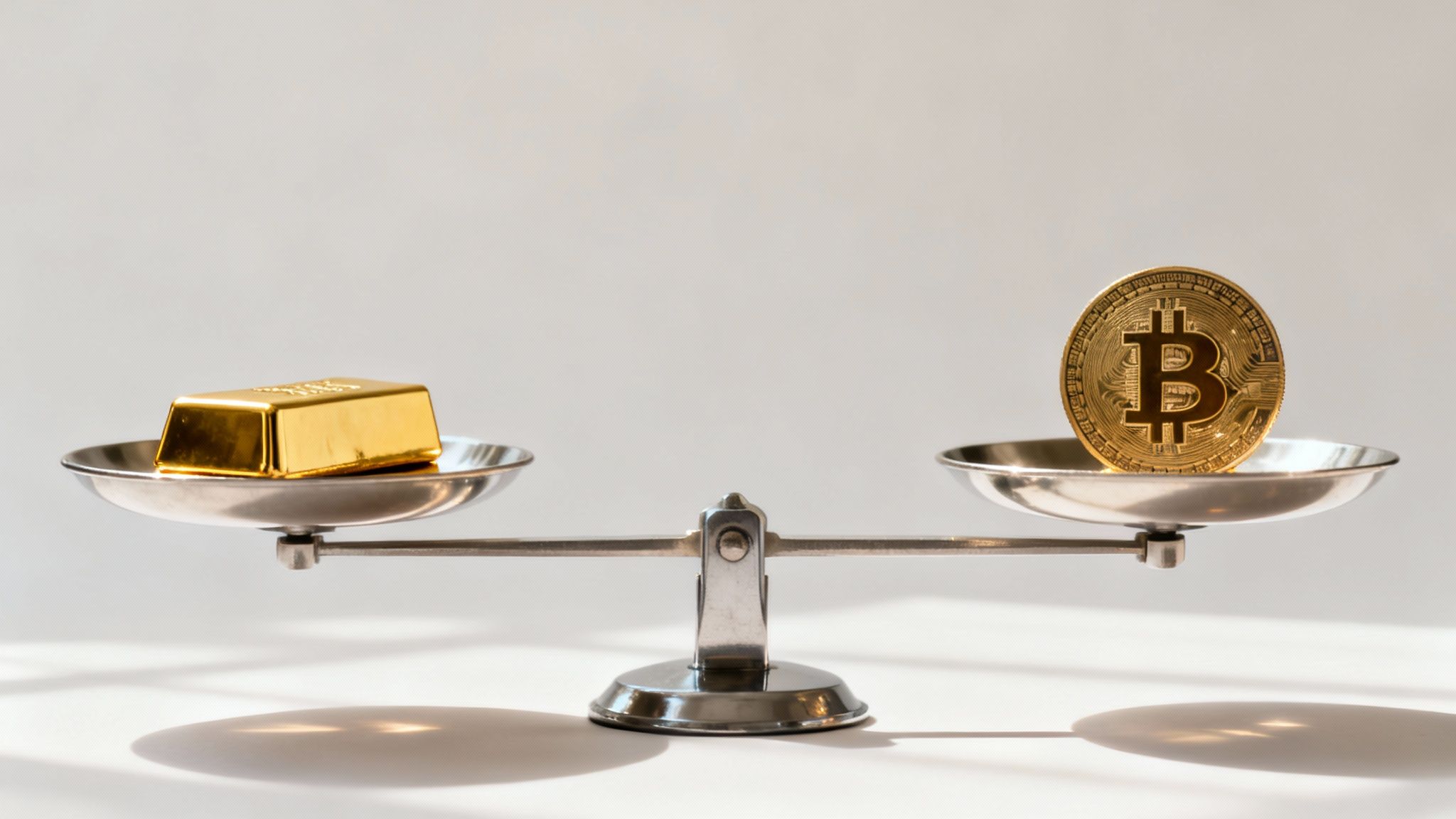
For many, buying gold with Bitcoin isn't about "cashing out." It's a deliberate wealth preservation play—a strategic move to diversify a digital-first portfolio with the world's oldest and most trusted store of value.
This isn't about choosing sides in a Bitcoin vs. Gold debate. It's about creating a powerful synergy between two completely different asset classes.
Bitcoin is famous for its explosive growth potential, but that comes with some serious price swings. Gold, on the other hand, has a multi-millennia track record as a stable hedge against inflation and economic chaos. By converting some Bitcoin profits into gold, you can lock in those gains and dial down your portfolio's overall volatility.
It's a "best of both worlds" approach:
- Bitcoin gives you incredible potential for high returns and a modern, decentralized asset.
- Gold provides a time-tested anchor, offering stability and a physical hedge that exists completely outside the digital world.
This rebalancing act is a smart way to protect your wealth while still staying in the game for future growth in the Bitcoin market. To better understand their distinct roles, let's compare them side-by-side.
Bitcoin vs Gold A Quick Comparison for Investors
The table below breaks down the core differences between Bitcoin and gold, highlighting why an investor might choose to trade one for the other depending on their goals.
| Characteristic | Bitcoin | Gold |
|---|---|---|
| Asset Class | Decentralized digital currency | Physical commodity and precious metal |
| Scarcity | Provably finite with a 21 million coin supply cap | Naturally scarce, but total supply is unknown |
| Volatility | High, prone to rapid price fluctuations | Low, known for its price stability |
| Primary Use Case | Growth, speculation, and medium of exchange | Wealth preservation, inflation hedge, and store of value |
| Portability | Extremely high; can be sent globally in minutes | Low; physical, requires secure transport and storage |
| History | A little over a decade old | Thousands of years as a trusted store of value |
| Regulation | Evolving regulatory landscape, varies by country | Well-established global market with clear regulations |
| Divisibility | Highly divisible (down to 100 millionth of a coin) | Divisible into bars and coins, but less granular than Bitcoin |
| Counterparty Risk | Low, if self-custodied | Low for physical holdings; can exist with paper gold (ETFs, futures) |
Each asset clearly has its own strengths. Bitcoin offers unparalleled digital efficiency and growth potential, while gold brings unmatched historical stability and a physical presence.
The Appeal of Tangible Stability
When the market gets chaotic, there's something uniquely comforting about holding a physical asset. A gold bar or coin is a real, tangible possession, offering a sense of security that purely digital assets just can't match.
We saw this dynamic play out perfectly during the market turmoil of October 2025. After news broke of new U.S.-China tariff threats, the broader market experienced its largest liquidation event on record, with approximately $19 billion in forced unwinds. Bitcoin's price plummeted from a high of $126,000 to around $104,800 in just five days.
During that exact same period, gold did what it always does—it acted as a safe haven, climbing to over $4,000 per ounce as investors fled to stability. That event really hammered home how using Bitcoin to buy gold is becoming a key strategy for both institutional and retail investors. You can learn more about how these assets reacted during the 2025 market crash.
By converting Bitcoin to gold, you are essentially trading digital scarcity for physical scarcity. It’s a method of turning on-chain value into a tangible asset that has preserved wealth through empires, wars, and currency collapses.
This isn't just about hedging your bets; it's smart asset allocation. The ability to use Bitcoin to buy gold creates a seamless bridge from a high-growth, high-risk asset to a low-volatility, time-tested one.
A Forward-Thinking Financial Strategy
Ultimately, the decision to buy gold with Bitcoin is a forward-thinking move that plays to the unique strengths of both assets. Think of it this way: Bitcoin is an incredible engine for wealth creation, while gold is the ultimate tool for wealth preservation.
Pairing them allows you to capture the massive upside of digital finance while grounding your portfolio in an asset with unmatched historical resilience. As the market continues to evolve, this blended approach is quickly becoming the hallmark of a truly robust and well-rounded investment strategy.
How to Actually Buy Gold With Bitcoin: Picking Your Path
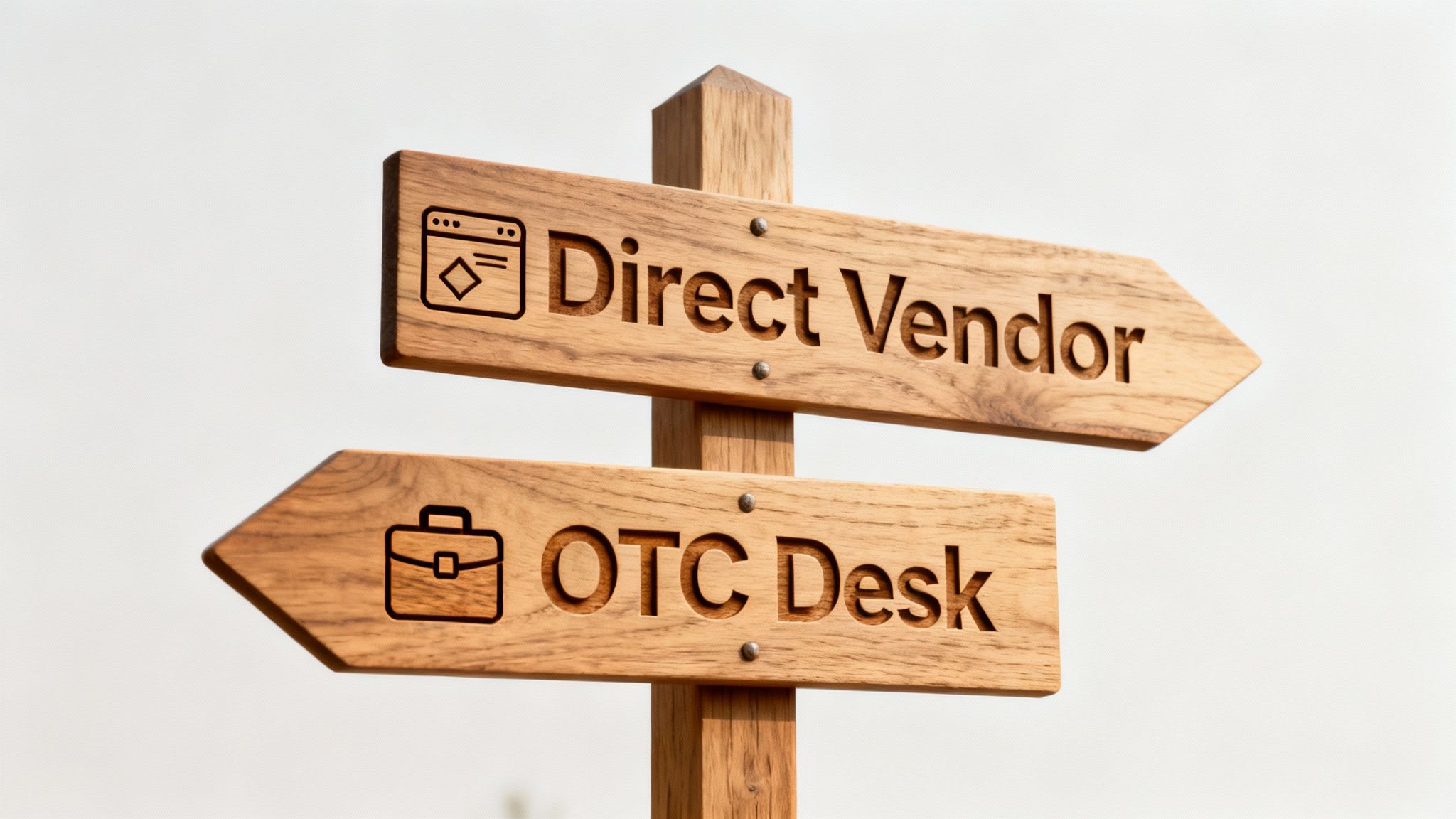
Okay, so you're ready to trade some of your digital gold for the real thing. The next big decision is how you're going to do it. The right path really boils down to how much you're buying, how much privacy you need, and how fast you want the deal done.
You've basically got two main routes: going through a direct Bitcoin-to-gold vendor or working with a specialized Over-the-Counter (OTC) desk. They serve very different needs, and knowing which one is for you is the key to a smooth transaction. Let's dig into what each looks like in practice.
Using Direct Bitcoin to Gold Vendors
This is the most well-trodden path for good reason. Direct vendors are simply online precious metals dealers who have added a "Pay with Bitcoin" button to their checkout. It's the go-to method for anyone looking to turn small or medium amounts of Bitcoin into physical gold.
The experience is a lot like any other online shopping trip. You find the gold bars or coins you want, pop them in your cart, and head to checkout. Instead of pulling out a credit card, you select Bitcoin. The site will then generate a payment request with a QR code and a BTC address, giving you a short window to send the exact amount from your wallet.
It’s convenient and about as simple as it gets. But you need to pay attention to the pricing. Most vendors will have a premium baked into the spot price of gold, and some might add a small processing fee for the Bitcoin transaction itself.
- Best For: Folks making regular, smaller buys—maybe a few ounces at a time.
- Transaction Speed: The gold price is usually locked in for a 10-15 minute window to sidestep any wild price swings while you're paying. The actual gold, of course, will take a few days or weeks to get to you.
- Security: Your main job here is vetting the dealer. Stick with established names that have been around for years, have solid public reviews, and are crystal clear about their shipping and insurance policies.
A quick pro tip: Always, always double-check the final Bitcoin amount on the payment page before you hit send. A simple typo can be an expensive mistake. Confirm the details on their site match what your wallet is showing.
This direct route is perfect if you want to dollar-cost average into gold using your Bitcoin. For instance, you could set a goal to convert 0.01 BTC into a specific coin every month, a strategy these platforms make incredibly easy to execute.
Leveraging Over The Counter (OTC) Desks
Now, if you're talking about a serious purchase—think kilograms of gold, not grams—an Over-the-Counter (OTC) desk is where you need to be. This is a private, white-glove service that happens directly between you and a dealer, completely off the public market. It's for high-net-worth individuals and institutions for a reason.
This approach solves some major problems for large trades. First off, it eliminates slippage. That’s when a huge buy order pushes the price up while it's being filled, costing you money. With an OTC desk, you negotiate a fixed price upfront, so a massive transaction doesn't move the market against you.
Second, the privacy and service are on another level. You get a dedicated person who walks you through everything, from negotiating the price to arranging secure, insured delivery or vaulting. When you're moving hundreds of thousands or millions of dollars, this kind of hands-on service is non-negotiable.
Here’s the typical flow for an OTC deal:
- Onboarding: You'll go through a more thorough KYC/AML process because of the large sums involved.
- Price Quote: You request a quote for the amount of gold you want, and the desk gives you a firm price based on the current market.
- Execution: Once you agree to the price, you send the Bitcoin to a secure wallet address they provide.
- Settlement: As soon as the BTC transaction confirms on-chain, the dealer arranges for the physical gold to be delivered or moved into a secure vault in your name.
While the percentage-based fees at an OTC desk are often lower than what you'd find at a retail vendor, they're structured as a small spread on the spot price. The biggest hurdle is the minimum transaction size, which often starts at $50,000 and can be much higher.
Putting Your Bitcoin to Work: Your First Gold Purchase
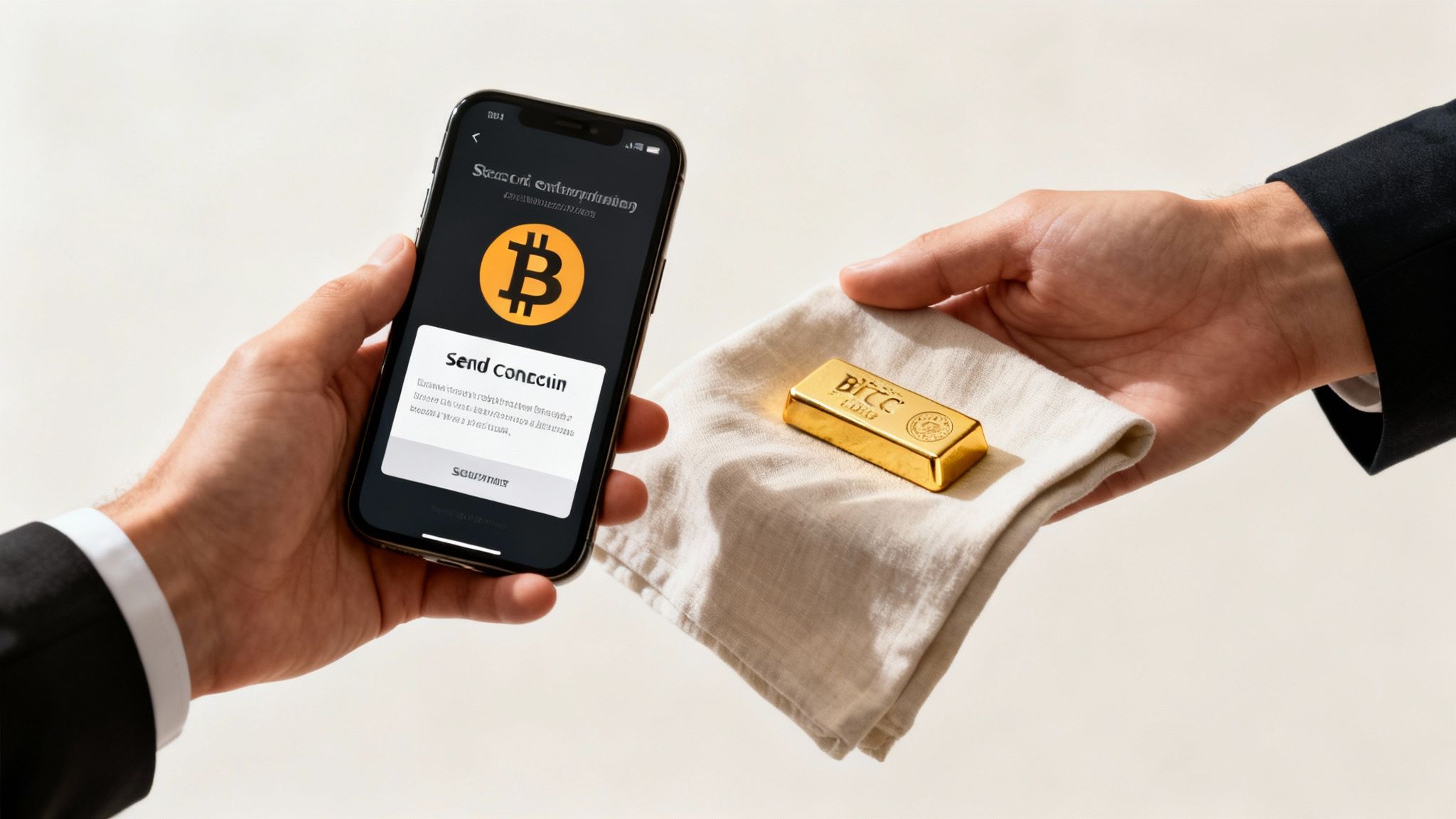
Alright, let's move from theory to action. Making that first move to buy gold with Bitcoin can feel like a big step, but it’s actually quite a smooth process once you know what to expect. We'll walk through a real-world example, focusing on a direct transaction with a vendor—the most common route for most people.
The idea here is to pull back the curtain on the entire process. From doing your homework on a dealer to actually sending Bitcoin from your wallet and getting that final confirmation, we'll cover the practical details that make for a safe and successful purchase.
Finding a Gold Dealer You Can Trust
Before a single satoshi leaves your wallet, your number one job is to make sure you're dealing with a legitimate, reputable precious metals vendor. This is, without a doubt, the most critical part of the whole thing. A flashy website means nothing; you need to dig deeper for signs of trust and a solid track record.
Here are a few checks I never skip:
- Reputation and Reviews: Look for dealers who have been around for a while and have a history of positive feedback on independent review sites. A quick search for their name plus words like "scam" or "complaint" can be very revealing.
- Transparent Pricing: A good vendor clearly shows their gold prices, including any premiums they charge over the spot price. They should also be upfront about shipping costs and insurance. No hidden fees.
- Real Contact Info: Do they have a physical address? A phone number that someone actually answers? Responsive customer support? Give them a call and see how they handle a few questions.
- Clear Bitcoin Policies: Read their terms for Bitcoin payments. Find out how they lock in the price, how long you have to pay, and what their refund policy looks like for crypto.
Cutting corners on this initial research is the fastest way to lose your money. A few minutes of due diligence now can save you a world of pain later.
Locking in Your Price
Once you’ve picked your dealer and the gold bars or coins you want, you head to checkout. This is where things get time-sensitive. Because the prices of both gold and Bitcoin are always on the move, dealers give you a short "payment window" to lock in your price—usually about 10 to 15 minutes.
During this window, the deal is set. The amount of gold you're getting and the exact amount of BTC you need to send are fixed. This protects both you and the dealer from any wild market swings. If you don't send the payment in time, the order typically expires, and you'll have to start over with a new quote.
The price lock-in is a critical feature. It ensures you know precisely what you’re paying and what you’re getting, removing guesswork from the transaction. Always be prepared to send your payment promptly after initiating the order.
Making the Bitcoin Payment
With your price locked, the dealer will show you the payment details. You'll usually see a QR code you can scan with a mobile wallet and a full Bitcoin address you can copy.
From your side, the process is simple:
- Open your Bitcoin wallet.
- Start a "Send" transaction.
- Enter the dealer's details. Either scan the QR code or carefully copy and paste the vendor’s Bitcoin address. Never, ever type an address by hand.
- Input the exact BTC amount shown on the invoice. Sending too little can cause the order to fail, while sending too much is a hassle to get back.
- Double-check everything one last time—the address and the amount—before you hit send.
This is becoming an increasingly familiar workflow for many. The 2025 Bitcoin market hit an unprecedented scale, with its total market cap blowing past the $4 trillion mark. As Bitcoin surged to an all-time high over $126,000, mainstream investors took notice, and the number of Bitcoin mobile wallet users jumped by 20% from the year before. You can dive deeper into the state of crypto adoption in the 2025 report.
Network Fees and Confirmations
The moment you hit send, your transaction is broadcast to the Bitcoin network. Now, two things come into play: network fees and confirmation times.
The network fee (or "miner fee") is a tiny bit of BTC you include to encourage miners to process your transaction quickly. Most modern wallets suggest a good fee based on how busy the network is. For a time-sensitive payment like this, it's smart to accept the standard or priority fee to avoid delays.
Next, the transaction has to be confirmed on the blockchain. Most gold dealers wait for a certain number of confirmations—usually between one and six—before they officially mark the payment as complete. This can take anywhere from ten minutes to over an hour, all depending on network traffic. You can watch its progress yourself using a public block explorer by just pasting in the transaction ID.
Once the required confirmations are in, the dealer will process your order and get your gold ready for shipment or storage. You'll get a final confirmation email, and that’s it. You've officially turned your Bitcoin into gold.
How to Securely Store Your Physical Gold
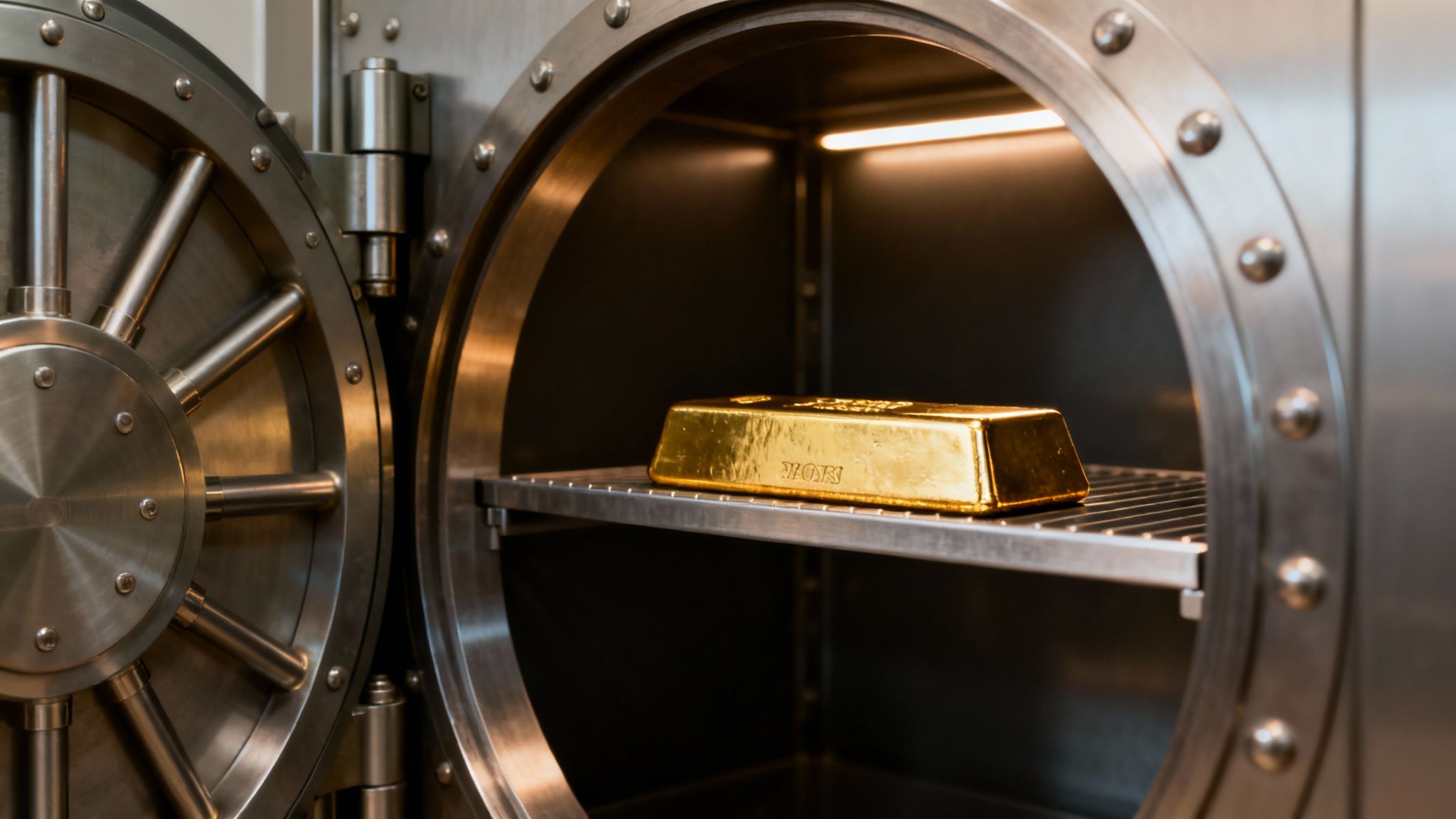
Getting your hands on physical gold using Bitcoin is a huge win, but it's only half the job. Now you're holding a real, tangible asset that demands serious protection. Figuring out where to keep your gold is just as critical as the purchase itself—your choice will define its security, how easily you can access it, and ultimately, your peace of mind.
You've got three main paths to consider: professional vaulting, a bank safe deposit box, or storing it at home. Each has its own set of trade-offs between security, cost, and convenience. The right answer for you really boils down to how much gold you have and what level of risk you're comfortable with.
Professional Vaulting Services
If you're dealing with a significant amount of gold, a professional, non-bank vault is the undisputed champion of security. These aren't just strong rooms; they're purpose-built fortresses designed specifically for precious metals, with security protocols that are light-years ahead of anything you could set up yourself. For serious investors, this is the go-to for institutional-grade protection.
As you look into vaulting, you’ll come across two main types of storage:
- Allocated Storage: This means your gold is held in a shared, insured pool alongside other clients' holdings. You own a specific amount of gold, but not a particular, identifiable bar or coin.
- Segregated Storage: This is the premium service. Your gold is kept completely separate from everyone else's, often in its own sealed container. The exact bars you put in are the exact ones you'll get out.
While both are incredibly secure, segregated storage gives you that final layer of assurance. You know your specific assets are accounted for, which is a big deal if you're storing large quantities or uniquely marked pieces.
Think of a professional vault as a complete custody solution, not just a storage locker. They handle detailed audits, provide robust insurance, and manage secure logistics, making them the perfect fit for anyone protecting significant wealth in physical gold.
Bank Safe Deposit Boxes and Home Storage
A classic bank safe deposit box is an option many people know. It's relatively inexpensive, private, and offers a decent level of security against most common threats. But you need to be aware of some major drawbacks.
For one, you can only get to your gold during banking hours, which isn't always convenient. More importantly, and this is the big one: the contents of a safe deposit box are not insured by the FDIC or the bank itself. If there's a robbery or a fire, you're on your own. You'd need to get a separate, specialized insurance policy to cover what's inside.
Then there's home storage. It's the most direct route, giving you 24/7 access to your assets. For a small amount of gold, a high-quality, fire-rated safe that's bolted to the floor can work. The downside is pretty obvious, though—you bear all the responsibility for security, which can make your home a target. Getting insurance for gold stored at home can also get pricey and difficult for larger amounts.
Making the Right Choice
Deciding on the best storage method really comes down to your personal situation. To help you weigh the options, I've put together a quick breakdown of the pros and cons for each.
Gold Storage Options Pros and Cons
Choosing a storage method is a balance between security, cost, and accessibility. This table compares the most common options to help you find the right fit for your gold holdings.
| Storage Method | Best For | Pros | Cons |
|---|---|---|---|
| Professional Vault | Large holdings; maximum security | Fully insured; audited; segregated options; highest level of security | Higher cost; less immediate access |
| Bank Safe Deposit Box | Small to moderate holdings; convenience | Low cost; secure from most threats; private | Not insured by the bank; limited access; not ideal for large amounts |
| Home Storage | Small holdings; immediate access | No fees; direct control and 24/7 access | Puts you at risk of theft; insurance can be costly; limited security |
Ultimately, the goal is to secure your investment in a way that lets you sleep at night.
When it comes to insuring your gold, especially if you opt for home or bank storage, stick with established institutions. You can find examples from Reputable Insurance Providers that specialize in covering high-value assets. Before signing on with any storage provider, ask them the tough questions. Dig into their security protocols, the fine print of their insurance coverage, their audit processes, and all the fees involved. A little due diligence now will ensure your new asset stays safe for years to come.

Navigating Tax and Compliance
Trading some of your Bitcoin for gold is a classic diversification strategy, but it’s absolutely critical to get the financial and legal side of things right. Here's the deal: when you buy gold with Bitcoin, it's almost always considered a taxable event. This isn't just a simple swap; it's a transaction that tax authorities are watching.
Think of it this way: regulators like the IRS see Bitcoin as property, not as cash. So, when you use it to buy anything—a cup of coffee or a gold bar—you're technically "disposing" of that property. That disposal is what triggers a potential capital gain or loss, all depending on how Bitcoin's price has moved since you first got it.
For example, say you bought some Bitcoin for $2,000. Later, you use that same Bitcoin to buy a gold coin, but by then, its value has shot up to $10,000. In that moment, you've realized an $8,000 capital gain. You'll owe tax on that profit, even though no dollars ever touched your bank account.
Good Records Are Your Best Friend
To stay on the right side of the law, meticulous record-keeping isn't just a good habit—it's essential. Without it, calculating what you owe becomes a messy guessing game, and that's the kind of thing that can lead to costly mistakes or an unwanted audit.
For every single trade, you need to track:
- Cost Basis of Your Bitcoin: What you originally paid for the Bitcoin you're spending.
- Acquisition Date: The date you first bought that specific Bitcoin.
- Transaction Date: The exact day you traded the Bitcoin for gold.
- Fair Market Value: The value of your Bitcoin (in your local currency) at the precise moment of the transaction.
Keeping this data in a dedicated spreadsheet or using a specialized tax software will make your life infinitely easier come tax season.
The main principle is simple: every time you spend Bitcoin, you're creating a reportable event. The smartest approach is to treat these transactions with the same seriousness as selling stocks to stay compliant and avoid future headaches.
Why KYC and AML Matter
When you transact with a legitimate, reputable gold dealer, expect to go through Know Your Customer (KYC) and Anti-Money Laundering (AML) checks. Yes, this means handing over your ID and other personal details. It might feel at odds with Bitcoin's privacy-centric roots, but for regulated dealers, it's a non-negotiable legal requirement.
These rules exist to stamp out illicit finance and protect the integrity of the financial system. If you find a dealer who doesn't ask for KYC, that's a massive red flag. It likely means they're operating outside the law. Sharing your information with a trusted dealer is just a standard part of doing things securely and legally.
The connection between digital assets and physical reserves is only growing stronger. In a major market shift, stablecoin issuer Tether became a huge gold buyer in 2025, with its acquisitions making up about 12% of all central bank gold buying for the year. This just goes to show how even the biggest players in the digital asset space must play by the rules when they deal in traditional assets like gold. You can read more about this trend and what it means for the market here.
Ultimately, figuring out the tax and compliance side is a crucial part of the process. Your best bet is to always talk to a qualified tax professional who really understands both Bitcoin and commodities to get advice that fits your specific situation.
Common Questions About Buying Gold With Bitcoin
Diving into the world where precious metals meet digital currency naturally brings up a lot of questions. Before you pull the trigger to buy gold with Bitcoin, getting solid answers is key to feeling confident and making sure your transaction is secure. This section is designed to tackle the most common things people ask.
Think of it as your quick-reference guide. We'll cut through the confusion around fees, how to spot a credible dealer, and the crucial differences between holding physical bullion in your hand versus owning a digital token that just represents gold.
Is Buying Gold With Bitcoin Anonymous
This is probably one of the biggest myths, born out of Bitcoin's early, wild-west days. While Bitcoin transactions are pseudonymous, they are absolutely not anonymous.
Every single transaction is etched permanently onto the public blockchain. This means, with enough effort, it can be traced.
More importantly, any legitimate gold dealer you buy from is legally required to run you through a Know Your Customer (KYC) process. You'll have to provide identification to comply with Anti-Money Laundering (AML) regulations. So, even though you're paying with a decentralized currency like Bitcoin, the purchase itself is a regulated, documented transaction. It's not off the books.
How Do I Know if a Gold Dealer Is Trustworthy
This is the single most important part of the whole process. Seriously. Vetting your dealer is the foundation of a safe purchase. A great deal from a shady vendor isn't a great deal at all.
Here's what I look for to signal a reputable dealer:
- A Long-Standing History: Have they been around the block? Look for companies that have been operating for several years, not just a few months. A solid track record usually means they have a history of happy, repeat customers.
- Transparent Pricing: A legit dealer won't hide their numbers. They'll clearly show their premiums over the spot price of gold and spell out any extra fees for shipping and insurance. There shouldn't be any nasty surprises waiting for you at checkout.
- Public Reviews: Scour independent review sites and forums. A stream of positive feedback is obviously a good sign, but also look at how a company handles negative reviews. Do they engage professionally or get defensive?
- Professional Accreditations: Check if the dealer is a member of respected industry groups. These organizations often require members to stick to a strict code of ethics, which adds another layer of trust.
When in doubt, just pick up the phone. A real, human conversation with someone who knows their stuff can tell you volumes about a company’s professionalism. If you can't get a person on the line easily, that’s a big red flag for me.
What Are the Typical Fees Involved
When you buy gold with Bitcoin, the costs you'll encounter fall into a few different buckets. Knowing what they are ahead of time helps you figure out your total investment accurately.
First up is the dealer's premium. This is their markup over the "spot price" of gold, covering their costs for sourcing, verifying, and selling the metal. Premiums aren't fixed; they can change based on what you're buying (coins usually have higher premiums than bars) and how much you're buying.
Next, you've got Bitcoin network fees. This is a small fee you pay to the miners who process your transaction and add it to the blockchain. Most wallets will suggest a fee for you, but my advice for a time-sensitive purchase like this is not to cheap out. Choosing the lowest fee can lead to long delays.
Finally, there are the shipping and insurance costs. Your physical gold has to be securely transported to you or your vault. This isn't something to skimp on—it's what protects your new asset while it's on its way to you.
Physical Gold or Gold-Backed Tokens What Is the Difference
It's absolutely critical to understand the distinction here. While both give you exposure to the price of gold, they are fundamentally different assets with different risk profiles.
Owning physical gold means you have the actual, tangible asset in your possession. You can hold it in your hand. It exists completely outside the digital and financial systems, which is the whole point for many investors. It offers a unique kind of security and gives you 100% control. It's a true bearer asset—if you hold it, you own it, period. For a deeper look into the financial side, including how capital gains tax works with physical gold, this A Guide to Investing in Gold Coins UK is an excellent resource that breaks down a lot of the details.
A gold-backed token, on the other hand, is a digital IOU. It's a claim on a piece of gold held by a third-party custodian somewhere. You own a digital representation, not the metal itself. While this makes it easy to trade, it introduces counterparty risk. You're placing your trust in the issuer—trusting that they actually have the gold they claim to and that they'll let you redeem your token for the real thing if you ever decide to.
For anyone looking to truly hedge against the risks of the digital and financial worlds, physical gold remains the classic, most direct way to do it.
Ready to accept Bitcoin payments at your own business? With Flash, you can integrate secure, wallet-to-wallet Bitcoin payments in under a minute. Eliminate intermediaries, reduce fees, and connect with millions of Bitcoin users worldwide. Get started today at .