Of course you can buy things with Bitcoin. But let's be real—it's not quite as simple as swiping your Visa just yet.
Think of it like using a foreign currency on vacation. Sometimes, you can pay a shopkeeper directly. Other times, you need to find an exchange first. Bitcoin works in a similar way.
Yes, You Can Buy Things With Bitcoin—But It's Nuanced
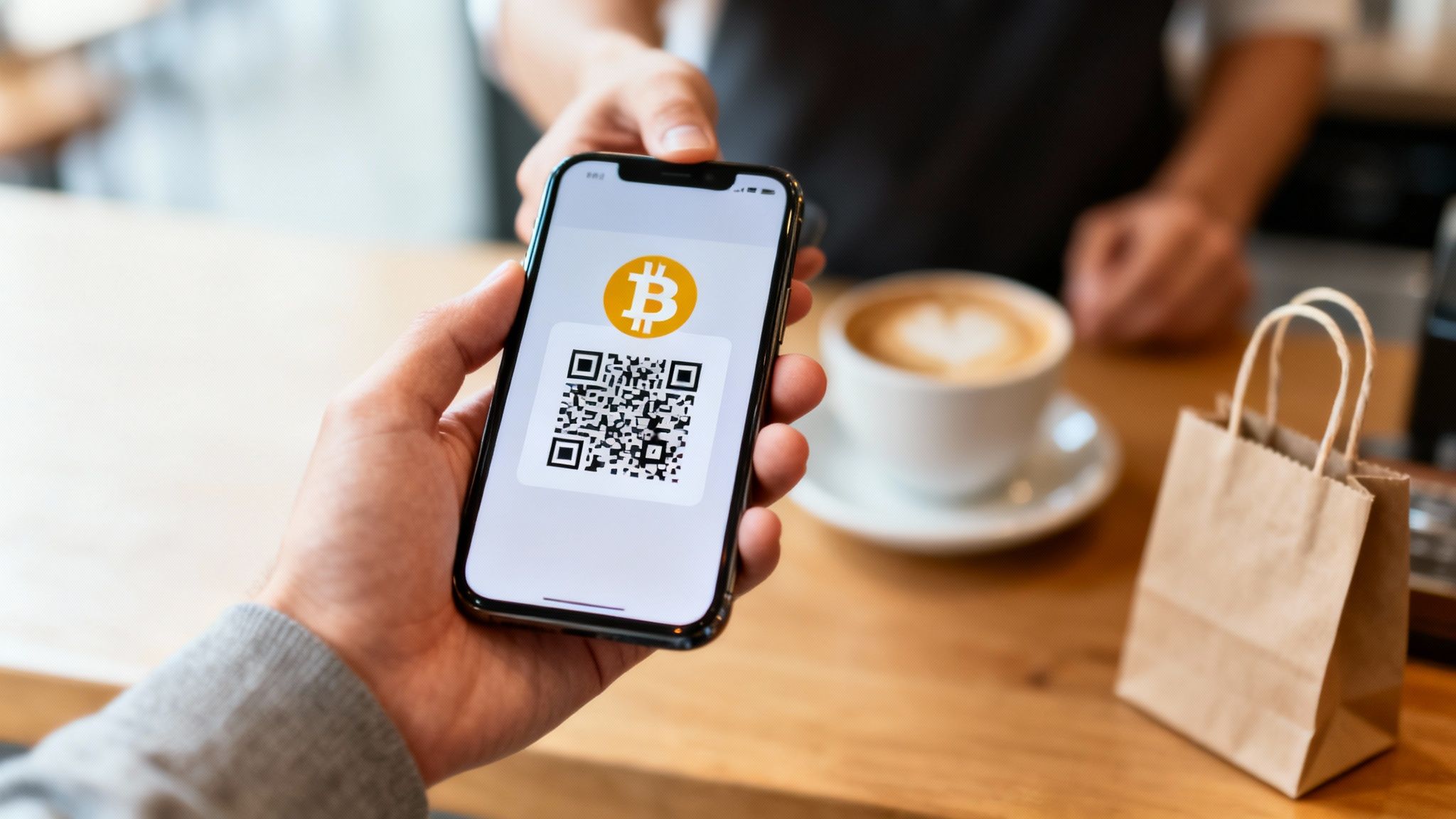
Using Bitcoin for your morning coffee or a new laptop is a real thing, though the world is still catching up. Instead of one single "right way" to pay, you have a few different options. Each one offers a different experience, depending on whether you value convenience, privacy, or pure, peer-to-peer ideals.
For the purists, a direct wallet-to-wallet transaction is the gold standard. This is the digital equivalent of a cash handshake. You send Bitcoin from your wallet straight to the merchant's, with no middleman. It's the original vision, and you'll find plenty of forward-thinking businesses and online stores that embrace it for its low fees and censorship resistance.
Then you have the bridges—third-party services that connect the Bitcoin network to the traditional financial world. With these, you might pay an invoice in Bitcoin, but the merchant gets paid in dollars or euros. This approach blows the doors open on where you can spend your BTC, since the business doesn't have to deal with the complexities of holding a digital asset.
The Current State of Bitcoin Commerce
So, what does spending Bitcoin look like today? It’s a mix of direct adoption and some pretty clever workarounds. While you probably can't use BTC at every corner store just yet, the rails are being laid, and fast. This growth is fueled by some serious money moving through the ecosystem.
Bitcoin is the undisputed king of on-ramps in the digital currency world, with over $1.2 trillion in fiat flowing into it over a recent 12-month period. All that liquidity is what powers the payment services making it possible to spend your BTC.
This level of activity shows that everyone from individual investors to big institutions is interested, which helps build a solid foundation for payment networks. Still, getting merchants to accept it directly is an uneven process. A recent global survey found that while crypto ownership is on the rise—nearly one in four people hold digital assets in some markets—that doesn't automatically mean stores are ready to accept it. You can dive deeper into the complexities of global adoption in Chainalysis's latest report.
Bitcoin Payment Methods At A Glance
To make sense of it all, it helps to break down the primary ways you can spend your Bitcoin. Each method serves a different purpose, whether you're buying a coffee or paying a contractor.
Here's a quick summary of the main payment channels available today.
| Payment Method | How It Works | Best For |
|---|---|---|
| Direct Wallet-to-Wallet | You scan a QR code or copy an address to send BTC directly from your wallet to the merchant's. | Online stores, freelance payments, and businesses that actively support Bitcoin. |
| Payment Processors | A service like BitPay or Flash converts your BTC to fiat for the merchant at the point of sale. | Mainstream retail and e-commerce where the business wants dollars but you want to pay with Bitcoin. |
| Bitcoin Debit Cards | A card provider lets you preload your card with Bitcoin, which is then converted to fiat currency whenever you swipe or tap. | Everyday in-person purchases at any store that accepts standard debit/credit cards. |
| Peer-to-Peer (P2P) Marketplaces | You find someone willing to sell a good, service, or gift card in exchange for your Bitcoin. | Niche purchases, gift cards for popular retailers, and services where both parties are comfortable with BTC. |
This table gives you a bird's-eye view, but the best method always depends on the situation. Choosing the right one is about balancing your needs for speed, cost, and privacy.
Why The Way You Pay Matters
Understanding these different paths is crucial because each one comes with its own trade-offs in speed, fees, and privacy. A direct, on-chain payment is very different from a lightning-fast layer-2 transaction or using a custodial debit card.
As we dig into how each of these methods works, you'll get a clear picture of the pros and cons, helping you decide which route makes the most sense for the purchase you want to make.
How Bitcoin Payments Actually Work
So, you've decided to actually spend some Bitcoin. But what really happens when you tap "send" on your phone? Let's skip the dense technical manuals and break it down. The whole process is far more intuitive than you’d think.
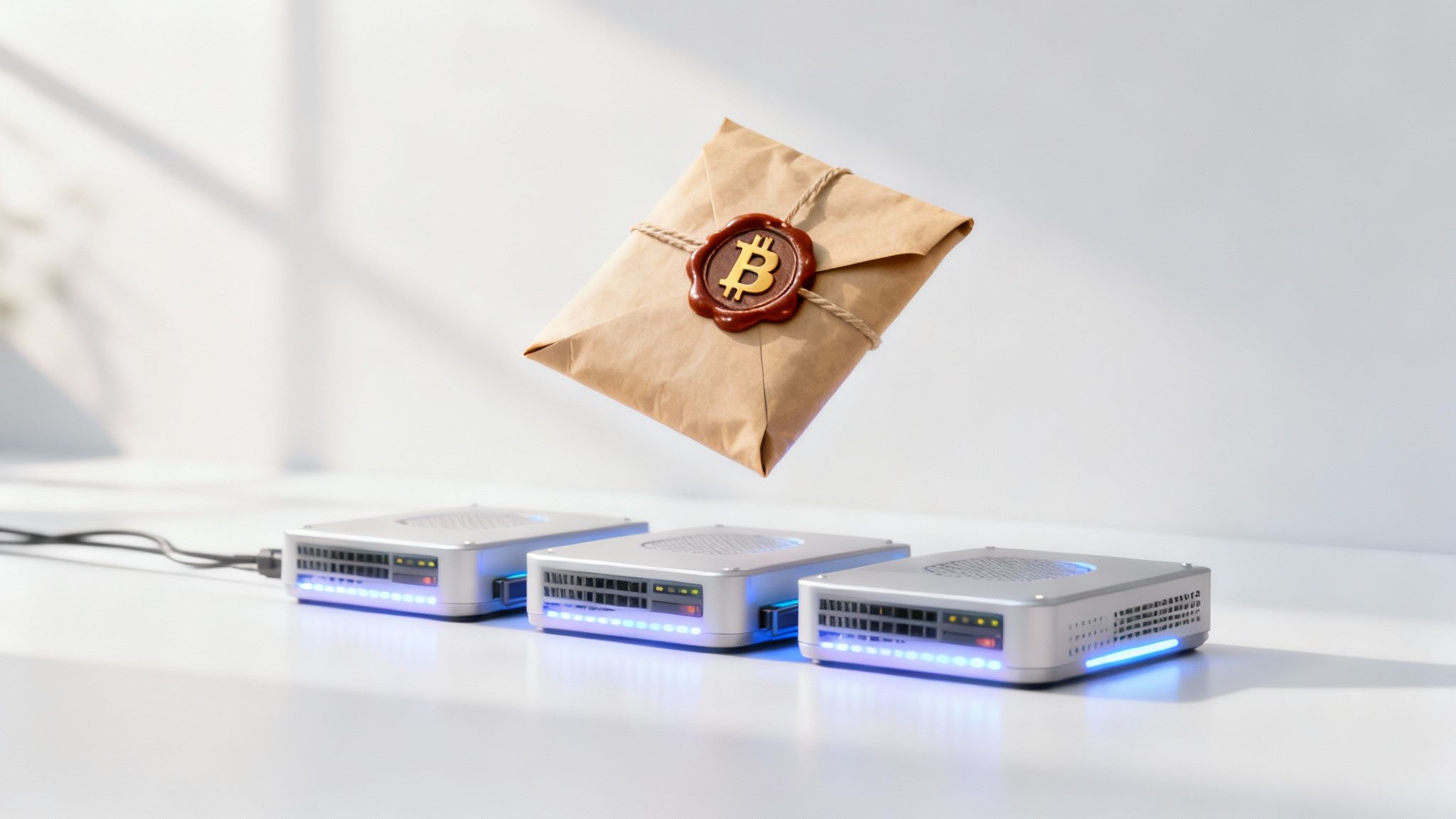
Think of it like sending a high-security package. To get it there, you need two critical pieces of information: the destination address and a special key to seal the box so no one can tamper with it. Bitcoin works in a surprisingly similar way.
The Secure Package Analogy
Your Bitcoin wallet acts as your personal, digital post office. It’s where you hold your funds and create these "packages"—or transactions—to send to others. Every transaction you build has a couple of vital components.
- The Destination (Wallet Address): This is just a long string of letters and numbers. Most of the time, you'll see it as a scannable QR code to avoid typos. It’s the digital equivalent of a mailing address, telling the network exactly where to send the funds.
- The Seal (Private Key): This is your secret. It's a cryptographic key that your wallet uses to digitally "sign" the transaction when you authorize a payment. This signature is mathematical proof that you—and only you—approved this specific transaction.
That digital signature is what makes Bitcoin so secure. It's mathematically impossible to forge, which means nobody can spend your Bitcoin without your permission.
Verification By The Global Network
Once you send your signed "package," it doesn't just zap directly to the recipient. Instead, it gets broadcast to a massive, worldwide network of computers called miners. You can think of these miners as the diligent, decentralized postal workers of the Bitcoin network.
Their job is to grab a bunch of recent transactions, verify that each one is legitimate, and bundle them together into a "block." They all compete to solve a complex math puzzle, and whoever solves it first gets to add their block to Bitcoin's official public ledger, the blockchain.
This is what makes Bitcoin transactions unstoppable and uncensorable. Once a transaction gets confirmed in a block, it's permanently etched into the blockchain. No bank, government, or single person can ever alter or reverse it.
This shared, permanent record is what gives everyone trust in the system. The merchant knows the payment is final, and you have an unchangeable record of the transfer.
On-Chain vs. Lightning Network Payments
When you get down to actually buying things with Bitcoin, you'll run into two main ways to pay. Knowing the difference helps you pick the right tool for the job.
A standard on-chain transaction is the "secure package" we just walked through. It’s recorded directly on the main Bitcoin blockchain. This makes it incredibly secure but also a bit slow and more expensive, especially if the network is busy. It's the perfect method for large, high-stakes payments where security is everything.
But what about buying a cup of coffee? Waiting ten minutes and paying a few dollars in fees just doesn’t make sense. That’s exactly what the Lightning Network was built to solve.
- Lightning Network Payments are Instant: We're talking seconds, not minutes.
- Fees are Extremely Low: Usually just a fraction of a cent.
The best way to picture the Lightning Network is as a high-speed express lane built on top of the main Bitcoin highway. It handles tons of small payments instantly by settling them "off" the main chain. This makes Bitcoin practical for everyday commerce. Modern wallets and payment providers, like Flash, are designed to use Lightning seamlessly, giving you the security of Bitcoin with the speed you need for daily life.
The Pros And Cons Of Paying With Bitcoin
So, you're thinking about using Bitcoin to buy things. It’s a bit like choosing to drive an electric car instead of a gasoline one—both will get you where you’re going, but the experience, the costs, and the underlying principles are worlds apart. Making that switch requires understanding what you gain and what you give up.
On one hand, paying with Bitcoin can feel incredibly empowering. You get a level of control and privacy that's just not possible with the traditional banking system. On the other hand, it comes with its own set of quirks, like price swings and "no-take-backs" transactions that can be a surprise if you're not ready for them.
Let's dive in and get a real feel for both sides of the coin.
The Upside Of Using Bitcoin For Payments
The perks of spending Bitcoin go way beyond just being a novelty. They get to the very heart of what money can be: a tool for financial freedom, privacy, and truly global commerce.
You Are Your Own Bank: This is the big one. When you hold Bitcoin in your own wallet, you are in control, period. No bank can freeze your account because they don't like a transaction, and no government can confiscate your funds without getting their hands on your private keys. It's a level of financial sovereignty that’s hard to grasp until you experience it. Think about journalists or activists in restrictive countries who rely on Bitcoin to receive funds when their bank accounts are suddenly closed—for them, it’s not an abstract idea, it’s a lifeline.
Enhanced Privacy: Every time you swipe a credit card, you're handing over a bundle of personal data: your name, address, and card details. That information gets passed between the merchant and a whole chain of payment processors. Bitcoin transactions are different. They don't require you to reveal who you are. While the transaction itself is public on the blockchain, it isn't directly tied to your real-world identity, keeping your personal info shielded from the seller.
Lower International Fees: Ever tried sending money overseas with a wire transfer? It's often slow and painfully expensive, with various banks each taking a slice of the pie along the way. Bitcoin just bypasses that entire messy system. As a global, borderless network, the cost to send $10,000 to someone across the planet can be the same as sending $10. This makes it a game-changer for international business, sending money home to family, or paying freelancers anywhere in the world without getting hit with ridiculous fees.
The Challenges And Risks To Consider
While the advantages are compelling, using Bitcoin for payments isn't always a walk in the park. You have to be aware of some real-world hurdles before you start spending.
The biggest one for day-to-day use is price volatility. The value of Bitcoin can swing wildly, sometimes in the time it takes to grab a coffee.
Imagine you agree to buy a laptop for $1,000 in Bitcoin. By the time your payment confirms 10 minutes later, the market price of BTC might have dipped, meaning you actually paid $1,020. Or it could have jumped, and you ended up paying only $980. That's a headache for both you and the merchant.
This is exactly why many businesses use a service like Flash to instantly convert Bitcoin payments into their local currency. It completely sidesteps the price risk for them.
Another crucial point to understand is the finality of transactions.
Once a Bitcoin payment is sent, it's gone. There’s no customer service line to call, no dispute process, and definitely no chargebacks like you get with a credit card. If you send money to the wrong address by mistake or get tricked by a scammer, that Bitcoin is gone for good.
This makes Bitcoin incredibly secure for merchants fighting fraud, but it puts all the responsibility on you. Always, always double-check wallet addresses and make sure you're dealing with someone you trust.
Finally, while transaction fees are usually low, they can spike when the network gets busy. This can make small, everyday purchases like a cup of coffee impractical if you're paying on-chain. This is the very problem the Lightning Network was built to solve, allowing for instant, nearly free payments for exactly those kinds of small transactions.
Bitcoin Vs Credit Card Payments A Head-To-Head Comparison
To really see the differences in action, it helps to put Bitcoin and credit cards side-by-side. Each has its strengths and is built for a different purpose. One gives you ultimate control and privacy, while the other offers familiarity and consumer protections.
Here’s a direct comparison of how they stack up.
| Feature | Bitcoin | Credit Card |
|---|---|---|
| Control Over Funds | You hold the keys. No one can freeze or seize your funds without them. | The bank controls your account and can freeze it at their discretion. |
| Transaction Privacy | Pseudonymous. Your real-world identity is not tied to the transaction. | Your personal data (name, address) is shared with the merchant. |
| Reversibility | Irreversible. Transactions are final once confirmed on the blockchain. | Reversible. You can file a chargeback for fraud or disputes. |
| Global Access | Borderless. Anyone with an internet connection can send/receive. | Requires a bank account and is subject to regional banking rules. |
| Fees for Merchants | Typically very low (~1% or less with processors like Flash). | High (2-4% per transaction), plus monthly and other hidden fees. |
| Price Volatility | High. The value can change significantly in a short period. | Stable. Tied to a government-issued currency like the USD or EUR. |
| Settlement Time | Near-instant with Lightning, or 10-60 mins on-chain. | Can take 2-3 business days for the merchant to actually receive the funds. |
Choosing between Bitcoin and a credit card isn't about which one is "better" overall, but which one is the right tool for the job. For a quick, reversible purchase where you want buyer protection, a credit card is great. For a private, censorship-resistant, and low-fee global payment, Bitcoin is in a class of its own.
Alright, we've talked about the mechanics and the trade-offs. Now for the fun part: where can you actually spend your Bitcoin?
While you might not see a "Bitcoin Accepted Here" sign at every corner store just yet, the list of businesses happy to take your BTC is growing faster than you'd think. It's a mix of forward-thinking companies that accept it directly and some clever workarounds that open up millions of other shops.
From high-end electronics and your next vacation to a simple cup of coffee, spending Bitcoin is more practical than ever. You just have to know where to look.
Tech-Savvy Online Retailers
It probably won't surprise you that the first wave of merchants to jump on board came from the tech world. These online stores often serve a privacy-focused, tech-literate crowd, so accepting BTC at checkout just made sense.
You'll find a lot of direct Bitcoin acceptance in these niches:
- Electronics and Computer Hardware: Plenty of online shops selling custom-built PCs, components, and the latest gadgets will let you pay directly with Bitcoin.
- VPNs and Privacy Services: It's a natural fit. Companies selling digital privacy tools often prefer a payment method that aligns with their core values.
- Web Hosting and Domain Services: Paying for your domain name or server hosting with Bitcoin is now commonplace in the industry.
These merchants usually have a payment processor baked into their checkout, or they'll just show you a QR code. Scan it with your wallet, and you're done. Simple as that.
The World of Travel And Tourism
One of the most powerful use cases for Bitcoin is traveling the world. Think about it: no more currency conversion scams, ridiculous foreign transaction fees, or the anxiety of carrying wads of cash. A growing number of travel companies get this.
You can now book flights, hotels, and even full vacation packages with your Bitcoin. It’s a huge step forward that makes global travel cheaper and easier for anyone holding BTC.
The Ultimate Workaround: Gift Cards
What happens when your favorite store doesn’t take Bitcoin directly? Don’t worry, there’s a bridge for that: gift cards. Several trusted online services let you buy gift cards for hundreds of major brands using your Bitcoin.
This simple trick unlocks thousands of retailers that haven't integrated Bitcoin directly. You can grab a gift card for a big-box store, your go-to coffee chain, or a massive online marketplace and spend it just like cash.
Suddenly, you can use your Bitcoin for almost anything—from buying groceries to grabbing dinner out.
Finding Bitcoin-Friendly Businesses
Okay, so how do you track down these places, both online and in your neighborhood? While a universal "Bitcoin Accepted" sticker isn't a thing yet, a few tools can help you map out the scene.
- Online Merchant Directories: Websites and apps built to list businesses that take Bitcoin are your best bet. Most let you search by what you're looking for or where you are.
- Look for the Logo: When you're shopping online, scroll down to the footer of the website or check the payment page. Many e-commerce sites will proudly display the Bitcoin logo if they accept it.
- Local Bitcoin Meetups: In many cities, local Bitcoiners share intel on which shops, cafes, or restaurants have started accepting BTC. These grassroots movements are often the first sign of real-world adoption. In some towns, local champions have even sparked entire circular economies where dozens of businesses accept Bitcoin for daily goods.
As the ecosystem grows, finding places to spend your Bitcoin will only get easier. The key is to mix direct payments with smart tools like gift cards to cover all your bases.
A Merchant's Guide To Accepting Bitcoin
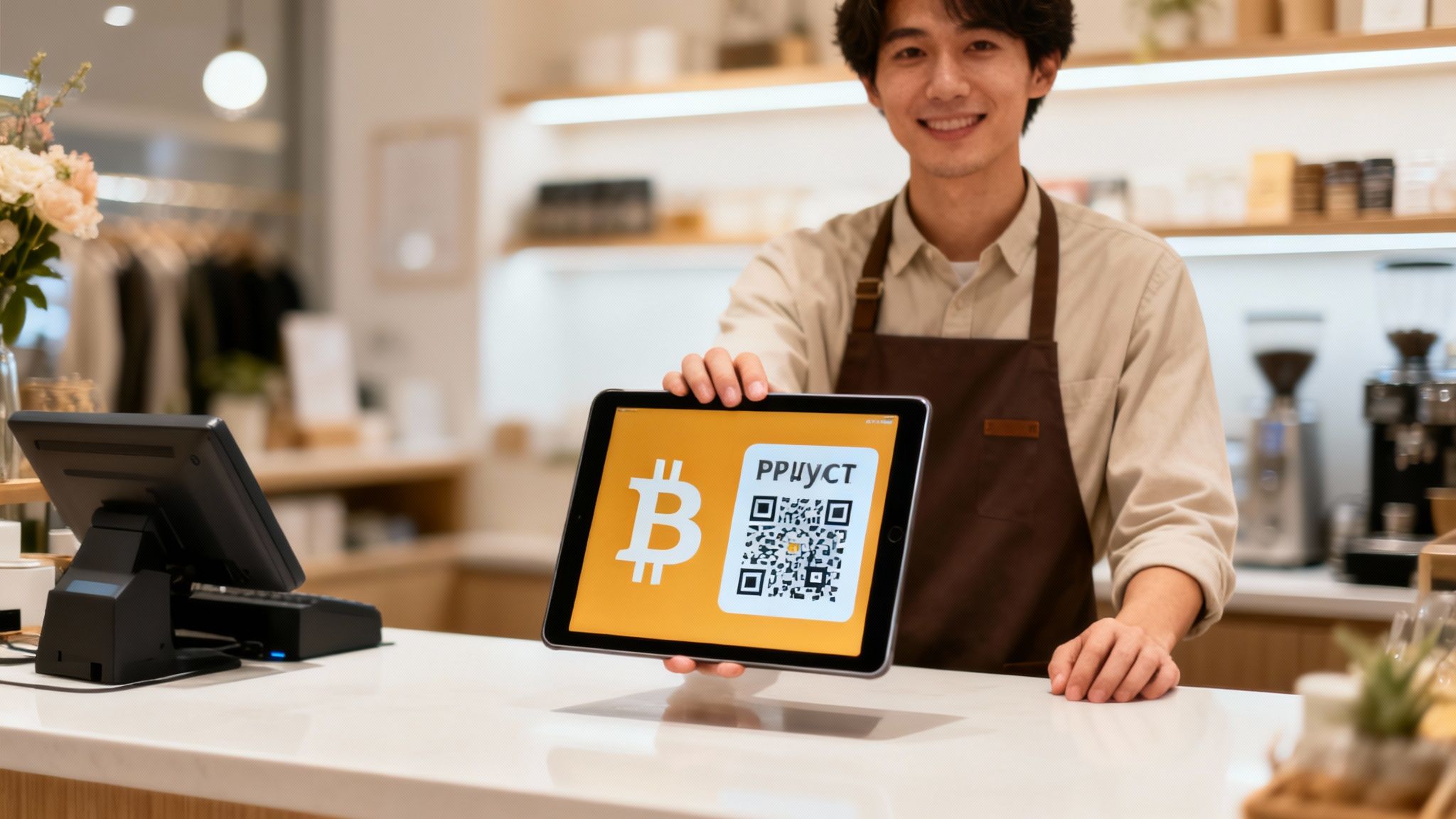
So, you're a business owner, and you keep hearing about Bitcoin. You see a real opportunity to connect with a new wave of tech-savvy customers, but let's be honest—the idea of handling a totally new kind of money can feel a bit intimidating.
The good news? It doesn't have to be complicated.
As a merchant, you face one fundamental choice: do you want to accept and hold Bitcoin yourself, or would you rather let customers pay with it but get good old U.S. dollars in your bank account? Each path has its own logic, and the right one for you comes down to your business model and your comfort with digital assets.
This guide will walk you through both options, giving you clear, business-focused advice to help you decide without taking on any unnecessary risks.
The Two Paths To Accepting Bitcoin
When a customer wants to buy something from your store with Bitcoin, that payment can go to one of two places: directly into a Bitcoin wallet that you control, or to a payment processor who handles the messy parts for you.
Getting this distinction is the first and most critical step.
- Direct Self-Custody: The Bitcoin lands directly in your wallet. You're in charge of keeping it safe, dealing with the price swings, and figuring out the accounting.
- Using a Payment Processor: A service steps in as the middleman. The customer pays in Bitcoin, and the processor instantly swaps it for your local currency (like USD or EUR) and sends it to your bank.
Let's break down what each of these really means for your day-to-day operations.
Option 1: Holding Bitcoin Yourself
Going this route means you're not just adding a new payment button to your checkout—you're adding a new asset to your company's balance sheet. This approach is a natural fit for businesses that truly believe in Bitcoin's long-term potential.
What are the upsides?
- No Intermediaries: Payments are genuinely peer-to-peer, moving from your customer's wallet straight to yours. It's the purest form of what Bitcoin was designed for.
- Potential for Appreciation: If Bitcoin's value climbs, the payments you collected could become worth a lot more over time.
- Lower Transaction Fees: Without a processor taking their cut, your costs on each sale can drop significantly.
But this path comes with some serious responsibilities.
The biggest challenge by far is price volatility. The Bitcoin you receive for a $100 sale might be worth $95 or $105 by the end of the day. This can create massive headaches for bookkeeping and managing your cash flow.
You're also 100% responsible for security. That means carefully protecting your private keys and knowing enough about wallet security to avoid theft or loss. And on top of that, the tax rules for holding a volatile asset can get tricky, often requiring an accountant who knows the space.
Option 2: Using A Bitcoin Payment Processor
For most businesses, the most practical way to start is with a Bitcoin payment processor. This approach lets you attract Bitcoin-spending customers without shouldering any of the risk that comes with holding a volatile asset. It's the "best of both worlds" solution.
Here’s how it usually works: at checkout, your customer chooses to pay with Bitcoin. They scan a QR code, and the processor does all the work. The service instantly converts their Bitcoin payment into your local currency at a locked-in exchange rate.
This method has some huge advantages for merchants:
- Zero Volatility Risk: You get the exact amount you charged, every single time. The processor eats all the risk from price swings.
- Simple Accounting: Since you only receive deposits in your native currency, your bookkeeping stays exactly the same. No need to track the ever-changing value of a digital asset.
- Easy Integration: Modern payment tools like Flash offer solutions you can set up in minutes. You can run a point-of-sale app on a tablet, add payment links to your website, or even manage recurring subscriptions with almost no technical work.
For any business ready to jump in, following a step-by-step guide to integrating payment gateways is a great way to ensure a smooth setup.
Making The Right Choice For Your Business
So, which path is yours? It all boils down to your goals and how much risk you're willing to take on.
If you’re a true believer in Bitcoin’s future and have the team to manage volatility and security, holding it yourself could be a powerful strategic move.
But for the vast majority of businesses that just want to open their doors to more customers and offer flexible payment options, a processor is the clear winner. It takes the biggest hurdles—volatility and complexity—off the table completely. This lets you confidently welcome a new generation of customers while keeping your finances stable and predictable.
The Future Of Bitcoin As A Payment Method
The old question—"can you buy things with bitcoin?"—is quickly becoming obsolete. The real question now is about practicality. Bitcoin's journey from a niche digital oddity to a potential global payment system is well underway, fueled by some key breakthroughs that tackle its biggest historical limitations.
Looking ahead, the landscape for Bitcoin commerce is set for a massive upgrade.
The single most important development is the explosive growth of the Lightning Network. Think of it as a high-speed express lane built on top of the main Bitcoin blockchain. It was engineered from the ground up to solve the two things that made Bitcoin clunky for everyday use: speed and cost.
Instead of waiting around for poky on-chain confirmations, Lightning payments are nearly instant and cost next to nothing—often just a fraction of a cent. This is what makes buying a coffee or paying for a subscription with Bitcoin not just a novelty, but genuinely practical.
The Role Of The Lightning Network
The Lightning Network isn't just a minor tweak; it's a complete game-changer for how Bitcoin functions day-to-day. By moving all the small, frequent payments off the main chain, it keeps the super-secure base layer free for large, important settlements. Meanwhile, everyone else gets a fluid, cheap payment experience.
This setup neatly solves the classic scalability problem. It opens the door for Bitcoin to handle a massive number of transactions without clogging up the network or sending fees to the moon. For merchants, it means a reliable and affordable payment option. For you and me, it means our Bitcoin becomes as useful as the cash in our pocket.
The Lightning Network's growth isn't random; it's a direct answer to the market's demand for faster, cheaper payments. Its capacity to handle transactions has been rocketing up, pointing to one clear trend: Bitcoin is becoming a real-deal medium of exchange for everyday stuff.
Evolving Regulations And Mainstream Integration
It's not just about the tech. The traditional financial world is finally starting to catch up. As regulatory frameworks around the globe become clearer, more banks and financial institutions are dipping their toes into Bitcoin services. This brings a whole new level of legitimacy and makes it much easier for regular people to get involved.
This integration smooths out the whole process. Businesses get trusted, simple ways to accept Bitcoin without needing a team of engineers, and consumers find it's no longer a huge hassle to manage and spend their digital assets.
This one-two punch of breakthrough technology like the Lightning Network and growing mainstream acceptance is paving a clear path forward. The future of buying things with Bitcoin looks faster, cheaper, and more accessible than ever, turning what was once a theoretical dream into a practical reality for global commerce.
Alright, here’s that section rewritten to sound like it was crafted by a human expert, following the style and tone of the examples provided.
A Few Common Questions About Spending Bitcoin
As you start thinking about using Bitcoin for everyday purchases, some practical questions naturally pop up. Let's tackle the big ones so you can spend your BTC with confidence.
Are Bitcoin Payments Truly Anonymous?
Not exactly. The better word is pseudonymous. Think of it like a pen name. Your real name isn’t directly attached to your Bitcoin wallet address, but every single transaction is etched into the public blockchain for anyone to see, forever.
This means if your address ever gets linked to your real-world identity—maybe through an exchange where you provided ID—your entire payment history could be traced right back to you. It definitely offers more privacy than a bank statement, but it's a far cry from being completely untraceable.
What If I Send Bitcoin to the Wrong Address?
This is a big one. Bitcoin transactions are irreversible. Once you hit send, that's it. There’s no customer support line to call, no bank to reverse the charge. If you accidentally send funds to the wrong string of characters, that Bitcoin is likely gone for good unless you know the person on the other end and can ask them to send it back.
This finality is a core feature, not a bug. It puts all the responsibility squarely on you, the user. It's absolutely crucial to double—or even triple—check the recipient's address before you confirm any payment.
Do I Have to Pay Taxes When I Buy Something with Bitcoin?
In many places, including the United States, tax agencies like the IRS don't see Bitcoin as currency. They treat it as property, like a stock or a piece of real estate.
This means that simply spending your Bitcoin is often considered a taxable event. If the value of your Bitcoin went up between when you got it and when you spent it, you could owe capital gains tax on that profit. Tax laws are notoriously tricky and change based on where you live, so it’s always a smart move to chat with a qualified tax professional to figure out what your obligations are.
Ready to start accepting Bitcoin payments with zero volatility risk and instant settlement? Flash provides easy-to-use tools for any business, from point-of-sale apps to subscription billing, all without KYC requirements. Integrate Bitcoin into your business in under a minute by visiting .