Of course, you can cash out your cryptocurrency. Anyone telling you otherwise is either misinformed or trying to sell you something.
Think of it like this: when you come home from a trip abroad, you head to a currency exchange to swap your leftover euros or yen back into dollars. Cashing out your Bitcoin is pretty much the same deal. You're just converting a digital asset back into your local fiat currency. In the crypto world, we call this "off-ramping," and it's a routine part of the ecosystem.
Yes, You Can Cash Out Your Cryptocurrency
A common worry for newcomers is whether their Bitcoin is somehow "stuck" in a digital wallet, disconnected from the real world. Let me put that fear to rest. Turning your crypto holdings into cold, hard, spendable cash is not only possible, it’s getting easier all the time.
The process boils down to one simple thing: you sell your Bitcoin to someone who wants to buy it. In exchange, they give you fiat money. This transaction just needs a safe and trustworthy place to happen, which is where various platforms and services step in. Getting a handle on these options is your first step.
Main Paths to Convert Bitcoin to Cash
While there are a few different routes you can take, they mostly fall into three buckets. Each one strikes a different balance between speed, cost, convenience, and privacy.
- Centralized Exchanges: These are the most well-trodden paths for a reason. Think of them as a stock brokerage or a digital bank for your crypto. They offer a regulated, structured place to sell your assets and wire the money straight to your bank account.
- Peer-to-Peer (P2P) Platforms: This is the marketplace model, directly connecting buyers and sellers. You get a lot more flexibility in how you get paid—bank transfer, digital payment apps, even cash in person—but it means you're dealing directly with another person.
- Bitcoin ATMs: Need physical cash, right now? These specialized machines are your go-to. You can sell your Bitcoin on the spot and walk away with currency in hand. You pay a premium for that instant convenience, though.
Cashing out is the critical link that connects the value of your Bitcoin back to the traditional financial world. Choosing the right method depends entirely on your personal priorities, whether that's getting the best possible price, needing cash in a hurry, or maintaining your privacy.
This guide will pull back the curtain on the entire process. We'll walk through each of these methods, breaking down the steps, fees, and things you need to watch out for. By the end, you'll be able to confidently pick the best off-ramp strategy for you.
Using Centralized Exchanges to Sell Your Bitcoin
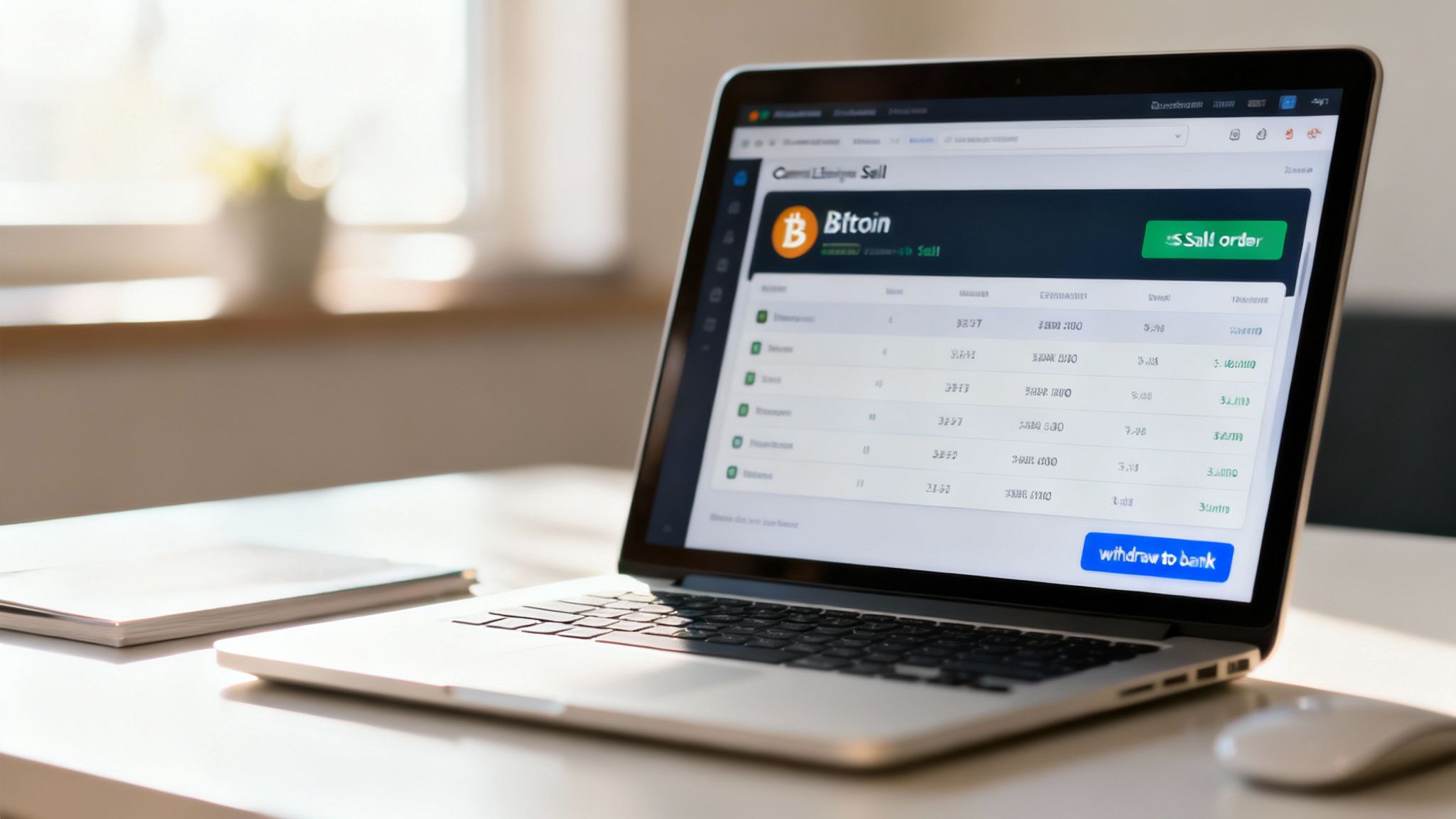
For most people, a centralized exchange (CEX) is the most direct and familiar path to cash out of cryptocurrency. Think of these platforms as a digital bank for your Bitcoin. They’re the trusted middleman that connects the world of digital assets to the traditional banking system you use every day.
These exchanges are popular for a reason: they provide a structured, high-volume environment. This massive liquidity means there are almost always buyers waiting, which lets you sell your Bitcoin quickly at a fair market price.
The Standard Process for Cashing Out
The journey from having Bitcoin in your wallet to seeing cash in your bank account follows a pretty standard path on any CEX. While every platform has a slightly different look and feel, the core steps are almost always the same.
- Account Creation and Verification: First things first, you need an account. To comply with financial regulations, you’ll have to complete a Know Your Customer (KYC) process. This just means providing personal identification, like a driver's license and proof of address, to verify who you are and help prevent fraud.
- Deposit Your Bitcoin: Once you're verified, the exchange gives you a unique Bitcoin deposit address for your account. You'll send the Bitcoin you want to sell from your personal wallet to this specific address.
- Place a Sell Order: After the deposit gets confirmed on the blockchain—which can take a little bit of time—the Bitcoin will show up in your exchange balance. From there, you just head to the trading section, choose how much you want to sell, and execute a sell order for your local currency (like USD or EUR).
- Withdraw to Your Bank: With the sale done, the cash is now sitting in your account's fiat wallet. The final step is to start a withdrawal to your linked bank account, usually via an ACH or wire transfer.
Key Takeaway: Centralized exchanges are regulated businesses built to make turning Bitcoin into cash as simple and secure as possible. The trade-off for all this convenience and security is that you must verify your identity.
Understanding the Costs and Timeline
While using an exchange is efficient, it’s not completely free. It’s smart to know the costs involved so you can predict how much cash you’ll actually end up with.
- Trading Fees: Exchanges charge a tiny percentage to execute your sell order. This usually falls somewhere between 0.1% and 0.5% of the total value of your trade.
- Withdrawal Fees: You'll also run into a flat fee for sending the cash to your bank. These fees can vary quite a bit depending on the method—wire transfers are typically more expensive but also faster than a standard ACH transfer.
The whole process, from the moment you sell your Bitcoin to the funds landing in your bank account, generally takes 1 to 5 business days. The sale itself is instant, but the bank transfer has to move through the old-school banking networks, which takes time.
Peer-to-Peer Platforms for Direct Bitcoin Sales
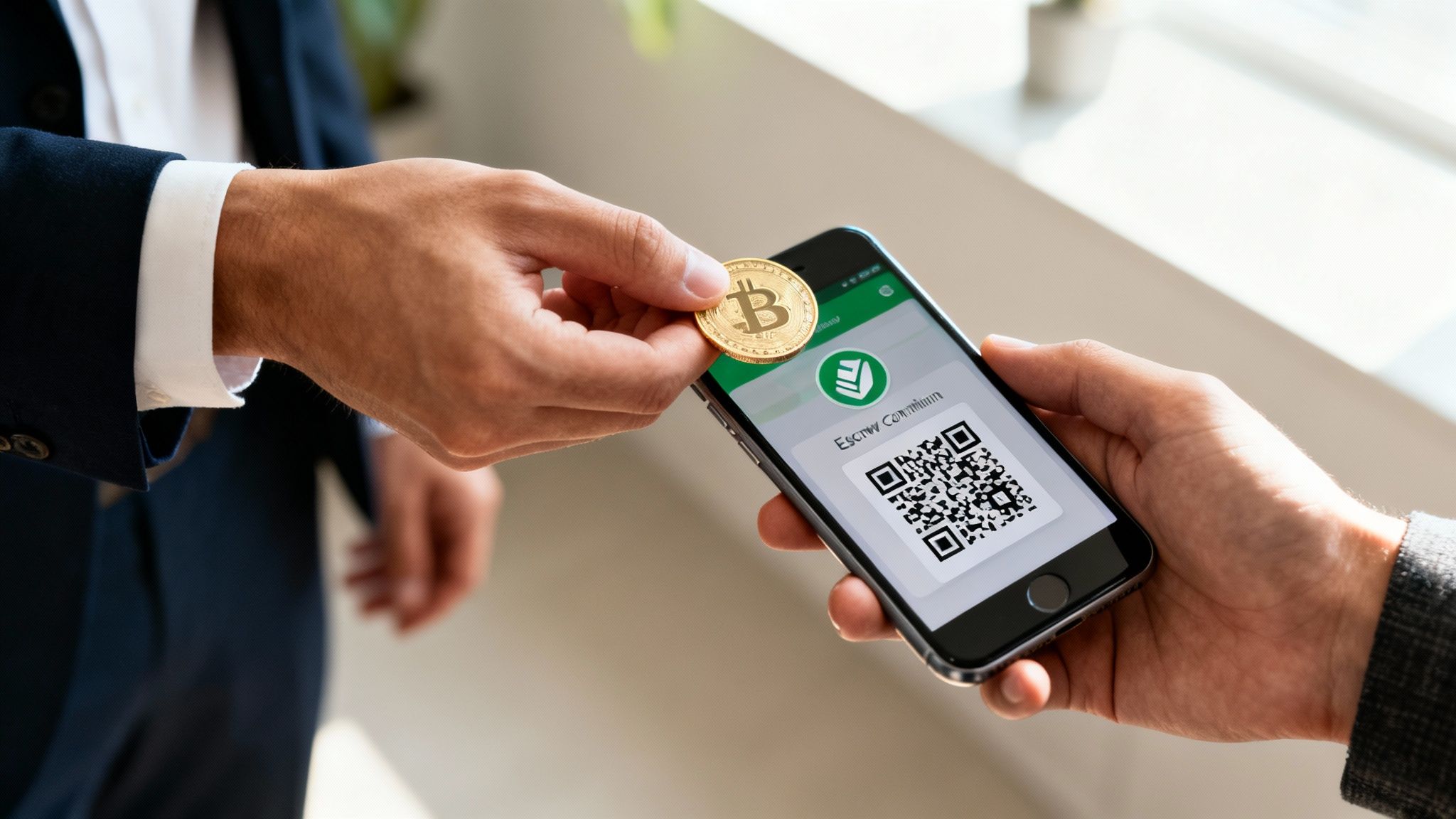
If you find centralized exchanges a bit too much like the old-school banking system, peer-to-peer (P2P) platforms are a fantastic alternative. Think of them as a secure eBay or Craigslist, but specifically for Bitcoin. Instead of selling your crypto to a massive corporation, you’re selling it directly to another person.
This direct approach puts you firmly in the driver's seat. You get to name your price, pick from a huge list of payment methods, and deal one-on-one with your buyer. It’s a powerful way to cash out of cryptocurrency entirely on your own terms.
To keep everyone honest, these platforms use a trusted middleman system. As soon as a trade begins, your Bitcoin is automatically locked in a secure escrow service. The platform holds onto the coins until the buyer pays you and you confirm the money has landed, which protects both of you from getting ripped off.
How P2P Bitcoin Sales Work
Getting the hang of a P2P platform is pretty simple once you see the process in action. You're basically posting a "for sale" ad that other users can browse and accept.
- Create Your Offer: First, you list how much Bitcoin you're selling. You also set the exchange rate (often a small percentage above the market price to make a little extra) and decide which payment methods you'll accept. This can be anything from a bank transfer to a digital payment app.
- A Buyer Accepts: Someone will see your offer and agree to the trade. The moment they do, the platform locks your Bitcoin into its escrow account.
- Receive Payment: The buyer then sends the cash directly to you using the method you specified.
- Release the Bitcoin: Once you've checked your account and confirmed the money has arrived, you let the platform know. The escrow service then releases the Bitcoin to the buyer, and the deal is done.
By acting as a neutral third party with a secure escrow, P2P platforms make it possible to trade with strangers from around the world with confidence. Your Bitcoin is never released until your cash is confirmed.
Benefits and Risks of P2P Trading
The biggest draw for P2P platforms is the blend of flexibility and privacy they provide. You can get paid in ways that most big exchanges just don't support, and since you're not wiring money directly from an exchange to your bank, the whole thing feels a lot more private.
But with great power comes great responsibility. This direct interaction means you need to stay sharp. It's crucial to only trade with users who have a solid reputation—you can usually check this through a rating or feedback system on the platform. Scammers love to use payment methods that can be reversed, so sticking to trusted, irreversible options is a smart move.
And the golden rule? Always, always double-check that the payment is fully settled in your account before you even think about releasing your Bitcoin from escrow.
How to Use Bitcoin ATMs for Instant Cash
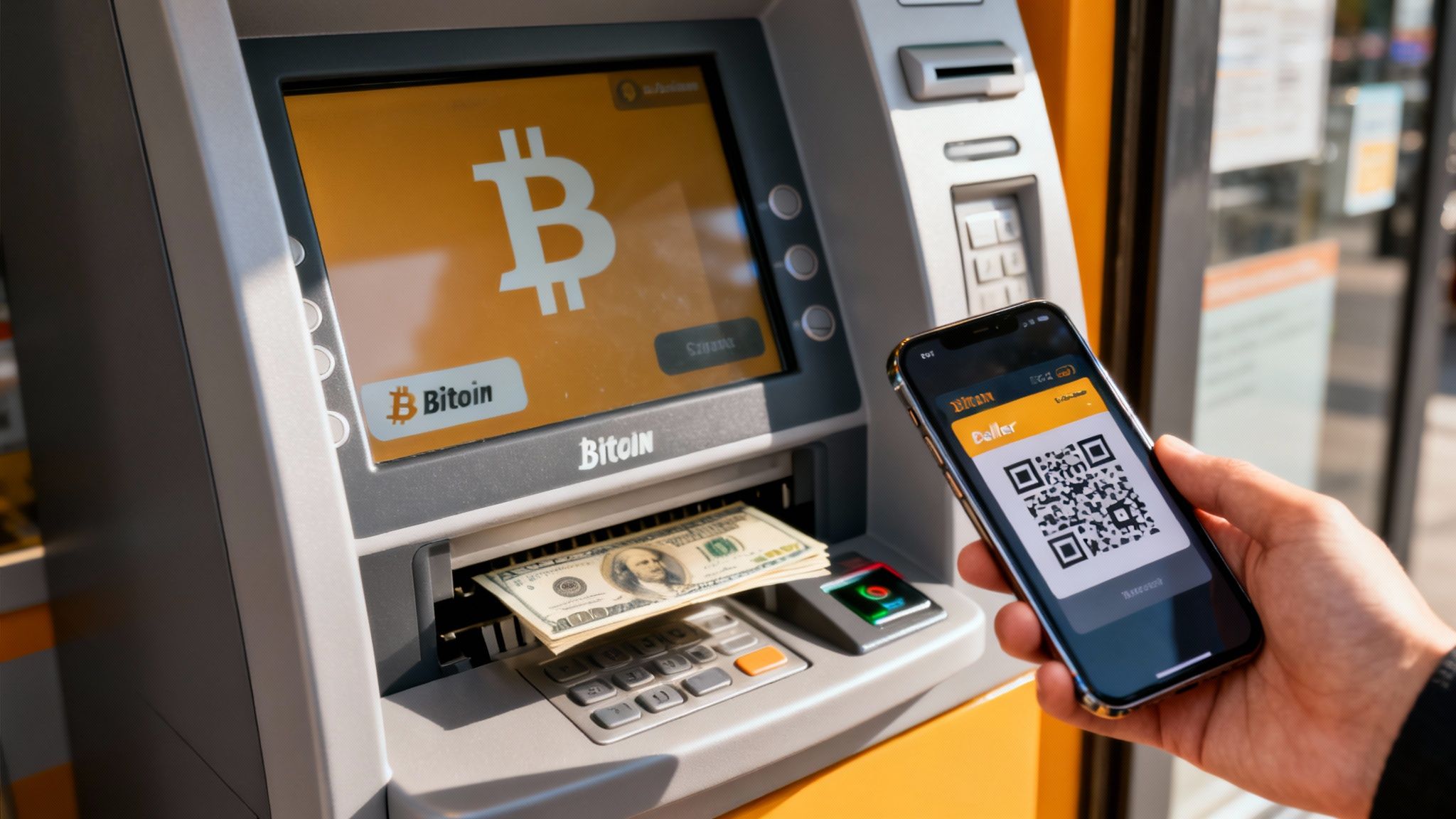
When you absolutely need to cash out of cryptocurrency and have physical bills in your hand right now, a Bitcoin ATM is your go-to. Think of it as a reverse ATM. Instead of putting in a card to get cash, you send Bitcoin from your phone, and the machine spits out dollars, euros, or whatever the local currency is.
This is all about speed and convenience. Bitcoin ATMs are the physical bridge connecting your digital assets to the real world, letting you turn crypto into spendable cash without waiting days for a bank transfer to clear.
A Step-by-Step Guide to Selling Bitcoin at an ATM
Every machine’s screen looks a little different, but the basic steps for selling your Bitcoin are pretty much the same. They’re designed to be simple, even if it’s your first time.
- Find the Right Machine: First things first, you need to find an ATM near you. Use an online map like Coin ATM Radar to locate one that allows you to sell Bitcoin. Many only let you buy, so make sure it’s a "two-way" machine before you head out.
- Choose 'Sell Bitcoin': Tap the screen and select the option to sell. The machine will then ask you how much cash you want to take out.
- Scan the QR Code: Next, the ATM will show a QR code on its screen. Just open your Bitcoin wallet on your phone and scan it. This tells your wallet exactly where to send the crypto.
- Send the Bitcoin: Your wallet will prompt you to enter the amount of Bitcoin the machine requested. Double-check the amount, then hit send.
- Grab Your Cash: Once the transaction gets a confirmation or two on the Bitcoin network (which usually takes a few minutes), the ATM will dispense your cash.
Bitcoin ATMs are built for one thing: speed. They are the perfect tool when you need cash on the spot and you're willing to pay a premium for that convenience.
The Trade-Offs of Using Bitcoin ATMs
That incredible speed comes with a hefty price tag. Bitcoin ATMs are notoriously expensive, with fees that can range from 7% to a staggering 20%. That’s worlds away from the low fees you’d find on a crypto exchange or a P2P platform.
They also have pretty strict withdrawal limits, often capping you at a few hundred or a couple of thousand dollars per transaction to stay compliant with financial regulations. This makes them ideal for cashing out small amounts in a pinch, but not for liquidating a large crypto position. For anything substantial, those high fees will take a serious bite out of your profits, making other methods far more sensible.
What to Know Before You Cash Out Bitcoin
Cashing out your Bitcoin isn't as simple as hitting a "sell" button. If you want to protect your funds and actually keep as much of your gains as possible, you need a smart strategy. Before you even think about making a move, there are a few critical things to get straight.
Think of it like a pre-flight checklist. Skipping any of these steps—taxes, security, or market timing—can lead to nasty surprises like an unexpected tax bill, a security breach, or selling at a rock-bottom price. A little planning goes a long way.
Navigating Tax Implications
Let's get the big one out of the way first: taxes. In most countries, selling Bitcoin for cash is a taxable event. That profit you made? It's typically considered a capital gain, and the taxman will want his cut.
This is where keeping good records becomes non-negotiable. You absolutely have to know:
- Your Cost Basis: What you originally paid for the Bitcoin.
- The Sale Price: What you sold it for.
- Transaction Dates: The exact dates you bought and sold.
Without this info, you’re flying blind when it comes to calculating your profit and reporting it correctly. To get a handle on how you can legally minimize what you owe, you should review these Top Capital Gains Tax Strategies.
Remember, a profitable sale isn't just about the market price—it's about how much you keep after taxes. Proper planning can make a significant difference in your net profit.
Reinforcing Security Habits
Security has to be your top priority when you decide it's time to sell. The second you move your Bitcoin from the safety of your personal wallet to an exchange or P2P platform, you’re stepping into a higher-risk environment. You need to be on high alert.
At a bare minimum, enable two-factor authentication (2FA) on any exchange account you use. It’s an essential extra layer of defense. Get paranoid about phishing scams—those fake emails and messages designed to look legit but are really just trying to steal your login details. Never, ever click on suspicious links or share your private keys or passwords with anyone.
The need for secure, regulated platforms is more important than ever. While it's getting harder for bad actors to move funds directly to exchanges, these platforms still process billions in illicit funds every year. This just goes to show that both users and the platforms themselves need to stay constantly vigilant.
Making Smart Market Decisions
Finally, let's talk about timing. Bitcoin’s price swings are legendary, and trying to time the market perfectly is a fool's errand. Making emotional decisions—like panic-selling during a dip or getting greedy at a peak—is the fastest way to lose money.
A much better approach is to have a clear, pre-defined strategy.
Consider setting specific price targets for selling off portions of your holdings. This lets you lock in profits methodically instead of gambling on hitting the absolute top. When you approach the sale with a plan, you can navigate the volatility with confidence and make sure your exit is as profitable as it can be.
A Few Common Questions About Cashing Out
When you're ready to turn your Bitcoin into cash, a few questions almost always pop up. Let's walk through them so you can move forward confidently and choose the best path for you.
How Long Does It Take to Cash Out Bitcoin?
There’s no single answer here—it really comes down to the method you pick. Each one offers a different trade-off between speed and convenience.
- Bitcoin ATMs: These are your instant gratification option. You can have physical cash in your hand just minutes after sending your crypto.
- Centralized Exchanges: The actual sale of your Bitcoin on an exchange happens in a flash. The waiting game starts when you want to get that money into your bank account, which usually takes 1 to 5 business days via a standard transfer.
- P2P Platforms: The speed here is all over the map. It completely depends on the payment method you and the buyer agree on. If you use an instant payment service, the whole deal could be wrapped up in less than an hour. A traditional bank transfer, on the other hand, will take longer.
What Are the Fees for Cashing Out Bitcoin?
The costs can vary wildly, so it’s crucial to know what you’re getting into before you hit "sell."
Bitcoin ATMs are, without a doubt, the most expensive way to go. You're paying a steep price for convenience, with fees often starting around 7% and sometimes climbing as high as 20%. In stark contrast, centralized exchanges are much easier on your wallet. They'll typically take a small trading fee (think 0.1% to 0.5%) plus a small, flat fee for the bank withdrawal itself. P2P platforms often have the lowest fees, which are usually just baked into the exchange rate you negotiate with the buyer.
Key Takeaway: Always, always double-check the fee structure before you commit to a transaction. A high fee can take a surprisingly large bite out of your final cash amount, especially on bigger sales.
Do I Have to Pay Taxes When I Sell Bitcoin?
Yes. In most places, including the United States, selling your Bitcoin for cash is a taxable event. If you sell it for more than you originally paid, that profit is typically treated as a capital gain, and the tax man will want his cut.
Tax laws are notoriously complex and change based on where you live and your own financial situation. It's always a smart move to chat with a qualified tax professional to make sure you're playing by the rules and reporting everything correctly.
What Is the Safest Way to Cash Out Bitcoin?
The "safest" method really depends on what you value most and how much you're cashing out. For larger amounts, your best bet is almost always a reputable, regulated centralized exchange that takes security seriously with features like two-factor authentication (2FA).
For smaller sums, P2P platforms can be quite secure, especially if they use a reliable escrow service to hold the funds and you stick to buyers with high ratings. While Bitcoin ATMs are physically secure, using one in a sketchy, poorly-lit area introduces a personal safety risk you shouldn't ignore. The bottom line? Stick with platforms that have a long, proven track record of keeping their users' funds safe.
Ready to accept Bitcoin payments directly from your customers? Flash provides secure, wallet-to-wallet payment solutions for merchants, with no intermediaries and no KYC. Integrate Bitcoin into your business in under a minute by visiting .