Holding too much cash can hurt businesses more than help them. While cash reserves provide financial security, they lose value over time due to inflation, generate low returns, and signal a lack of growth plans to investors. Here's what companies need to know:
- Inflation Impact: Cash loses purchasing power as inflation rises, especially when yields on savings or bonds fall behind inflation rates.
- Missed Opportunities: Excess cash often sits idle, leading to missed chances for investments in growth or innovation.
- Investor Concerns: Large reserves may make companies appear stagnant, reducing their appeal to shareholders.
- Case Study: By 2023, U.S. corporations held $6.9 trillion in cash, about 20% of total assets, much of which quietly lost value.
To counter these risks, some companies are turning to Bitcoin as a treasury asset. With its limited supply and inflation-resistant properties, Bitcoin offers an alternative for preserving value and diversifying reserves. Companies like MicroStrategy and Block Inc. have already integrated Bitcoin into their treasuries, with notable financial outcomes.
Key Takeaway: Businesses should rethink treasury strategies by balancing cash holdings with inflation-resistant assets like Bitcoin, supported by clear policies and risk management practices.
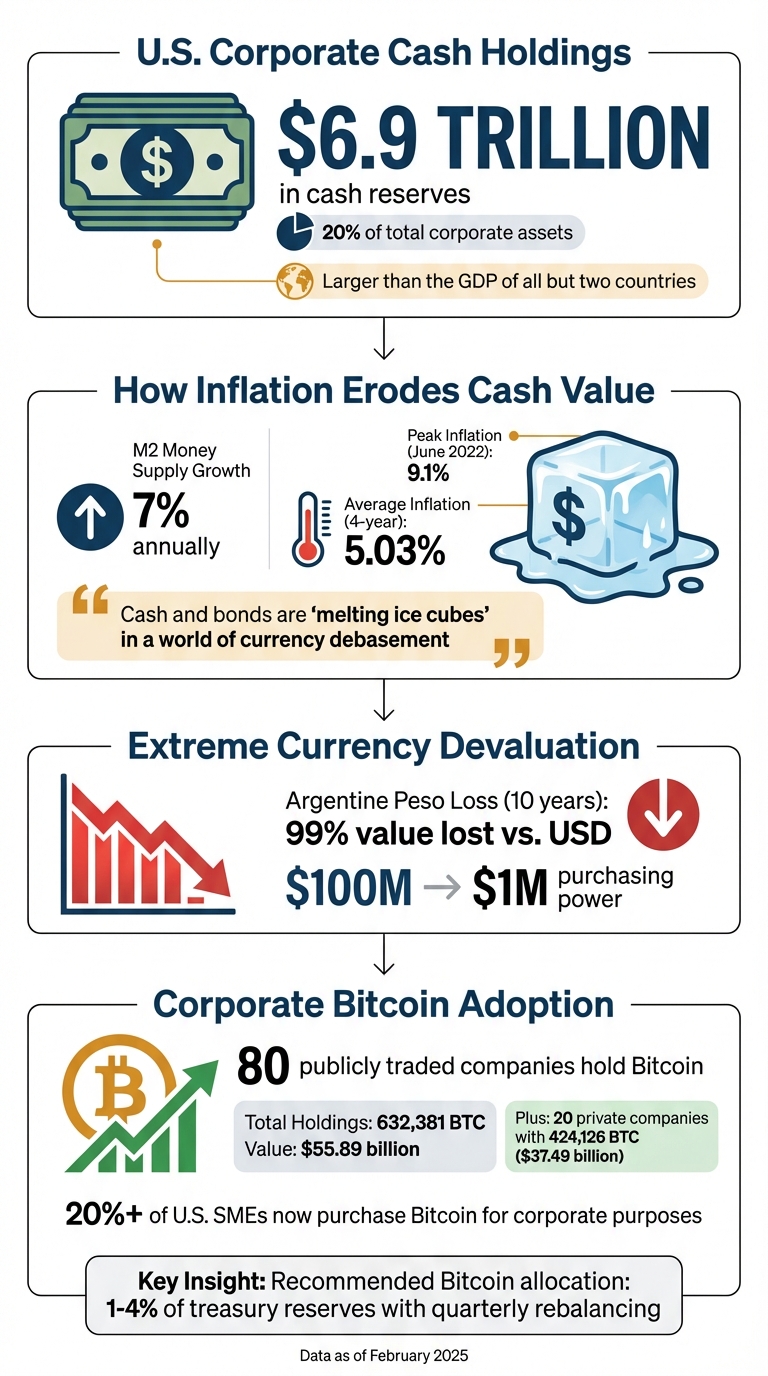
The Hidden Costs of Excess Corporate Cash Holdings: Key Statistics
An Inflation Follow Up: Company Exposure to Inflation's Effects
The Problems with Holding Too Much Cash
Excessive cash reserves, while seemingly a sign of financial security, can actually weaken a company’s financial position. Although cash offers a safety net, holding too much of it can diminish corporate value. Non-banking U.S. firms currently hold around $6.9 trillion in cash - an amount larger than the GDP of all but two countries and accounting for roughly 20% of their total assets. A large portion of this cash remains idle, quietly losing value in ways that aren’t reflected in quarterly earnings.
Inflation Eats Away at Cash Value
Cash doesn’t just sit idly - it actively loses purchasing power over time. Inflation and the expanding money supply erode its value. Historically, the U.S. money supply (M2) has grown at about 7% annually, while inflation has averaged 5.03% over the past four years, peaking at 9.1% in June 2022. Reserves with low yields often fail to keep up with inflation, reducing their real value.
This means earnings lose value even before they’re put to use. Companies relying on Treasury bills and bonds experience this firsthand, as these instruments frequently lag behind the growth of the money supply. BitGo summarizes the issue well:
Cash and bonds do not keep up with the inflation rate and lose purchasing power over time. They are what Michael Saylor calls "melting ice cubes" in a world of governments debasing their currencies.
The risk becomes especially pronounced in volatile economies. Over the past decade, for instance, the Argentine peso lost 99% of its value against the U.S. dollar, highlighting how fiat currencies can rapidly lose purchasing power.
Missed Investment Opportunities and Low Returns
Holding too much cash creates a "yield gap" that can drag down financial performance. Companies often park their cash in low-yield investments that generate returns far below their cost of borrowing. This means they might be paying more to borrow money than they earn on their cash reserves. In today’s fast-paced, knowledge-driven economy, firms need to act quickly to seize critical opportunities. Excess idle cash can cause companies to miss out on time-sensitive investments, whether in R&D, technology upgrades, or strategic acquisitions.
Tax policies can further complicate matters. Many companies have historically kept profits overseas to avoid repatriation taxes, resulting in "trapped" cash that can’t be used effectively for domestic growth or innovation. A well-known example is Apple Inc., which borrowed billions to fund share buybacks and dividends despite holding significant offshore cash reserves. This demonstrates how excess cash can become inaccessible when it’s needed most.
Reduced Flexibility in Changing Markets
Ironically, holding too much cash can make a company less financially agile. As the money supply grows, cash reserves lose value. For instance, a $100 million reserve might only have the purchasing power of $93 million after a 7% M2 increase.
This creates a unique challenge, as explained by the National Center for Public Policy Research:
In periods of consistent, and often rampant, inflation, a company's financial standing is unfortunately measured not only by how well it conducts its business, but also by how well it stores the profits from its business.
The pandemic offered a clear example of this dynamic. Between 2020 and 2021, U.S. firms accumulated large cash reserves thanks to policy support. However, by 2022, many of these companies had to dip into their cash buffers to cover operations, growth, and payouts as external funding became more expensive. Additionally, holding excessive cash can tempt executives into risky ventures, such as unprofitable acquisitions or unnecessary diversifications, which can ultimately erode shareholder value. These challenges highlight the need for smarter treasury strategies.
Using Bitcoin as a Treasury Asset
With the challenges of holding excessive cash reserves, some companies are turning to Bitcoin as an alternative for their treasuries. Bitcoin’s unique features address many of the drawbacks tied to traditional cash holdings. For instance, its capped supply of 21 million tokens acts as a safeguard against inflation, unlike fiat currencies, which can be expanded at will. To put this in perspective, the U.S. money supply has historically grown at an average rate of about 7% annually. These characteristics make Bitcoin an intriguing option for corporate treasuries looking for a modern solution.
Bitcoin's Core Advantages for Corporate Treasuries
Bitcoin brings several key benefits to the table for corporate treasuries. Its 24/7 market ensures companies have continuous access to liquidity. For businesses engaged in international trade, Bitcoin offers a cost-effective alternative to traditional cross-border transactions. While the average fee for such transfers is 6.3%, Bitcoin transactions typically cost just over $1 and are completed in minutes. Additionally, Bitcoin’s low correlation with government bonds and cash provides an opportunity for diversification, making it a valuable addition to a company’s financial strategy.
Companies Already Using Bitcoin in Their Treasuries
Several companies have already embraced Bitcoin to strengthen their treasury operations, showcasing its potential in real-world scenarios.
In August 2020, MicroStrategy made headlines by adopting Bitcoin as its primary treasury reserve. The company converted $500 million in cash reserves, which were losing value due to inflation, into Bitcoin. Initially, it acquired 38,250 BTC for $425 million. Fast-forward to February 25, 2025, MicroStrategy’s holdings had grown to 478,740 BTC, valued at $42.22 billion, delivering a $17 billion profit by December 2024[7,11].
Block Inc., formerly known as Square, opted for a more conservative approach. Under the leadership of CEO Jack Dorsey, the company purchased 4,709 BTC for $50 million in October 2020, representing about 1% of its total assets at the time. By February 25, 2025, Block Inc.’s Bitcoin holdings had increased to 8,363 BTC, valued at $737.6 million. In May 2024, the company announced plans to reinvest 10% of its monthly Bitcoin-related profits into additional Bitcoin purchases[7,11]. Dorsey has been vocal about his belief in Bitcoin’s future, stating:
The world ultimately will have a single currency, the internet will have a single currency. I personally believe that it will be bitcoin.
In the healthcare industry, Semler Scientific took a bold step in May 2024 by declaring Bitcoin its primary treasury reserve asset. Chairman Eric Semler spearheaded the initiative, acquiring 581 BTC for $40 million. He explained:
We believe [Bitcoin] has unique characteristics as a scarce and finite asset that can serve as a reasonable inflation hedge and safe haven amid global instability.
As of February 25, 2025, 80 publicly traded companies collectively held 632,381 BTC on their balance sheets, valued at approximately $55.89 billion. Additionally, 20 private companies owned 424,126 BTC, worth $37.49 billion.
How to Add Bitcoin to Your Treasury
Adding Bitcoin to your corporate treasury can help reduce the risks associated with holding too much cash. However, this requires a well-thought-out plan that aligns your leadership team, board members, and key departments around a unified strategy. The process begins with education and ends with clear policies, complementing the broader goal of using Bitcoin to counteract cash devaluation.
Educating Leadership and Evaluating Risk
Start by ensuring your leadership team understands Bitcoin's role as a treasury asset. This involves educating your board and executives on what Bitcoin is, how it works, and its potential benefits. Define your strategic objective - whether you're looking to hedge against inflation, diversify your assets, or embrace innovation - and evaluate Bitcoin's volatility in light of your company's risk tolerance. Each goal will influence how much Bitcoin you allocate and how you manage it.
For instance, as of February 25, 2025, the 60-day Bitcoin volatility index was 1.58%, compared to gold at 1.2% and fiat currencies, which typically range between 0.5% and 1%. These figures highlight Bitcoin's higher volatility, which your leadership must weigh against your company's operational cash flow and the portion of funds you can allocate without disrupting daily operations.
This decision isn't just a financial one - it requires input from multiple departments. Investor relations, compliance, legal, and IT teams all play critical roles in addressing regulatory, technical, and stakeholder concerns. Bringing these groups into the conversation early ensures a smoother implementation process.
Determining Allocation Size and Setting Policies
There’s no universal formula for how much Bitcoin a company should hold. Allocations typically range from 1% to 30% of treasury reserves, depending on risk tolerance and strategic goals. Some companies take a conservative route with a 1% allocation, while others adopt bolder strategies, allocating over 30%.
A practical starting point is the "4% rule" - allocating up to 4% of your portfolio to Bitcoin with quarterly rebalancing. This approach has historically allowed companies to benefit from Bitcoin's gains while managing its volatility. Some firms also reinvest a portion of their Bitcoin profits, creating a scalable strategy tied to business performance.
Once you determine your allocation size, formalize it with a written Bitcoin trading policy. This document should outline allocation limits, rebalancing schedules, and who is authorized to execute transactions. To enhance security and accountability, segregate duties so that custody, transaction authorization, and recordkeeping are handled by different individuals.
Tax compliance is another key consideration. Use standard tax methods, such as "First-In, First-Out", to meet IRS requirements for tracking transaction details. Additionally, the 2023 FASB update now allows companies to use fair value accounting for Bitcoin holdings. This means you can mark assets to market value, providing a clearer view of your financial position rather than recording only impairments.
With a clear strategy and policies in place, integrating Bitcoin into your treasury operations becomes a more structured and confident process.
sbb-itb-f81ab9b
Using Flash for Bitcoin Payments and Treasury Operations

Once you've tackled the liquidity risks of holding excessive cash, the next logical step is ensuring you have the right tools to manage payments and integrate digital assets smoothly. Flash provides enterprises with the infrastructure they need to accept Bitcoin payments and incorporate digital assets into their treasury operations. Here's a closer look at how Flash addresses common treasury and payment challenges.
Flash Features Tailored for Enterprise Treasury
Flash operates as a non-custodial gateway, meaning your company has full control over funds immediately after a transaction is completed. With Lightning Network integration, the platform enables instant, 24/7 settlement for global transactions.
The platform also offers real-time analytics, giving CFOs and finance teams instant visibility into Bitcoin transactions. This feature simplifies cash flow tracking and makes account reconciliation more efficient. Flash supports a wide range of payment tools, including payment links, point-of-sale systems, widgets, and custom API integrations, making it adaptable for various business needs. Additionally, businesses can implement Bitcoin invoicing and subscription models, which help create predictable revenue streams.
For IT teams, Flash provides low-code and no-code integration options, reducing the technical workload. For larger enterprises, custom API solutions enable seamless embedding of Bitcoin payment capabilities into existing financial systems. This flexibility ensures that adopting Bitcoin payments doesn’t require overhauling your current infrastructure, making it easier to transition to Bitcoin-based treasury management.
Simplifying Bitcoin Payments While Cutting Costs
Flash doesn’t just facilitate Bitcoin transactions - it also helps businesses save money. Traditional payment processors often charge hefty transaction fees and additional costs for international transfers. Flash eliminates these intermediaries by enabling direct wallet-to-wallet payments, which can lead to significant cost reductions.
The platform’s instant settlement feature is a game-changer for treasury operations. Faster settlement times improve cash flow management, allowing finance teams to reallocate capital more efficiently and enhance working capital management.
Flash also makes it easy to accept Bitcoin payments in a variety of settings, from retail stores to trade shows, without requiring specialized hardware. By offering customizable product pages, businesses can ensure their brand identity remains consistent while providing customers with a seamless Bitcoin payment experience.
Managing Risks When Holding Bitcoin
Once Bitcoin becomes part of your treasury operations, the next step is managing the risks that come with it. This includes addressing security concerns, navigating regulatory requirements, and handling price volatility to protect your financial position.
Securing Bitcoin with Custody Solutions
When it comes to Bitcoin treasuries, security is non-negotiable. Without the right measures in place, your holdings are vulnerable to hacks, errors, or unauthorized access. A widely accepted solution is using multi-signature (multisig) wallets, which require multiple approvals for transactions. For instance, a company might use a 3-of-5 multisig setup, where at least three out of five designated individuals must approve any Bitcoin transfer.
Another must-have security measure is cold storage, which involves keeping private keys offline. This approach shields your Bitcoin from cyberattacks. Many institutional treasurers combine cold storage with advanced key management systems to ensure that even if one layer of security is breached, the funds remain protected.
Some companies choose to work with third-party regulated custody providers to reduce legal liabilities and gain access to expert services. For example, BitGo provides insurance coverage for digital assets up to $250 million. When selecting a custodian, make sure they hold SOC-1 and SOC-2 certifications, and carefully evaluate their track record, transparency, and how they handle storage and insurance costs.
A notable example is MicroStrategy Incorporated, which made headlines in August 2020 as the first publicly traded company to adopt Bitcoin as its primary treasury reserve asset. They relied on regulated custodians and exchanges to safely execute trades and store their assets. As of Q1 2024, MicroStrategy held an impressive 214,400 BTC.
| Custody Arrangement | Pros | Cons |
|---|---|---|
| Self-Custody | Full control; eliminates counterparty risk | High technical complexity; risk of loss from errors |
| Exchange Custody | High liquidity; easy trading | Counterparty risk; prone to hacks or insolvency |
| Third-Party Regulated Custody | Advanced security; insurance coverage; regulatory compliance | Counterparty risk; requires thorough due diligence |
Accounting Standards, Regulations, and Price Fluctuations
Once your assets are secure, the next challenge is managing Bitcoin's price volatility while staying compliant with accounting and regulatory standards. In December 2023, the Financial Accounting Standards Board (FASB) introduced new guidelines allowing companies to use fair value accounting for Bitcoin starting in 2025. This change improves transparency for shareholders but also means that price swings will directly impact net income, increasing earnings volatility.
Strong custody measures help mitigate security risks, but sound accounting practices are essential for navigating market fluctuations. For example, in Q1 2025, MicroStrategy reported a $5.91 billion unrealized loss due to Bitcoin price drops, illustrating the impact of the updated FASB reporting rules. Companies need to be prepared for such fluctuations to affect their financial statements.
To manage price volatility, it’s wise to allocate only a small portion of your treasury - typically 1% to 4% - to Bitcoin. This approach allows you to capture potential upside while reducing the risk of major financial setbacks during market downturns. Another effective strategy is dollar-cost averaging (DCA). For instance, in May 2024, Block Inc. implemented a policy to reinvest 10% of its monthly Bitcoin-related gross profits into additional Bitcoin purchases.
A formal Bitcoin trading policy is also essential. This policy should outline allocation limits, rebalancing procedures, and the roles of authorized personnel. Regular quarterly rebalancing can help lock in gains during price surges and maintain a stable risk profile. Additionally, ensure all liquidity providers and custodians comply with key regulations like the Bank Secrecy Act, USA PATRIOT Act, FinCEN rules, and OFAC sanctions.
"Bitcoin's short-term volatility needs to be managed through proper position sizing and regular re-balancing." - BitGo
Finally, periodic reconciliations are crucial. Verify your Bitcoin holdings against the public blockchain to ensure your ledger is accurate. Just as you would optimize cash usage, disciplined Bitcoin risk management strengthens your treasury’s overall resilience.
Conclusion
Holding excess cash can diminish value over time due to inflation (with M2 money supply growing around 7% annually), missed opportunities for high-return investments, and rising borrowing costs. What may seem like a safe strategy can quickly become a financial burden.
One way companies are addressing these risks is by diversifying with digital assets. Bitcoin, in particular, offers protection for reserves with its limited supply and potential diversification advantages. As of February 25, 2025, 80 publicly traded companies collectively held 632,381 BTC, valued at roughly $55.89 billion. Additionally, over 20% of U.S. small and medium-sized enterprises (SMEs) have started purchasing Bitcoin for corporate purposes.
Flash simplifies Bitcoin adoption by offering a global, instant, and low-cost payment solution. Through its non-custodial, wallet-to-wallet gateway, which supports the Lightning Network and real-time analytics, businesses can integrate Bitcoin seamlessly into their operations.
A prudent starting point for companies is allocating a small portion of reserves - around 1% to 4% - to Bitcoin, combined with strict risk management and regular rebalancing. The new FASB guidelines, effective January 2025, provide further clarity on fair value reporting, ensuring greater transparency. By adopting this balanced approach, businesses can enhance the resilience of their treasuries in today’s fast-changing economic landscape.
FAQs
Why can holding too much cash be risky for companies?
Holding onto too much cash can actually backfire for companies. One major issue is inflation erosion - over time, the value of cash shrinks as prices rise. Then there’s the opportunity cost - all that idle money could have been put into investments that drive growth. On top of that, large cash reserves can limit a company’s flexibility, making it tougher to respond quickly in unpredictable markets.
To avoid these pitfalls, businesses can take smart steps like diversifying their reserves, adopting modern payment technologies, or exploring alternative treasury assets. These strategies ensure that cash isn’t just sitting around but actively contributing to the company’s growth and resilience.
How can Bitcoin be a strategic alternative to holding excess cash?
Bitcoin offers a compelling alternative to traditional cash reserves by acting as a digital asset that sidesteps the inflationary pressures often tied to fiat currencies. While cash can lose purchasing power over time due to inflation, Bitcoin's decentralized structure and capped supply make it an appealing choice for companies aiming to safeguard value and protect against currency devaluation.
Beyond that, Bitcoin opens doors for portfolio diversification and added financial flexibility. Businesses can choose to hold, trade, or sell Bitcoin based on market dynamics, potentially capitalizing on its long-term growth prospects. By integrating Bitcoin into their treasury strategies, companies can improve their financial adaptability and mitigate the risks that come with holding large cash reserves.
What should companies consider before adding Bitcoin to their treasury?
Adding Bitcoin to a company’s treasury can bring variety and potential for growth, but it’s not without challenges. One major issue is market volatility - Bitcoin’s value can swing dramatically, sometimes leading to significant unrealized losses if prices drop after acquisition. For example, several companies have faced financial strain during sharp Bitcoin price corrections.
Another concern is balance sheet impairment. Holding large amounts of Bitcoin can result in accounting losses, which might undermine financial stability and shake investor confidence. On top of that, businesses need to navigate an ever-changing regulatory environment and ensure that their digital assets are securely stored to guard against theft or mishandling. While Bitcoin does present opportunities, companies should only proceed with a well-thought-out risk management plan and careful preparation.