So, you’ve decided it’s time to turn some of your Bitcoin into cash. Cashing out simply means converting your digital holdings into a traditional currency, like US dollars, and getting it into your bank account.
The most well-trodden paths for this are using a centralized cryptocurrency exchange, a peer-to-peer (P2P) platform, or a specialized Bitcoin ATM. Each route strikes a different balance between speed, fees, and privacy.
Understanding Your Bitcoin Cash-Out Options
When you're ready to cash out your Bitcoin, you're essentially just selling it. The platform you choose for that sale is the single most important decision you'll make. It directly impacts how fast you get your money, what you'll pay in fees, and how much personal information you'll need to hand over.
Think of it just like selling any other asset. You need a marketplace where buyers are ready to trade. The same principles of finding the right venue and timing apply here, much like the advice on maximising value when selling assets for cash.
The Three Main Pathways
Let's break down the main ways to convert your Bitcoin to cash. Each one is built for different priorities, so knowing how they work will help you pick the right tool for the job.
- Centralized Exchanges: These are the big, regulated names in the industry—think Coinbase or Kraken. They act as a trusted middleman, matching countless buyers and sellers. Their biggest advantage is high liquidity, which means you can sell a lot of Bitcoin quickly without crashing the price. For most people, this is the most reliable and straightforward option.
- Peer-to-Peer (P2P) Platforms: Services like Bisq or Hodl Hodl connect you directly with another person who wants to buy your Bitcoin. This route gives you way more control over the price and the payment method (think bank transfer, PayPal, even cash in person). The trade-off is that it can take more time to find a buyer and coordinate the sale, but it often provides a higher degree of privacy.
- Bitcoin ATMs: If you need physical cash right now and are dealing with smaller amounts, a Bitcoin ATM is a solid choice. You just scan a QR code at the machine, send your BTC from your wallet, and it dispenses cash. Be warned, though: this convenience comes at a premium. ATM fees are notoriously high, often ranging from 7% to 20%.
To make it easier to decide, here’s a quick rundown of how these methods stack up against each other.
Bitcoin Cash-Out Methods at a Glance
This table gives you a quick comparison of the most common ways to cash out Bitcoin, highlighting their key features to help you choose the best option for your needs.
| Method | Best For | Typical Speed | Common Fees |
|---|---|---|---|
| Centralized Exchange | Reliability, large amounts, ease of use | 1-5 business days | 0.1% to 1.5% trading + withdrawal fees |
| Peer-to-Peer (P2P) | Privacy, control over price, payment flexibility | Varies (minutes to days) | 0% to 1%, set by the seller |
| Bitcoin ATM | Immediate cash, small amounts, convenience | Instant | 7% to 20% (very high) |
Ultimately, the right choice depends entirely on what you're trying to achieve.
Key Takeaway: The best way to cash out your Bitcoin depends entirely on your goals. Prioritize a centralized exchange for security and volume, a P2P platform for control and privacy, or a Bitcoin ATM for immediate cash access with small amounts. Each method has its own distinct advantages and trade-offs.
Choosing Where to Sell Your Bitcoin
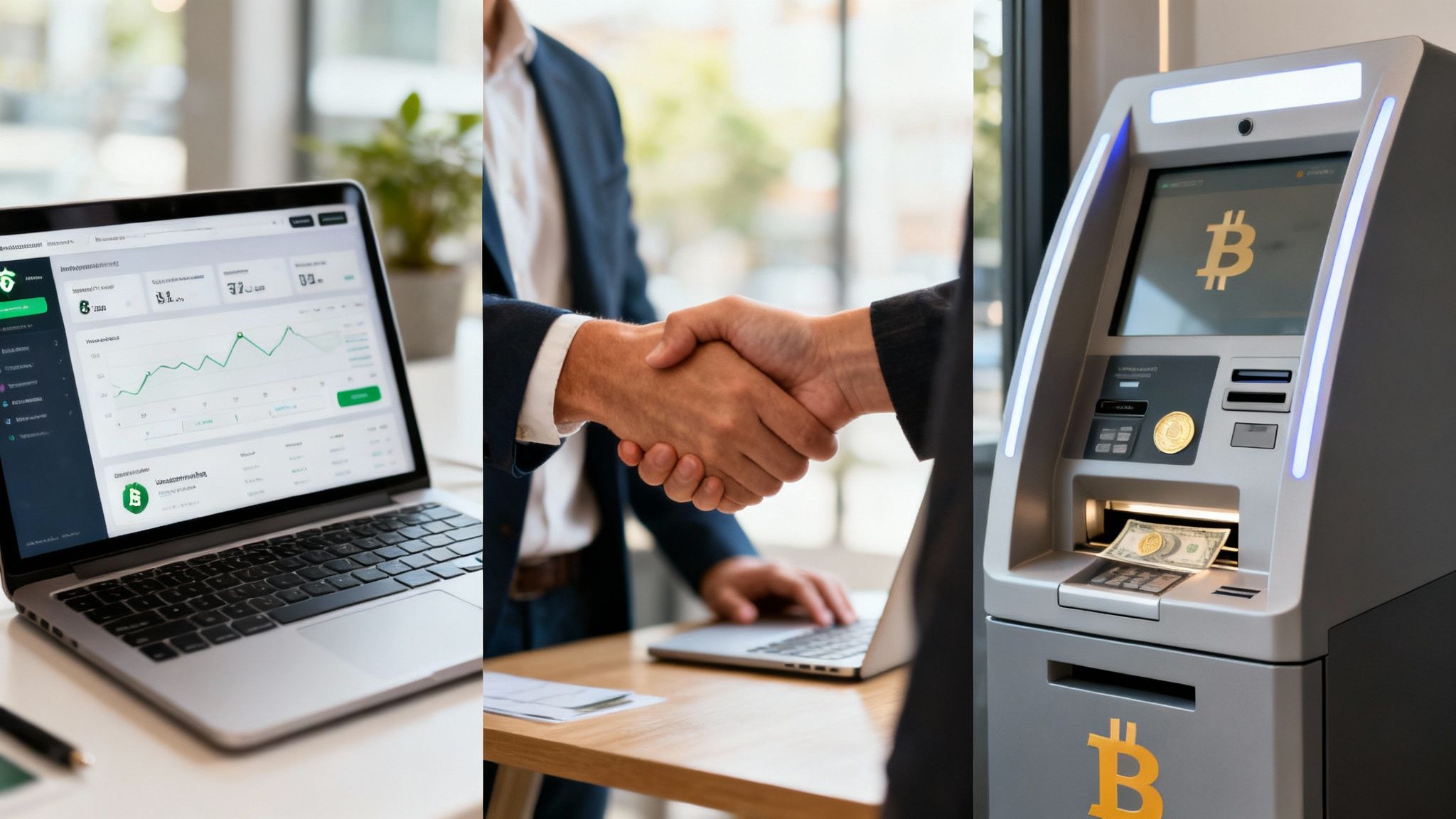
Deciding where to cash out your Bitcoin isn't just about finding a marketplace—it's a choice that shapes the entire experience. This decision will directly impact the fees you pay, how fast you get your money, and the security wrapped around your funds.
Your personal needs will point you in the right direction. Are you selling a small amount for some quick cash, or are you liquidating a significant holding? The answer will help you choose between the three main venues for selling Bitcoin: centralized exchanges, peer-to-peer (P2P) marketplaces, and Bitcoin ATMs.
Each of these operates on a completely different model. A centralized exchange is like a stock market for Bitcoin. A P2P platform, on the other hand, feels more like a classifieds site where you deal directly with other people.
Centralized Bitcoin Exchanges
For most people, a well-known centralized exchange is the go-to option, and for good reason. Platforms like Kraken or Coinbase are large, regulated businesses that offer a secure environment and, most importantly, high liquidity.
High liquidity means there are always buyers waiting, so you can sell your Bitcoin instantly at the market price without worrying about your sale tanking the price. The process is straightforward: deposit your BTC, place a sell order, and withdraw the cash to your linked bank account. This makes them a solid choice for both newcomers and seasoned pros.
Peer-to-Peer (P2P) Marketplaces
If you're someone who values flexibility and having more control over the deal, a peer-to-peer (P2P) marketplace is probably a better fit. These platforms connect you directly with buyers, which lets you negotiate your own price.
Even better, you get a much wider range of payment options, from standard bank transfers to various digital payment apps. This direct negotiation can sometimes land you a better exchange rate and much lower fees, often sitting between 0% and 1%. The trade-off? It takes more time and effort. You're in charge of finding a trustworthy buyer and making sure the transaction goes off without a hitch.
P2P platforms give you the power to set your own terms. For example, if you need funds sent to a specific online payment service that an exchange doesn't support, you can find a buyer willing to accommodate that request, giving you unparalleled flexibility.
Bitcoin ATMs For Quick Cash
When speed is everything and you need physical cash in your hand right now, nothing beats a Bitcoin ATM. The process is ridiculously fast: you scan a QR code at the machine, send Bitcoin from your mobile wallet, and the machine spits out cash, usually within minutes.
It’s the perfect solution for cashing out small amounts when you're in a pinch. But—and this is a big but—that convenience comes at a very steep cost. Bitcoin ATM fees are notoriously high, often ranging from a painful 7% to 20% of your transaction. They're not practical for large amounts but serve a very specific purpose for small, urgent cash needs.
Comparing Your Options
So, which service is right for you? It all comes down to what you prioritize.
Here’s a quick breakdown to help you decide:
- Security & Volume: For selling a large amount of Bitcoin without crashing the market, a centralized exchange with an Over-The-Counter (OTC) desk is the safest and most effective route.
- Flexibility & Control: If you want total control over the price and how you get paid, a P2P marketplace is your best bet for customized transactions.
- Speed & Convenience: Need physical cash immediately? A Bitcoin ATM will get it done, but only use it for small amounts unless you’re okay with those eye-watering fees.
A Practical Walkthrough of The Cashing Out Process
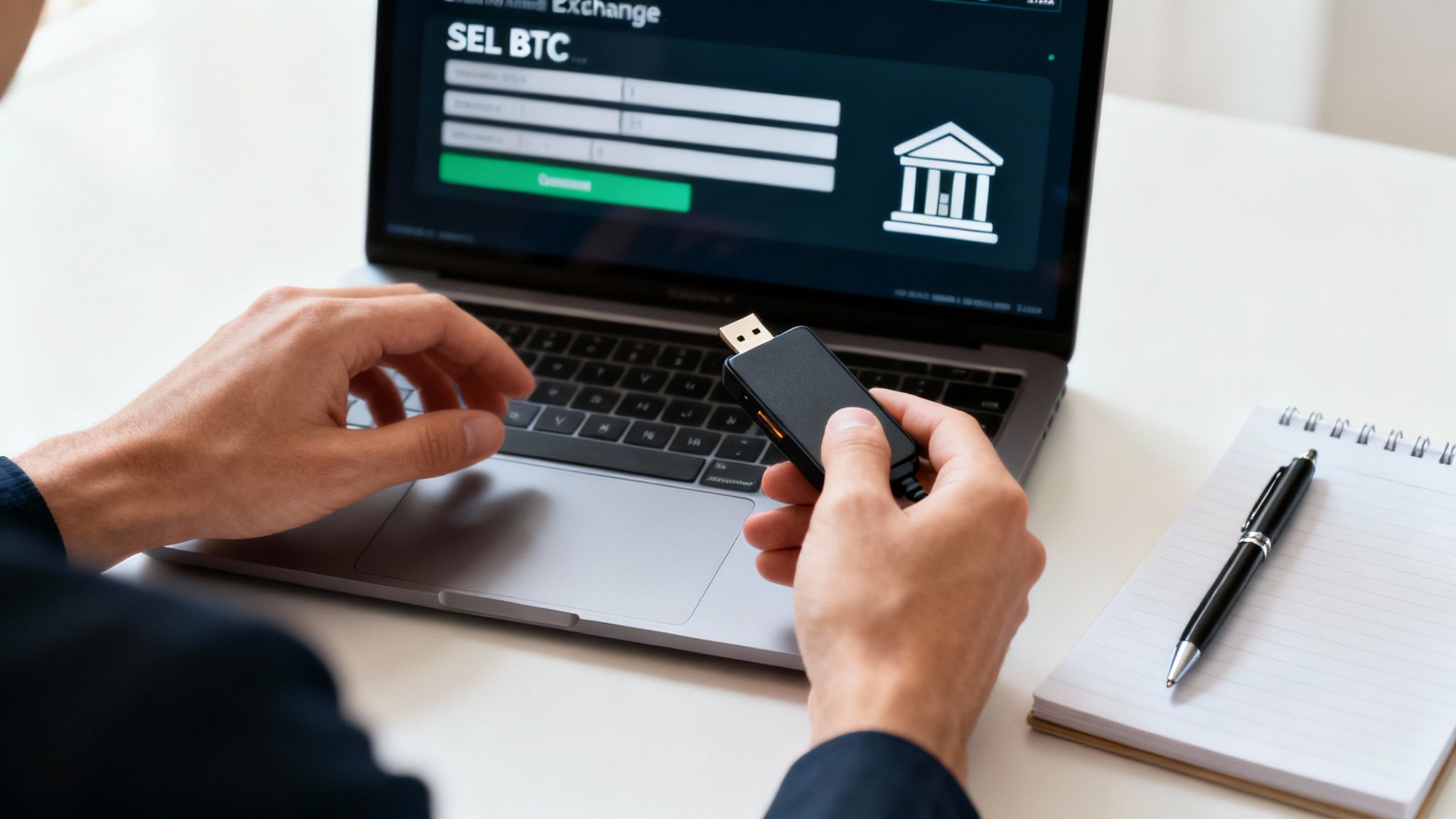
Alright, let's get down to brass tacks. For most people, cashing out Bitcoin will happen on a major, centralized exchange. It's the most well-trodden path for a reason—it’s generally secure, straightforward, and the most common way to turn your crypto back into dollars, euros, or whatever your local currency is.
The whole dance can be broken down into a few key moves: setting up your account, getting your Bitcoin onto the platform, actually selling it, and then pulling the cash back to your bank. Each part needs a bit of care to make sure things go off without a hitch.
Preparing Your Exchange Account
First things first, you can't just show up and sell. Before you do anything, your exchange account needs to be fully verified. This is all part of the Know Your Customer (KYC) process, a regulatory hoop that every legitimate exchange has to make you jump through. You'll need to upload a government-issued photo ID and sometimes a utility bill for proof of address.
Don't put this off. Verification can be instant, but it can also take a couple of days. The last thing you want is to be stuck in verification limbo when you’re trying to sell at a specific price. Get it done before you need it.
Moving Bitcoin to The Exchange
Once you're verified, it's time to deposit your Bitcoin. You'll be sending the coins from your personal wallet—whether that's a hardware device or a software app—to a unique Bitcoin deposit address generated by the exchange.
This is where you need to be extra careful. Mistakes here can be costly and irreversible.
- Copy and Paste: Seriously, never type a Bitcoin address by hand. One wrong character and your funds are gone forever. Always use the copy function.
- Double-Check the Address: Before you hit "send," check the first few and last few characters of the address you pasted. Make sure they perfectly match what the exchange is showing you.
- Send a Test Transaction: If you're moving a large amount for the first time, send a tiny "feeler" transaction first. Just a few dollars' worth. Wait for it to show up and confirm in your exchange account before sending the rest. It's a small step that buys a lot of peace of mind.
A lot of people get what I call "address anxiety." Those long, random strings of letters and numbers are intimidating. Sending that small test transaction is the best cure. It confirms your process is correct before you commit the full amount.
Placing The Sell Order
With your Bitcoin safely in your exchange account, you're ready to sell. Head over to the trading section and find your trading pair, like BTC/USD or BTC/EUR. You'll generally see two main ways to sell:
- Market Order: This is the "sell it now" button. A market order executes immediately at the current best available price. It’s perfect when speed is your top priority.
- Limit Order: This gives you precise control. You set the exact price you’re willing to sell at. Your order just sits there until the market price hits your target. It's the right choice if you have a specific price goal in mind and you're willing to wait.
Withdrawing Your Cash
The final lap. After the sale, you'll have fiat currency sitting in your exchange account. Now, you just need to get it to your bank. You’ll find this option in the "Withdraw" or "Wallet" area of the site. Just select your currency, enter the amount, and choose the bank account you linked during verification.
Heads up: withdrawal times can vary wildly. A standard ACH transfer might take 3-5 business days to land in your account. A wire transfer is usually faster, sometimes same-day, but it almost always comes with a higher fee. Check the exchange’s withdrawal options and fees so you know exactly when to expect your money.
Fees and Taxes: The Part Nobody Likes to Talk About
Getting your Bitcoin cashed out is one thing, but what you actually pocket is another story entirely. It's not just about hitting "sell" at a great price. Two unavoidable hurdles can shrink your final take-home amount if you're not paying attention: fees and taxes.
Ignoring these is like planning a road trip without budgeting for gas and tolls—you simply won't get as far as you hoped. Every platform, from a big-name exchange to a corner Bitcoin ATM, has its own unique fee structure. Let's break them down so you know exactly what to expect.
Decoding the Fee Structures
When you're ready to cash out your Bitcoin, you’ll run into a few different kinds of fees. They might seem like small percentages, but on larger transactions, they can definitely add up.
Here's a quick rundown of the usual suspects you'll encounter:
- Trading Fees: This is the most common one, charged by the exchange for actually executing your sell order. It's typically a small slice of the total transaction value, often somewhere between 0.1% and 1.5%.
- Withdrawal Fees: Once you've sold your BTC for cash, you'll pay another fee to move that money from the exchange to your bank account. These can be a flat rate (like $5 for a standard bank transfer) or vary based on the method you choose, with wire transfers usually costing more.
- Network Fees: Before you can even sell on an exchange, you have to get your Bitcoin there from your personal wallet. That move incurs a network fee, often called a "miner fee." This doesn't go to the exchange; it goes to the Bitcoin miners who process and confirm your transaction on the blockchain.
Don't Forget About Uncle Sam
Beyond the platform fees, taxes are easily the single biggest financial factor to consider. In most countries, selling Bitcoin for a profit is a taxable event. Any money you make is typically subject to capital gains tax, just as if you'd sold stocks or a piece of real estate.
To figure out your tax bill, you need to know your cost basis—that's the original price you paid for the Bitcoin you're now selling. The difference between what you sold it for and what you paid is your capital gain (or loss). This is exactly why keeping meticulous records of every purchase you've ever made is non-negotiable.
Remember the euphoric market of 2017? It's a perfect real-world example. As Bitcoin rocketed towards $20,000, a massive wave of cashing out followed. Some exchanges reported daily withdrawals topping $1 billion. Investors who had bought in around $1,000 earlier that year saw gains of over 1,300%. This highlights the incredible profits possible, but also the significant tax liabilities that come with them.
Good Records Are Your Best Friend
Seriously, staying organized is your best defense against a massive tax-season headache. You have to treat your Bitcoin sales with the same diligence you would any other serious investment.
A good small business tax preparation checklist can actually be a huge help here, even if you're just an individual. The core principles are the same: track your income (sales), expenses (fees), and all the important dates.
By properly documenting every single transaction—when you bought, the price you paid, when you sold, and the price you got—you give yourself and your tax advisor a crystal-clear picture. Taking this proactive approach means no nasty surprises and the confidence that you're reporting everything correctly.
Essential Security for a Safe Transaction
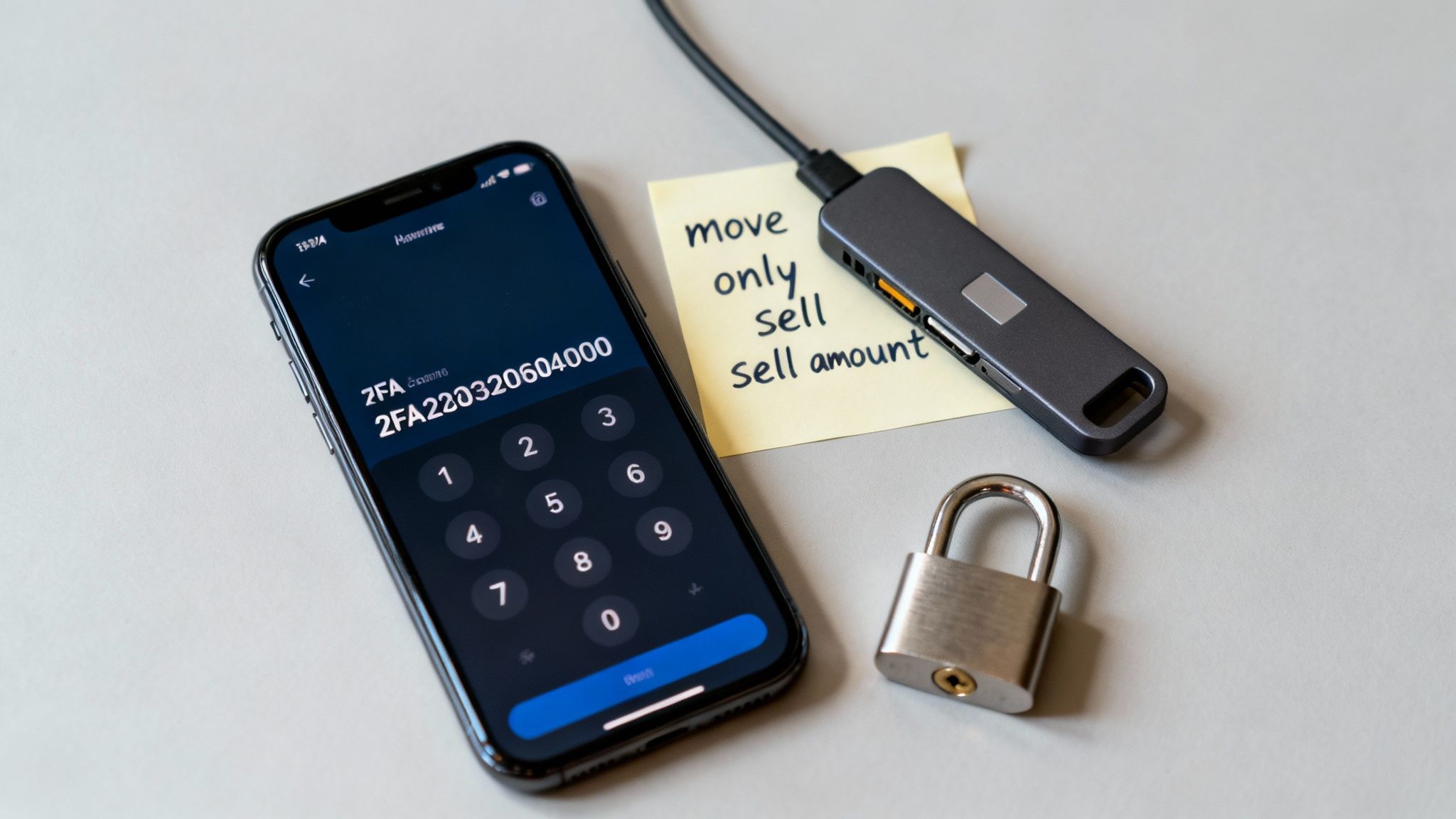
When you're ready to cash out your Bitcoin, it's easy to get tunnel vision and focus only on the price. But overlooking security at this stage is a rookie mistake that can cost you everything. Protecting your funds during the sale isn't just a good idea; it's a non-negotiable part of the process. One wrong click can put your entire stack at risk.
Your first line of defense is your exchange account login. This means creating a strong, unique password for every single platform you use. Seriously, don't recycle passwords from other sites. A data breach at some random forum you used years ago could hand attackers the keys to your crypto kingdom.
But a strong password isn't enough. You absolutely must enable Two-Factor Authentication (2FA). Using an authenticator app on your phone adds a time-sensitive code, creating a powerful second security layer. It makes it exponentially harder for anyone to get into your account, even if they somehow snag your password.
Protecting Your Bitcoin from Common Threats
Cybercriminals are always cooking up new ways to trick you, but some of the oldest tricks are still the most effective. Phishing scams, where attackers send emails or messages pretending to be from your exchange, are everywhere.
These messages are designed to create panic, telling you to click a link to "verify your account" or "stop a fraudulent transaction." Always be skeptical. Instead of clicking links in an email, open a new browser tab and type the exchange’s URL in yourself.
Key Takeaway: Never send your entire Bitcoin stash to an exchange all at once. Only move the exact amount you plan on selling right now. This simple habit dramatically limits your potential loss if the exchange account ever gets compromised, as the rest of your funds remain safe in your personal wallet.
Think of an exchange as a public place. You wouldn't walk around with your life savings in your pocket, would you? Treat your exchange balance the same way—only carry what you need for the day.
A Security Checklist Before You Sell
Before you hit that "sell" button, run through a quick mental checklist. Turning these steps into habits is one of the smartest things you can do to protect your crypto.
- Confirm the Website URL: Always double-check that you're on the legitimate exchange site. Look for the correct spelling in the URL and the "https://" lock symbol. Scammers create convincing fakes.
- Use a Secure Network: Avoid cashing out while on public Wi-Fi at a café or airport. These networks are notoriously insecure and ripe for snooping. Stick to your trusted home or office network.
- Beware of Public Offers: If a stranger on social media DMs you promising a better exchange rate, it’s a scam. 100% of the time. Block and move on.
By making these practices second nature, you can navigate the process of selling your Bitcoin with confidence, knowing you've taken the right steps to secure your hard-earned assets.
Common Questions About Cashing Out Bitcoin
Even with a solid game plan, you're bound to have questions when it's time to turn your Bitcoin back into dollars. It’s that tricky intersection where the digital world of crypto meets the old-school banking system, so a little uncertainty is totally normal.
We've pulled together the most common questions we hear to give you some straight answers. Think of it as a final checklist to run through before you dive in.
How Long Does It Take to Cash Out Bitcoin?
Cashing out Bitcoin is definitely not an instant process. It's more of a multi-step journey that can take anywhere from a few hours to several days. The biggest holdup, funny enough, is usually the final step involving the traditional banking system.
Let's break down the typical timeline:
- Moving Your Bitcoin: First, you have to get your Bitcoin from your personal wallet over to an exchange. This relies on the Bitcoin network itself and can take anywhere from 10 minutes to over an hour, depending on how busy the network is and the transaction fee you choose to pay.
- Making the Sale: Selling your BTC for fiat on a major exchange is the fastest part. A market order will fill almost instantly. Done.
- The Bank Withdrawal: Here’s where you'll need some patience. Getting that cash from the exchange to your bank account via a standard ACH transfer usually takes 1 to 5 business days to finally show up.
Can I Cash Out Bitcoin Without Paying Taxes?
Simply put, no. In most places, including the U.S., selling Bitcoin for a profit is a taxable event. Trying to sidestep this can land you in serious trouble with the tax authorities.
Any profit you realize is typically considered a capital gain, and you're required to report it. To figure this out, you subtract your original purchase price (your cost basis) from the final sale price. This is exactly why keeping meticulous records of every single transaction is so important.
Seriously, we can't stress this enough: talk to a qualified tax professional. They can help you understand exactly what you owe and make sure you're staying on the right side of the law.
A quick but critical point: you can't just send Bitcoin directly to your bank account. The Bitcoin network and the traditional banking system are two completely separate worlds. You have to use an intermediary like a crypto exchange to sell your BTC for a fiat currency (like USD or EUR) first. Only then can you withdraw that cash to your bank.
What Is the Safest Way to Cash Out a Large Amount?
When you’re talking about a significant amount of Bitcoin, your priorities shift to security and not tanking the market with your own sale. The best way to handle this is by using a large, reputable exchange that offers Over-the-Counter (OTC) services.
An OTC desk sets up a private, direct trade between you and another large buyer, keeping it completely off the public order books. This is huge because it prevents slippage—that’s when a large sell order pushes the market price down, leaving you with less money than you expected.
For an extra layer of security, consider cashing out in smaller chunks over a period of time. And when it comes to the final step, use a secure method like a wire transfer to move the funds to your bank. This careful, layered approach is the gold standard for protecting large transactions.
Ready to accept Bitcoin payments for your business without the hassle of intermediaries? Flash provides a secure, decentralized solution that connects directly to your wallet. With instant settlements, minimal fees, and no KYC requirements, you can start accepting Bitcoin in under a minute. Explore our tools and join the future of payments at .