Accepting Bitcoin donations offers charities and NGOs a way to reduce transaction costs, reach global donors, and attract younger, wealthier supporters. With crypto payment fees as low as 1–2%, compared to over 3.5% for credit cards, organizations can retain more funds. Bitcoin also enables instant, borderless donations, bypassing banking restrictions and delays. For example, during Tonga's 2022 crisis, $125,000 was raised in Bitcoin with just $25.24 in fees. Additionally, tax advantages for donors, like avoiding capital gains taxes, encourage larger contributions. By integrating Bitcoin, non-profits can modernize fundraising while ensuring transparency and security through blockchain technology.
Key benefits include:
- Lower fees: Save on transaction costs compared to traditional methods.
- Global access: Accept donations from anywhere without currency conversion issues.
- Transparency: Blockchain ensures a public, verifiable record of donations.
- Younger donors: Crypto appeals to a tech-savvy demographic with higher incomes.
- Tax perks: Donors can give more by avoiding capital gains taxes.
Bitcoin donations are already embraced by 56% of the top 100 U.S. charities, showing their growing role in philanthropy.
Nonprofit Fundraising Ideas: How to Get Cryptocurrency Donations
Benefits of Accepting Bitcoin Donations
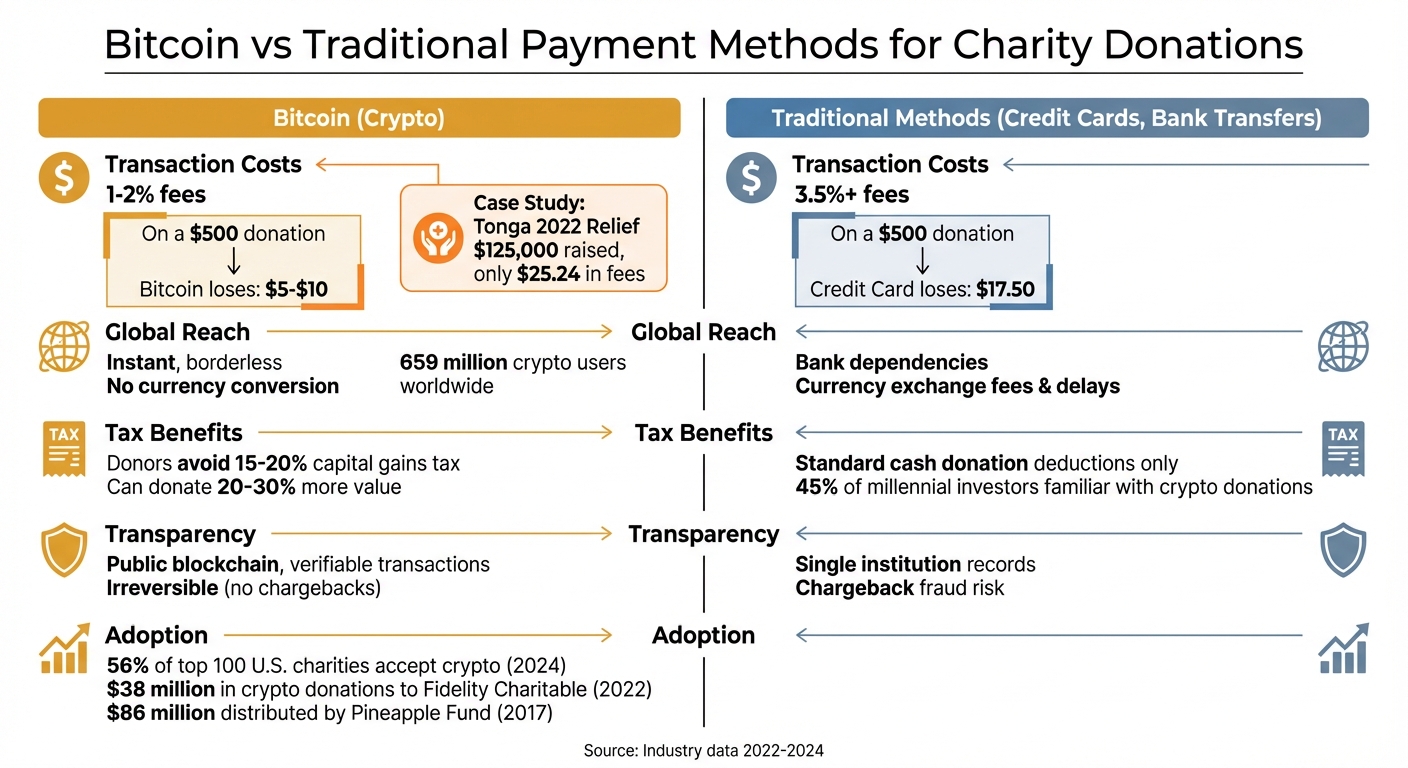
Bitcoin vs Traditional Payment Methods for Charity Donations Comparison
Reach More Donors Globally
Bitcoin makes it possible to accept instant, borderless donations without relying on banks or dealing with currency exchange hassles. This is especially helpful in regions where financial systems are unstable.
Take the Feminist Coalition in Nigeria, for example. During the anti-police brutality protests in November 2020, the Nigerian government froze their bank accounts. To keep raising funds despite government interference, they turned to Bitcoin using BTCPay Server. This allowed them to receive donations both locally and internationally without restrictions.
"The complete control over our funds and the additional privacy that bitcoin gave us felt much safer for us" - Ire Aderinokun, Organizer, Feminist Coalition
Bitcoin also offers tax advantages that encourage larger donations. Since the IRS treats Bitcoin as property, donors can bypass capital gains taxes (typically 15-20%) and deduct the full market value of their donation. This means they can contribute 20-30% more compared to cash donations. And with 45% of millennial investors already familiar with crypto donation options, this opens the door to a younger, tech-savvy donor base. Considering there are 659 million crypto users worldwide, the potential reach is enormous.
Next, let’s look at how Bitcoin’s lower transaction fees make donations even more effective.
Lower Transaction Costs
Bitcoin transactions cost significantly less than traditional payment methods. While credit card fees can exceed 3.5%, Bitcoin fees are typically just 1-2%. For example, on a $500 donation, you’d lose $17.50 to credit card fees but only around $5 to $10 with Bitcoin.
International donations also benefit from Bitcoin’s cost efficiency, as it eliminates the need for expensive wire transfers and currency conversion fees. For instance, during the January 2022 Tonga relief project, organizers raised $125,000 in Bitcoin while incurring only $25.24 in total fees.
Another advantage? Bitcoin payments are irreversible. This eliminates the risk of chargeback fraud, which can be a costly and time-consuming issue for nonprofits. With Bitcoin, you receive the full donation amount without worrying about disputes weeks or months later.
Beyond saving money, Bitcoin also builds trust through its transparent transaction system.
Increase Transparency and Donor Confidence
Bitcoin operates on a public blockchain, creating a permanent and verifiable record of every transaction. Unlike traditional payment methods that rely on a single bank or processor, Bitcoin’s decentralized network ensures transparency. Donors can track exactly where their money goes, which enhances trust and accountability - especially important for organizations working in areas where corruption might be a concern.
For donors who value privacy, Bitcoin offers the option to give anonymously or under a pseudonym while still supporting a cause.
Accepting Bitcoin also signals that your organization is forward-thinking. By 2024, 56% of the top 100 U.S. charities have embraced cryptocurrency donations, including major names like United Way and the American Red Cross.
The impact of crypto donations is evident in the numbers. In 2022 alone, Fidelity Charitable received $38 million in crypto donations. Another example is the anonymous "Pineapple Fund", which distributed $86 million worth of Bitcoin to various charities in December 2017. These examples highlight how Bitcoin’s transparency and flexibility can drive significant philanthropic efforts while offering donors the option to maintain their privacy.
How to Start Accepting Bitcoin Donations
Set Up a Flash Account and Donation Tools
Getting started is straightforward. First, sign up for a free Flash account - it only takes a few minutes. Once registered, verify your organization's identity and configure the necessary security settings to ensure compliance with regulations.
After your account is active, Flash provides three main tools to facilitate Bitcoin donations. The Donation Widget is mobile-friendly and can be embedded directly on your website using simple copy-and-paste code. Shareable Links allow you to create custom donation pages with preset amounts, perfect for sharing via email, text, or social media. Additionally, you can generate QR codes that donors can scan with their mobile wallets for instant Bitcoin payments. Select the tool that aligns best with how your supporters prefer to contribute.
Integrate Bitcoin Donation Options Across Your Channels
To make Bitcoin donations accessible, add a "Donate with Bitcoin" button to your homepage and donation page. Flash simplifies the process by offering easy-to-use code snippets that work with most website platforms - no developer needed.
Take it further by including Bitcoin donation links in email campaigns and social media outreach. Consider creating a dedicated landing page that highlights the benefits of donating with Bitcoin. With nearly 95% of Americans aware of cryptocurrency and about one in seven adults owning digital assets, this is a great way to reach a broader audience.
Once your donation channels are updated, test the system to ensure everything runs smoothly.
Test and Launch Your Bitcoin Donation System
Before launching, test the entire donation process - from clicking the donation button to completing the payment - to ensure it works seamlessly. Verify that donor information, such as names, emails, and addresses, is captured correctly before payment processing. This step is critical for issuing tax receipts and maintaining strong donor relationships.
Train your fundraising team to understand the donation process and answer common questions about Bitcoin contributions. They should also be familiar with the tax advantages for donors, like avoiding capital gains tax on appreciated Bitcoin. To simplify accounting and reduce the impact of price volatility, set your Flash account to automatically convert Bitcoin donations into U.S. dollars upon receipt.
Once everything is tested and ready, start promoting your new Bitcoin donation option to your supporters.
sbb-itb-f81ab9b
Managing Volatility, Compliance, and Security
Handle Price Volatility
Bitcoin's value can fluctuate wildly - sometimes by thousands of dollars in just one day. To manage this instability, you can use Flash's auto-conversion feature, which immediately converts Bitcoin donations to lock in the market value at the time of the transaction. Another option is partnering with a 501(c)(3) intermediary or Donor Advised Fund (DAF). These organizations can take care of legal, accounting, and liquidation responsibilities on your behalf. Whichever method you choose, make sure your approach is clearly outlined in a Gift Acceptance Policy. Once volatility is under control, ensure your donation process aligns with U.S. tax and reporting regulations.
Meet U.S. Tax and Reporting Requirements
The IRS classifies Bitcoin as property, not currency, which means charities must adhere to specific tax and reporting guidelines. Here's a summary of the key requirements for handling cryptocurrency donations. Following these rules not only ensures compliance but also builds trust with your donors. Remember, all cryptocurrency donations should be reported as non-cash contributions on Schedule M of your annual Form 990.
| Donation Value | Donor Requirement | Your Requirement |
|---|---|---|
| Under $250 | Keep a receipt with the charity's name, date, and Bitcoin amount | Provide a basic receipt |
| $250–$500 | Obtain a written acknowledgment | Acknowledge if any goods or services were exchanged |
| $501–$5,000 | File Form 8283, Section A | Provide acknowledgment and report on Form 990 Schedule M |
| Over $5,000 | Obtain a qualified appraisal and file Form 8283, Section B | Sign Section B of Form 8283 and file Form 8282 if sold within three years |
Protect Your Bitcoin Donations
Once compliance is addressed, turn your attention to securing your Bitcoin contributions. Flash provides institutional-grade infrastructure to safeguard donations. For added security, enable two-factor authentication on all your platforms. Additionally, collect donor details before sharing wallet addresses. This "Know Your Donor" strategy helps ensure accurate tax receipts and audit trails while reducing risks related to money laundering. If your organization handles a large volume of Bitcoin donations, consider using platforms equipped with Anti-Money Laundering (AML) and Know Your Customer (KYC) features for extra protection.
Conclusion: New Opportunities Through Bitcoin Donations
Accepting Bitcoin donations opens the door to a younger, wealthier donor demographic while creating a steady stream of fundraising opportunities. With crypto philanthropy expected to grow over time, this presents an exciting chance for non-profits to expand and diversify their funding strategies.
To make the most of these benefits, having the right tools in place is key. Flash makes it simple by offering payment links, donation widgets, and custom integrations that fit right into your website and communication platforms. Plus, its auto-conversion feature takes the guesswork out of cryptocurrency volatility by instantly converting Bitcoin to USD at the current market rate. This ensures your organization receives consistent funding without worrying about price fluctuations.
Bitcoin donations also bring operational perks that go beyond the financial. You can connect with international donors instantly, avoiding the delays and high fees tied to wire transfers. The blockchain's transparent ledger fosters trust, appealing to supporters who value accountability. Additionally, the tax-efficient nature of Bitcoin donations can encourage more generous contributions.
Flash takes care of the technical side, so you can focus on your mission. With features like institutional-grade security, automated compliance tools, and real-time analytics, the platform removes the typical obstacles associated with cryptocurrency donations. Whether you’re a small local charity or a large international organization, accepting Bitcoin through Flash sets you up as a leader in modern fundraising.
As digital assets continue to gain traction, it’s worth noting that 56% of the top 100 U.S. charities already accept cryptocurrency. By integrating Bitcoin donations now, you can modernize your fundraising efforts and build stronger, long-term connections with donors.
FAQs
What tax benefits can donors receive by giving Bitcoin to charities?
Donating Bitcoin to a qualified U.S. charity can offer some appealing tax benefits. Since the IRS classifies Bitcoin as property, donors can sidestep capital gains taxes on any appreciation when they donate the cryptocurrency directly. This means avoiding the typical 15%–20% tax on long-term capital gains. On top of that, if the Bitcoin has been held for over a year, donors can claim a tax deduction based on its fair market value at the time of the donation.
There is, however, a limit: deductions for gifts of appreciated property are capped at 30% of the donor's adjusted gross income. The good news? Any unused deduction can be rolled over for up to five years. This combination of tax savings and flexibility makes Bitcoin donations an efficient way to support meaningful causes while getting the most out of your contributions.
How can charities and nonprofits start accepting Bitcoin donations?
To begin accepting Bitcoin donations, nonprofits need to take a few straightforward steps. Start by selecting a trusted platform tailored for charities that supports Bitcoin transactions and provides tools like donation tracking and compliance features. After that, set up a secure Bitcoin wallet to receive the funds. Make it easy for donors by adding a donation button or QR code to your website, emails, and social media channels.
Since Bitcoin's value can fluctuate, you might want to convert donations to U.S. dollars either automatically or on a regular schedule. Stay compliant with IRS regulations by documenting the fair-market value of each donation, issuing detailed receipts, and keeping thorough records for reporting purposes. Lastly, educate your team on managing cryptocurrency donations and actively promote this giving option to reach new donors while ensuring smooth and transparent operations.
How does accepting Bitcoin donations improve transparency for charities and nonprofits?
Accepting Bitcoin gives nonprofits the ability to log every donation on a secure and unchangeable blockchain ledger. This provides a clear and traceable record of all transactions, giving donors and stakeholders the ability to see, in real time, how funds are received and handled.
This kind of transparency strengthens trust with donors while showcasing a dedication to modern technology and accountability - qualities that can help nonprofits differentiate themselves in today's digital landscape.