Bitcoin’s main network struggles with handling frequent, small payouts due to slow transaction speeds, high fees, and scalability limits. These issues create challenges for cloud mining services, including delayed payments, unpredictable costs, and inefficient treasury management. The Lightning Network solves these problems by enabling near-instant, low-cost transactions off-chain. This makes it ideal for micro-payouts, improving speed, reducing fees, and enhancing scalability.
Key Benefits of Lightning Network for Cloud Mining Services:
- Faster Transactions: Payments settle in milliseconds instead of waiting for block confirmations.
- Lower Costs: Minimal fees make small payouts feasible, even during network congestion.
- Improved Scalability: Capable of handling millions of transactions per second, meeting high-volume demands.
- Direct Wallet Payments: Non-custodial transfers ensure security and eliminate third-party risks.
Mining pools like Braiins Pool have already adopted Lightning payouts, cutting fees, enabling instant payments, and improving miner satisfaction. Tools like Flash simplify the integration process by managing nodes, liquidity, and payment routing, making the transition easier for operators.
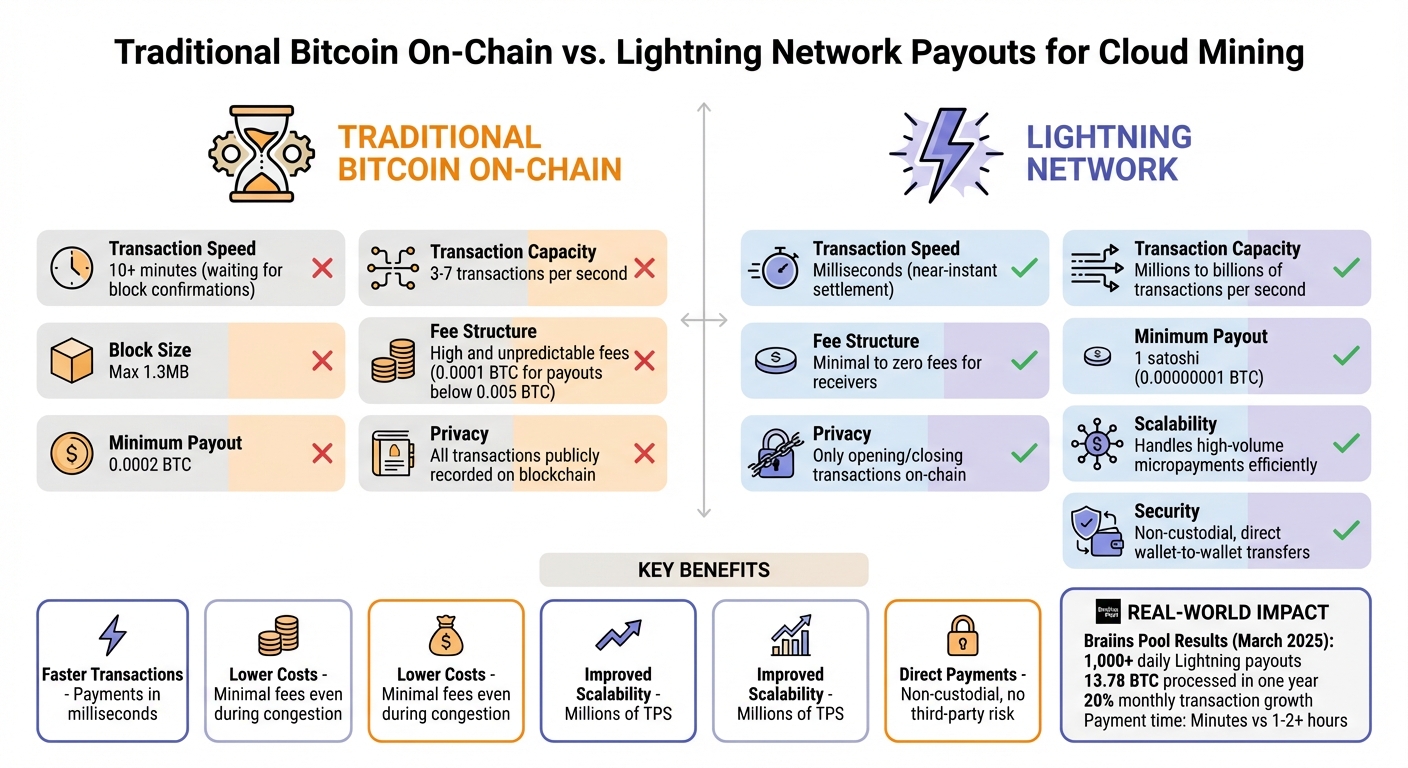
Traditional Bitcoin Payouts vs Lightning Network: Speed, Cost & Scalability Comparison
Lightning Network Bitcoin Pool Mining Payout Setup - No Fee Bitcoin Mining Withdrawal Setup Guide
Problems with Current Bitcoin Cloud Mining Payouts
Cloud mining services that depend on traditional on-chain payouts face significant challenges that can undermine both profitability and operational efficiency. These issues are tied to the inherent constraints of the Bitcoin network and create obstacles for service providers and their enterprise clients alike. Let’s break down the key problems.
High Fees and Transaction Delays
One of the biggest hurdles is the combination of high fees and slow transaction confirmations. On-chain transaction fees are notoriously unpredictable, making it tough for enterprises to estimate their operational costs. When the network gets congested, transactions pile up in the mempool, and those with lower fees risk being ignored altogether. This unpredictability directly impacts profitability. As Voltage pointed out in their 2025 announcement:
The Bitcoin mining sector has long grappled with congested on-chain transactions. On-chain fees can be volatile and unpredictable, cutting into miners' profits and slowing access to earnings.
On top of the financial burden, miners often have to wait for multiple block confirmations before they can access their funds, which limits their financial flexibility.
Scaling Limitations
Beyond fees, Bitcoin’s limited capacity for transactions presents another challenge. The network can handle only about 3 to 7 transactions per second, and block sizes rarely exceed 1.3MB. This creates a bottleneck that makes frequent, small payouts impractical, especially for operations managing payouts to thousands of users. Each individual payout also generates a UTXO (unspent transaction output), which can lead to high consolidation fees over time. The cost of processing transactions is based on data size rather than value, meaning that even a small 0.001 BTC payout can cost nearly as much as transferring 10 BTC.
Liquidity and Treasury Management Problems
The issues with fees and scaling also spill over into treasury management. Bitcoin’s average block time of 10 minutes delays settlements, tying up capital and forcing treasury managers to hold larger reserves to cover operational costs while waiting for payouts to finalize. This delay adds another layer of complexity to financial planning, making it harder for CFOs to predict when funds will be available for reinvestment or other expenses.
Some companies have found solutions to these problems. For example, by March 2025, Braiins Pool introduced Lightning Network payouts, enabling them to process up to 1,000 transactions daily. CEO Eli Nagar highlighted the impact:
Lightning payouts have completely changed the way miners receive their earnings. Rather than waiting for on-chain transactions to confirm and paying high fees, our miners are now getting instant, frictionless payouts - every single day.
In just one year, the pool processed 13.78 BTC using Lightning, with transaction volumes growing by 20% each month. This shift demonstrates how alternative solutions can address the inefficiencies of traditional on-chain payouts.
Lightning Network: A Better Way to Handle Bitcoin Payouts
The Lightning Network introduces a fresh approach to Bitcoin transactions by moving most activities off the main blockchain. Instead of logging every payout on Bitcoin’s primary layer, it uses bidirectional channels to handle off-chain transactions. This method tackles common challenges associated with traditional cloud mining payouts, such as high transaction fees, slow confirmation times, and limited capacity. Let’s explore how the Lightning Network addresses these issues with faster transactions, reduced costs, and improved scalability.
Fast Transactions and Lower Costs
Thanks to its off-chain design, the Lightning Network delivers speed and cost efficiency that directly resolve payout delays. Transactions are settled in milliseconds, eliminating the long waits that often frustrate miners who need quick access to their earnings.
The network’s low fees and near-instant settlements make frequent, small-value micropayments practical. Sending payments incurs minimal costs for the sender and often no charges for the receiver. This efficiency allows cloud mining services to distribute earnings daily - or even hourly - without fees significantly cutting into the payout amounts.
Better Scaling and Privacy
The Lightning Network can handle an enormous volume of transactions, ranging from millions to billions per second. As highlighted in the Lightning Network documentation:
Capable of millions to billions of transactions per second across the network. Capacity blows away legacy payment rails by many orders of magnitude.
This impressive scalability is made possible through routing, where payments are directed across a network of interconnected channels without requiring a blockchain entry for every transaction. This not only meets the demands of high transaction volumes but also supports enterprise-level treasury management. Additionally, since individual transactions are not permanently recorded on the public blockchain, the approach enhances privacy for users.
Direct Wallet-to-Wallet Payments
Beyond speed and scalability, the Lightning Network strengthens security by enabling direct wallet interactions. It employs Hash Time-lock Contracts (HTLCs), which ensure payments are either fully completed or canceled entirely. These blockchain-compatible smart contracts secure funds without the need for a third-party custodian.
For enterprises, this non-custodial structure is a major advantage. Cloud mining services can send payouts straight from their wallet to miners’ wallets, retaining full control over the funds. The Lightning Network whitepaper underscores this capability:
The bitcoin protocol can encompass the global financial transaction volume in all electronic payment systems today, without a single custodial 3rd party holding funds or requiring participants to have any more than a computer on a home broadband connection.
This direct wallet-to-wallet setup eliminates counterparty risks, ensuring both mining services and their clients maintain full ownership of their Bitcoin throughout the payout process. It’s an approach that aligns perfectly with the goal of optimizing treasury management in cloud mining operations.
How Flash Enables Lightning Network Integration
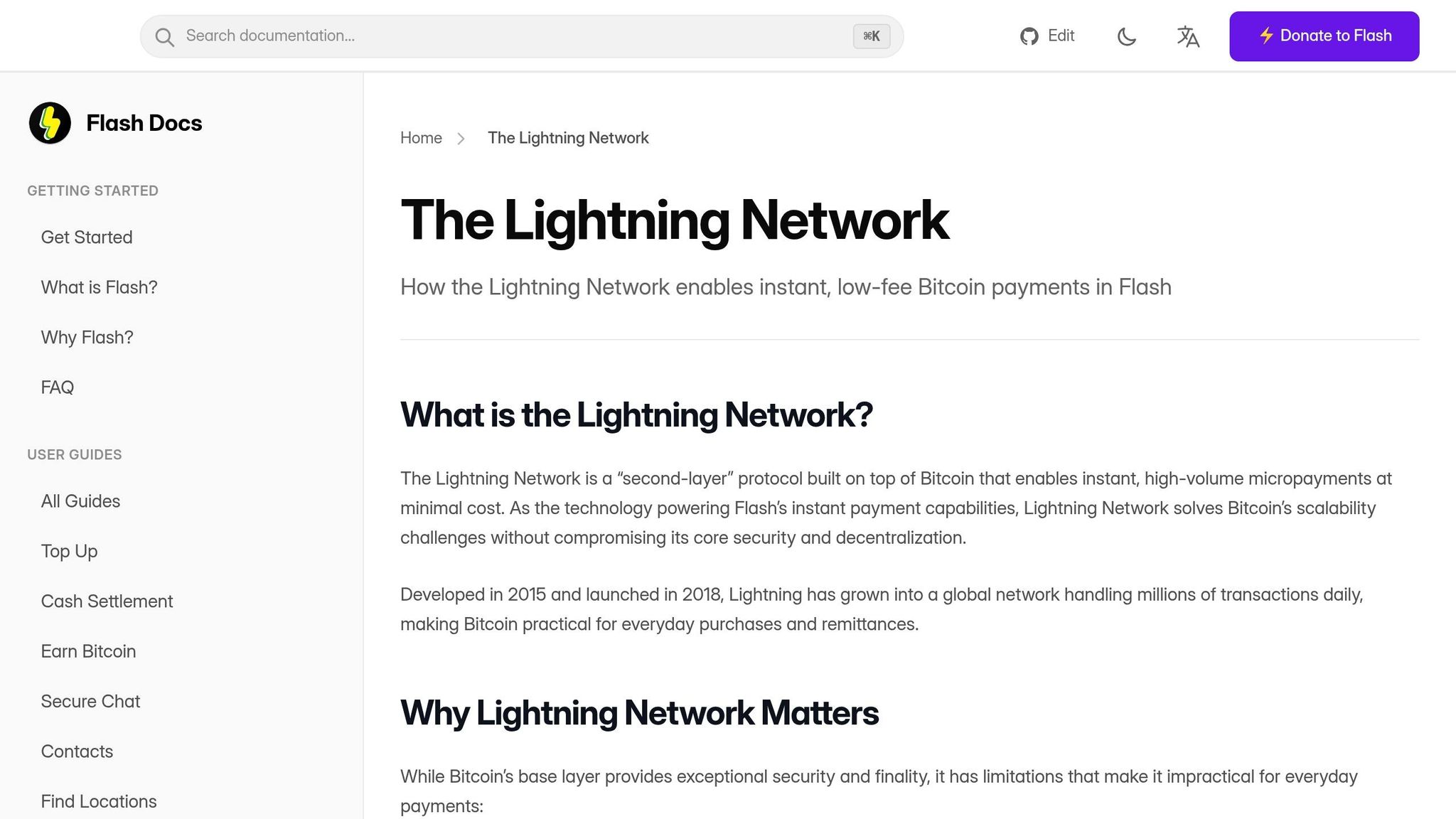
Flash builds on the advantages of the Lightning Network to streamline cloud mining payouts. By managing node operations, channel liquidity, and payment routing, Flash allows operators to focus entirely on payouts. Its tools are designed to help operators create customized and efficient payout systems.
Customizable Payment Tools
Flash offers a suite of tools like payment links, invoicing options, and real-time analytics, all tailored to fit cloud mining workflows. Operators can use static QR codes for recurring payouts and set flexible payment ranges. With an API-driven approach, Flash automates wallet creation and payout distribution. The real-time analytics dashboard provides clear insights into transaction flows and payout performance, ensuring operators have the data they need to optimize their processes.
Non-Custodial Wallet Infrastructure
Flash's system facilitates direct wallet-to-wallet payments, giving mining services and their clients complete control over their Bitcoin during the payout process. By using HTLCs (Hashed Time-Locked Contracts), Flash ensures atomic transfers without the need for intermediary trust. This non-custodial setup eliminates counterparty risk, allowing payouts to move directly from the mining service's wallet to the miner's wallet without a third party holding the funds.
Enterprise-Level Scaling and Support
Flash is designed to handle high transaction volumes with ease. Its automated liquidity management and scalable node operations keep things running smoothly. Operators can use web-based dashboards to manage nodes, explore the network, and adjust liquidity in real time. The integration of the L402 protocol adds another layer of functionality, combining Lightning payments with authentication. This enables automated payouts based on real-time mining data, enhancing efficiency and reliability.
sbb-itb-f81ab9b
How to Implement Lightning Network Distributions in Cloud Mining
Introducing Lightning Network distributions into cloud mining operations requires setting up a reliable node infrastructure, integrating miners with Lightning-compatible wallets, and performing rigorous stress tests to handle high transaction volumes. This approach enables faster and more cost-effective payouts, which can streamline treasury management for mining enterprises.
Setting Up Lightning Nodes
To get started, deploy LND (Lightning Network Daemon) on high-performance hardware. At a minimum, the system should have 4 GB of RAM (8 GB is better), a multi-core CPU running at 2 GHz or higher, and at least 1 TB of NVMe SSD storage to handle the frequent read/write demands.
You'll also need an archival Bitcoin node configured with txindex=1 and ZMQ for real-time transaction updates. For optimal performance, use databases like PostgreSQL or SQLite, enabling native SQL with db.use-native-sql=true. This setup ensures faster startups and better handling of transaction loads.
To improve accessibility and reduce latency, configure the node in hybrid mode - making it reachable via both Tor and clearnet. Additionally, establish payment channels with enough outbound liquidity. Tools like Lightning Loop or Lightning Pool can help manage liquidity effectively. Don’t forget to automate Static Channel Backups (SCB) to safeguard your funds.
Connecting Miner Lightning Wallets
Once the node infrastructure is in place, the next step is to ensure miners can easily connect their wallets to the network.
Start by implementing LNURL-pay (LNURLp). This feature allows miners to use static QR codes or addresses for payouts, eliminating the hassle of generating new invoices for every transaction. Secure the node’s API using Cloudflare Tunnels, which protects your server by avoiding direct IP exposure or the need to open router ports.
For handling large payouts, consider enabling Atomic Multi-path Payments (AMP). AMP splits transactions into smaller parts, increasing the likelihood of successful payouts even for substantial amounts. Automate these payouts using LND’s REST or gRPC APIs. The lncli payinvoice command or custom scripts can trigger payments based on mining output. To further secure the system, activate watchtowers, which monitor and protect channels from fraudulent closures when the node is offline.
Testing for High-Volume Transactions
After setting up nodes and wallet connections, it’s crucial to test the system under simulated heavy loads to ensure smooth operations during peak periods.
Start by adjusting gossip rate limits (gossip.msg-rate-bytes and gossip.msg-burst-bytes) to prevent excessive bandwidth use that could disrupt peer connections. Keep a close eye on HTLC (Hashed Time-Locked Contract) limits - each channel typically supports up to 483 concurrent HTLCs, so plan payout batches accordingly.
Set the bitcoin.timelockdelta to a higher value, such as 144 blocks (roughly 24 hours), to give the system more time to resolve any issues before HTLCs are settled on-chain. Enable features like automatic database compaction (db.bolt.auto-compact=true) and garbage collection for canceled invoices (gc-canceled-invoices-on-the-fly=true) to maintain long-term performance.
Run stress tests that simulate peak payouts to identify and address any resource bottlenecks. Monitor for "zombie channels" (inactive channels) and close them to free up liquidity for other uses. By thoroughly testing the system, you can ensure it’s ready to handle the high transaction volumes that cloud mining operations demand.
Lightning Network Success Stories in Cloud Mining
Some mining pools have successfully adopted Lightning Network payouts, showcasing improvements in cost savings, miner satisfaction, and overall efficiency. These examples underline how the Lightning Network enhances payment speed and streamlines operations in the world of cloud mining.
Case Study: Braiins Pool
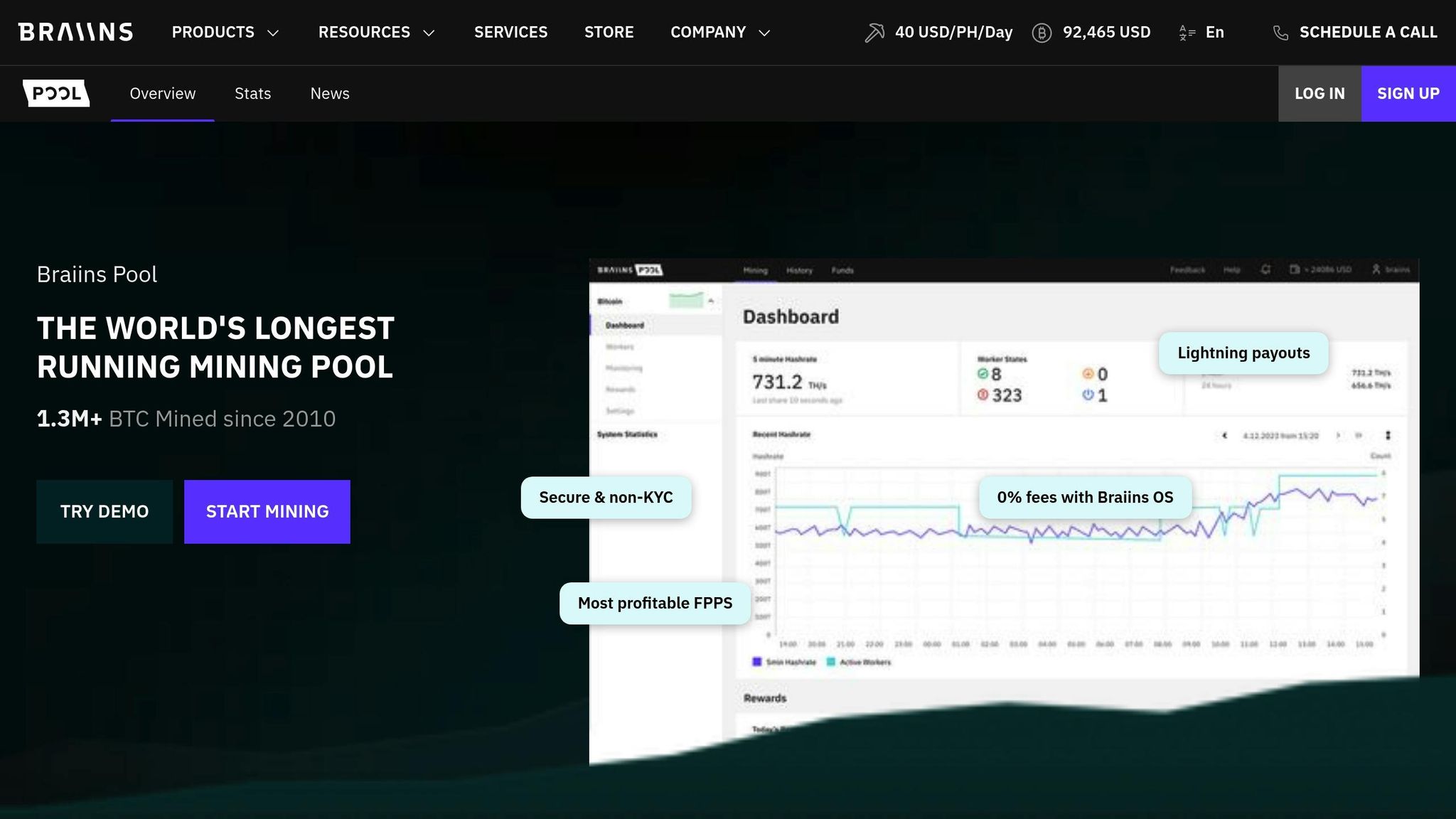
In February 2024, Braiins Pool teamed up with the payments platform Voltage to become the first major mining pool to implement Lightning Network payouts. Spearheaded by CEO Eli Nagar and Chief of Propaganda Kristian Csepcsar, the initiative aimed to tackle the issue of "dust" UTXOs and ease the strain of high on-chain transaction fees.
By March 11, 2025, Braiins Pool was processing over 1,000 daily Lightning payouts. Miners started receiving payments almost instantly - within just a few minutes, compared to the 1–2 hours (or even longer during network congestion) required for on-chain transactions. On top of that, while on-chain payouts below 0.005 BTC incur a fee of 0.0001 BTC, Lightning payouts are fee-free. The minimum payout threshold also dropped to 1 satoshi (0.00000001 BTC), a significant reduction from the previous 0.0002 BTC threshold.
Graham Krizek, CEO of Voltage, emphasized the broader impact of this achievement:
"This milestone demonstrates how Lightning enables real-world, high-volume transactions at an unprecedented scale."
– Graham Krizek, CEO, Voltage
Case Study: Titan Lightning
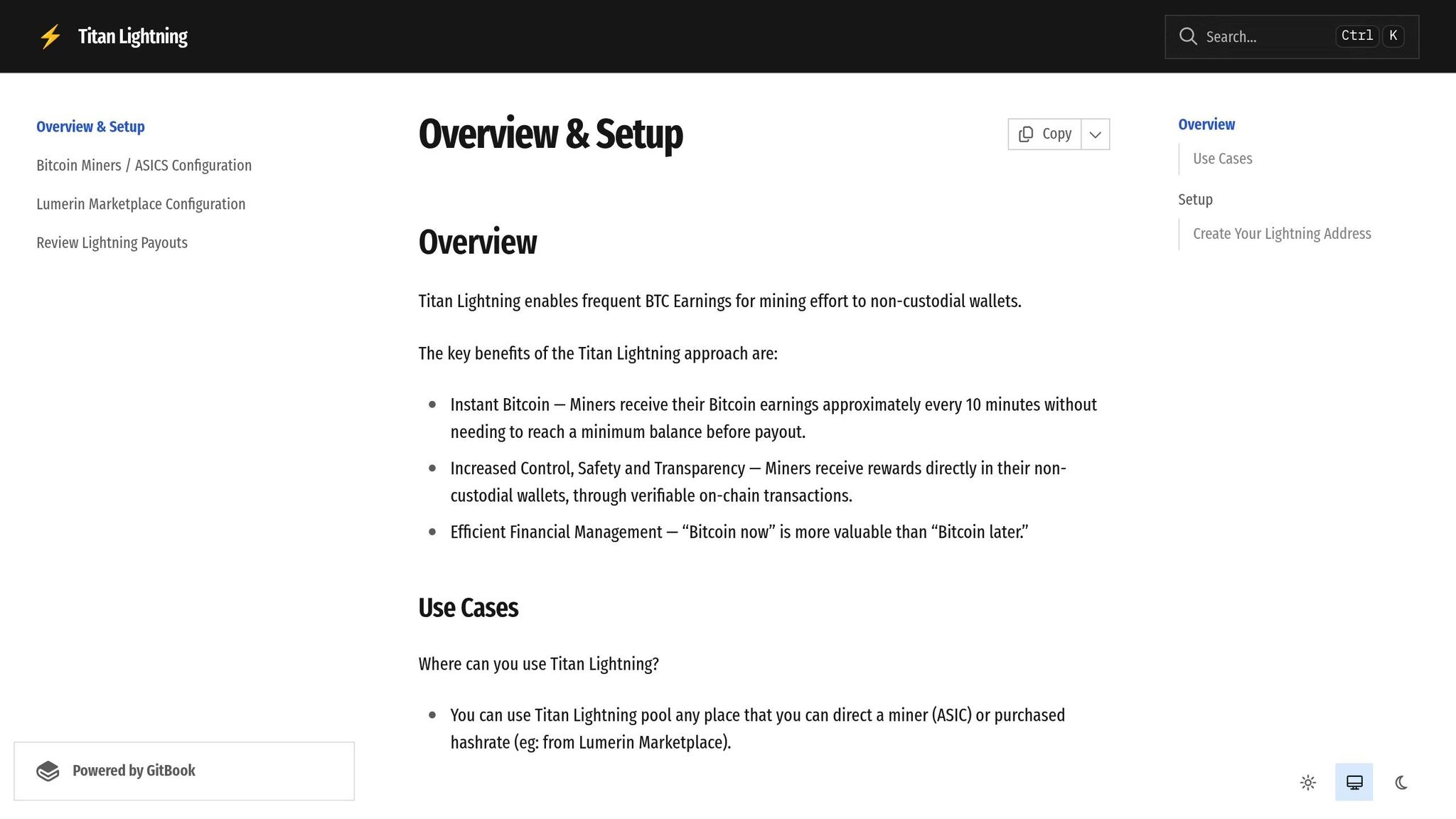
Although detailed metrics for Titan Lightning are not available, the platform has made it possible to distribute mining rewards every 10 minutes. Such frequent payouts, which would be prohibitively expensive using traditional on-chain methods, allow miners to access their earnings almost in real time. This approach significantly boosts miner liquidity and satisfaction, as they no longer need to wait for daily or weekly settlements.
Case Study: OCEAN's Cost Reduction
OCEAN leverages BOLT12 offers, which provide static and reusable payment requests along with an automated fallback system for liquidity issues. This ensures miners consistently receive their funds without delays or complications.
Conclusion
Cloud mining services face persistent challenges like high fees, slow settlements, and liquidity constraints. The Lightning Network tackles these issues head-on by enabling near-instant payouts, drastically reducing fees, and handling millions - potentially billions - of transactions per second. As Daniel Gray from Fidelity Digital Assets notes:
The Lightning Network appears to be successfully delivering on its goal of being the most efficient way to transact in the digital asset ecosystem.
This solution brings tangible advantages. For enterprise clients, miners can receive their earnings in milliseconds, and privacy is enhanced since only the opening and closing transactions are recorded on-chain. With major platforms like Coinbase, Cash App, and Kraken already connecting over 200 million users to Lightning, the infrastructure is well-established and ready for broader adoption.
Flash further simplifies this process by offering enterprise-grade APIs, automated liquidity management, and a non-custodial wallet. These tools allow CFOs to integrate Lightning-powered payouts seamlessly, eliminating the need to build backend systems from the ground up. This isn’t just a technical improvement - it’s a strategic shift that transforms efficiency in cloud mining payouts.
FAQs
How does the Lightning Network make cloud mining payouts faster and more cost-effective?
The Lightning Network transforms cloud mining payouts by utilizing off-chain transactions, which significantly cut down both the time and cost typically involved in Bitcoin payments. Instead of processing every transaction directly on the Bitcoin blockchain, this system ensures payouts are nearly instantaneous and come with very low fees.
By removing the delays tied to on-chain confirmation times, the Lightning Network becomes a perfect fit for frequent or high-volume transactions. For cloud mining services, adopting this technology means smoother payment processes and quicker, more efficient solutions tailored to enterprise needs.
What problems with traditional Bitcoin payouts does the Lightning Network solve?
Traditional Bitcoin payouts come with a few hurdles that make them less ideal for business use. Transactions on the blockchain can take up to an hour to confirm, which slows down cash flow and complicates treasury management. On top of that, transaction fees can climb to several dollars, making frequent or smaller payments expensive. The base layer's limited transaction capacity also poses scalability issues, which can be a headache for businesses handling a high volume of payouts.
The Lightning Network offers a smart solution to these problems. By using off-chain payment channels, it enables instant settlements, typically within seconds. This method slashes fees to just fractions of a cent, making even tiny payments affordable. Plus, its design supports millions of transactions per second, providing the scalability needed for large-scale operations, such as cloud mining payouts.
How can cloud mining services use the Lightning Network to improve payouts?
Cloud mining services can use the Lightning Network to make payouts faster and more affordable by running a non-custodial Lightning node. This approach allows them to send payments directly to miners’ wallets with speed and efficiency. By establishing payment channels with well-funded peers, funds can move seamlessly, ensuring miners get paid promptly and without hefty transaction fees.
Once the setup is complete, mining pools can create Lightning invoices for each miner’s earnings, typically calculated in satoshis. These invoices are settled almost instantly, doing away with traditional minimum payout thresholds and cutting transaction costs to nearly zero. This setup not only gives businesses better visibility into cash flow but also simplifies their treasury management processes.
To ensure everything runs smoothly, operators need to keep an eye on channel performance and adjust liquidity as necessary. This helps maintain consistent, scalable payouts that meet the fast-paced needs of enterprise clients while supporting the long-term growth of the mining service.