Processing Bitcoin payments doesn't have to be expensive. By combining cloud infrastructure with the Lightning Network, businesses can cut costs and improve transaction efficiency. Here's how:
- On-chain fees can exceed $60 during congestion, but Lightning Network fees are often just fractions of a cent.
- Running a Bitcoin node on physical hardware is costly - cloud platforms like AWS reduce expenses with pay-as-you-go pricing, starting at $3.70/day.
- Platforms like Flash simplify technical tasks like node management and liquidity, enabling faster, cheaper Bitcoin payments.
Key Benefits:
- Cloud services eliminate the need for physical servers, saving on storage, bandwidth, and maintenance costs.
- Lightning Network reduces transaction fees and speeds up payments.
- Managed cloud solutions provide scalability, reliability, and real-time analytics to optimize costs.
Switching to cloud-based Bitcoin payment processing can save businesses money, reduce operational complexity, and ensure smooth global transactions.
The Lightning Network in 2025 with Graham Krizek - Founder of Voltage Cloud
Bitcoin Payment Cost Breakdown
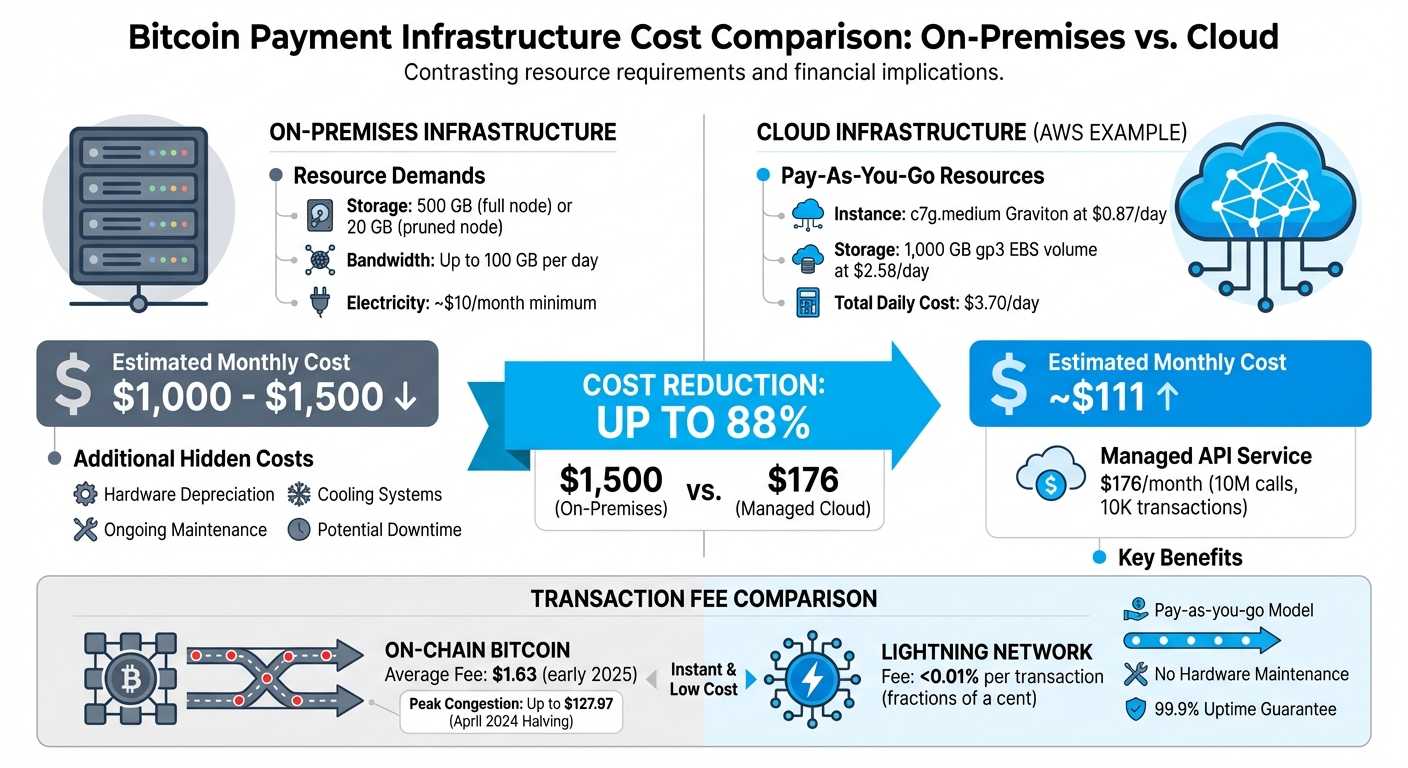
On-Premises vs Cloud Bitcoin Payment Infrastructure Cost Comparison
Processing Bitcoin payments involves two main expenses: infrastructure costs and transaction fees. Understanding these can help pinpoint where cloud-based solutions can save money.
On-Premises Infrastructure Costs
Running a Bitcoin node on physical hardware requires upfront investments in servers, storage, power, and bandwidth. For example, a full Bitcoin node stores the entire blockchain, which exceeds 500 GB, while a pruned node keeps only the most recent blocks, reducing storage needs to about 20 GB. You’ll also need a dedicated CPU and memory for validating transactions, along with sufficient bandwidth to share blocks and transactions across the network. Bandwidth usage for a full node can reach up to 100 GB per day, which can quickly drive up costs. On top of that, maintenance, cooling, and downtime add to the overall expenses.
Cloud platforms, however, offer a pay-as-you-go model that can significantly reduce costs. For instance, Syntactic Engineering reported in January 2024 that running a full Bitcoin node on AWS costs approximately $3.70 per day. This setup includes a c7g.medium Graviton instance at $0.87 per day and a 1,000 GB gp3 EBS volume at $2.58 per day. By configuring a maxuploadtarget limit of 1,440 MB per day, they managed to cap bandwidth expenses, which otherwise could climb above $30 daily due to AWS's $0.09/GB outbound data charges.
Bitcoin Transaction Fees Explained
Bitcoin transaction fees, paid to miners, are based on the size of the transaction data (measured in virtual bytes), not the amount being sent. For example, a $10 transaction takes up the same block space - and incurs the same fee - as a $1 million transaction. In early 2025, the average on-chain transaction fee was around $1.63, which might be manageable for larger payments but becomes impractical for smaller, everyday transactions. During high-traffic periods, fees can skyrocket. For instance, during the April 2024 halving event, users faced record-high average fees of $127.97 to secure block space.
To address this, Layer-2 solutions like the Lightning Network provide a cost-effective alternative. The Lightning Network operates off-chain using payment channels, requiring only two on-chain transactions (to open and close a channel) while allowing unlimited intermediate payments. Fees on the Lightning Network are typically very low - often less than 0.01% per transaction, amounting to just a few satoshis - making it ideal for small payments and high-volume retail transactions.
As Chris Stewart, Co-Founder & CEO of SuredBits, puts it: "The scarce resources that a blockchain consumes are energy and file space. The Lightning network consumes a different scarce resource - capital".
These dynamics highlight why cloud-based solutions can play a key role in reducing costs.
How Flash Reduces Payment Costs

Flash tackles both hardware and transaction fee challenges by offering cloud-based node management for Bitcoin payment processing. With Flash, businesses can enable direct, non-custodial wallet-to-wallet transactions, bypassing traditional payment processors and avoiding the 1% to 1.5% swap fees often charged by multi-chain wallets and centralized exchanges.
Flash handles the technical requirements like node management, channel liquidity, and network routing in the cloud. This eliminates the need for businesses to maintain their own Lightning nodes, cutting down on infrastructure costs and simplifying operations. The result? Near-instant Bitcoin payments with minimal fees, no matter where your customers are located.
Cloud Infrastructure Benefits for Bitcoin Payments
Cloud platforms offer a practical alternative to expensive physical hardware for Bitcoin payment processing. Instead of investing in servers and storage, companies can use managed blockchain services accessed through APIs. For instance, Amazon Managed Blockchain Access allows developers to connect with the Bitcoin network via JSON-RPC APIs, removing the need to manage node hardware.
Running a dedicated Bitcoin node in the cloud typically costs between $1,000 and $1,500 per month. In contrast, a managed API service that handles 10 million calls and 10,000 transactions costs roughly $176. This pay-as-you-go model ensures businesses only incur costs during active usage, making it easier to scale without upfront hardware expenses.
Scale Without Hardware Investment
A full Bitcoin node requires around 500 GB of storage, with an additional 16–22 GB added monthly. Cloud services take care of these growing storage demands, eliminating the need for capacity planning or hardware upgrades. This allows businesses to avoid operational headaches and focus on their core goals.
"Builders in the blockchain space are often burdened with the undifferentiated heavy lifting involved in managing a resilient fleet of blockchain node clients to access one or more public blockchains." - Amazon Managed Blockchain
By adopting a serverless approach, companies no longer need to allocate resources for hardware maintenance, synchronization, or software updates. Instead, teams can channel their efforts into developing customer-focused payment features.
Multi-Region Deployment for Reliability
Cloud infrastructure ensures high reliability through multi-region deployments, offering 99.9% uptime. Managed Bitcoin services distribute nodes across multiple Availability Zones, so if one region experiences downtime, traffic is automatically routed to healthy nodes elsewhere.
For example, when Coinbase transitioned to a managed cloud infrastructure, they achieved a 62% reduction in costs and scaled 50% faster during peak times. Tiberiu Oprisiu, Senior Staff Software Engineer at Coinbase, highlighted the importance of this infrastructure:
"We want to provide economic freedom for the rest of the world through cryptocurrency... That requires having the right infrastructure in place to enable scalability and reliability, and AWS helps us do that".
Managed services also offer horizontally scalable node fleets, monitored and replaced automatically when needed, ensuring JSON-RPC requests are processed with sub-second latency.
Real-Time Analytics for Cost Control
Cloud dashboards provide detailed insights, linking costs directly to resources. This level of transparency is crucial, as cloud users are estimated to waste 35% of their spending on unused or underutilized resources. Real-time analytics help identify and eliminate inefficiencies, such as unattached storage volumes or idle instances.
For Bitcoin payments, these tools can optimize transaction fees. Businesses can monitor network congestion using platforms like mempool.space and schedule non-urgent transactions during low-traffic periods to save on costs. Lightning Network operators can also track channel liquidity, routing success rates, and error codes, using this data to automate rebalancing for cost-efficient payment routing.
"The secret to cloud cost reduction is building cost-saving practices into the architecture" - Stephen Lucas, CPO at Hyperglance.
With cloud-native tools, businesses can implement automated rules to detect waste and notify teams of cost-saving opportunities, ensuring budgets are used effectively.
sbb-itb-f81ab9b
Moving Bitcoin Payments to the Cloud
Migrating Bitcoin payments to the cloud involves a straightforward three-step process. This approach builds on the cost analysis discussed earlier.
Step 1: Calculate Current Infrastructure Costs
Start by assessing your current expenses. Running on-premises Bitcoin nodes typically costs about $10 per month in electricity alone. But that's just the start - factor in hardware depreciation, bandwidth, and maintenance labor to get a full picture of your total costs. Tracking these expenses over a billing cycle will give you a solid baseline.
If you're using physical servers for full nodes, don't forget to account for future storage expansion over the next 12–24 months. This baseline will help you compare and evaluate the potential savings and benefits of moving to the cloud.
Step 2: Set Up Lightning Nodes on Cloud Platforms
Next, deploy your Lightning nodes on cloud platforms like AWS. For example, you can use Graviton instances such as c7g.medium, which cost roughly $0.87 per day. Pair this with gp3 EBS volumes for storage at $0.08 per GB per month to keep costs manageable. Cloud deployment also offers scalability and reliability by leveraging multi-region availability.
Start with a high-performance instance to sync your node in about 6–8 hours. Once synced, switch to a smaller instance (2 cores, 2 GB) to reduce ongoing costs. To manage bandwidth expenses, set maxuploadtarget=1440M in your bitcoin.conf file. This limits daily bandwidth costs to around $0.25, avoiding hefty AWS egress fees that can climb to over $30 per day.
For better reliability, deploy your nodes across multiple Availability Zones or regions. As highlighted in Mastering the Lightning Network:
"If the Lightning node is offline, it cannot receive any payments from anyone, and thus its open invoices cannot be fulfilled".
Don't forget to automate backups for channel states and node configurations. Losing this data could result in permanent fund loss.
Step 3: Connect Flash for Payment Processing
Once your cloud nodes are up and running, the next step is to optimize payment processing. This is where Flash comes in. Flash offers tools like payment links, widgets, point-of-sale systems, and custom integrations - all designed to work seamlessly with your Lightning nodes. It supports non-custodial wallet-to-wallet payments, ensuring funds move directly between parties.
You can configure Flash tools through APIs or no-code options, depending on your needs. Additionally, set up real-time analytics dashboards to track key metrics like channel liquidity, routing success rates, and transaction costs. This level of visibility helps you fine-tune payment flows and uncover ways to save money as your transaction volume grows.
Optimizing Cloud-Based Bitcoin Payment Costs
Once your cloud-based Bitcoin infrastructure is up and running, the next step is to fine-tune it for cost efficiency. The biggest savings come from focusing on three areas: automating channel management, monitoring performance metrics, and reducing data transfer expenses.
Automate Lightning Channel Operations
Managing Lightning channels manually can quickly become expensive and time-consuming. By using automated tools, you can handle tasks like rebalancing, liquidity management, and fee adjustments without constant oversight. This not only lowers labor costs but also extends the lifespan of your channels, spreading the cost of opening and closing them over more transactions.
For instance, Autoloop within the Lightning Terminal can automatically swap off-chain funds for on-chain funds, ensuring steady inbound liquidity without manual intervention. You can also deploy rebalancing scripts like rebalance-lnd, balanceofsatoshis, or LNDg to maintain balanced channels for two-way traffic. Additionally, running Faraday regularly helps you identify and close inactive "zombie" channels, reallocating capital to routes that generate fees. However, always ensure that the cost of rebalancing is justified by the routing income it generates. Automating these operations is one of the key ways to maximize cost efficiency in a cloud-based setup.
Track and Improve Payment Performance
Real-time monitoring is essential for identifying inefficiencies before they escalate into bigger problems. For example, tracking "Max Flow" helps you understand the likelihood of successful payments across the network based on current channel constraints and liquidity. Monitoring channel uptime and lifetime is also crucial since offline channels lock up capital and reduce efficiency.
Another important metric is the comparison of routing fees earned (e.g., fees_incoming_msat) against rebalancing and on-chain fees, which provides a clear view of cost efficiency. Tools like Flash's analytics dashboards make this process easier by offering insights into channel liquidity, routing success rates, and transaction costs in real time. These dashboards complement cloud monitoring tools, helping you streamline operations further. Additionally, setting up spending alerts through services like Amazon CloudWatch can notify you when estimated charges exceed predefined thresholds. Monitoring CPU usage, memory, and network I/O also allows you to optimize instance sizes, which can lead to significant cost reductions - especially after the initial node synchronization phase.
Lower Data Transfer and Storage Costs
Data transfer fees can add up quickly if not carefully managed. To minimize these costs, use VPC endpoints to keep traffic within your cloud provider's network, avoiding pricey internet egress fees. For services like Amazon S3 and DynamoDB, Gateway VPC endpoints are a better choice since they don’t incur hourly charges like Interface VPC endpoints do. Using Amazon CloudFront with a security savings bundle can also reduce data transfer costs by as much as 30%.
Another tip is to place NAT gateways in the same Availability Zones as high-traffic instances to avoid cross-AZ data transfer charges. You can also configure auto-settlement thresholds to automatically convert balances to fiat or stablecoins when they reach certain levels, which simplifies accounting and reduces the need to store large amounts of transaction data. Additionally, batching multiple transfers into a single on-chain transaction and scheduling them during off-peak hours can cut fees by up to 50%. These strategies align with your cloud migration efforts to further reduce Bitcoin payment costs effectively.
Conclusion
Switching to the cloud can slash node expenses from $1,000–$1,500 to as low as $176 per month, while also eliminating the hassle of managing 500 GB of data that grows by 16–22 GB monthly.
Flash takes advantage of the Lightning Network to avoid on-chain fees, enabling near-instant payments at a fraction of the cost. Its non-custodial design ensures you retain full control of your funds, offering fast settlements with minimal fees. Features like serverless detection and automated channel rebalancing further reduce the need for manual intervention, saving both time and money.
The financial benefits of cloud migration go well beyond infrastructure savings. Companies that have made the shift report a 50% reduction in five-year operational costs and a 40% cut in overall IT expenses. Take Conde Nast's 2022 migration, for example - they reduced costs by 40% while boosting operational performance by 30–40%. Similarly, Australia Finance Group saved AU$500,000 annually on IT operations, reallocating those funds toward innovation. These examples highlight the strategic edge of embracing cloud-based systems.
You don’t have to overhaul your setup all at once. Begin by assessing your current infrastructure costs. From there, deploy Lightning nodes on cloud platforms using managed services with 99.9% uptime guarantees. Integrate Flash for payment processing to handle transactions while letting your cloud infrastructure manage the heavy computational tasks. This step-by-step approach transitions you from on-premises limitations to a scalable, cost-effective cloud solution for Bitcoin payments, delivering immediate savings and setting your business up for growth as transaction volumes increase.
FAQs
How does the Lightning Network help lower Bitcoin transaction costs?
The Lightning Network cuts down Bitcoin transaction fees by using off-chain payment channels. These channels let users exchange multiple payments directly with each other without logging every transaction on the blockchain. This reduces network traffic and brings fees down to mere fractions of a cent.
With instant payment processing and no need for intermediaries, the Lightning Network doesn't just lower costs - it also boosts the speed and capacity of Bitcoin transactions. This makes it a great option for businesses managing frequent payments or small-scale transactions.
How does using cloud infrastructure lower Bitcoin payment costs?
Leveraging cloud infrastructure for Bitcoin payments offers businesses a smart way to cut costs. By lowering transaction fees, simplifying processes, and removing the need for pricey on-site hardware, companies can save significantly. Cloud-based solutions also allow for near-instant settlements and support direct, wallet-to-wallet payments, eliminating intermediaries and their fees.
On top of that, businesses can scale their payment systems effortlessly to meet changing demand. This flexibility ensures a cost-efficient and dependable method to handle Bitcoin transactions worldwide.
How can businesses save money by automating Bitcoin payments?
Businesses can cut costs on Bitcoin payments by using blockchain technology and automation tools offered by platforms like Flash. For instance, integrating the Lightning Network can bring transaction fees down to mere fractions of a cent while ensuring settlements happen almost instantly. This approach eliminates many of the expenses tied to traditional payment methods, such as credit card processing fees or bank transfer charges.
Platforms like Flash also provide automation tools that make handling Bitcoin payments easier. These tools can manage tasks like secure storage, transaction approvals, and compliance checks, all while reducing errors and enhancing security. By simplifying these processes, businesses can manage large transaction volumes efficiently, keep operational costs low, and maintain smooth payment workflows.