When you start comparing payment gateways, you quickly realize the core difference isn't that complicated: each one strikes a unique balance between fees, features, and the headache of integration. The best choice isn't a one-size-fits-all solution; it depends entirely on your business model, how much you sell, and whether you have a developer on standby.
Why Your Payment Gateway Choice Matters
Picking the right payment gateway is one of those foundational decisions that ripples through your entire online business, hitting everything from customer checkout conversions to your actual profit margin. The market for these services is exploding—it was valued at around $12.81 billion in 2025 and is on a steep upward climb. That means more options for you, but also more noise to cut through.
This guide is designed to go beyond the usual shallow feature lists. My goal is to give you the strategic insights you need to confidently pick a partner that will actually help your business grow. We'll be comparing three major players head-to-head: Stripe, PayPal, and Flash. For those with very specific needs, looking into the best payment processing solutions for small businesses can offer even more tailored advice.
A First Look at the Contenders
Before we get into the nitty-gritty, let's get a high-level feel for each contender. This quick snapshot will help frame the detailed analysis that follows, giving you an immediate sense of their main strengths and who they're built for. Think of it as the 30,000-foot view before we dive deep into the weeds.
Key Insight: Don't just pick a payment gateway because it's the most popular. The biggest name on the block might not be the most cost-effective or feature-rich for what you actually need. A real, detailed comparison is non-negotiable.
Here’s a quick overview of the payment gateways we'll be breaking down throughout this guide.
High-Level Payment Gateway Snapshot
This table gives you a starting point for understanding where each gateway fits in the market.
| Gateway | Best For | Key Feature Highlight |
|---|---|---|
| Stripe | Tech-savvy businesses & custom integrations | Robust APIs and extensive developer tools for customization. |
| PayPal | E-commerce stores seeking trust and high conversion | Unmatched brand recognition and a massive existing user base. |
| Flash | Merchants prioritizing speed and low fees | Instant, decentralized Bitcoin payments with no intermediaries. |
This table provides a great launchpad for our discussion. Now, let's unpack how these high-level traits translate into real-world performance, costs, and user experience to find the perfect match for your business.
The Four Pillars of Payment Gateway Comparison
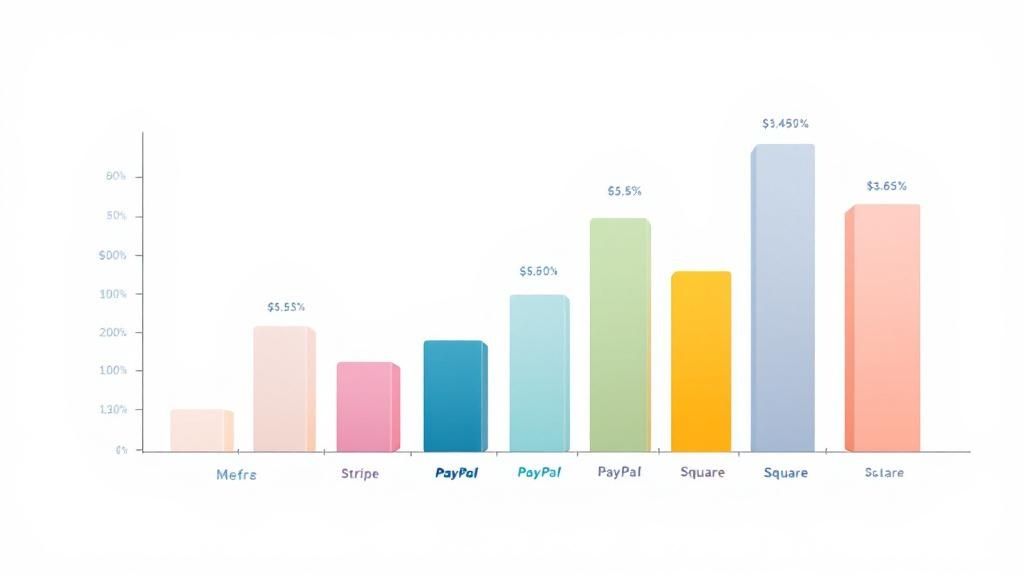
Before you start pitting payment gateways against each other, you need a solid game plan. Without a clear framework, it's easy to get tangled up in marketing speak and lose sight of what actually matters for your business. We've boiled down this entire process into four foundational pillars to guide your choice.
Think of these pillars less as technical specs and more as the core business functions your payment processor will manage. Grasping them lets you cut through the noise and focus on what drives revenue, protects your customers, and sets you up for future growth.
Pillar 1: Transaction Fees and Pricing Models
Let's start with the most obvious factor: cost. But a gateway's price tag is rarely just a single percentage. You have to look past the headline rate to get a true sense of what you'll be paying.
Pricing models generally come in a few flavors:
- Flat-Rate Pricing: Simple and predictable. You pay a set percentage plus a small fixed fee for every sale (think 2.9% + $0.30). This is perfect for startups or businesses with a lower average ticket size because it makes forecasting a breeze.
- Interchange-Plus Pricing: This one's more transparent but also more complex. It passes the direct interchange fee from card networks like Visa or Mastercard straight to you, adding a fixed markup. For high-volume businesses, this almost always works out to be cheaper.
- Tiered Pricing: Here, transactions get sorted into different tiers (like qualified or non-qualified), each with its own rate. Be warned: this model can be confusing and often ends up costing more because it's not always clear which tier your transactions will fall into.
And don't forget to hunt for hidden fees. Are there monthly charges? Setup costs? Fees for PCI compliance or chargebacks? A temptingly low transaction rate can be a smokescreen for a dozen other little charges that add up.
Situational Insight: A small Etsy shop doing $5,000 a month might be best off with a simple flat-rate provider like PayPal. On the flip side, a retailer processing $100,000 a month could save a bundle with an interchange-plus model, even if it means more work reading the statements.
Pillar 2: Security and Compliance
This is non-negotiable. Protecting customer data is everything. A single security breach can sink your brand's reputation for good, not to mention the financial hit. Your payment gateway is your first and most important line of defense.
The absolute bedrock of payment security is PCI DSS (Payment Card Industry Data Security Standard) compliance. It’s a set of rigorous security rules for any company that handles credit card information. Using a gateway that is fully PCI compliant takes a huge chunk of this security burden off your shoulders.
Beyond that, look for modern fraud detection tools. The best gateways now use machine learning to scan transactions in real-time, automatically flagging and stopping shady activity. Features like Stripe Radar or other proprietary systems can literally save you thousands in fraudulent chargebacks.
Pillar 3: Integration and Developer Experience
So, how does this thing actually connect to your website or app? Ease of integration has a direct impact on how quickly you can get up and running and how much you'll spend on maintenance down the road. For many, a gateway with pre-built plugins for platforms like Shopify, WooCommerce, or Magento is the path of least resistance.
If you need a more custom setup, the quality of the API (Application Programming Interface) and developer docs becomes critical. A clean, flexible API gives your tech team the power to build a completely seamless and branded checkout experience. This is especially vital for SaaS companies, marketplaces, and businesses with unique subscription models.
The market for these tools is massive. In 2022, the payment gateway industry was already worth $26 billion, a number that ballooned to $47 billion by 2025. Projections show it rocketing to an incredible $161 billion by 2032. With large enterprises accounting for 55% of the market and SMEs the other 45%, it’s clear why we need everything from simple plugins to powerful APIs. You can dive deeper into these trends in this detailed payment gateway analysis.
Pillar 4: Support and Payout Schedules
When—not if—a payment issue pops up, you need help, and you need it fast. A customer who can't pay is a lost sale. Simple as that. Look at the support options. Is it just email and forums, or can you actually get a human on the phone or via live chat? Scour reviews and forums to see how responsive and helpful they really are.
Finally, check the payout schedule. How quickly does the money from your sales actually land in your bank account? This can vary wildly, from the next business day to several days or even weeks. For any business managing a tight cash flow, a fast and reliable payout schedule is an operational lifeline.
Comparing Stripe vs PayPal vs Flash Head to Head

Alright, this is where the rubber meets the road. It’s time to put Stripe, PayPal, and Flash next to each other and see how they stack up against the criteria that actually matter to a business owner.
The goal here isn't to crown a single "winner." It's to give you the specific, real-world insights you need to figure out which platform genuinely fits your business's DNA. We're going beyond generic feature lists to look at how their fee structures will impact your bottom line and how their developer tools either help or hinder your growth. By the end, you'll see clearly where each one shines and where they might not be the right fit for you.
Transaction Fees and Pricing: A Practical Breakdown
For any merchant, the first and most immediate concern is cost. Even a fraction of a percent can add up to thousands of dollars in lost revenue over a year. Let's break down how each of these contenders handles pricing.
Stripe: Famous for its developer-first approach, Stripe keeps things simple with a predictable flat-rate fee for online card payments, typically 2.9% + $0.30. While this predictability is a huge plus, keep in mind that costs can creep up if you deal with a lot of international cards or need currency conversions.
PayPal: PayPal’s standard online rate is a mirror image of Stripe's at 2.9% + $0.30. But don't let that fool you—their fee structure can get complicated quickly. You'll find different rates for things like QR code payments, international sales, and various other transaction types.
Flash: Here’s where the model gets a complete overhaul. As a decentralized Bitcoin payment provider, Flash enables direct wallet-to-wallet transactions. This setup cuts out the traditional banking networks entirely, leading to dramatically lower fees—often just a tiny fraction of a percent with no fixed per-transaction cost.
Real-World Scenario: Picture an e-commerce store pulling in $20,000 in domestic sales each month from about 400 transactions. With Stripe or PayPal, the fees would hover around $700 ($20,000 * 2.9% + 400 * $0.30). With Flash, the cost would be almost negligible, tied only to the minimal Bitcoin network fee at that moment. That's a potential saving of over $8,000 a year.
Integration and Developer Experience
How easily a gateway plugs into your website or app is a massive factor. This dictates how quickly you can get up and running and how much you'll spend on ongoing maintenance.
Stripe is the undisputed champion for any business that needs deep customization. Its API is famously powerful, well-documented, and incredibly flexible, making it the go-to for SaaS platforms, marketplaces, and anyone building a unique payment experience. The sheer volume of official and third-party integrations for platforms like WooCommerce and Shopify is a game-changer.
PayPal, on the other hand, puts simplicity first. While it does offer APIs, its real strength is in its straightforward, plug-and-play buttons and pre-built integrations. You can add them to a website with almost no technical skill, making it perfect for small businesses or e-commerce stores that just want a trusted checkout solution, fast. Understanding its core functions, like the PayPal subscription payment setup, is key to seeing if it fits your model.
Flash carves out a middle ground. It offers dead-simple, no-code tools like customizable payment buttons and links that you can deploy in minutes. For those who need more muscle, Flash also provides well-documented APIs and webhooks for custom integrations into apps and complex e-commerce systems, all without the traditional compliance headaches.
Security and Fraud Prevention
Protecting your business and your customers is non-negotiable. Each of these gateways approaches security with a different philosophy and toolset.
Stripe has poured huge resources into its proprietary security, with Stripe Radar as its crown jewel. This machine-learning system sifts through data from millions of global transactions to spot and stop fraud before it happens. This proactive, automated protection is baked right into the platform and is a huge selling point.
PayPal leans on its massive global network and decades of experience. Its seller protection policies can shield merchants from losses due to chargebacks and fraud, as long as you play by their rules. Plus, the sheer familiarity of the PayPal brand gives customers a sense of security that can genuinely boost conversions.
Flash provides security through a fundamentally different mechanism: decentralization. By handling direct wallet-to-wallet Bitcoin payments, it eliminates the need for any middleman to store sensitive customer financial data. This architecture drastically shrinks the target for data breaches and completely removes the risk of traditional chargeback fraud, since Bitcoin transactions are irreversible. For merchants in high-risk industries or those plagued by fraudulent disputes, this is a massive advantage.
Detailed Feature and Fee Comparison
To really see the differences, we need to line them up feature-for-feature. The table below breaks down the key distinctions, from what you'll pay per transaction to how quickly you get your money.
| Feature/Criteria | Stripe | PayPal | Flash |
|---|---|---|---|
| Standard Fee | 2.9% + $0.30 | 2.9% + $0.30 | Minimal Bitcoin network fee |
| International Cards | Additional 1.5% fee | Additional 1.5% fee | No extra fee (global by nature) |
| Currency Conversion | Additional 1% fee | 4.0% or higher fee | No conversion fee (uses BTC) |
| Developer API | Highly robust and flexible | Functional, but less extensive | Simple and easy to integrate |
| Subscription Tools | Advanced (Stripe Billing) | Available (PayPal Subscriptions) | Built-in (Recurring Invoices) |
| In-Person Payments | Yes (Stripe Terminal) | Yes (PayPal Zettle) | Yes (Point-of-Sale App) |
| Fraud Protection | Advanced (Stripe Radar) | Strong (Seller Protection) | Inherent (Decentralized) |
| Payout Speed | 2 business days (standard) | 1-3 business days | Instant (wallet-to-wallet) |
| KYC Requirement | Yes, for merchant | Yes, for merchant | No |
This side-by-side view makes their unique value propositions crystal clear. Stripe is all about customization and powerful tools. PayPal wins on brand trust and out-of-the-box simplicity. And Flash stands apart with its instant settlement, rock-bottom fees, and global reach through the Bitcoin network, offering a powerful alternative for businesses focused on efficiency and cost-cutting.
Ultimately, your choice depends on which of these columns best reflects what your business needs most right now.
Matching a Gateway to Your Business Model
 A feature-by-feature comparison is a great starting point, but the spec sheet doesn't tell the whole story. The right payment gateway is the one that fits your business like a glove—its strengths have to align with your specific operational needs, your customer base, and where you plan to grow. What’s a perfect fit for one company can be a clunky, expensive mistake for another.
This is where we get practical. Let's move beyond the theory and look at common business models to see which gateway offers the most direct benefits. By examining real-world scenarios, you can see which solution truly lines up with your goals and sidestep the common trap of just picking the most popular name.
For SaaS and Marketplaces Needing Customization
When you're running a Software-as-a-Service (SaaS) company, a multi-vendor marketplace, or any platform-based business, your payment needs are far more complex than a simple "buy now" button. You're dealing with tiered subscriptions, metered billing, and the tricky logistics of splitting payments between multiple parties. This is where a developer-first solution isn't just a nice-to-have; it's essential.
Stripe is the definitive choice for this model. Its API is the gold standard for a reason—it’s powerful, flexible, and famously well-documented. Stripe gives your developers the toolkit they need to build truly sophisticated payment flows from the ground up. Whether you're managing recurring revenue with Stripe Billing or building out a complex marketplace with Stripe Connect, the entire platform is engineered for this level of technical control.
Think about a SaaS business that needs to automatically bill customers based on their specific feature usage each month. Or a marketplace for freelance artists that has to seamlessly route a client's payment to the correct artist while automatically deducting a platform fee. That's the kind of granular control Stripe was built for, and it's what makes complex, scalable business models possible.
For Ecommerce and D2C Brands Prioritizing Conversion
If you're in the direct-to-consumer (D2C) or traditional ecommerce space, your world revolves around one thing: reducing friction at checkout. The biggest enemy is the abandoned cart, and a major cause is a checkout process that feels unfamiliar or untrustworthy.
PayPal is the undisputed leader in this arena. Its power comes from immense brand recognition and a colossal existing user base. When a potential customer sees that familiar PayPal button, it provides an instant dose of security. Better yet, for millions of users, it means they can check out in a couple of clicks without ever needing to get up and find their credit card.
A study on checkout optimization found that offering a trusted, familiar payment method like PayPal can boost conversion rates by a significant margin. For an online store, this translates directly into more sales and revenue from the same amount of website traffic, making it a powerful and low-effort growth lever.
This trust factor is especially valuable for new brands that are still working to establish credibility. While Stripe and Flash also provide clean checkout experiences, neither can compete with the sheer global familiarity that the PayPal brand brings to the table.
For Startups and Niche Businesses Focused on Efficiency
Startups, creators selling digital products, and businesses serving niche markets usually run on lean teams and even tighter margins. Their priorities are different. They need to get up and running fast, keep overhead 비용 to an absolute minimum, and avoid operational headaches. They need a payment solution that "just works" without demanding a team of developers or eating into their profits with high fees.
Flash is purpose-built for this use case. By bypassing the old-school payment rails, Flash enables instant, wallet-to-wallet Bitcoin payments. This approach absolutely slashes transaction fees to a tiny fraction of what credit card processors charge—a game-changing advantage for any business where every percentage point counts.
Imagine a digital artist selling an ebook for $15. With a traditional gateway, a hefty chunk of that small sale disappears into processing fees. With Flash, the cost is next to nothing, allowing the creator to keep almost all of their hard-earned revenue. Plus, since Flash requires no KYC (Know Your Customer) to get started, a merchant can start accepting payments from anywhere in the world in minutes, not days. This blend of ultra-low cost and speed makes it the perfect choice for agile businesses that need to maximize efficiency.
This shift aligns with what's happening in the broader market. The global payment gateway market is on track to grow from $26.7 billion to $48.4 billion between 2024 and 2029. This explosive growth is driven by new digital business models that demand more flexible, efficient payment solutions. As commerce becomes more global, the need for low-cost, instant transaction methods will only get stronger. You can explore more insights on this market growth at GlobeNewswire.com.
How to Finalize and Implement Your Choice
Okay, you've done the homework. You’ve stacked up the features, scrutinized the fee structures, and identified which business models each gateway serves best. Now comes the critical part: moving from analysis to action.
This is where you lock in your choice and get it wired into your operations. It’s about taking all that research and turning it into a real, functioning setup that puts money in your bank. It starts with one last look in the mirror, followed by a clear plan to get things live.
Your Final Decision Checklist
Before you sign on the dotted line, take a moment to run through these final questions. This isn't about second-guessing; it's about making sure your choice is grounded in the reality of your business, not just what looks good on paper.
- What's my real monthly sales volume? If you're pushing serious volume, even a fraction of a percent in fees adds up fast. A provider like Flash, with its minimal network fees, could save you a small fortune compared to a standard flat-rate processor.
- What’s my team’s tech-savviness? Let's be honest here. Do you need a plug-and-play solution like a PayPal button or a simple Flash payment link? Or do you have developers ready to dive into a robust API from a provider like Stripe? Your choice has to match your resources.
- Where are my customers? If your audience is global, you need a gateway that doesn't put up borders. Stripe is a solid choice for simplifying cross-border card payments, but an inherently global network like Flash opens you up to anyone, anywhere, without the usual currency conversion headaches.
- Where is this business headed? The right gateway for today should also be the right gateway for tomorrow. If you're planning to introduce subscriptions, expand into new countries, or launch a full-blown marketplace, make sure your provider has the tools to scale with you.
Key Takeaway: The "best" gateway isn't a universal title. It's the one that provides the best answers to your business's specific questions. The final decision should feel less like a compromise and more like a strategic advantage.
Kicking Off Your Implementation
Decision made. Now for the fun part: getting it all up and running. While every provider has its own unique quirks, the path from creating an account to accepting that first payment generally follows the same core steps.
Don't rush this. A sloppy setup can come back to bite you with declined payments, angry customers, security holes, or delayed settlements. Let's walk through how to do it right.
Here’s a no-nonsense guide to getting started:
Create Your Merchant Account: This is square one. You'll hand over your basic business details to get your account on the books. For traditional players like Stripe or PayPal, this kicks off their formal verification. With decentralized options like Flash, this part is often nearly instant since there's no traditional KYC.
Complete the Verification Process: Legacy processors are legally obligated to run Know Your Customer (KYC) or Know Your Business (KYB) checks. This means you'll need to submit documents like your business registration, tax ID, and personal identification. Be ready for this to take a few days.
Configure Your Settings: Once you're in, get familiar with your new dashboard. This is your mission control. You’ll link your bank account for payouts, customize your checkout page's look and feel, set up security rules, and tweak notification settings. Take your time and explore every option.
Integrate with Your Platform: Here’s where the magic happens. If you’re on a common e-commerce platform like Shopify or WooCommerce, this is usually as easy as installing a plugin and pasting in your API keys. For a custom-built site or app, your developer will need the gateway’s API documentation to build the connection.
Run Test Transactions: I'll say it again: never, ever skip this step. Every gateway provides a "test mode" or "sandbox" environment for a reason. Use it. Run a few dummy transactions to confirm the entire customer journey works flawlessly—from cart to checkout to the successful payment confirmation in your dashboard.
Follow these steps, and you'll confidently bridge the gap between your research and a live system that’s ready to generate revenue.
Frequently Asked Questions About Payment Gateways
Even with all the details laid out, a few common questions always seem to pop up when merchants are trying to pick the right payment gateway. Let's tackle those head-on to clear up any lingering confusion and help you make a final decision you can feel good about.
Can I Use More Than One Payment Gateway?
You absolutely can, and in many cases, you probably should. This strategy, often called payment orchestration, is a smart way to cover all your bases. For instance, you could keep a PayPal button for its massive user base and high-conversion checkout, while running credit card and ACH payments through Stripe for its robust processing. Doing this caters to different customer habits and can directly lift your sales figures.
The trade-off, however, is complexity. Juggling multiple dashboards, different fee schedules, and separate payout timelines can quickly become an administrative headache. This is where an all-in-one provider can simplify things. Modern solutions from Stripe or a focused Bitcoin tool like Flash bring multiple payment types under one roof, giving you the benefits without the chaos.
Expert Insight: Think of using multiple gateways as more than just a customer convenience—it's a critical risk management move. If one provider suddenly has downtime or, worse, freezes your funds, having a backup means you can keep accepting payments and business goes on as usual.
What Is the Difference Between a Gateway and a Processor?
This is one of the most common mix-ups, but the distinction is pretty straightforward.
Think of it this way:
- The payment gateway is the frontline technology. It's the digital version of a physical credit card reader on your website, securely capturing and encrypting a customer's payment information.
- The payment processor is the behind-the-scenes workhorse. It takes that encrypted information and communicates with the customer's bank, your bank, and the card networks (like Visa or Mastercard) to get the transaction approved or declined.
Integrated platforms like Stripe and PayPal bundle both the gateway and the processor into one seamless service. Decentralized options like Flash streamline it even further. By facilitating direct wallet-to-wallet Bitcoin transfers, Flash acts as the gateway, but a traditional processor isn't needed at all.
Is My Business Too Small for a Custom Gateway Solution?
Not anymore. A few years ago, accessing powerful APIs to build custom payment flows was a privilege reserved for big companies with deep developer resources. Today, things have changed dramatically. While a full-blown custom integration with a platform like Stripe still requires some technical know-how, the rise of no-code and low-code tools has made advanced solutions accessible to everyone.
A great example is a freelance creator using Flash. They can set up a Bitcoin-powered subscription paywall on their site in just a few minutes, with zero coding required. This empowers even the smallest operations to offer sophisticated payment options that were once completely out of reach, helping them stand out and compete with much larger players.
We've tried to cover the most common questions that come up when businesses evaluate payment solutions. Below are a few more specific queries we often hear.
Frequently Asked Questions
| Question | Answer |
|---|---|
| Why should I consider a Bitcoin-only gateway like Flash if I already accept credit cards? | Accepting Bitcoin isn't about replacing your existing payment methods; it's about expanding your reach and future-proofing your business. A Bitcoin-only gateway like Flash allows you to tap into a global, tech-savvy market of over 420 million crypto users who often prefer paying directly with digital assets. This demographic is typically underserved by traditional payment systems. Furthermore, you can significantly reduce overhead. Instead of paying 2-3.5% on credit card fees, plus chargeback costs, you get a simple, low-fee structure. It’s also a way to attract a new customer segment that values privacy and financial sovereignty, signaling that your business is innovative and forward-thinking. Think of it as opening a new, highly efficient sales channel. |
| How does a Bitcoin payment gateway handle price volatility? | This is a valid concern, but modern Bitcoin payment gateways are designed to mitigate it. When a customer pays, the gateway can instantly convert the Bitcoin to your local currency (like USD or EUR) at the exact exchange rate at the moment of the transaction. This means you, the merchant, are never exposed to Bitcoin's price fluctuations. You receive the exact amount you charged, just as you would with a credit card. Alternatively, for businesses that want to hold Bitcoin as an asset, gateways like Flash give you the option to receive and keep the payment in Bitcoin. This flexibility allows you to choose the settlement method that best fits your financial strategy, whether that’s immediate cash-out or long-term holding. |
| Is it difficult to integrate a payment gateway like Flash into my existing website? | Not at all. Modern gateways are built with ease of use in mind. Flash, for example, offers simple no-code solutions and pre-built integrations for popular e-commerce platforms like WordPress, WooCommerce, and Shopify. For a typical setup, it's as easy as installing a plugin, entering your API key, and configuring a few settings in a user-friendly dashboard. You can be up and running, ready to accept Bitcoin payments, in under a minute without writing a single line of code. For more custom needs, clear and well-documented APIs are available for developers, but for the vast majority of businesses, the plug-and-play options are more than sufficient to get started immediately. |
Hopefully, these answers provide the clarity you need to move forward. Choosing the right payment tools is a foundational decision for any online business, and understanding these nuances makes all the difference.
Ready to tap into the global cryptocurrency economy with instant, low-fee transactions? Flash provides the tools you need to accept Bitcoin payments in under a minute, with no KYC and no intermediaries. Get started at .