If you're going to accept Bitcoin payments, the very first step is creating a wallet for cryptocurrency. Think of it as your digital vault—it gives you direct control over your funds without needing to go through traditional banks or payment processors. It’s the tool that empowers you to take payments instantly from a global customer base.
Why Your Business Needs a Bitcoin Wallet
Jumping into Bitcoin payments isn't just a tech upgrade; it's a strategic move that positions your business for what's coming next. For any merchant, from a small e-commerce shop to an established retailer, a dedicated business wallet is your gateway to a more efficient, secure, and global financial world. It unlocks a whole new level of operational freedom.
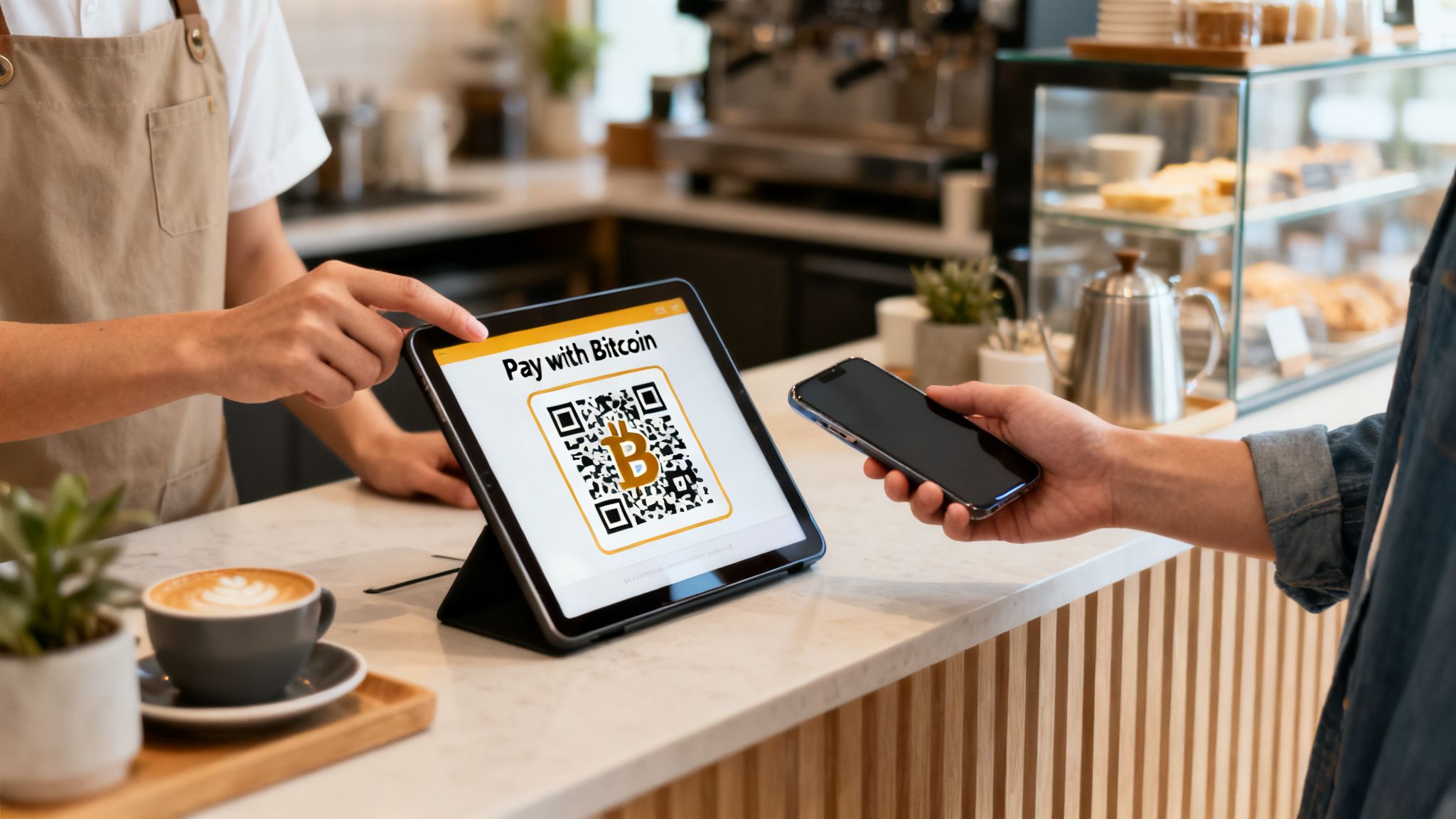
The most immediate benefit? You can tap directly into a massive, tech-savvy market. By accepting Bitcoin, you're opening your doors to hundreds of millions of users worldwide who actually prefer this modern, private way to pay.
The Business Case for a Bitcoin Wallet
Setting up a dedicated wallet for your business gives you several clear advantages over old-school payment methods. These aren't just abstract benefits; they translate directly into a stronger bottom line and a better experience for your customers.
Here’s what you stand to gain:
- Drastically Lower Fees: Bitcoin transactions can be worlds cheaper than the 2-3% fees that credit card companies skim off the top. That means more of every sale stays right in your pocket.
- No More Chargebacks: Bitcoin payments are final. Once a payment is made, it's irreversible. This completely eliminates the risk of fraudulent chargebacks, a common and expensive headache for merchants.
- Immediate Settlement: Forget waiting days for bank transfers to clear. Bitcoin payments settle almost instantly. This gives a serious boost to your cash flow.
- True Global Reach: Bitcoin is borderless. You can accept payments from anyone, anywhere in the world, without getting tangled up in currency conversion or international banking red tape.
By creating your own wallet, you effectively become your own bank. This self-custody model ensures that you—and only you—have complete control over your company's funds, free from the risk of third-party interference or censorship.
Tapping Into a Growing Market
The demand for cryptocurrency wallets has absolutely exploded as more people and businesses adopt Bitcoin. The crypto wallet market, valued at USD 12.20 billion in 2025, is on a trajectory to hit a staggering USD 98.57 billion by 2034. You can read more about this incredible growth on einpresswire.com.
This surge shows just how essential wallets have become, especially for merchants using systems like Flash's payment software to reach over 500 million Bitcoin users without having to hold the funds themselves. This isn't just a passing trend; it's a fundamental shift in how people transact, and having a Bitcoin wallet makes sure your business is ready for it.
Choosing the Right Bitcoin Wallet for Your Business
Not all wallets are created equal, especially when your business’s funds are on the line. When you’re setting up a wallet to accept cryptocurrency, you have to think beyond the basic features and dig into what your daily operations actually demand. The type of wallet you choose directly shapes your workflow, security, and how you manage your assets.
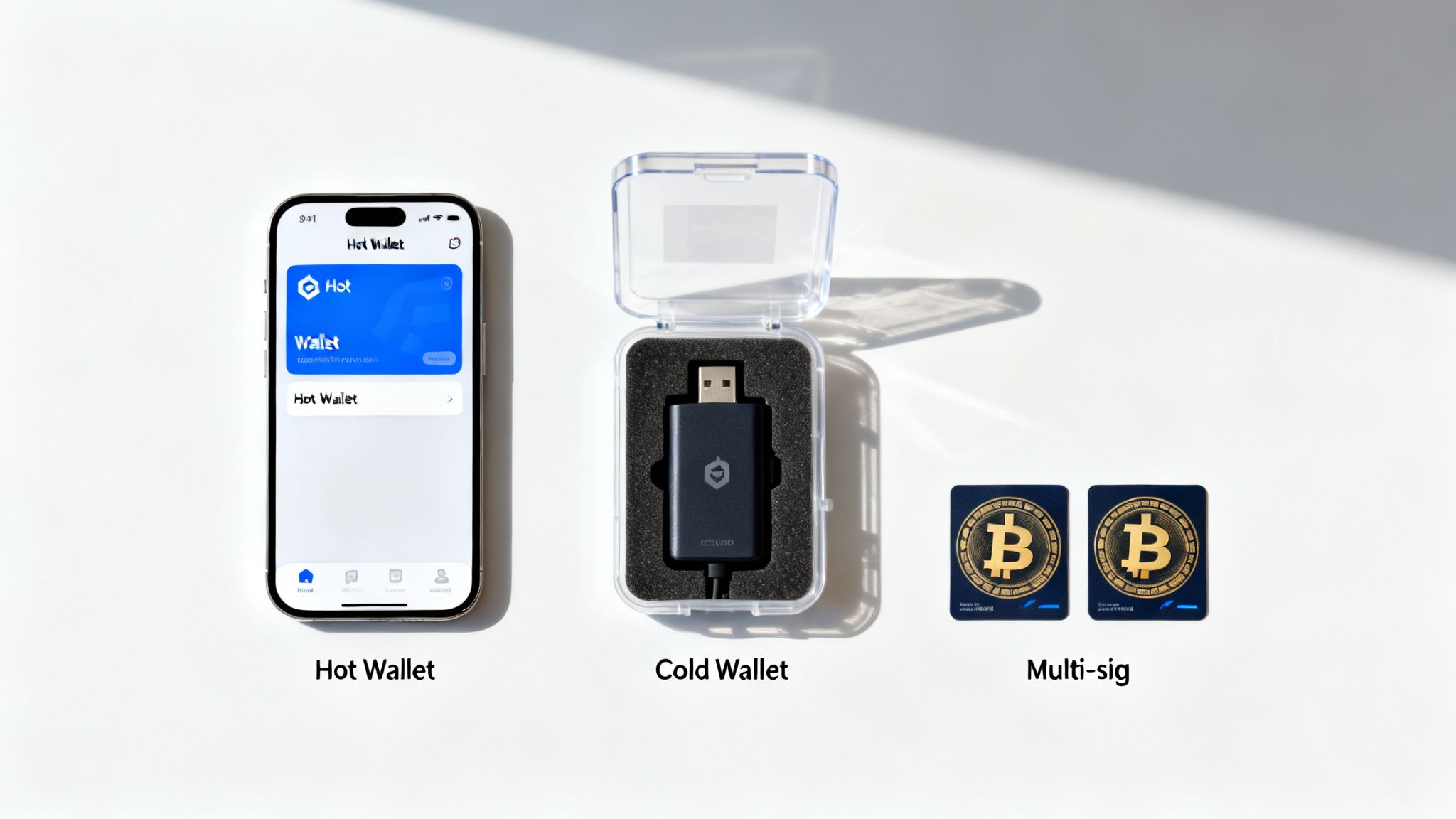
Picking the right Bitcoin wallet isn't just a tech decision; it's a core business decision. The best setup hinges entirely on your specific situation—how many transactions you process, how tight your security needs to be, and how you actually interact with your customers day-to-day.
To make this choice clearer, let's break down the main options merchants have. The table below gives a quick overview, but we'll dive deeper into each one.
Bitcoin Wallet Types for Merchants at a Glance
| Wallet Type | Primary Use Case | Security Level | Accessibility | Best For |
|---|---|---|---|---|
| Software | Daily transactions & point-of-sale | Lower (Online) | High (Instant) | Businesses needing fast, frequent payments like retail or cafes. |
| Hardware | Long-term savings & large amounts | Highest (Offline) | Lower (Requires device) | Securing significant revenue or treasury funds away from online risks. |
| Multi-Sig | Corporate treasury & joint control | High (Distributed) | Moderate | Partnerships or companies requiring multiple approvals for transactions. |
Ultimately, the best strategy often involves using more than one type of wallet. A software wallet for daily cash flow and a hardware or multi-sig for the company's savings is a powerful and secure combination.
Software Wallets for Daily Operations
Software wallets, often called "hot wallets," are apps that live on your computer or smartphone. Their biggest selling point is pure convenience. Because they're always connected to the internet, they're perfect for the quick, frequent payments you’d see in any retail setting.
Think about a busy coffee shop. The barista needs a fast, simple way to pop up a QR code for a customer's payment. A software wallet on a tablet makes this process totally seamless, keeping the line moving without any friction.
But that constant online connection is also their biggest weakness, making them a poor choice for storing large sums of Bitcoin. Still, their ease of use has driven massive adoption. The software wallet market was already valued at USD 199.30 million back in 2019 and is still growing, with North America's 66 million users leading the way in 2024. You can discover more about the crypto wallet market on technavio.com.
Hardware Wallets for Secure Savings
When it comes to holding serious value, hardware wallets are the gold standard. These are small, physical devices that keep your private keys completely offline—a practice known as "cold storage." This simple fact makes them immune to the online threats, like malware or hacking, that could easily compromise a software wallet.
Imagine an online consulting firm that gets paid in large, infrequent sums from international clients. Leaving that kind of money in a hot wallet would be a huge, unnecessary risk. Instead, the firm would use a hardware wallet to sweep those payments into cold storage, where they stay safe until needed. It's a level of peace of mind a software wallet just can't offer.
Key Takeaway: The smartest strategy for most businesses is a hybrid one. Use a software wallet for daily liquidity and regularly sweep larger balances into a secure hardware wallet for long-term safekeeping.
Multi-Signature Wallets for Corporate Control
Multi-signature wallets, or "multi-sig," add a powerful layer of security that’s perfect for partnerships or any business with multiple decision-makers. These wallets require more than one private key to sign off on a transaction. It’s like a digital version of a bank's safe deposit box that needs two different keys to open.
A common setup for a business partnership is a 2-of-3 multi-sig wallet. This means the wallet is controlled by three co-signers, and any two of them must approve a transaction before funds can be moved.
This structure is brilliant for preventing both unauthorized access and internal theft, since no single person has total control over the company’s Bitcoin. It builds a system of checks and balances right into your treasury management, ensuring all major financial moves are made collectively. For corporate governance, that's absolutely essential.
Your Guide to Wallet Setup and Seed Phrase Security
Alright, you've picked your wallet. Now it’s time to get it set up. This part is straightforward, but you need to pay close attention to one thing above all else: your seed phrase. This little string of 12 or 24 words is the master key to your Bitcoin kingdom.
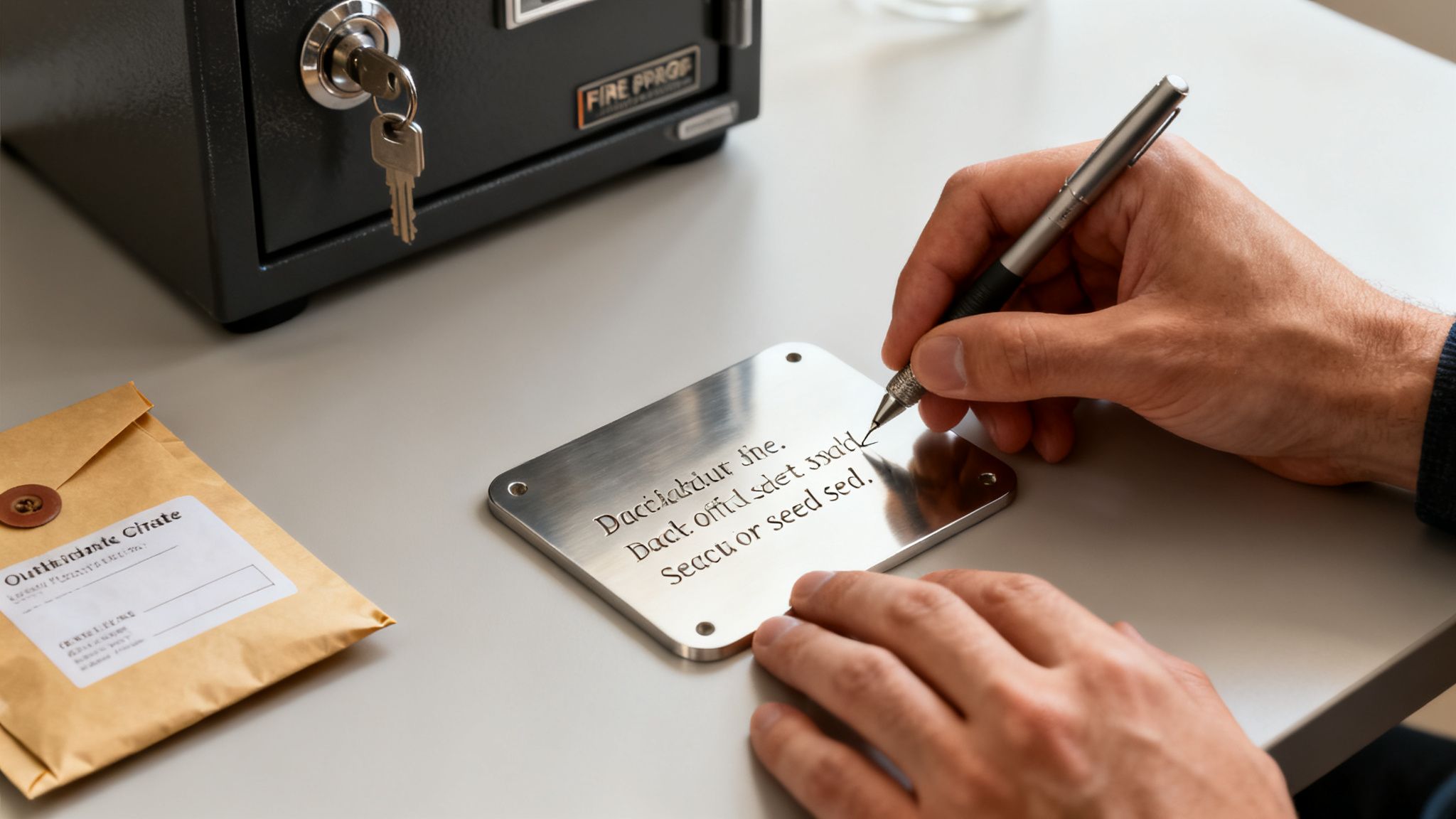
Here's the best way to think about it: if your private keys unlock individual safes, your seed phrase is the skeleton key that opens every single one of them. If your laptop gets fried or your hardware wallet goes missing, this phrase is the only way to get your funds back. Protecting it is the most important job you have as a self-custodian of your business's Bitcoin.
This isn't an exaggeration. You should treat your seed phrase with the same gravity as the deed to your office building. It's your ultimate failsafe.
The Golden Rules of Seed Phrase Management
The moment your new wallet spits out that seed phrase, your security protocol kicks in. There are some hard-and-fast rules here—no exceptions. Breaking them is like leaving the vault door wide open for hackers.
Here are the non-negotiables:
- Never, ever store it digitally. Don't screenshot it. Don't save it in a notes app, email it to yourself, or upload it to a cloud drive. Any device with an internet connection is a potential attack vector.
- Write it down on paper immediately. As the words pop up, write them down. Be meticulous. Double-check the spelling and make sure the order is perfect. Both are critical.
- Verify your backup. Any decent wallet will make you re-enter the words to prove you wrote them down correctly. Don't you dare skip this step.
Remember, your seed phrase is generated completely offline by your wallet. It has never touched the internet, and your mission is to keep it that way. Forever. That air gap is its greatest strength.
Creating Resilient Physical Backups
A single piece of paper is a single point of failure. It's vulnerable to fire, floods, or just getting lost in a messy desk. For a business, that's just not good enough. The professional move is to create multiple, durable backups and store them in different locations.
Imagine a consulting firm that holds large client payments in Bitcoin. They might stamp their seed phrase onto three separate metal plates. This redundancy means that even if a fire destroys their office, their funds are still safe and recoverable.
Consider these battle-tested methods:
- Metal Seed Plates: You can etch or stamp your seed phrase onto a small metal plate. This makes it practically indestructible—resistant to both fire and water. It's a massive upgrade from paper.
- Geographic Separation: Don't keep all your eggs in one basket. Store backups in different, secure places. Maybe one copy is in a fireproof safe at the office, and another is in a bank's safe deposit box across town.
- Lamination and Sealing: If you must use paper, laminating it offers some protection from moisture. For an extra layer of security, seal it in a tamper-evident bag. You'll know instantly if someone has tried to access it.
By taking these physical security measures seriously, you're building a fortress around your business's Bitcoin. You become the sole guardian, with complete and total control.
Implementing Advanced Security for Merchant Wallets
Alright, you’ve got your wallet set up and your seed phrase is tucked away safely. Good start. But for any serious merchant, the default settings are just that—a start. It's time to fortify your digital vault with some business-grade security measures. The goal is to make your Bitcoin as difficult to compromise as possible, and that means going beyond the basics to layer your defenses.
The first move, and it's a critical one, is to get a hardware wallet. This isn't just a friendly suggestion; it’s a foundational security practice for anyone handling more than pocket change. Hardware wallets keep your private keys completely offline, creating a physical "air gap" between your funds and any online threats like malware or phishing scams. Simply put, your keys never touch an internet-connected device, which is the ultimate shield.
Upgrading Your Seed Phrase With a Passphrase
For those who want to take security to an even higher level, you can add a passphrase to your existing 24-word seed phrase. Some people call it the "25th word." It’s a powerful, advanced feature that essentially creates a new, hidden wallet on top of your existing one.
Think of it this way: if a thief gets their hands on your 24-word seed phrase, they can take your funds. But if you’ve protected it with a passphrase, that seed phrase is useless without that extra word or phrase. It acts as a second, secret password that only you know.
- Plausible Deniability: You can even keep a small "decoy" amount of Bitcoin in the wallet without a passphrase. If you're ever forced to reveal your seed phrase, an attacker would only see the small amount, while your main stash remains safely hidden in the passphrase-protected wallet.
- Infinite Wallets: Every unique passphrase creates a brand-new wallet tied to your original seed. This means you can create multiple hidden wallets for different business purposes, all managed from one master key.
This kind of robust security is a major reason why the hardware wallet market, valued at USD 680 million in 2025, is projected to surge to USD 4,767.2 million by 2035. As global guidelines increasingly recommend hardware for secure custody, North America is expected to capture 41.5% of this market, driven by businesses like yours adopting best practices.
Implementing Multi-Signature for Team Control
If you have business partners or a team that needs access to funds, a multi-signature (multi-sig) setup is non-negotiable. It's the key to solid internal security and corporate governance. A multi-sig wallet requires multiple people to approve a transaction before any funds can be moved, kind of like a digital version of a bank vault that needs two keys to open.
A common setup is a "2-of-3" wallet. Here, three individuals hold keys, but any two of them must sign off on a transaction. This simple configuration brilliantly solves two huge business problems:
- Prevents Internal Fraud: No single employee or partner can run off with the company funds.
- Protects Against a Single Point of Failure: If one person loses their key or is unavailable, the other two can still access and manage the funds.
By distributing control, multi-sig embeds checks and balances directly into your financial operations, protecting against both internal threats and external attacks. To significantly strengthen the security of your merchant wallet, integrating an extra layer of protection like Multi-Factor Authentication for your access points is also a smart move.
Connecting Your Wallet to Payment Systems
Okay, so you've set up your wallet and you're confident in its security. What's next? It's time to put that wallet to work. After all, a secure Bitcoin wallet is only half the battle—the real goal is to get paid.
This is where you bridge the gap between setup and sales, integrating your wallet with a payment system that lets you accept Bitcoin without a hitch.
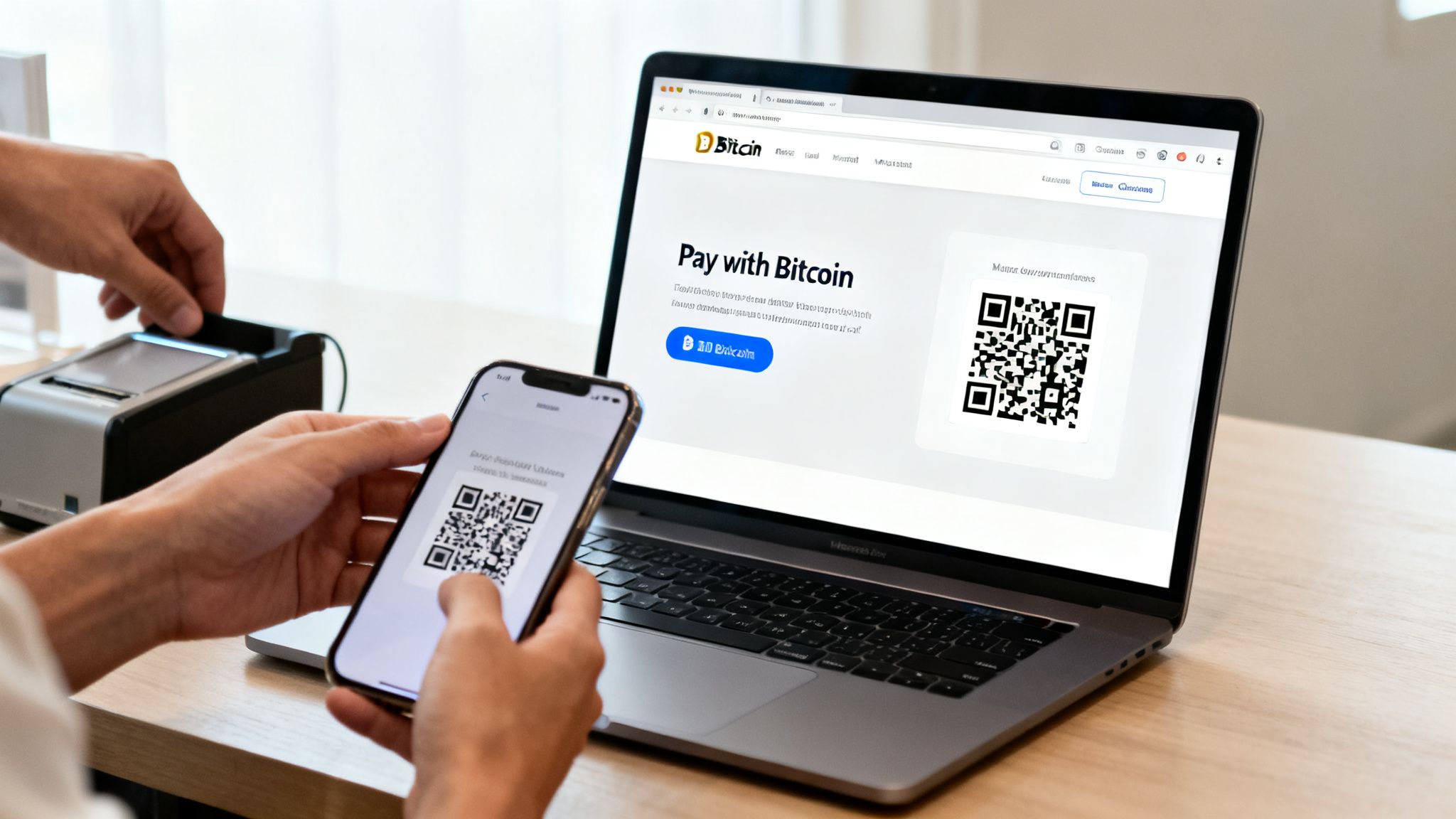
The idea is to make the Bitcoin checkout process feel just as smooth as a traditional card payment for your customers. With a system like Flash, you can generate payment requests in whatever format fits your business. Whether you’re running an online store, a local coffee shop, or a service-based business, there's a straightforward way to start accepting Bitcoin.
Bringing Bitcoin Payments to Your Business
You don’t need to be a technical wizard to start accepting Bitcoin. Modern payment software is built for simplicity, letting you flip the switch on Bitcoin payments in minutes. The key is picking the right tool for your specific sales environment.
Here are the most common ways merchants get paid in Bitcoin:
- Payment Links for Invoices: If you bill clients directly, you can create a unique payment link for each invoice. This link sends your customer to a simple checkout page where they can pay the exact amount from their wallet. No more chasing down payments.
- QR Codes for In-Store Sales: For physical spots like cafes or boutiques, a point-of-sale app can generate a dynamic QR code for every single transaction. The customer just scans it with their mobile wallet, and the payment is done instantly.
- Website Payment Buttons: E-commerce stores can easily add a "Pay with Bitcoin" button to their checkout. This is usually done with simple widgets or plugins that integrate directly into popular platforms you’re already using.
The core principle behind all these methods is decentralization. When a customer pays you, the transaction is purely peer-to-peer—it goes directly from their wallet to yours. A payment processor like Flash never takes custody of your funds, which is a massive security advantage.
The Power of Direct Wallet-to-Wallet Transactions
This direct payment model is what truly sets Bitcoin apart from traditional finance. With no middleman holding your money hostage, you completely sidestep many of the headaches merchants deal with daily. This isn't just a philosophical win; it delivers real benefits that hit your bottom line.
For instance, this peer-to-peer system means you can avoid the invasive Know Your Customer (KYC) hoops that legacy payment processors force you to jump through. This protects your privacy and dramatically simplifies the onboarding process, letting you get started way faster.
Plus, by cutting out the middleman, you get some serious perks:
- Enhanced Security: Your funds are never at risk of being frozen or held by a third party. You have 100% control, always.
- Lower Fees: Without layers of intermediaries each taking their cut, transaction costs drop significantly.
- Instant Settlement: Payments hit your wallet fast, which is a game-changer for your business's cash flow.
This streamlined process lets you go from setting up a wallet to accepting Bitcoin from a global customer base in no time, whether you're selling from a storefront or a website.
Got Questions About Your Merchant Bitcoin Wallet?
After getting your wallet set up, it's totally normal for a few questions to pop up. Let's walk through some of the most common things merchants ask, so you can feel completely in control of your business's Bitcoin.
Should I Keep a Separate Bitcoin Wallet for My Business?
Yes, without a doubt. Mixing your business and personal Bitcoin is a surefire way to create an accounting nightmare and introduce unnecessary security risks.
Think of it just like your business bank account—it's non-negotiable for any serious company. A dedicated wallet keeps your bookkeeping clean, lets you use professional-grade security like multi-sig, and maintains a clear line between your assets. When tax time rolls around, keeping everything separate from the start makes the process infinitely simpler, especially if you're using crypto tax software.
What’s the Real Difference Between a Private Key and a Seed Phrase?
This is a great question, and the distinction is crucial.
Your seed phrase (those 12 or 24 words) is the master key to your entire wallet. It’s the one thing you need to restore all your Bitcoin on a new device if your old one is lost, stolen, or just stops working.
A private key, on the other hand, is a single code that authorizes a specific transaction from one of your wallet's many addresses. In practice, you'll almost never see or handle individual private keys. Your wallet software manages them for you. Your one and only job is to protect that seed phrase, because it holds the power to everything.
Here's the gold standard for backing up your seed phrase: Create multiple physical, offline copies. Write the words down clearly on paper or, even better, etch them onto a metal plate for durability. Store these copies in completely separate, secure locations. This protects you from losing everything in a single event like a fire or theft.
Can I Actually Run My Business from a Mobile Wallet?
Absolutely. For day-to-day operations, mobile wallets are fantastic. They’re perfect for taking in-person payments or just checking on incoming transactions when you're on the move. Their convenience is hard to beat for the kind of quick, smaller-scale payments that keep business humming.
But here’s the critical part: they should never be where you store large sums of Bitcoin. For merchants, the best approach is a hybrid model:
- Use a mobile wallet for daily transactions. Think of it as your digital cash register—convenient for immediate use.
- Sweep larger balances into a secure hardware wallet. This is your vault. Regularly move your accumulated revenue into this long-term cold storage.
This strategy gives you the best of both worlds: the speed you need for daily sales and the ironclad security your business deserves for its savings.
Ready to put that new wallet to work? With Flash, you can start accepting Bitcoin payments directly from customers in under a minute. Our tools connect your wallet to your business, enabling seamless wallet-to-wallet transactions with no middlemen and no KYC. Get started with Flash today.