When your business starts accepting Bitcoin, one of the first big decisions you'll face is choosing between a crypto exchange and a wallet. This isn't just a technical detail—it's a foundational choice that dictates how you manage your revenue. The difference boils down to one critical thing: control.
A custodial crypto exchange operates like a bank. It holds your Bitcoin for you, managing the keys on your behalf. On the other hand, a non-custodial Bitcoin wallet is like a digital safe where you, and only you, hold the keys. This distinction has massive implications for your security, operational freedom, and overall risk.
Custodial Exchange or Non-Custodial Wallet: What Merchants Need to Know
For any business dipping its toes into the Bitcoin world, the setup can feel a bit overwhelming. You'll hear the words "exchange" and "wallet" thrown around, sometimes interchangeably, but they represent two completely different philosophies for managing your money. Getting this right from the start defines who is actually in control of the payments you receive.
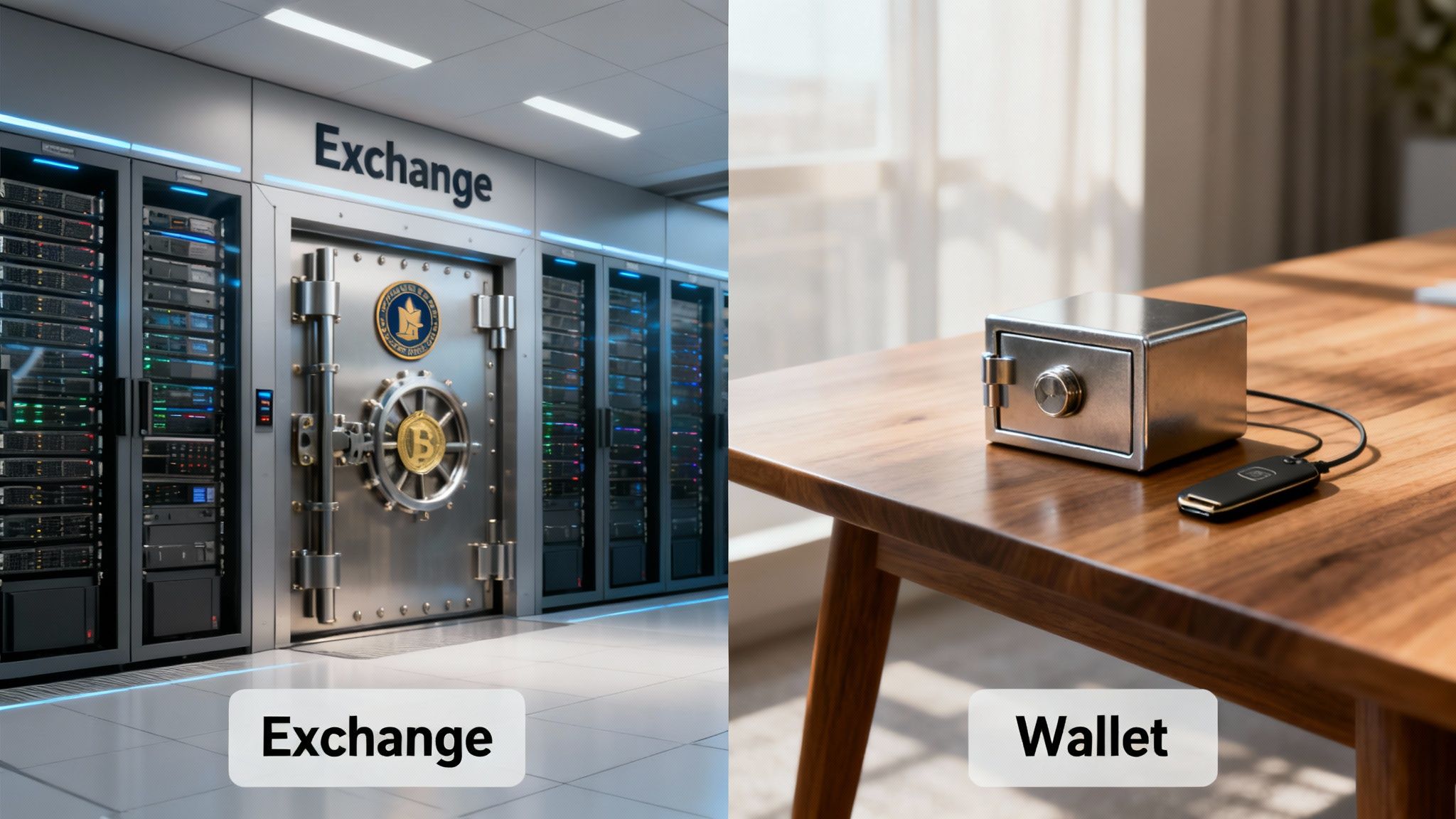
A custodial exchange handles the private keys for you. It's convenient, feeling a lot like logging into a traditional bank account. But that convenience comes at a price: you're trusting a third party not to get hacked, go bankrupt, or freeze your funds.
In stark contrast, a non-custodial wallet puts you firmly in the driver's seat. You are 100% responsible for your private keys—the cryptographic proof that you own your Bitcoin. This is the very essence of what Bitcoin was built for: letting you "be your own bank."
Key Differences at a Glance
To make the choice clearer for your business, it helps to see a side-by-side comparison. Each model strikes a different balance between convenience, security, and control.
| Feature | Custodial Crypto Exchange | Non-Custodial Bitcoin Wallet |
|---|---|---|
| Asset Control | The exchange holds your private keys and controls the funds. | You hold your own private keys and have full control. |
| Primary Function | Buying, selling, and trading Bitcoin for fiat currency. | Securely storing, sending, and receiving Bitcoin directly. |
| Security Model | You trust the exchange's security infrastructure to protect funds. | You are responsible for securing your own private keys. |
| Risk Profile | Exposed to counterparty risk (exchange hacks, freezes, insolvency). | Risk is limited to your own security practices. |
| Analogy | A bank account where the bank guards your money. | A personal safe where only you know the combination. |
The core issue in the crypto exchange vs wallet debate is custody. If you don't hold the private keys, you don't truly own your Bitcoin. You hold an IOU from the exchange.
This is the bottom line for merchants. While an exchange is a necessary tool for converting Bitcoin into dollars or euros, using it as the primary destination for customer payments introduces a dangerous third-party risk.
A non-custodial wallet, however, ensures that revenue from a sale settles directly into an account that only you can access. It completely cuts out the middleman. Ultimately, the choice comes down to whether your business values perceived convenience over absolute financial sovereignty.
A Detailed Comparison for Business Operations
When you're deciding between a crypto exchange and a non-custodial wallet, you're not just picking a piece of software. You're making a fundamental choice about how your business handles its revenue. It's a decision that dictates who controls your money, what you pay in fees, and how easily you can operate.
Let's break down this choice through the six lenses that matter most to any merchant accepting Bitcoin.
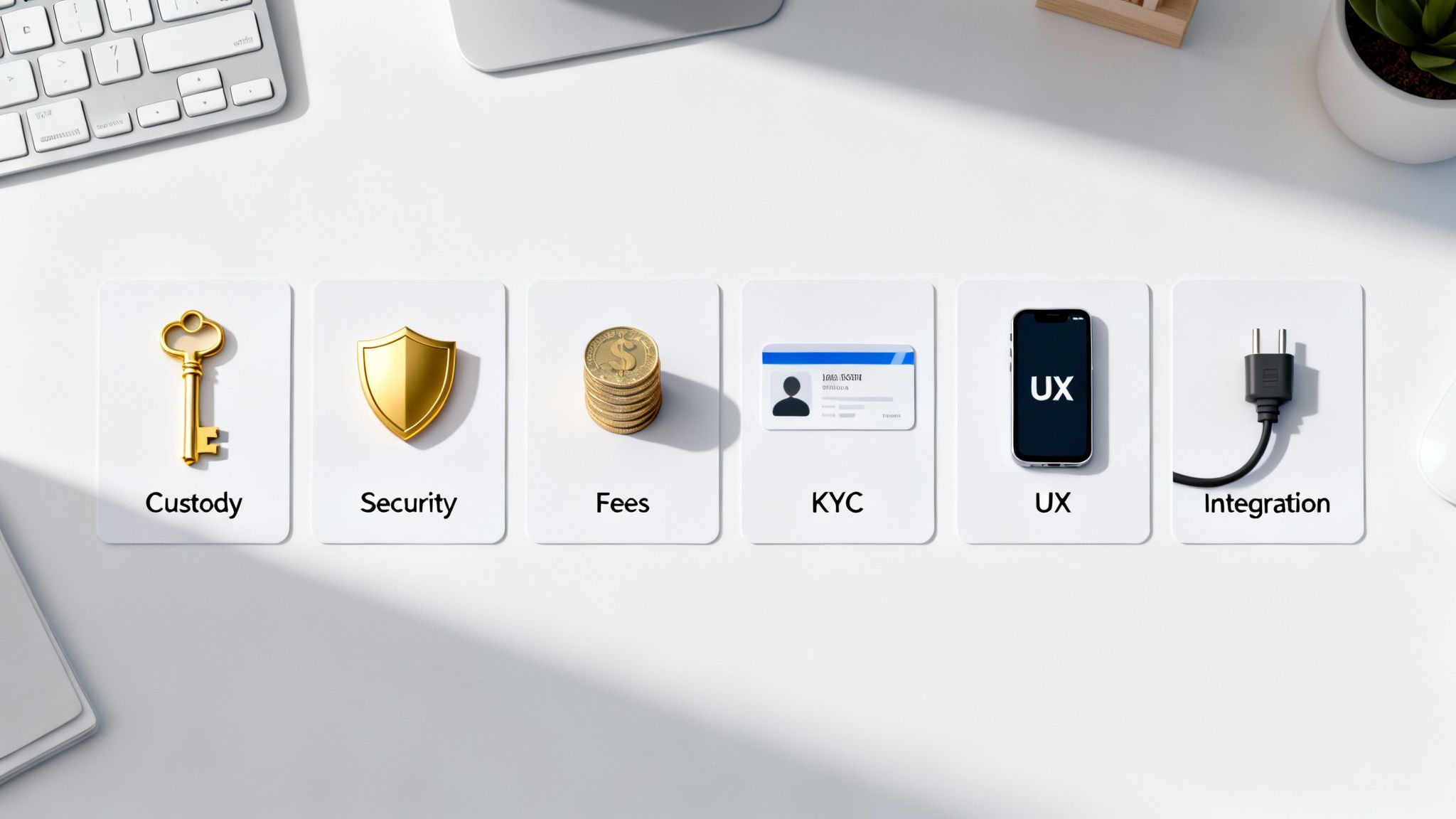
Asset Custody and Control
This is the big one. The most critical difference between an exchange and a wallet boils down to one word: custody. When you use a custodial exchange, you're handing over your private keys. They control the Bitcoin your customers send you, and you're trusting them to keep it safe and give it back when you ask.
A non-custodial wallet completely flips that script. Your business holds the private keys, giving you complete and direct sovereignty over your funds. No third party can freeze your account, block a withdrawal, or go offline when you need your money most.
For a merchant, this is the difference between having funds in a bank account versus holding cash in your own secure safe. One relies on a trusted institution, while the other offers absolute self-control.
Security Vulnerabilities and Risks
Centralized exchanges are giant honeypots for hackers. By holding billions of dollars worth of Bitcoin in one place, they become a prime target. Their entire security model is about protecting a central point of failure. A single successful attack, like the infamous Mt. Gox hack, can wipe out funds for every single user on the platform.
A non-custodial wallet, on the other hand, decentralizes security right down to you. The responsibility to protect the private keys is yours and yours alone. While this demands diligence, it eliminates the systemic risk of an exchange-wide hack hitting your funds. Your security isn't tied to someone else's infrastructure.
Transaction Fees and Business Costs
Exchanges are notorious for their complex fee structures that can chip away at your margins. You'll often run into a mix of charges:
- Deposit Fees: Some charge just to receive money.
- Trading Fees: A percentage is sliced off every time you convert Bitcoin to fiat.
- Withdrawal Fees: A flat fee is almost always applied when you move your funds out.
Non-custodial wallets have a much cleaner cost model. Your main cost is the Bitcoin network fee, which goes directly to miners for processing the transaction on-chain. It's a transparent, market-driven fee—not one marked up by a middleman, which often means lower overall costs for getting paid.
Onboarding and Compliance
To operate legally, nearly every reputable crypto exchange enforces a strict Know Your Customer (KYC) process. This means handing over sensitive business details, personal IDs, and proof of address. Getting verified can be a slow grind, sometimes taking days or even weeks before you can actually do business.
Non-custodial wallets don't need KYC. Since you're your own bank, there's no third-party "account" to create or verify. This allows a merchant to start accepting Bitcoin payments almost instantly, all while preserving the privacy of the business and its customers.
Merchant User Experience
On the surface, exchanges can seem convenient. They bundle receiving, storing, and converting into one slick interface that might feel like your online banking portal. But that convenience is fragile. It's subject to the exchange’s platform downtime, withdrawal limits, and frozen activity during busy market periods.
A non-custodial wallet offers a different kind of UX, one built on control and reliability. Modern wallet software is surprisingly intuitive, capable of turning any phone or tablet into a point-of-sale device. Payments arrive directly and settle instantly, giving you immediate, unrestricted access to your revenue.
Payment Integration and Flexibility
Using an exchange's payment gateway usually means locking your business into their specific APIs and plugins. This creates a dependency. If they change their API, update their terms, or go out of business, your payment system breaks.
Wallet-to-wallet payment solutions provide far more flexibility. They enable direct peer-to-peer transactions from your customer's wallet to yours. This model is incredibly adaptable and can be woven into any workflow—from e-commerce checkouts to in-person QR codes—without being tied to a third-party platform's fate.
The global Bitcoin exchange market shows just how dominant the custodial model is today, growing from $43.8 billion in 2024 to an expected $54.8 billion in 2025. This concentration of users and funds—with giants like Binance processing an average of $22.7 billion daily—highlights a massive reliance on centralized platforms for trading. For merchants who value direct control and want to avoid counterparty risk, these numbers underscore the appeal of wallet-to-wallet solutions that completely bypass that centralized infrastructure. You can explore more data about the largest crypto exchanges to see the scale of this market.
For a clearer picture, here's a quick breakdown of how these two options stack up for a business.
Crypto Exchange vs Non-Custodial Wallet: A Merchant's Quick Comparison
| Feature | Custodial Crypto Exchange | Non-Custodial Bitcoin Wallet |
|---|---|---|
| Asset Custody | Third-party (the exchange) holds your private keys and controls your funds. | Self-custody; you hold your private keys and have full control. |
| Security Model | Centralized; vulnerable to large-scale platform hacks and internal fraud. | Decentralized; security is your responsibility, eliminating third-party risk. |
| Primary Risk | Counterparty risk—the exchange could fail, get hacked, or freeze your account. | Operational risk—you could lose your private keys if not managed properly. |
| Transaction Fees | Multi-layered: deposit, trading, and withdrawal fees that can reduce profit margins. | Primarily Bitcoin network fees paid to miners; no middleman markup. |
| Onboarding (KYC) | Mandatory KYC/AML verification required, often involving a lengthy approval process. | No KYC required; you can start accepting payments instantly. |
| User Experience (UX) | Familiar "all-in-one" platform, but subject to platform downtime and withdrawal limits. | Direct and reliable; payments are instant and funds are immediately accessible. |
| Integration | Dependent on the exchange's proprietary APIs, creating platform lock-in. | Highly flexible; enables direct peer-to-peer payments adaptable to any business model. |
| Best For | Businesses needing frequent fiat conversion and willing to trade control for convenience. | Businesses prioritizing sovereignty, lower costs, and direct control over their revenue. |
Ultimately, the choice hinges on what your business values most: the bundled convenience of a third-party service or the sovereign control of managing your own funds.
Real-World Scenarios: Which Model Fits Your Business?
Knowing the theory behind the crypto exchange vs. wallet debate is a good start, but what really counts is how it applies to your business. The way you accept Bitcoin payments needs to mesh with your day-to-day operations, your customers' experience, and how much risk you're willing to take on.
Let's ground this comparison in reality by walking through four common business scenarios. Each one has different priorities, which will make it obvious why one model is a perfect fit and the other just creates headaches.
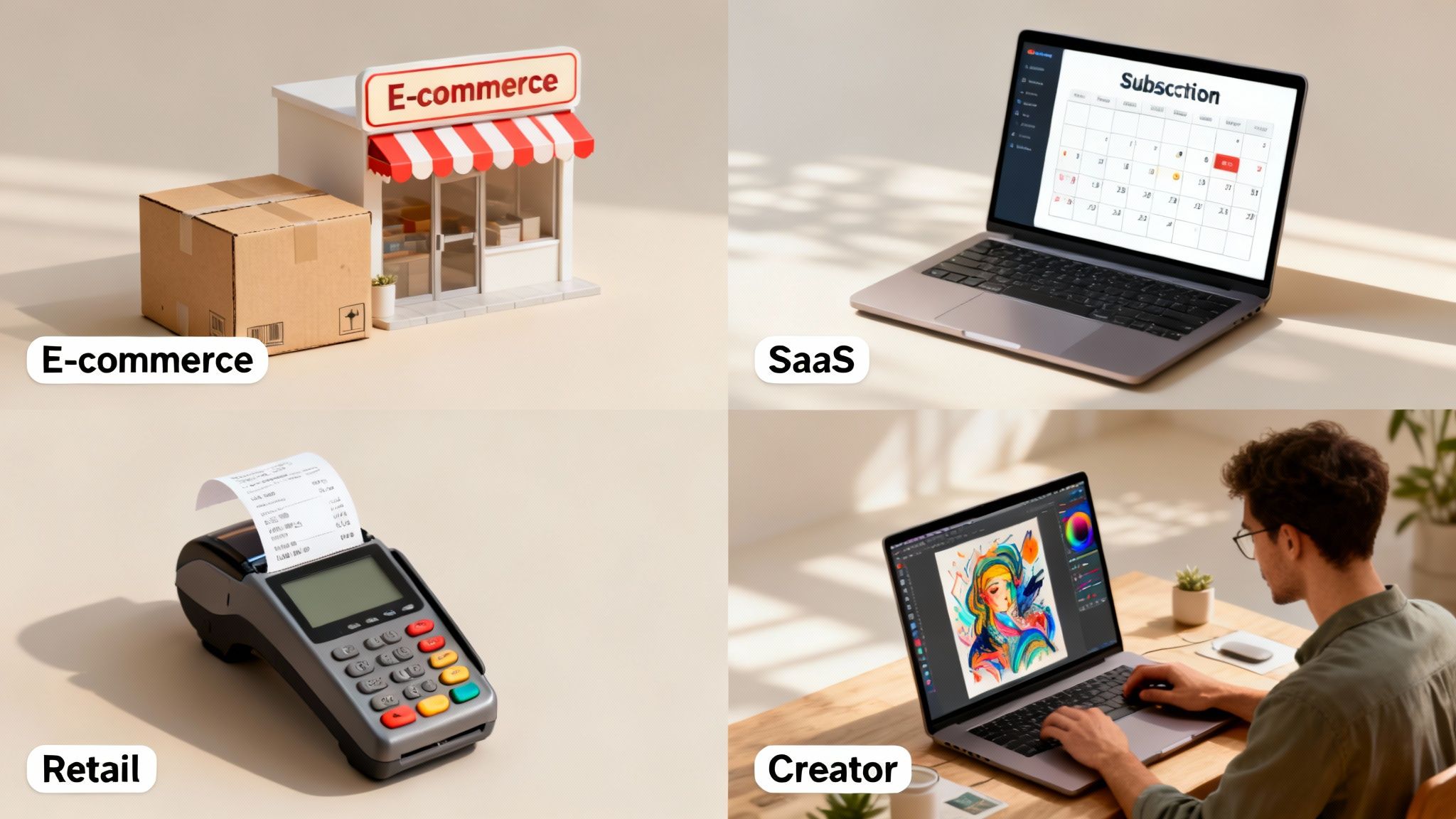
The E-commerce Store
If you're running an online store selling physical goods, you're probably all too familiar with the pain of cross-border fees, slow bank settlements, and the ever-present risk of chargebacks. Bitcoin tackles all three head-on.
Using an Exchange: At first glance, an exchange-based payment processor seems easy. But every single payment gets routed through their system, where your funds sit until you get around to withdrawing them. You’re right back to having a middleman, adding conversion fees, and leaving your revenue exposed to the exchange's downtime or a sudden account freeze.
Using a Non-Custodial Wallet: A direct wallet-to-wallet setup is a much cleaner, more direct approach. A customer pays, and the Bitcoin lands directly in your wallet. Settlement is practically instant, the only fee is the tiny Bitcoin network fee, and chargebacks simply don't exist. This model gives you immediate, undisputed control over your revenue—a game-changer for managing cash flow.
The SaaS Company
Software-as-a-Service businesses are built on the foundation of predictable, recurring revenue. Accepting automated Bitcoin subscriptions can unlock a global market of customers who might not have access to traditional banking.
Here, reliability is everything. An exchange’s API might offer recurring payments, but that decision ties your entire subscription engine to their platform. If they have an outage or change their API, your revenue stream grinds to a halt.
A non-custodial wallet solution, particularly one built for merchants, is far more resilient. You can generate unique payment requests for each billing cycle, letting customers pay directly. This decentralized approach means your subscription system operates on its own terms, free from any third-party custodian that could disrupt your business.
The Physical Retailer
For a brick-and-mortar shop—a café, a local boutique, a market stall—speed is king. Customers need to pay and go, keeping the line moving.
A merchant's point-of-sale (POS) system must be fast, reliable, and easy for both staff and customers to use. The choice between an exchange and a wallet directly impacts this in-person experience.
Using an exchange's mobile app might work, but it often forces the customer to have an account on that specific exchange, which is a major point of friction. On top of that, the payment is technically settling in your exchange account, not your hand. There's a delay before you truly own the funds.
A non-custodial wallet app, however, can turn any smartphone or tablet into a Bitcoin POS terminal. It spits out a simple QR code for the sale amount. The customer scans it with any Bitcoin wallet, and the funds are confirmed in your wallet in seconds. It’s a pure peer-to-peer transaction: fast, final, and secure.
The Content Creator
Digital creators, artists, and online educators often sell their work through one-time purchases or paywalls. Their main goals are keeping transaction costs low—especially for micropayments—and providing a smooth experience that doesn't get in the way of the content.
An exchange gateway just adds another complicated step, often making customers log in or navigate a clunky checkout flow. The fees can also take a significant bite out of your earnings, particularly on smaller sales.
A non-custodial wallet integration is far more elegant. A simple payment button can unlock an article, video, or digital download. The payment is direct, the fees are minimal, and the entire process is almost invisible to the user. That means better conversion rates and more revenue in your pocket.
The relevance of these scenarios is only growing. In 2025, global on-chain activity surged, with the Asia-Pacific region alone seeing a 69% year-over-year increase in value received. North America wasn't far behind, growing by 49%. This isn't some niche market; it's a rapidly expanding global customer base. The United States alone accounts for over $2.4 trillion in total volume, and Bitcoin makes up about 41% of all fiat-to-crypto purchases. For merchants, a direct wallet-to-wallet solution is the most direct and effective way to tap into this growth, bypassing slow, expensive infrastructure to serve customers anywhere. To read the full analysis on global crypto adoption, check out the latest industry data.
Understanding the Business Risks of Custodial Solutions
On the surface, custodial crypto exchanges offer a familiar, bank-like experience. That convenience, however, hides some serious risks for any business handling Bitcoin. When you hand over your revenue to a third party, you're introducing vulnerabilities that simply don't exist with a non-custodial setup.
For any merchant, getting a handle on these risks is essential for protecting cash flow and keeping the lights on.
The biggest danger by far is counterparty risk. This is the chance that the exchange itself—the "counterparty" holding your funds—won't be able to meet its obligations. When you hold funds on an exchange, you don't actually own any Bitcoin; you own an IOU from the exchange for Bitcoin.
If that platform gets hacked, goes bankrupt, or gets shut down by regulators, your funds can disappear. The history of Bitcoin is littered with exchange collapses that have wiped out billions in customer funds. It’s a harsh but necessary reminder of the classic mantra: "not your keys, not your coins."
Operational Hazards and Business Disruption
Beyond the nightmare scenario of a total loss, custodial platforms create serious operational headaches that can hit your day-to-day business functions hard. These problems can choke your cash flow and damage your reputation with zero warning.
When you rely on an exchange, you’re playing by their rules, which can change without notice. Common operational risks include:
- Frozen Accounts: Exchanges can freeze your account instantly due to an automated fraud alert, a sudden policy shift, or a regulatory flag. This locks you out of your own revenue.
- Withdrawal Limits: Most platforms cap how much you can withdraw daily or weekly. This becomes a massive problem if you need to move a large sum to pay a supplier or cover a major expense.
- Platform Downtime: Exchanges often go down for "maintenance" during periods of high market volatility—exactly when you need access the most. You're left unable to access, move, or convert your funds.
These aren't just theoretical worries. They are practical realities that create a ton of unpredictability for any business using an exchange as its main wallet.
By holding funds on a custodial platform, a merchant's financial operations become dependent on the stability, security, and policies of a single, centralized company. This single point of failure introduces a level of risk that is fundamentally at odds with Bitcoin's decentralized design.
Privacy and Data Security Trade-Offs
To stay on the right side of regulations, exchanges have to collect extensive Know Your Customer (KYC) data. For a business, this often means uploading sensitive corporate documents, financial statements, and personal info on company directors. All this creates a centralized honey pot of your company's most private information.
This data collection is a significant privacy trade-off. If the exchange suffers a data breach, all that sensitive information could leak, exposing your business to targeted phishing scams, fraud, and other cyber threats. This is a world away from non-custodial solutions, which let you accept Bitcoin payments without surrendering private business data.
Even beyond the specific risks of custodians, every business needs to implement robust general cybersecurity best practices to protect its operations. Ultimately, the custodial model forces you to choose between perceived convenience and the very real dangers of third-party dependency, operational chaos, and data exposure.
The Non-Custodial Advantage for Bitcoin Payments
After weighing the very real business risks of custodial solutions, it becomes clear that a non-custodial approach offers a far more resilient and aligned path for merchants accepting Bitcoin. Modern payment software leans into wallet-to-wallet transactions, tapping into the core strengths of the Bitcoin network while completely sidestepping the dangers of intermediaries.
This model isn't just a technical preference; it's a strategic decision to embrace security, efficiency, and financial sovereignty.
The concept is refreshingly simple: when a customer pays, their Bitcoin moves directly from their personal wallet to your business's non-custodial wallet. At no point are the funds held, processed, or controlled by a third party. This pure peer-to-peer flow is the original vision for Bitcoin, and today’s purpose-built tools make it incredibly easy for any merchant to implement.

Unlocking Key Benefits for Your Business
Switching to a non-custodial payment system delivers several powerful advantages that directly address the glaring shortcomings of exchange-based models. These benefits aren't just minor tweaks; they fundamentally change how your business manages its revenue.
First and foremost is enhanced security. By eliminating the central point of failure that a custodial exchange represents, you drastically reduce your exposure to large-scale hacks. Your funds are secured by your private keys, not by the shaky promise of a third party's cybersecurity team. It's a far more robust, decentralized security model.
Next up is instant settlement. Payments arrive directly in your wallet and are confirmed on the Bitcoin blockchain. There are no arbitrary holding periods, withdrawal limits, or platform downtimes to worry about. This means your revenue is truly yours the moment a transaction is complete, giving you immediate and absolute control over your cash flow.
Streamlining Operations and Cutting Costs
Beyond the security upgrade, the non-custodial model simplifies your day-to-day operations and fattens your bottom line. With no middleman, you get to skip the complex and often predatory fee structures that exchanges are known for. Your primary cost becomes the predictable Bitcoin network fee—totally transparent and never marked up for profit.
This direct approach also creates a vastly better customer experience. There is no mandatory KYC process required for customers to pay you, which removes a massive point of friction and respects their privacy. The payment process is as simple as scanning a QR code, making it fast and intuitive for anyone with a Bitcoin wallet.
For merchants, the distinction in the crypto exchange vs wallet debate is profound. A non-custodial solution doesn't just process payments; it delivers a secure, low-cost, and direct financial rail between you and your customers, fully aligning with Bitcoin's principles of decentralization and self-sovereignty.
While centralized exchanges drive immense trading volume, a parallel infrastructure for direct wallet-based transactions is growing rapidly. Recent data shows that even as some exchanges gain market share, massive on-chain transaction volumes occur entirely outside their ecosystems. This trend shows a clear and growing demand for peer-to-peer value transfer, offering merchants an alternative path to process payments without relying on custodial intermediaries and their associated risks. You can read more about crypto market share dynamics to understand these trends.
Ultimately, purpose-built tools like Flash make it easy for any merchant to implement a secure, decentralized Bitcoin payment system that is both powerful and practical.
Frequently Asked Questions for Merchants
Making the jump into Bitcoin payments often brings up a few practical questions. For business owners new to the space, the day-to-day management, security, and process for converting funds are top of mind. Let's clear up some of the most common questions merchants have when deciding between an exchange and a non-custodial wallet.
How Do I Convert Bitcoin to Fiat If I Use a Non-Custodial Wallet?
This is a common hang-up for merchants, but it's based on a misunderstanding. Many assume you have to hold your Bitcoin on an exchange to cash out into dollars or other fiat currencies. That’s not how it works.
Using a non-custodial wallet simply separates the act of getting paid from the act of cashing out. The process is actually quite simple. When you're ready to convert, you just send the Bitcoin from your secure wallet to a crypto exchange of your choice. You use the exchange for what it's good at—trading—not as a risky piggy bank for your business revenue.
This two-step approach gives you the best of both worlds:
- Airtight Security: Your money stays under your control, in your wallet, right up until the moment you decide to sell.
- Total Flexibility: You're not locked into one exchange's ecosystem. You can shop around for the best rates and service whenever you need to convert.
- Lower Risk: By keeping your funds off exchanges until absolutely necessary, you dramatically reduce your exposure to hacks, frozen accounts, and other counterparty risks.
Isn't Managing My Own Wallet More Difficult Than an Exchange?
It's true that self-custody comes with more responsibility, but the idea that it's difficult is a holdover from Bitcoin's early days. Back then, you needed to be pretty tech-savvy. Today, that barrier is gone.
Modern non-custodial wallet apps are built for simplicity, turning any smartphone into a point-of-sale device. For most merchants, the workflow is just as easy as using an exchange-based system, if not easier. Creating a payment request is as simple as typing in an amount and letting the customer scan a QR code.
The notion that non-custodial wallets are complex is completely outdated. Today’s software handles all the technical heavy lifting behind a clean, user-friendly interface. It makes direct Bitcoin payments accessible to any business owner, no technical background required.
This means you get the massive security benefits of true ownership without a painful learning curve.
Are Non-Custodial Wallets Truly Secure If I Can Lose My Keys?
This is a fantastic question because it gets right to the core of what self-custody means. Yes, the security of a non-custodial wallet is absolute, but it hinges entirely on you protecting your private keys. If you lose your keys, your funds are gone. Forever.
But here’s the thing: that’s not a weakness, it's the entire point. There's no "forgot password" link because there is no central company that can step in, access your money, or freeze your account. Your control is total, which means your responsibility is, too.
Proper key management isn't some insurmountable obstacle; it's a straightforward process. It all comes down to making secure, offline backups of your wallet's seed phrase—the master key that can restore your funds on any device. By following simple best practices, like writing down your seed phrase and storing physical copies in a couple of safe locations, you virtually eliminate the risk of loss while enjoying unmatched security and control over every dollar you earn.
Ready to take full control of your Bitcoin payments with a secure, non-custodial solution? Flash provides wallet-to-wallet payment software that ensures you are always in charge of your revenue. Get started in under a minute and join thousands of merchants who have unlocked the power of direct, peer-to-peer Bitcoin payments. Learn more and sign up at .