A crypto gas fee is the common slang for the transaction fee you pay to get a payment processed on a blockchain. In the Bitcoin world, this fee is like adding priority postage to a package—it ensures miners pick up your transaction and process it quickly and securely. The cost isn't based on how much money you send, but on how much digital space your transaction takes up.
What Is A Crypto Gas Fee In The Bitcoin World
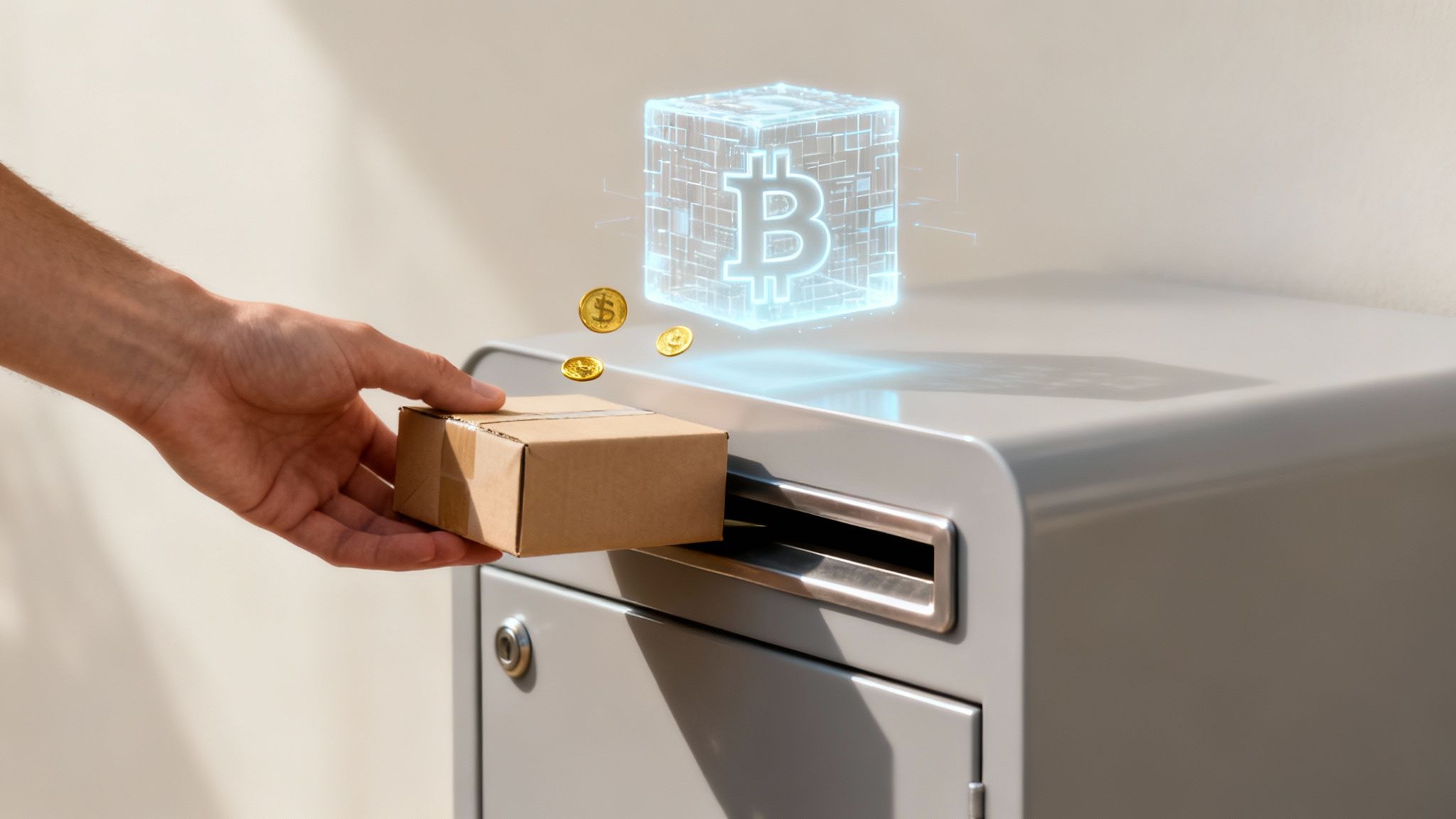
Let's clear something up right away. The term "gas fee" actually comes from the Ethereum network. But it's become such a popular shorthand that you'll hear people use it for any blockchain transaction cost, including Bitcoin's. For Bitcoin, the more accurate terms are transaction fee or miner fee.
Think of the Bitcoin network as a massive, global post office. Every ten minutes or so, a mail truck (a "block") leaves to deliver a batch of packages (transactions). The catch? There's only so much room on each truck, and thousands of people are all trying to get their packages on it at the same time.
So, how do you make sure your package gets on the very next truck? You pay a little extra for postage. That's exactly how Bitcoin's transaction fees work.
The Competition for Block Space
When you send a Bitcoin payment, you're competing with everyone else on the network for that limited space in the next block. The miners—people running powerful computers to process and secure these transactions—are going to prioritize the payments offering the highest fees.
This creates a real-time, dynamic marketplace where users are constantly bidding for a spot.
A higher fee is a direct incentive for miners. It signals that your transaction is urgent and worth their attention. This is the simple, powerful mechanism that keeps the entire network chugging along.
Crucially, your fee has nothing to do with the dollar amount you're sending. A $1,000,000 transaction could technically cost less to send than a $10 one. Instead, the cost boils down to two key factors:
- Data Size: How much digital space your transaction occupies, measured in virtual bytes (vBytes).
- Network Congestion: How many other people are trying to send transactions at the exact same moment.
While we're zeroing in on Bitcoin, it's good to remember that similar fee dynamics play out across different cryptocurrencies. For instance, these same considerations pop up during transactions on various crypto platforms. For any merchant, getting a handle on this simple supply-and-demand concept is the first step toward managing transaction costs and giving your customers a smooth checkout experience.
Why Bitcoin Transaction Fees Can Be So Unpredictable
Bitcoin's transaction fees, often just called network fees, run on a classic supply and demand model. Think of the Bitcoin network as a single, major highway with only a few lanes. When traffic is light, cruising along is cheap and easy. But hit rush hour, and suddenly everyone is trying to cram onto the same road. That congestion leads to a bidding war for the fast lane, with drivers willing to pay higher tolls to get ahead.
That's a pretty good picture of what happens on the Bitcoin network. The "lanes" are the fixed amount of space available in each new block, which is mined and added to the blockchain roughly every 10 minutes. When network activity spikes—maybe during a big market rally or when a new app gets popular—tons of people are trying to shove their transactions into that very limited space.
This creates a competitive, real-time auction. To make sure your transaction doesn't get stuck in traffic, you have to offer a fee high enough to catch a miner's attention. Miners, naturally, prioritize the transactions that pay them the most. This constant bidding is the root cause of Bitcoin's notoriously volatile and unpredictable fees.
A Look Back at The 2017 Fee Spike
The wild market run of 2017 is the perfect, if painful, example of this in action. As Bitcoin's price and popularity exploded, the network was absolutely swamped. The resulting traffic jam sent transaction fees into the stratosphere, making it a nightmare for anyone trying to use Bitcoin for simple, everyday payments.
At the peak of the 2017 bull run, the average Bitcoin transaction fee shot up to over $50. That’s a jaw-dropping leap from the early days when fees were often just a few cents. It got so extreme that on a single day—December 22, 2017—network fees made up a mind-boggling 78% of the total reward miners earned for creating a new block. You can see this trend play out in the historical data, which you can explore in more detail on Statista.
The business risk here is impossible to ignore. A cafe owner selling a $5 cup of coffee could have been hit with a transaction fee ten times the price of the coffee itself. That doesn't just wipe out your profit; it creates an awful, confusing experience for the customer.
Why Historical Volatility Matters for Merchants
Understanding this history isn't just an academic exercise—it’s crucial for any merchant who accepts Bitcoin or is thinking about it. The table below gives you a quick snapshot of just how chaotic these fees can get.
This table illustrates the dramatic fluctuations in average Bitcoin transaction fees during key periods, showing merchants the potential cost instability they face.
Bitcoin Fee Volatility: A Historical Snapshot
| Period | Average Transaction Fee (USD) | Primary Cause |
|---|---|---|
| Mid-2015 | ~$0.05 | Low network usage, stable market |
| December 2017 | ~$55 | Massive bull run, network congestion |
| May 2021 | ~$60 | Renewed market hype and network activity |
| May 2023 | ~$31 | BRC-20 tokens and Ordinals craze |
As you can see, relying solely on on-chain Bitcoin transactions means leaving your business exposed to the network's unpredictable "rush hours." These fee spikes can hit with almost no warning, triggered by anything from market speculation to new tech trends that drive up usage.
This uncertainty makes it incredibly difficult to manage your operating costs or offer a consistent checkout experience. A customer might see a perfectly reasonable fee one day and a shockingly high one the next, leading to abandoned carts and frustration. For businesses to truly thrive with Bitcoin, they need a way to sidestep this on-chain volatility. This is exactly why modern solutions have become not just a nice-to-have, but an absolute necessity for real-world commerce.
How Your Bitcoin Transaction Fee Is Calculated

Figuring out how Bitcoin fees work is actually more intuitive than you'd think. The first thing to do is completely forget about the dollar value of the transaction you're sending. It’s almost irrelevant.
Instead, think about sending Bitcoin like mailing a package. The post office doesn't care if you're shipping a priceless diamond or a pair of old socks. They charge you based on the package's size and weight.
The Bitcoin network runs on that exact same logic. The fee you pay isn’t tied to the value of the bitcoin being sent, but to the transaction's data size, which is measured in virtual bytes (vBytes). This is the secret behind why a $10,000 transaction can sometimes cost less in fees than a $10 one—if the first is simpler, it takes up less digital real estate.
It all boils down to this: a larger, more complex transaction demands more effort from miners to process and squeeze into a block, so it naturally commands a higher fee.
The Mempool and Setting Your Rate
So, what happens to your transaction before it gets confirmed? It gets tossed into a global digital waiting room called the mempool (short for memory pool). Just picture a massive, chaotic pile of packages at the post office, all waiting to get loaded onto the next truck. Miners act like the postal workers, scanning the pile and picking the packages with the most postage first.
To make sure your transaction doesn't get buried at the bottom of the pile, your Bitcoin wallet acts like a smart shipping clerk. It checks the current network congestion and suggests a competitive "postage rate." This rate is measured in satoshis per virtual byte (sats/vB).
Think of sats/vB as the price you're willing to pay for each "gram" your digital package weighs. When the network is jammed, the price per gram skyrockets as everyone bids for the limited space on the next truck out.
Your total fee is just simple math: the size of your transaction in vBytes multiplied by the sats/vB rate you agree to pay. If your transaction is 200 vBytes and you choose a rate of 50 sats/vB, your total fee comes out to 10,000 satoshis.
What Makes a Transaction "Bigger"?
A transaction's "size" has little to do with the amount you're sending. It's all about complexity, specifically the number of inputs and outputs. An input is just a source of funds from a previous transaction you received.
Let's use a cash analogy. If you buy a $5 coffee with a $5 bill, it's a clean, simple exchange. But what if you pay for that same coffee with a giant handful of dimes, nickels, and quarters? The cashier has to do a lot more work to count everything up.
Bitcoin works the same way. A transaction that has to pull funds together from many small, separate payments (lots of inputs) is physically larger in data size than one using a single, larger input. That extra complexity directly inflates the vByte size, and as a result, the final crypto fee you'll end up paying.
How High Fees Impact Your Business And Customers

The nitty-gritty of a crypto gas fee or a Bitcoin transaction fee isn't just technical jargon; it has real, tangible consequences for your day-to-day operations. When these fees swing wildly, they throw a wrench into everything from customer happiness to your bottom line.
Think about it. Say you run an online shop selling e-books for $5. A sudden wave of network congestion sends the transaction fee skyrocketing to $7. Just like that, you’ve lost money on the sale. The entire profit—and then some—is gone, eaten up by the cost of simply processing the payment.
This isn't some far-fetched hypothetical. It's a genuine operational risk for any business accepting on-chain payments. Relying on the main Bitcoin blockchain puts you at the mercy of fee volatility you can't control, turning financial planning into a guessing game.
The Customer Checkout Experience
From the customer's side of the counter, unpredictable fees create a messy and off-putting checkout. Someone might be excited to buy your product, only to get hit with an unexpectedly high network fee on the final screen. That kind of friction is a recipe for abandoned carts and lost revenue.
For brick-and-mortar shops, the problem is even more absurd. A coffee shop accepting Bitcoin could easily find itself in a situation where the fee to buy a latte costs more than the latte itself. This makes small, everyday purchases completely impractical and sours the customer’s perception of using crypto.
High on-chain fees are one of the biggest hurdles to widespread Bitcoin adoption in commerce. They transform what should be a simple, seamless payment into a complex and costly calculation for both the merchant and the customer.
The Challenge of Refunds and Micropayments
The headache doesn't stop once the sale is made. What about something as basic as issuing a refund? If a customer needs $10 back during a period of high network congestion, the fee to send it could easily swallow the entire refund amount. Now you've got both a financial and an operational nightmare on your hands.
This volatility reveals a massive usability gap for everyday business. Looking at the big picture, Bitcoin's total daily transaction fees have swung dramatically, hitting $616,996 a year ago before recently settling around $210,008. While these numbers prove the network's core security, they also highlight its limitations for commerce. You can explore more data on daily Bitcoin fees on YCharts.
For businesses in major markets, these fees can easily represent over 1-2% of the transaction volume. That’s a crippling cost for models built on small, frequent payments, like SaaS subscriptions or digital content sales. It becomes painfully clear that a stable, low-cost solution is non-negotiable for any business serious about accepting Bitcoin.
Proven Strategies To Reduce Your Bitcoin Transaction Fees
Navigating the world of Bitcoin transaction fees doesn't have to be a guessing game. You can’t control network congestion, but you can use some smart tactics to bring your costs way down. These strategies range from simple on-chain adjustments to powerful off-chain solutions that completely change the game for Bitcoin payments.
The key is to think more efficiently about how you use the blockchain. Instead of treating every single payment as a separate event, you can optimize your activity to save both time and money. This turns unpredictable fees from a frustrating business risk into a manageable operational cost.
Optimize Your On-Chain Transactions
Before jumping into more advanced solutions, a few on-chain tactics can give you immediate relief from high crypto fees. One of the most effective methods is transaction batching.
Think of it like a carpool for your payments. Let's say you need to pay three different suppliers. Instead of sending three separate transactions—and paying three separate fees—you can group them into a single, slightly larger transaction. This one transaction still only takes up one "seat" in the block, which can drastically slash your total fee outlay.
Another simple but powerful strategy is all about timing. Just like rush-hour traffic, the Bitcoin network has predictable peak hours. Fees often spike during business hours in North America and Europe when activity is highest.
By scheduling non-urgent payments for weekends or late nights when the network is quieter, you can often lock in a much lower fee. Most modern wallets provide real-time fee estimates that help you spot these lulls in activity.
A savvy merchant combines these tactics. By batching several payments and scheduling them for an off-peak time, you can stack your savings and significantly cut down on the transaction fees that eat into your profit margins.
Embrace The Power of Layer-2 Solutions
While on-chain optimizations are a great start, the real game-changer for merchants is moving transactions off the main blockchain entirely. This is where Layer-2 solutions come into play, and for Bitcoin, the most important one by far is the Lightning Network.
The Lightning Network is a technology built right on top of the Bitcoin blockchain. It works by creating payment channels between users that allow for a virtually unlimited number of transactions to happen instantly and off-chain.
Here’s how it helps you dodge high fees:
- Instantaneous Payments: Transactions settle in seconds, not minutes. This creates a checkout experience that feels just as fast as using a traditional credit card.
- Microscopic Fees: Because your transactions aren't competing for limited space in a block, the fees are typically just fractions of a cent.
- Scalability: The network is built to handle millions of transactions per second, eliminating the congestion that plagues the main chain.
This technology makes Bitcoin practical for everyday commerce—everything from selling digital downloads to accepting payments for a cup of coffee. It transforms Bitcoin from a sometimes slow and expensive asset into a quick and nimble medium of exchange. By embracing the Lightning Network, you're not just finding a workaround for the fee problem. You're adopting the modern infrastructure designed to make Bitcoin payments fast, cheap, and scalable for businesses everywhere.
Using Flash To Eliminate The Fee Problem Entirely
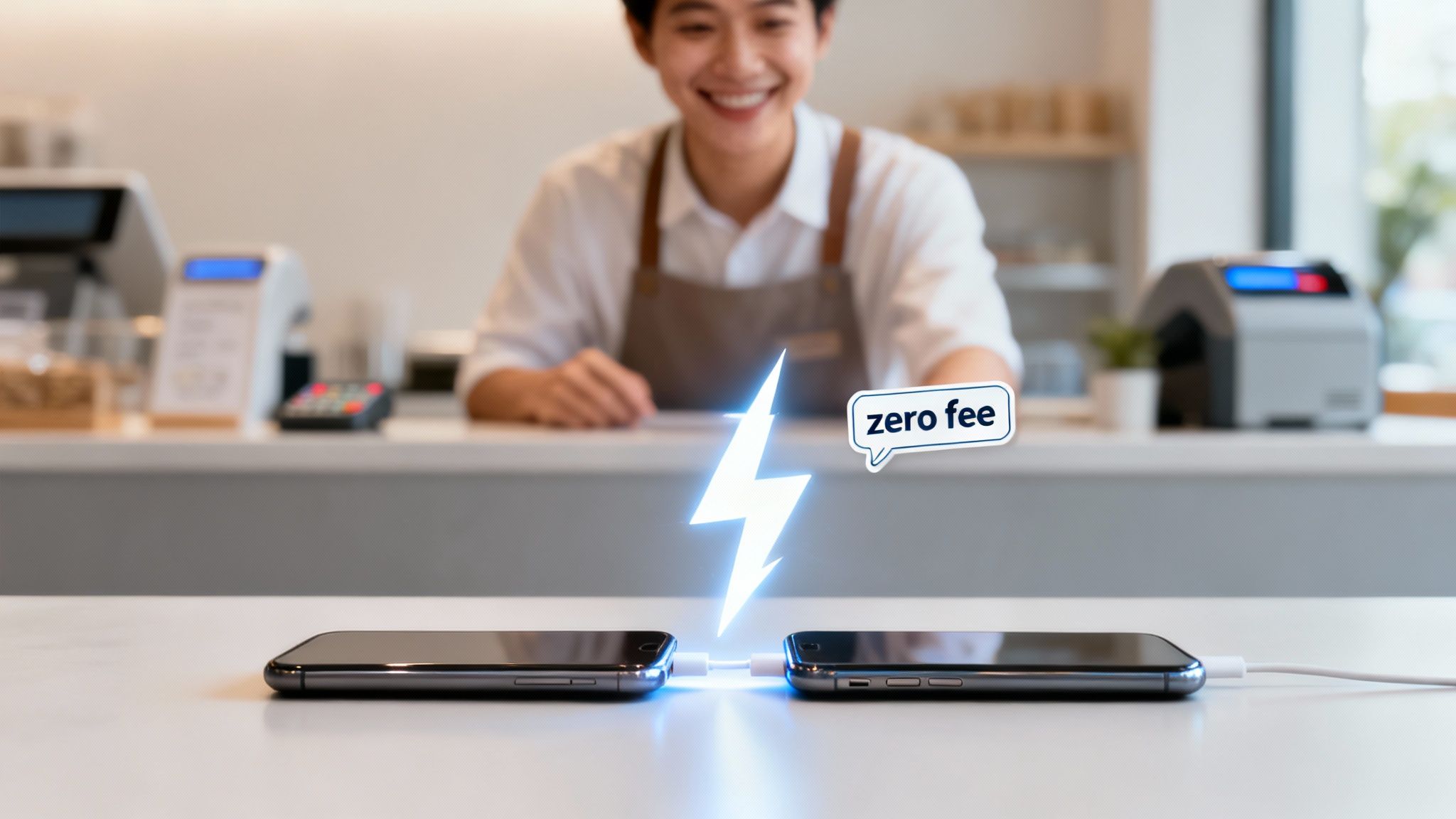
While smart strategies like batching and using the Lightning Network are powerful tools, let's be honest—they can be a headache to implement. This is where Flash comes in. We specifically engineered it to shield merchants from the chaos of high crypto gas fees by making these advanced solutions incredibly simple to use.
Flash taps into the Lightning Network to enable direct, wallet-to-wallet payments that are practically instant and cost next to nothing. This approach cuts right to the heart of the problems we've been talking about. Unpredictable costs vanish, replaced by tiny, consistent fees. Slow, clunky checkouts become immediate confirmations, giving your customers the smooth experience they expect.
Best of all, the entire platform is designed for simplicity, tearing down the technical walls that keep most businesses from accepting Bitcoin in the first place.
Designed for Merchants First
Flash was built to solve the real-world obstacles merchants face when trying to accept crypto. The platform is grounded in a few core principles that put business owners back in control:
- No Coding Required: Forget about hiring a developer. You can get started in minutes with tools that just work—a point-of-sale app, simple payment links, and customizable website widgets.
- No Intermediaries: Payments flow directly from your customer’s wallet straight into yours. Flash never holds your funds, so you always maintain 100% control.
- No Lengthy Onboarding: We skip the complex know-your-customer (KYC) hoops. This means you can get set up fast while preserving your and your customers' privacy.
Flash completely changes the game for businesses. Its near-zero fee model, built on direct, optimized payments, makes it a perfect fit for everything from corner coffee shops and retail stores to online subscriptions and digital content paywalls.
Bitcoin transaction fees have been a rollercoaster, dropping from over $50 in the 2017 mania to a more reasonable $0.764 average recently. Still, that volatility stings. Non-profits, for example, can lose 2-5% of a donation's value to unpredictable fees.
Flash delivers the stability and efficiency you need to open your doors to a global customer base, all without the headaches of traditional on-chain payments. To see just how wild these fee swings can be, it's worth taking a look at some live Bitcoin transaction fee charts.
Bitcoin Fee FAQs
If you’re a merchant, you’ve probably heard a lot of conflicting terms thrown around, especially "crypto gas fee." It's easy to get confused, but let's clear the air and answer some of the most common questions you might have about Bitcoin's transaction costs.
Getting a grip on these concepts is your first step to using Bitcoin effectively in your business. While the jargon can feel a bit much at first, the core ideas are actually pretty simple once you break them down.
Why Do People Call Bitcoin Fees "Gas Fees"?
The term gas fee actually comes from the Ethereum network. Think of "gas" as the fuel needed to power a car; on Ethereum, it's the unit of measurement for the computational work required to process a transaction or run a smart contract. The more complex the operation, the more gas it needs.
Bitcoin’s network works differently. Here, the fee isn't based on computational effort but on the size of your transaction data, measured in sats/vB (satoshis per virtual byte). The correct term is transaction fee or miner fee. Still, "gas fee" has caught on as a kind of informal slang for any crypto transaction cost, even if it's not technically accurate for Bitcoin.
Can I Really Accept Bitcoin With Zero Fees?
For any transaction recorded directly on the main Bitcoin blockchain (what we call "on-chain"), there will always be a fee. This fee is essential—it's what incentivizes miners to process your transaction and secure the network.
However, you can get incredibly close to a zero-fee experience by using Layer-2 solutions like the Lightning Network. This is where the magic happens for everyday commerce.
Platforms like Flash are built on top of Lightning to offer instant payments where the fees are often less than a single penny. This makes accepting Bitcoin practical and profitable for everything from a cup of coffee to a large sale.
What's The Easiest Way To Take Low-Fee Bitcoin Payments?
For any merchant, the most direct path is to use a payment solution built specifically to handle the Lightning Network. This lets you sidestep all the technical heavy lifting and just focus on what you do best: running your business.
A dedicated platform like Flash gets you set up in minutes, no coding needed. You get instant access to a point-of-sale app, payment links, and other tools that all run on direct, low-cost wallet-to-wallet transactions. It’s the perfect way to bypass the high fees and slow confirmation times of the main Bitcoin network, making it a setup built for modern business.
Ready to eliminate high fees and accept instant Bitcoin payments? With Flash, you can set up a wallet-to-wallet payment system in under a minute with no coding required. Start accepting Bitcoin today.