Think of a Bitcoin wallet address as a unique bank account number, but for your Bitcoin. It’s a string of characters you can safely share with anyone who needs to send you funds, without ever giving them access to your assets.
What Is a Bitcoin Wallet Address?
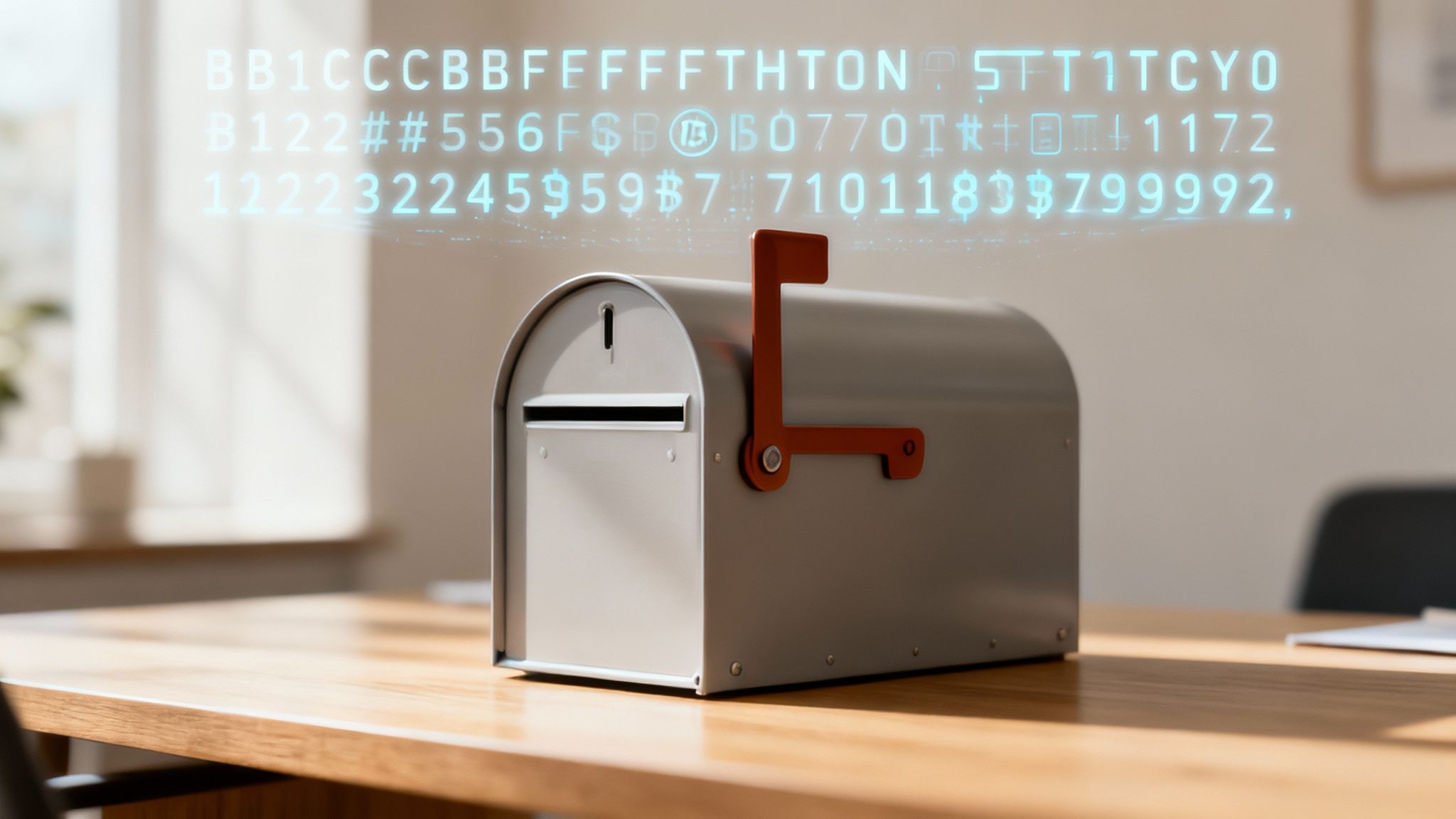
Let's use an analogy. Imagine your Bitcoin wallet is a digital safe. Your Bitcoin wallet address is like a P.O. Box number for that safe. You can give this address to anyone, anywhere in the world, and they can use it to deposit Bitcoin right into your wallet. It's your public receiving point on the Bitcoin network.
This address isn't just a random bunch of characters; it's generated from your wallet's public key, which itself is mathematically linked to a secret private key. This clever relationship is the foundation of Bitcoin's security. It means you can receive payments safely because the address reveals absolutely nothing about the private key that actually controls the funds.
Public Address vs. Private Key
Getting this next part right is absolutely crucial. The difference between your public address and your private key is the most important concept for any new Bitcoin user to understand.
- Public Address: This is your "account number." It's perfectly safe to share it with others so they can send you Bitcoin. Sharing it does not give anyone control over your funds.
- Private Key: This is your "PIN code" or the physical key to your safe. It grants total control over your Bitcoin. You must never share your private key with anyone. Ever.
Your public Bitcoin wallet address is strictly for receiving funds, while your private key is for spending them. Protecting your private key is the single most important rule in managing your Bitcoin.
This one-way design ensures that while the whole world can see your address on the public blockchain, only you can ever authorize transactions moving funds out of it.
For a quick summary of these essential terms, here's a simple breakdown:
| Key Components of Your Bitcoin Wallet |
| :--- | :--- | :--- |
| Component | Analogy | Primary Function |
| Public Address | P.O. Box Number | Receiving Bitcoin from others |
| Public Key | The Lock on your P.O. Box | Verifies you own the address without revealing the key |
| Private Key | The Key to your P.O. Box | Spending or sending your Bitcoin |
Grasping these three components and their real-world analogies is the first step toward using Bitcoin confidently and securely.
The Role of Your Digital Identifier
Every single transaction on the Bitcoin network moves funds from one address to another. When someone sends you Bitcoin, they are creating a transaction record that transfers ownership of those coins to your unique address. This record is then broadcast across the network and permanently cemented into the blockchain.
This system makes your Bitcoin wallet address a fundamental tool for interacting with the Bitcoin ecosystem. It doesn't matter if you're a merchant accepting payments or just an individual sending funds to a friend—the address is your gateway.
If you're looking for a deeper dive, Your Guide to Understanding a Crypto Wallet Address offers a great, comprehensive overview. Ultimately, your address acts as your pseudonymous identity for every transaction, securing your place in the decentralized economy.
How a Bitcoin Wallet Address Is Generated
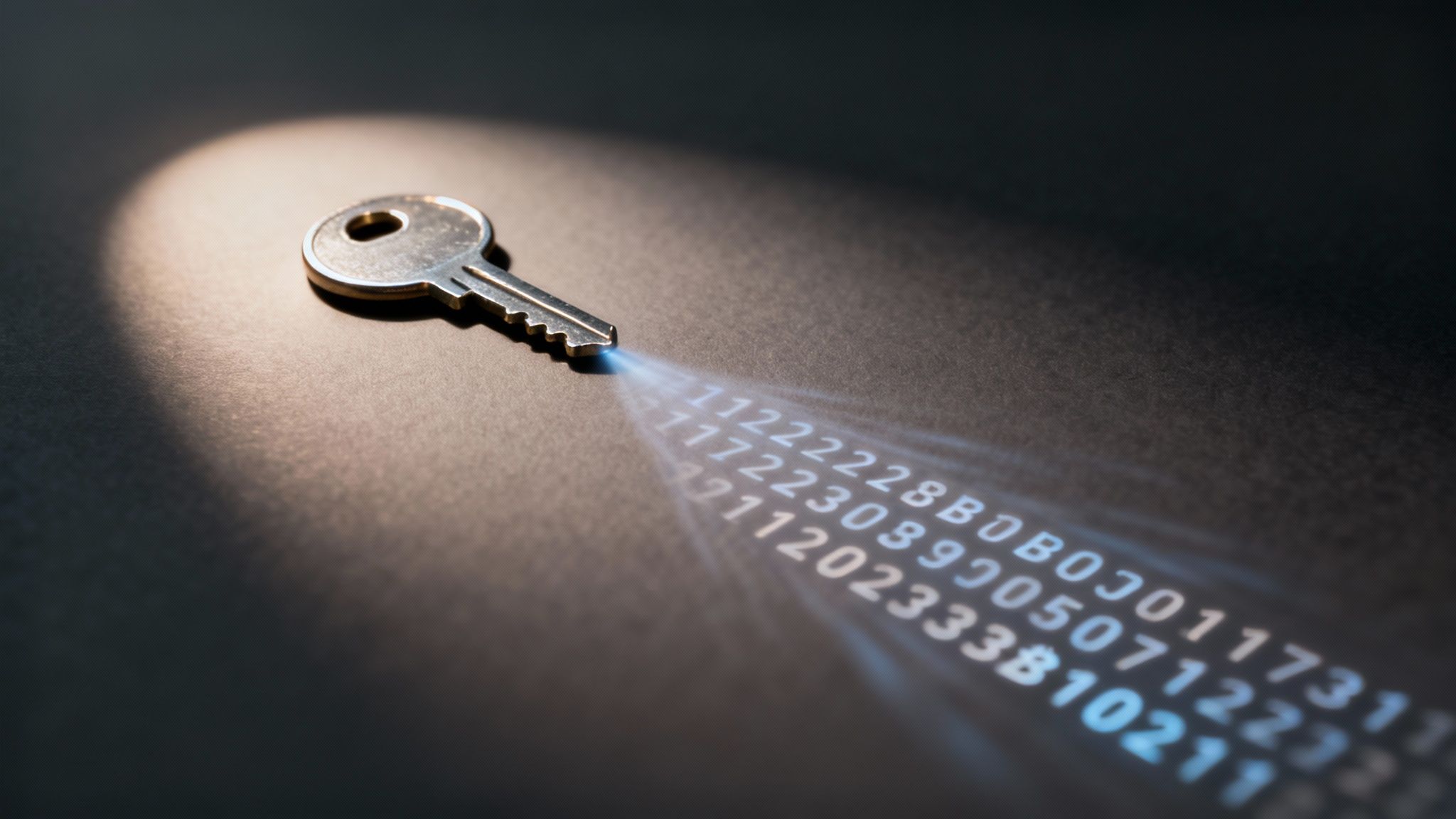
A Bitcoin address might look like a jumble of random characters, but it’s actually the end result of a clever cryptographic process built for ironclad security. The whole thing starts not with something public, but with something you should guard with your life: your private key.
Think of your private key as the master key to your digital vault. It’s a massive, randomly generated number that your wallet software creates and keeps secret. From this one secret, your wallet derives a corresponding public key using some pretty neat one-way math.
This one-way street is the secret sauce behind Bitcoin's security. It's dead simple to create a public key from a private one, but practically impossible to go backward and figure out the private key just by looking at the public one. This is how you can prove you own your bitcoin without ever showing your hand.
From Private Key to Public Address
Once your wallet has the public key, it puts it through another round of transformations to create the address you actually share with people. The public key is run through hashing algorithms—think of them as digital fingerprinting machines—that shrink it down into a shorter, unique string.
That final string is your Bitcoin address. The entire journey, from a secret number to a shareable address, is a one-way street by design. Every single step is engineered to protect your private key, which never leaves the safety of your wallet.
This cryptographic chain reaction ensures your public address is mathematically tied to your private key, yet reveals absolutely nothing about it. It’s like creating a unique keyhole (your address) from a master key (your private key) in a way that no one could ever guess what the key looks like just by studying the lock.
This generation process also allows modern Hierarchical Deterministic (HD) wallets to create a virtually endless supply of new addresses from a single backup, which is a game-changer for privacy.
Different Types of Bitcoin Addresses
As Bitcoin has grown up, so have its address formats. You’ll run into a few different types, and knowing the difference can actually save you money on transaction fees and prevent compatibility headaches.
Here are the main formats you'll see in the wild:
- Legacy (P2PKH): These are the OGs of Bitcoin addresses, always starting with the number 1. They work everywhere but are the least efficient, meaning you'll pay higher transaction fees.
- SegWit (P2SH): These addresses, which typically start with the number 3, were a major upgrade. They were introduced to help shrink transaction data, acting as a bridge between old and new systems and offering lower fees than their Legacy counterparts.
- Native SegWit (bech32): This is the modern standard, and you can spot them because they start with bc1q. They offer the absolute lowest transaction fees and have better error detection, though some very old services might not support them yet.
Using a wallet that supports modern formats like Native SegWit is a no-brainer. You'll save a little on every transaction, and you'll also be helping the entire Bitcoin network run more efficiently.
How to Find and Share Your Bitcoin Address
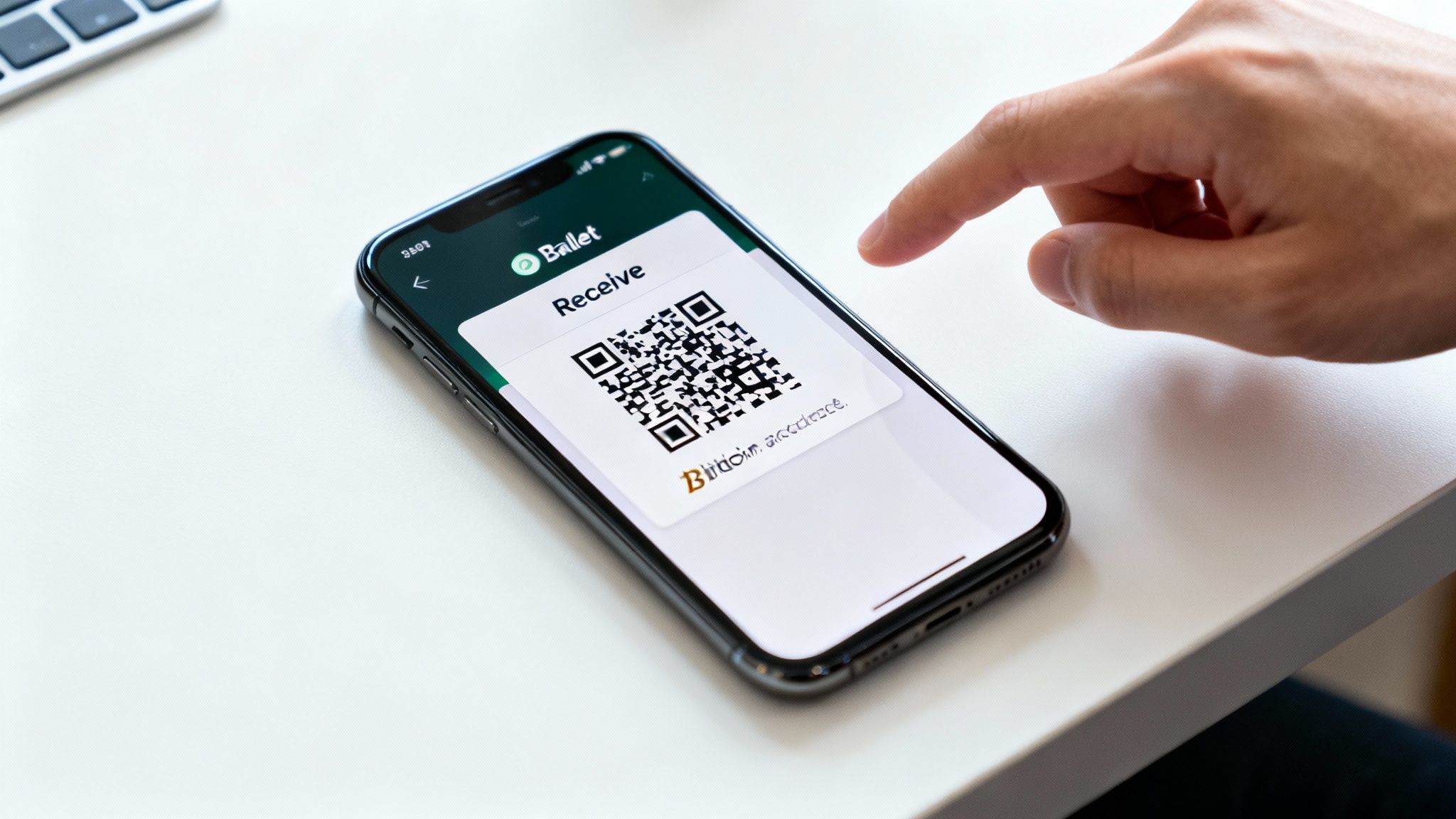
Alright, so you get what a Bitcoin address is and where it comes from. The next logical step is actually finding it and putting it to use. Don't worry, this part is surprisingly simple, whether you're using a mobile app, desktop software, or even a dedicated hardware device. Your wallet address is your gateway for receiving Bitcoin, so let's walk through how to find and share it safely.
Nearly every Bitcoin wallet out there is built to be intuitive. You’ll just need to look for a button or tab that says "Receive" or "Deposit." Tapping this will bring up everything you need for the next incoming transaction.
When you do, your wallet will show you two things: a long string of letters and numbers, and a QR code. Both represent the exact same Bitcoin wallet address—they're just different formats to make your life easier.
Safely Locating Your Address
No matter which wallet you've chosen, the process for finding your address is pretty much the same. This consistency is intentional; it creates a predictable and reliable experience across the entire Bitcoin ecosystem.
Here’s a quick rundown of what to expect:
- Open Your Wallet: Unlock your mobile, desktop, or hardware wallet.
- Navigate to 'Receive': Find and tap the button labeled "Receive," "Deposit," or one that just shows a QR code icon.
- Display Your Address: Your wallet will instantly generate and show a fresh address for you to use.
- Choose Your Sharing Method: Decide if it's easier to copy the text string or have the sender scan your QR code.
It's worth repeating: Bitcoin transactions are final. Once funds are sent, they can't be clawed back. This is exactly why double-checking every single character of a Bitcoin wallet address is the most important step before you hit "send."
How to Share Your Address Securely
Sharing your address is easy, but doing it safely is what separates the novices from the pros. It's all about protecting your funds from common scams and simple human error. You have two main options: copy-pasting the text or using the QR code.
For any in-person transaction, the QR code is your best friend. It completely removes the risk of typos, since the sender's wallet scans the code and gets the address right every single time.
If you're online, you'll be copying the text string. This is where you need to be extra cautious. Nasty bits of software called clipboard hijackers exist, and their only job is to secretly replace the address you copied with a scammer's address. To stay safe, always double-check the first and last few characters of the address right after you paste it. Make sure they match what your wallet is showing.
The Bitcoin network is a bustling place. There are roughly 106 million Bitcoin owners worldwide, who collectively make about 270,000 transactions every single day. While over 460 million Bitcoin addresses have held a balance at some point, many are now empty or inactive. This just highlights why careful address management is so critical for today's active users. You can dig into more stats on Bitcoin's user base and check out global adoption trends to see the bigger picture.
Public Address vs Private Key Explained
If you're going to use Bitcoin safely, there’s one rule you absolutely have to internalize: the difference between your public address and your private key. Getting these two mixed up is easily the most common—and most expensive—mistake a newcomer can make. Nail this concept, and you've built the foundation for protecting your digital wealth.
Think of it like your bank account.
Your public Bitcoin wallet address is like your bank account number. It's the information you must share with others to get paid. You can post it, send it in an email, or show it to anyone without any risk. It only allows people to send money to you.
Your private key, however, is your secret PIN and your signature all rolled into one. This is the only thing that proves you own the Bitcoin at your address and gives you the power to actually spend it.
The Unbreakable Link and Its Consequences
The relationship between your public address and private key is a mathematical one-way street. Your wallet uses your private key to generate your public address, but it's cryptographically impossible for anyone to work backward and figure out your private key just by looking at your public address. This is the magic that keeps the whole Bitcoin network secure.
But all of that security depends on you keeping your private key completely secret.
If your public address is for receiving, your private key is for authorizing. Anyone who gets their hands on your private key gains immediate and total control over your funds. There are no take-backs or reversals in Bitcoin.
Giving away your private key is the digital equivalent of handing a stranger a stack of blank checks you've already signed. They can drain your account, and there is absolutely nothing you or anyone else can do to stop them. This is why you must never share it, screenshot it, or store it anywhere online.
Custodial vs Non-Custodial Who Holds the Keys
This critical difference between public and private keys forces an important choice: who is actually in control of them? Your answer determines whether you're using a custodial or a non-custodial wallet.
- Non-Custodial Wallets: You, and only you, hold the private keys. This gives you complete sovereignty over your funds but also makes you solely responsible for keeping them safe.
- Custodial Services: A third party, like an exchange, holds the private keys for you. This is often more convenient, but it means you're trusting that company to protect your assets.
This choice is reflected across the entire crypto ecosystem. As of 2025, there are around 820 million active crypto wallets worldwide. Of those, a clear majority—59%—are non-custodial, showing that users prefer to have direct control over their own assets. The other 41% are held with custodial services, which people often choose for their ease of use. You can dive deeper into these trends by reading more about wallet adoption statistics.
Best Practices for Managing Your Bitcoin Address
Managing your Bitcoin address effectively goes way beyond just knowing how to copy and paste. To protect your funds for the long haul, you need to build strong habits around security and privacy. The good news is that a few simple, consistent practices can make all the difference in protecting your digital assets from common threats.
One of the most powerful privacy tools you have is address rotation. Security experts are pretty clear on this: you should use a brand-new Bitcoin address for every single transaction you receive. When you keep reusing the same address, you create a public breadcrumb trail on the blockchain. This lets anyone track your entire transaction history, monitor your balance, and link all your financial activities together.
Thankfully, most modern wallets handle this for you, automatically generating a fresh address each time you click "Receive." It’s a simple action that helps break the chain of traceability, making it much harder for prying eyes to connect the dots and profile your financial life.
Organizing and Protecting Your Funds
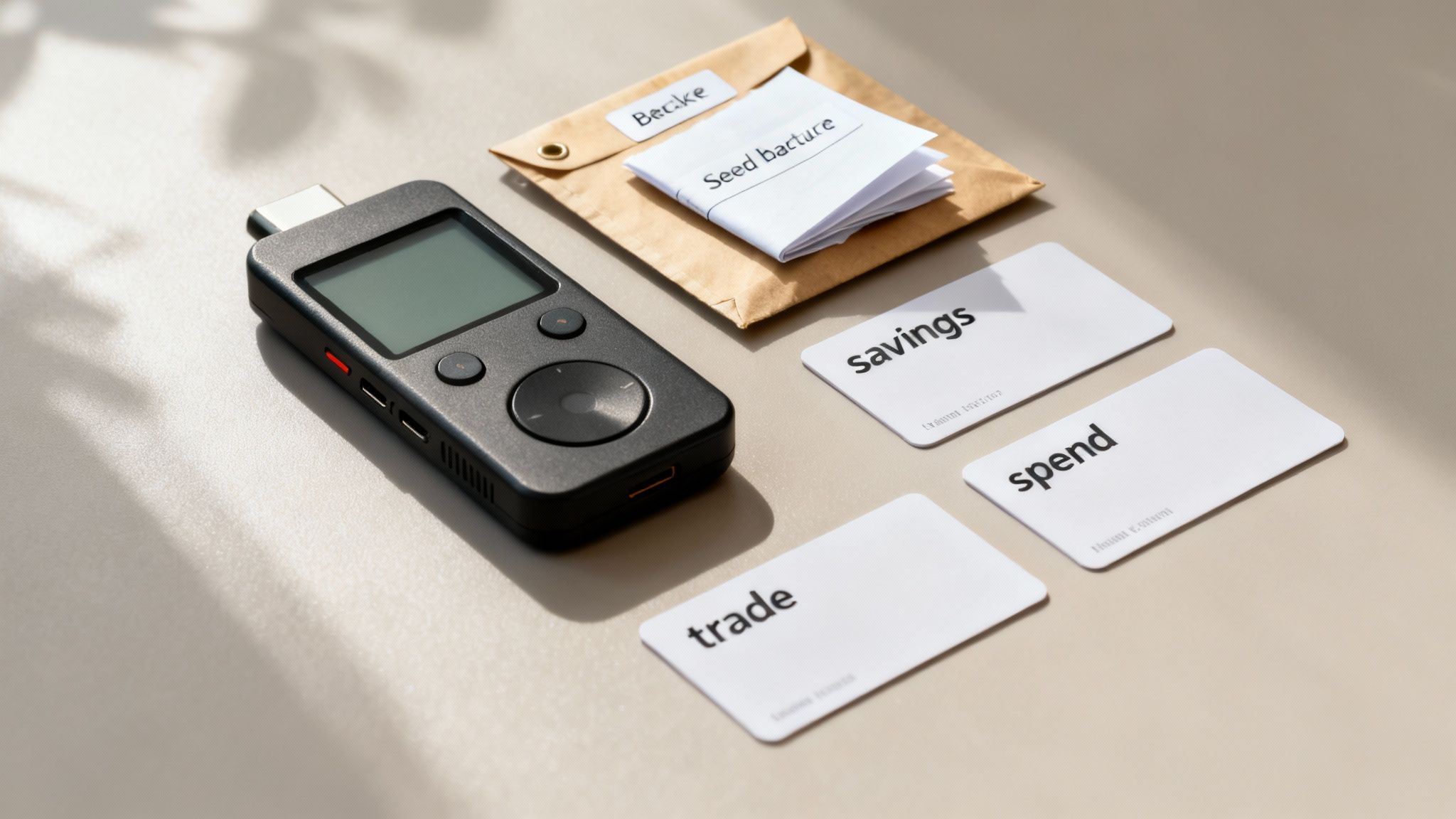
A smart way to manage your Bitcoin is to separate your funds across different addresses or even different wallets for specific jobs. Think of it like this: you might have one wallet for your long-term savings (a "cold storage" solution) and another for small, daily spending (a "hot wallet"). This segmentation contains your risk. If your daily spending wallet ever gets compromised, your main stash stays safe and sound.
This organizational approach is catching on as the market grows up. The number of Bitcoin addresses holding over $1 million has jumped since early 2024, partly because big players are holding huge balances. This surge in high-value wallets highlights the growing need for smarter management practices among serious investors.
The single most critical step in securing your Bitcoin is backing up your wallet's seed phrase—sometimes called a recovery phrase. This string of 12 or 24 words is the master key to every address and private key in your wallet.
If your device is ever lost, stolen, or just stops working, this phrase is the only way to get your funds back. Write it down on paper and store it in multiple secure, offline locations.
Key Do's and Don'ts
Follow these quick tips to keep your Bitcoin secure:
- DO double-check addresses on a hardware device screen before you confirm any transaction.
- DON'T ever store your seed phrase digitally—not in a photo, an email, or a cloud drive. Ever.
- DO use a fresh address for every payment you receive to protect your privacy.
- DON'T make transactions on public Wi-Fi, which can open you up to all sorts of security risks.
Beyond just wallet security, it's wise to think about your broader digital footprint. Learning how to prevent IP address tracking is another layer that can strengthen your overall security when you're dealing with Bitcoin.
Your Bitcoin Address Questions, Answered
Once you get the hang of Bitcoin, a few practical questions always pop up about handling your wallet address. Let's tackle some of the most common ones to make sure you can manage your Bitcoin with confidence.
Think of this as a quick-reference guide to reinforce the best practices for keeping your funds and your privacy safe.
Should I Reuse My Bitcoin Wallet Address?
You technically can, but you absolutely shouldn't. It's a huge privacy misstep.
Every single transaction on the Bitcoin network is public. When you reuse an address, you're making it incredibly easy for anyone to connect all your payments—both in and out—and build a detailed financial profile on you.
The gold standard for privacy is to generate a brand new address for every single payment you receive. Modern wallets are built for this; they can create a nearly endless supply of addresses from your one backup phrase. Most will even automatically give you a fresh address every time you hit the "Receive" button, making it completely effortless.
It's like using a unique invoice number for every sale. It keeps your books clean, separate, and shielded from prying eyes on the public ledger.
This one simple habit makes a massive difference in your financial anonymity.
What Happens If I Send Bitcoin to a Wrong Address?
This is the scary one, so pay close attention: Bitcoin transactions are irreversible. Once you hit send, it's gone. There's no "undo" button, no customer service line to call, and no bank that can reverse the payment.
If you send your coins to the wrong address, they are almost certainly lost forever.
The only long-shot chance of getting them back is if you happen to know the person who owns that address and they're honest enough to send them back. As you can imagine, that almost never happens. This is precisely why you must double-check, then triple-check, every character of an address before you confirm a transaction. The safest way? Just scan a QR code. It completely removes the risk of a typo.
Are Bitcoin Wallet Addresses Case-Sensitive?
This is a great question, and the answer depends on the type of address you're looking at. Getting this wrong can be costly.
- Legacy Addresses: The old-school addresses that start with a '1' are case-sensitive. If you mix up an uppercase and a lowercase letter, the address will be invalid, and your wallet will likely reject it.
- SegWit and Taproot Addresses: Thankfully, the newer addresses that start with 'bc1q' (SegWit) or 'bc1p' (Taproot) are not case-sensitive. They were designed to use only lowercase letters to make them easier to read and eliminate this exact kind of human error.
To be perfectly safe, just get into the habit of never typing an address by hand. Always use your device's copy-paste function or scan a QR code. Problem solved.
How Many Different Bitcoin Addresses Can I Have?
You can have a virtually unlimited number of them, all from a single wallet.
This isn't an accident; it's a powerful feature of modern Hierarchical Deterministic (HD) wallets. They use your single seed phrase (that 12 or 24-word backup) to mathematically generate a massive tree of private keys and their matching public addresses.
This design has one critical purpose: protecting your privacy. By giving you a fresh, clean address for every incoming payment, it makes it incredibly difficult for anyone to track your financial activity on the blockchain. You get all the privacy benefits of using countless addresses without the nightmare of managing separate wallets and backups.
Ready to accept Bitcoin payments directly and securely? Flash gives merchants the tools to integrate wallet-to-wallet Bitcoin payments in under a minute—no middlemen, no KYC. Start reaching a global audience of Bitcoin users today by visiting .