Are high transaction fees quietly eating into your profit margins? Here's the thing: many merchants just accept Bitcoin fees as a fixed cost of doing business. But they're not. With the right crypto wallet and a bit of strategy, they become a manageable expense. Finding a crypto wallet with low fees is the first, most critical step to protecting your bottom line.
The Hidden Costs in Bitcoin Payments and How to Avoid Them
As a merchant, you're used to paying for payments. Traditional credit card processors skim a percentage off every single sale, usually somewhere between 2-3%. That fee grows right alongside your revenue—the more you sell, the more you hand over. It’s a built-in tax on your success.
Bitcoin transaction fees play by a completely different set of rules. Instead of a percentage, the cost is based on data. Think of it less like a sales tax and more like a variable ‘shipping cost’ for getting your transaction data onto the network. This one difference changes everything, giving you a surprising amount of control over what you actually pay.
Understanding Network Congestion
So what drives this "shipping cost"? The biggest factor is network congestion.
Picture the Bitcoin network as a busy highway. Every transaction is a car trying to get on. When traffic is light, merging is cheap and easy. But during rush hour, cars (your transactions) start piling up in a digital waiting room called the mempool.
To jump the queue, users can offer a higher "toll"—the transaction fee—to the miners who act as traffic controllers. This creates a real-time bidding war where higher fees get priority processing.
One of the biggest myths is that Bitcoin fees are always expensive. In reality, they are constantly changing. Once you understand what makes them tick, you can strategically time payments and use the right wallet tech to slash your costs.
This guide is your roadmap to navigating the Bitcoin network like a pro. We’ll break down how these fees work, show you why paying high fees is often a choice (not a requirement), and give you practical strategies to keep your costs low. By the end, you'll see why a low-fee crypto wallet isn't just a nice-to-have; it's an essential tool for any business looking to grow. Your journey to lower transaction costs starts right now.
How Bitcoin Transaction Fees Actually Work
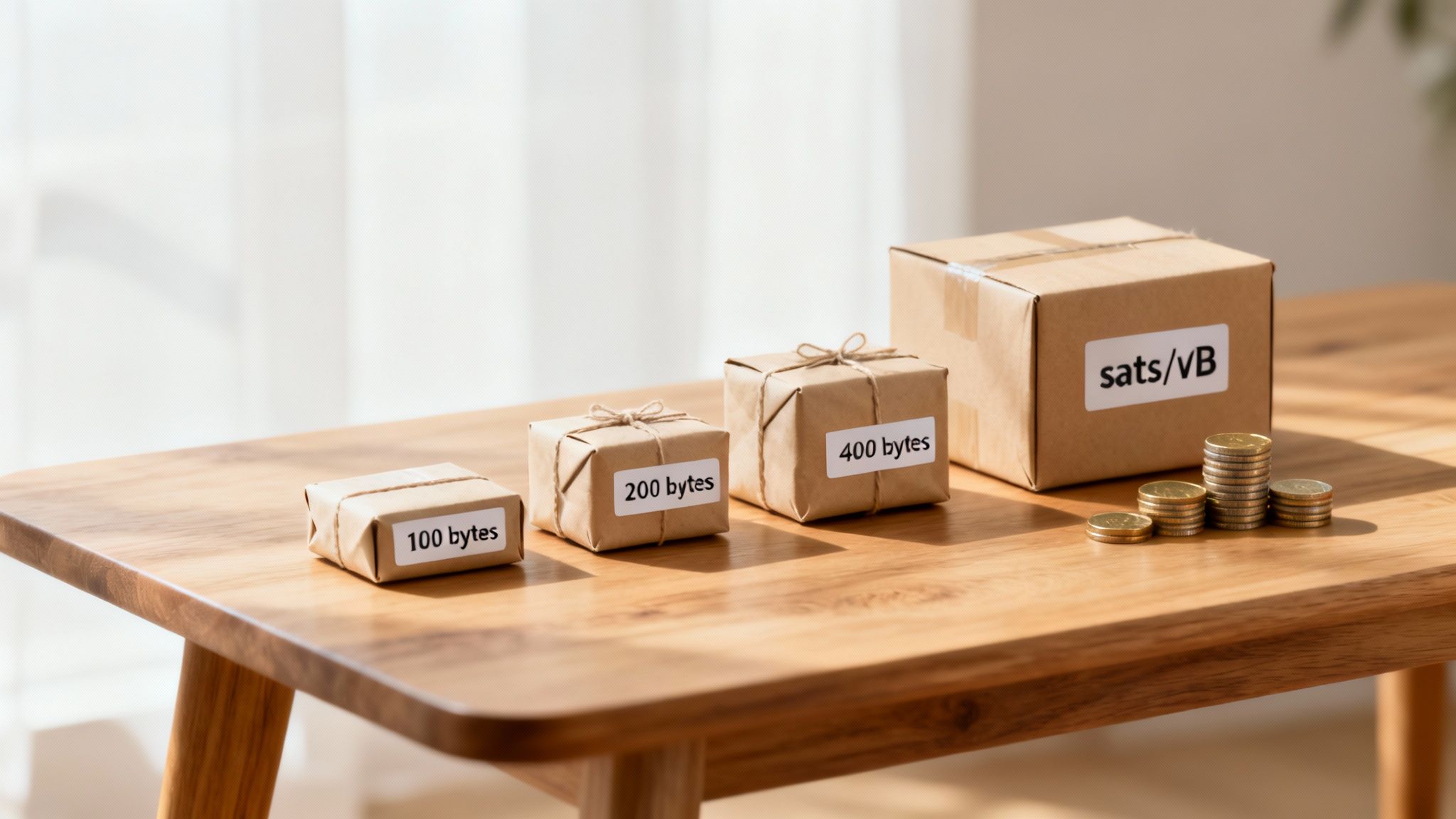
To get a grip on Bitcoin fees, you have to toss out one huge misconception. The fee you pay has absolutely nothing to do with the dollar value of your transaction. Sending $10 or $10 million can, in theory, cost the exact same amount.
Think of it like shipping a package with FedEx. The shipping cost isn’t based on the value of the stuff inside the box; it’s all about the box's size and weight. On the Bitcoin network, the "size and weight" is simply how much data your transaction takes up, measured in bytes.
This is a fundamental shift in thinking for most merchants. A simple payment from a single source is like a small, lightweight envelope. On the other hand, a more complex transaction—say, one that pulls together funds from a dozen different previous payments—is like a big, heavy parcel that needs more postage.
Your Bid in the Bitcoin Auction
So, how is this "postage" calculated? It’s priced in satoshi per virtual byte (sat/vB). A satoshi is the smallest unit of Bitcoin—just one hundred-millionth of a single coin. The sat/vB rate is your bid, the price you're willing to pay for each byte of data your transaction takes up.
Imagine a fast-paced auction. Bitcoin miners are the auctioneers, and they only have limited space in each new block they create. To make as much money as possible, they’re always going to pick the packages with the highest postage bids first.
When the network is swamped with transactions, lots of people are bidding to get their payments included, driving the sat/vB rate through the roof. When things are quiet, you can get away with a much lower bid. This is why using a crypto wallet with smart, low-fee estimation tools is crucial for making a competitive bid without just giving money away.
The fee isn’t a fixed price but a strategic bid. Your goal is to bid just high enough to get your transaction confirmed in your desired timeframe without unnecessarily giving away your profits.
The Factors You Can Actually Influence
Understanding this auction model is empowering. You're no longer just taking whatever price is offered; you're an active player who can strategically manage costs. Some things, like overall network demand, are out of your hands. But several key elements are directly influenced by the wallet you use and how you use it.
Choosing a wallet that gives you control over these elements is the first step toward slashing your expenses. Below is a breakdown of what determines your final fee and what you, as a merchant, can do about it.
Key Factors That Determine Your Bitcoin Transaction Fees
To really get a handle on your costs, it helps to see exactly what you can and can't control. This table breaks down the core components of a Bitcoin fee.
| Factor | Simple Explanation | How Merchants Can Optimize It |
|---|---|---|
| Transaction Size (in vBytes) | The amount of data your transaction contains. More inputs and outputs generally mean a larger size. | Use a modern wallet that supports SegWit, which makes transaction data more efficient. Practice transaction batching—paying multiple suppliers in one large but efficient transaction instead of many small ones. |
| Fee Rate (sat/vB) | The amount you "bid" per byte to get your transaction confirmed by a miner. | Use a wallet with a reliable fee estimator. During non-urgent periods, set a lower custom fee rate. Transact during off-peak hours (like weekends) when network congestion is typically lower. |
| Network Congestion | How busy the network is at any given moment. High traffic means more competition and higher fee rates. | While you can't control congestion, you can react to it. Delay non-critical payments until the mempool (the waiting area for transactions) clears and fee rates drop. |
| Wallet Technology | The software you use to create and send the transaction. Different wallets have different efficiencies. | Select a wallet designed for merchants that offers custom fee settings, SegWit support, and integrates with technologies like the Lightning Network for nearly free, instant payments. |
Ultimately, your choice of wallet technology is the single biggest lever you can pull. A great wallet not only helps you bid smarter on the main chain but also gives you access to alternatives like Lightning, where fees are practically a non-issue.
Why High Fees Are a Choice, Not a Requirement
Too many merchants get burned by high, unpredictable Bitcoin fees and just assume it's the cost of doing business. It’s a common and expensive myth. The reality is, the fees gutting your profit margins often have little to do with the actual network cost—they’re inflated charges from middlemen.
The critical difference comes down to custodial exchanges versus non-custodial wallets. When you withdraw Bitcoin from a major exchange, you're not just paying the network fee. You’re also paying their internal service fee, a premium they charge for bundling transactions and offering convenience. You’re paying more than you have to.
A direct, wallet-to-wallet setup changes the entire equation. By connecting your business wallet straight to your customer's, you cut out the intermediary. You only ever pay the true, real-time Bitcoin network fee, putting you back in control of your costs.
The Power of Second-Layer Solutions
Beyond just cutting out the middleman, modern payment tech offers an even better way to get that low-fee crypto wallet experience. For merchants, the single most important innovation is the Bitcoin Lightning Network.
Think of the main Bitcoin blockchain as a heavily secured superhighway. It’s perfect for large, important shipments, but it can get congested and pricey during rush hour. The Lightning Network is a second layer built right on top—like a network of local express lanes designed for smaller, everyday traffic.
This allows for instant transactions that cost next to nothing, making it ideal for the day-to-day payments that drive commerce.
- Retail and Cafes: Selling a cup of coffee or a t-shirt is suddenly practical, with fees of just fractions of a cent.
- Digital Content: Micropayments for articles, videos, or game items finally make economic sense.
- Subscriptions: Recurring billing can be automated without a processor shaving a percentage off every single payment.
By guiding customers to pay over the Lightning Network, merchants can completely sidestep the congestion and higher fees of the main blockchain for most transactions. This is exactly where a platform like Flash becomes indispensable, as it weaves Lightning payments into a simple, easy-to-use system.
Comparing Costs Against Traditional Payments
Once you adopt a direct, wallet-to-wallet approach, the savings are impossible to ignore. Traditional credit card processors hit you with a percentage-based fee of 2-3% on every single transaction. On a $10,000 sale, that's $200-$300 that vanishes before the money even touches your account.
Bitcoin, when managed properly, works on a totally different cost model. The fees are for data, not for value. As of January 2026, Bitcoin's average daily transaction fee is just 0.7948 USD, and that number often dips below $1 during off-peak times. For merchants, this means processing $10,000 in monthly Bitcoin volume can cost pennies in network fees, compared to the $300-$500 that many custodial wallets might charge in swap fees. For a deeper dive, you can read the full research about the crypto wallet market to understand these trends.
High fees are a symptom of using the wrong tools. With a non-custodial wallet and access to the Lightning Network, you're not just accepting Bitcoin; you're using it to build a more profitable and efficient business.
Choosing a low-fee crypto wallet isn't just about saving a few dollars. It's a strategic move to reject the percentage-based model of traditional finance and the bloated costs of custodial services. When you take control of your payment infrastructure, you keep more of your hard-earned revenue and set your business up for a future where direct, peer-to-peer commerce is the standard. The tools to make high fees a thing of the past are already here.
Actionable Strategies to Minimize Bitcoin Fees
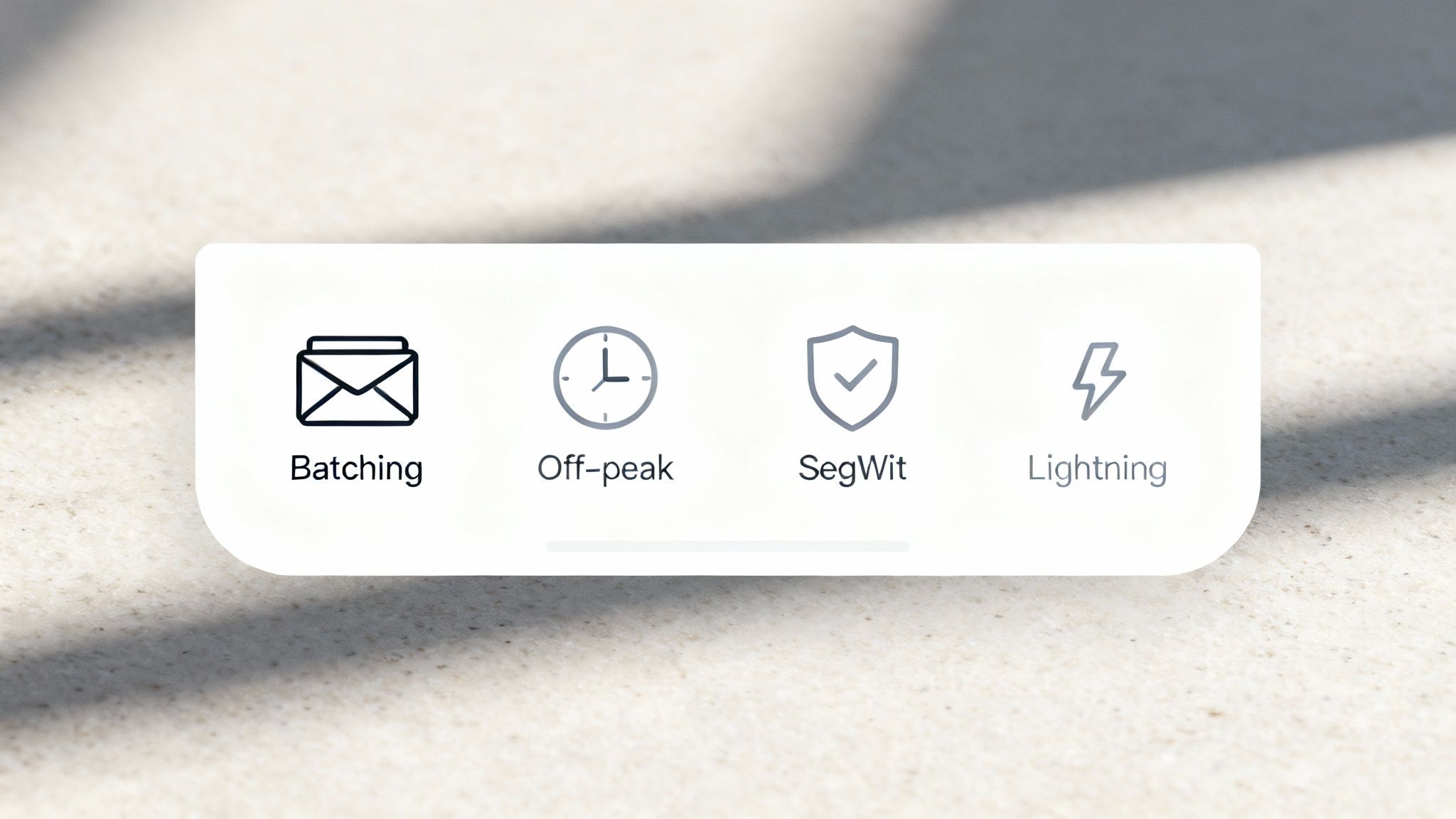
Knowing how Bitcoin fees work is one thing, but putting that knowledge into action is how you directly impact your bottom line. Getting the lowest possible fees isn’t about luck; it’s about having the right tools and knowing when to use them.
The good news is that a modern crypto wallet with low fees capabilities makes these strategies surprisingly simple to implement for both you and your customers. We’ll cover the practical, step-by-step methods you can start using today to ensure you’re never overpaying to move your Bitcoin.
Optimize Your Transaction Timing
One of the easiest yet most effective ways to slash fees is to send transactions when the Bitcoin network is less busy. Think of it like a highway during rush hour—when traffic is high, the competition for block space drives up prices.
If your payment isn't time-sensitive, just wait for a quieter period. It's like choosing an off-peak delivery window to get a better rate. Network activity often takes a dip during weekends or late at night in major economic hubs.
A good wallet will have a real-time fee estimator, showing you the current sat/vB rate needed for a timely confirmation. By keeping an eye on these rates, you can easily spot the lulls in demand and send your transaction for a fraction of the peak cost.
Embrace SegWit for Smaller Transactions
For any business serious about cutting costs, support for Segregated Witness, or SegWit, is non-negotiable. This upgrade to the Bitcoin protocol changes how transaction data is structured, making everything far more efficient. In simple terms, it shrinks the data size of your transaction without touching its value.
Imagine you're shipping a product. SegWit is like a technique that lets you use a smaller, lighter box for the same item. Since Bitcoin fees are based on data size, a smaller transaction automatically means a lower fee.
A SegWit-enabled wallet is a passive way to save on every single on-chain transaction. It can shrink your payment’s data footprint by up to 40%, which translates directly into lower network fees.
Most reputable, modern wallets support SegWit by default. If yours doesn't, making the switch is one of the most important steps you can take. It’s a foundational piece of the cost-saving puzzle.
Use Transaction Batching for Payouts
For businesses making multiple payments at once—think paying suppliers, affiliates, or employees—transaction batching is a complete game-changer. Instead of sending ten individual payments, each racking up its own fee, you can bundle them into a single, larger transaction.
This is massively more efficient. While the batched transaction is bigger than any single payment, its total data size is significantly smaller than the sum of ten separate ones. You're essentially paying the base "shipping cost" once instead of ten times. This is especially powerful for businesses that handle regular, high-volume payouts. Any wallet built for merchants should make batching easy.
Prioritize the Lightning Network for Daily Commerce
When it comes to everyday customer payments, the most powerful tool in your arsenal is the Bitcoin Lightning Network. As we've mentioned, this second-layer solution is built for instant, near-zero fee transactions, making it the perfect fit for retail, online content, and subscriptions.
Encouraging customers to pay with Lightning should be a core part of your strategy. By pushing the bulk of your daily transactions to this network, you can save the main Bitcoin blockchain for larger, less frequent settlements. This two-pronged approach gives you the best of both worlds: fortress-like security for major transfers and lightning-fast, cheap payments for everything else.
Platforms like Flash make integrating Lightning payments a breeze, letting you offer a superior, low-cost experience without the technical headaches.
Putting Low-Fee Bitcoin Payments to Work for Your Business
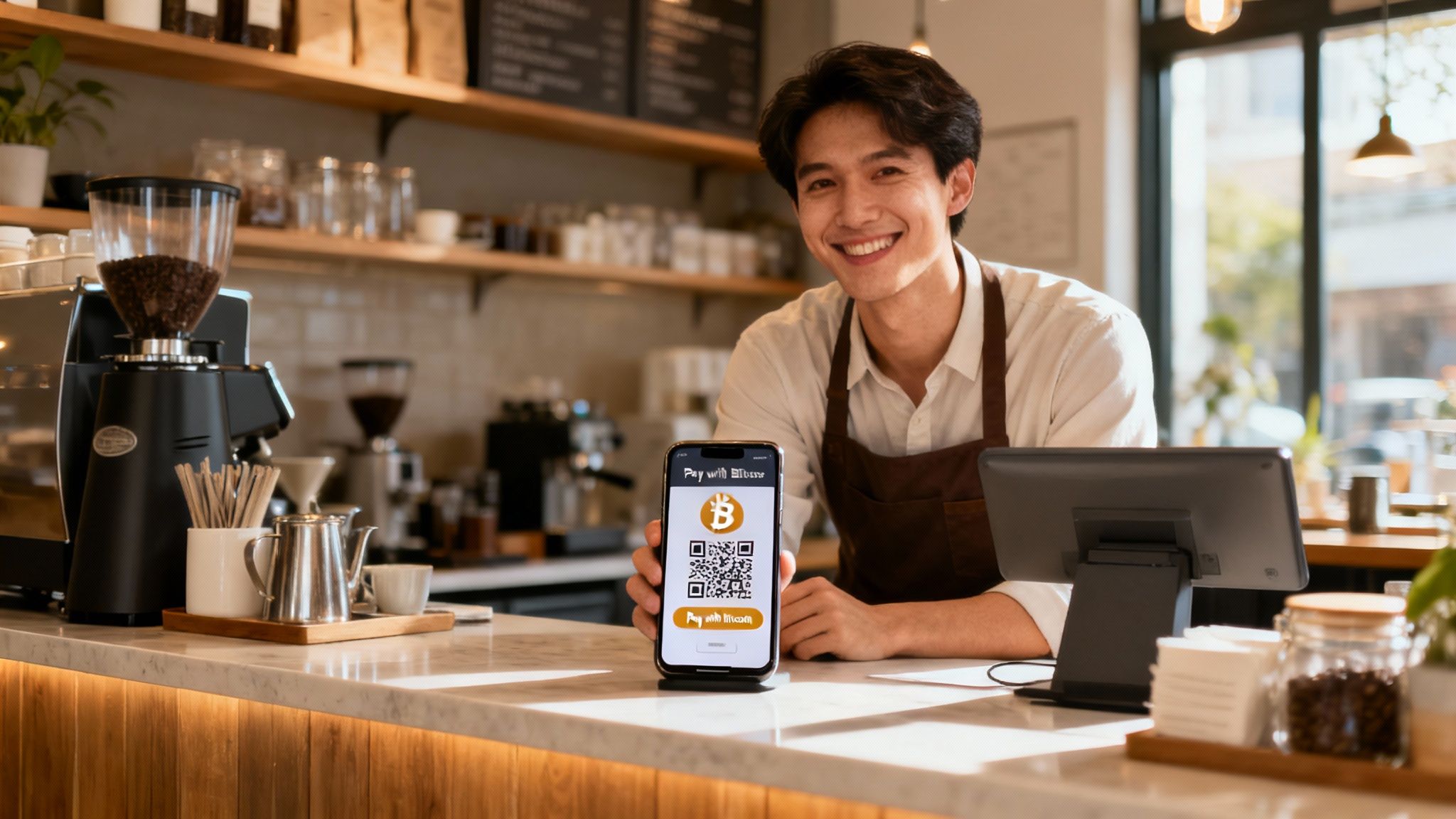
Actually putting these cost-saving ideas into practice is much easier than you might think. The days of needing a dev team just to accept Bitcoin are long gone, replaced by simple, no-code tools built for merchants like you. The tech headaches have been sorted out, making it surprisingly straightforward to offer a fast and cheap payment option to anyone, anywhere.
Modern platforms are designed to get you up and running in minutes. Think about it: you can turn any smartphone or tablet into a full-fledged Bitcoin point-of-sale terminal just by downloading an app. This is a huge win for brick-and-mortar stores, cafes, and even vendors at a farmers market, letting them take instant, low-fee payments without buying any new hardware.
The setup process for these tools is deliberately simple. Often, you can start taking payments almost immediately, skipping the drawn-out KYC (Know-Your-Customer) hoops that traditional payment companies make you jump through. This quick onboarding is a massive plus for businesses that want to get going fast and cater to customers who value their privacy.
Versatile Tools for Every Business Model
The real beauty of today's low-fee Bitcoin payment systems is how adaptable they are. Whether you're running a busy e-commerce store, a subscription service, or a neighborhood coffee shop, there's a tool out there that fits your exact needs.
Customizable Payment Widgets: Perfect for online stores. You can add a "Pay with Bitcoin" button to your checkout page by just copying and pasting a bit of code. It creates a smooth experience that fits right into your existing website.
Digital Paywalls: A lifesaver for content creators, educators, and news sites. Paywalls built on the Bitcoin Lightning Network make micropayments effortless. You can sell access to articles, videos, or courses for tiny amounts without losing most of your revenue to fees.
Mobile Point-of-Sale (POS) Apps: As we touched on, these apps are a game-changer for physical retail. They create a unique QR code for every sale, which your customer can scan with their Bitcoin wallet to pay in a flash.
The bottom line is this: the technology has matured to the point where integration isn't a barrier anymore. A crypto wallet with low fees is now accessible through intuitive tools that work for almost any kind of business, from selling digital downloads to invoicing clients across the globe.
A Growing Global Trend
This newfound ease of use is driving real adoption. Around the world, the efficiency of Bitcoin is pushing it into the mainstream. As of January 2026, a remarkable 39% of U.S. merchants now accept digital assets. What's more, 84% expect them to be a common way to pay within five years.
Non-profits and charities are also seeing the benefits. Low-fee, wallet-to-wallet donations cut out the middlemen and compliance headaches, ensuring more money goes directly to the cause. With 90% of merchants saying they'd be ready to adopt crypto if the setup was as easy as traditional card systems, the no-code widgets from platforms like Flash are making that transition seamless.
You can dive deeper into these market trends and see how digital payments are evolving on MEXC Global's news platform.
The Future of Commerce Is Wallet-to-Wallet
The move away from traditional payment processors isn't just another tech trend; it's a fundamental rewiring of how money moves. Direct, wallet-to-wallet Bitcoin transactions are the next evolution in commerce, giving merchants the tools to build leaner, more profitable, and far more secure businesses.
When you cut out the layers of middlemen that bog down legacy financial systems, you unlock some serious benefits. The most obvious one is the cost savings. Instead of kissing 2-3% of every sale goodbye, you pay a tiny network fee based on data usage, not the size of the transaction.
The True Benefits of Financial Sovereignty
Beyond just lower costs, this direct model offers advantages that old-school systems simply can't compete with. Instant settlement means your money is yours in minutes, not days, which is a game-changer for cash flow.
And maybe the most important part? It completely nukes the risk of chargeback fraud. Bitcoin transactions are final. They're irreversible. This protects you from a costly, frustrating headache that plagues every online merchant. This direct pipeline also opens your business to a global market of Bitcoin users, no borders attached.
The core idea is simple but powerful: with a non-custodial wallet, you are your own bank. You always hold full, exclusive control over your funds—a level of financial sovereignty that third-party processors can never offer.
A Strategic Advantage for Tomorrow
Adopting this technology isn't just about finding a crypto wallet with low fees; it’s about future-proofing your business. Customers are increasingly demanding faster, more flexible ways to pay, and smart merchants are paying attention.
By January 2026, an estimated 39% of U.S. merchants are expected to accept crypto at their point of sale, a direct result of this shift. Even more telling, 90% of merchants say they would adopt crypto if the setup were as simple as traditional cards. With Bitcoin’s average daily network fees sitting at just $0.7948 USD, the math speaks for itself.
This isn't an experiment anymore. Bitcoin payments are becoming a key ingredient for growth. You can discover more insights about the rise of crypto payments and what it means for your business.
Embracing direct Bitcoin payments is a strategic move to build a more resilient and globally competitive operation. It’s an investment in efficiency, security, and a direct relationship with your customers that will pay off for years to come.
Frequently Asked Questions
Jumping into the world of Bitcoin payments can definitely stir up a few questions, especially when you're trying to keep costs down. Let's tackle some of the most common things merchants ask when they start looking for a low-fee crypto wallet.
Are Low-Fee Bitcoin Wallets Secure for My Business?
Absolutely. Thinking low fees equal low security is a common misconception. In reality, the fees are a product of smart tech and network efficiency, not a shortcut on safety.
The gold standard for security are non-custodial wallets. They put you in sole, undisputed control of your funds. Because you and only you hold the private keys, you completely sidestep the risk of an exchange getting hacked or freezing your assets. The Bitcoin network itself is secured by a staggering amount of computing power, making it one of the most robust payment systems ever built. With the right wallet, you get top-tier security and low fees—they go hand-in-hand.
The key takeaway is that in a non-custodial model, your security is in your hands. Low fees are simply a feature of using the network efficiently, not a sign of cutting corners on safety.
How Can I Accept Recurring Bitcoin Payments Without High Fees?
This is where the Bitcoin Lightning Network really shines. Traditional payment processors have a nasty habit of taking a percentage cut from every single recurring payment, which slowly bleeds your subscription revenue dry.
Modern payment platforms, however, offer tools like digital paywalls and subscription services built right on top of Lightning. This tech allows for frequent, automated payments with fees that are usually just fractions of a cent. It’s a massive upgrade, letting you keep nearly all of your recurring revenue while giving your subscribers a silky-smooth experience.
Do I Need Technical Skills to Set Up a Low-Fee Bitcoin Wallet System?
Not anymore. That old idea that you need to be a developer to accept Bitcoin is a complete myth today. The best solutions out there are designed for business owners, not coders.
You can roll out powerful payment tools without touching a single line of code. For instance, you can:
- Add a payment button to your site by just copying and pasting a ready-made snippet.
- Fire off a direct payment link to a client over email or text.
- Use a point-of-sale app on your phone or tablet to take in-person payments instantly.
The whole point of these modern platforms is to make accepting low-fee Bitcoin payments just as easy—if not easier—than setting up a standard credit card processor. The technical hurdles are gone, opening the door for any business to jump in.
Ready to eliminate high fees and future-proof your business? With Flash, you can accept instant, wallet-to-wallet Bitcoin payments in under a minute. Get started with Flash today and join the future of commerce.