Before we dive into the different kinds of crypto wallets, let's clear up a common misunderstanding about what a Bitcoin wallet actually is—and more importantly, what it isn’t. Most people think a wallet stores your Bitcoin. In reality, it just secures the secret keys that prove you own your funds. Think of it less like a physical wallet and more like a high-tech digital keychain.
What Is a Bitcoin Wallet, Really?
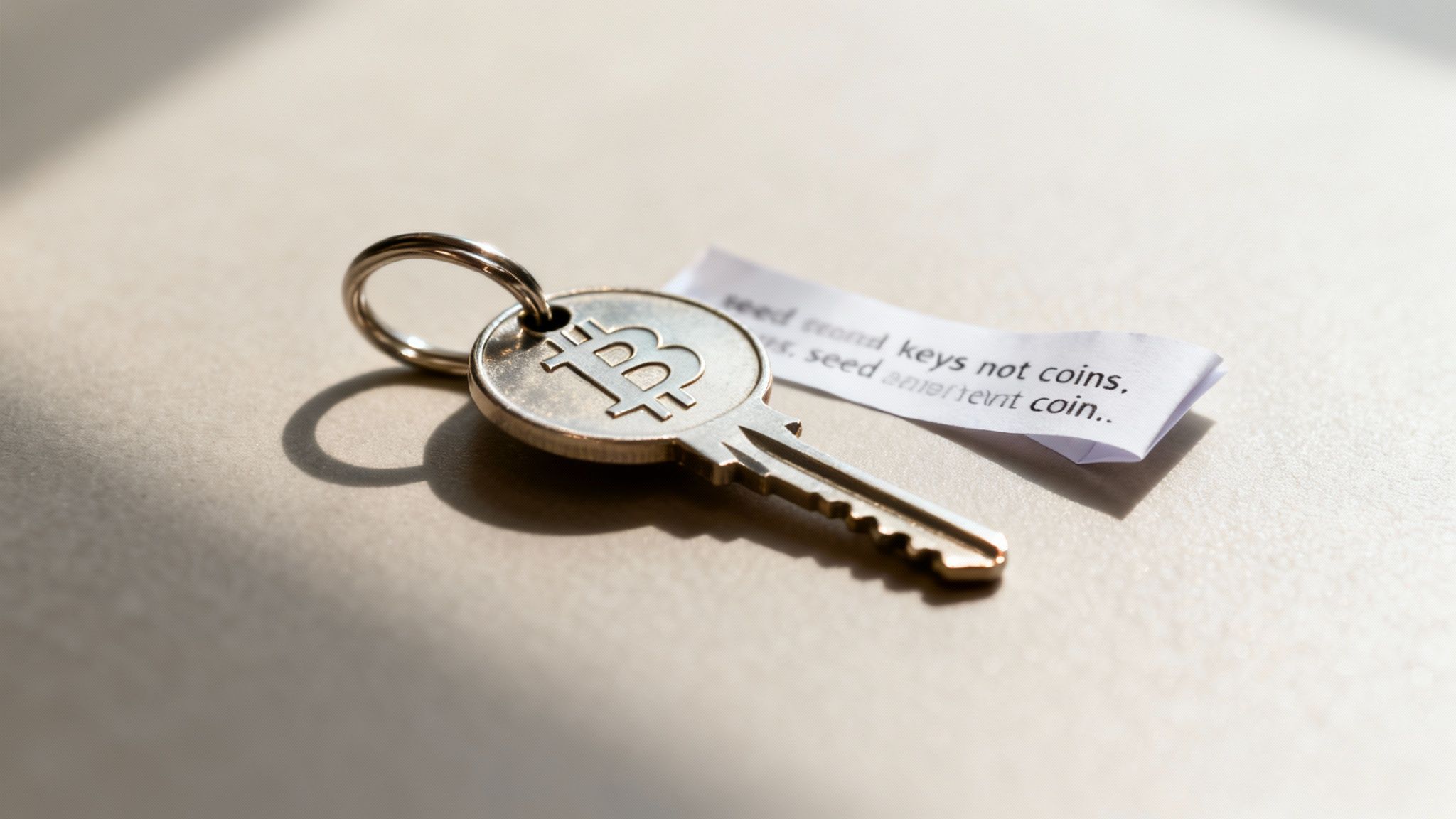
At its core, a Bitcoin wallet is a piece of software or a physical gadget that talks to the Bitcoin network. Your bitcoin doesn't live inside the wallet. Instead, your coins exist as transaction records on a global public ledger called the blockchain. The wallet simply holds the cryptographic keys that let you access and control those records on the ledger.
It’s a lot like your email account. Anyone can send an email to your address, but only you can get into your inbox with your password to read them or send new ones. Bitcoin follows a similar logic.
- Public Key: This is like your email address. It’s used to generate receiving addresses that you can share with anyone who wants to send you Bitcoin. It's safe to give out.
- Private Key: This is your password. You must keep this secret at all times because it gives anyone who has it the power to spend the Bitcoin associated with your address.
A wallet's main job is to manage these keys. When you decide to send Bitcoin, your wallet uses your private key to digitally "sign" the transaction, which is how you prove to the entire network that you have the authority to move those funds.
The Concept of Self-Custody
This brings us to one of the most powerful ideas in Bitcoin: self-custody. When you use a wallet where you—and only you—control the private keys, you have total ownership and authority over your funds. No bank, government, or third party can freeze your account or stop you from making a transaction.
This financial freedom is a core pillar of Bitcoin, neatly captured by the popular mantra, "Not your keys, not your coins."
But what happens if you lose your phone or your computer crashes? To make sure you never lose access, nearly all modern wallets give you a master backup key.
Your Master Backup Key
This backup is called a seed phrase (or recovery phrase). It's a simple list of 12 to 24 common words generated by your wallet. This phrase is the ultimate master key; it can be used to restore your entire wallet, including all your private and public keys, on a brand-new device.
It is absolutely critical that you write down your seed phrase and store it somewhere safe and offline. Losing this phrase is like losing the master key to a vault. If your wallet is lost, stolen, or destroyed, that seed phrase is the only way back in. Without it, your Bitcoin could be gone forever. Grasping this concept is the first real step to understanding how to choose the right wallet.
Hot Wallets For Everyday Bitcoin Use
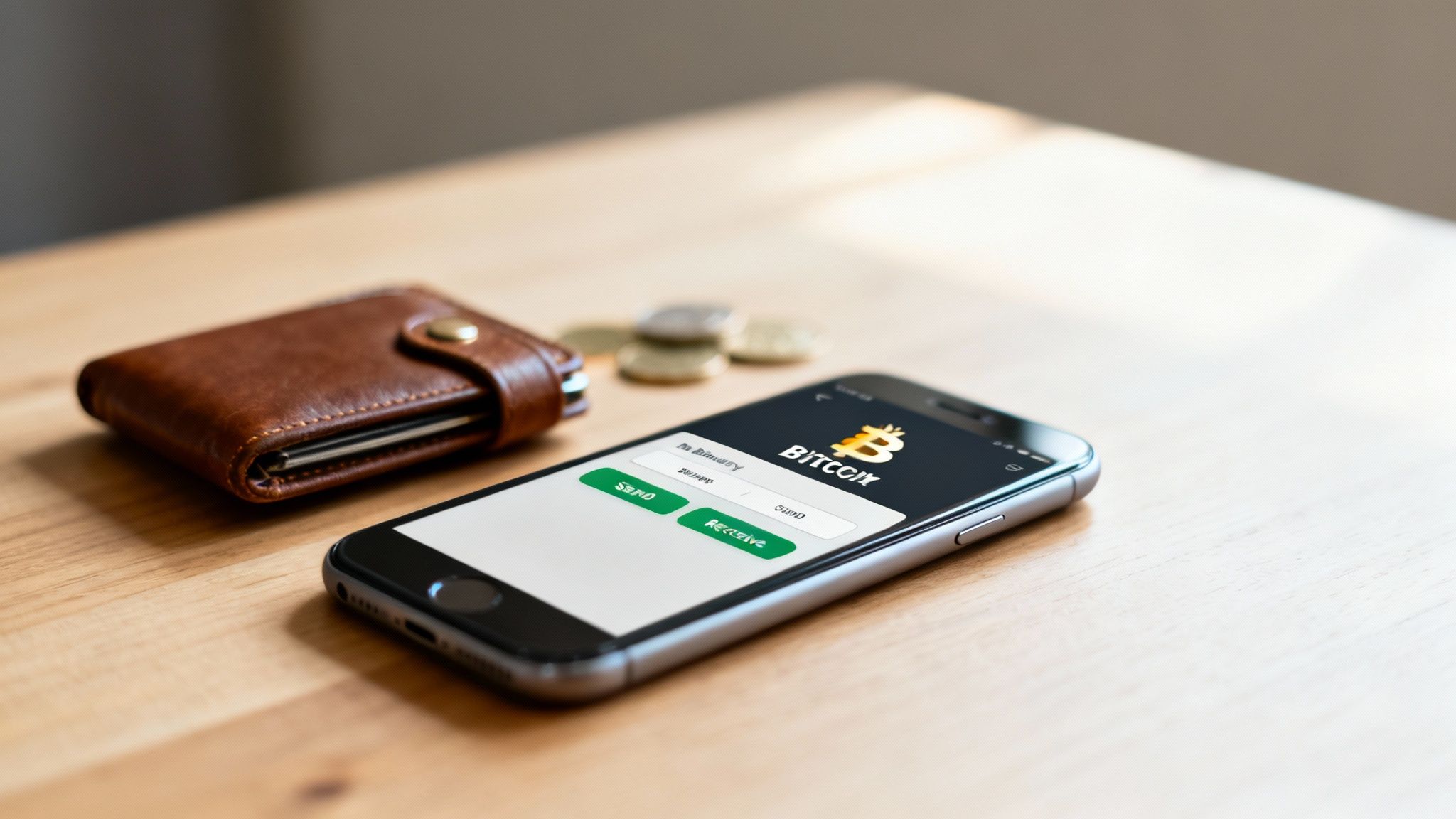
For most people dipping their toes into the world of Bitcoin, the first stop is usually a hot wallet. These are just software applications—either on your phone or computer—that are always connected to the internet. This "always-on" status is their defining trait, and it's both their greatest strength and their biggest weakness.
Think of a hot wallet like the cash you keep in your physical wallet. It's right there when you need it, perfect for buying a coffee, paying for something online, or zipping some money over to a friend. You don't have to go to a bank vault to get it. Hot wallets bring that same level of instant access and convenience to your bitcoin.
Their straightforward interfaces and quick setup make them the default choice for anyone actively using Bitcoin. If you're a merchant taking daily payments or just someone who transacts often, the convenience is a game-changer. It’s a huge reason they’re so popular.
The Trade-Off Between Convenience and Security
But that very same internet connection that makes hot wallets so handy also opens them up to risk. Because they live on devices that are constantly online, they're exposed to threats that offline wallets simply aren't. We're talking about malware, spyware, and clever phishing schemes designed to trick you into giving up your private keys or seed phrase.
This is where the cash wallet analogy really hits home. You wouldn't walk around with your entire life savings stuffed in your back pocket, right? It could get lost or stolen. In the same way, a hot wallet is fantastic for handling smaller, day-to-day amounts of bitcoin, but it’s definitely not the right place to stash your long-term holdings.
The name of the game is balancing access with risk. Keep your "spending money" in a hot wallet, but use more secure storage for your "savings." This lets you enjoy the speed of Bitcoin without putting your main stack in jeopardy.
This practical approach is why they dominate the market. Globally, about 78% of users lean on hot wallets as their main way to store their funds, mostly because they're just so easy to use. Even with more options available, projections show hot wallets will still make up roughly 69% of all storage choices in 2025, cementing their essential role in the ecosystem. You can find more stats on global crypto adoption over at Chainalysis.com.
Common Types of Hot Wallets
Hot wallets aren't a one-size-fits-all solution. They come in a few different flavors, each built for different situations. Figuring out the differences will help you—especially as a merchant—pick the right tool for the job.
Here’s a quick rundown of the most common types of hot wallets and what they're best for.
Hot Wallet Types At a Glance
| Wallet Type | Primary Platform | Best For | Key Feature |
|---|---|---|---|
| Mobile Wallet | Smartphone (iOS/Android) | In-person payments, on-the-go transactions | Portability and QR code scanning |
| Desktop Wallet | PC or Laptop (Windows, macOS, Linux) | Managing larger funds from a secure office | Advanced features and robust security |
| Web Wallet | Web Browser | Quick access from any device | Accessibility without software installation |
| Exchange Wallet | Bitcoin Exchange Platform | Trading and quick conversions to fiat | Integration with trading platform features |
Each of these serves a purpose, from the pocket-sized convenience of mobile apps to the feature-rich environment of a desktop client.
Now let's break them down a bit further.
Mobile Wallets: These are the apps on your smartphone that offer maximum portability. They often use QR codes to make paying in person a breeze, which is perfect for brick-and-mortar stores with a point-of-sale setup or anyone making transactions out and about.
Desktop Wallets: Installed directly on a laptop or desktop computer, these wallets tend to pack more of a punch than their mobile cousins. They can offer more sophisticated features, better privacy controls, and integrations with other services, making them a solid pick for power users or businesses managing funds from a dedicated office computer.
Cold Wallets: Your Fort Knox for Bitcoin
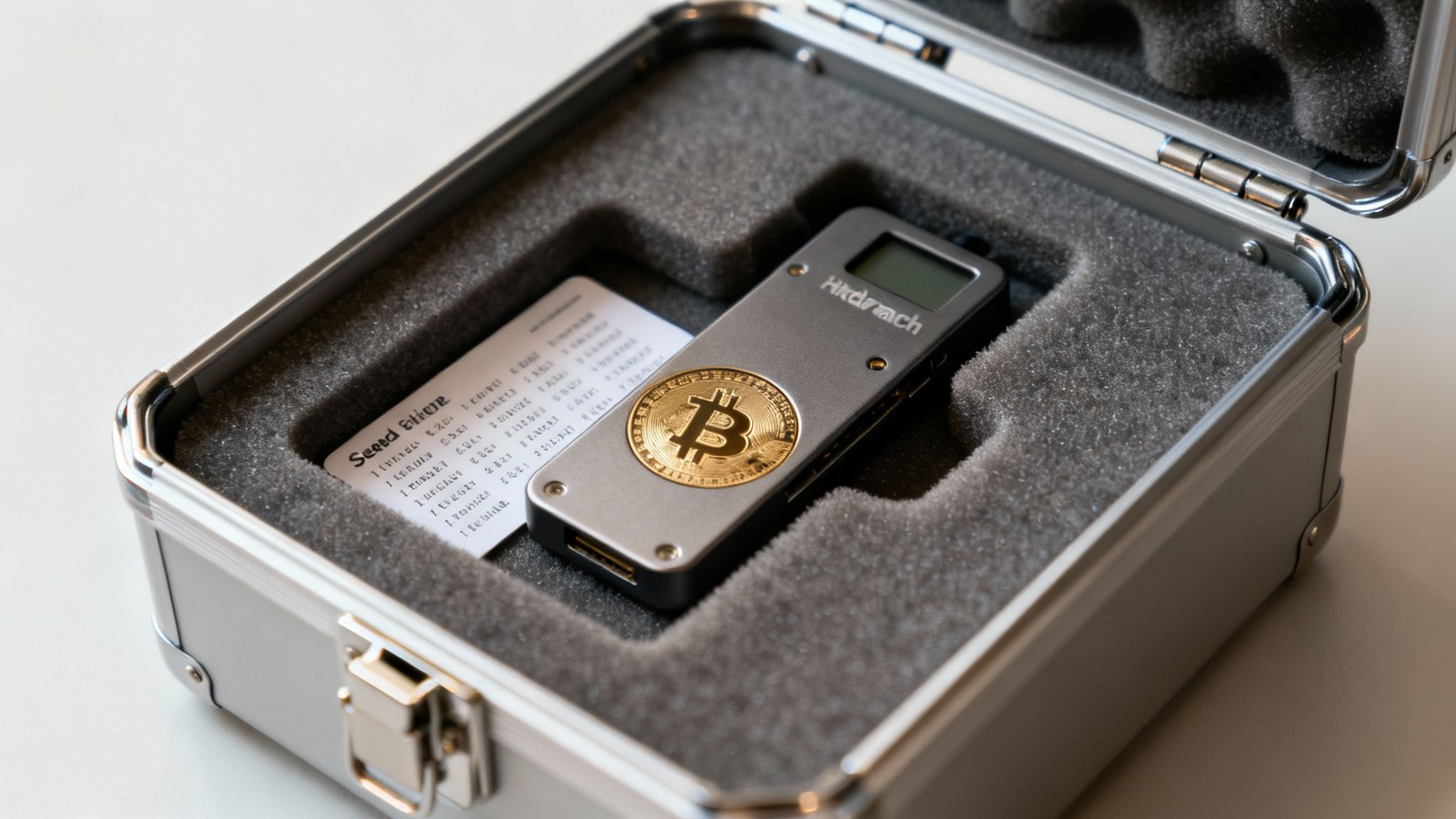
If hot wallets are like the cash in your wallet for daily spending, then a cold wallet is your personal bank vault. It’s where you go when security is the absolute top priority, especially for holding significant amounts of Bitcoin for the long haul. This is the undisputed champion of Bitcoin security.
Unlike their online cousins, cold wallets keep your private keys completely offline.
This offline nature is what makes them so unbelievably secure. By creating an "air gap" between your private keys and the internet, cold wallets form a protective bubble around your funds. It’s a simple concept: you can't hack what isn't connected. This design makes them virtually immune to online threats like viruses, malware, and phishing attacks that plague internet-connected devices.
This is exactly why serious investors, businesses, and long-term holders swear by cold storage. For a merchant, this is the gold standard for securing business profits and large treasury reserves. The peace of mind that comes from knowing your Bitcoin is physically isolated from online dangers is priceless.
How Do Cold Wallets Work?
The most popular type of cold wallet is the hardware wallet. These are small, physical devices, often looking like a fancy USB stick, built for one single purpose: to guard your private keys in a secure, offline bubble.
Here’s where the magic happens. Even when you use a hardware wallet to send Bitcoin, your private keys never leave the device. The transaction details are sent from your computer or phone to the hardware wallet. The device then signs the transaction internally, using the protected keys, and sends only the signed, authorized transaction back to the computer to be broadcast to the Bitcoin network.
Think of it like a royal seal. To authorize a decree, a king would press his signet ring into hot wax. The ring (your private key) never leaves his finger, but its unique signature (the signed transaction) proves the decree is legitimate. A hardware wallet does the same for your Bitcoin.
This process ensures your keys are never exposed to your potentially compromised, internet-connected computer. It's a simple yet incredibly powerful system.
The growing demand for real digital asset security has fueled a massive market for these devices. In fact, cold wallets are projected to account for roughly 22-30% of the total crypto wallet revenue share in 2025. The hardware wallet space is booming, with expected market growth of around 23-25% for 2024-2025. You can dig into these cold wallet statistics and their market impact to see just how fast this trend is growing.
Different Forms of Offline Storage
While hardware wallets get most of the attention, they aren't the only game in town. It's good to know the other options, as each can play a role in a comprehensive security plan.
Here are the main types of cold wallets:
- Hardware Wallets: As we've covered, these are specialized electronic devices that store keys offline and sign transactions. They strike the perfect balance between top-tier security and ease of use, making them the best choice for most people.
- Paper Wallets: This is old-school. You literally print your public and private keys (often as QR codes) onto a piece of paper. While it's 100% offline, it’s fragile. It’s vulnerable to fire, water, or even just fading ink. They're less common now but represent the simplest form of cold storage.
- Deep Cold Storage: This is the big leagues, typically used by institutions or individuals holding fortunes in Bitcoin. It involves creating wallets on computers that have never and will never touch the internet. The keys are then stored on multiple encrypted devices in geographically separate, high-security locations like bank vaults.
For the vast majority of merchants and serious holders, hardware wallets hit the sweet spot. They provide the ideal blend of Fort Knox-level security and practical usability for managing your Bitcoin safely.
Custodial vs. Non-Custodial: Who Really Owns Your Bitcoin?
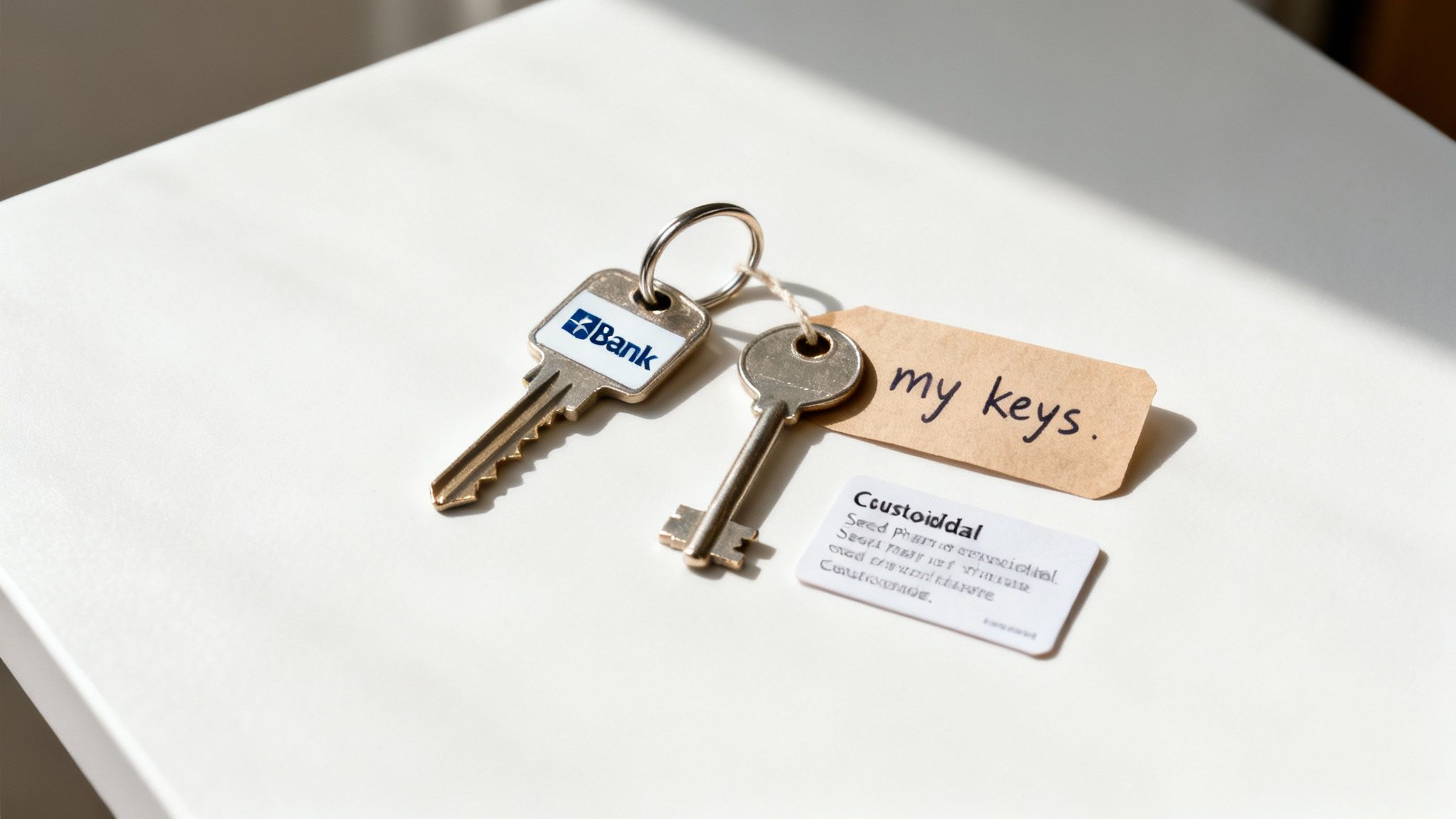
So far, we've walked through different kinds of crypto wallets, but the single most important distinction isn't whether it’s hot or cold. It all boils down to one critical question: who actually holds your private keys?
This one concept determines who has the final say over your Bitcoin. It’s the difference between true ownership and simply having an IOU, splitting the wallet world into two camps: custodial and non-custodial. Getting this right is everything—it impacts your control, your security, and your financial freedom.
The entire idea is perfectly captured in a famous Bitcoin mantra.
"Not your keys, not your coins."
This phrase is the bedrock of self-sovereignty in Bitcoin. It’s a stark reminder that if you don't personally control the private keys to your funds, you don't really own your Bitcoin. You're just trusting a third party to give you access to them when you ask.
Non-Custodial Wallets: You Are the Bank
A non-custodial wallet is a wallet where you—and only you—hold the private keys. All the hot and cold wallets we've covered, from mobile apps to hardware devices, typically fall into this category. They grant you complete and total control over your funds.
Think of it like owning a personal safe in your home. You know the combination, you decide what goes in and out, and nobody can stop you from opening it. That’s what real financial sovereignty feels like.
- Total Control: You have absolute authority to send and receive Bitcoin anytime you want, without asking for permission.
- Ultimate Responsibility: This freedom comes with a heavy dose of responsibility. You are solely in charge of protecting your seed phrase. If you lose it, your funds are gone for good. There's no one to call.
For merchants, this model is incredibly empowering. It means no third party can freeze your business account or block incoming payments, offering a level of censorship resistance that traditional finance simply can't match. With a platform like Flash, you can accept payments directly into your own non-custodial wallet, ensuring the funds are yours the second they arrive.
Custodial Wallets: Someone Else Holds the Keys
On the other side of the fence are custodial wallets. With these services, a third party—usually a big Bitcoin exchange—holds the private keys for you. When you buy Bitcoin on a major exchange and just leave it sitting there, you're using a custodial service.
This is much more like using a safe deposit box at a bank. The bank keeps your valuables secure, and you can access them during business hours by showing your ID. It's convenient because you don't have to worry about securing the box yourself, but you are ultimately relying on the bank's security, its rules, and its hours.
The main draw here is convenience. If you forget your password, there's usually a recovery process, just like with a normal online account. But that convenience comes at a steep price. You're giving up control and introducing a whole new set of risks, like having your assets frozen, facing withdrawal limits, or even losing everything if the exchange gets hacked or goes bankrupt. You are placing your trust in them to be a good custodian of your money.
How to Choose the Right Bitcoin Wallet
Alright, now that you know the different types of crypto wallets out there, it's time for the real work: picking the one that actually makes sense for you. Finding the right Bitcoin wallet isn’t about chasing the “best” one on the market. It’s about finding the best one for your specific situation. The right choice really comes down to your personal habits, how comfortable you are with the tech, and what you plan to do with your Bitcoin.
Think of it like choosing between a checking account and a high-security savings vault. You use a checking account for everyday spending—it’s convenient for small, frequent transactions, but you wouldn’t park your life savings in it. The vault is for serious, long-term security. Your Bitcoin wallet strategy should follow the same logic, balancing everyday convenience with bulletproof protection.
The global crypto wallet market is exploding, projected to jump from USD 4.18 billion in 2025 to a massive USD 56.74 billion by 2035. Software wallets are driving this growth, with around 60% of crypto users worldwide relying on them. This just goes to show how important it is to make a smart choice in a market that's expanding so quickly. You can dig deeper into the crypto wallet market trends at Business Research Insights.
First, Assess How You'll Use Bitcoin
The very first question to ask yourself is, "What am I actually doing with this Bitcoin?" Your answer will immediately point you in the right direction and cut down your options. Are you a merchant accepting payments every day, or are you an investor planning to hold for the long haul?
For Frequent Transactions: If you’re constantly sending or receiving Bitcoin, convenience is everything. A mobile hot wallet is your best friend here, giving you on-the-go access that’s perfect for in-person sales or quick online checkouts. It’s always connected, making transactions feel effortless.
For Long-Term Holding (HODLing): If you're buying Bitcoin to save for months or years, security is the only thing that matters. A hardware cold wallet is really the only serious choice. It keeps your private keys completely offline, making it virtually impossible for online hackers to get to your funds.
Next, Evaluate Your Security Needs
Your personal comfort level with risk is a huge piece of the puzzle. How much convenience are you willing to trade for security? This usually ties directly to how much Bitcoin you're holding.
A simple rule of thumb: match your wallet's security level to the value of the funds it's protecting. You wouldn't walk around with your entire net worth in your pocket, so don't store a fortune on a hot wallet.
For any amount of Bitcoin you can't afford to lose, a hardware wallet should be your default choice. For smaller, "spending" amounts, a reputable mobile or desktop wallet works just fine—as long as you’re following basic security hygiene like protecting your device and keeping that seed phrase safe.
Finally, Be Honest About Your Technical Confidence
This is where you need to be real with yourself about your tech skills. Bitcoin wallets have become much more user-friendly over the years, but they still demand a certain degree of personal responsibility.
Non-custodial wallets give you complete control, which is incredibly empowering. But it also means you are your own bank. You—and only you—are responsible for backing up your seed phrase and keeping it secure. If you’re comfortable with that level of responsibility, a non-custodial wallet offers true financial sovereignty.
Wallet Selection Guide Based on User Profile
To make this even easier, here's a quick guide comparing wallet types against common user profiles to help you nail down the best choice for your needs.
| User Profile | Primary Need | Recommended Wallet Type | Key Consideration |
|---|---|---|---|
| The Daily Spender | Convenience & Speed | Mobile Wallet (Hot) | Keep small amounts only; like cash in a physical wallet. |
| The Long-Term Investor | Maximum Security | Hardware Wallet (Cold) | Your digital vault for significant holdings. |
| The Active Trader | Quick Access & Security | Desktop Wallet (Hot) + Hardware Wallet | Use the desktop wallet for trading and sweep profits to cold storage. |
| The Newcomer | Simplicity & Ease of Use | Reputable Mobile or Desktop Wallet | Focus on learning seed phrase management and basic security. |
| The Merchant | Integration & Reliability | Desktop Wallet or Specialized POS System | Needs to handle frequent, small-to-medium transactions reliably. |
By thinking through how much you'll hold, how often you'll transact, and how comfortable you are with being your own bank, you can confidently pick a wallet that aligns perfectly with your goals. This isn't a one-size-fits-all decision, so take the time to get it right.
Got Questions? We've Got Answers
Diving into Bitcoin wallets can feel a bit like learning a new language. You've got the basics down, but a few nagging questions keep popping up, especially when it comes to keeping your money safe and accessible. Let's clear up some of the most common ones.
How Many Bitcoin Wallets Should I Have, Really?
There’s no magic number here, but a smart strategy used by seasoned Bitcoiners is to have at least two different types of wallets. It’s the same logic you use with your regular bank account and your long-term savings.
- Your "Spending" Wallet: Think of this as your digital cash. A mobile hot wallet is perfect for this. It's for the Bitcoin you might use for small, day-to-day purchases. Convenient, quick, and ready when you are.
- Your "Savings" Wallet: This is your vault. A hardware cold wallet is the gold standard for storing the majority of your Bitcoin—the funds you don't need to touch often.
This two-wallet approach gives you the best of both worlds: easy access for spending while your main stash is locked down and safe from the risks of being constantly online.
Can Someone Actually Steal Bitcoin From My Wallet?
Yes, it can happen, but the "how" really depends on the wallet you're using and the security habits you've built. The Bitcoin network itself has never been hacked, but the wallets that hold Bitcoin can definitely be targeted.
With a hot wallet, your private keys live on a device that's connected to the internet. This opens the door to risks like malware or clever phishing scams. If a hacker gets into your phone or computer and finds those keys, they can drain your funds.
With a cold wallet, your keys are kept completely offline, which makes online theft pretty much a non-issue. The main things you have to worry about are someone physically stealing the device or getting their hands on your backup seed phrase.
The single most important rule in Bitcoin is this: Never, ever share your seed phrase. Don't type it into a website, don't tell it to "customer support," don't even whisper it. This 12 or 24-word phrase is the master key to your entire balance. Guard it with your life.
What if I Lose My Hardware Wallet? Did I Just Lose My Bitcoin?
That heart-stopping moment when you can't find your hardware wallet is terrifying, but take a deep breath—it doesn't mean your Bitcoin is gone forever. As long as you have your seed phrase backed up safely, you can get it all back.
Remember, the physical device is just a tool; the seed phrase is the actual key. If your wallet is lost, stolen, or even run over by a truck, all you have to do is:
- Get a new hardware wallet. It can even be from a different brand.
- During setup, look for the "restore from backup" or "recover wallet" option.
- Carefully enter the seed phrase you wrote down, in the exact order.
Your new device will sync with the blockchain and restore full access to your Bitcoin. This is precisely why protecting your seed phrase is even more critical than protecting the little gadget it's tied to.
Ready to put this knowledge to work and accept Bitcoin payments directly into a wallet you control? Flash gives merchants the tools to integrate Bitcoin without giving up custody. Our platform links straight to your wallet, so you hold the keys from the moment a customer pays. Start accepting instant, low-fee payments today by visiting .