At its core, a cryptocurrency payment solution is simply a system that lets a business accept digital currencies, like Bitcoin, straight from a customer. Think of it as a modern alternative to traditional credit card processors or bank wires, but one that’s built for a global, digital-first world.
For merchants, this isn't just about adding a new payment option. It's about fundamentally changing the game with faster settlements, significantly lower transaction fees, and the complete elimination of chargeback fraud.
Why Your Business Needs a Cryptocurrency Payment Solution
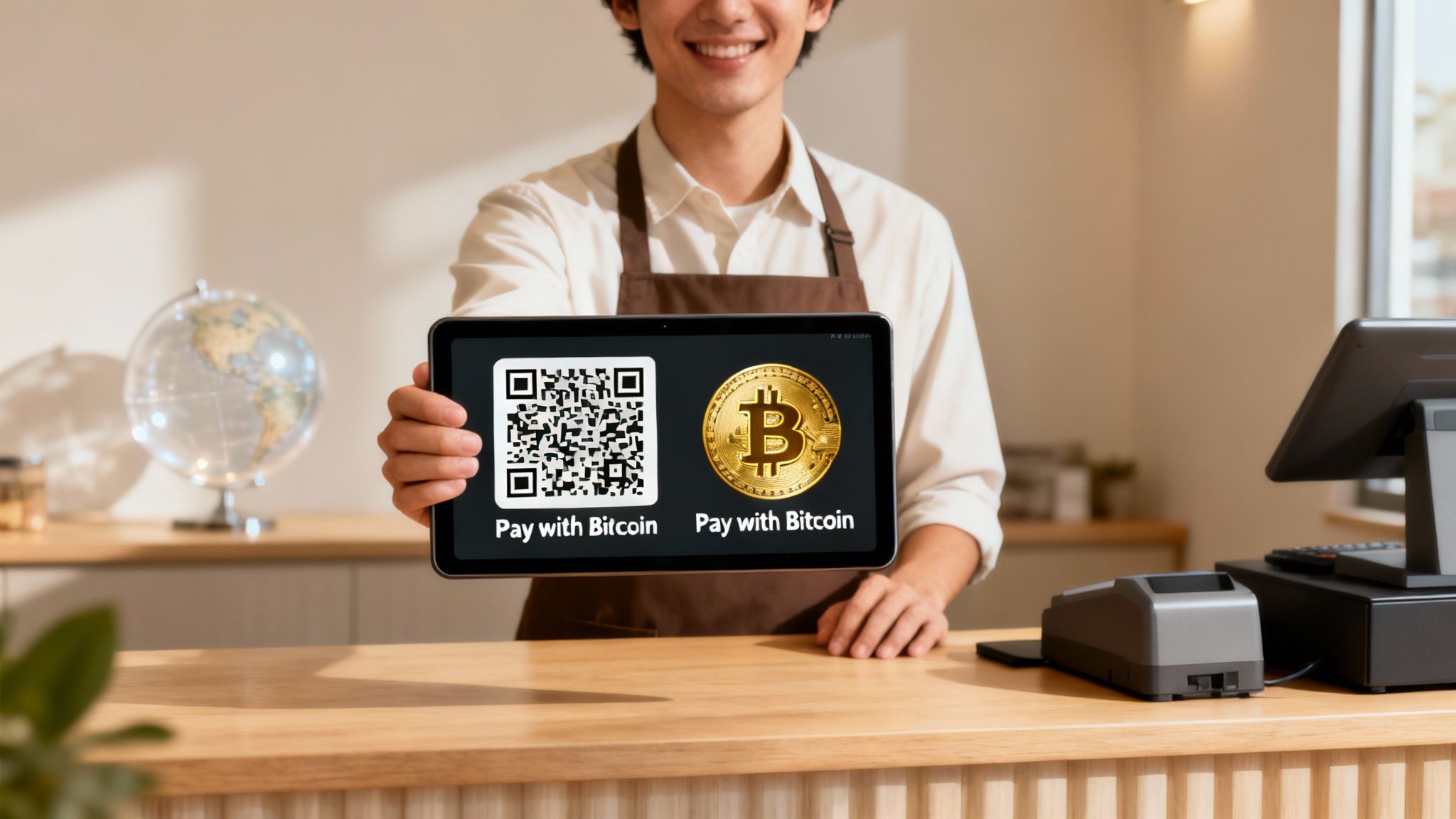
Adopting a crypto payment solution is no longer a fringe move for tech startups; it's a practical strategy for growth. As digital commerce evolves, businesses are quickly realizing that accepting Bitcoin offers a powerful competitive edge. It's about much more than just sticking another payment icon on your checkout page—it reshapes how you receive, manage, and secure your revenue.
This shift is happening for one simple reason: people are demanding better payment systems. Traditional banking and credit card networks are notoriously slow, expensive, and tangled in geographic red tape. A direct Bitcoin payment system cuts through all that, offering a modern alternative that just works.
Unlocking Global Markets and Lowering Costs
One of the biggest wins of adopting a cryptocurrency payment solution is the ability to tear down financial borders. With Bitcoin, you can sell to anyone, anywhere on the planet, without breaking a sweat over currency conversion fees or cross-border transaction delays. The payment process is identical whether your customer is next door or on another continent. Just like that, you've unlocked a massive new customer base.
And then there are the cost savings. Credit card companies routinely skim 2-3% off every transaction, a hefty tax that eats directly into your profits. Bitcoin network fees are often just a tiny fraction of that, meaning you get to keep more of the money you've worked hard to earn.
A direct, non-custodial Bitcoin payment system gives merchants a secure and efficient alternative to the slow, expensive, and fraud-prone traditional banking system.
Eliminating Fraud and Improving Cash Flow
Chargeback fraud is a constant, costly headache for merchants. It creates revenue uncertainty and a mountain of administrative work. Because Bitcoin transactions are irreversible and final, they completely wipe out the risk of fraudulent chargebacks. Once you receive a payment, it's yours. Period.
This growing appeal among merchants is part of a much bigger trend. The global market for these payment systems is projected to hit a staggering USD 4,240.80 billion by 2034, signaling a massive shift in how businesses and consumers handle money. You can read the full research about cryptocurrency payment solutions to see the data for yourself. This growth makes it clear: integrating a Bitcoin payment option isn't just about keeping up—it's about getting your business ready for the future of commerce.
How Bitcoin Payments Actually Work
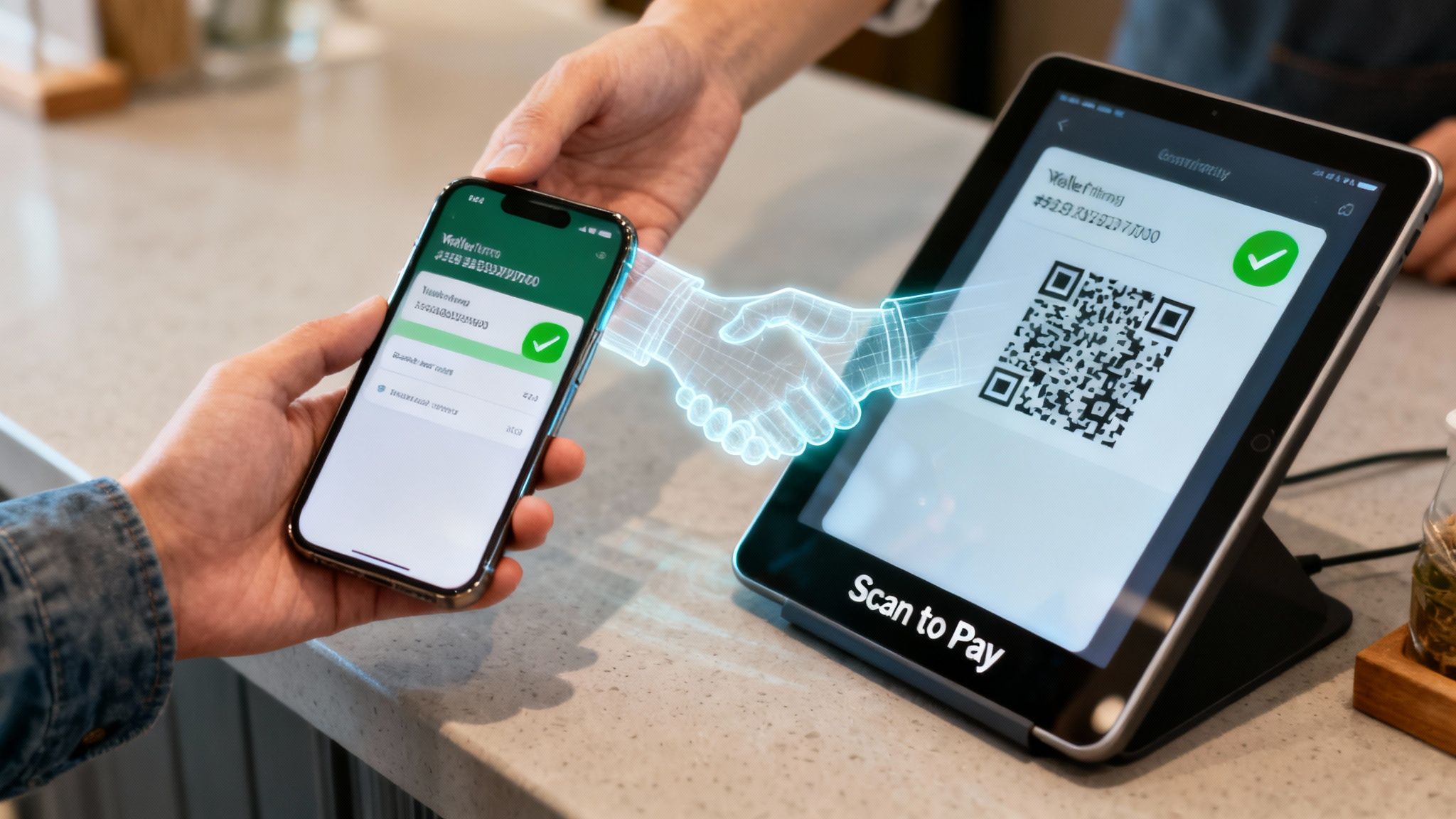
To really get your head around a Bitcoin payment solution, you first need to toss out everything you know about traditional banking. Forget the tangled web of banks, processors, and other middlemen. A Bitcoin transaction is more like a direct digital handshake—a secure transfer of value from your customer’s wallet straight into yours.
This peer-to-peer setup is the whole point. It means when you accept Bitcoin, you’re in the driver's seat from the second the payment arrives. No bank or third-party processor is holding your money hostage, which completely cuts out counterparty risk and gives you genuine control over your finances.
The Two Models: Custodial vs Non-Custodial
When you start looking at a cryptocurrency payment solution, you'll run into two main flavors: custodial and non-custodial. Nailing down the difference is huge because it all comes down to who actually controls your money.
A custodial service acts a lot like your old bank. They take the Bitcoin on your behalf, stash it in an account they control, and then let you pull it out later. This brings a third party back into the mix, adding layers of complexity, potential for delays, and the very real risk that you could lose access to your cash if the provider hits a snag.
On the flip side, a non-custodial solution—which is exactly what Flash provides—never lays a finger on your money. The software is just a bridge, connecting your customer's wallet directly to your own. The payment hits the Bitcoin network and settles right in your wallet, giving you immediate and exclusive control.
The guiding principle of a non-custodial system is simple but powerful: Your keys, your Bitcoin. This model guarantees that only you can access and manage your funds, giving your business the highest level of security and autonomy.
For merchants who put a premium on security and direct access to revenue, this distinction is everything. With a non-custodial setup, you are your own bank.
To make this crystal clear, let's break down how these two models stack up against each other. Understanding these differences is key to choosing a partner that aligns with your business's need for security and control.
Custodial vs Non-Custodial Bitcoin Payment Solutions
| Feature | Non-Custodial (e.g., Flash) | Custodial (Third-Party Processor) |
|---|---|---|
| Control Over Funds | Total. Only you can access your money. | Limited. The provider holds your funds for you. |
| Security Risk | Low. No third party to trust. | High. You're exposed to provider failure or hacks. |
| Settlement Speed | Instant. Funds arrive directly in your wallet. | Delayed. Settlement depends on the provider's process. |
| Fees | Lower. Fewer intermediaries mean lower costs. | Higher. Fees for custody, withdrawal, and processing. |
| Privacy | High. Direct wallet-to-wallet transactions. | Low. The provider sees and records all transactions. |
Ultimately, the choice comes down to a simple question: Do you want to be in complete control of your revenue, or are you comfortable handing that control over to someone else? For businesses that value true ownership, a non-custodial solution is the clear winner.
The Simple Flow of a Bitcoin Transaction
The actual process of accepting Bitcoin is surprisingly smooth, whether you're in a physical store or selling online. It’s built for speed and simplicity, making it a breeze for both your team and your customers to get on board.
Here’s what the payment flow looks like in action:
- Generate an Invoice: Your point-of-sale system or website creates a unique payment request, usually shown as a QR code. This code has all the necessary details: the exact amount and your business's Bitcoin address.
- Customer Scans and Pays: The customer fires up their Bitcoin wallet app, scans the code, checks the details, and confirms the payment with a tap.
- Broadcast to the Network: Their wallet sends the signed transaction out to the global Bitcoin network. This is the "digital handshake," where nodes all over the world start validating the transfer.
- Confirmation and Settlement: Within seconds, the payment shows up in your wallet. Over the next few minutes, the network confirms it, making it permanent and irreversible. The funds are settled and they're all yours.
The hunger for these kinds of direct payment channels is growing fast. The Bitcoin payment ecosystem is on track to jump from $1.55 billion in 2025 to $1.79 billion in 2026 at a healthy 15.6% CAGR. This boom is driven by decentralized solutions connecting merchants with the 500 million+ Bitcoin users around the globe. You can dive deeper into this trend in this detailed report on the Bitcoin payment ecosystem. This data really drives home how important it is to offer a solid cryptocurrency payment solution.
Once you grasp these mechanics, it's easy to see how Bitcoin cuts out the friction, delays, and third-party risks that plague the old financial system, offering a much smarter way to do business.
The Real-World Benefits of Accepting Bitcoin
Knowing how Bitcoin payments work is one thing. Seeing the direct impact on your bottom line is what really matters.
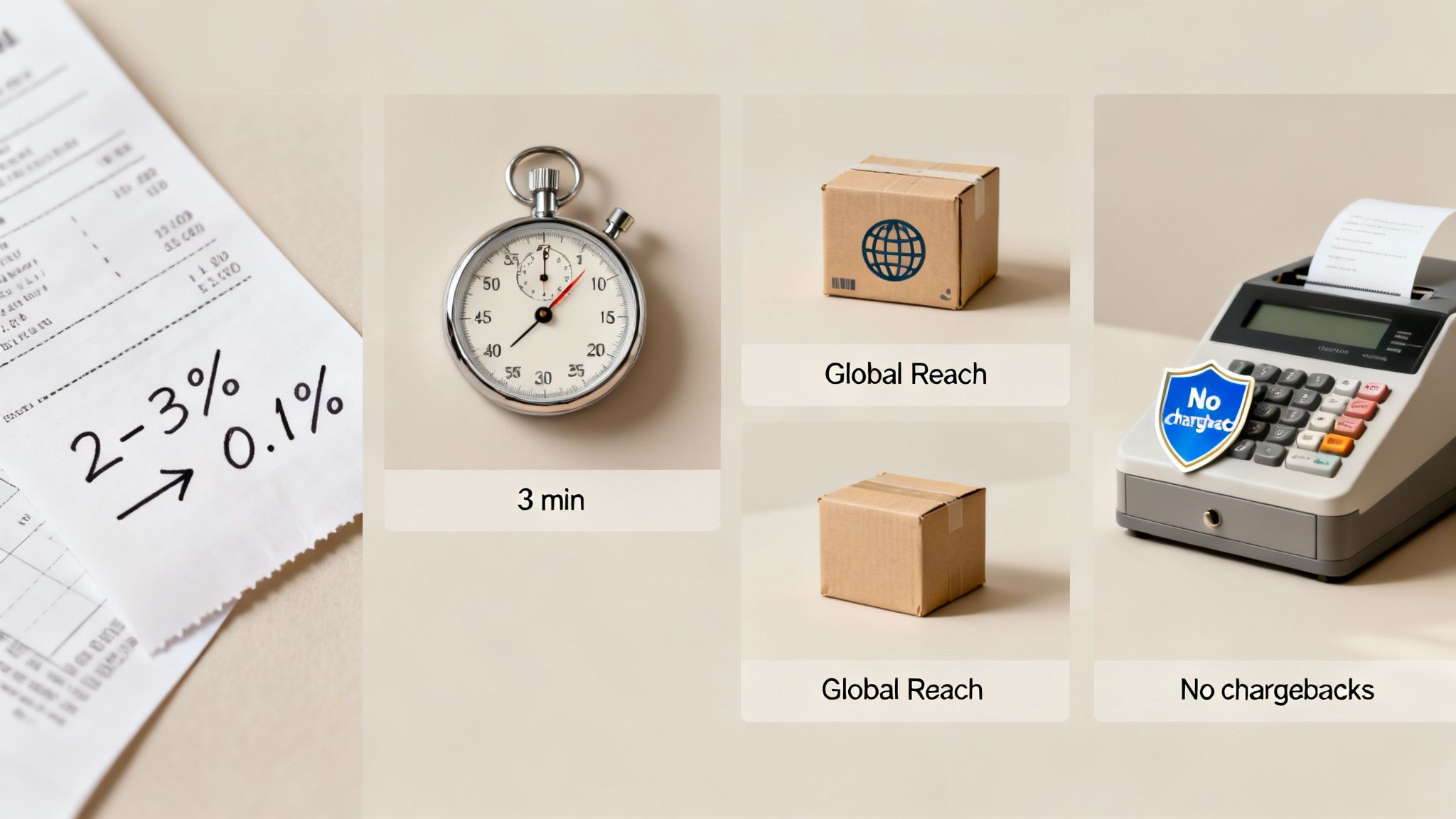
Adding a cryptocurrency payment solution isn't just a tech upgrade; it's a strategic business decision with four clear, powerful advantages. These benefits hit directly at the biggest headaches merchants deal with in traditional finance, from sky-high costs to sluggish cash flow.
Let's break down exactly how accepting Bitcoin makes your business more efficient, secure, and profitable.
Slash Your Transaction Fees
Every time a customer swipes their credit card, you're kissing 2-3% of your hard-earned revenue goodbye. Those fees add up fast, quietly draining your profit margins on every single sale. It’s a massive cost of doing business that merchants have simply been forced to swallow.
Bitcoin flips this script completely. A Bitcoin transaction fee—often called the network fee—is usually just a few cents, no matter the size of the payment. It doesn't matter if your customer is buying a $5 coffee or a $5,000 piece of equipment; the cost to process the payment is next to nothing.
Ditching percentage-based card fees for the flat, rock-bottom cost structure of the Bitcoin network gives you an immediate boost in profitability. We're not talking about small savings here; this is a fundamental change to your cost structure that puts real money back into your pocket.
You get to keep nearly every dollar you earn, freeing up capital that would otherwise be lost to financial middlemen.
Accelerate Your Cash Flow
In the traditional banking system, "settlement" is code for "slow." When a customer pays with a card, those funds can take anywhere from two to five business days to actually show up in your bank account. That built-in delay ties up your working capital and puts a constant drag on your finances.
A Bitcoin payment solution is a world apart. Transactions on the Bitcoin network are confirmed and settled in your wallet in minutes. The funds are yours, fully accessible and ready to use almost instantly.
This near-instant settlement gives your financial agility a massive upgrade. You can pay suppliers faster, reinvest in inventory on the spot, or cover operational costs without waiting for last week's sales to clear. It’s your money, and you get it right away.
Unlock a Truly Global Market
Selling internationally with traditional payment systems is a nightmare. You’re forced to navigate a maze of currency conversion rates, cross-border transaction fees, and different banking rules for every country. This friction often makes it too expensive or just too difficult to serve a global customer base.
Bitcoin is borderless and permissionless. A payment from Japan is handled the exact same way as a payment from down the street. No currency conversions, no international wire fees, and no banks blocking transactions.
By adding a Bitcoin payment option, you instantly open your doors to a global market of millions of potential customers. This allows you to tap into new revenue streams and expand your reach without the usual financial and administrative headaches. You can sell to anyone, anywhere.
Eliminate Chargeback Fraud for Good
For many merchants, especially in e-commerce, chargeback fraud is a constant, expensive threat. A customer can buy something, receive the product, and then dispute the charge with their credit card company to force a refund. This leaves you out of pocket for both the product and the revenue.
Bitcoin transactions are final and irreversible. Once a payment is confirmed on the network, it cannot be reversed by the sender. That's it. This design completely eliminates the possibility of fraudulent chargebacks.
This finality gives you a level of security and revenue certainty that is simply impossible with credit cards. You can sell your products with confidence, knowing every payment you receive is secure and final, ending the costly and time-consuming process of fighting illegitimate disputes.
Finding the Right Bitcoin Integration for Your Business
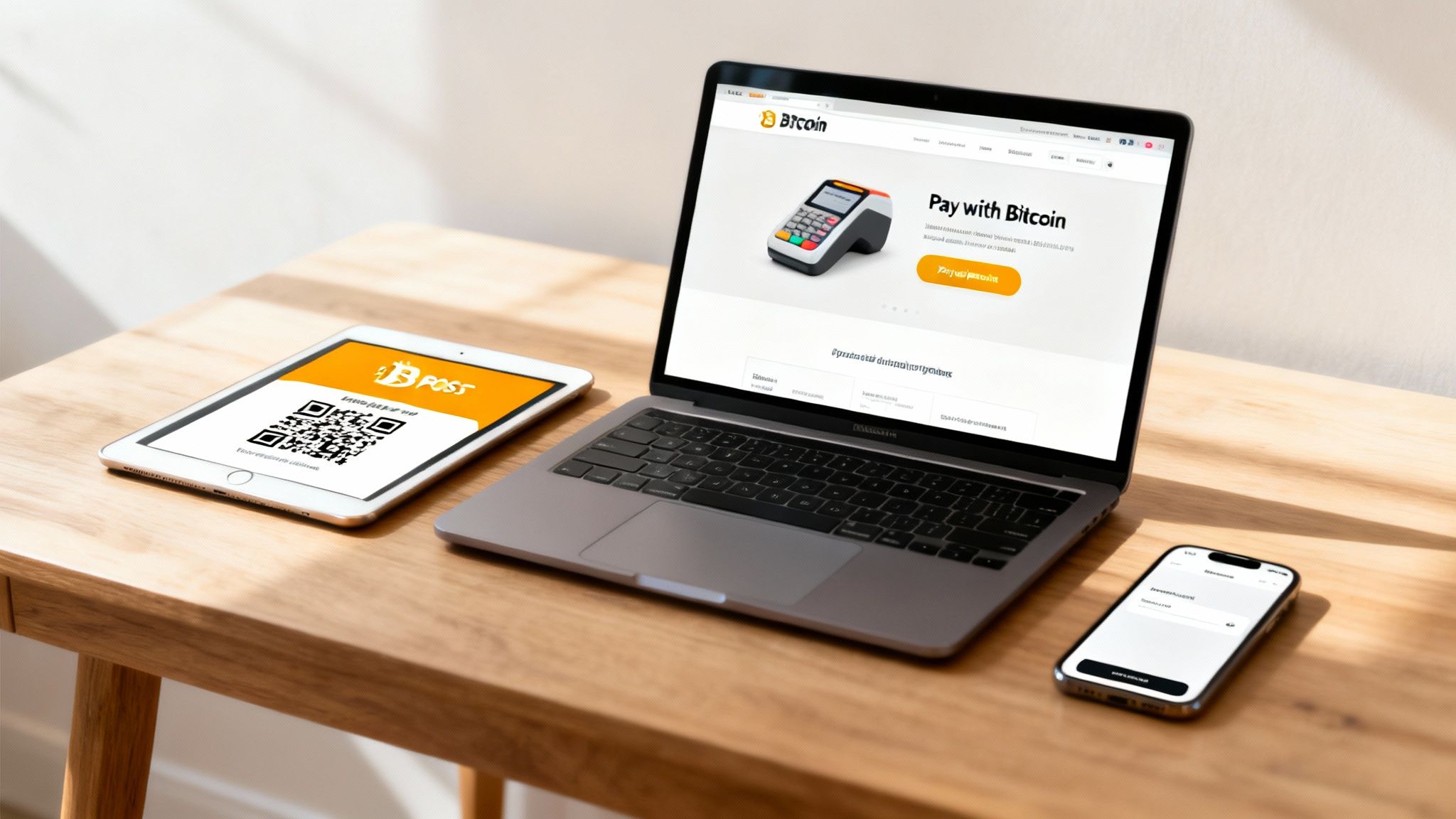
So, you see the upside of Bitcoin. That’s the easy part. The next logical step is figuring out how a cryptocurrency payment solution actually fits into your daily operations without causing a massive headache.
Good news: you don't need a team of developers or a PhD in cryptography to get started. Modern tools are built for regular business owners, making the whole process surprisingly straightforward.
The real trick is matching the right tool to your sales environment. Whether you're slinging coffee, running an e-commerce empire, or managing a subscription service, there's a practical way to start accepting Bitcoin today. Let's dig into the most common options.
Point-of-Sale Apps for Physical Stores
If you run a brick-and-mortar business, you can get up and running with Bitcoin almost instantly. Modern Point-of-Sale (POS) apps can turn any tablet or smartphone you already own into a Bitcoin terminal. No need to buy any new, clunky hardware.
The process is dead simple for both your staff and your customers. When it's time to pay, the cashier just punches in the total. The app spits out a unique QR code. The customer scans it with their Bitcoin wallet, confirms the payment, and the funds hit your wallet in minutes. It’s just as quick as tapping a card.
This setup is perfect for all kinds of physical businesses:
- Retail Shops: An iPad by the register is all you need.
- Restaurants and Cafes: Staff can generate QR codes right at the table, making for a slick checkout experience.
- Service Providers: Mechanics, consultants, or trainers can take payment on the spot with just their phone.
Payment Buttons and Widgets for E-commerce
For online stores, getting set up is just as simple. One of the most popular routes is to add a payment button or widget to your checkout page. Most of these are "plug-and-play," meaning you can add them with a few clicks—no coding required.
When a customer is ready to check out, they just click the "Pay with Bitcoin" button. It works just like the in-person QR code, generating a payment request they can pay from their desktop or mobile wallet. The whole thing happens right inside your existing sales flow, so it feels professional and seamless.
These simple buttons are a powerful way to tap into a global customer base. You instantly remove the friction of cross-border payments and open your doors to millions of Bitcoin users looking for places to spend.
This approach works like a charm on platforms like Shopify, WooCommerce, or even custom-built sites. It’s a low-effort move with a massive potential upside.
Advanced Tools for Specialized Business Models
What if your business is a bit more complex than a simple one-off sale? A solid Bitcoin cryptocurrency payment solution has you covered with tools that automate the tricky stuff, saving you a ton of administrative work.
Recurring Billing for Subscriptions
If you run on a subscription model—think SaaS products, paid newsletters, or membership sites—you need automated billing. Specialized tools can handle recurring Bitcoin payments for you, sending out invoices and tracking payment cycles without you having to lift a finger.
Payment Links for Invoicing
For freelancers, agencies, and B2B service providers, payment links are a game-changer. Instead of a full checkout process, you generate a simple, shareable link for a specific invoice. Send it to your client via email or text, and they get a direct, easy way to settle up with Bitcoin.
At the end of the day, the right integration comes down to how and where you sell. The beauty of modern Bitcoin payment solutions is their flexibility. No matter your business model, there’s a practical path forward.
And if you're exploring options beyond Bitcoin, guides like the Solana Pay Shopify Guide show just how adaptable digital currency payments have become. The variety of choices available proves that this is no longer a niche technology; it's a legitimate, versatile payment rail for any serious business.
Your Quick-Start Checklist for Accepting Bitcoin
Ready to dive in? Setting up a Bitcoin payment solution is surprisingly straightforward. You don't need to be a tech wizard.
We've boiled it down to an actionable checklist to get you from zero to your first Bitcoin sale. Think of this as your roadmap—a few simple, practical steps to confidently launch your new payment system in just minutes.
Step 1: Set Up Your Business Wallet
First things first: before you can accept Bitcoin, you need a secure place to receive it. This is your business wallet. Think of it as your new digital cash register, an app that holds your funds and is completely under your control.
Choosing the right wallet is the most critical decision you'll make. You absolutely want a reputable, non-custodial wallet. This just means that you, and only you, hold the "private keys"—the digital password—to your money. Never, ever store business funds in a wallet where someone else controls the keys.
Once you’ve installed your chosen wallet app on a secure device, take a moment to:
- Back up your seed phrase: This is the master key to your funds. Write it down carefully and store it in multiple safe, offline places.
- Secure your device: Use a strong password and turn on any extra security features on the phone or tablet where your wallet lives.
Step 2: Choose Your Payment Provider
With your wallet ready to go, the next step is picking a non-custodial cryptocurrency payment solution provider. This is the software that acts as the bridge, connecting your customers' wallets to yours without ever touching the money itself. It's the engine that generates the QR codes and confirms the payments land safely in your wallet.
The goal here is to find a provider that gives you the tools you actually need—whether that's a Point-of-Sale (POS) app for your counter, a simple payment button for your website, or a slick invoicing tool. Make sure they have a solid reputation for reliability and, most importantly, stick to the non-custodial model. Full control over your revenue is non-negotiable.
A non-custodial payment provider like Flash is just a simple software layer. It makes the transaction happen but never holds your funds, ensuring you always remain in complete control of your Bitcoin.
Step 3: Integrate the Payment Tool
Now it's time to plug the tool into your sales flow. How you do this depends on your business, but modern solutions are designed to be incredibly easy to set up.
- Retail Stores: Download the provider’s POS app onto a tablet or smartphone. A few taps to connect it to your business wallet, and you're ready to generate QR codes right at the counter.
- E-commerce Sites: Add the payment button or widget to your checkout page. Often, this is as simple as copying and pasting a snippet of code or installing a plugin. No developers needed.
- Service Providers: Start using payment links. Create a unique link for each invoice and send it directly to clients via email or text. It's a clean, simple payment experience for them.
Step 4: Train Your Team
Your staff needs to feel comfortable with the new way to pay. The great thing is, the process is ridiculously intuitive.
Just hold a quick training session. Walk them through the simple steps of generating a QR code and what a successful payment looks like. The key is to show them that a completed transaction will pop up as "confirmed" or "paid" in the POS app or your dashboard. A five-minute orientation is usually all it takes to ensure a smooth, professional customer experience from day one.
Step 5: Announce You're Open for Business
You're all set! Now, shout it from the rooftops. Let your customers know you're now accepting Bitcoin.
Put it on your website, post it on social media, and add some "Bitcoin Accepted Here" signage in your store. The Bitcoin community is an active, passionate bunch, and many people go out of their way to support businesses that accept their preferred currency. This simple announcement can bring in a whole new, enthusiastic customer base and signals that you're a forward-thinking business ready for the future.
We've put together a handy table to summarize the entire process. Use this as your go-to guide to make sure you've covered all your bases.
| Bitcoin Integration Quick-Start Checklist |
|---|
| Step |
| 1. Set Up Wallet |
| 2. Choose Provider |
| 3. Integrate Tool |
| 4. Train Staff |
| 5. Announce & Promote |
Following these steps ensures a smooth transition into accepting Bitcoin, opening up your business to a global, enthusiastic, and rapidly growing market. You're not just adding a payment option; you're future-proofing your business.
Thinking about accepting Bitcoin for your business? It's a big step, and it’s natural to have questions. Most merchants I talk to bring up the same handful of concerns, so let's tackle them head-on.
Is This Going to Be a Technical Nightmare?
Let's get the biggest fear out of the way first. You’re probably wondering, "Is this hard to set up?" The answer is a resounding "no." Modern cryptocurrency payment solutions are built for regular people, not developers. You don't need to write a single line of code.
Seriously, you can be up and running, ready for your first Bitcoin sale, in just a few minutes. It's often simpler than setting up a traditional merchant account.
What About Bitcoin’s Crazy Price Swings?
This is a big one. You've seen the headlines about volatility, and you're thinking, "What if the price crashes right after I make a sale?" It's a fair question, and you have two solid options.
First, you can hold the Bitcoin you earn. If you're a believer in Bitcoin for the long haul, this turns your revenue into a potential investment. Many businesses choose this path.
The second option? Ditch the volatility completely. You can have your Bitcoin automatically converted into your local currency—dollars, euros, you name it—the instant the sale happens. You get all the perks of a Bitcoin payment (tiny fees, zero chargebacks) without ever being exposed to price risk. It’s the best of both worlds.
The real power here is choice. With a non-custodial system, you're in total control. You decide whether to stack sats or stick with cash, depending on what's right for your business.
Is It Actually More Secure Than a Credit Card?
Security is everything, so merchants always ask, "Is this really safer than my current setup?" Without a doubt. The magic of Bitcoin is that transactions are final. Once a payment is confirmed on the network, that money is yours. Period.
This completely eliminates chargeback fraud. No more waking up to find a customer has reversed a legitimate payment. That’s a level of security credit card companies can only dream of offering.
And finally, everyone wants to know, "How fast do I actually get my hands on the money?" Forget waiting days for a bank to settle your funds. Bitcoin payments land in your wallet and are spendable in minutes. That kind of speed can be a game-changer for your cash flow.
Ready to see how faster, cheaper, and fraud-proof payments can change your business? With Flash, you can start accepting Bitcoin in less than 60 seconds. Our non-custodial solution means your money is always your money. Get started with Flash today!