At its core, cryptography in cryptocurrency is the science of secure communication that makes digital money like Bitcoin possible. It's the invisible armor protecting transactions, verifying ownership, and ensuring the whole network runs smoothly without a central referee like a bank.
The Unseen Engine Securing Your Bitcoin Transactions

Think of every Bitcoin payment you receive as being sealed inside a digital, tamper-proof envelope. That’s the simplest way to picture cryptography's role. It’s the foundational magic that turns a public, shared ledger into a secure payment system you can actually trust.
For merchants, this isn't just some tech-nerd detail—it's the very bedrock of confidence in a system without middlemen. Cryptography is what guarantees that when a customer pays you, the funds are real, verifiably owned by them, and haven't been messed with. This provides a level of certainty that’s crucial for business.
The Three Pillars of Bitcoin Security
Bitcoin's security isn't just one thing; it's a tight-knit trio of cryptographic concepts working together. Understanding them, even at a high level, is key to feeling confident about accepting Bitcoin.
Here’s a quick rundown of the essential cryptographic tools that make Bitcoin work and how they protect your business payments.
| The Three Pillars of Bitcoin Security |
|---|
| A quick overview of the essential cryptographic concepts that secure the Bitcoin network and what they do for your business. |
| Cryptographic Concept |
| Hash Functions |
| Public/Private Keys |
| Digital Signatures |
| A Simple Analogy |
| A unique digital "fingerprint" for data. |
| Your public bank account number (public key) and your secret PIN (private key). |
| An unforgeable wax seal on a letter. |
| Its Role in Your Bitcoin Payment |
| Guarantees transaction data hasn't been altered. Any change creates a totally different fingerprint, making tampering obvious. |
| Proves ownership. Customers pay your public key, and you use your private key to spend the funds. |
| Confirms you authorized the payment. It’s created with your private key and proves the transaction is legitimately from you. |
This trio of hash functions, public/private keys, and digital signatures creates a remarkably robust and transparent payment network. This combination of signing and hashing algorithms has proven its mettle time and time again.
In fact, since Bitcoin first launched on January 3, 2009, its cryptographic backbone has successfully secured over 1 billion transactions. If you want to dive deeper, you can find more crypto security market insights on futuremarketinsights.com.
At its heart, Bitcoin's cryptography solves a fundamental problem of the digital age: how to prove ownership and prevent duplication of a digital asset without a central referee. It’s what makes digital scarcity possible.
Ultimately, this system ensures that once a transaction is locked into the blockchain, it’s final. The funds are yours, and the payment can’t be reversed. This cryptographic finality is one of Bitcoin's killer features for merchants, as it completely wipes out the risk of chargeback fraud that plagues traditional payment systems.
Your Digital Keys Explained: Public vs. Private
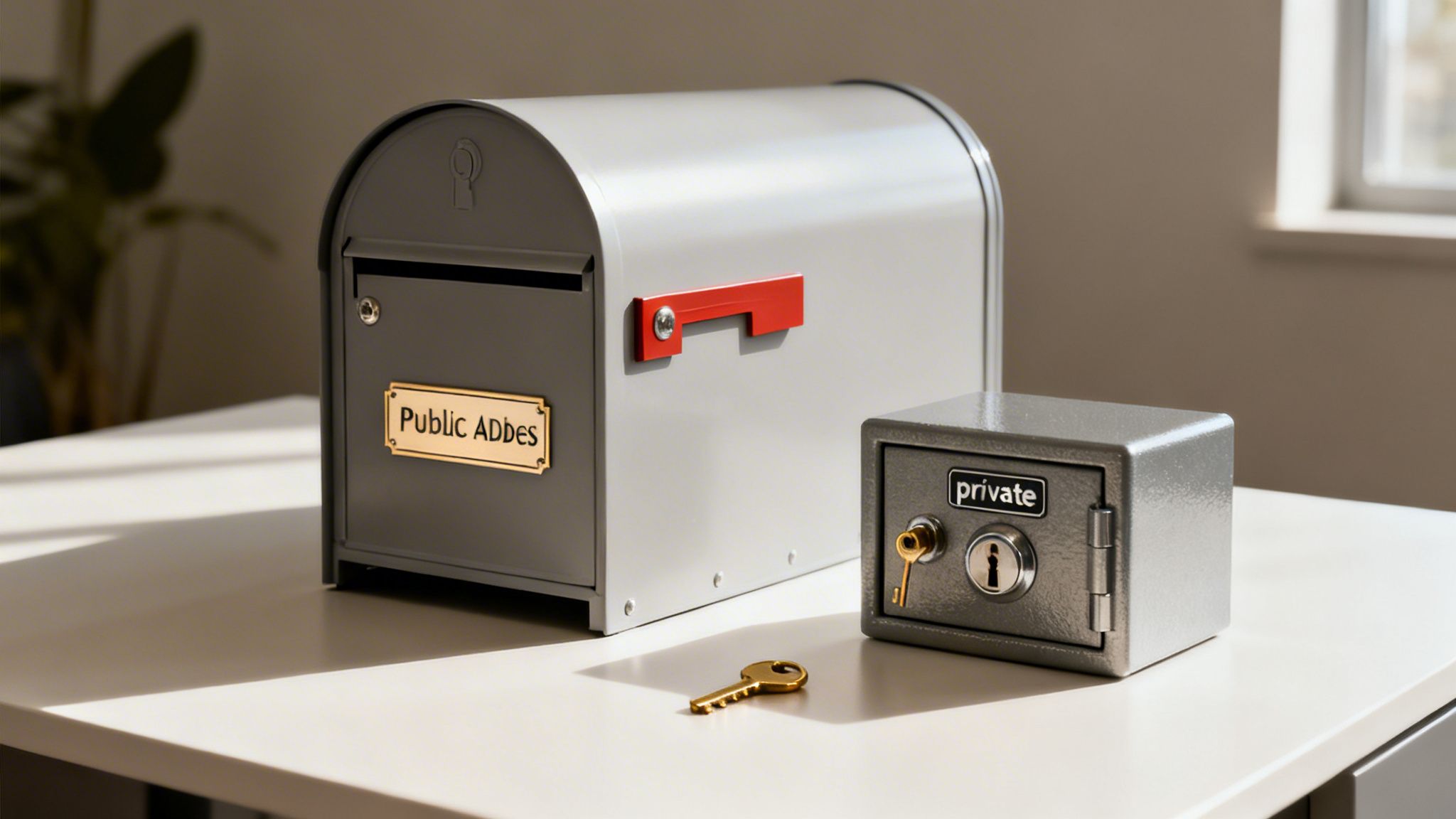
To really get how cryptography in cryptocurrency works, you have to nail the concept of public and private keys. For any merchant, this is the single most important idea to grasp for managing your own funds securely. It’s the difference between holding a flimsy IOU and having direct, undeniable control over your money.
Think of your Bitcoin wallet as a super-secure, transparent mailbox. Your public key is the address on the front of that box. You can—and should—share this address with anyone who wants to send you a payment. It's public for a reason, and sharing it doesn't put the funds already inside at any risk.
Your private key, on the other hand, is the only key that can open that mailbox. It’s a secret string of data that gives you the power to access and spend the bitcoin sent to your public address. This key must be guarded fiercely. If anyone else gets their hands on it, they can take your funds. End of story.
The Source of Your Financial Sovereignty
This duo of public and private keys is created through some pretty clever math called Elliptic Curve Cryptography (ECC). It’s a sophisticated process that generates a mathematically linked pair of keys. The whole system is designed to be a one-way street: it's incredibly simple to figure out the public key from a private one, but it's practically impossible to go the other way around.
This one-way function is the cryptographic shield that guarantees your ownership. It lets the entire world see your public address and send you funds, but only you—the holder of the private key—can sign off on sending funds out. This is the very essence of self-custody and what gives you financial sovereignty on the Bitcoin network.
There's a core rule in Bitcoin that is simple and absolute: Not your keys, not your coins. Whoever controls the private key controls the Bitcoin. There are no do-overs, no reversals, and no "forgot password" button to click.
Understanding this is non-negotiable when deciding how to manage your Bitcoin. When you use a third-party service that holds your private keys for you (a custodial service), you’re placing your complete trust in them. This brings a whole new layer of risk—the service could get hacked, go bankrupt, or just decide to freeze your access to your own funds.
Taking Control with Non-Custodial Wallets
A non-custodial wallet flips the script, putting the power—and the responsibility—right back in your hands. When you create a non-custodial wallet, you are the one who generates and stores the private key. This is usually managed through a seed phrase, a list of 12 or 24 words that serves as the master backup for your private key.
- You Have Full Control: No third party can freeze your account, block a transaction, or lose your funds. You are your own bank.
- Enhanced Security: You completely cut out the counterparty risk that comes with custodial services. Your security is down to your own practices, not a company’s policies.
- Greater Privacy: Wallet-to-wallet transactions, like those Flash enables, offer better privacy because there's no central middleman logging every detail of your business.
This direct control is what makes Bitcoin such a powerful tool for merchants. By using a non-custodial wallet, you’re using the network's core cryptographic security to its full potential. You accept payments directly from customers into a wallet that only you can access, slashing your reliance on traditional financial gatekeepers and all their associated risks and fees. The cryptography ensures that once a payment lands at your public address, only your private key can ever move it.
How Digital Signatures and Hashes Protect Your Payments
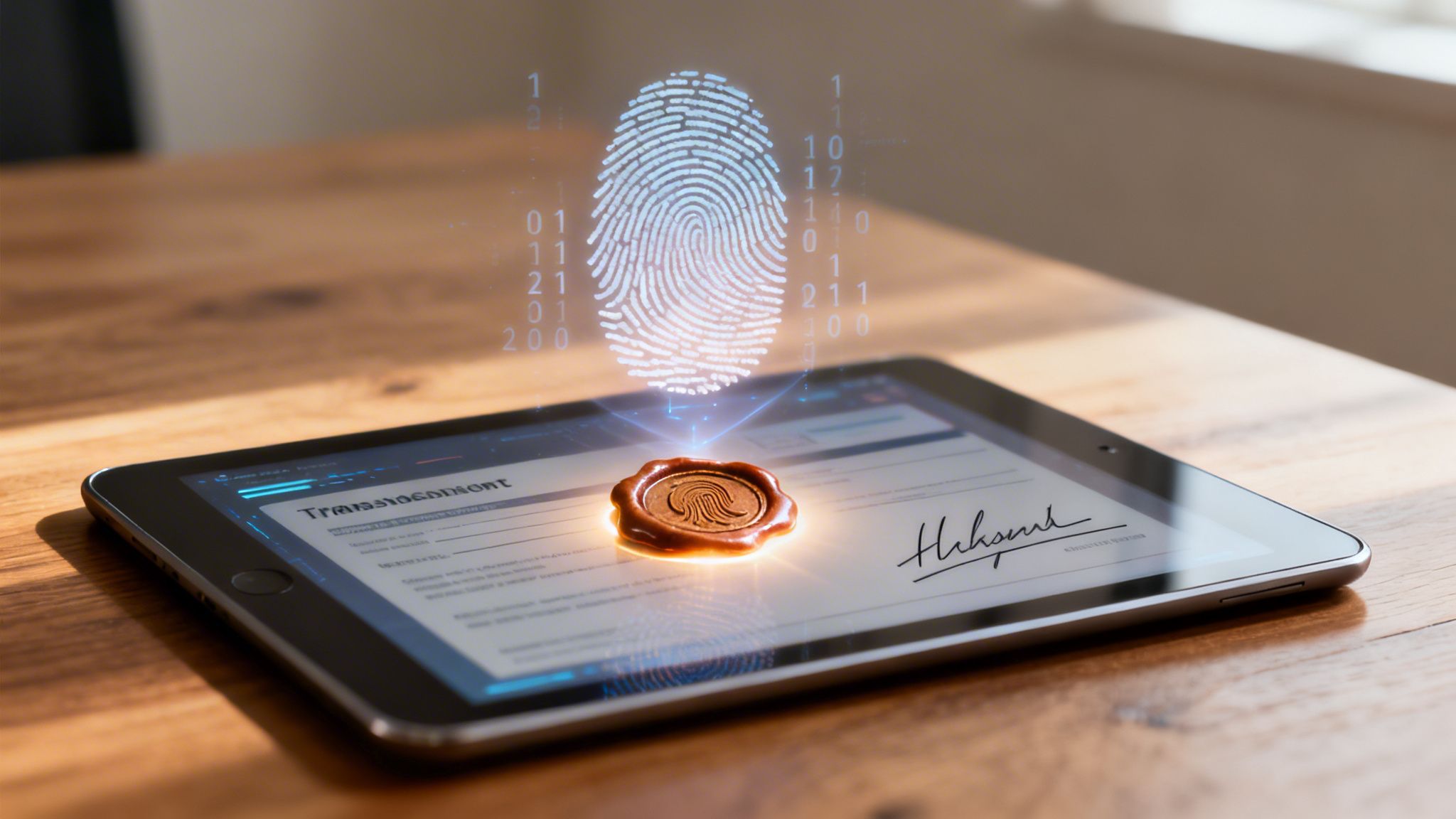
So, your digital keys prove you own your Bitcoin—that's a huge step. But what stops someone from meddling with a payment while it’s on its way to you? How can you be sure the transaction itself is authentic and hasn't been altered?
This is where two other workhorses of cryptography in cryptocurrency step in: digital signatures and hash functions. These tools are the dynamic duo that gives every transaction unshakeable proof of its origin and its integrity. For any merchant, this is where real peace of mind comes from—knowing that every payment you receive is legitimate and the details are exactly as they should be.
Digital Signatures: The Unforgeable Seal of Approval
The best way to think about a digital signature is like a high-tech wax seal on an old royal decree. That seal did two things: it proved the letter came from the king, and it showed no one had opened it. A digital signature does the exact same job for your Bitcoin transactions.
When you send Bitcoin, your wallet uses your private key to create a unique digital signature for that specific payment. This isn’t just a copy of your key; it’s a small, unique piece of data mathematically tied to both your private key and the specific details of that transaction.
This is what guarantees authenticity. Anyone else on the network can take your public key—which is safe to share—and use it to check the signature. If it matches, they know the payment came from the rightful owner of the funds, all without ever seeing your precious private key.
Hash Functions: The Digital Fingerprint Generator
While a signature proves who sent the money, a hash function proves that what they sent hasn't been touched. A hash function is an algorithm that takes any amount of data—your transaction details, for instance—and crunches it down into a unique, fixed-length string of text. This string is called a hash.
Think of it as a "digital fingerprint" for your data. The magic of a good hash function is that even a tiny change to the input, like altering the payment amount by a single satoshi, produces a completely different and unrecognizable hash. This makes any attempt at tampering instantly obvious.
Before a transaction is signed, all its data is first run through a hash function (Bitcoin uses one called SHA-256). Your wallet then applies your digital signature to this hash, which is much more efficient than trying to sign all the raw transaction data.
When a digital signature is applied to a transaction's hash, it creates a tamper-evident seal. It simultaneously proves the sender's consent (via the signature) and the transaction's exact details (via the hash), making the payment record secure and reliable.
This powerful combination has completely reshaped markets around the world. The tech is incredibly solid, but poor implementation, especially on centralized platforms, can still create weak spots. Even so, the numbers show that strong cryptographic defenses are winning. In 2025, while illicit crypto volume hit USD 158 billion, its slice of total on-chain activity actually fell to just 1.2%. You can learn more in the 2026 Crypto Crime Report.
Digital Signatures vs Hash Functions at a Glance
It's easy to mix these two up, but they perform very distinct jobs in every Bitcoin transaction you process. This table breaks down the key differences.
| Feature | Digital Signature | Hash Function |
|---|---|---|
| Primary Goal | Proves authenticity (who sent it) | Proves integrity (that it hasn't changed) |
| How It's Made | Uses a private key to sign transaction data | Uses a mathematical algorithm to "fingerprint" data |
| Is It Unique? | Unique to a specific person and transaction | Unique to the specific data being processed |
| How It's Verified | Checked using the sender's public key | Checked by re-hashing the data to see if it matches |
| Analogy | A wax seal or a handwritten signature | A digital fingerprint or a checksum |
In short, the hash function creates a perfect summary of the transaction, and the digital signature is your personal, unforgeable stamp of approval on that summary.
How Signatures and Hashes Work Together
So, how does this team-up actually play out when you receive a payment? Here's the play-by-play for every Bitcoin transaction:
- Data Hashing: All the transaction details—sender, receiver, amount—are fed into the hash function. Out comes a unique digital fingerprint, the hash.
- Signature Creation: Your wallet software takes your private key and mathematically "signs" that hash, creating the digital signature.
- Broadcasting: The transaction, along with its digital signature and your public key, is sent out to the Bitcoin network.
- Verification: Nodes across the network quickly use your public key to do two things: confirm that your signature is valid and check that it perfectly matches the hash of the transaction data they received.
If everything checks out, the network knows the payment is authentic and unaltered. But if even one character of the transaction data was changed in transit, its hash would be completely different. The signature would no longer match, and the network would instantly reject the transaction as a fraud. It's a cryptographic checkmate that makes Bitcoin so incredibly secure.
Understanding the Blockchain and Transaction Finality

We've seen how individual payments are locked down, but how do they become a permanent part of Bitcoin's history? This is where the real magic of cryptography in cryptocurrency comes into play. It’s not just about securing a single transaction, but about weaving every transaction together into an unbreakable, public record.
This record is the blockchain—a continuously growing chain of blocks. Think of each block as a page in a global ledger. Roughly every 10 minutes, a new block filled with a batch of recently verified transactions is added to the chain.
But what stops someone from just changing a page? It's a simple but incredibly powerful cryptographic trick. Every new block contains the unique hash—that digital fingerprint we talked about—of the block that came before it. This creates a digital chain, linking all the blocks in chronological order all the way back to the very first one.
How Merkle Trees Summarize Transactions
Each block has to pack in hundreds, sometimes thousands, of transactions. To manage all that data efficiently and securely, Bitcoin uses another clever tool: a Merkle Tree.
Picture a knockout tournament bracket. In the first round, individual transactions are paired up, and their hashes are combined to create a new, parent hash. These new hashes then face off in the next round, get hashed together again, and keep moving up the bracket.
This continues until only one hash is left at the very top. This final hash is the Merkle Root, and it's a compact summary of every single transaction in that block. It’s like the tournament trophy—a single, verifiable result that represents the entire competition.
This structure is a game-changer for security and efficiency:
- Data Integrity: The Merkle Root is a tamper-evident fingerprint for all the block's transactions. Change just one tiny detail in one transaction, and a ripple effect cascades all the way up the tree, resulting in a completely different Merkle Root. Everyone would know something was wrong.
- Verification Speed: Instead of downloading and checking every single transaction in a block, you can quickly prove your transaction is included just by checking a few hashes along a single branch of the tree. It's incredibly fast.
The blockchain's chained structure, secured by hashes and Merkle Trees, makes Bitcoin's history tamper-evident. Changing a past transaction would require re-calculating the hash of that block and every single block that came after it—a computationally impossible feat.
The Power of Payment Finality
This cryptographic architecture leads to one of Bitcoin's most valuable features for merchants: payment finality. In the traditional financial world, payments are almost never final. A customer can dispute a charge, and the bank can yank the money right back out of your account days or even weeks later. That's a chargeback.
Chargeback fraud is a massive headache and a real cost for businesses, especially those selling online. Bitcoin completely eliminates this risk.
Once a transaction is confirmed in a block—and a few more blocks are built on top of it for good measure—it is permanent and irreversible. The math simply doesn't allow anyone to undo the payment. The money is truly yours, with zero risk of it being clawed back.
For a merchant, this means:
- Zero Chargeback Fraud: You can accept payments from anyone, anywhere, without the fear of fraudulent chargebacks.
- Reduced Costs: Forget paying for expensive chargeback insurance or wasting time and resources fighting disputes.
- Immediate Settlement: While it takes a few confirmations to be fully secure, funds settle on a global ledger much faster than traditional bank transfers, which can drag on for days.
This level of certainty is a revolution for commerce. The cryptographic finality baked into Bitcoin's blockchain gives merchants a degree of security and confidence that old-school payment systems just can't offer. It's the ultimate proof that a transaction is done, dusted, and settled for good.
How Advanced Cryptography Supercharges Bitcoin Payments
The cryptography underpinning Bitcoin isn't some dusty relic; it’s a living, breathing technology that keeps getting better. While the core ideas of public keys and hashing are rock-solid, developers are constantly building new and powerful tools on top of them. For merchants, these advancements mean tighter security, smarter features, and a more efficient way to run your business.
This constant evolution is what keeps cryptography in cryptocurrency so exciting. It’s all about solving real-world problems, like protecting a company's treasury or making small, everyday payments fast and cheap. Two of the biggest game-changers for merchants right now are Multi-Signature wallets and the Lightning Network.
Securing Business Funds with Multisig Wallets
Imagine a bank vault that needs two or three different keys, held by different people, to unlock it. That’s the simple idea behind a Multi-Signature (or Multisig) wallet. It's a special type of Bitcoin wallet that demands more than one private key to approve a transaction.
This is a massive leap forward from a standard wallet, where a single private key is the one and only thing with power. For any business, putting all your trust in one key creates a single point of failure. If that key gets lost, stolen, or compromised by a hacker, the funds are just… gone. Multisig spreads that risk out.
A popular setup for a business is a "2-of-3" wallet. This means three private keys exist, but you only need any two of them to sign off on a payment.
- Key 1: Held by the business owner.
- Key 2: Held by the CFO or another trusted executive.
- Key 3: Stored safely offline as a backup, maybe in a physical vault.
With this system, no single person can move funds on their own. It builds in shared control and creates a tough shield against both internal fraud and external attacks. Even if a hacker nabs one key, they still can't touch the company's Bitcoin.
Scaling Payments with the Lightning Network
Bitcoin's main network is incredibly secure, but it can be a bit slow and pricey for small, frequent purchases—like buying a cup of coffee. That’s the exact problem the Lightning Network was built to solve. It’s a "Layer 2" solution that sits on top of Bitcoin, using some clever cryptography to make payments instant and practically free.
The Lightning Network works by letting users open private payment channels between each other. The best analogy is opening a bar tab. Instead of swiping your card for every single drink, you keep a running tab and just settle the final bill once at the end of the night.
In the same way, two people can open a Lightning channel by locking up some Bitcoin in a special Multisig address on the main blockchain. With the channel open, they can fire countless tiny payments back and forth instantly, all off-chain. These are real Bitcoin payments, secured by the same crypto magic, but they aren’t broadcast to the whole world.
The Lightning Network uses cryptography to create secure, off-chain payment channels. This allows for instant, low-cost transactions that settle later on the main Bitcoin blockchain, solving the network's scalability challenge for everyday commerce.
When they’re done, they close the channel, and only the final balance is recorded as a single transaction on the main blockchain. This design is perfect for retail, e-commerce, or any business that deals with a high volume of small payments.
This relentless pace of innovation is a huge reason cryptocurrency is finally breaking into mainstream commerce. The market, valued at USD 3.35 billion in 2026, is on track to nearly double to USD 6.33 billion by 2030. This boom is powered by scalable tech like Lightning and the brute-force security of Bitcoin's core network, which now boasts a hash rate over 600 EH/s—making a malicious attack a practical impossibility. You can dig deeper into these numbers in a report on the cryptocurrency market from Research and Markets.
These more advanced cryptographic tools show how Bitcoin is adapting to the real demands of business. For merchants, the benefits are clear and direct: Multisig offers enterprise-grade security for your funds, while the Lightning Network delivers the speed and low cost you need to compete.
Practical Security Steps for Accepting Bitcoin
Understanding the theory behind cryptography in cryptocurrency is one thing, but putting it into practice to protect your business is what really counts. The good news is you don't need to be a cryptographer to do it.
By turning these powerful concepts into simple, consistent habits, any merchant can accept Bitcoin safely and confidently. Let's walk through an actionable checklist grounded in the cryptographic principles we've covered, designed to help you reduce fees, kill chargebacks, and reach a global customer base without taking on unnecessary risk.
Take Full Control with a Non-Custodial Wallet
The single most critical security decision you'll make is your choice of wallet. As we've seen, your private key is the sole authority over your funds. This makes your first and most important step picking a non-custodial wallet.
This choice puts you in direct command of your private keys—you literally become your own bank. Platforms like Flash are built for this, facilitating direct wallet-to-wallet payments. The money moves from your customer to a wallet only you can access, with no middleman ever holding your funds. It’s the embodiment of Bitcoin's core principle: financial sovereignty.
Your private key is the ultimate cryptographic authority over your funds. A non-custodial wallet ensures that this authority belongs to you and you alone, removing the counterparty risk associated with third-party custodians.
Making this one decision massively shrinks your risk profile. You’re no longer exposed to exchange hacks, frozen accounts, or company bankruptcies. It’s the practical application of the classic mantra: "not your keys, not your coins."
Safeguard Your Master Key: Your Seed Phrase
When you set up your non-custodial wallet, it will give you a seed phrase—usually a list of 12 or 24 random words. Think of this phrase as the master key to your digital vault. It’s the ultimate backup that can restore your entire wallet and all its funds on any other compatible device if yours is lost, stolen, or destroyed.
Protecting this seed phrase is everything. Here’s how you do it right:
- Write It Down Physically: Never, ever store your seed phrase on a computer, in a cloud drive, or as a photo on your phone. Digital storage is a honeypot for hackers. Use a pen and paper, or better yet, a more durable medium like a steel plate designed for this purpose.
- Store It Securely and Offline: Keep your physical backup somewhere safe, private, and disconnected from the internet. Think of a fireproof home safe or a bank deposit box. For extra security, consider making two copies and storing them in separate, secure locations.
- Never Share It: Treat your seed phrase with more secrecy than your bank password. No legitimate company, service, or support agent will ever ask you for it. Anyone who does is trying to steal your funds.
Verify Payments by Waiting for Confirmations
The final piece of the puzzle is understanding when a payment is truly yours. When a customer sends you a Bitcoin payment, it gets broadcast to the network almost instantly. But it isn't truly secure until it’s been included in a block and permanently added to the blockchain. Each new block mined on top of that one cements the transaction further into history.
For merchants, this means waiting for a few confirmations before you hand over the goods or provide the service.
While one confirmation might be fine for a cup of coffee, the established best practice for larger amounts is to wait for three to six confirmations. At that point, the transaction is effectively irreversible, protecting you completely from any attempt to double-spend.
Common Questions About Bitcoin Cryptography
Even after you get the hang of the basics, a few practical questions always seem to pop up. Let's tackle the most common ones we hear from merchants about the cryptography that keeps their Bitcoin payments safe.
Is Bitcoin’s Cryptography Actually Breakable?
In short, no—not with any computer that exists today or in the foreseeable future. The algorithms powering Bitcoin, like SHA-256 and ECDSA, are the same battle-tested standards trusted by governments, militaries, and global financial institutions to protect their most sensitive data. Trying to break them would demand a frankly impossible amount of computing power.
The only theoretical threat on the very distant horizon is quantum computing. While these super-powerful machines are still mostly science fiction, a functional quantum computer could, in theory, crack today's public-key cryptography. But don't lose sleep over it. The developer community is already deep into creating "post-quantum" cryptographic standards to keep the network secure for generations to come.
Could Two People Accidentally Create the Same Private Key?
The chances of this are so microscopically small that it's statistically meaningless. It is, for all practical purposes, zero.
A Bitcoin private key is a 256-bit number. The total number of possible keys is 2²⁵⁶—a number so vast it’s hard to wrap your head around. It's far larger than the estimated number of atoms in the entire known universe.
To put it another way, you're more likely to win the lottery every single day for a year while simultaneously being struck by lightning than for two people to ever generate the same Bitcoin private key. This immense keyspace is a fundamental pillar of its security.
What Happens if I Lose My Private Key?
If you lose your private key and don't have a backup of your seed phrase, any Bitcoin in that wallet is gone for good. There’s no "forgot password" link, no customer service line to call, and no central company that can help you.
The very same cryptographic security that gives you sovereign control over your money also means you have total responsibility for it. This is precisely why backing up your seed phrase is the single most critical security step you can take. It’s the only cryptographic lifeline you have to get your funds back if your hardware is ever lost, stolen, or destroyed.
Ready to accept secure, direct Bitcoin payments and put an end to chargebacks for good? Flash gives you the tools to integrate wallet-to-wallet transactions in minutes. Get started today and connect with a global customer base.