If you've ever used a regular bank account, you already understand the basics of a custodial crypto wallet. It's essentially a bank account for your Bitcoin, where a trusted third party holds and manages your funds and private keys for you. This approach makes for a simple and familiar experience, prioritizing convenience over the absolute control you'd get with other options.
What Are Custodial Crypto Wallets
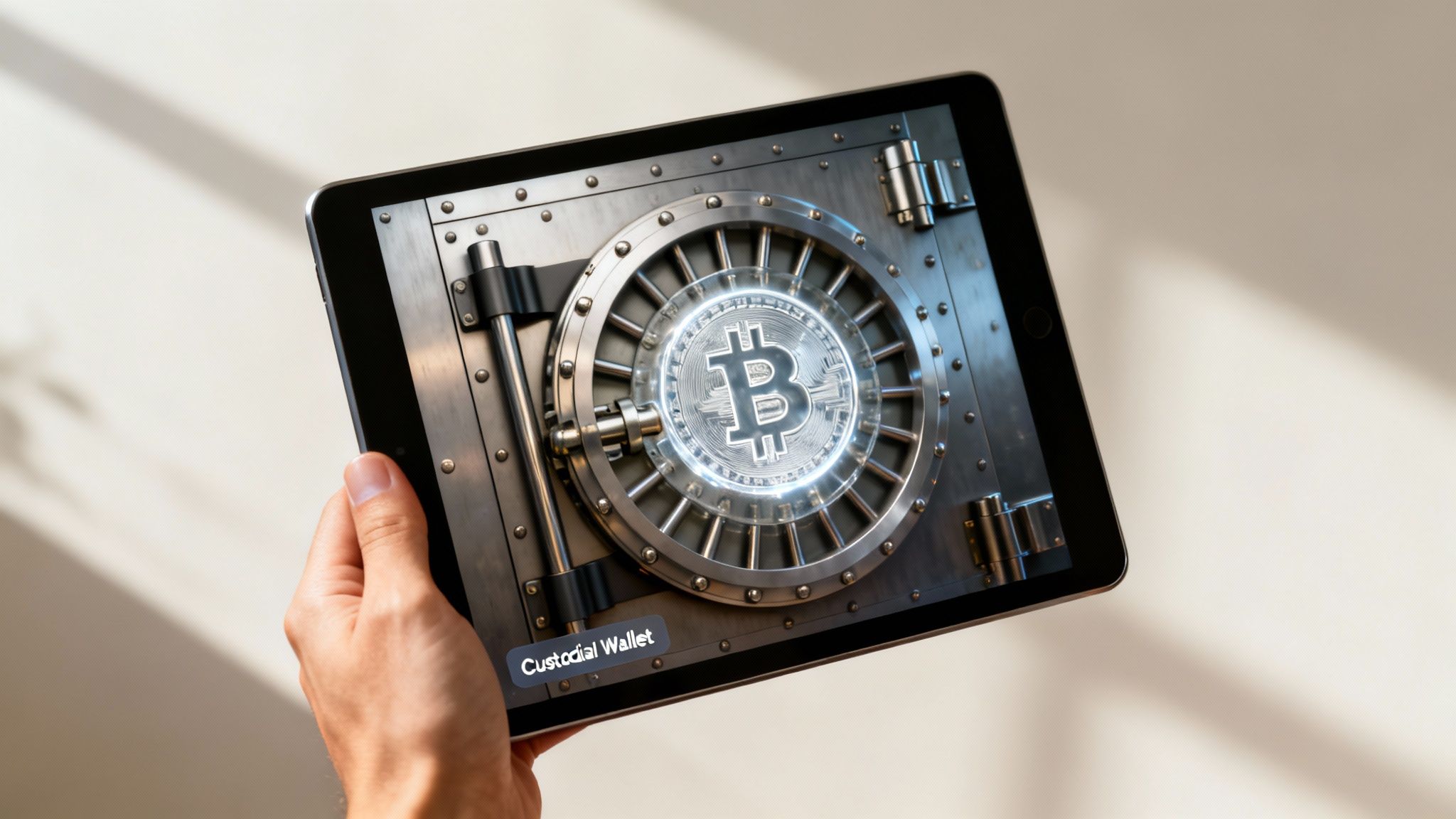
Think about your traditional bank. You deposit cash, and the bank takes on the job of keeping it safe. They handle transactions, give you a password-protected app to manage everything, and you trust them to secure your money. A custodial crypto wallet works almost exactly the same way, just for Bitcoin.
A third-party company—usually a major Bitcoin exchange—handles all the tricky security stuff for you. The most important part of this is managing the private keys, which are long, complex cryptographic codes that prove you own your Bitcoin and allow you to spend it.
By handing over your private keys to a custodian, you get a much simpler user experience. You don't have to stress about losing your keys, a mistake that could mean your Bitcoin is gone forever. Instead, you log in with a familiar username and password, and you often have recovery options like email resets if you forget your credentials.
The Trade-Off Between Convenience and Control
The whole point of Bitcoin is self-sovereignty, perfectly captured by the mantra, "not your keys, not your coins." It means that if you aren't the one holding your private keys, you don't really have final say over your Bitcoin. With a custodial wallet, you're trusting another company to be a good steward of your assets.
This model has become the go-to starting point for millions of people. Custodial services are wildly popular; hot wallets, which are almost always custodial exchange wallets, made up roughly 78% of the entire market by 2025. That's over 640 million active wallets where users have chosen convenience.
For many merchants, especially those just dipping their toes into Bitcoin, this trade-off makes perfect sense. The upsides are clear:
- Ease of Use: Simple interfaces that don't require you to be a tech genius.
- Account Recovery: You can actually get back into your account if you forget your password.
- Customer Support: There's a real help desk you can contact for troubleshooting.
A custodial wallet abstracts away the technical complexities of the Bitcoin network. It provides a user-friendly layer that feels much like modern online banking, making it an accessible first step for businesses looking to accept digital payments.
To really get what custodial wallets are, it helps to see where they fit into the broader fintech ecosystem. They act as a bridge, connecting the familiar world of traditional finance with the decentralized nature of Bitcoin by offering a structure that most people already understand.
Custodial Wallet At a Glance
To quickly break it down, here’s a summary of what defines a custodial Bitcoin wallet and the relationship between you and the service provider.
| Feature | How It Works |
|---|---|
| Private Key Management | The third-party custodian holds and secures the private keys for you. |
| Security Responsibility | The custodian is responsible for protecting the funds from threats. |
| Account Access | You access your funds using a standard login (username and password). |
| Transaction Signing | The custodian signs transactions on your behalf when you send a payment. |
| User Experience | Designed to be simple and intuitive, especially for beginners. |
| Primary Benefit | Convenience and the ability to recover account access if a password is lost. |
This table shows how the key responsibilities are shifted from the user to the provider, making the entire process feel less intimidating for newcomers.
How Custodial Wallets Actually Work
So, how does a custodial wallet actually handle your funds? It's a common misconception that when you deposit Bitcoin, it goes into a personal, isolated digital vault just for you. The reality is quite different—and far more efficient.

Custodial services pool your funds together with those of thousands of other users into a massive, highly secure wallet system. This system is usually a mix of "hot" online wallets for quick access and "cold" offline storage for Fort Knox-level security. This collective, pooled approach is the secret sauce behind their speed and convenience.
The best way to think about it is like your regular bank account. When you deposit cash, the bank doesn't squirrel away your specific bills in a safety deposit box with your name on it. It pools all deposits into its reserves, and your account balance is simply a record in their internal ledger—an IOU for the amount they owe you. Custodial crypto platforms work on the exact same principle.
What you see as your "balance" is really just a number in the custodian's private database. This is what enables lightning-fast, and often free, transactions between users on the same platform.
Internal Ledgers and Off-Chain Transactions
Let's say you need to pay another merchant who also uses the same custodial service. When you hit "send," something interesting happens—or rather, doesn't happen. No transaction is broadcast to the public Bitcoin blockchain.
Instead, the custodian simply adjusts the numbers in its own private books. It's an instant, internal accounting trick:
- The payment amount is subtracted from your account balance in their database.
- At the same time, that same amount is added to the recipient's balance.
- All the while, the actual Bitcoin never moves from the custodian's large, pooled wallets.
This is what we call an "off-chain" transaction. It all happens within the custodian's closed system, completely separate from the public Bitcoin network. This is how they can bypass network transaction fees (miner fees) and confirmation wait times, making payments between their users instant and cheap.
Imagine a bank needing to move money between two of its customers. It wouldn't send an armored truck to drive cash from one branch to another. It would just update the numbers in its digital ledger. Off-chain transactions in a custodial wallet are the crypto equivalent—it's just efficient bookkeeping.
The only time a real "on-chain" transaction occurs is when you decide to withdraw your Bitcoin to an external wallet (one not on the same platform). Only then does the custodian use its private keys to sign and broadcast a transaction on the public blockchain, which will incur standard network fees and require network confirmations.
Onboarding and Identity Verification
Before you can start using these services, you'll need to go through an onboarding process that's standard for any regulated financial company. This means Know Your Customer (KYC) and Anti-Money Laundering (AML) checks. Because custodial wallet providers operate like financial institutions, they are legally required to verify who their users are.
The process is pretty straightforward and should feel familiar:
- Create an Account: You'll start with the basics, like your name and email.
- Submit Identification: You'll be asked to upload a government-issued photo ID, like a driver's license or passport.
- Provide Business Documents: Merchants will likely need to provide proof of business registration or similar corporate documents.
- Verify Your Identity: This often involves a "liveness check"—taking a selfie or a short video to prove you're a real person who matches the ID.
These aren't Bitcoin-specific hoops to jump through; they're the same requirements you'd face opening a bank account or signing up with a traditional payment processor. This regulatory framework is there to prevent financial crime and ensure the custodian is playing by the rules. It adds an extra step to get started, but it's a core part of the trust-based model that defines custodial crypto wallets.
Custodial Vs Non-Custodial Wallets: A Merchant's Guide
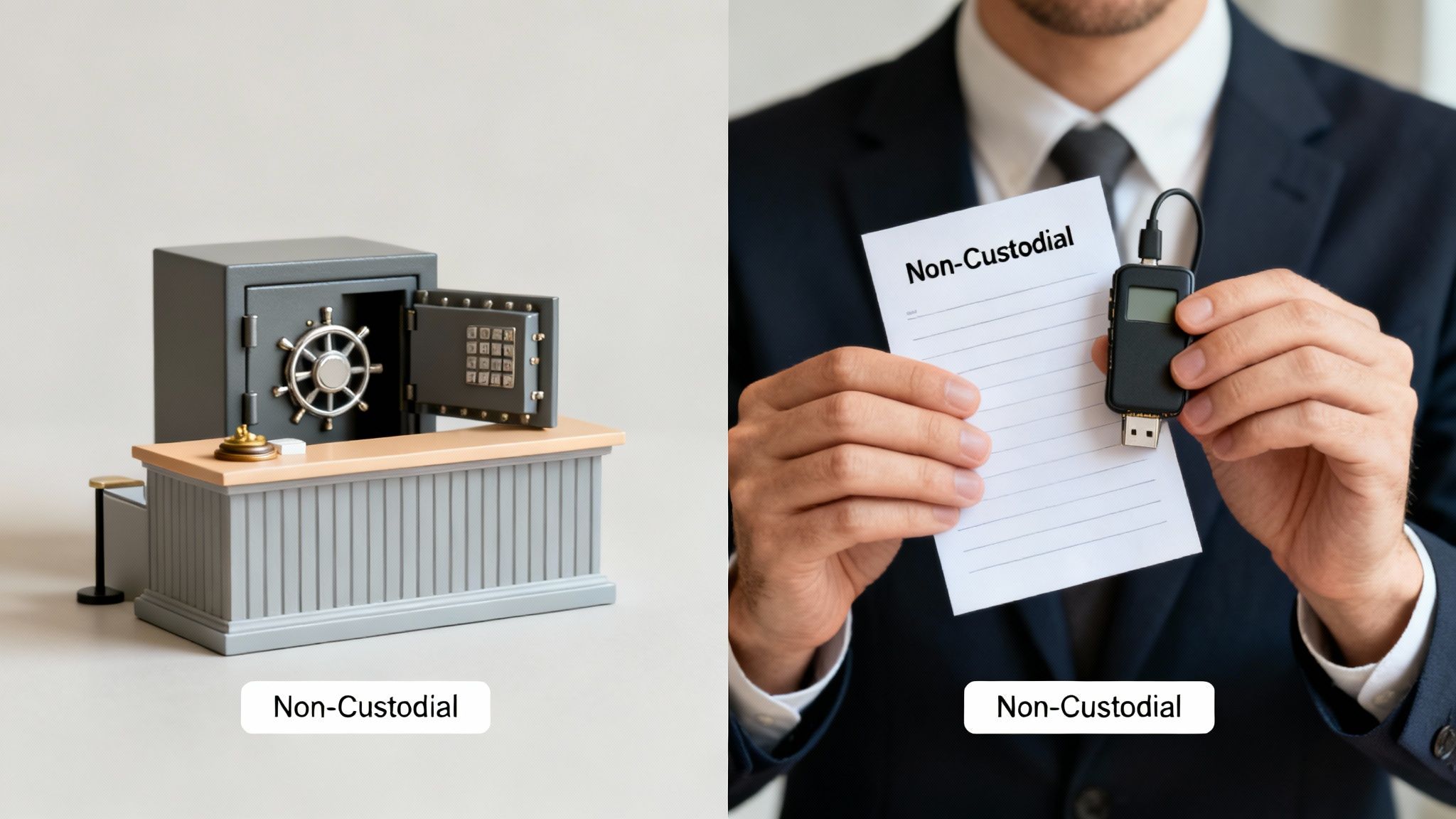
When you decide to accept Bitcoin, your first big decision is choosing a wallet. This choice really boils down to one thing: convenience versus control. On one side, you have custodial crypto wallets, which act a lot like a bank, handling the tricky security stuff for you. On the other, there are non-custodial wallets, which put you in the driver's seat, making you the sole controller of your funds.
For any business, this isn't just a tech preference. It's a strategic move that affects daily operations, security protocols, customer experience, and even your fees. The whole difference comes down to who holds the private keys—the master password to your Bitcoin. With a custodial service, a third party holds them. With a non-custodial wallet, you do.
This one distinction sends you down two completely different paths. One offers a familiar, hands-off experience, while the other gives you total financial freedom. Getting these differences straight is the key to picking a payment setup that matches your business goals and how much risk you're comfortable with.
The Great Debate: Control Vs Convenience
At the heart of the debate is a famous Bitcoin saying: "not your keys, not your coins." This isn't just a catchy phrase; it’s the literal truth. If you don't control your private keys, you're placing your trust in someone else not to lose, freeze, or mess up your funds.
For a merchant, this introduces what’s known as counterparty risk—the chance that the other party (the custodian) won't hold up their end of the deal. If their platform gets hacked, faces a regulatory crackdown, or goes belly-up, your business revenue could be in jeopardy. That's the price you pay for the convenience of managed security and easy password resets.
A non-custodial wallet, on the other hand, wipes that risk off the table completely. You hold the private keys, so no third party can ever touch your Bitcoin without your say-so. This is the bedrock of a true wallet-to-wallet payment system like Flash, where money moves directly from your customer’s wallet to yours, with no middleman ever handling the funds. It offers rock-solid security and freedom from censorship, but it also means the responsibility for keeping those keys safe is all on you.
The decision for a merchant is simple but profound: Is the managed security and ease-of-use from a custodian worth giving up direct, sovereign control of your funds? Answering this question honestly will guide you to the right solution for your business.
This choice also shapes what you and your customers experience. Custodial platforms often feel slick and app-like, similar to modern online banking. In contrast, non-custodial solutions give you direct peer-to-peer power, often with lower fees and better privacy, since KYC (Know Your Customer) checks usually aren't required.
Custodial vs Non-Custodial Wallets: A Merchant's Comparison
To really weigh your options, it helps to see a direct comparison of the features that matter most to a business. The table below breaks down the key differences to help you see the trade-offs clearly.
| Feature | Custodial Wallet | Non-Custodial Wallet |
|---|---|---|
| Private Key Control | The third-party provider holds and manages your private keys. | You hold your own private keys, giving you complete and exclusive control. |
| Security Responsibility | The custodian is responsible for securing the pooled funds against hacks and theft. | You are solely responsible for securing your private keys and seed phrase. |
| Access & Recovery | You can recover your account with a password reset, backed by customer support. | If you lose your keys and recovery phrase, your funds are permanently lost. No one can help. |
| Transaction Fees | May include platform-specific withdrawal or service fees on top of network fees. | You only pay the standard Bitcoin network (miner) fees, with no intermediary markup. |
| Account Freezes | Your account can be frozen or restricted by the custodian due to policy or legal orders. | Your funds cannot be frozen or seized by any third party. You are censorship-resistant. |
| Onboarding | Requires identity verification (KYC/AML), which can be a barrier for some customers. | No KYC is required. You can create a wallet and start accepting payments instantly. |
| Customer Experience | Offers a familiar, bank-like interface with integrated services like fiat conversion. | Provides a direct, peer-to-peer payment experience that is private and empowers users. |
Ultimately, what's right for you comes down to your business priorities. If you value simplicity and strong support and are okay with a trust-based model, a custodial wallet is a solid place to start. But if your business puts a premium on financial independence, the lowest possible fees, and zero chance of outside interference, a non-custodial wallet is the undisputed winner.
Understanding The Risks of Custodial Wallets

While the convenience of custodial crypto wallets is a big draw, it comes with a unique set of trade-offs every merchant needs to weigh carefully. When you hand over your business's Bitcoin to a third party, you're not just trusting them with your funds; you're also adopting their security model, their operational stability, and their legal baggage.
This isn't about fear-mongering. It's about making smart, informed decisions to protect your assets.
The most obvious danger is a massive platform hack. Custodial services pool huge amounts of Bitcoin, turning themselves into giant, glowing targets for sophisticated hackers. If a custodian's defenses are breached, the loss can be catastrophic for everyone on the platform, since your funds are just one part of that central honeypot.
And it’s not just external threats. You also have to consider internal issues, which can range from simple mismanagement and technical glitches to outright employee fraud. When you don't hold the private keys, you're placing your trust in the custodian's staff and their internal controls to do the right thing.
The Specter of Insolvency and Frozen Funds
One of the biggest risks, and one that often gets overlooked, is custodian insolvency. If the company running your wallet goes bankrupt, your funds can get tangled up in years of legal battles. In a worst-case scenario, they could even be used to pay off the company's creditors. The shocking collapse of major players like FTX is a brutal reminder that even the biggest names aren't too big to fail.
Then there's the risk of having your account frozen or your funds seized. Custodial providers have to play by the rules, which means they can be forced by government agencies to lock down assets. This could be triggered by a regulatory probe, a court order, or even an automated system flagging your account activity, leaving your business suddenly cut off from its revenue.
The core vulnerability of a custodial wallet boils down to one thing: counterparty risk. You are betting that a third party will stay solvent, secure, and accessible 24/7. When that bet goes wrong, the consequences can be sudden and severe.
These aren't just hypothetical problems. Recent research found that nearly 1 in 5 crypto owners have had trouble accessing or withdrawing their funds from custodial platforms. That means around 20% of users have hit a wall trying to get to their own money, a crucial detail highlighted in studies on consumer sentiment on cryptocurrency security.
Proactive Strategies for Risk Mitigation
Despite the risks, you can use custodial crypto wallets safely if you take a proactive approach to security. The idea is to minimize your exposure by layering your defenses and being extremely picky about your provider. A few simple, powerful strategies can make all the difference.
First, stick with reputable and well-regulated custodians. Look for companies with a long, established track record, transparent security audits, and clear regulatory standing in your country. It's also worth digging into their adherence to security standards, like achieving SOC 2 compliance.
Next, lock down your own account with strong personal security habits. This is your first and most important line of defense.
- Enforce Strong Two-Factor Authentication (2FA): Ditch the less secure SMS-based 2FA. Always use an authenticator app (like Google Authenticator) or a physical security key. This makes it incredibly difficult for an attacker to get in, even if they manage to steal your password.
- Use a Unique, Complex Password: Never, ever reuse passwords. Get a password manager to create and store strong, unique credentials for your custodial account. It’s a small step that provides massive protection.
- Utilize Withdrawal Address Whitelisting: This is a game-changer. Most major custodians offer this feature, which lets you create a pre-approved list of Bitcoin addresses that funds can be sent to. If a hacker breaks into your account, they can't drain your funds to their own address.
Taking these steps adds powerful layers of security to protect your business assets. While they don't eliminate counterparty risk entirely, they dramatically reduce the odds of your specific account being compromised by common attacks.
When To Use a Custodial Wallet For Your Business
Deciding between a custodial and a non-custodial wallet isn't just a tech question—it's a strategic move that hinges on your business model, how you handle risk, and your day-to-day operations. The dream of total financial control is a powerful one, but for many businesses, the practicalities of the real world often make custodial crypto wallets the smarter choice.
The trick is to look past the ideals and see where the convenience of a managed service adds real, bottom-line value. For a lot of merchants, handing off the headaches of security and compliance is a trade-off that easily beats the burden of managing private keys themselves.
Ideal Scenarios for a Custodial Wallet
A custodial wallet is usually the perfect on-ramp for any business just dipping its toes into accepting Bitcoin. If your team doesn't have a deep background in blockchain security, a managed solution is like having a safety net. You get to focus on running your business, not on the nail-biting responsibility of safeguarding private keys.
This approach works especially well for a few common business types:
- Businesses That Need Simplicity and Support: If you're looking for a "plug-and-play" setup with a support team you can actually call, a custodial wallet is the hands-down winner. The sign-up feels familiar, and you can recover your account if you lose a password.
- Merchants Who Need Easy Fiat Conversion: For businesses that have to keep their books in dollars or euros, custodial platforms are a lifesaver. They often have built-in services that automatically swap incoming Bitcoin for your local currency, which simplifies accounting and shields you from price swings.
- High-Volume, Low-Value Transaction Models: If your business is built on tons of small, frequent payments, the off-chain capabilities of many custodial services are a huge plus. Payments between users on the same platform are often instant and free, dodging Bitcoin network fees and confirmation waits.
Think of a custodial wallet as a managed gateway to the Bitcoin economy. It lets a business start taking digital payments right away, without the steep learning curve and operational drag of self-custody.
Put it this way: if you run a small coffee shop, you want to focus on brewing great coffee, not on becoming a cybersecurity expert. A custodial point-of-sale system that takes care of the Bitcoin side of things is a practical, efficient choice.
When a Non-Custodial Wallet is the Superior Choice
On the flip side, there are times when going non-custodial is the only move that makes sense. For businesses that absolutely prioritize financial sovereignty, censorship resistance, and keeping costs to a minimum, holding your own keys is non-negotiable.
You should seriously consider a non-custodial wallet if your business:
- Prioritizes Censorship Resistance: If you're in a high-risk industry or a place with shaky regulations, a non-custodial wallet ensures that no third party can freeze or grab your funds. Your money is yours, period.
- Wants Absolute Control and the Lowest Fees: With a direct wallet-to-wallet solution like Flash, you cut out the middleman completely. This means you only ever pay the base Bitcoin network fee—no platform markups or withdrawal charges—maximizing your profit on every single sale.
- Has the Technical Chops for Self-Custody: If your team has the skills and processes to manage private keys securely, the upsides of full ownership and eliminating counterparty risk are massive.
At the end of the day, the right choice has to line up with your core business priorities. By understanding these different scenarios, you can build a clear framework for picking the Bitcoin wallet that truly supports your operational needs and your vision for the future.
Where Bitcoin Custody is Headed for Merchants
The world of Bitcoin custody for merchants is growing up. For a long time, the line between purely custodial and non-custodial wallets was pretty sharp, but that's starting to change. We're now seeing smarter, more flexible options pop up for businesses, driven by two big shifts: clearer regulations and some powerful new technology.
For years, custodial crypto wallets existed in a kind of regulatory fog. That's clearing up fast. As governments finally lay down some ground rules, you're seeing established financial players step into the Bitcoin space with more confidence. This brings a much-needed dose of legitimacy and security, giving merchants real assurance that their custodial partner is stable, compliant, and not going to disappear overnight.
The Rise of Hybrid Solutions
At the same time, new technologies are creating hybrid models that truly offer the best of both worlds. The most interesting development here is Multi-Party Computation (MPC). Think of MPC as splitting a single private key into several pieces, or "shards," and handing them out to different people—say, the merchant, a custodian, and a third-party security firm.
With this setup, no single person or company can move the funds on their own. To sign off on a transaction, several parties have to bring their key shards together. It’s a fantastic middle ground that offers some serious advantages:
- Tougher Security: It gets rid of the classic single point of failure that makes traditional custodial wallets a bit nerve-wracking.
- Shared Responsibility: Merchants get to keep a degree of control without having to shoulder the entire weight of self-custody.
- Real Convenience: You still get the simple user experience and, crucially, the account recovery options that are just impossible with a pure non-custodial wallet.
This hybrid approach points to a future where merchants won’t be forced into a black-and-white choice between total control and total convenience.
A Market That's Maturing and Exploding
The demand from businesses for secure Bitcoin custody is not just real—it's growing like a weed. The custodial wallet industry was valued at around USD 3.5 billion in 2023, and it's on track to hit roughly USD 11.5 billion by 2032. This isn't just retail investors; a huge chunk of that growth is coming from the commercial sector. Businesses and institutions are hungry for enterprise-level security, multi-signature setups, and rock-solid compliance. You can dig into more of the numbers on custodial wallet market trends and projections.
The future of Bitcoin custody isn’t some cage match between custodial and non-custodial models. It's about building out a diverse ecosystem where any business can find a solution that fits its specific operations, risk appetite, and technical comfort level.
At the end of the day, a healthy Bitcoin economy needs both things: strong, reliable custodial providers and powerful, liberating non-custodial tools. The growing sophistication of custodial services, running parallel to the raw freedom of wallet-to-wallet payments, is what makes the market stronger and more welcoming for every kind of merchant. That balance is exactly what will power the next big wave of Bitcoin adoption in commerce.
Got Questions? Let's Clear Things Up.
Dipping your toes into Bitcoin payments always brings up a few questions, especially when you're deciding how to handle your funds. Here are some straightforward answers to the things merchants ask most about custodial crypto wallets.
Are My Funds Safe in a Custodial Wallet?
It’s a fair question. While no system on earth is 100% foolproof, reputable custodial providers use serious, institutional-grade security to protect your funds. Think offline cold storage for most of the assets and multi-signature protocols that make them incredibly tough to crack.
But here's the catch: you're still dealing with counterparty risk. At the end of the day, the safety of your funds boils down to the provider's financial health and how seriously they take their own security.
Can I Recover My Account if I Lose My Password?
Yes, and honestly, this is one of the biggest draws for businesses using custodial wallets. If you lose your password, it's not game over. Just like with your bank, you can usually get back into your account by going through a standard identity check with their customer support team.
This simple feature is a lifeline that prevents the catastrophic loss of funds that can happen if you misplace the keys to a non-custodial wallet.
With a custodial service, you trade absolute control for a critical safety net. The ability to recover an account provides essential peace of mind for businesses managing daily operations and employee access.
What Is KYC and Why Is It Required?
KYC stands for "Know Your Customer." It's the same identity verification process you'd go through at any regulated financial institution. Since custodial wallet providers are essentially money services businesses, they're required by law to verify who you are.
This helps prevent things like money laundering and other illegal activities. It usually just means you'll need to submit some personal and business documents to get set up.
Are There Withdrawal Limits?
Most of the time, yes. Many custodial platforms put daily or weekly withdrawal limits in place as a security measure. The exact amount often depends on how much you’ve verified your account.
If you're a merchant who moves a lot of money, this is a big one to watch. You’ll want to double-check a provider's policies to make sure their limits won't get in the way of your business's cash flow.
Ready to bypass the risks and restrictions of custodial services? With Flash, you can accept Bitcoin payments directly, wallet-to-wallet, with no middleman, no KYC, and no withdrawal limits. Get started in under a minute and take full control of your revenue. Start accepting Bitcoin today.