For any business dipping its toes into the world of crypto payments, the first hurdle is often the jargon. The terms ‘coin’ and ‘token’ get thrown around interchangeably, but they are fundamentally different. Getting this distinction right isn't just a technicality—it's the foundation of your entire digital asset strategy.
The choice you make impacts your payment infrastructure, security posture, and even your operational freedom. Let's break down what separates them.
Coins vs Tokens: Understanding the Core Difference
At the heart of the matter, a coin operates on its own independent blockchain, while a token is built on top of an existing blockchain.
Think of it this way: a coin like Bitcoin is the native currency of its own digital country. A token, on the other hand, is more like a concert ticket or an arcade voucher—it only works within a specific venue (the host blockchain). This is the most critical concept to grasp when you're considering which digital payments to accept.
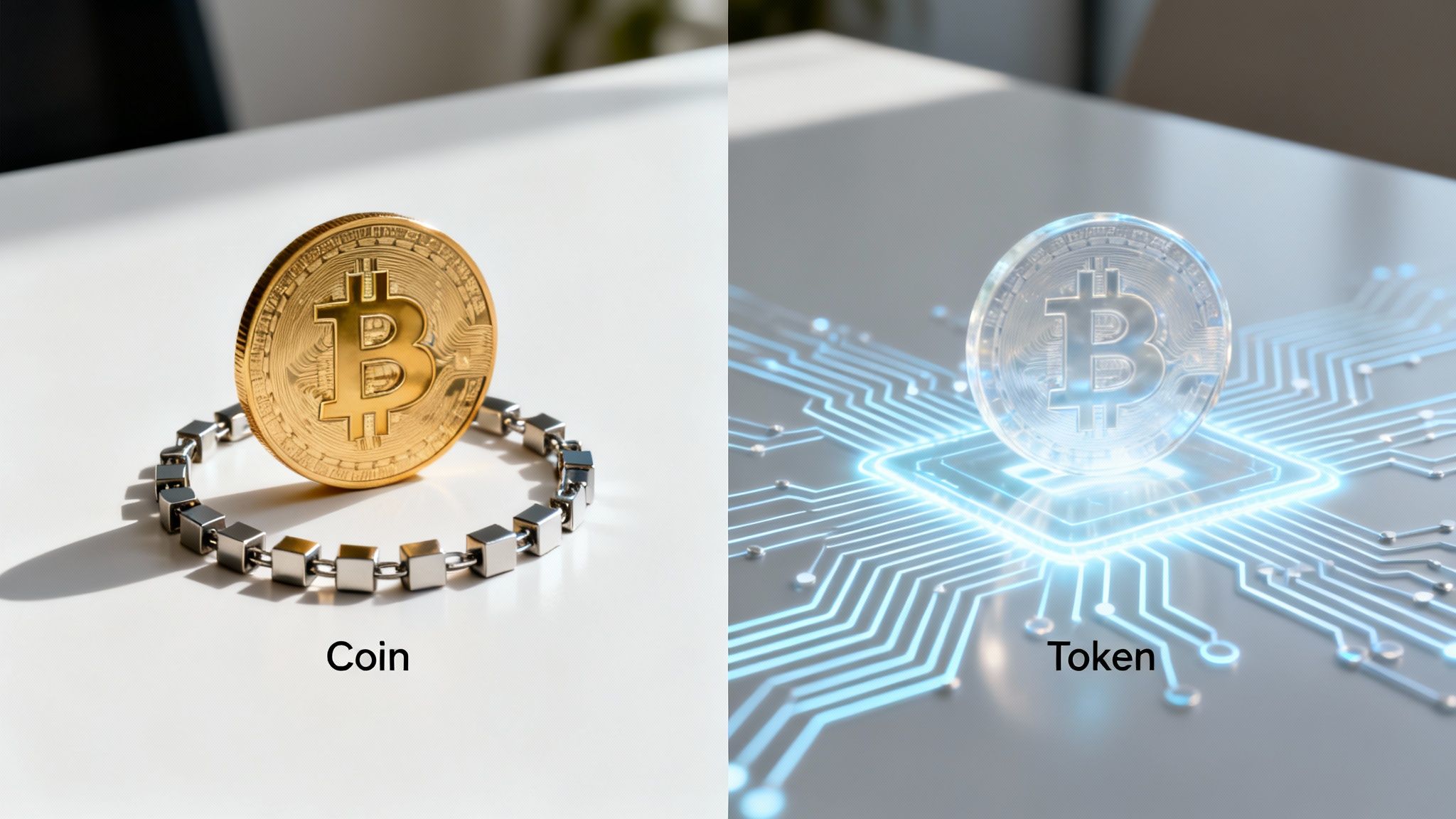
Defining the Two Digital Asset Types
A coin is the native currency of its own blockchain. Bitcoin is the classic example; it runs on the Bitcoin blockchain, a self-contained and sovereign ledger. Every single Bitcoin transaction is recorded and secured on this dedicated network. Because of this, a coin's primary job is often to act like digital money—a store of value and a means of exchange.
A token, conversely, piggybacks on another blockchain. It's created and managed by a smart contract on a pre-existing network. This makes tokens entirely dependent on their host blockchain for everything: security, transaction processing, and validation. Their purpose is usually more specialized, representing anything from a utility function in an app to a piece of digital art or a membership pass.
The simplest way to frame it is that coins build their own roads, while tokens rent space on existing highways. For a merchant, this means a coin like Bitcoin offers a direct, peer-to-peer payment rail, while a token payment travels through an intermediary system.
This distinction has become incredibly important for merchants to understand. The market has shifted dramatically as tokens gained traction, with Bitcoin's market dominance falling from nearly 90% in December 2016 to less than 43% by January 2022. You can learn more about this evolution from Morningstar's analysis of the crypto market.
Coin vs Token Key Distinctions for Merchants
To give you a quick, at-a-glance reference, this table breaks down the core differences from a merchant's perspective. It highlights how the underlying technology shapes their function and what that means for your business.
| Attribute | Coin (e.g., Bitcoin) | Token (Built on another blockchain) |
|---|---|---|
| Underlying Technology | Operates on its own native, independent blockchain. | Built and managed by a smart contract on a host blockchain. |
| Primary Function | Acts as a store of value and medium of exchange (digital money). | Represents a specific utility, asset, or access right. |
| Network Reliance | Self-sufficient; maintains its own network security and rules. | Dependent on the host blockchain for security and transaction processing. |
| Transaction Method | Direct, peer-to-peer value transfer on its native network. | Interacts with a smart contract, which processes the transaction. |
Ultimately, whether you accept a coin or a token, you're tapping into different technological ecosystems. Coins offer a direct payment experience native to their own network, while tokens rely on the infrastructure and rules of a parent blockchain, which can introduce both opportunities and dependencies.
How a Coin's Technology Creates a Self-Sustaining Network
To really get the difference between a coin and a token, you have to look under the hood of something like Bitcoin. It’s not just a digital asset; it’s the native currency of its own dedicated, self-sustaining blockchain. This independence is what gives a coin its foundational strength and sets it apart.
For a merchant, this isn't just some technical jargon. It’s the core reason why accepting a coin gives you a direct and secure payment system. Bitcoin doesn't need another platform to exist; its value and transactions are baked into a standalone economic system.

The Role of Miners in a Decentralized Network
Bitcoin's blockchain is essentially a global public ledger, but it’s maintained by a huge network of participants called miners. These aren't people with pickaxes; they're powerful computers across the globe competing to solve complex math problems. When one solves the puzzle, it gets to add the next "block" of transactions to the chain.
This process, known as Proof-of-Work, does two critical things for the network:
- Transaction Validation: Miners verify every transaction, making sure no one spends bitcoin they don’t actually have. This is what stops fraud and double-spending in its tracks.
- Network Security: The sheer combined computing power of all miners locks down the network. To change a past transaction, a bad actor would need to overpower more than half of the entire global network—a task so expensive it's practically impossible.
This decentralized system means no single company, government, or person can control the Bitcoin network, block your transactions, or freeze your funds. It’s a truly open financial rail.
Why Native Value Matters for Merchants
The fact that Bitcoin is the native asset of its own blockchain is a huge deal for businesses. Unlike tokens, which are built on a host network and are subject to that network’s rules and congestion, Bitcoin transactions are a direct transfer of value on its own dedicated plumbing.
The key takeaway for merchants is that a coin represents direct, native value on a secure, standalone ledger. This offers unparalleled security and control over your funds because there’s no intermediary platform adding complexity or risk.
This self-sustaining structure means the coin's value is directly tied to the security and health of its own network. It’s a closed-loop system where the asset itself is used to pay the miners who secure the very network it runs on, creating a powerful economic incentive that has kept Bitcoin running securely for over a decade.
Contrasting Coins with Dependent Tokens
Now, let's look at the alternative. A token doesn't have its own blockchain. It's a digital asset that piggybacks on a pre-existing network, completely dependent on that host platform for security, transaction processing, and rules. This dependency introduces layers of complexity and potential points of failure that just don't exist with a coin like Bitcoin.
This fundamental design difference is the most important thing to understand when weighing the difference between a coin and a token for your business. Accepting a coin is like taking a payment on a globally secure public utility. Accepting a token is more like using a private app that runs on that utility—its performance is always secondary to the underlying network it relies on.
Practical Implications for Merchant Payment Systems
When you get past the technical jargon, the coin vs. token debate boils down to two very different experiences for your business. For merchants, this isn't just theory; it directly hits your bottom line, influencing how you get paid, what you pay in fees, and how smooth the whole process is.
Accepting a coin like Bitcoin means a direct, wallet-to-wallet transfer on its own network. It’s a clean, straightforward process that cuts out the middlemen. When a customer pays you in Bitcoin, the transaction is settled directly into the wallet you control.
On the other hand, accepting a token adds extra layers of complexity. Since tokens live on other blockchains, their transactions aren’t simple value transfers—they’re instructions sent to a smart contract. That means the payment has to be processed by the token's specific contract, which then runs on the host network.
Transaction Flow and Intermediaries
The real difference in the payment flow comes down to directness versus dependency. A Bitcoin payment is a true peer-to-peer exchange on its own financial rails. Think of it like a customer handing you cash—the money moves from their hand to yours without a third party managing the process.
A token transaction is never quite that direct. It’s really just a message sent to a program (the smart contract) that runs on somebody else’s infrastructure. The host network is an unavoidable intermediary, and your payment's success hinges on that network’s performance and congestion levels.
- Bitcoin (Coin): The path is simple: Customer's Wallet → Bitcoin Network → Your Wallet.
- Token: The path is more involved: Customer's Wallet → Host Network → Token's Smart Contract → Your Wallet.
That extra step for tokens introduces potential points of failure that just don't exist with a native coin transaction. If the host network is clogged or the smart contract has a bug, your payment could get stuck or even fail completely.
Settlement Speed and Finality
For any business, knowing when a payment is truly yours is everything. Settlement finality is the point where a transaction can't be reversed and the funds are officially in your account. This is another area where the coin versus token distinction really matters.
With Bitcoin, finality is solid once a transaction is confirmed in a few blocks. After that, it's practically impossible to reverse, giving you strong assurance that the payment is secure. This process typically takes around 10 minutes for a high degree of certainty.
Token settlement, however, is entirely at the mercy of its host blockchain. Some networks might boast faster block times, but their finality guarantees can be weaker or less reliable than Bitcoin's. Worse, network congestion can slow down confirmation times for token transactions to a crawl, making settlement totally unpredictable. A merchant might see a payment appear instantly but have to wait an agonizingly long time for it to be considered final.
A coin transaction is a peer-to-peer settlement on its own rails. A token transaction is a program running on someone else's, directly impacting the cost, reliability, and finality of every payment your business receives.
Predictability of Transaction Fees
Fees are a huge operational headache for merchants. With Bitcoin, the transaction fee is determined by simple supply and demand for block space on its network. Fees can fluctuate, sure, but they’re transparent and tied only to the job of processing Bitcoin transactions.
Token transactions often come with more complicated fee structures. A customer pays a fee to the host network, but they might also be interacting with smart contracts that have their own internal fees. The fees on the host network can be incredibly volatile and are affected by all activity on that blockchain—not just your specific token.
This means the cost to process a token payment can spike out of nowhere because of something completely unrelated, like a popular new app launching on the same network. That lack of predictability makes it tough to manage costs and can create a terrible checkout experience where transaction fees are suddenly higher than the purchase price. Accepting a native coin like Bitcoin gives you a much more isolated and predictable fee environment.
Security and Custody Considerations for Your Business
For any business owner, the safety of your funds isn't just important—it's everything. When you're looking at coins versus tokens, the differences in security and custody are where the rubber really meets the road. How an asset is secured and who truly controls it will directly impact your company's risk.
A coin like Bitcoin gets its security from its own blockchain. This network is hardened by an absolutely massive amount of computing power, known as the hash rate, which is contributed by thousands of miners across the globe. This creates an incredibly powerful and decentralized security net that is notoriously difficult to attack.
Tokens, on the other hand, don't have any security of their own. They essentially "rent" their safety from the host blockchain they're built on. If that host network gets attacked, becomes clogged, or has a major bug, every single token on it is immediately in jeopardy.

Network Security: Bitcoin vs. Dependent Tokens
Bitcoin's security is baked right into its economic DNA. Miners are rewarded with new bitcoin for validating transactions and securing the network. The more miners who join, the higher the hash rate climbs, and the more secure the whole system becomes. It’s a self-reinforcing loop that has kept the Bitcoin ledger safe for over a decade, making it the most battle-tested decentralized network out there.
A token's security model is a lot more tangled and introduces extra layers of dependency. Its transactions are handled by the host blockchain, which means your business is fundamentally trusting a third-party system you have zero control over. A security breach on the host network could wipe out your token assets, even if the token's own code is flawless.
For a merchant, this is the core security distinction: Bitcoin's security is an intrinsic property of the asset itself. A token's security is a rented service, subject to the vulnerabilities and rules of an external platform.
This dependency creates a much larger surface for potential attacks. Instead of just worrying about one network, you now have to think about the host blockchain, the smart contract that runs the token, and any other platforms you need to use just to manage it.
The Power of True Self-Custody
Custody is all about how you hold and control your digital assets. This is where the operational difference between a coin and a token becomes crystal clear for a business owner.
With a coin like Bitcoin, you can achieve true self-custody. This means you hold the private keys to your funds in your own dedicated wallet. By controlling your keys, you have complete and final authority over your money. No bank, company, or third party can freeze your funds, seize them, or block your access. This is the financial sovereignty that makes Bitcoin so powerful for commerce.
For merchants, this translates directly to:
- Full Control: You are the sole owner of your revenue. No questions asked.
- Reduced Counterparty Risk: You aren't trusting some other company to hold your funds for you.
- Censorship Resistance: Your ability to do business can't be shut down by an intermediary.
Token Custody: A More Complicated Path
Holding tokens can be a lot more complex. Because tokens are run by smart contracts, you often need specific kinds of wallets that know how to interact with these programs. This can introduce new technical hurdles and potential security holes if you're not careful.
More often than not, managing tokens forces businesses to rely on third-party platforms or exchanges for custody. While that might sound convenient, it brings back the very same intermediaries that Bitcoin was designed to get rid of. When you hand over custody to another entity, you no longer truly own your assets; you're just trusting that platform to keep them safe and give them back when you ask. This reliance on others creates a single point of failure and exposes your business to risks like exchange hacks, platform insolvency, or sudden changes in their terms of service.
Choosing the Right Digital Asset for Your Business
After breaking down the technical differences, the big question for your business is simple: which digital asset actually solves your problems? The answer really depends on what you’re trying to achieve, but for most merchants, the goal is a payment system that's straightforward, secure, and reliable. When you look at it that way, the choice becomes pretty clear.
For any business focused on commerce, accepting a foundational coin like Bitcoin is almost always the smarter strategic move. It was designed from the ground up to be a decentralized, secure, and censorship-resistant way to send value. That lines up perfectly with what every merchant wants: to get paid directly and reliably, without a third party getting in the way.
Why Bitcoin Is Built for Commerce
Bitcoin was literally created to be a peer-to-peer electronic cash system. Its entire architecture, from its own independent blockchain to its predictable supply, is optimized for transferring value. This makes it a natural fit for businesses that care about financial independence, lower transaction costs, and connecting directly with a global customer base.
When you accept Bitcoin, you're plugging into a financial network built specifically for that purpose. You aren't dealing with an asset whose main job is to unlock a software feature or represent a vote in some niche project. You're using a digital asset designed to be money.
Here's the most compelling argument for any merchant: a coin like Bitcoin serves the universal purpose of exchange. A token, on the other hand, almost always serves a specialized function that has little to do with your day-to-day business.
This universal utility is what gives Bitcoin its deep liquidity and global recognition. It's known and valued around the world precisely because its purpose is clear and consistent. For a business, that means a bigger potential market and a much more stable foundation for your payment setup.
The Niche Role of Tokens in Payments
This doesn't mean tokens are useless; they just solve different, more specific problems. A token might be used to get access to a software service, vote on a project's roadmap, or prove ownership of a digital item. Those are powerful functions inside their own ecosystems, but they rarely match the general needs of everyday commerce.
Accepting a token for a product can add a layer of complexity you just don't need. Your business suddenly becomes dependent on the health of that token's specific project and its host blockchain. You'd also be accepting a payment whose value is tied to factors completely outside your control or your customer's purchase.
Think about it this way:
- Utility Tokens: These are like digital keys to a specific platform. Accepting them as payment is like a coffee shop accepting arcade tokens—sure, they have value, but only in a very narrow context.
- Governance Tokens: These give you voting rights in a decentralized organization. Their value is tied to influencing a project, not buying a T-shirt.
- Asset-Backed Tokens: While interesting, these bring back custodial risks and reliance on the company backing the asset, re-creating the exact centralization that Bitcoin was designed to get rid of.
The fundamental difference between a coin and a token in a business setting comes down to focus. Bitcoin is focused on payment. Tokens are focused on function.
A Clear Recommendation for Merchants
For businesses ready to step into digital payments, the most durable, future-proof strategy is to start with a foundational coin. By choosing Bitcoin, you’re adopting a payment system that is:
- Globally Recognized: Understood and used by millions of people worldwide.
- Operationally Simple: Involves direct wallet-to-wallet transfers without navigating complex smart contract logic.
- Economically Sovereign: Puts you in total control of your money with true self-custody.
While the world of tokens is vast and full of innovation, they are ultimately solutions to different problems. For the core business challenge of getting paid securely and efficiently, Bitcoin remains the purpose-built tool for the job. It offers a straightforward, reliable, and globally interoperable payment system that empowers merchants instead of weighing them down with unnecessary dependencies.
Alright, let's break down what this coin vs. token distinction means for your business and how Flash fits into the picture.
Knowing the difference is one thing, but applying it is what really counts. You're trying to get paid, not get a degree in computer science. The world of digital payments can feel complicated, but at the end of the day, you just need a simple, reliable way to accept money. We built Flash specifically to cut through the noise and make accepting Bitcoin—the original and most secure digital coin—dead simple for any business.
Flash is built to leverage Bitcoin's greatest strengths for everyday commerce. We enable direct, wallet-to-wallet payments, giving your business the full benefit of the Bitcoin network's security and decentralized nature. There are no middlemen holding your funds hostage. From the moment a customer pays, you're in complete control.
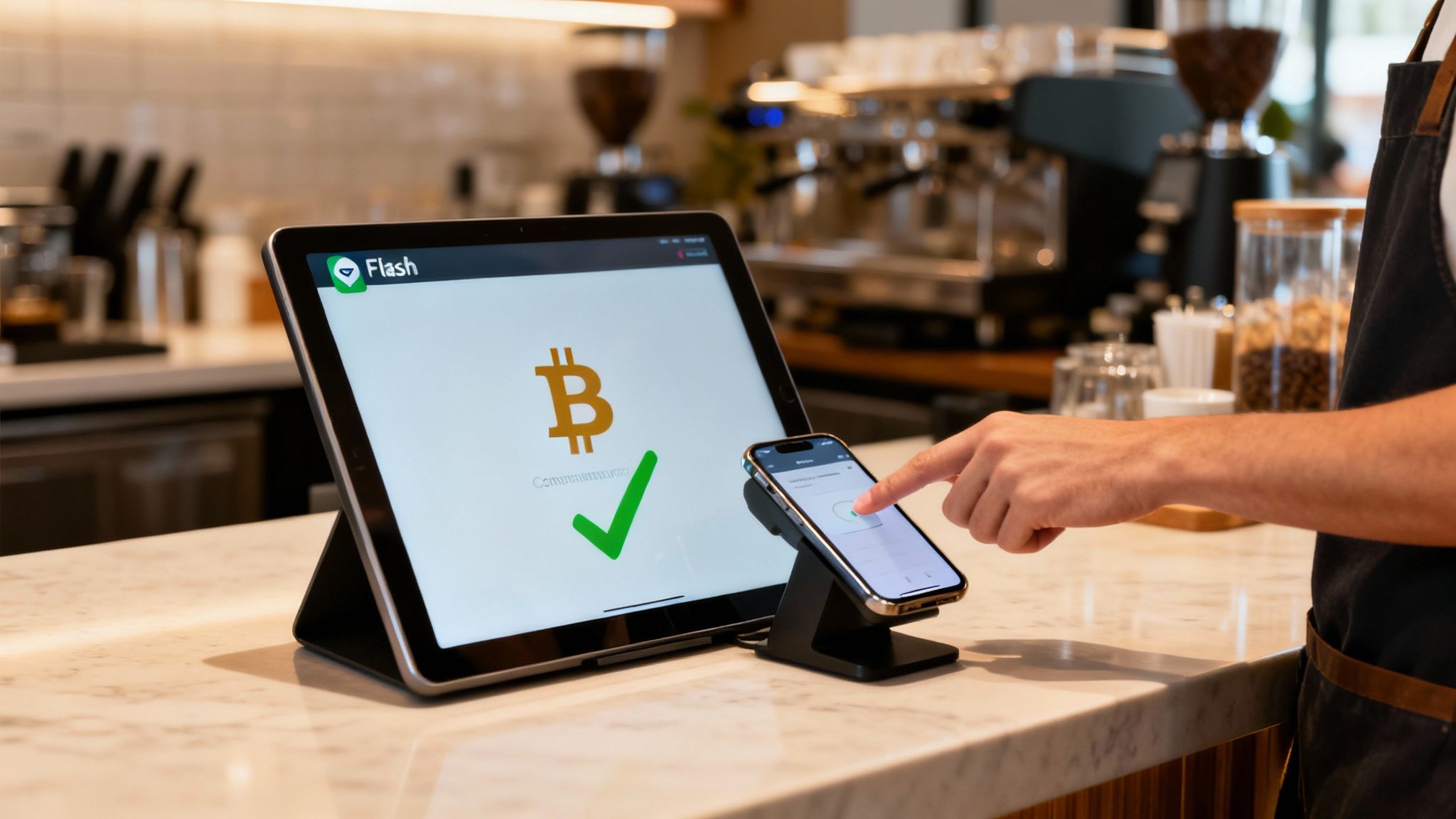
Unlocking Direct Bitcoin Commerce
A lot of crypto payment processors just add more layers and complexity. We do the opposite. Flash strips all that away, connecting your Bitcoin wallet directly to your customer's. We never touch your funds. It's a truly non-custodial solution that gives you genuine financial sovereignty—one of the core promises of using a coin like Bitcoin.
You hold your keys, you control your money. Period.
To make this direct model work in the real world, we've developed a suite of practical tools for merchants.
- Point-of-Sale App: Our simple app can turn any phone or tablet into a Bitcoin-ready terminal. It's perfect for brick-and-mortar shops that want to accept crypto payments as easily as they take credit cards.
- Customizable Payment Links: Selling online? You can create and share a payment link in seconds. Send it over email, in a text, or through social media for a seamless checkout experience that works for customers anywhere.
- No KYC Requirements: We believe in Bitcoin's privacy-first ethos. Our no-KYC (Know Your Customer) policy means you can get set up and start accepting payments in under a minute. No invasive paperwork, no lengthy approval process.
Think of Flash less like a bank and more like a piece of software that connects you straight to the Bitcoin network. It gives you the power to accept a true digital coin without needing to become a blockchain expert yourself.
Built for Business, Powered by Bitcoin
Our philosophy is simple: make the superior technology of a coin accessible to everyone. By focusing only on Bitcoin, we sidestep all the complexities and dependencies that come with tokens and the platforms they run on. This laser focus means your business gets a payment system built on the most secure, battle-tested decentralized network in existence.
Ultimately, choosing between a coin or a token comes down to what you prioritize. If you want a simple, secure, and globally recognized payment system that puts you firmly in control, a coin is the obvious answer. Flash just provides the tools to make that choice a practical reality for your business, bridging the gap between Bitcoin’s powerful tech and your day-to-day needs.
Frequently Asked Questions
You've probably heard the terms 'coin' and 'token' thrown around, and it's easy to think they're the same thing. But for a business, understanding the difference is critical—it hits your security, your fees, and your operational freedom.
Coins like Bitcoin are the native currency of their own self-contained, secure payment network. Tokens, on the other hand, are assets built on someone else's platform, which can introduce a lot of complexity and unpredictable costs. This one distinction shapes your entire digital payment strategy, so getting it right is the first step to using digital assets safely and effectively.
Why Should I Care About the Difference?
It all comes down to control. When you accept a coin like Bitcoin, you're using its own dedicated blockchain. Your transactions are processed on a purpose-built, incredibly secure network. You gain total sovereignty over your funds without having to trust an intermediary platform.
Tokens are a different story. They're built on host blockchains. This means you're completely dependent on that host network for security, transaction speed, and fees. If that host platform gets congested, has a security flaw, or sees its fees skyrocket, it directly impacts your ability to get paid. That's a huge risk that's completely out of your hands.
Is It Harder to Accept Bitcoin?
Not at all. With modern payment tools, accepting Bitcoin is often simpler than dealing with many tokens. The process is a direct wallet-to-wallet transfer, and the fee structure is predictable, based only on the Bitcoin network's current activity. You don't have to get tangled up in the complexities of smart contracts or variable fees from an unrelated host network.
With a solution like Flash, the whole process is designed to be as easy as any traditional payment. The system handles the technical stuff behind the scenes, letting you accept a global currency without needing a degree in blockchain technology.
Can I Convert Bitcoin to My Local Currency?
Absolutely. Converting Bitcoin payments into your local fiat currency is a well-established and straightforward process. The Bitcoin ecosystem is mature, with plenty of reputable exchanges and third-party services that specialize in providing this kind of liquidity for merchants.
This gives you total flexibility. You can choose to hold Bitcoin as an asset on your balance sheet or immediately convert it to cash. You're in full control of how you manage your revenue, letting you pick the strategy that best fits your business's financial goals and risk tolerance.
Ready to accept the world's most secure digital coin? With Flash, you can start accepting direct, wallet-to-wallet Bitcoin payments in under a minute. Get started with Flash today and connect your business to a global payment network.