The fundamental difference between a coin and a token boils down to their relationship with a blockchain. In simple terms, a coin is the native currency of its very own, independent blockchain. Think of Bitcoin. It lives and breathes on the Bitcoin network.
A token, on the other hand, is built on top of a pre-existing blockchain. It essentially "rents" the security and infrastructure from a host network.
The Core Distinction: Native vs. Built-On-Top
Every coin has its own dedicated blockchain, but a token does not. This is the single most important concept to grasp.
Let’s use an analogy. Think of a blockchain as a country. The coin is that country’s official currency—like the U.S. Dollar or the Japanese Yen—essential for its economy to function. A token is more like a concert ticket, a loyalty point, or a stock certificate issued by a company within that country. It has a specific purpose but relies entirely on the country's established systems (roads, laws, banks) to exist and be exchanged.
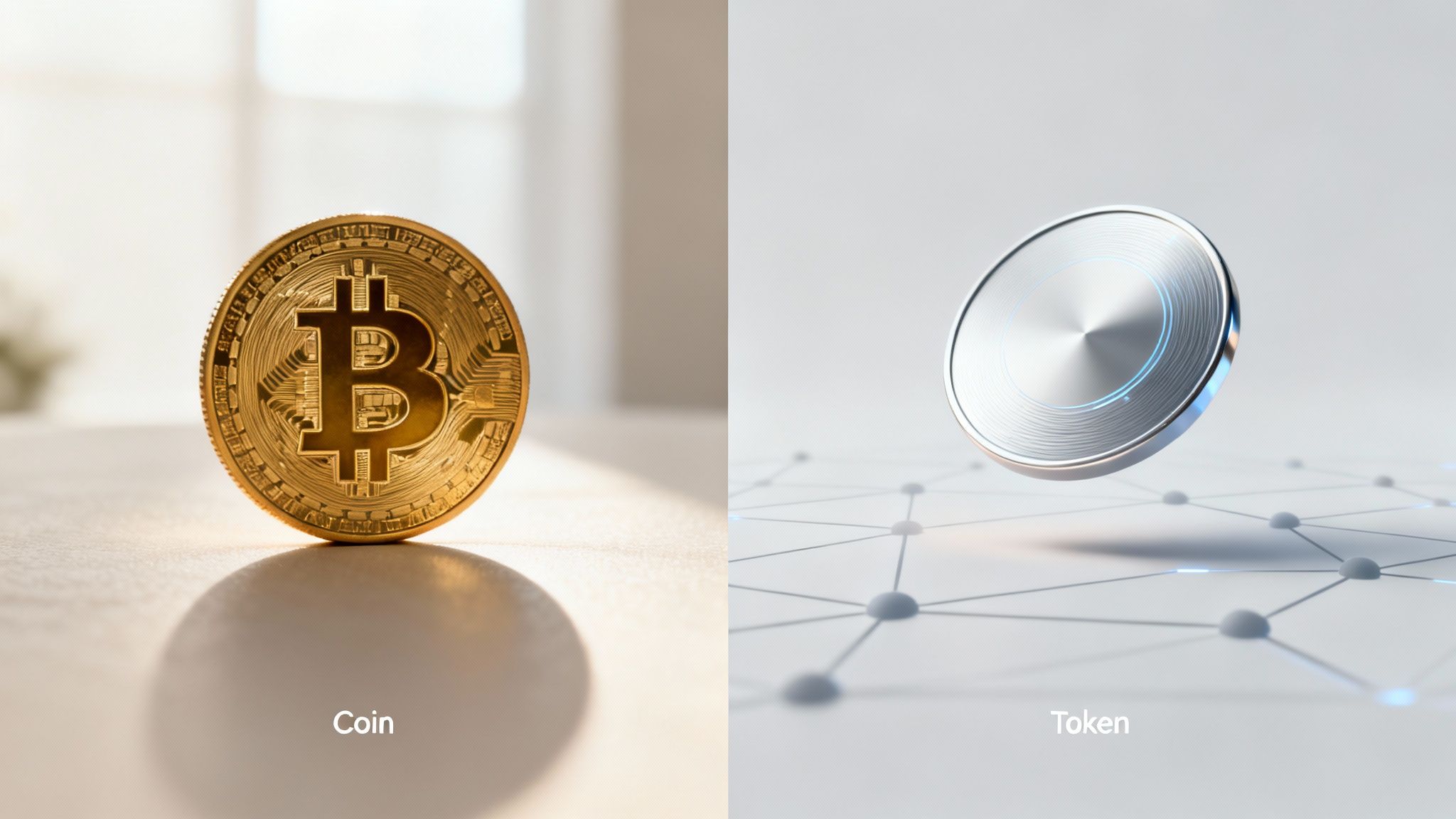
This structural difference has huge implications for how they are created, secured, and used. Coins are the fuel that powers a network. Tokens represent a specific asset or grant access to a service running on that network.
How a Blockchain Changes Everything
A coin is absolutely integral to its blockchain’s survival. Take Bitcoin again: the coin (BTC) is used to reward the miners who validate transactions and secure the entire network. Without the coin, there's no incentive for miners, and the blockchain itself grinds to a halt.
Tokens have it easier. They leverage the security and consensus mechanism of their host blockchain. This allows developers to focus on building their specific application without the monumental task of creating and securing a brand-new global network from scratch.
It helps to think of a coin as the foundational infrastructure, like the national power grid. A token is an appliance you plug into that grid to do something specific, like toast your bread or power your TV.
Coin vs Token at a Glance
To make this crystal clear, let's break down the key differences side-by-side. This table gives you a quick snapshot of how a native coin like Bitcoin stacks up against a token built on another platform.
| Characteristic | Coin (e.g., Bitcoin) | Token |
|---|---|---|
| Blockchain | Operates on its own native, independent blockchain. | Built on top of an existing blockchain. |
| Primary Function | Acts as a medium of exchange and a store of value. | Represents a specific utility or asset (e.g., access, ownership). |
| Creation | Typically created through a process like mining. | Issued through a smart contract on a host network. |
| Infrastructure | Is the fundamental asset that secures its own network. | Relies on the host blockchain for security and validation. |
As you can see, while both are digital assets, their purpose and technical foundation are worlds apart. One builds the road, and the other drives a car on it.
Why Coins Are the Bedrock of Digital Value
To really get the difference between a coin and a token, you have to start with the foundation: the coin itself. A coin is the native asset of its own blockchain—it's completely inseparable from the network it powers. Bitcoin (BTC) is the purest example of this; it doesn't just run on the Bitcoin blockchain, it is the Bitcoin blockchain's lifeblood.
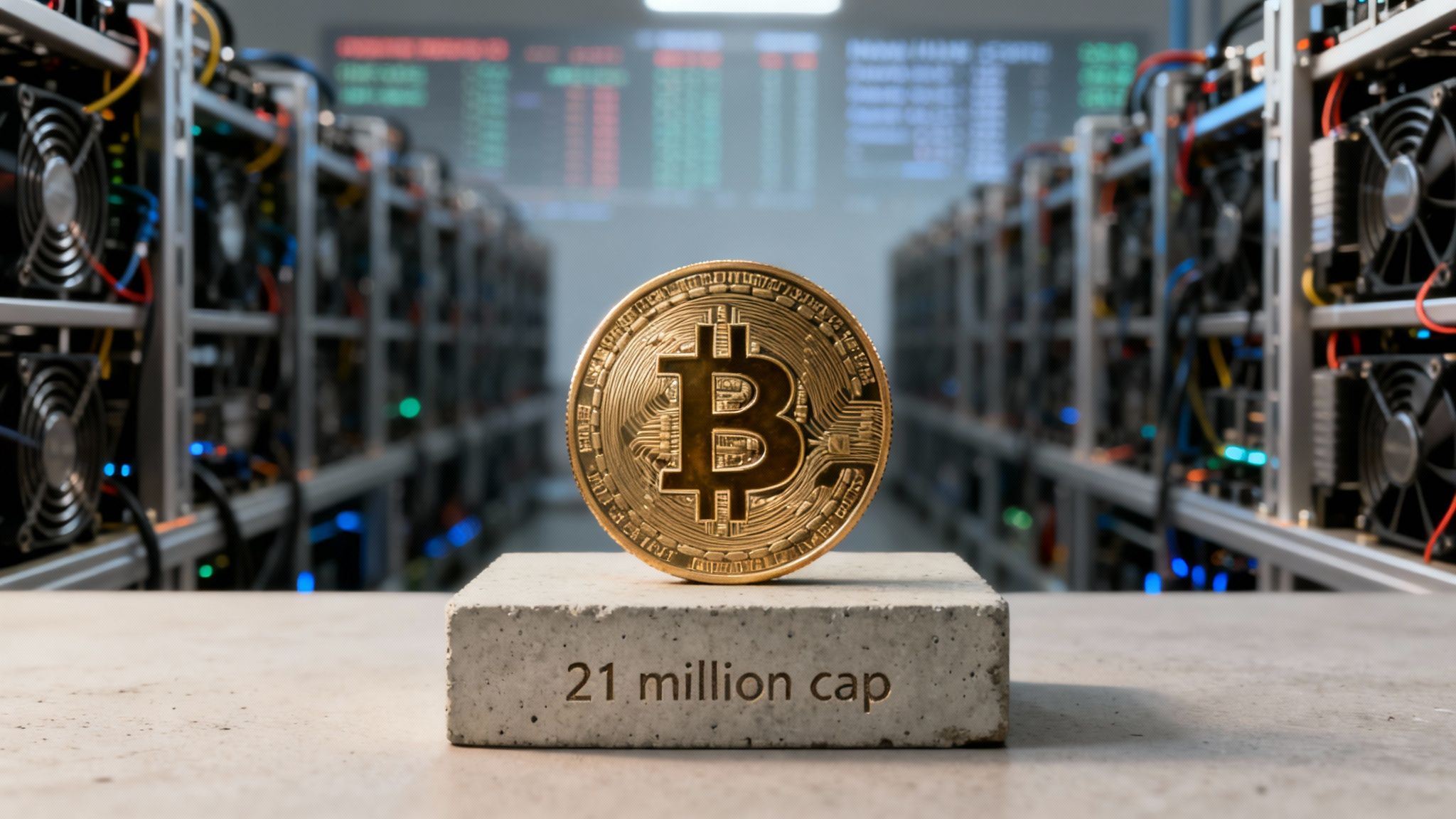
This unbreakable link gives a coin three core functions that should sound familiar—they mirror traditional money. It acts as a store of value, a medium of exchange, and a unit of account. For any business, this means a coin is engineered from the ground up to be digital money. It isn't an access pass or a stand-in for another asset; its value is baked directly into the network itself.
The Security of Scarcity and Work
A coin’s value is directly tied to the security and integrity of its network. This is where the process of mining comes in. In a proof-of-work system like Bitcoin's, miners pour massive amounts of computational power and real-world energy into solving incredibly complex mathematical problems.
When they succeed, they validate a new block of transactions and get rewarded with newly created coins. This process accomplishes two critical things:
- Controlled Issuance: It's the only way new bitcoins are ever created, and it follows a predictable, unchangeable schedule.
- Network Security: The sheer cost and effort involved make it ridiculously expensive for a bad actor to attack the network. All that accumulated work secures every single transaction in the chain.
The immense energy and computational power behind Bitcoin aren't a flaw; they are a feature. This "work" is what gives the network its robustness and makes the coin a reliable foundational asset for merchants.
This deliberate, resource-heavy process also enforces one of Bitcoin’s most powerful features: digital scarcity. Unlike government currencies that can be printed into oblivion, Bitcoin has a hard-coded supply cap of 21 million coins. That finite supply is absolutely fundamental to its value proposition.
You can see the maturity of this model playing out today. Coins like Bitcoin maintain their scarcity, backed by massive real-world energy investment that bolsters their security. This makes BTC a top choice for serious buyers and institutional players.
Just look at the rise of US spot Bitcoin ETFs, which now hold 1.36 million BTC (that's 6.9% of the entire supply) with $168 billion in assets under management. This is a level of institutional trust that tokens rarely achieve, precisely because they don't have their own sovereign chains. You can learn more about the state of crypto from the 2025 report by a16z crypto.
For merchants, this deep connection between energy, scarcity, and security is what makes a coin the bedrock of digital value.
How Tokens Function as Assets on Existing Blockchains
If a coin like Bitcoin is a pioneer building its own railroad from the ground up, a token is the high-speed train running on those pre-existing tracks. Tokens are digital assets that don't need to create their own blockchain; instead, they are built on top of an existing one.
This is the fundamental difference between a coin and a token. A token "borrows" the security, decentralization, and consensus rules from its host chain. An Ethereum-based token, for instance, is secured by that network’s validators. This arrangement lets developers skip the monumental task of building a global network and focus entirely on what their token actually does.
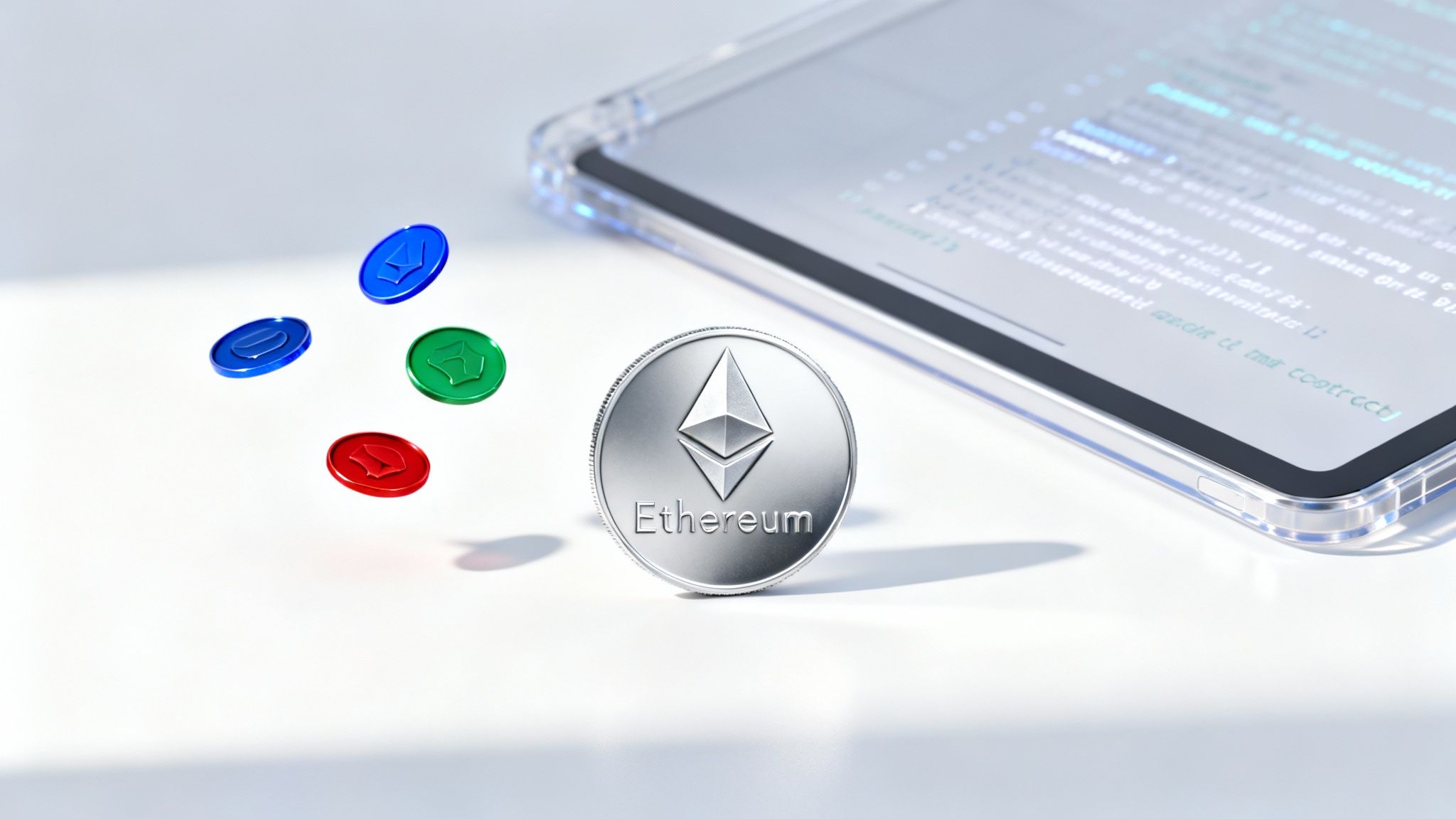
This distinction is precisely why we've seen an explosion of tokens in the market. Launching a token is as straightforward as deploying a smart contract—a self-executing piece of code—on a host blockchain. It’s exponentially simpler than launching an entirely new coin with its own blockchain.
The Diverse Roles of Tokens
The real magic of tokens is their programmability. They can be designed to represent practically anything, leading to a few distinct categories that are useful for any merchant to understand.
- Utility Tokens: Think of these as digital access passes or in-game credits. They grant the holder the right to use a specific product or service within a defined ecosystem. Their value comes from their usefulness inside that environment.
- Security Tokens: These are the digital equivalents of traditional financial assets. A security token can represent a share in a company, ownership of real estate, or a stake in an investment fund. Because they function as investment contracts, they fall under strict securities regulations.
- Governance Tokens: These give holders a voice. They function like voting shares in a decentralized project, allowing token holders to influence key decisions like protocol upgrades or changes to fee structures.
Tokens are essentially digital contracts that define rules, ownership, and access, all while piggybacking on the robust security of an established blockchain. Their value comes from the utility or asset they represent, not from securing a network.
This flexibility is what enables unique assets like Non-Fungible Tokens (NFTs), which are distinct, one-of-a-kind digital items. For a deep dive into how you could leverage these unique tokens, check out this ultimate guide to creating an NFT store on Shopify.
A Look Under the Hood: Technical and Operational Differences
The core distinction between a coin and a token—one being native to its own blockchain, the other piggybacking on someone else's—creates a cascade of technical and operational differences. For any business thinking about accepting digital assets, these aren't just minor details; they define everything from security to day-to-day management.
Let's break down exactly what sets them apart in practice.
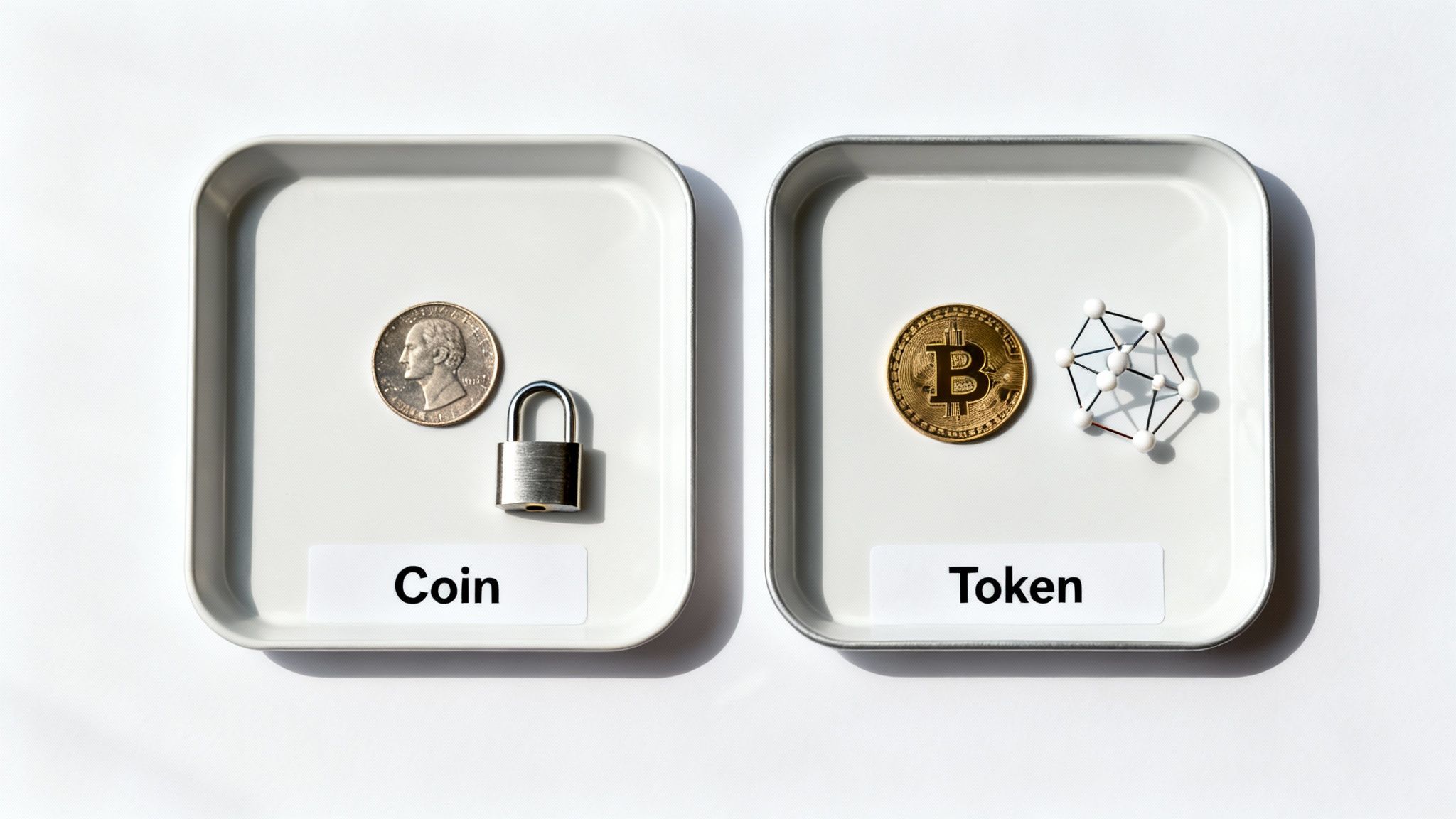
These distinctions aren't just for developers. They have real-world consequences for how you handle, secure, and use each type of asset.
Creation and Security
A coin's security is entirely self-sufficient. Take Bitcoin. Its security comes from the immense computational power of miners engaged in proof-of-work. This "work" is what validates every transaction, making the network extraordinarily difficult to attack. The coin itself is the reward that incentivizes miners to keep the network secure.
Tokens, on the other hand, don't secure themselves. They are created via a smart contract and simply inherit the security of their host blockchain. A token's safety is completely dependent on the strength and reliability of the network it's built on.
A coin is like a fortress that builds and defends its own walls. A token is a resident living inside that fortress, protected by walls someone else built and maintains.
Use Case and Functionality
Functionality is where coins and tokens really show their different stripes. A coin like Bitcoin has a singular, incredibly powerful purpose: to be a form of money. Its entire design—from the ground up—is optimized to serve as a medium of exchange, a store of value, and a unit of account.
Tokens are specialists. They aren't trying to be universal money. Instead, they serve specific functions inside a particular ecosystem or application.
- Coins (like Bitcoin): Built for broad economic activity. They act as the foundational layer for financial transactions and value storage. Their function is general-purpose and monetary.
- Tokens: Designed for specific, programmable actions. This could be anything from granting access to a service, representing ownership of a real-world asset, or giving you voting rights in a project.
This means Bitcoin's value is tied directly to its network's security and its adoption as money. A token's value is derived from the demand for the specific utility or asset it represents.
Wallet and Custody Management
Finally, how you store these assets reflects their deep technical divide. To manage a coin, you need a dedicated wallet that's compatible with its specific, native blockchain. If you want to hold and transact with Bitcoin, you need a Bitcoin wallet. Simple as that.
Tokens require a wallet that's compatible with their host blockchain. For instance, tokens created on a certain platform can be stored in any compatible wallet. You don't need a separate wallet for every single token; you just need one that speaks the language of the parent network.
For merchants, this creates a huge operational difference. Accepting Bitcoin means managing a single, well-established infrastructure. Accepting a variety of tokens could mean juggling assets across multiple blockchains, each with its own wallet requirements and fee structures—a recipe for complexity. This is a key reason why so many businesses start their journey by accepting only Bitcoin.
Technical Breakdown Coin vs Token
To make these differences crystal clear, here’s a side-by-side comparison of the technical and operational aspects of a native coin versus a token.
| Aspect | Coin (Bitcoin) | Token (Built on another blockchain) |
|---|---|---|
| Underlying Tech | Native asset of its own unique blockchain. | Built on top of an existing blockchain using smart contracts. |
| Security Model | Secures itself via its own consensus mechanism (e.g., Proof-of-Work). | Inherits security from the host blockchain. Its safety is only as strong as the parent network. |
| Primary Function | Acts as money: a store of value and medium of exchange. | Represents a specific utility, asset, or right within an application (e.g., voting, access). |
| Transaction Fees | Paid in the native coin (e.g., BTC) to network miners/validators. | Paid in the host blockchain's native coin, not the token itself. |
| Wallet Support | Requires a wallet specific to its own blockchain (e.g., a Bitcoin wallet). | Requires a wallet compatible with the host blockchain. |
| Development | Changes require a major network upgrade or fork, involving consensus from the entire community. | Can be created and updated quickly by deploying or modifying a smart contract. |
This table highlights the fundamental divide: coins are the foundational infrastructure, while tokens are applications built on that infrastructure. Understanding this is the first step to making smart decisions about which assets fit your business model.
Market Behavior and Regulatory Outlook: The Real-World Divide
Knowing the technical difference between a coin and a token is just the starting point. The real story unfolds when you look at how they behave in the wild—in the open market and under the watchful eye of regulators.
Coins and tokens are two entirely different beasts when it comes to market dynamics. This isn't just a trivial distinction; it directly shapes their stability, risk profile, and whether they'll be around in the long run.
The Two Sides of the Market
Bitcoin, the original coin, still dominates the market's total value. After more than a decade of running without a hitch, it’s increasingly seen as a mature store of value. This isn't just talk—major institutional players are piling in through regulated products like spot ETFs, signaling a level of trust the token market just hasn't earned yet.
The token market, on the other hand, is a chaotic and sprawling universe of assets. Each one is tied to a specific, and often speculative, use case. While this environment breeds incredible innovation, it also creates gut-wrenching volatility. A token's value is completely dependent on the success of its project, making it feel more like a risky startup stock than a foundational currency.
For merchants, this is the critical takeaway: a coin like Bitcoin offers a relatively stable and highly liquid asset. The token world? It’s a minefield of high-risk, high-reward gambles. Accepting tokens means taking on risks tied to a project's viability, unpredictable demand, and often paper-thin liquidity.
A Widening Regulatory Gap
Regulators are slowly but surely starting to draw a hard line between Bitcoin and everything else. Bitcoin’s simple, elegant design as a decentralized digital commodity has given it a clearer path to regulatory acceptance in many parts of the world. For businesses, that clarity is gold because it reduces risk.
Tokens have a much tougher road ahead. Their functions are all over the map—some act like securities, others like utility vouchers—which throws them into a complex and uncertain regulatory gray area.
The market is already reacting to this. Adoption trends clearly favor the stability that coins provide. For example, Bitcoin's unhackable security and hard cap of 21 million coins have made it the target for two-thirds of all planned digital asset purchases in 2025. This demand is supercharged by clear US regulations and the success of ETFs, which now hold a staggering 6.9% of Bitcoin's total supply.
While the US is seeing adoption grow by 50% year-over-year, the trend is global. In regions like South Asia, adoption is also surging, though often with tokens being used for remittances in shaky economies. You can dig deeper into these trends in the 2024 cryptocurrency consumer report.
So, Which Digital Asset Should Your Business Accept?
Making the call on which digital asset to accept can feel like a high-stakes decision. But when you boil it down to what really matters for a business—security, stability, and what your customers actually use—the choice gets a lot simpler.
For almost every merchant out there, the smartest and safest first step is to accept Bitcoin. As the original coin, it brings some serious advantages to the table that tokens just can't compete with.
Bitcoin’s liquidity is in a league of its own, which means you can easily convert customer payments into your local currency without a headache. More importantly, its network is the most secure and battle-tested system in the space, with over a decade of non-stop, reliable operation. That track record builds a ton of trust, not just for you, but for the more than 500 million people who hold Bitcoin worldwide.
Understanding the Risks of Accepting Tokens
The world of tokens is exciting and full of innovation, but for a business, it's also packed with risk. Welcoming tokens into your checkout process introduces some very real operational and financial hurdles:
- Wild Volatility: A token's value is often hitched to a single, unproven project. This makes its price far more of a rollercoaster than Bitcoin's.
- Shallow Liquidity: Many tokens don't have much trading activity. Trying to sell a large payment for cash can be difficult without tanking the price.
- Operational Headaches: Juggling tokens means dealing with a mess of different blockchains and wallets. This adds layers of complexity and more room for costly errors.
For a merchant, the difference between a coin and a token comes down to one word: risk. Bitcoin is a foundational monetary network. A token is a bet on a specific, and often unproven, application.
The Simple Path to Accepting Bitcoin
The good news? You don't need a PhD in cryptography to start accepting Bitcoin. Payment processors like Flash were built to strip away all that complexity. They act as a simple bridge, letting your customers pay straight from their Bitcoin wallets while you stay in complete control.
With a payment provider handling the technical side, you can even choose to have payments instantly converted to your local currency. This takes all the volatility risk right off your plate. You get the exact sale amount you charged, every time, and your customer gets the freedom to pay with the world's most recognized digital currency.
For any business dipping its toes into this space, a Bitcoin-only approach is, without a doubt, the safest and most effective way to start.
Common Questions Answered
When you're trying to figure out the difference between a coin and a token, a few practical questions always seem to pop up. Let's clear the air on the most common ones.
Can a Token Become a Coin?
Yes, but it's a huge undertaking and not very common. A project might start as a token on a platform and later decide to build and launch its own blockchain.
When that happens, they perform a "mainnet swap," where the old tokens are traded in for the new native coins of the network. This is a massive technical leap that few projects pull off successfully. It means building a secure, decentralized network from the ground up—no small feat.
Is Bitcoin the Only Type of Coin?
No, but it's the one that set the standard. Any digital currency running on its own independent blockchain is technically a coin.
For any business, though, Bitcoin is the most relevant coin by a long shot. Its market size, battle-tested security, and global brand recognition are unmatched. While other coins are out there, none come close to Bitcoin’s level of trust and adoption, which is why it should be the main focus for merchants.
Why Would a Business Accept Only Bitcoin?
Merchants often choose to accept only Bitcoin for three straightforward reasons: security, liquidity, and brand recognition.
- Security: Bitcoin has the longest track record and the most secure decentralized network on the planet.
- Liquidity: It has the deepest market, making it the easiest digital asset to convert into traditional currency without causing price swings.
- Recognition: It’s the one digital asset your customers around the world are most likely to already own and trust.
Focusing on Bitcoin simplifies your operations and avoids the risks that come with less-established assets.
Ready to accept the world's most secure digital currency? With Flash, you can start accepting Bitcoin payments in under a minute. Our wallet-to-wallet software gives you full control, with no intermediaries and no KYC. Join the global economy at .