The whole difference between a token and a coin boils down to one simple thing: a coin, like Bitcoin, runs on its very own, custom-built blockchain. It's the native currency for that entire network. A token, however, is built on top of an existing blockchain, acting more like a digital voucher for a specific use.
Understanding The Fundamental Difference
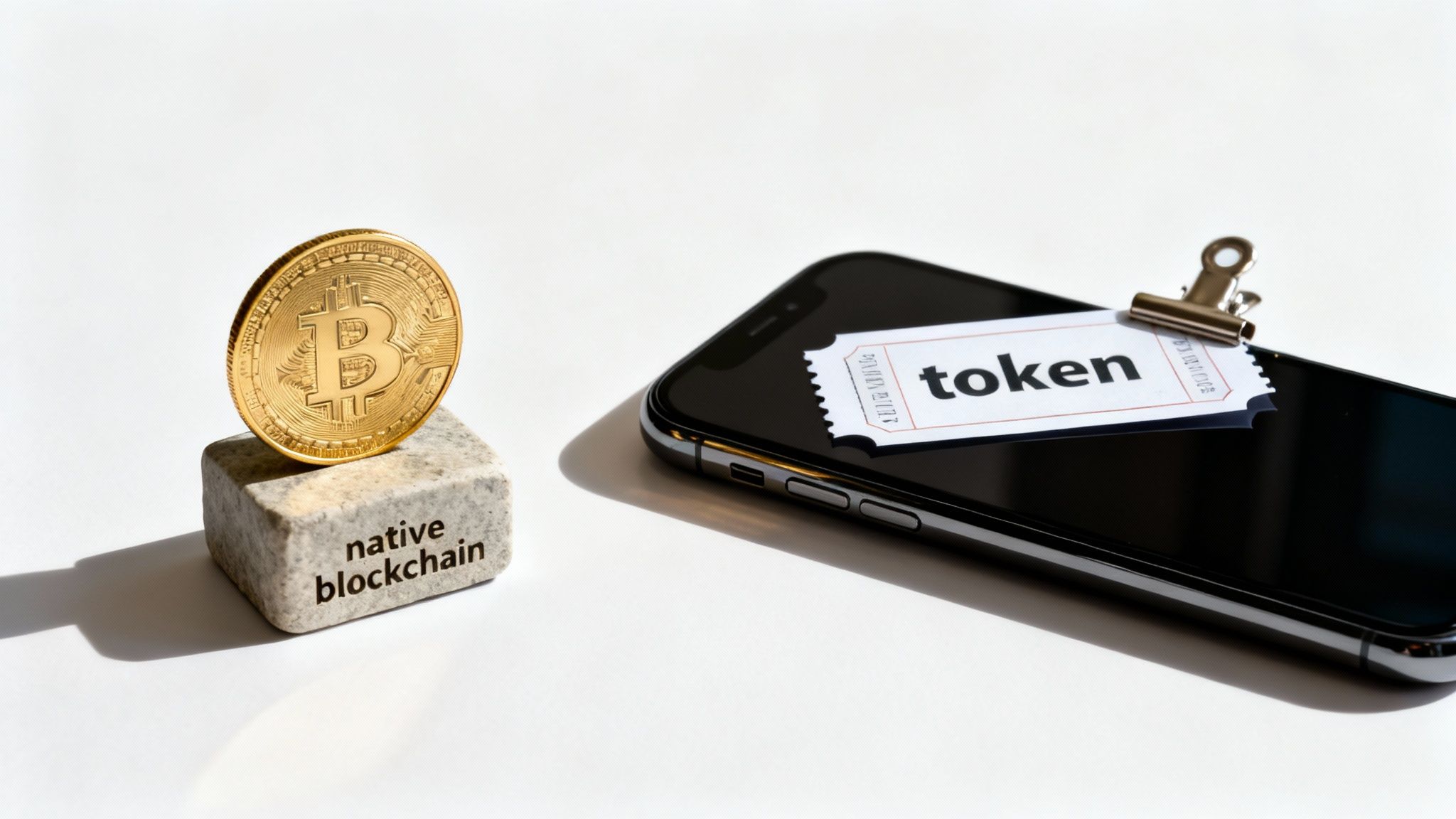
To really get this, think of a blockchain as a country's complete infrastructure—its highways, laws, and government. A coin is the national currency used everywhere inside that country, like the U.S. dollar. It’s fundamental to how everything works.
A token, on the other hand, is like a ticket to a concert or a token for an arcade game. You can't use it to buy groceries at the corner store, but it gives you access or represents value within a specific place. That concert ticket relies on the country's roads to get you to the venue, but its purpose is highly specialized. To really make sense of this, it helps to first understand the core technology by reading about What is the Blockchain?
Key Differences At a Glance
Here’s a quick overview of the essential distinctions between a native blockchain coin and a token built on an existing network.
| Attribute | Coin (e.g., Bitcoin) | Token |
|---|---|---|
| Foundation | Operates on its own native blockchain. | Built on top of a pre-existing blockchain. |
| Primary Role | Acts as a store of value or medium of exchange. | Represents a utility, asset, or right to participate. |
| Analogy | A country's native currency (e.g., USD). | A concert ticket or store gift card. |
| Independence | Fully independent and self-sustaining. | Dependent on the host blockchain's security. |
The most critical distinction is where each asset lives. While there are thousands of unique coins running their own blockchains, the number of tokens is mind-boggling—over 50 million of them, all piggybacking on those foundational networks.
If you remember one thing, make it this: Coins are self-sufficient monetary systems. Tokens are assets that need a host blockchain just to exist and function.
Exploring Bitcoin as the Original Coin
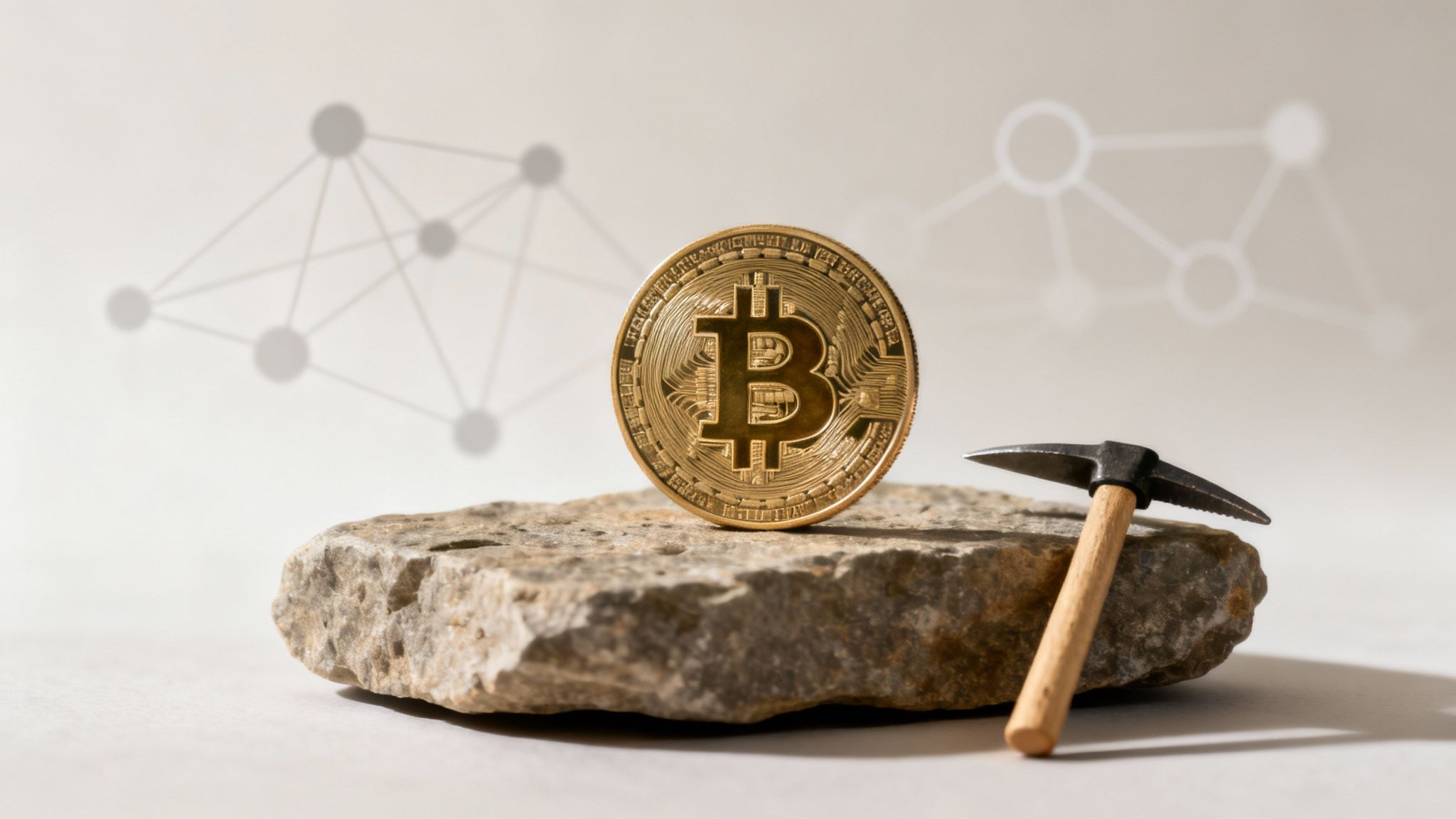
To really get the difference between a token and a coin, you have to go back to the beginning. To Bitcoin.
As the first cryptocurrency, Bitcoin (BTC) is the quintessential coin. It lives on its own independent blockchain, the Bitcoin network, which was designed from the ground up for one job and one job only: to be a peer-to-peer electronic cash system.
Bitcoin isn't an asset built on someone else’s platform; it is the platform. Its existence doesn’t rely on another network for security or to process transactions. Instead, the value and function of BTC are woven into the very fabric of its native blockchain. This creates a powerful, self-sustaining ecosystem where the coin is the fuel for every single action.
Every transaction is validated and added to the public ledger by a global, decentralized network of miners. There's no central point of failure, making the entire system incredibly resilient and independent.
The Role of Proof-of-Work
The engine keeping Bitcoin independent is its consensus mechanism, Proof-of-Work (PoW). This is the clever process that lets a worldwide network agree on the state of the ledger without needing a boss. Miners compete to solve complex math puzzles, and the winner gets to add the next block of transactions to the chain.
For all that computational heavy lifting and electricity, miners are rewarded with newly minted bitcoin. This reward is brilliant for two reasons:
- It pays for security: Miners have a direct financial incentive to contribute their computing power, which in turn secures the network from bad actors.
- It controls the supply: This is the only way new bitcoin enters circulation, and it happens on a predictable, unchangeable schedule.
This elegant system ensures Bitcoin’s integrity is maintained by its own community, scattered all across the globe. The coin and its blockchain are inseparable—a fundamental trait that sets it apart from any token.
A coin's value is directly tied to the security and adoption of its native blockchain. For Bitcoin, this means its worth is a reflection of the strength of its entire decentralized network.
Bitcoin as a Store of Value
Because of its built-in scarcity—with a hard cap of only 21 million coins ever to exist—and its battle-tested security, Bitcoin's main job has evolved. It's now seen by many as a global store of value.
Think of it like digital gold. It offers a way to preserve wealth completely outside the traditional financial system.
Its purpose is simple yet powerful: be a reliable way to exchange value and a resilient place to store it. This singular focus is what defines a coin in its purest form, giving us a clear blueprint for what it means to be a native asset on a sovereign blockchain.
How Tokens Leverage Existing Blockchains

While a coin like Bitcoin builds its own house from the ground up, a token simply rents a room in a pre-built, secure mansion. This is the fundamental difference between a token and a coin and it's what makes creating tokens so much more accessible. They don't have to establish a new network, convince miners to join, or figure out complex security challenges from scratch.
Instead, tokens are deployed right on top of an existing, fully operational blockchain. They essentially "borrow" the security, infrastructure, and consensus mechanism of their host. This approach dramatically lowers the barrier to entry for anyone looking to create a new digital asset.
Think of it this way: launching a new coin is like founding a country. You need a government, a currency, and a military for defense. Launching a token is more like starting a business within an established country—you use the existing laws and infrastructure, letting you focus purely on what your business does.
The Power of Smart Contracts
The magic that brings a token to life is the smart contract. This isn't a legal document; it's a piece of self-executing code stored on the host blockchain that lays down all the rules for the token. A smart contract is the token's digital DNA, dictating everything from its creation to its use.
This code defines things like:
- Total Supply: The maximum number of tokens that will ever exist.
- Issuance Rules: The process for creating, or "minting," new tokens.
- Functionality: What the token actually does—granting voting rights, providing access to a service, etc.
- Transfer Logic: The specific conditions under which the token can be sent from one wallet to another.
Once this smart contract is deployed, it runs automatically and can't be changed. The host network’s miners or validators are the ones who process all the token's transactions, treating them just like any other activity on the blockchain.
A token is essentially a digital agreement enforced by a smart contract that lives on a parent blockchain. It inherits the security and decentralization of its host, allowing creators to innovate without reinventing the foundational layer.
This relationship is symbiotic. The host blockchain offers a secure and reliable foundation, and in return, tokens bring a huge range of applications and utility to that ecosystem. This ability to piggyback on established security is why millions of tokens can exist, each serving a unique purpose without needing to build and maintain its own separate network. It's a key distinction that clarifies the practical difference between token and coin in the real world.
Analyzing Their Technical and Security Models
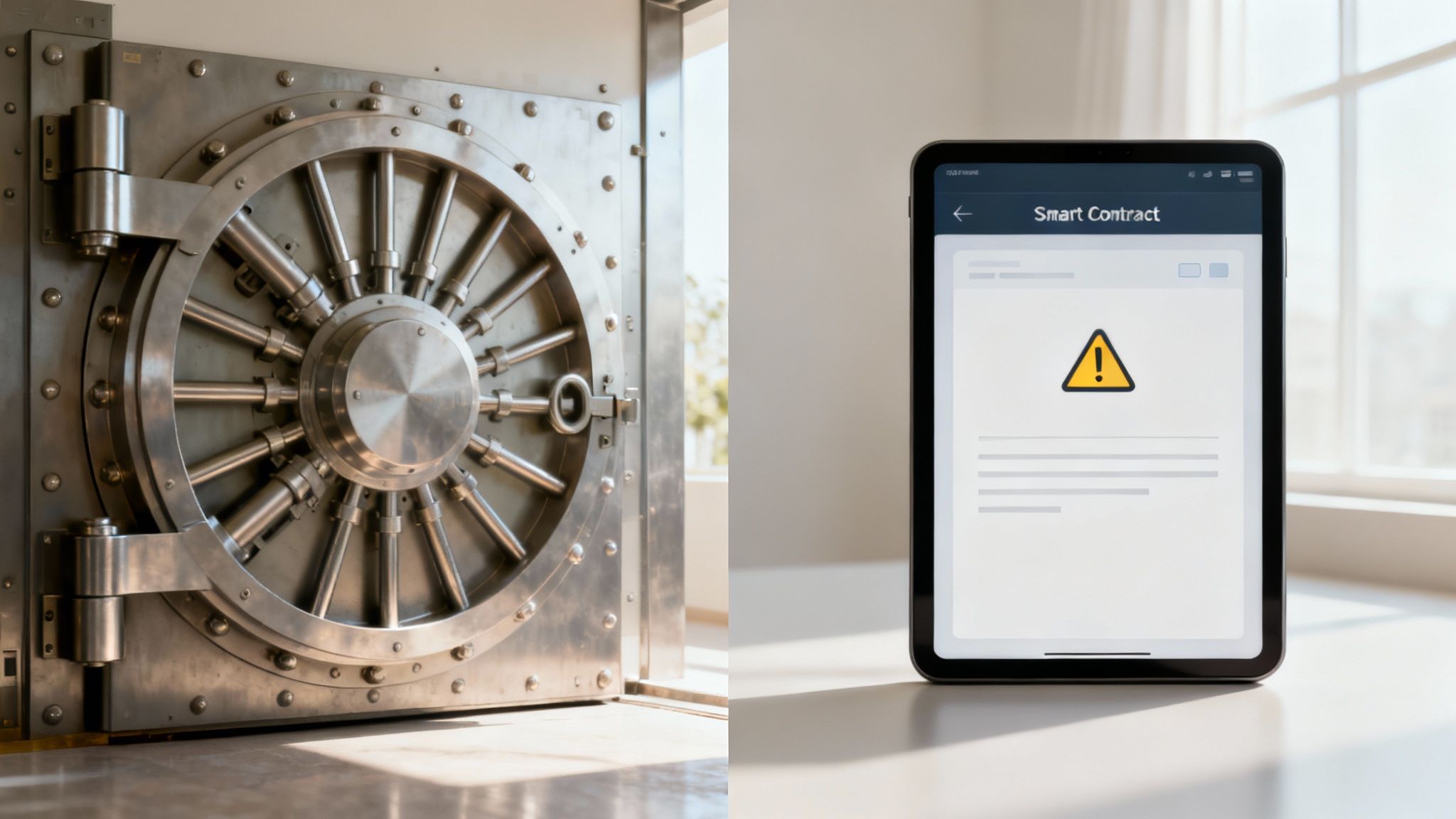
When you dig into the difference between a token and a coin, their security models jump out as one of the most critical distinctions. Security isn't just an add-on feature; it’s baked into their core architecture, and each approach is worlds apart.
Bitcoin, as a native coin, operates like a digital fortress. Its security is built directly into its blockchain. The entire defense rests on a massive, globally distributed network of miners all taking part in the Proof-of-Work consensus. This decentralized power makes a direct attack on the network outrageously expensive and logistically next to impossible.
Every single transaction gets independently verified by thousands of nodes. The network's sheer scale creates an immense wall of computational power that guards the integrity of the ledger. This means the safety of your bitcoin is one and the same as the health of the entire Bitcoin network.
The Layered Security of Tokens
Tokens play by a completely different set of rules. Their security is layered and, most importantly, dependent on another platform—it's not self-contained. A token's safety really comes down to two things: how solid its host blockchain is and the quality of its own smart contract code.
First off, a token inherits the security of the network it's built on. If a token is on a secure, battle-tested blockchain, it gets to piggyback on that network's defenses against major attacks. That’s a huge plus, as token creators don't have to build a global security network from the ground up.
But that dependency is also its biggest vulnerability. If the host blockchain ever gets compromised, every single token on it is immediately at risk. It's a shared-fate situation where a token is only as strong as the platform it calls home.
Smart Contracts: The Second Layer of Risk
Beyond the host chain, tokens introduce a unique point of failure: the smart contract. This is the self-executing code that dictates everything the token can do. A well-written, thoroughly audited smart contract can certainly add layers of protection, but a buggy one can be absolutely catastrophic.
Coins like Bitcoin have native security protocols built right into the blockchain, maintained by a whole ecosystem of participants who verify transactions and ward off attacks. In contrast, tokens are guests on existing blockchains, and their security is tied to that underlying network. This adds a new risk vector, making tokens more vulnerable to smart contract bugs or exploits. You can get a deeper dive into how these models stack up on Bitunix's blog.
A bug in a smart contract can lead to devastating outcomes, such as drained funds or frozen assets—a risk that simply doesn't exist for a native coin like Bitcoin, whose core protocol has been battle-tested for over a decade.
At the end of the day, securing a coin is all about the strength of its decentralized network. For a token, it's a two-part question: how secure is the host blockchain, and how secure is the token's specific code? Grasping this nuanced difference in their risk profiles is absolutely essential.
Comparing Real-World Use Cases
https://www.youtube.com/embed/aLh8jlYYvZA
When we shift from the technical weeds to the real world, the difference between a token and a coin becomes crystal clear. Each asset is built for a specific job in the digital economy. They aren't interchangeable tools—they are distinct solutions for very different problems.
Bitcoin, as the original native coin, has two primary jobs it does exceptionally well: acting as a global store of value and providing an incredibly secure settlement layer. Its whole purpose is to be a censorship-resistant, decentralized form of money.
This makes it perfect for long-term value preservation—think digital gold—and for large-scale transfers where security and finality are non-negotiable.
Bitcoin for Value Preservation
Bitcoin’s design prioritizes security and scarcity above everything else. With a hard cap of 21 million coins, it's designed to be deflationary, protecting your purchasing power over the long haul.
That’s why BTC is the tool of choice when the main goal is to preserve wealth. It was never meant for small, everyday purchases like buying a coffee, where you need speed and low fees. Instead, see it as the bedrock asset for storing serious value outside of the old-school financial system.
Tokens for Transactional Efficiency
Tokens, on the other hand, are built for speed and specialized functions. The most common example is the stablecoin, a token designed to hold a steady value, usually by pegging itself to a fiat currency like the U.S. dollar.
Stablecoins shine exactly where Bitcoin’s volatility is a problem—in everyday payments, remittances, and online commerce. Their stability makes them a predictable way to transact for merchants and shoppers who can't afford to worry about price swings.
The sheer scale of their usage tells the story. While Bitcoin is mostly used for moving value on its own network, stablecoin tokens have taken over as the go-to for payments. The total stablecoin transaction volume is staggering, with some estimates putting organic activity at $9 trillion. You can dig deeper into this trend in the full State of Crypto Report.
When choosing between a coin and a token, ask yourself what job needs doing. For preserving value with maximum security, Bitcoin is the answer. For transactional speed and price stability, a stablecoin token is the right tool for the job.
To really grasp the practical differences, it helps to understand how their markets behave. Learning how to read crypto charts can give you a better feel for why one asset is treated as a long-term holding while another is used for daily transactions.
Ultimately, the coin is the foundational money, while the token is a functional instrument built to perform a specific, often transactional, task.
Got Questions? We've Got Answers
Diving into the world of digital assets can feel like learning a new language. Let's clear up some of the most common questions about coins and tokens, building on what we've covered so far.
Is Bitcoin a Coin or a Token?
Bitcoin (BTC) is, without a doubt, a coin. It's the original cryptocurrency, running on its very own independent and self-sufficient blockchain—the Bitcoin network.
The entire Bitcoin blockchain was built for one primary purpose: to support BTC as its native currency. It doesn't sit on top of another platform, which is the key difference when you're talking about a token vs. a coin. Every single part of its operation, from validating transactions to keeping the network secure, happens within its own closed-loop ecosystem.
Can You Trade Tokens for Bitcoin?
Yes, absolutely. Trading tokens for Bitcoin is one of the most common activities you'll find on any cryptocurrency exchange. These platforms are essentially marketplaces where you can swap a huge variety of digital assets based on their current market value, which shifts with supply and demand.
This ability to trade provides liquidity, allowing value to flow freely between different assets, even if they're built on completely separate technologies. For example, you can sell a token that exists on one blockchain and immediately use that money to buy Bitcoin, which operates on its own unique network. This kind of interoperability is the lifeblood of the broader digital asset economy.
The fact that you can trade between asset types reveals a core functional difference: Bitcoin often serves as a base asset or a "reserve currency" in many trading pairs, much like the U.S. dollar in traditional finance. Tokens, on the other hand, usually represent more specialized assets tied to a specific function or project.
Which Is a Better Investment: A Coin or a Token?
There’s no simple answer here. Neither a coin nor a token is inherently a "better" investment; they just represent different kinds of opportunities with wildly different risk profiles. The right choice for you depends entirely on your investment goals, how much risk you're comfortable with, and what you believe will hold value in the long run.
Coins, like Bitcoin, are often viewed as a direct investment in a foundational technology.
- How it gets its value: Its worth is tied to the security, adoption, and overall health of its entire decentralized network.
- What are the risks? The risks usually come from broader market trends, potential regulatory changes, and whether the blockchain itself remains viable long-term.
- What's its main job? Many see it as a store of value, like digital gold, thanks to its programmed scarcity and battle-tested security.
Tokens get their value from a specific project or its utility.
- How it gets its value: A token's success is directly linked to how well its underlying project, platform, or the asset it represents performs.
- What are the risks? Tokens inherit all the risks of their host blockchain plus project-specific risks like smart contract bugs, bad management, or simply failing to find a market.
- What's its main job? Tokens are built to do something—whether it's enabling stable payments, giving access to a service, or representing ownership.
Deciding where to put your money requires some real thought. An investment in Bitcoin is basically a bet on the future of a sovereign, decentralized monetary network. An investment in a token is a bet on the success of a specific app or idea built on someone else's infrastructure. Getting your head around that fundamental difference is the first step toward making a smart decision.
Ready to accept Bitcoin payments with zero intermediaries and rock-solid security? Flash offers wallet-to-wallet payment software that connects you directly to the Bitcoin network. You can get started in under a minute and open your doors to a global audience of over 500 million Bitcoin users.