Tired of delays and high fees when getting paid internationally? Bitcoin invoicing might be the solution you need. For digital nomads, it simplifies payments with fast settlements, low costs, and no currency conversion hassles. Here's why it's worth considering:
- Faster Payments: Transactions settle in minutes, even on weekends or holidays.
- Lower Fees: Avoid $40+ wire transfer fees; Bitcoin transactions cost just cents.
- Borderless Payments: No currency conversion losses - get paid globally without extra steps.
- Control & Security: Use non-custodial wallets to manage your funds without third-party interference.
- Manage Volatility: Lock exchange rates or convert Bitcoin to fiat or stablecoins instantly.
Platforms like Flash make this process simple - connect your wallet, send invoices, and get paid quickly. Bitcoin invoicing lets you take charge of your finances, no matter where you work.
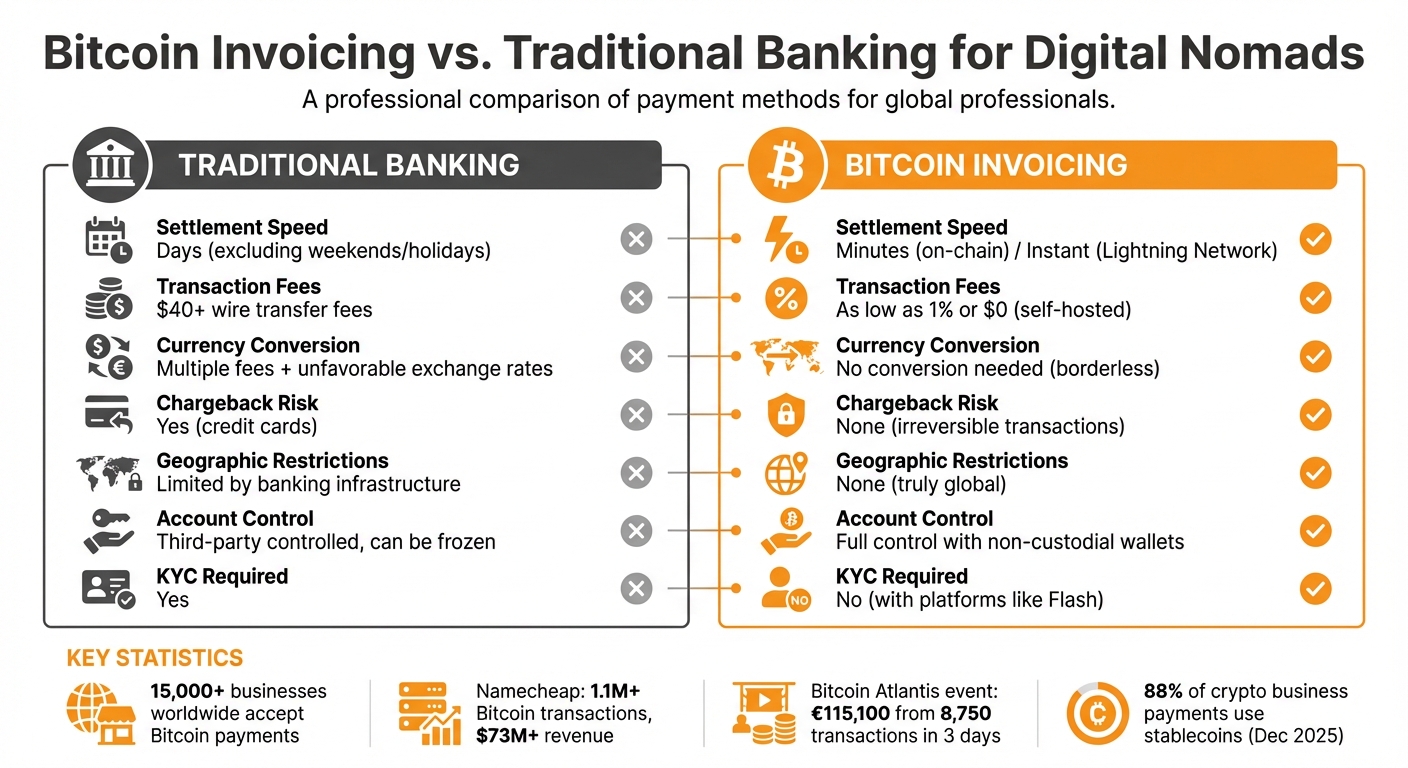
Bitcoin Invoicing vs Traditional Payment Methods for Digital Nomads
Benefits of Bitcoin Invoicing for Digital Nomads
Faster Payments and Quick Settlement
Waiting days for traditional bank transfers to clear can be frustrating, especially for digital nomads who rely on timely payments. Bitcoin, however, changes the game. On-chain Bitcoin transactions are processed in minutes, while payments made through the Lightning Network are almost immediate - no delays from weekends or holidays. For example, Namecheap has handled over 1.1 million Bitcoin transactions, generating more than $73 million in revenue. Similarly, during the Bitcoin Atlantis event, organizers managed to process €115,100 from 8,750 transactions in just three days. This highlights Bitcoin's ability to efficiently handle large volumes of payments.
The speed of these settlements also means reduced fees and truly global transactions without the typical banking bottlenecks.
Lower Transaction Fees
International payments through traditional banks often come with hefty wire transfer, intermediary, and processing fees. Bitcoin invoicing eliminates these extra costs by cutting out banks and other middlemen. Peer-to-peer Bitcoin transactions allow you to bypass these fees entirely. Some platforms charge as little as 1% per transaction, while self-hosted tools like BTCPay Server allow you to process payments with zero transaction fees. Additionally, Bitcoin transactions are irreversible, protecting you from chargeback risks that commonly occur with credit card payments.
This cost efficiency makes Bitcoin an attractive option for invoicing clients across the globe.
Borderless Payments Without Currency Conversion
With Bitcoin’s universal reach, you can receive payments from anywhere without worrying about currency conversions. This spares you from losing money to unfavorable exchange rates or hidden conversion fees.
"Blockchain invoice payments are fast, borderless, and final. BitPay crypto invoices are paid in minutes and settled in fiat to your bank account." - BitPay
Bitcoin invoicing also simplifies the payment process. You can send invoices as URLs or PDFs via email or text message, offering clients a user-friendly way to pay - no need to navigate traditional banking systems. This is particularly beneficial for merchants in areas with limited banking infrastructure, where Bitcoin invoicing has been adopted seamlessly.
Many invoicing tools secure the value of your payment in fiat currency at the time of transaction. They also offer flexible settlement options, allowing you to keep the payment in Bitcoin or convert it to USD, EUR, or GBP. Some processors even provide next-day deposits to your bank account, giving you quick access to local currency when needed.
How to Set Up Bitcoin Invoicing
Setting up Bitcoin invoicing involves three main steps: choosing a secure wallet, generating invoices, and keeping track of payments. These steps are designed to simplify the payment process while giving you financial independence - perfect for digital nomads.
Selecting a Bitcoin Wallet
The first step is picking the right wallet to handle Bitcoin payments. Non-custodial wallets are a solid choice because they give you full control over your private keys, meaning no third party can freeze your funds or require you to go through KYC verification.
For larger transactions, hardware wallets like ColdCard, Ledger, or Trezor offer top-notch security. These devices allow you to sign transactions offline, keeping your private keys safe from online threats. If you’re expecting frequent, smaller payments, look for a wallet that supports the Lightning Network. This feature enables instant payments with minimal fees.
On the other hand, a "hot wallet" stores your seed on a server, which makes it convenient for frequent transactions. However, it comes with greater security risks compared to hardware wallets.
Creating and Sending Bitcoin Invoices
Once your wallet is ready, you can start creating invoices. Using your invoicing platform, input key details like the payment title, amount, and currency. The platform will generate a unique URL for each invoice, which you can share with your clients via email or text.
For clients with recurring or high-volume transactions, dynamic invoicing can be a lifesaver. It adjusts to real-time exchange rates and allows for scheduled payments. Additionally, the invoicing system ensures privacy by generating a new Bitcoin address for every invoice, preventing address reuse.
Once the invoices are created, you’re ready to track and confirm payments effortlessly.
Tracking Payments and Verifying Confirmations
Monitoring your invoices is crucial for secure transactions. Most invoicing dashboards automatically update the payment status. When a client pays, the invoice typically moves through stages: "New", "Processing" (while waiting for blockchain confirmations), and finally "Settled" once fully confirmed.
For higher-value transactions, you can set a "speed policy" to require 1–3 blockchain confirmations before marking the payment as complete. If you need to check the status of any payment, clicking the transaction ID will show its real-time progress on a blockchain explorer. Incoming funds are often highlighted in green, while unconfirmed transactions appear grayed out.
If a client pays after the invoice expires, the system will mark it as "Expired (paidLate)." While the funds still arrive, you’ll need to manually verify the transaction.
To make bookkeeping and tax reporting easier, choose a system that allows you to export invoice data in formats like CSV or JSON. This feature is especially handy when you’re constantly on the move.
Managing Bitcoin Price Fluctuations
Bitcoin's unpredictable price swings can be a headache for digital nomads who rely on stable income. Fortunately, invoicing tools can lock in exchange rates, sparing you from constantly tracking the market.
Set short invoice expiration windows. When you create an invoice, the exchange rate is locked for a limited time, typically 15–30 minutes. As explained in the BTCPay Server documentation: "Invoices have expiration because they lock the exchange rate within a specified time frame to protect the receiver from price fluctuations". If the payment isn't completed within that window, the client will need a new invoice with an updated exchange rate.
Converting Bitcoin to Stablecoins or Cash
One of the easiest ways to sidestep volatility is to convert Bitcoin immediately after receiving it. Many payment processors offer instant fiat settlement, transferring funds directly to your bank account in USD, EUR, or GBP by the next business day. This approach eliminates the risk of price fluctuations.
For those who prefer staying within the crypto space, converting Bitcoin into stablecoins like USDC offers similar protection while keeping your assets digital. In December 2025, 88% of crypto business payments processed through Request Finance were made in stablecoins, showcasing the popularity of this method. Some payment processors even allow split settlements - letting you receive a portion in local currency for immediate needs while keeping the rest in Bitcoin for future savings.
These conversion options pair well with flexible payment methods, giving you an extra layer of protection against market volatility.
Timing Payments to Reduce Volatility Impact
Timing your payments strategically is another way to manage Bitcoin's price swings. Instead of using static invoices, opt for dynamic payment requests, especially for ongoing client relationships. These requests generate URLs that update the exchange rate in real time until the payment is made. This ensures you receive the correct dollar-equivalent value, whether the client pays the same day or two weeks later.
Additionally, the Lightning Network offers near-instant transactions, settling payments in seconds. This speed minimizes the risk of price changes during the payment process, even during periods of market instability. Faster confirmations mean less chance of the price shifting unfavorably between when the payment is initiated and completed.
sbb-itb-f81ab9b
Using Flash for Bitcoin Invoicing
Flash makes Bitcoin invoicing a breeze for digital nomads by directly linking wallets, enabling instant fund transfers between clients and recipients. As Flash Lightning Solutions explains: "Flash is not a financial company, it is a payment software that connect wallets between themselves. We never touch your funds".
Getting started is quick and simple. All you need is a Lightning-enabled non-custodial wallet - like Phoenix, Breez, or Wallet of Satoshi - to receive instant payments. There’s no need for KYC verification; just an email and name to register. Julien Bouvier, Head of Marketing at Flash, highlights: "Flash lets you start in minutes. Connect your wallet, generate your first invoice, and get paid - no code, no approvals, no fees".
Flash takes Bitcoin invoicing to the next level with features designed to streamline every step of the process.
Customizable Invoice Creation
Flash allows you to create professional invoices tailored to your brand. Add your logo and company details, and each invoice comes with a Bitcoin checkout link or QR code for one-click payments. You can share these invoices easily via email, messaging apps, or direct links.
The "invoice hub" acts as a central dashboard for managing clients, giving you a polished freelance presence - whether you’re working from a beach in Bali or a café in Lisbon. Best of all, Flash is completely free for freelancers and contractors. The only costs are the standard Bitcoin network fees.
In addition to professional invoicing, Flash ensures secure and fast transactions.
Fast Transactions with Low Fees
With its non-custodial setup, Flash lets you stay in full control of your funds, making it an excellent choice for freelancers who rely on steady cash flow.
A real-time dashboard helps you track payments and export transaction records for tax purposes. You can also set invoice amounts in satoshis, BTC, or fiat equivalents, depending on your preference.
Mobile-Friendly Tools for Remote Work
Designed for both mobile and desktop, Flash is ideal for digital nomads working from any location. Its smooth checkout experience ensures that clients can pay quickly, whether they're using a laptop or a smartphone. This mobile-first approach fits perfectly with the flexible lifestyle of remote workers, who might manage invoices from a co-working space one day and a mountain cabin the next.
The platform’s user-friendly interface requires no technical expertise. From creating invoices to tracking payments, the process is straightforward and doesn’t demand in-depth blockchain knowledge - just connect your wallet and you’re good to go.
This all-in-one, mobile-friendly solution gives digital nomads the tools to handle payments effortlessly, no matter where they are.
Conclusion
Bitcoin invoicing offers digital nomads a powerful way to handle global finances with ease. By simplifying international transactions, it provides instant settlements, low fees, and eliminates the hassle of currency conversions. With over 15,000 businesses worldwide already accepting Bitcoin payments, it’s clear this isn’t just a passing trend - it’s a practical solution for today’s remote work environment.
Non-custodial tools further enhance financial freedom for nomads. As Satshacker, a technical contributor, explains:
"For freelancers, developers, and creators in the Bitcoin space, non‑custodial invoicing means real financial sovereignty".
This approach puts you in full control of your private keys, protects you from frozen accounts, and eliminates chargeback risks.
Platforms like Flash make the process even simpler. With a free, user-friendly setup, Flash integrates all the invoicing tools mentioned, requiring no KYC verification. Just connect a Lightning-enabled wallet, such as Phoenix or Breez, and you’re ready to send invoices to clients worldwide.
FAQs
How can digital nomads handle Bitcoin's price fluctuations when invoicing clients?
Digital nomads can navigate Bitcoin's price fluctuations by invoicing in fiat currencies like USD and using platforms that instantly convert payments into Bitcoin based on the current exchange rate. This approach ensures the payment's value stays steady, no matter how the market shifts.
Another smart tactic is to settle payments promptly after receiving them, reducing the risk of being affected by sudden price changes. Many also turn to stablecoins - cryptocurrencies that are pegged to fiat currencies - as a way to dodge volatility while still enjoying the perks of fast and borderless transactions. By combining these methods, digital nomads can keep their finances steady and simplify their invoicing workflows.
What makes non-custodial wallets a secure choice for Bitcoin invoicing?
Non-custodial wallets offer a safer way to manage Bitcoin invoicing by putting you in full control of your private keys. Unlike custodial wallets, where a third-party platform holds your keys, non-custodial wallets ensure that only you have access. This minimizes the risk of losing funds due to platform hacks or poor management practices.
By keeping your private keys directly under your control, these wallets boost both security and privacy. They block third parties from accessing your transaction data or funds, and they allow you to implement stronger safeguards, like hardware wallets or offline storage. For digital nomads, this setup provides more financial freedom and a secure method for managing global payments.
How can Bitcoin invoicing make international payments easier for digital nomads?
Bitcoin invoicing streamlines international payments by offering quick, borderless transactions that skip the usual banking delays and hefty fees. Unlike traditional payment methods, it removes the need for currency conversions, ensuring you get the full amount owed without surprise deductions.
For digital nomads, this translates to greater financial freedom and convenience when collaborating with clients across the globe. Bitcoin invoicing makes payments simple, clear, and perfectly suited for a remote, globally connected lifestyle.