Bitcoin is transforming global payments for businesses. Here's why:
- Speed: Transactions settle in minutes, unlike traditional methods that take days.
- Lower Costs: Fees range from 0.5% to 1%, compared to 2-5% for credit cards or wire transfers.
- Global Access: Works in regions with limited banking infrastructure, bypassing intermediaries.
- Transparency: Blockchain ensures secure, trackable, and irreversible payments.
- Customer Behavior: Crypto-paying customers often spend twice as much as credit card users.
In 2025, Bitcoin accounted for $1.2 trillion in North American crypto inflows, dominating enterprise payments. Companies like Microsoft, Gucci, and Deel are already leveraging its benefits. Challenges like regulatory compliance and volatility remain, but tools like payment gateways simplify integration. Bitcoin isn’t just an option anymore - it’s becoming a key part of global business operations.
Ep. 5 | Crypto Payment Integration for Enterprises: Benefits, Gateways & Strategy
Bitcoin Adoption Trends in Enterprises: Key Data
The momentum behind enterprise Bitcoin adoption in 2024–2025 is undeniable, supported by compelling data. In North America alone, crypto transaction volumes soared to over $2.2 trillion - a 49% year-over-year increase. Of this, Bitcoin took the lion’s share, accounting for more than $1.2 trillion in fiat inflows - roughly 70% higher than Ethereum during the same period. These figures highlight Bitcoin's dominance and set the stage for understanding its growing role in enterprise transactions.
The United States leads the charge in enterprise Bitcoin adoption, where Bitcoin represents 41% of all fiat purchases, compared to 34% in the UK and 27% in the EU. Among U.S. merchants, 5–10% already accept Bitcoin, and a striking 75% plan to implement Bitcoin payment options within the next two years. This trend underscores Bitcoin's increasing integration into mainstream business operations.
While North America leads in absolute transaction volumes, the Asia-Pacific (APAC) region is seeing rapid growth, with a 69% increase in transaction volumes, climbing from $1.4 trillion to $2.36 trillion. This surge is fueled by enterprises in emerging markets seeking cost-effective cross-border payment solutions, especially in areas where traditional banking systems are underdeveloped.
Globally, Bitcoin remains the top choice for enterprise payments, accounting for 42% of all merchant crypto transactions. Its established infrastructure, global recognition, and reliability for large-value transfers make it the preferred option. Although stablecoins like USDT have gained traction - processing $1.01 trillion per month by mid-2025 - Bitcoin continues to dominate enterprise-to-enterprise transactions.
Key industries driving this adoption include technology firms, e-commerce platforms, luxury retail, travel services, and digital marketplaces. High-profile companies like Microsoft, AT&T, and Gucci have already integrated Bitcoin payments. These early adopters report substantial benefits, with one study revealing a 327% return on investment after implementing Bitcoin payment systems.
Payment and payroll platforms are also leveraging Bitcoin's speed and low transaction fees to simplify international settlements. This is particularly valuable for businesses with global supply chains or workforces. Data shows that up to 40% of crypto-paying customers are new, and their purchases are typically twice as valuable as those made with credit cards.
In the broader market, the global cryptocurrency payments app market reached $550–600 million in 2024, with projections pointing to continued expansion. Regulatory advancements, such as the approval of spot Bitcoin ETFs in major markets, have further opened the door for institutional investors seeking regulated avenues to gain Bitcoin exposure.
Regulatory clarity is playing a pivotal role in driving institutional adoption. A Deloitte survey found that 85% of merchants believe crypto payments help attract new customers, while 77% cite lower transaction costs as a key reason for adoption. These motivations align perfectly with Bitcoin's core strengths for enterprise users.
Geographically, while North America and Europe dominate in transaction volumes - Europe processed $2.6 trillion, reflecting 42% growth - emerging markets are experiencing the fastest growth. Latin America saw a 63% increase, and Sub-Saharan Africa reported 52% growth. These numbers suggest that Bitcoin adoption is rapidly becoming a global phenomenon.
Looking ahead, experts predict major developments in 2025. Analysts foresee at least one major nation incorporating Bitcoin into its treasury reserves and one of the largest corporations disclosing Bitcoin holdings in its financial reports. Such moves would mark a shift from experimental adoption to mainstream financial strategy, solidifying Bitcoin's role in global enterprise operations.
With technological advancements, clearer regulations, and proven business advantages, Bitcoin adoption is accelerating faster than anticipated. For enterprises navigating global payment challenges, these trends signal that integrating Bitcoin is no longer a luxury - it’s quickly becoming a necessity for staying competitive in international markets.
Key Benefits of Bitcoin for Enterprise Global Payments
Bitcoin brings distinct advantages to the table when it comes to international payments. Studies show that businesses adopting Bitcoin payment systems often achieve noticeable improvements in cost savings, transaction speed, and operational adaptability. Here's a closer look at why Bitcoin is reshaping enterprise-level global payments.
Lower Transaction Costs
One of Bitcoin's standout features is its ability to dramatically cut transaction fees. Traditional international wire transfers often come with steep costs - ranging from $20 to $50 per transaction, plus currency conversion fees. In contrast, Bitcoin transactions typically cost less than $5, depending on network activity. Even more compelling, blockchain payment fees generally fall between 0.5% and 1%, a stark contrast to the 2% to 3% fees associated with credit card payments. By enabling direct wallet-to-wallet transfers, Bitcoin eliminates banking fees altogether, offering substantial savings for enterprises handling large transaction volumes.
Faster Settlement Times
Cross-border payments through traditional banking channels can take several days to process due to limited operating hours and layers of intermediaries. Bitcoin, however, offers settlement times ranging from 10 to 60 minutes, depending on network conditions. This rapid processing is invaluable for businesses managing just-in-time supply chains or dealing with urgent payment deadlines. Plus, Bitcoin operates 24/7, meaning there are no delays due to weekends or holidays.
Transparency and Reduced Counterparty Risk
Bitcoin's blockchain technology offers a transparent and immutable record of transactions. This transparency reduces the risk of fraud, payment disputes, and counterparty issues. Enterprises can track payment statuses and histories in real time, providing greater operational clarity. Additionally, Bitcoin's direct, non-custodial transfers eliminate reliance on intermediary institutions, ensuring funds move securely from sender to recipient.
Access to Emerging Markets
Bitcoin operates independently of traditional banking systems, making it an effective tool for reaching partners in regions with limited or unstable financial infrastructure. By removing the need for local banking relationships and bypassing currency conversion hurdles, Bitcoin helps businesses expand globally with fewer logistical challenges.
Treasury Diversification Options
For many enterprises, Bitcoin serves as a strategic asset for treasury diversification and protection against fiat currency devaluation. Often referred to as "digital gold" due to its finite supply and global liquidity, Bitcoin provides a safeguard against inflation and macroeconomic uncertainty. Its 24/7 liquidity also offers treasury managers flexibility that traditional assets may lack, making it a useful tool for managing currency risks across multiple markets.
These benefits highlight why 93% of crypto owners are open to using their digital assets for purchases, and why the average value of crypto transactions is often double that of typical credit card transactions. Together, these advantages underscore the growing trust enterprises place in Bitcoin for global payment solutions.
Challenges and Considerations for Bitcoin Adoption in Enterprises
While Bitcoin offers clear benefits for global payments, enterprises face several challenges that could limit these advantages if not carefully addressed. Tackling these obstacles with well-thought-out strategies is essential for successful adoption.
Regulatory Compliance and Legal Considerations
The regulatory environment for Bitcoin is complex and constantly shifting. In the United States, enterprises must navigate federal and state regulations, including anti-money laundering (AML) and know-your-customer (KYC) requirements, as well as detailed tax reporting rules.
Globally, the situation is even more varied. Some countries have embraced cryptocurrencies with clear regulatory frameworks, while others have imposed strict restrictions or outright bans. Recent progress in major markets like the US and EU shows a move toward more structured rules, such as the introduction of spot Bitcoin ETFs and stablecoin regulations.
For enterprises, compliance across multiple jurisdictions is a significant challenge, especially as regulations evolve. Companies must establish robust compliance programs, including automated identity verification, transaction monitoring, and detailed reporting systems. Partnering with payment providers that offer built-in compliance tools can help reduce the administrative burden and mitigate legal risks.
Regular audits and continuous staff training on regulatory updates are critical. Many organizations are also creating dedicated crypto teams or roles to monitor changes in laws and ensure ongoing compliance. Beyond regulatory issues, enterprises must also grapple with financial and accounting complexities.
Volatility and Accounting Complexities
Bitcoin's price volatility presents significant challenges for financial reporting and treasury management. Under US GAAP and IFRS accounting standards, Bitcoin transactions often require mark-to-market accounting, which involves frequent valuation updates and detailed disclosures. This adds complexity to financial processes and increases administrative workloads.
In the U.S., Bitcoin is treated as property for tax purposes, meaning enterprises must track the cost basis and calculate capital gains or losses for every transaction. This creates additional accounting overhead that can be time-consuming and complicated.
To address these issues, businesses can adopt several strategies. Payment gateways that convert Bitcoin to USD instantly at the point of transaction can minimize exposure to price fluctuations. Hedging tools, like futures or options contracts, can lock in exchange rates and protect against volatility. Some companies opt to use stablecoins for transactions, benefiting from price stability while retaining the advantages of blockchain.
Enterprises can also implement treasury policies that limit Bitcoin holdings or set automatic conversion thresholds. Specialized accounting software tailored for cryptocurrency, along with advice from tax professionals experienced in digital assets, can streamline compliance and reporting. However, financial challenges are only part of the equation - technical and organizational readiness is equally important.
Technical and Organizational Readiness
Integrating Bitcoin into enterprise systems requires significant technical infrastructure and organizational adjustments. Companies need secure wallet management solutions, robust cybersecurity measures, and efficient payment processing systems to handle cryptocurrency transactions safely.
On the technical side, this means setting up multi-signature wallets, integrating APIs with existing systems, and conducting regular security audits. Security threats like wallet theft, phishing attacks, and unauthorized access to private keys demand strong safeguards, such as hardware wallets, multi-factor authentication, and employee training on cybersecurity risks.
From an organizational standpoint, enterprises must prioritize staff training on cryptocurrency basics, compliance requirements, and security protocols. This often involves creating new roles or teams dedicated to crypto operations, risk management, and regulatory oversight. Change management becomes a key focus to address internal resistance and align these initiatives with broader business goals.
Companies like Starbucks and Tesla have successfully navigated these challenges by building comprehensive frameworks that address volatility, compliance, and security concerns. Platforms like Deel and payment providers such as Worldpay and Rapyd have integrated cryptocurrency payments by partnering with specialized providers for compliance, instant settlement, and risk management.
For most enterprises, the best way to overcome technical and organizational hurdles is to collaborate with established payment service providers. These partners can handle the complexities of compliance, security, and infrastructure, allowing businesses to focus on their core operations while leveraging cryptocurrency payment solutions effectively.
sbb-itb-f81ab9b
Real-World Use Cases: Bitcoin in Cross-Border Transactions
Case Studies Across Key Sectors
Businesses in various industries are using Bitcoin to reshape how they handle global payments, reaping benefits like lower costs, faster transactions, and broader market access.
Technology and Software Services
In 2024, Microsoft started accepting Bitcoin for Xbox and Azure services. This allowed customers worldwide to make instant payments while avoiding international card fees. By using a third-party payment gateway, Microsoft cut processing costs by 2% and saw a boost in international sales, especially in regions where traditional payment methods face challenges.
Deel, a global payroll platform, has adopted Bitcoin for paying contractors across the globe. This shift has reduced settlement times from days to just minutes, while also cutting transaction costs. For remote workers in areas with limited banking options, this has proven to be a game-changer.
Luxury Retail and E-commerce
In early 2025, Gucci launched a pilot program to accept Bitcoin payments at select U.S. stores. The results were striking: 38% of crypto transactions came from first-time customers, and the average purchase amount was 1.8 times higher than purchases made with credit cards.
Similarly, a U.S.-based online retailer that introduced Bitcoin payments in 2025 saw a 2% reduction in card processing fees while gaining access to international customers who had previously been blocked by payment barriers. Interestingly, customers paying with Bitcoin spent twice as much as those using traditional payment methods.
Supply Chain and Logistics
Companies in the supply chain sector are using Bitcoin to streamline payments and enhance transparency. Bitcoin enables real-time tracking and final settlement with international partners, eliminating chargebacks and reducing counterparty risks. Blockchain records also make reconciliation faster and improve cash flow management.
Travel and Hospitality
Travel platforms are turning to Bitcoin to cater to customers in regions with limited banking services. This has led to quicker payments and higher-value transactions, especially in markets where local currency restrictions previously hindered international bookings.
Financial Services Integration
A leading financial institution recently incorporated Bitcoin into its cross-border payment system. This change reduced settlement times from several days to just minutes and expanded their global market reach. It’s a clear example of how traditional financial services are adopting cryptocurrency to improve their global payment systems.
To highlight these benefits, here’s a side-by-side comparison of Bitcoin and conventional payment methods:
Comparison Table: Bitcoin vs. Conventional Global Payment Methods
| Feature | Bitcoin | Conventional Payment Methods |
|---|---|---|
| Cost | 0.5–1.5% (typical) | 2–5% (card, wire, SWIFT) |
| Speed | Minutes | 1–5 business days |
| Transparency | Real-time, on-chain tracking | Limited, batch processing |
| Regulatory Complexity | Evolving, varies by region | Established but often complex |
| Market Access | Global, borderless | Restricted by banking networks |
| Counterparty Risk | Reduced (transaction finality) | Higher (chargebacks, delays) |
| Settlement Certainty | Immediate and final | Reversible, subject to disputes |
These examples show how Bitcoin is transforming global payments. By cutting settlement times from days to minutes and slashing transaction costs by up to 80%, Bitcoin is proving to be a valuable tool for businesses looking to modernize their payment systems. Its adoption is paving the way for seamless integration with advanced payment gateways like Flash.
Enabling Enterprise Adoption: Bitcoin Payment Gateways
The Role of Payment Gateways in Enterprise Integration
Bitcoin payment gateways act as a bridge between traditional enterprise systems and the Bitcoin network, removing technical barriers and enabling smooth wallet-to-wallet transactions without requiring businesses to have deep crypto knowledge.
Their primary role is to streamline the payment process while preserving the features that make Bitcoin appealing to enterprises. These gateways handle the technical connection to the Bitcoin network, route payments through the Lightning Network for rapid settlement, and provide detailed analytics to give businesses full visibility into their payment operations.
Traditional global payment systems often come with high transaction fees ranging from 2-5%, settlement delays lasting 1-5 business days, and cumbersome reconciliation processes. In contrast, Bitcoin payment gateways offer considerably lower fees (typically under 1%), nearly instant settlements, and straightforward transaction tracking, making accounting tasks much simpler.
Compliance is another critical factor for enterprise adoption. Leading Bitcoin payment gateways integrate automated Know Your Business (KYB), Know Your Customer (KYC), and Anti-Money Laundering (AML) checks directly into their platforms. This ensures businesses can meet regulatory requirements both in the United States and globally, while also generating the necessary audit trails for financial reporting and compliance monitoring.
These platforms enable businesses to track payments in real time, monitor transaction statuses, and produce detailed financial reports, which are essential for effective cash flow management and informed decision-making. For large enterprises handling high transaction volumes, this level of transparency is crucial for maintaining efficiency. Such technological advancements pave the way for specialized tools like Flash to simplify Bitcoin payment processes further.
Flash: A Leading Solution for Enterprise Bitcoin Payments
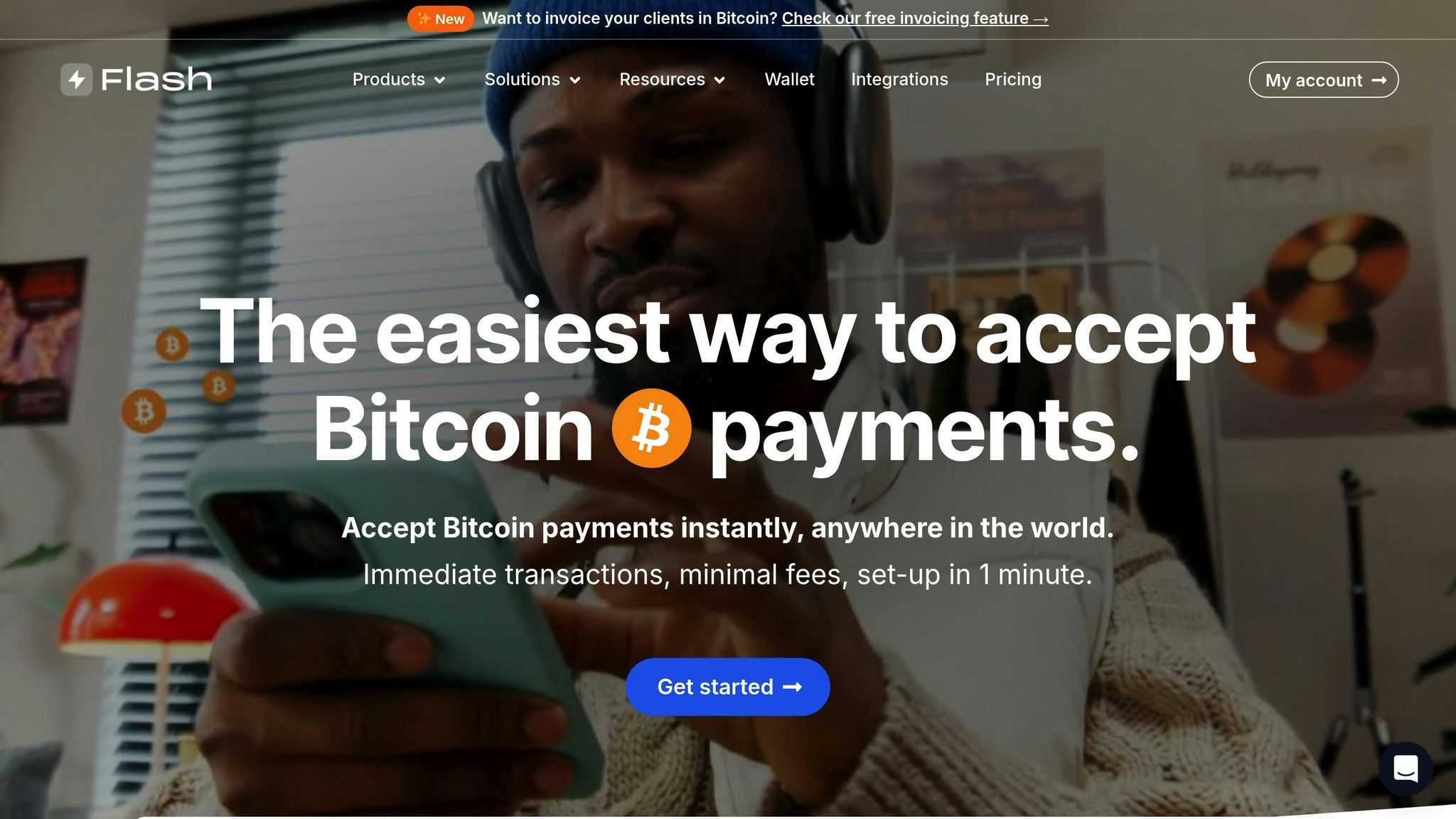
Flash stands out as a robust solution tailored to meet the needs of global enterprises. Its non-custodial design ensures that businesses retain full control over their funds throughout the transaction process, removing the counterparty risks commonly associated with traditional payment processors.
The platform’s focus is on direct, wallet-to-wallet transactions, bypassing traditional banking systems entirely. This approach reduces settlement times from days to mere minutes and ensures transaction finality, eliminating the risk of chargebacks. For enterprises dealing with international suppliers or customers, this speed and reliability offer a significant competitive edge.
Flash is built for scalability, supporting a range of enterprise use cases, including:
- Payment links for quick and easy transaction initiation
- Paywalls for monetizing digital content
- Subscription management for recurring revenue models
- Point-of-sale systems for retail businesses
Additionally, Flash offers custom integration options, allowing businesses to embed Bitcoin payment capabilities directly into their existing systems without disrupting established workflows.
For businesses looking to get started quickly, Flash provides no-code solutions that enable Bitcoin payment acceptance in just a few minutes. For more complex needs, the platform offers detailed APIs and documentation, making it possible to tailor integrations to specific business processes and compliance requirements.
Flash also opens doors to a global market. The platform allows businesses to tap into a pool of over 400 million potential customers who prefer or rely on Bitcoin for payments. This is especially beneficial for enterprises aiming to expand into emerging markets where traditional banking systems may be underdeveloped or where local currency regulations complicate international trade.
With its Lightning Network integration, Flash ensures low transaction costs and consistently high processing speeds, regardless of network congestion or transaction volume. This level of reliability is vital for enterprises that need dependable payment systems to maintain customer satisfaction and operational efficiency.
For compliance-conscious enterprises, Flash simplifies the regulatory landscape by functioning as payment software rather than a financial intermediary. The platform emphasizes that "No KYC required" applies to its operations, leaving compliance responsibilities to the enterprises themselves, which maintain full control over regulatory adherence. This approach provides businesses with the flexibility they need while minimizing regulatory complexity.
Conclusion: The Future of Bitcoin in Enterprise Global Payments
Bitcoin is making waves in global payments, with recent data showing it facilitated more than $1.2 trillion in fiat inflows in North America alone. Major brands are already embracing crypto payments, and interestingly, up to 40% of customers who pay with crypto are brand-new to these businesses. This shift highlights Bitcoin's appeal, especially when you consider the cost benefits: blockchain payments typically range from 0.5% to 1% in fees, compared to the 2% to 3% charged by credit cards. Add in nearly instant settlements and the irreversible nature of blockchain transactions (eliminating chargebacks), and it's clear why enterprises handling large transaction volumes or expanding into emerging markets are paying attention. These advantages are positioning Bitcoin as a game-changer for enterprise global payments.
Looking ahead, predictions for 2025 suggest that Bitcoin’s influence could grow even further. Experts foresee at least one major nation potentially adding Bitcoin to its treasury and one of the world’s largest corporations publicly holding Bitcoin for cross-border transactions. The combination of increasing institutional adoption, advancements in Layer 2 technologies, and clearer regulations is steadily integrating Bitcoin into the global financial system.
Technological hurdles are also becoming less of an issue. Payment gateways like Flash now offer no-code solutions, making it easier than ever for businesses to accept Bitcoin payments in just minutes. This opens the door to a market of over 400 million potential customers - all without overhauling existing systems.
With its efficiency, cost savings, and scalability, Bitcoin is reshaping how enterprises approach global payments. Companies adopting platforms like Flash are well-positioned to lead this transformation, setting the stage for a new era in global commerce.
FAQs
How can businesses handle Bitcoin's price fluctuations when using it for international payments?
Enterprises have a straightforward way to handle Bitcoin's price swings: they can convert Bitcoin payments into fiat currency right away. By using a payment gateway or exchange service, businesses can lock in the value of a transaction at the moment it's completed. This approach helps minimize the risk of market fluctuations impacting their revenue.
On the other hand, some businesses opt to hold onto a portion of their Bitcoin payments as a part of their long-term investment plans. This strategy involves weighing the risks of volatility against the potential for future profits. Using tools that offer real-time conversions and clear pricing can simplify the process, especially for businesses managing international transactions.
How can businesses stay compliant with international Bitcoin regulations?
To navigate the maze of international Bitcoin regulations, businesses need to start by thoroughly understanding the legal requirements of every country where they operate or handle transactions. These regulations can differ significantly and often address areas like taxation, reporting standards, and anti-money laundering (AML) protocols.
Equally important is putting in place strong internal policies to track transactions and keep detailed, accurate records. Collaborating with legal and financial professionals who specialize in cryptocurrency laws can provide valuable guidance and help businesses steer clear of costly penalties. Since Bitcoin regulations are constantly changing, staying up-to-date with the latest legal developments is essential for ensuring compliance.
How does Flash make it easy for enterprises to integrate Bitcoin into their payment systems?
Flash makes it easier for businesses to embrace Bitcoin by providing a flexible payment gateway that handles transactions worldwide. Companies can effortlessly incorporate Bitcoin payments using features like payment links, paywalls, subscriptions, widgets, point-of-sale systems, and tailored integrations.
With Flash, payments are processed instantly, come with low fees, and don’t rely on middlemen. This ensures secure, direct wallet-to-wallet transactions, offering a straightforward and efficient way for businesses to broaden their payment methods.