Chief Procurement Officers (CPOs) are now leading the charge in modernizing payment systems, driven by inefficiencies in traditional methods like credit cards and wire transfers. Bitcoin and its Lightning Network are transforming procurement with faster, lower-cost transactions, while tools like Flash simplify integration into existing workflows. Here's a quick breakdown:
- Challenges with Traditional Payments: High fees (2-5%), slow settlement times, and global barriers.
- Bitcoin Advantages: Near-instant payments, reduced fees (often under 1.5%), and no chargebacks.
- Enterprise Use Cases: Cross-border payments, early payment discounts, and digital product purchases.
- Compliance Needs: U.S. regulations require careful accounting and collaboration with legal teams.
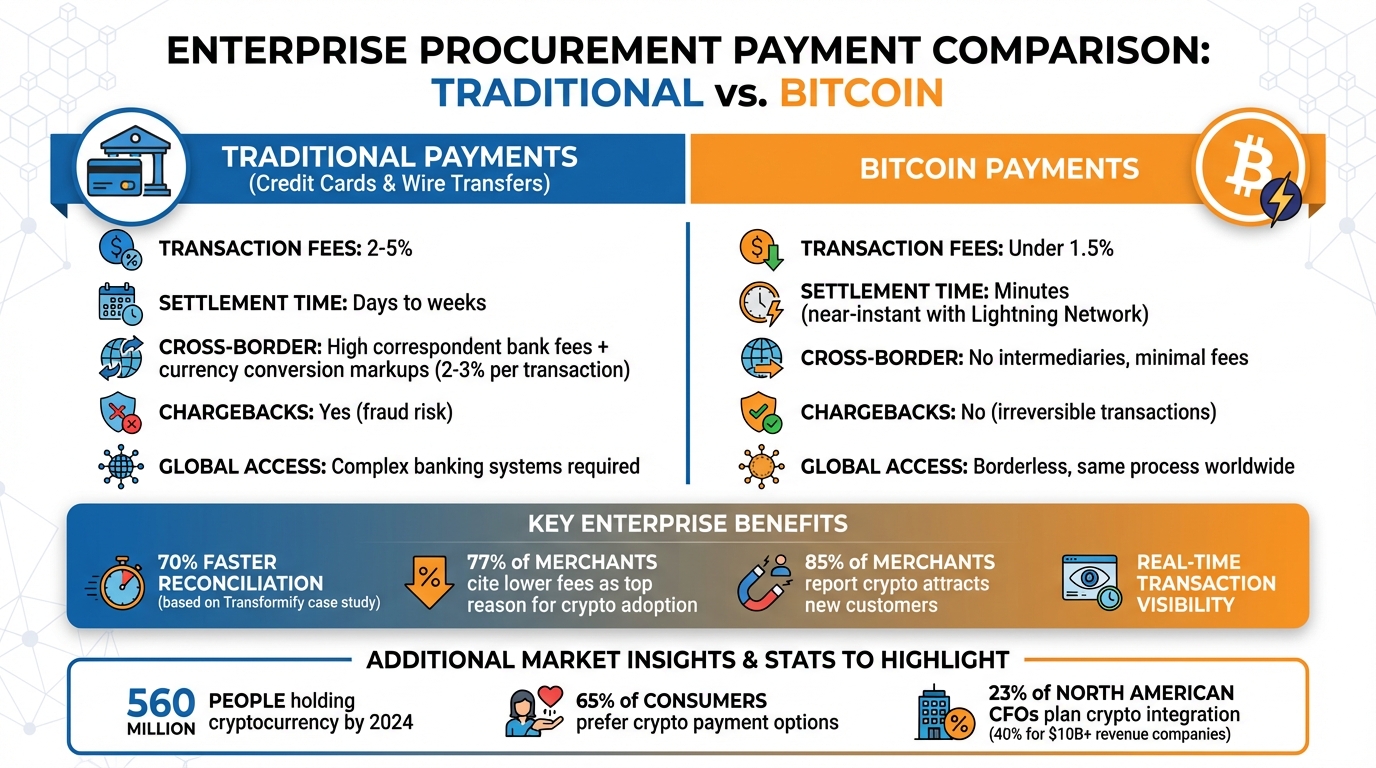
Traditional vs Bitcoin Payments: Cost and Speed Comparison for Enterprise Procurement
How the CPO Role Has Changed in Payment Innovation
From Cost Control to Financial Leadership
The role of Chief Procurement Officer (CPO) has undergone a significant transformation, especially with the rise of Bitcoin payment innovations. Once primarily focused on cutting costs, today's CPOs are key players in driving enterprise value and shaping strategy. Their responsibilities now extend beyond cost management to include compliance oversight, mergers and acquisitions, supply risk management, and environmental initiatives. This evolution underscores the growing importance of procurement in boosting financial efficiency and securing competitive advantages.
Working with Financial and IT Teams
Introducing Bitcoin payment systems into procurement processes demands seamless collaboration between procurement, finance, and IT departments. CPOs must work closely with these teams to tackle challenges related to security, compliance, and system integration. The goal is to deliver tangible business outcomes such as reducing costs, preventing fraud, and optimizing capital efficiency. For Bitcoin payments, this means partnering with IT to develop secure, integrated solutions that connect both physical and digital payment systems. Such teamwork is especially critical as CPOs navigate the stringent regulatory environment in the United States.
US Compliance and Governance Requirements
In the United States, adopting Bitcoin payments comes with a maze of compliance hurdles due to varying state and federal regulations. Without a unified federal framework for cryptocurrency payments, CPOs must carefully manage these complexities. For example, the IRS classifies Bitcoin as property, not currency, which makes every transaction - whether it's a sale, trade, or purchase - a taxable event. This classification demands meticulous accounting and reporting. Additionally, many crypto businesses facilitating Bitcoin payments are required to register as Money Services Businesses (MSBs) with FinCEN. To navigate these challenges, CPOs need to collaborate closely with legal and compliance teams to establish governance frameworks that align with regulatory requirements.
Adding Bitcoin Payments to Procurement Workflows
Connecting Bitcoin Payments to Procurement Steps
Incorporating Bitcoin payments into your procurement process doesn’t require a complete overhaul. The key is to integrate Bitcoin payment capabilities at critical stages - like purchase requisitions, approval workflows, payment execution, and reconciliation. For instance, when a procurement team approves a purchase order, the payment can be processed through a Bitcoin payment gateway. This allows suppliers to receive Bitcoin while your finance team continues to operate in USD.
The technical side usually involves API integrations that connect your existing procurement software with Bitcoin payment platforms. Take Transformify, for example - they integrated their API in just three weeks. The result? A 70% faster reconciliation process and two full workdays saved. Real-time exchange rate tracking also eliminated the need for manual conversions. This approach not only simplifies processes but also opens the door to exploring a variety of Bitcoin payment options for enterprises.
Enterprise Bitcoin Payment Options
There are several ways businesses can implement Bitcoin payments. A straightforward option is wallet-to-wallet transfers, where your company’s Bitcoin wallet directly sends payments to supplier wallets. This non-custodial method ensures you retain complete control over your private keys and funds.
For businesses handling high-volume, low-value transactions, the Lightning Network is a game-changer. It offers near-instant settlements with minimal fees, while also reducing fraud risks and eliminating payment reversals - issues that often plague traditional methods. Tools like Blockstream's Greenlight make it easier by hosting Lightning nodes in the cloud, reducing the technical workload for your IT team while keeping private keys secure. The Liquid Network has also seen record transaction volumes since late 2022, highlighting its growing popularity among enterprises.
Another option is using non-custodial gateways like Flash. These gateways strike a balance between simplicity and security. Flash supports payment links, subscription services, and custom integrations that seamlessly connect with your procurement systems. Plus, it offers real-time analytics, giving you immediate visibility into transactions. These solutions not only simplify the process but also bring measurable value to enterprise procurement.
Enterprise Benefits: Lower Costs, Faster Payments, Global Access
Adopting Bitcoin payments can lead to significant financial and operational benefits. Cross-border transactions, for example, become much more efficient. Unlike international wire transfers - which are slow and expensive - Bitcoin payments bypass intermediaries, cutting fees and allowing settlements to occur within minutes.
This speed can also improve supplier relationships. With Bitcoin, suppliers receive payment confirmations in just minutes via the Lightning Network, which can help procurement teams negotiate better terms. On top of that, blockchain technology adds an extra layer of security, making transactions nearly immutable and significantly reducing fraud risks compared to traditional payment systems.
Bitcoin’s borderless nature simplifies international transactions even further. Whether you’re paying suppliers in Japan, Brazil, or Germany, the process remains the same - no need to navigate complex banking systems or pay correspondent bank fees. This global accessibility is especially beneficial in regions with unstable financial systems, where Bitcoin provides a reliable and efficient alternative.
Reimagining the CFO–CPO Partnership
sbb-itb-f81ab9b
Bitcoin Payment Use Cases for Procurement Teams
Bitcoin isn't just a buzzword anymore - it’s proving to be a practical tool for procurement teams, especially when it comes to payments. By simplifying workflows and cutting down on costs, Bitcoin opens up new opportunities for efficiency in everyday transactions.
International and Small Supplier Payments
When it comes to cross-border payments, Bitcoin stands out. Traditional wire transfers are often slow, taking days or even weeks, and come with hefty fees - typically 2–3% per transaction. Bitcoin sidesteps these hurdles. It eliminates the need for intermediaries like correspondent banks and avoids currency conversion markups, making it possible to settle payments in just minutes.
Take Tomcar, an Australian car manufacturer, as an example. They started using Bitcoin early on to escape the high exchange rates and credit card fees that were eating into their profits on international transactions. For procurement teams dealing with global suppliers, this kind of efficiency doesn’t just save money - it strengthens relationships and boosts negotiating power. It’s no surprise that 77% of merchants accepting cryptocurrency cite lower transaction fees as the top reason.
Early Payment and Discount Programs
Bitcoin’s near-instant settlement capabilities unlock opportunities for early payment discount programs. Suppliers, who often wait days for payment confirmation with traditional systems, are much more likely to offer discounts when they can verify payment within minutes. Bitcoin’s transactions are also irreversible, giving suppliers the confidence they need to extend favorable terms.
By reducing days sales outstanding (DSO) and eliminating float costs, Bitcoin helps procurement teams optimize cash flow while enjoying early payment discounts. Deloitte US highlights this efficiency:
"Using crypto as a form of payment could reduce transaction fees and possibly eliminate the cost of float and the need to wait multiple days for cash settlement".
Additionally, the transparency of blockchain technology simplifies audits. Every Bitcoin transaction is recorded on an immutable ledger, cutting down on administrative tasks and making compliance checks a breeze. These benefits are particularly valuable in digital procurement, where fast and automated payments are essential.
Software and Digital Product Procurement
Bitcoin’s speed and precision make it a natural fit for digital procurement. Payments for software, digital products, and SaaS subscriptions align perfectly with Bitcoin’s digital-first nature. Without the need for shipping or complex logistics, these transactions are quick and hassle-free. In fact, 85% of merchants report that accepting crypto helps attract new customers.
For procurement teams managing multiple SaaS subscriptions across regions, Bitcoin simplifies recurring payments. Platforms like Flash streamline this process by integrating payment links and subscription features directly into workflows. Teams can set up automated payments for software licenses, eliminating manual intervention. Plus, Flash’s real-time analytics offer instant visibility into spending, making it easier to track expenses and fine-tune software portfolios.
Whether it’s paying for cloud services, API access, or digital content, Bitcoin’s minimal fees and fast processing times make it an efficient choice. For procurement teams, it’s more than just an alternative - it’s often the smartest option for managing digital purchases.
Risk Management and Controls for Bitcoin Payments
Bitcoin payments come with unique challenges, requiring procurement leaders to implement strict risk management strategies. From navigating market volatility to adhering to regulatory requirements, Chief Procurement Officers (CPOs) must establish firm controls to address these complexities.
Managing Price Volatility and Operational Risks
Bitcoin's value is notoriously unpredictable - its volatility is 3-4 times higher than that of US equity indices. This means the value of a payment can shift significantly between initiation and settlement. To manage this risk, many businesses use immediate conversion strategies, converting Bitcoin into US dollars upon receipt. This locks in the value and shields the company from potential market fluctuations.
Another critical challenge stems from the irreversible nature of blockchain transactions. Errors like sending funds to the wrong address or losing access to a private key can lead to permanent losses. To avoid such pitfalls, companies should implement safeguards like multi-signature approvals, enforce strict payment workflows, and conduct regular wallet audits.
Meeting US Regulatory Requirements
In the United States, Bitcoin transactions are subject to stringent Anti-Money Laundering (AML), Know Your Customer (KYC), and taxation regulations. Procurement teams must verify supplier identities and maintain detailed transaction records to meet these requirements. Failing to do so can lead to serious consequences, including money laundering charges or civil lawsuits if misappropriated cryptocurrencies are received. Close collaboration with legal and finance teams is essential to ensure that all transactions are well-documented and fully compliant with both state and federal laws.
These regulatory demands underscore the importance of integrated tools that simplify compliance.
Using Flash for Risk Management and Compliance
To help mitigate these risks, tools like Flash provide streamlined solutions. Flash enables non-custodial wallet-to-wallet payments, allowing businesses to retain full control over their Bitcoin without relying on third-party custodians. This reduces counterparty risk by keeping funds entirely under the enterprise's management.
Flash also offers real-time analytics, giving companies immediate access to transaction histories. This feature simplifies tracking, ensures transparency, and supports audit requirements. Moreover, Flash integrates seamlessly with existing procurement systems, cutting down manual processes and improving accuracy. By centralizing Bitcoin payment management, Flash helps procurement teams maintain compliance while reaping the efficiency benefits of cryptocurrency transactions.
Conclusion
The role of the Chief Procurement Officer (CPO) has evolved far beyond traditional cost management, stepping into the realm of strategic financial leadership. Today’s CPOs are at the forefront of payment innovation, with Bitcoin adoption offering a streamlined approach to procurement while enhancing financial efficiency. The benefits are clear: lower transaction fees - often under 1.5%, compared to the 2-5% typical of traditional cross-border payments - faster settlements, and the ability to operate globally without the constraints of conventional banking systems. These advantages translate into measurable value for businesses.
The numbers tell the story. By 2024, over 560 million people were holding cryptocurrency, and 65% of consumers expressed a preference for crypto payment options. Additionally, 23% of North American CFOs plan to integrate cryptocurrency into their business operations within the next two years, a figure that jumps to 40% for companies generating over $10 billion in annual revenue. This shift is no longer theoretical - it’s already happening.
Platforms like Flash are paving the way for this transformation by offering the infrastructure needed to modernize payment systems without sacrificing control or compliance. With features like non-custodial wallet-to-wallet payments, real-time analytics, and seamless integration into existing procurement systems, Flash addresses the practical challenges of Bitcoin adoption. A prime example of this success is Bealls, a 110-year-old U.S. retailer that now accepts over 99 cryptocurrencies across 660+ stores, while simultaneously settling transactions in U.S. dollars to mitigate volatility risks.
The regulatory landscape is also becoming more defined. Out of 131 emerging market countries, 92 have introduced crypto regulations. Countries with clear frameworks have experienced a 34% increase in crypto trading volumes. This alignment of infrastructure, regulatory clarity, and enterprise readiness signals a major shift in procurement strategies toward digital financial leadership.
For modern CPOs, adopting Bitcoin payment solutions is no longer optional - it’s a necessity. It provides a chance to cut costs, gain a competitive edge, and meet the growing expectations of suppliers in a rapidly digitizing economy.
FAQs
How can CPOs implement Bitcoin payments into their procurement processes?
CPOs looking to incorporate Bitcoin payments into their procurement processes can use specialized tools and platforms built for cryptocurrency transactions. These platforms often integrate smoothly with existing enterprise systems, making payment processing more efficient and allowing for real-time monitoring.
To begin, CPOs should work closely with their finance and IT teams to ensure regulatory compliance, evaluate security measures, and identify vendors that accept Bitcoin. Embracing Bitcoin in procurement can lead to quicker transactions, lower fees, and improved transparency across operations.
What compliance challenges do Chief Procurement Officers (CPOs) face when using Bitcoin in the U.S.?
CPOs in the U.S. face a range of hurdles when integrating Bitcoin into payment systems, starting with navigating regulatory requirements from agencies like the IRS and FinCEN. This includes ensuring proper tax reporting and adhering to anti-money laundering (AML) protocols. On top of that, the patchwork of state-specific laws adds another layer of complexity, as rules can differ significantly from one state to another.
There’s also the challenge of maintaining transparency and security in Bitcoin transactions while meeting the rigorous audit and reporting standards expected at the enterprise level. To avoid legal risks and ensure a seamless adoption process, staying informed about the latest regulatory changes is crucial for CPOs.
What are the advantages of using Bitcoin for international payments?
Bitcoin brings distinct benefits to international payments, offering businesses a more efficient way to handle cross-border transactions. One major perk is lower transaction fees, which can significantly cut costs compared to traditional banking systems. On top of that, Bitcoin transactions boast faster settlement times, which can improve cash flow and streamline operations.
Another advantage is the ability to bypass intermediaries, simplifying the payment process and allowing for more direct transactions. These features make Bitcoin an appealing option for companies aiming to refine their global procurement strategies and keep pace with changes in the financial world.